A brief overview of metadata for
datasets
Sally Rumsey
The Bodleian Libraries
University of Oxford
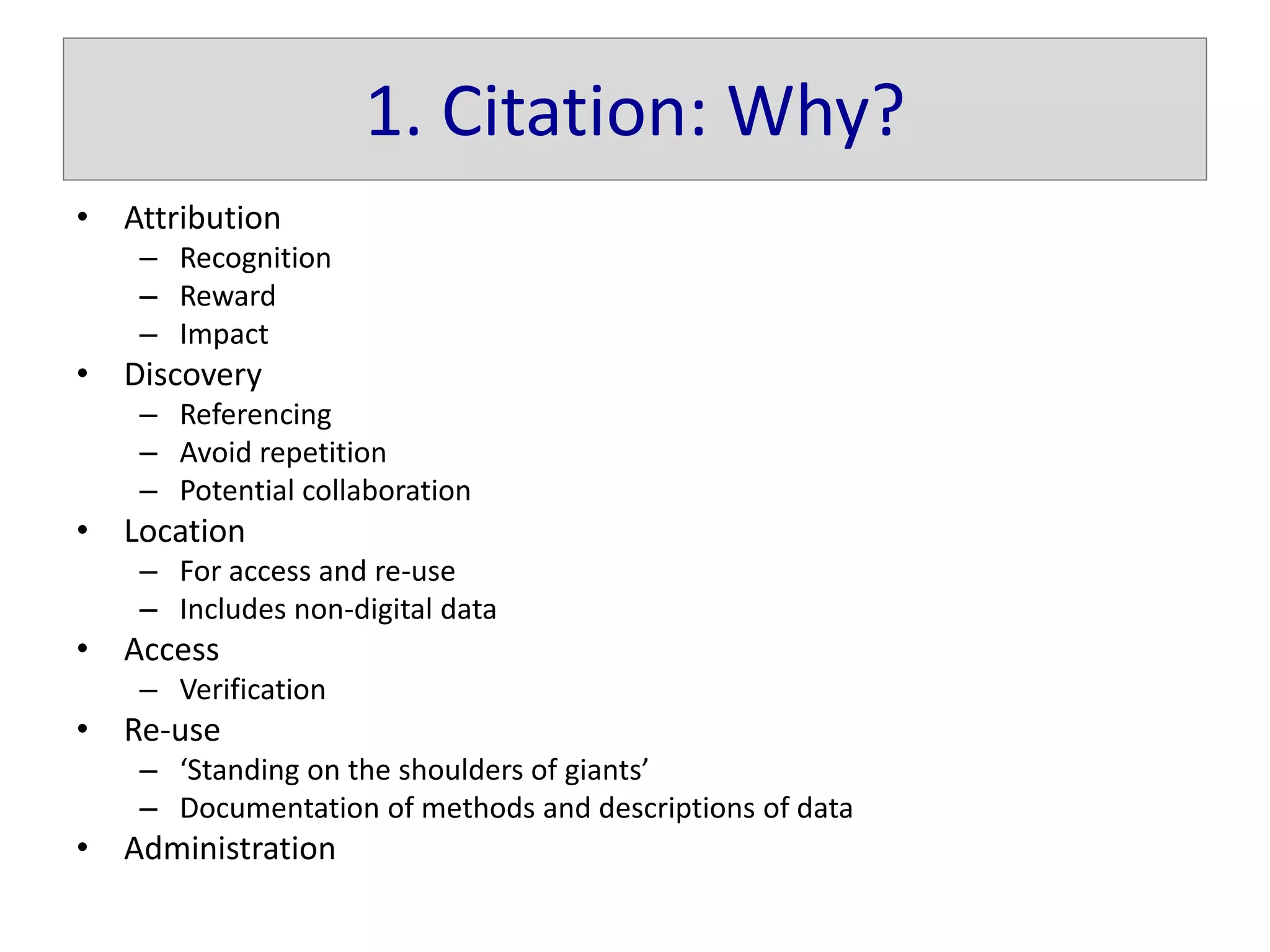
Structure
• Citation
• Discovery
• Documentation and re-use
• Timing of metadata creation
• WIP at Oxford
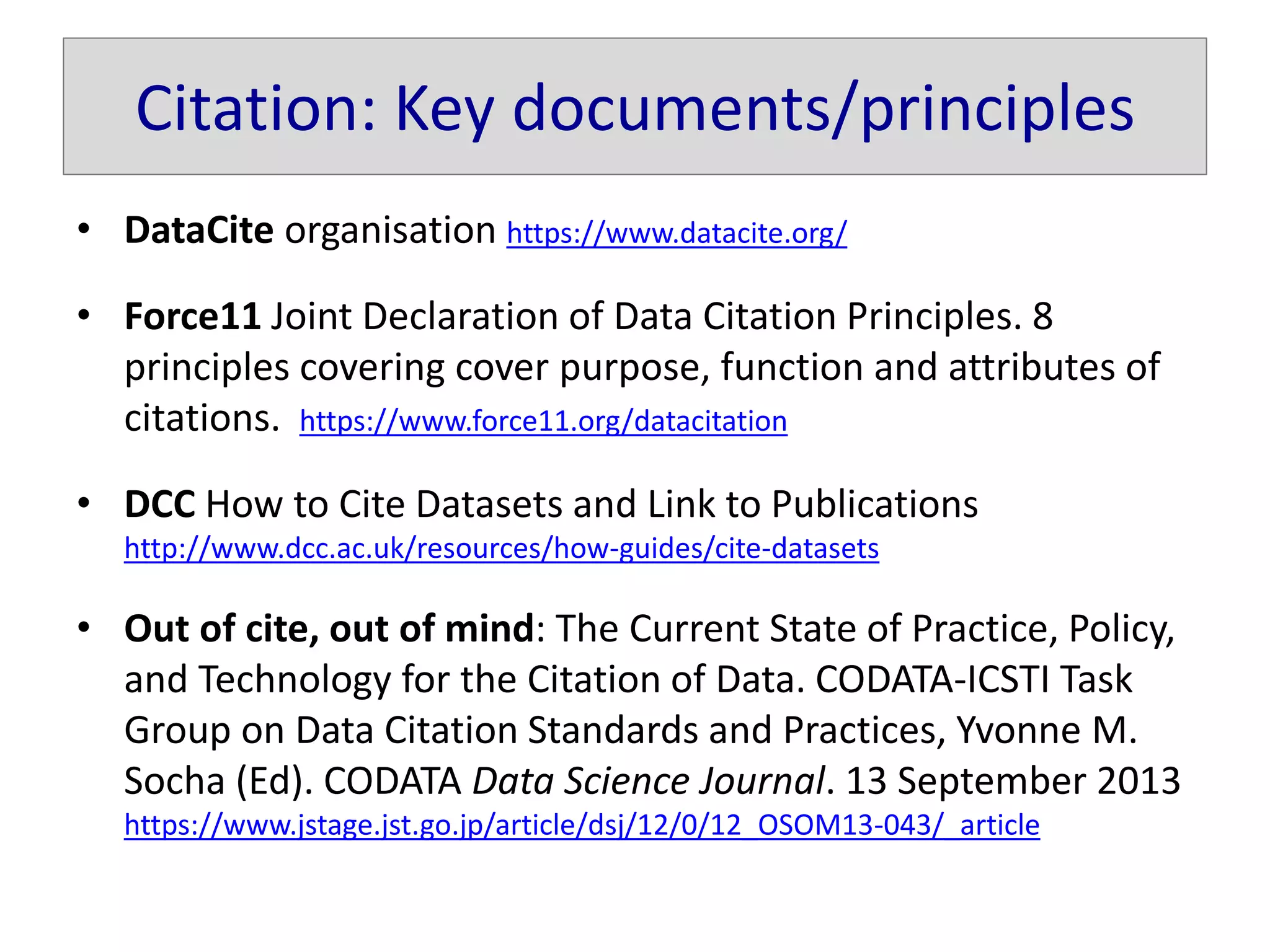
1. Citation: Why?
• Attribution
– Recognition
– Reward
– Impact
• Discovery
– Referencing
– Avoid repetition
– Potential collaboration
• Location
– For access and re-use
– Includes non-digital data
• Access
– Verification
• Re-use
– ‘Standing on the shoulders of giants’
– Documentation of methods and descriptions of data
• Administration
Citation: Key documents/principles
• DataCite organisation https://www.datacite.org/
• Force11 Joint Declaration of Data Citation Principles. 8
principles covering cover purpose, function and attributes of
citations. https://www.force11.org/datacitation
• DCC How to Cite Datasets and Link to Publications
http://www.dcc.ac.uk/resources/how-guides/cite-datasets
• Out of cite, out of mind: The Current State of Practice, Policy,
and Technology for the Citation of Data. CODATA-ICSTI Task
Group on Data Citation Standards and Practices, Yvonne M.
Socha (Ed). CODATA Data Science Journal. 13 September 2013
https://www.jstage.jst.go.jp/article/dsj/12/0/12_OSOM13-043/_article
Basic citation: DataCite metadata kernel
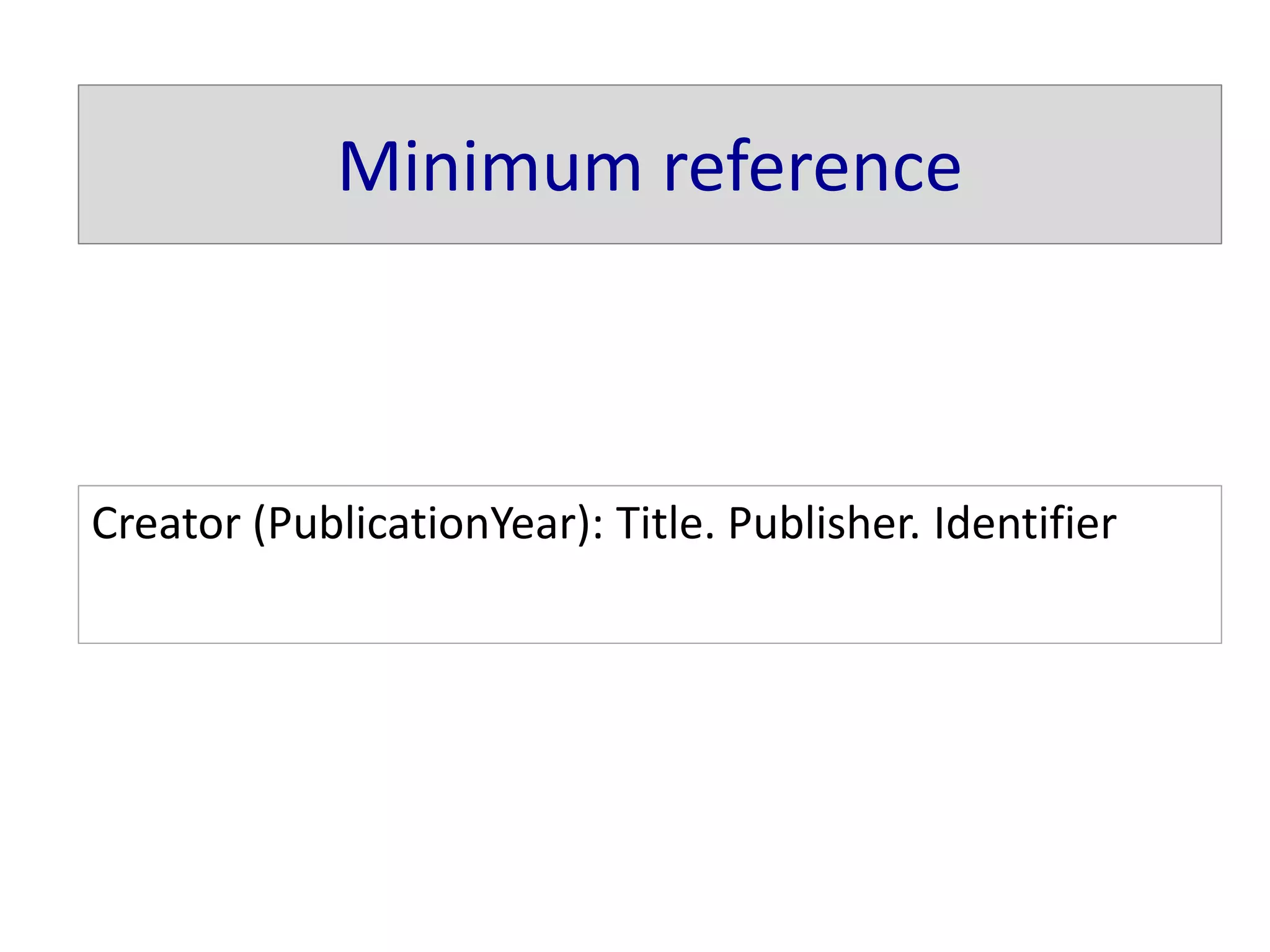
Minimum reference
Creator (PublicationYear): Title. Publisher. Identifier
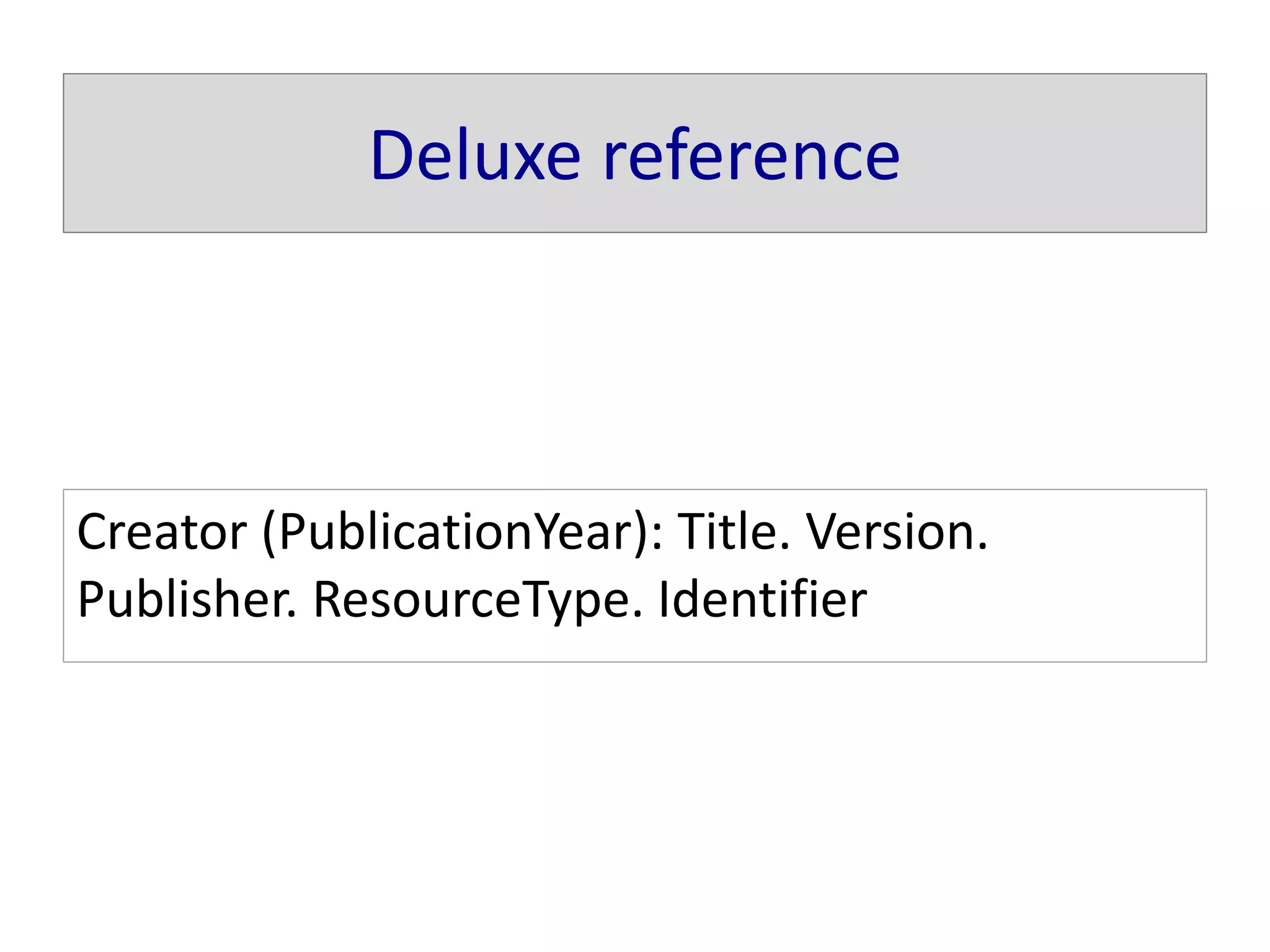
Deluxe reference
Creator (PublicationYear): Title. Version.
Publisher. ResourceType. Identifier
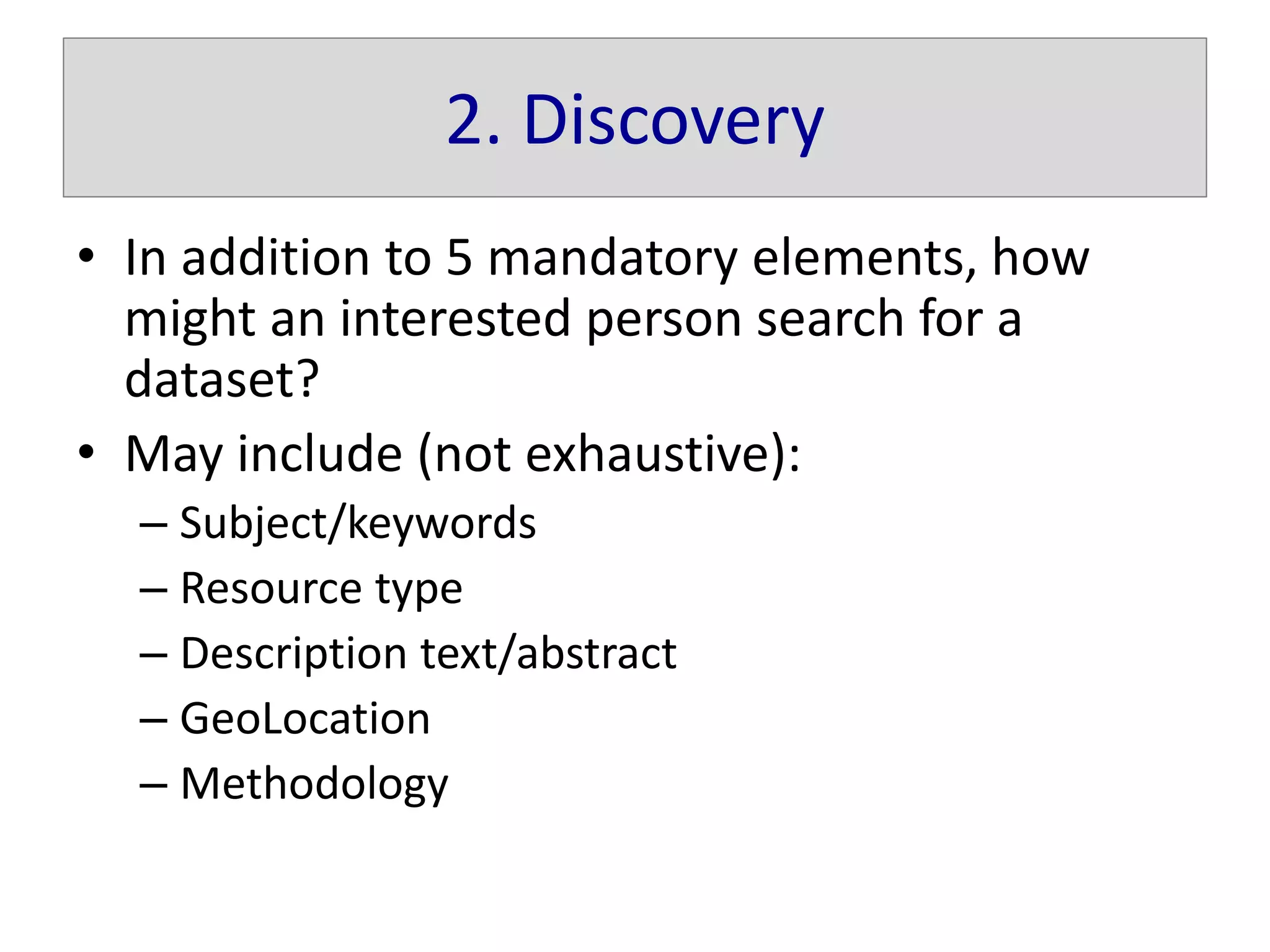
2. Discovery
• In addition to 5 mandatory elements, how
might an interested person search for a
dataset?
• May include (not exhaustive):
– Subject/keywords
– Resource type
– Description text/abstract
– GeoLocation
– Methodology
3. Documentation & Re-use
EPSRC policy framework on
research data: Principles
http://www.epsrc.ac.uk/about/standards/researchd
ata/Pages/principles.aspx
“Sufficient metadata should be recorded and made openly
available to enable other researchers to understand the
potential for further research and re-use of the data. Published
results should always include information on how to access the
supporting data.”
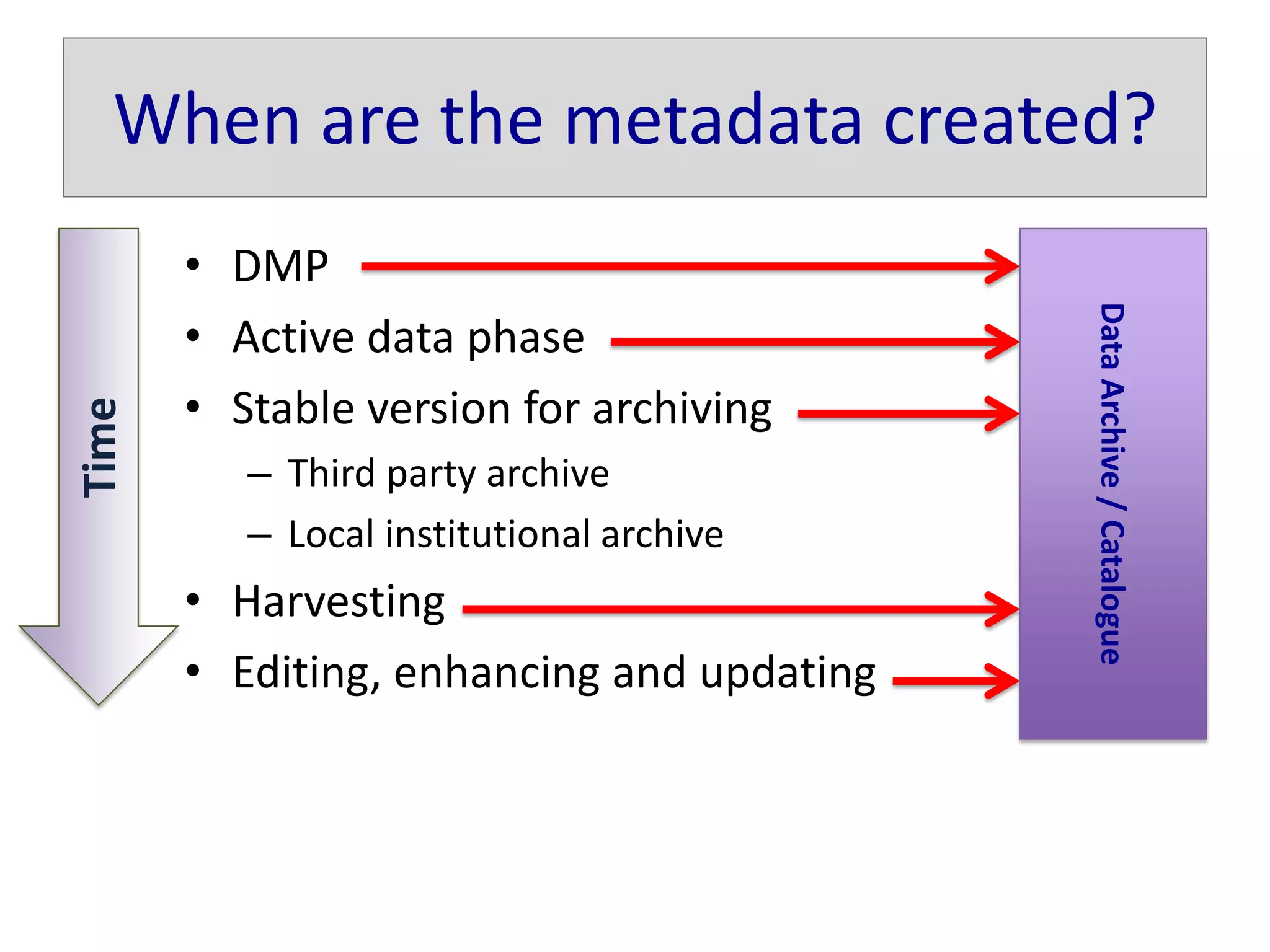
When are the metadata created?
• DMP
• Active data phase
• Stable version for archiving
– Third party archive
– Local institutional archive
• Harvesting
• Editing, enhancing and updating
DataArchive/Catalogue
Time
WIP at Oxford
• Library perspective: data archiving and cataloguing
• ORA-Data branding (Oxford University Research Archive)
• Phase 1: Basic service
• Hydra implementation http://projecthydra.org/
– Work completed under JISC Damaro project
– Checking all elements/fields
– Consistency with other item types
• Metadata creation/harvest
– Expect mixed model
– Low entry barrier
– Training/advocacy on benefits of rich metadata
• Integration with CUD (Core User Directory)
• FAST subject headings
• Work in parallel to service set-up
• Funder compliance as main driver for University

A brief overview of metadata for datasets

  • 1.
    A brief overviewof metadata for datasets Sally Rumsey The Bodleian Libraries University of Oxford
  • 2.
    Structure • Citation • Discovery •Documentation and re-use • Timing of metadata creation • WIP at Oxford
  • 3.
    1. Citation: Why? •Attribution – Recognition – Reward – Impact • Discovery – Referencing – Avoid repetition – Potential collaboration • Location – For access and re-use – Includes non-digital data • Access – Verification • Re-use – ‘Standing on the shoulders of giants’ – Documentation of methods and descriptions of data • Administration
  • 4.
    Citation: Key documents/principles •DataCite organisation https://www.datacite.org/ • Force11 Joint Declaration of Data Citation Principles. 8 principles covering cover purpose, function and attributes of citations. https://www.force11.org/datacitation • DCC How to Cite Datasets and Link to Publications http://www.dcc.ac.uk/resources/how-guides/cite-datasets • Out of cite, out of mind: The Current State of Practice, Policy, and Technology for the Citation of Data. CODATA-ICSTI Task Group on Data Citation Standards and Practices, Yvonne M. Socha (Ed). CODATA Data Science Journal. 13 September 2013 https://www.jstage.jst.go.jp/article/dsj/12/0/12_OSOM13-043/_article
  • 5.
    Basic citation: DataCitemetadata kernel
  • 6.
  • 7.
    Deluxe reference Creator (PublicationYear):Title. Version. Publisher. ResourceType. Identifier
  • 8.
    2. Discovery • Inaddition to 5 mandatory elements, how might an interested person search for a dataset? • May include (not exhaustive): – Subject/keywords – Resource type – Description text/abstract – GeoLocation – Methodology
  • 9.
    3. Documentation &Re-use EPSRC policy framework on research data: Principles http://www.epsrc.ac.uk/about/standards/researchd ata/Pages/principles.aspx “Sufficient metadata should be recorded and made openly available to enable other researchers to understand the potential for further research and re-use of the data. Published results should always include information on how to access the supporting data.”
  • 10.
    When are themetadata created? • DMP • Active data phase • Stable version for archiving – Third party archive – Local institutional archive • Harvesting • Editing, enhancing and updating DataArchive/Catalogue Time
  • 11.
    WIP at Oxford •Library perspective: data archiving and cataloguing • ORA-Data branding (Oxford University Research Archive) • Phase 1: Basic service • Hydra implementation http://projecthydra.org/ – Work completed under JISC Damaro project – Checking all elements/fields – Consistency with other item types • Metadata creation/harvest – Expect mixed model – Low entry barrier – Training/advocacy on benefits of rich metadata • Integration with CUD (Core User Directory) • FAST subject headings • Work in parallel to service set-up • Funder compliance as main driver for University