Assessing a human mediated
current awareness service
International Symposium of Information Science (ISI 2015)
Zadar, 2015-05-20
Zeljko Carevic1, Thomas Krichel2 and Philipp Mayr1
1firstname.lastname@gesis.org
2lastname@openlib.org
Outline
1. Introduction
2. RePEc and NEP
3. Results
3.1 Editing time
3.2 Indicators for report success
3.3 Editing effort
4. Conclusion and Outlook
Slide 2 / 31
Motivation
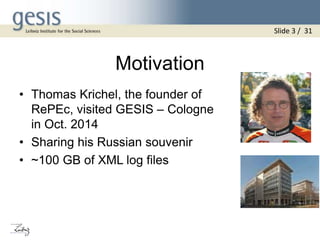
• Thomas Krichel, the founder of
RePEc, visited GESIS – Cologne
in Oct. 2014
• Sharing his Russian souvenir
• ~100 GB of XML log files
Slide 3 / 31
1. Introduction
• Current awareness in digital libraries
– To inform users / subscribers about new / relevant
acquisitions in their libraries [1].
• Current awareness services allow subscribers to keep up to
date with new additions in a certain area of research.
• Selection of relevant documents can be done (semi-
)automatically or manually.
• For this work we focus on the intellectual editing process
• Aim of this work:
How do editors work when creating a subject
specific report in Digital Libraries (DL)?
Slide 4 / 31
2. Use case: RePEc
• RePEc (Research Papers in Economics)
is a DL for working papers in economics
research.
• Covers metadata for working papers and
journal articles.
• Usually document metadata contains links
to full texts
Slide 5 / 31
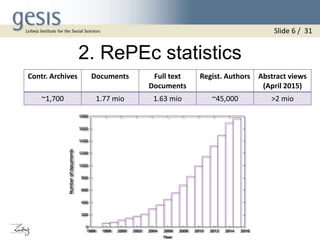
2. RePEc statistics
0
200
400
600
800
1000
1200
1400
1600
1800
1996 1998 2000 2002 2004 2006 2008 2010 2012 2014 2016
Numberofdocuments
Year
Contr. Archives Documents Full text
Documents
Regist. Authors Abstract views
(April 2015)
~1,700 1.77 mio 1.63 mio ~45,000 >2 mio
Slide 6 / 31
2. Current awareness service NEP
• NEP (New Economics Papers) is a current awareness service for
new additions in RePEc.
• NEP covers subject specific reports from over 90 specific fields.
– Business, Economic and Financial History
– Public Economics
– Social Norms and Social Capital
• Issues are sent to subscribers via E-Mail, RSS and Twitter
• Reports to new additions are generated by subject specific editors.
• Relevant document selection is done manually by the editor!
Slide 7 / 31
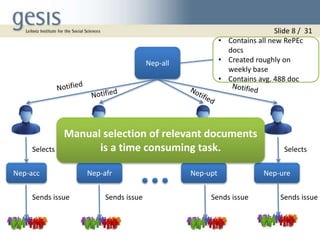
Nep-acc Nep-afr
Nep-all
• Contains all new RePEc
docs
• Created roughly on
weekly base
• Contains avg. 488 doc
Selects
Nep-upt Nep-ure
Selects Selects Selects
Sends issue Sends issue Sends issue Sends issue
Manual selection of relevant documents
is a time consuming task.
Slide 8 / 31
ERNAD
• ERNAD (Editing Reports on New Academic
Documents) is a purposed built system
• Re-rank nep-all for each editor based on the
specific report topic
• Looking at past issues of a report to produce
a ranked nep-all
• If presorting works well editors select highly
ranked documents from nep-all
Slide 9 / 31
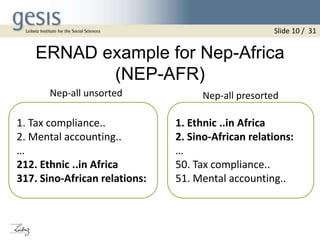
ERNAD example for Nep-Africa
(NEP-AFR)
1. Tax compliance..
2. Mental accounting..
…
212. Ethnic ..in Africa
317. Sino-African relations:
Nep-all unsorted Nep-all presorted
Slide 10 / 31
1. Ethnic ..in Africa
2. Sino-African relations:
…
50. Tax compliance..
51. Mental accounting..
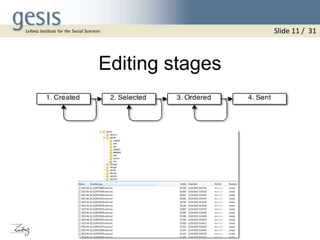
Editing stages
Slide 11 / 31
Research questions
• RQ 1: How long is the editing duration?
• RQ 2: What influences the success of a report?
– Editing duration
– Issue size
• RQ 3: How much effort is invested for selecting
and sorting papers per issue?
– Precision @ N
– Relative search length
Slide 12 / 31
RQ 1: Editing time
How much time do editors invest to
create a report?
Slide 13 / 31
Pre-selection
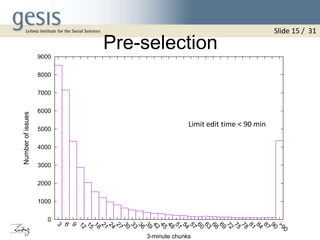
• Editing an issue can be interrupted
• This would distort the results
• Exclude interrupted issues by separating
the edit duration in 3-minute chunks
Slide 14 / 31
Pre-selection
0
1000
2000
3000
4000
5000
6000
7000
8000
9000 3
6
9
12
15
18
21
24
27
30
33
36
39
42
45
48
51
54
57
60
63
66
69
72
75
78
81
84
87
90
>90
Numberofissues
3-minute chunks
Limit edit time < 90 min
Slide 15 / 31
0
10
20
30
40
50
60
nep-ets
nep-gro
nep-opm
nep-pke
nep-cba
nep-hea
nep-rm
g
nep-geo
nep-hap
nep-tid
nep-dem
nep-soc
nep-cse
nep-net
nep-ifn
nep-lab
nep-ltv
nep-for
nep-law
nep-m
ig
nep-cdm
nep-m
on
nep-exp
nep-neu
nep-ino
nep-m
st
nep-ore
nep-fm
k
nep-ara
nep-m
kt
Averageeditingtimeinminutes
Report
Avg. editing time
RQ 1: Editing time
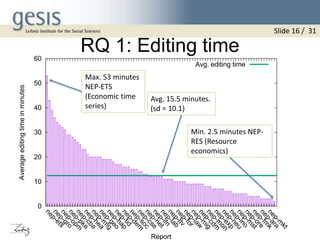
Avg. 15.5 minutes.
(sd = 10.1)
Min. 2.5 minutes NEP-
RES (Resource
economics)
Max. 53 minutes
NEP-ETS
(Economic time
series)
Slide 16 / 31
Summarize RQ 1
• Average editing time is comparable low
with 15.5 minutes
• Huge scattering between the reports:
–Min. 2.5 minutes
–Max. 53 minutes
Slide 17 / 31
RQ 2: Influences to successful
reports
• Popularity of a report can be measured by the number of
subscribers.
• Huge scattering between number of subscribers per report
– Max. 6859 NEP-HIS Business, Economic and Financial History
– Min. 75 NEP-CIS Confederation of Independent States
• Factors influencing reports success for example: topic, age of
a report..
• Does the issue size or the editing time influence the report
success?
Slide 18 / 31
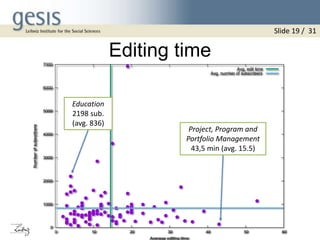
Editing time
0
1000
2000
3000
4000
5000
6000
7000
0 10 20 30 40 50 60
Numberofsubscribers
Average editing time
Avg. edit time
Avg. number of subscribers
Education
2198 sub.
(avg. 836)
Project, Program and
Portfolio Management
43,5 min (avg. 15.5)
Slide 19 / 31
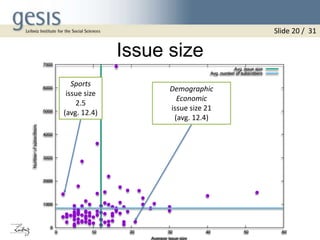
Issue size
0
1000
2000
3000
4000
5000
6000
7000
0 10 20 30 40 50 60
Numberofsubscribers
Average issue size
Avg. issue size
Avg. number of subscribers
Sports
issue size
2.5
(avg. 12.4)
Demographic
Economic
issue size 21
(avg. 12.4)
Slide 20 / 31
Summarize RQ 2
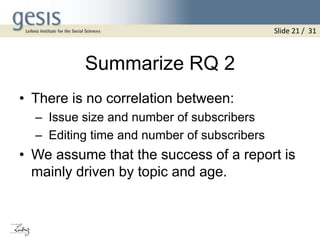
• There is no correlation between:
– Issue size and number of subscribers
– Editing time and number of subscribers
• We assume that the success of a report is
mainly driven by topic and age.
Slide 21 / 31
RQ 3: Effort in selecting and
sorting
How much effort is invested in selecting and
sorting relevant documents from nep-all?
Two measures are used:
Precision @N
Relative search length
Slide 22 / 31
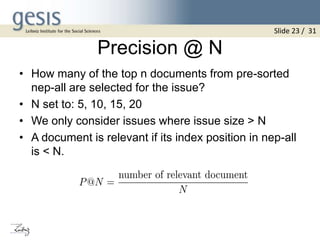
Precision @ N
• How many of the top n documents from pre-sorted
nep-all are selected for the issue?
• N set to: 5, 10, 15, 20
• We only consider issues where issue size > N
• A document is relevant if its index position in nep-all
is < N.
Slide 23 / 31
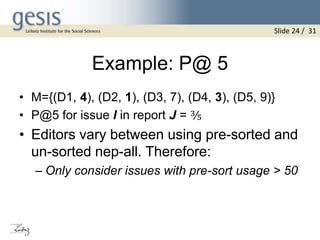
Example: P@ 5
• M={(D1, 4), (D2, 1), (D3, 7), (D4, 3), (D5, 9)}
• P@5 for issue I in report J = ⅗
• Editors vary between using pre-sorted and
un-sorted nep-all. Therefore:
– Only consider issues with pre-sort usage > 50
Slide 24 / 31
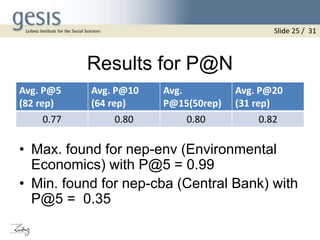
Results for P@N
Avg. P@5
(82 rep)
Avg. P@10
(64 rep)
Avg.
P@15(50rep)
Avg. P@20
(31 rep)
0.77 0.80 0.80 0.82
• Max. found for nep-env (Environmental
Economics) with P@5 = 0.99
• Min. found for nep-cba (Central Bank) with
P@5 = 0.35
Slide 25 / 31
Summarize P@N
• Editors work comfortably with the
presorting in nep-all.
• The number of papers per issue has no
significant influence for the precision.
Slide 26 / 31
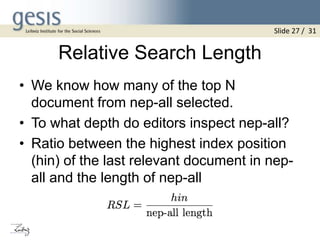
Relative Search Length
• We know how many of the top N
document from nep-all selected.
• To what depth do editors inspect nep-all?
• Ratio between the highest index position
(hin) of the last relevant document in nep-
all and the length of nep-all
Slide 27 / 31
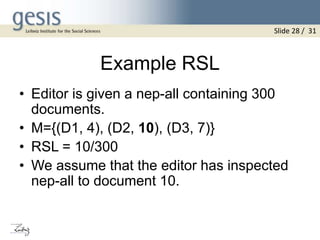
Example RSL
• Editor is given a nep-all containing 300
documents.
• M={(D1, 4), (D2, 10), (D3, 7)}
• RSL = 10/300
• We assume that the editor has inspected
nep-all to document 10.
Slide 28 / 31
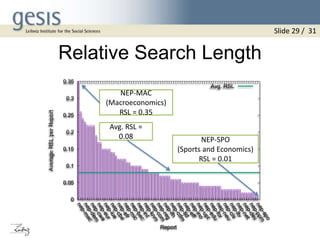
Relative Search Length
0
0.05
0.1
0.15
0.2
0.25
0.3
0.35
nep-mac
nep-dem
nep-cwa
nep-eur
nep-iuenep-cbe
nep-afrnep-mic
nep-bec
nep-intnep-knm
nep-com
nep-regnep-ifnnep-cdm
nep-tidnep-effnep-inonep-upt
nep-edu
nep-fornep-neu
nep-cisnep-ltvnep-net
nep-dev
nep-ppm
nep-spo
AverageRSLperReport
Report
Avg. RSL
NEP-MAC
(Macroeconomics)
RSL = 0.35
NEP-SPO
(Sports and Economics)
RSL = 0.01
Avg. RSL =
0.08
Slide 29 / 31
Summarize RSL
• The relative search length is comparable
low with 0.08
• Editors select papers from the very upper
part of nep-all.
Slide 30 / 31
Conclusion
• Focused on observable system features
– Editing time
– Influences on report success
– Effort in creating an issue
• Summarize: The system supports the editor well in creating
an issue
• A complete view requires a more user-centred observation.
• Future work:
– Why and under what conditions is a document relevant?
• NEP provides many opportunities for further research on data
that is relatively easily available.
Slide 31 / 31
Thank you!
Questions?

Assessing a human mediated current awareness service

  • 1.
    Assessing a humanmediated current awareness service International Symposium of Information Science (ISI 2015) Zadar, 2015-05-20 Zeljko Carevic1, Thomas Krichel2 and Philipp Mayr1 1firstname.lastname@gesis.org 2lastname@openlib.org
  • 2.
    Outline 1. Introduction 2. RePEcand NEP 3. Results 3.1 Editing time 3.2 Indicators for report success 3.3 Editing effort 4. Conclusion and Outlook Slide 2 / 31
  • 3.
    Motivation • Thomas Krichel,the founder of RePEc, visited GESIS – Cologne in Oct. 2014 • Sharing his Russian souvenir • ~100 GB of XML log files Slide 3 / 31
  • 4.
    1. Introduction • Currentawareness in digital libraries – To inform users / subscribers about new / relevant acquisitions in their libraries [1]. • Current awareness services allow subscribers to keep up to date with new additions in a certain area of research. • Selection of relevant documents can be done (semi- )automatically or manually. • For this work we focus on the intellectual editing process • Aim of this work: How do editors work when creating a subject specific report in Digital Libraries (DL)? Slide 4 / 31
  • 5.
    2. Use case:RePEc • RePEc (Research Papers in Economics) is a DL for working papers in economics research. • Covers metadata for working papers and journal articles. • Usually document metadata contains links to full texts Slide 5 / 31
  • 6.
    2. RePEc statistics 0 200 400 600 800 1000 1200 1400 1600 1800 19961998 2000 2002 2004 2006 2008 2010 2012 2014 2016 Numberofdocuments Year Contr. Archives Documents Full text Documents Regist. Authors Abstract views (April 2015) ~1,700 1.77 mio 1.63 mio ~45,000 >2 mio Slide 6 / 31
  • 7.
    2. Current awarenessservice NEP • NEP (New Economics Papers) is a current awareness service for new additions in RePEc. • NEP covers subject specific reports from over 90 specific fields. – Business, Economic and Financial History – Public Economics – Social Norms and Social Capital • Issues are sent to subscribers via E-Mail, RSS and Twitter • Reports to new additions are generated by subject specific editors. • Relevant document selection is done manually by the editor! Slide 7 / 31
  • 8.
    Nep-acc Nep-afr Nep-all • Containsall new RePEc docs • Created roughly on weekly base • Contains avg. 488 doc Selects Nep-upt Nep-ure Selects Selects Selects Sends issue Sends issue Sends issue Sends issue Manual selection of relevant documents is a time consuming task. Slide 8 / 31
  • 9.
    ERNAD • ERNAD (EditingReports on New Academic Documents) is a purposed built system • Re-rank nep-all for each editor based on the specific report topic • Looking at past issues of a report to produce a ranked nep-all • If presorting works well editors select highly ranked documents from nep-all Slide 9 / 31
  • 10.
    ERNAD example forNep-Africa (NEP-AFR) 1. Tax compliance.. 2. Mental accounting.. … 212. Ethnic ..in Africa 317. Sino-African relations: Nep-all unsorted Nep-all presorted Slide 10 / 31 1. Ethnic ..in Africa 2. Sino-African relations: … 50. Tax compliance.. 51. Mental accounting..
  • 11.
  • 12.
    Research questions • RQ1: How long is the editing duration? • RQ 2: What influences the success of a report? – Editing duration – Issue size • RQ 3: How much effort is invested for selecting and sorting papers per issue? – Precision @ N – Relative search length Slide 12 / 31
  • 13.
    RQ 1: Editingtime How much time do editors invest to create a report? Slide 13 / 31
  • 14.
    Pre-selection • Editing anissue can be interrupted • This would distort the results • Exclude interrupted issues by separating the edit duration in 3-minute chunks Slide 14 / 31
  • 15.
  • 16.
  • 17.
    Summarize RQ 1 •Average editing time is comparable low with 15.5 minutes • Huge scattering between the reports: –Min. 2.5 minutes –Max. 53 minutes Slide 17 / 31
  • 18.
    RQ 2: Influencesto successful reports • Popularity of a report can be measured by the number of subscribers. • Huge scattering between number of subscribers per report – Max. 6859 NEP-HIS Business, Economic and Financial History – Min. 75 NEP-CIS Confederation of Independent States • Factors influencing reports success for example: topic, age of a report.. • Does the issue size or the editing time influence the report success? Slide 18 / 31
  • 19.
    Editing time 0 1000 2000 3000 4000 5000 6000 7000 0 1020 30 40 50 60 Numberofsubscribers Average editing time Avg. edit time Avg. number of subscribers Education 2198 sub. (avg. 836) Project, Program and Portfolio Management 43,5 min (avg. 15.5) Slide 19 / 31
  • 20.
    Issue size 0 1000 2000 3000 4000 5000 6000 7000 0 1020 30 40 50 60 Numberofsubscribers Average issue size Avg. issue size Avg. number of subscribers Sports issue size 2.5 (avg. 12.4) Demographic Economic issue size 21 (avg. 12.4) Slide 20 / 31
  • 21.
    Summarize RQ 2 •There is no correlation between: – Issue size and number of subscribers – Editing time and number of subscribers • We assume that the success of a report is mainly driven by topic and age. Slide 21 / 31
  • 22.
    RQ 3: Effortin selecting and sorting How much effort is invested in selecting and sorting relevant documents from nep-all? Two measures are used: Precision @N Relative search length Slide 22 / 31
  • 23.
    Precision @ N •How many of the top n documents from pre-sorted nep-all are selected for the issue? • N set to: 5, 10, 15, 20 • We only consider issues where issue size > N • A document is relevant if its index position in nep-all is < N. Slide 23 / 31
  • 24.
    Example: P@ 5 •M={(D1, 4), (D2, 1), (D3, 7), (D4, 3), (D5, 9)} • P@5 for issue I in report J = ⅗ • Editors vary between using pre-sorted and un-sorted nep-all. Therefore: – Only consider issues with pre-sort usage > 50 Slide 24 / 31
  • 25.
    Results for P@N Avg.P@5 (82 rep) Avg. P@10 (64 rep) Avg. P@15(50rep) Avg. P@20 (31 rep) 0.77 0.80 0.80 0.82 • Max. found for nep-env (Environmental Economics) with P@5 = 0.99 • Min. found for nep-cba (Central Bank) with P@5 = 0.35 Slide 25 / 31
  • 26.
    Summarize P@N • Editorswork comfortably with the presorting in nep-all. • The number of papers per issue has no significant influence for the precision. Slide 26 / 31
  • 27.
    Relative Search Length •We know how many of the top N document from nep-all selected. • To what depth do editors inspect nep-all? • Ratio between the highest index position (hin) of the last relevant document in nep- all and the length of nep-all Slide 27 / 31
  • 28.
    Example RSL • Editoris given a nep-all containing 300 documents. • M={(D1, 4), (D2, 10), (D3, 7)} • RSL = 10/300 • We assume that the editor has inspected nep-all to document 10. Slide 28 / 31
  • 29.
  • 30.
    Summarize RSL • Therelative search length is comparable low with 0.08 • Editors select papers from the very upper part of nep-all. Slide 30 / 31
  • 31.
    Conclusion • Focused onobservable system features – Editing time – Influences on report success – Effort in creating an issue • Summarize: The system supports the editor well in creating an issue • A complete view requires a more user-centred observation. • Future work: – Why and under what conditions is a document relevant? • NEP provides many opportunities for further research on data that is relatively easily available. Slide 31 / 31
  • 32.