Group Member
1. KEN THEARITH
2. YIM SONY
3. TEP THORN
4. LY NYKA
5. VAN SONITA
6. SREY KALYAN
7. SOUEM SAMEANG
Democracy and Election
 Agenda
 Democracy
1. Introduction
2. What is Democracy?
3. Principle of Democracy
4. Benefits of Democracy
5. Less violence
6. Conclusion
 Election
1. Introduction
2. Voting Right
3. Voter participation
4. Voter Registration
5. Electoral System
6. Types of Election
7. How voters decide
8. Electoral Realignment
1.Introduction
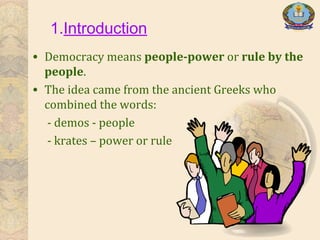
• Democracy means people-power or rule by the
people.
• The idea came from the ancient Greeks who
combined the words:
- demos - people
- krates – power or rule
2.What is Democracy?
• Democracy is a form of government where all
eligible citizens have an equality in the decisions
that affect their lives.
• According to Abraham Lincon: Democracy means
a government elected of the people, for the
people, to the people.
• In a democratic government, the people's views
influence the laws and decisions made by the
government.
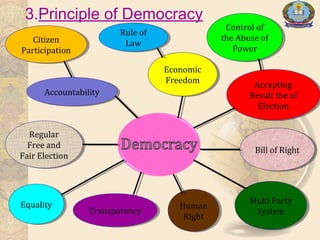
3.Principle of Democracy
Rule of
Law
Rule of
LawCitizen
Participation
Citizen
Participation
Control of
the Abuse of
Power
Control of
the Abuse of
Power
Accepting
Result the of
Election
Accepting
Result the of
Election
Bill of RightBill of Right
Multi Party
System
Multi Party
System
Regular
Free and
Fair Election
Regular
Free and
Fair Election
AccountabilityAccountability
EqualityEquality
TransparencyTransparency Human
Right
Human
Right
Economic
Freedom
Economic
Freedom
3.1.Democracy is accountable
form of government
• Democracy improves the quality of decision
making
• Democracy enhances the dignity of citizens
• Democracy provides a method to deal with
Differences and conflicts.
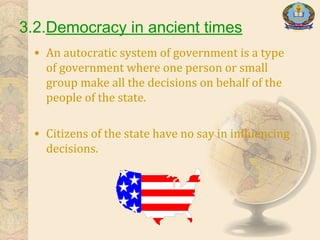
3.2.Democracy in ancient times
• An autocratic system of government is a type
of government where one person or small
group make all the decisions on behalf of the
people of the state.
• Citizens of the state have no say in influencing
decisions.
4. Benefits of democracies
• The main benefit of democracy is that every
adult person regardless of race, religious belief
or gender has the same political rights as each
other.
• People living in a democratic society are
protected from oppression by laws and limits on
governmental power.
• Democratic governments put laws into place to
protect their citizens and to ensure a safe and
fair society.
5. Less violence
• More democracy leads to less internal
violence
• People are given chance to change those
who are in power or can change policies
which they disagree.
• This makes it preferable to a system where
political change takes place through
violence.
6. Conclusion
• Democracies allow for information to be
more readily available to the public.
• People have more freedoms and rights in
democracies.
• True democracy will come to a country when
no one goes hungry to bed.
Election
•Election, Procedure that allows member of an
organization or community to choose
representative who will hold position of authority
within it .
•The most important elections select the leader of
local, state and national government .
•The chance to decide who will govern at these
levels service as an opportunity for the public to
make choices about policies, programs, and future
directions of government action.
1.Introduction
2.Voting Right
• Native-born or naturalized (foreign-born) U.S .
• Citizens over the age 18 possess the right to vote.
• Citizens can lose their right to vote.
• All state prohibit felons (people convicted of
serious crime) from voting during their
imprisonment or parole, and 13 state bar felons
from voting for life.
• However, convicted felons who have regained
their right to vote cannot be denied the right to
vote if they move to any of those 13 states.
3.Voter participation
• Compared to voter participation rates of citizens
in other democracies, Participation in U.S.
elections is low.
• Slightly more than 50 percent of those eligible
participate in national presidential elections.
• Barely 30 percent of eligible voters take part in
congressional elections during nonpresidential
election years.
• In European nations, by contrast, voter turnout
consistently exceeds 80 percent.
4.Voter Registration
• In addition to differences in political party
strength, these national differences in voter
participation result from variations in
registration rule and organization of elections.
• In European, Governments automatically register
their citizens as voter.
• In the U.S, eligible voters must register with state
election boards before they must vote.
• In southern states, these requirements also
provided an additional way to deprive both
blacks and poor whites of the opportunity to vote.
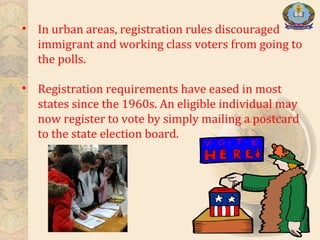
• In urban areas, registration rules discouraged
immigrant and working class voters from going to
the polls.
• Registration requirements have eased in most
states since the 1960s. An eligible individual may
now register to vote by simply mailing a postcard
to the state election board.
5.Electoral Systems
• The manner in which governments organize
elections and determine winners also affects
participation rates.
• Majority systems require that a victorious
candidate receive more than 50 percent of the
vote.
• Under a plurality system, winning candidate need
only receive more vote than any opponent.
• Virtually all national election in the united states
use the plurality system, although the majority
system services in some primary, state, and local
elections, especially in southern.
6.Types of Elections
• In most nations, political party leaders select
candidates for office in a general election.
• The united states is one of the few nations to hold
primary elections prior to the general election
campaign.
• In these elections, voters select the party’s
candidates for office.
• The primary is followed by the general election,
which normally is the decisive electoral contest.
• The referendum is a process that allows citizens
to vote directly on proposed laws or other
governmental actions.
• Direct primary election: several
candidates from the same party run against
each other for the nomination
Two types of primary:
– Closed primary: limited to registered members
of political parties
– Open primary: any registered voter
Primary Election
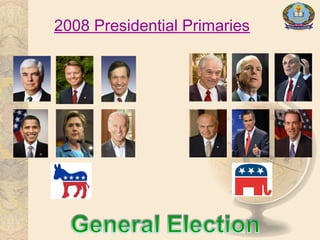
2008 Presidential Primaries
7.How voters decide
• Many Americans identify personally with and
maintain a sense of loyalty to either the
Democratic or Republican party.
• Issues and preferences also influence voter’s
choice. For example, concerns about crime may
encourage voters to elect the candidate with the
strongest platform against it.
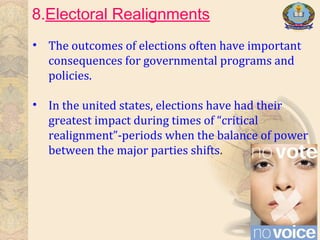
8.Electoral Realignments
• The outcomes of elections often have important
consequences for governmental programs and
policies.
• In the united states, elections have had their
greatest impact during times of “critical
realignment”-periods when the balance of power
between the major parties shifts.
9.Reference
• Global Studies II Book “NIB”
• www.slideshare.com
• www.google.com
Quiz
1. What is Democracy?
2. What is the benefit of Democracy?
3. What is principle of Democracy?
4. Why we need Democracy?
5. What is important of election?
1. Democracy is a form of government
where all eligible citizens have an
equality in the decisions that affect
their lives.
Answer
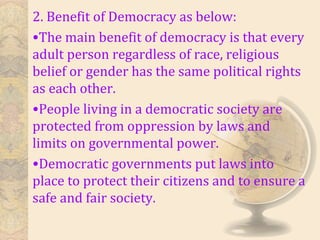
2. Benefit of Democracy as below:
•The main benefit of democracy is that every
adult person regardless of race, religious
belief or gender has the same political rights
as each other.
•People living in a democratic society are
protected from oppression by laws and
limits on governmental power.
•Democratic governments put laws into
place to protect their citizens and to ensure a
safe and fair society.
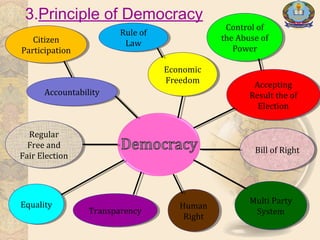
3.Principle of Democracy
Rule of
Law
Rule of
LawCitizen
Participation
Citizen
Participation
Control of
the Abuse of
Power
Control of
the Abuse of
Power
Accepting
Result the of
Election
Accepting
Result the of
Election
Bill of RightBill of Right
Multi Party
System
Multi Party
System
Regular
Free and
Fair Election
Regular
Free and
Fair Election
AccountabilityAccountability
EqualityEquality
TransparencyTransparency Human
Right
Human
Right
Economic
Freedom
Economic
Freedom
4. We need Democracy because:
- Obey the human right
- The people have freedom to voice out.
- The people can make demonstration.
- Free market
- People can choose the candidate to lead the
country.
5. Important of election:
- People can vote for the candidate that they are
prefer.
- The chance to decide who will govern at these
levels service as an opportunity for the public
to make choices about policies, programs, and
future directions of government action.
Democracies and Elections

Democracies and Elections

  • 1.
    Group Member 1. KENTHEARITH 2. YIM SONY 3. TEP THORN 4. LY NYKA 5. VAN SONITA 6. SREY KALYAN 7. SOUEM SAMEANG Democracy and Election
  • 2.
     Agenda  Democracy 1.Introduction 2. What is Democracy? 3. Principle of Democracy 4. Benefits of Democracy 5. Less violence 6. Conclusion
  • 3.
     Election 1. Introduction 2.Voting Right 3. Voter participation 4. Voter Registration 5. Electoral System 6. Types of Election 7. How voters decide 8. Electoral Realignment
  • 4.
    1.Introduction • Democracy meanspeople-power or rule by the people. • The idea came from the ancient Greeks who combined the words: - demos - people - krates – power or rule
  • 5.
    2.What is Democracy? •Democracy is a form of government where all eligible citizens have an equality in the decisions that affect their lives. • According to Abraham Lincon: Democracy means a government elected of the people, for the people, to the people. • In a democratic government, the people's views influence the laws and decisions made by the government.
  • 6.
    3.Principle of Democracy Ruleof Law Rule of LawCitizen Participation Citizen Participation Control of the Abuse of Power Control of the Abuse of Power Accepting Result the of Election Accepting Result the of Election Bill of RightBill of Right Multi Party System Multi Party System Regular Free and Fair Election Regular Free and Fair Election AccountabilityAccountability EqualityEquality TransparencyTransparency Human Right Human Right Economic Freedom Economic Freedom
  • 7.
    3.1.Democracy is accountable formof government • Democracy improves the quality of decision making • Democracy enhances the dignity of citizens • Democracy provides a method to deal with Differences and conflicts.
  • 8.
    3.2.Democracy in ancienttimes • An autocratic system of government is a type of government where one person or small group make all the decisions on behalf of the people of the state. • Citizens of the state have no say in influencing decisions.
  • 9.
    4. Benefits ofdemocracies • The main benefit of democracy is that every adult person regardless of race, religious belief or gender has the same political rights as each other. • People living in a democratic society are protected from oppression by laws and limits on governmental power. • Democratic governments put laws into place to protect their citizens and to ensure a safe and fair society.
  • 10.
    5. Less violence •More democracy leads to less internal violence • People are given chance to change those who are in power or can change policies which they disagree. • This makes it preferable to a system where political change takes place through violence.
  • 11.
    6. Conclusion • Democraciesallow for information to be more readily available to the public. • People have more freedoms and rights in democracies. • True democracy will come to a country when no one goes hungry to bed.
  • 12.
  • 13.
    •Election, Procedure thatallows member of an organization or community to choose representative who will hold position of authority within it . •The most important elections select the leader of local, state and national government . •The chance to decide who will govern at these levels service as an opportunity for the public to make choices about policies, programs, and future directions of government action. 1.Introduction
  • 14.
    2.Voting Right • Native-bornor naturalized (foreign-born) U.S . • Citizens over the age 18 possess the right to vote. • Citizens can lose their right to vote. • All state prohibit felons (people convicted of serious crime) from voting during their imprisonment or parole, and 13 state bar felons from voting for life. • However, convicted felons who have regained their right to vote cannot be denied the right to vote if they move to any of those 13 states.
  • 15.
    3.Voter participation • Comparedto voter participation rates of citizens in other democracies, Participation in U.S. elections is low. • Slightly more than 50 percent of those eligible participate in national presidential elections. • Barely 30 percent of eligible voters take part in congressional elections during nonpresidential election years. • In European nations, by contrast, voter turnout consistently exceeds 80 percent.
  • 16.
    4.Voter Registration • Inaddition to differences in political party strength, these national differences in voter participation result from variations in registration rule and organization of elections. • In European, Governments automatically register their citizens as voter. • In the U.S, eligible voters must register with state election boards before they must vote. • In southern states, these requirements also provided an additional way to deprive both blacks and poor whites of the opportunity to vote.
  • 17.
    • In urbanareas, registration rules discouraged immigrant and working class voters from going to the polls. • Registration requirements have eased in most states since the 1960s. An eligible individual may now register to vote by simply mailing a postcard to the state election board.
  • 18.
    5.Electoral Systems • Themanner in which governments organize elections and determine winners also affects participation rates. • Majority systems require that a victorious candidate receive more than 50 percent of the vote. • Under a plurality system, winning candidate need only receive more vote than any opponent. • Virtually all national election in the united states use the plurality system, although the majority system services in some primary, state, and local elections, especially in southern.
  • 19.
    6.Types of Elections •In most nations, political party leaders select candidates for office in a general election. • The united states is one of the few nations to hold primary elections prior to the general election campaign. • In these elections, voters select the party’s candidates for office. • The primary is followed by the general election, which normally is the decisive electoral contest. • The referendum is a process that allows citizens to vote directly on proposed laws or other governmental actions.
  • 20.
    • Direct primaryelection: several candidates from the same party run against each other for the nomination Two types of primary: – Closed primary: limited to registered members of political parties – Open primary: any registered voter Primary Election
  • 21.
  • 22.
    7.How voters decide •Many Americans identify personally with and maintain a sense of loyalty to either the Democratic or Republican party. • Issues and preferences also influence voter’s choice. For example, concerns about crime may encourage voters to elect the candidate with the strongest platform against it.
  • 23.
    8.Electoral Realignments • Theoutcomes of elections often have important consequences for governmental programs and policies. • In the united states, elections have had their greatest impact during times of “critical realignment”-periods when the balance of power between the major parties shifts.
  • 24.
    9.Reference • Global StudiesII Book “NIB” • www.slideshare.com • www.google.com
  • 26.
    Quiz 1. What isDemocracy? 2. What is the benefit of Democracy? 3. What is principle of Democracy? 4. Why we need Democracy? 5. What is important of election?
  • 27.
    1. Democracy isa form of government where all eligible citizens have an equality in the decisions that affect their lives. Answer
  • 28.
    2. Benefit ofDemocracy as below: •The main benefit of democracy is that every adult person regardless of race, religious belief or gender has the same political rights as each other. •People living in a democratic society are protected from oppression by laws and limits on governmental power. •Democratic governments put laws into place to protect their citizens and to ensure a safe and fair society.
  • 29.
    3.Principle of Democracy Ruleof Law Rule of LawCitizen Participation Citizen Participation Control of the Abuse of Power Control of the Abuse of Power Accepting Result the of Election Accepting Result the of Election Bill of RightBill of Right Multi Party System Multi Party System Regular Free and Fair Election Regular Free and Fair Election AccountabilityAccountability EqualityEquality TransparencyTransparency Human Right Human Right Economic Freedom Economic Freedom
  • 30.
    4. We needDemocracy because: - Obey the human right - The people have freedom to voice out. - The people can make demonstration. - Free market - People can choose the candidate to lead the country.
  • 31.
    5. Important ofelection: - People can vote for the candidate that they are prefer. - The chance to decide who will govern at these levels service as an opportunity for the public to make choices about policies, programs, and future directions of government action.