1
By
SN Panigrahi
2
SN Panigrahi is a Versatile Practitioner, Strategist, Energetic Coach, Learning Enabler & Public Speaker.
He is an International-Corporate Trainer, Mentor & Author
He has diverse experience and expertise in Project Management,
Contract Management, Supply Chain Management, Procurement,
Strategic Sourcing, Global Sourcing, Logistics, Exports & Imports,
Indirect Taxes – GST etc.
He had done more than 100 Workshops on above
He is an Engineer + MBA +PGD ISO 9000 / TQM with around 29 Yrs of
Experience
He is a certified PMP® from PMI (USA) and become PMI India
Champion
Also a Certified Lean Six Sigma Green Belt from Exemplar Global
Trained in COD for 31/2 Yrs. on Strategy & Leadership
GST Certified – MSME – Tech. Dev. Centre (Govt of India Organization)
ZED Consultant – Certified by QCI – MSME (Govt of India Organization)
Member Board of Studies, IIMM
Co-Chairman, Indirect Tax Committee, FTAPCCI
Empanelled Faculty in NI MSME
He has shared his domain expertise in various forums as a speaker & presented a number of papers in various national and
international public forums and received a number of awards for his writings and contribution to business thoughts.
SN Panigrahi
9652571117
snpanigrahi1963@gmail.com
Hyderabad
3SN Panigrahi
4
Demand Forecasting is the Scientific & Analytical Prediction &
Estimation of Future Demand for Goods or Services for a Particular
Period for the Purpose of Short Term or Long Term Decision &
Planning.
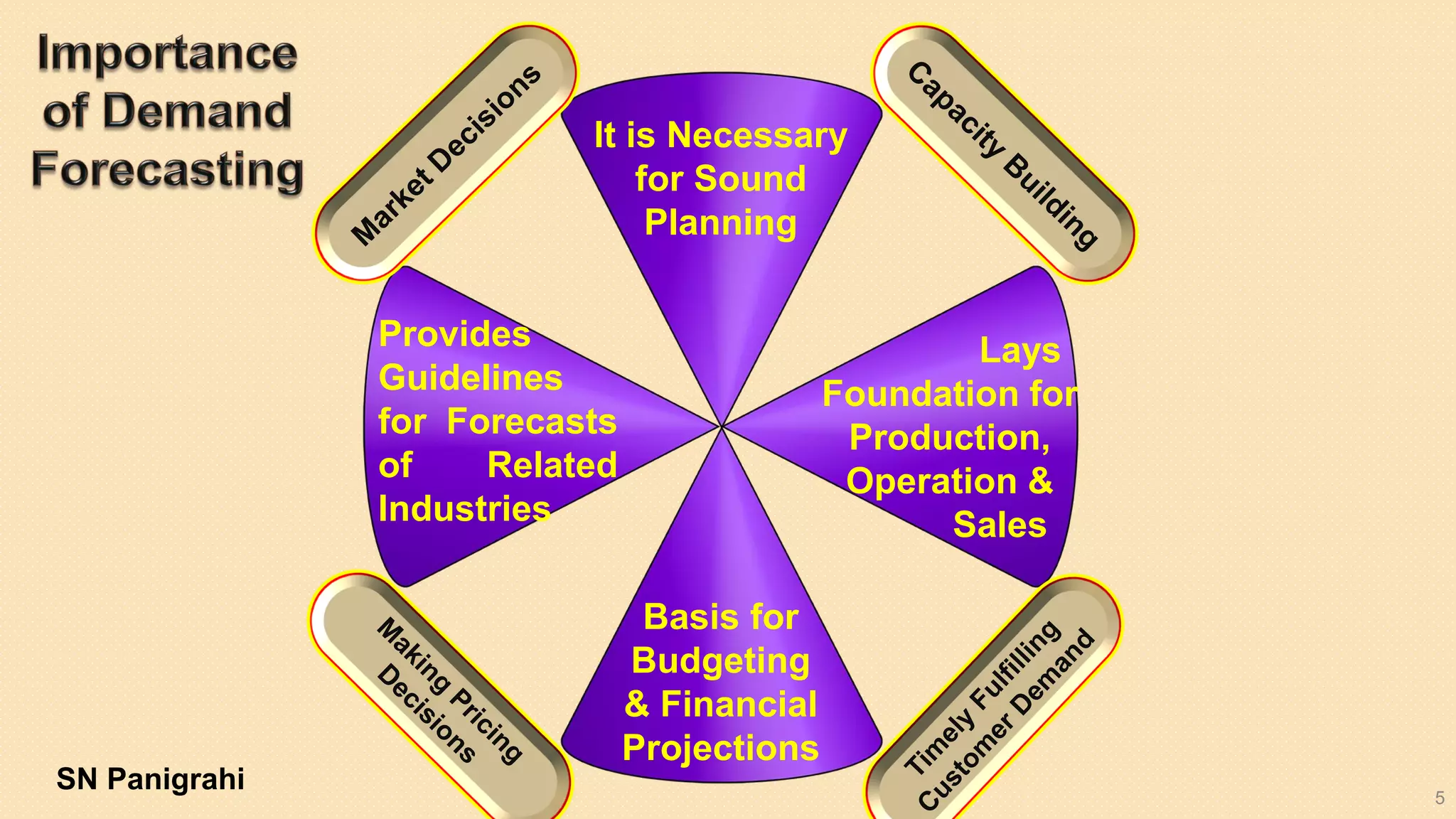
 It is Necessary for Sound Planning
 It Lays the Foundation for Production, Operation & Sales
 Basis for Budgeting & Financial Projections
 Provides Guidelines for Forecasts of Related Industries
SN Panigrahi
5
It is Necessary
for Sound
Planning
Lays
Foundation for
Production,
Operation &
Sales
Basis for
Budgeting
& Financial
Projections
Provides
Guidelines
for Forecasts
of Related
Industries
SN Panigrahi
6
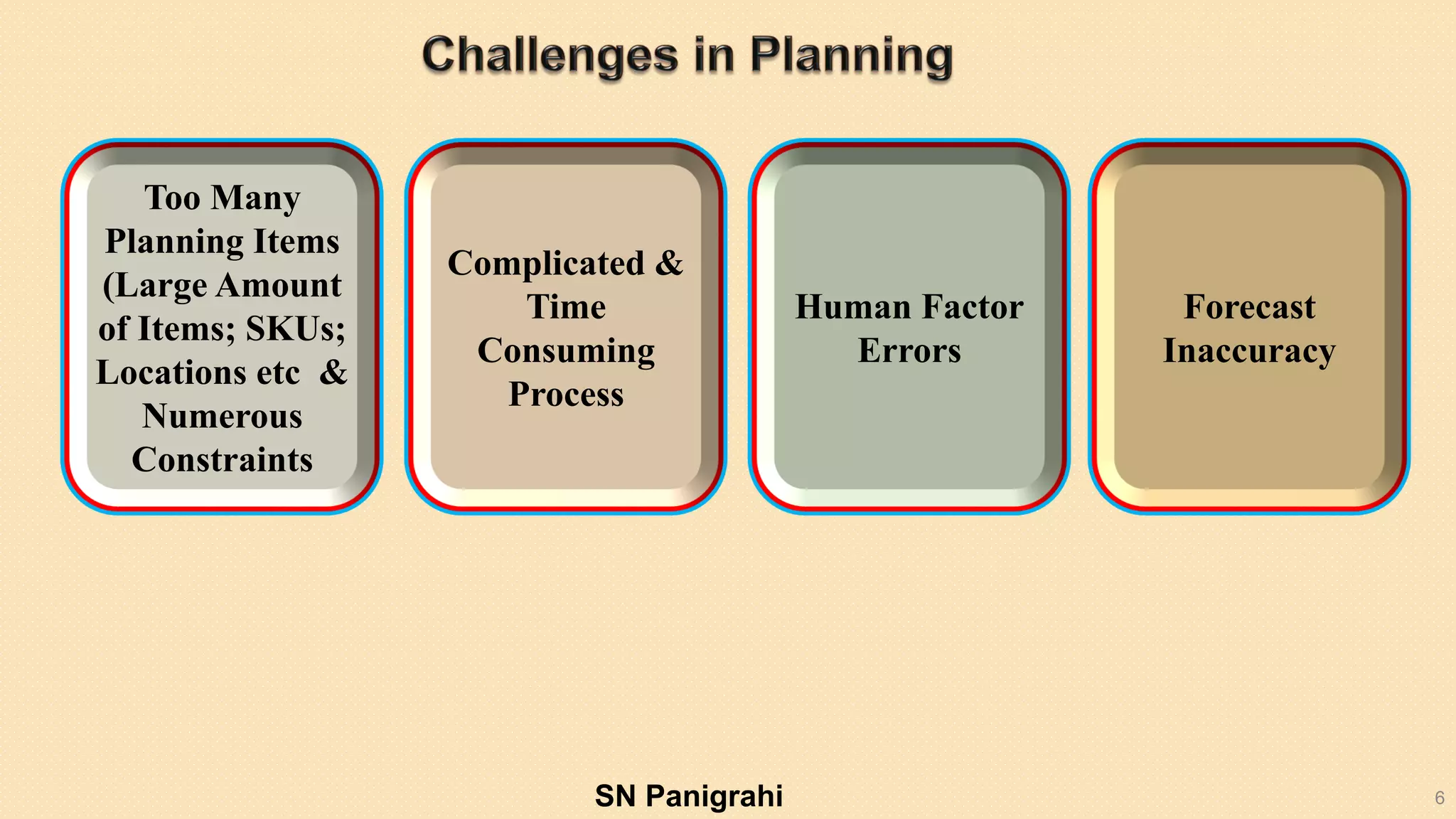
Too Many
Planning Items
(Large Amount
of Items; SKUs;
Locations etc &
Numerous
Constraints
Complicated &
Time
Consuming
Process
Human Factor
Errors
Forecast
Inaccuracy
SN Panigrahi
7
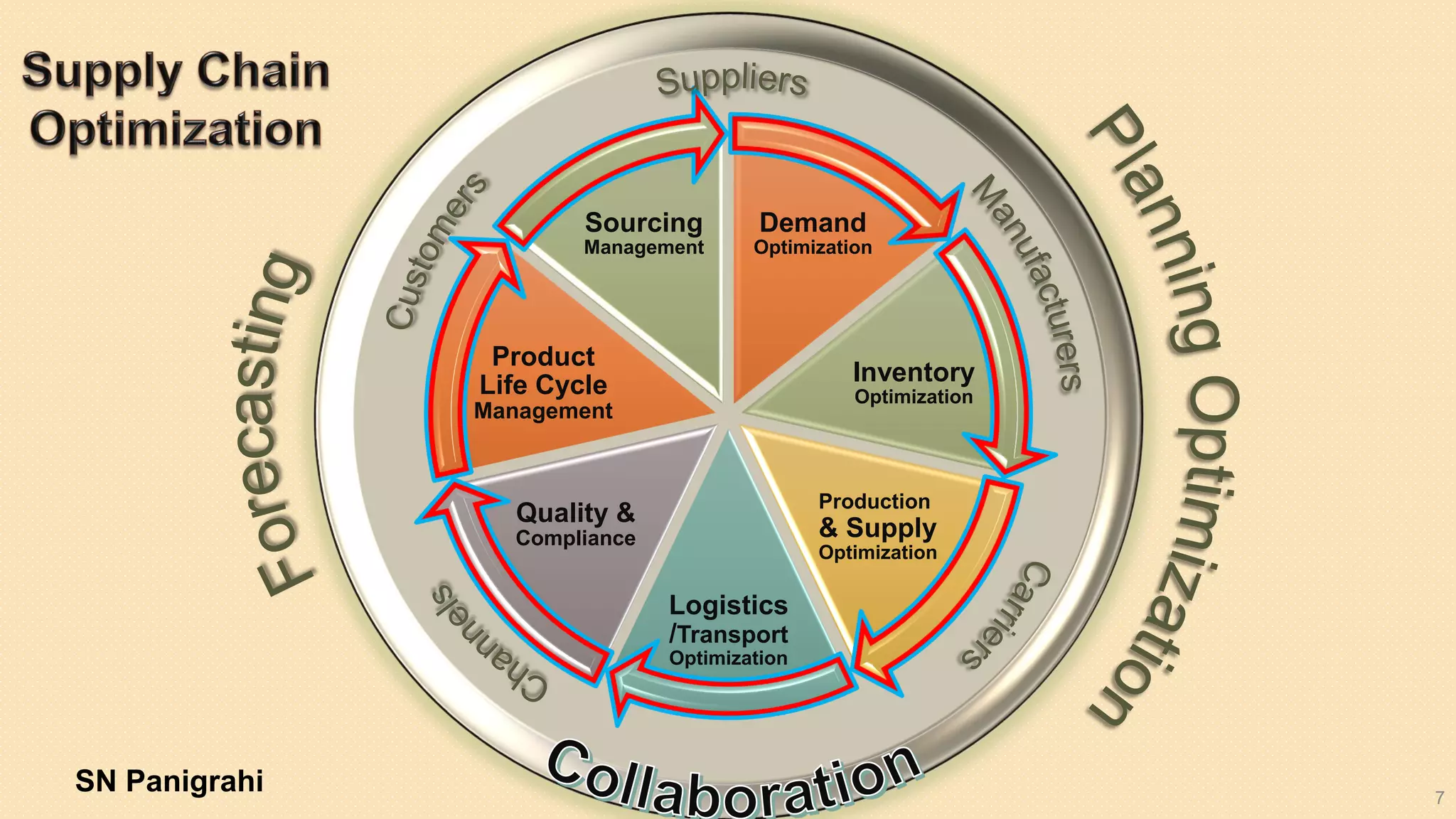
Demand
Optimization
Inventory
Optimization
Production
& Supply
Optimization
Logistics
/Transport
Optimization
Quality &
Compliance
Product
Life Cycle
Management
Sourcing
Management
SN Panigrahi
8
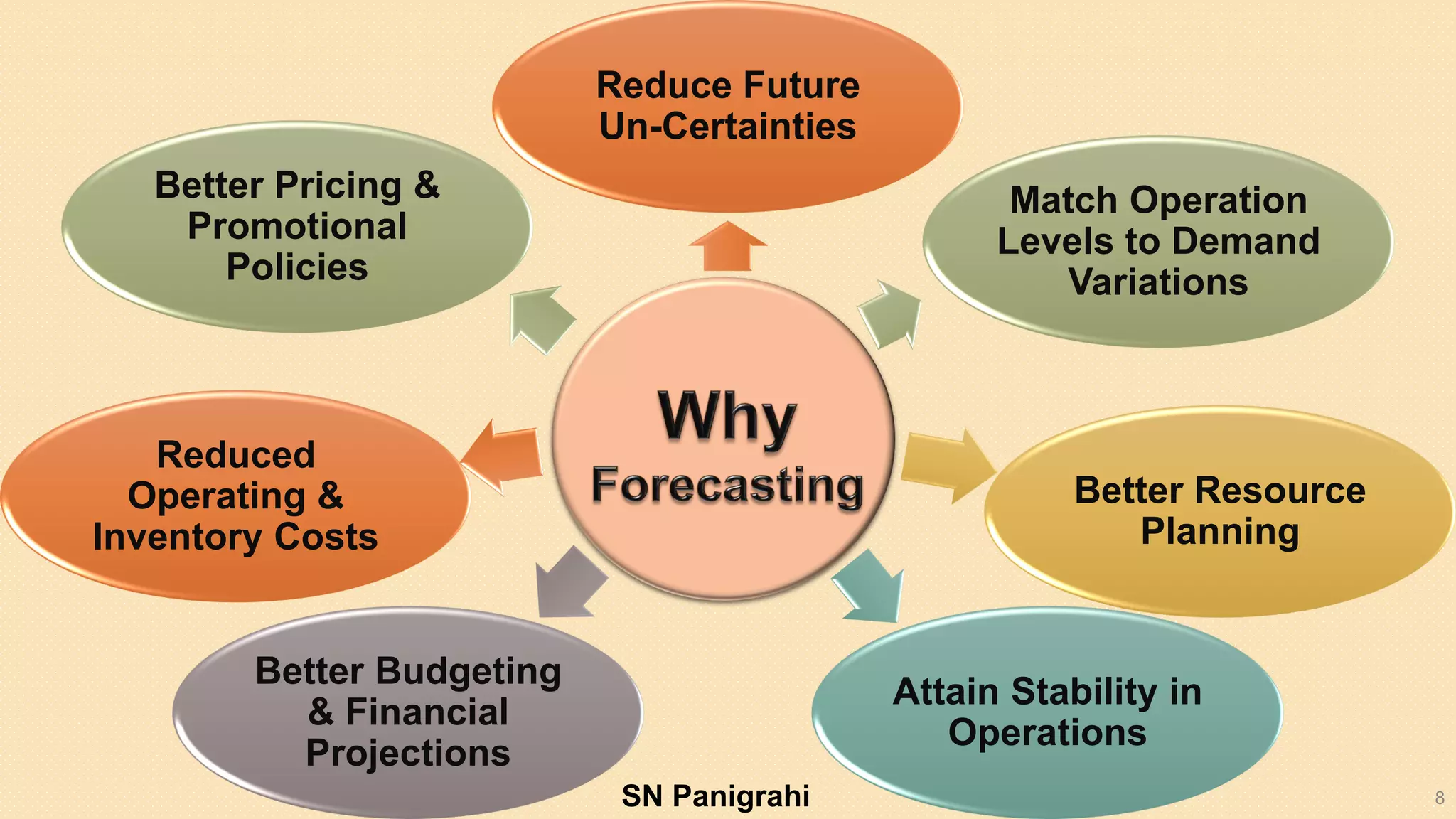
Reduce Future
Un-Certainties
Match Operation
Levels to Demand
Variations
Better Resource
Planning
Attain Stability in
Operations
Better Budgeting
& Financial
Projections
Reduced
Operating &
Inventory Costs
Better Pricing &
Promotional
Policies
SN Panigrahi
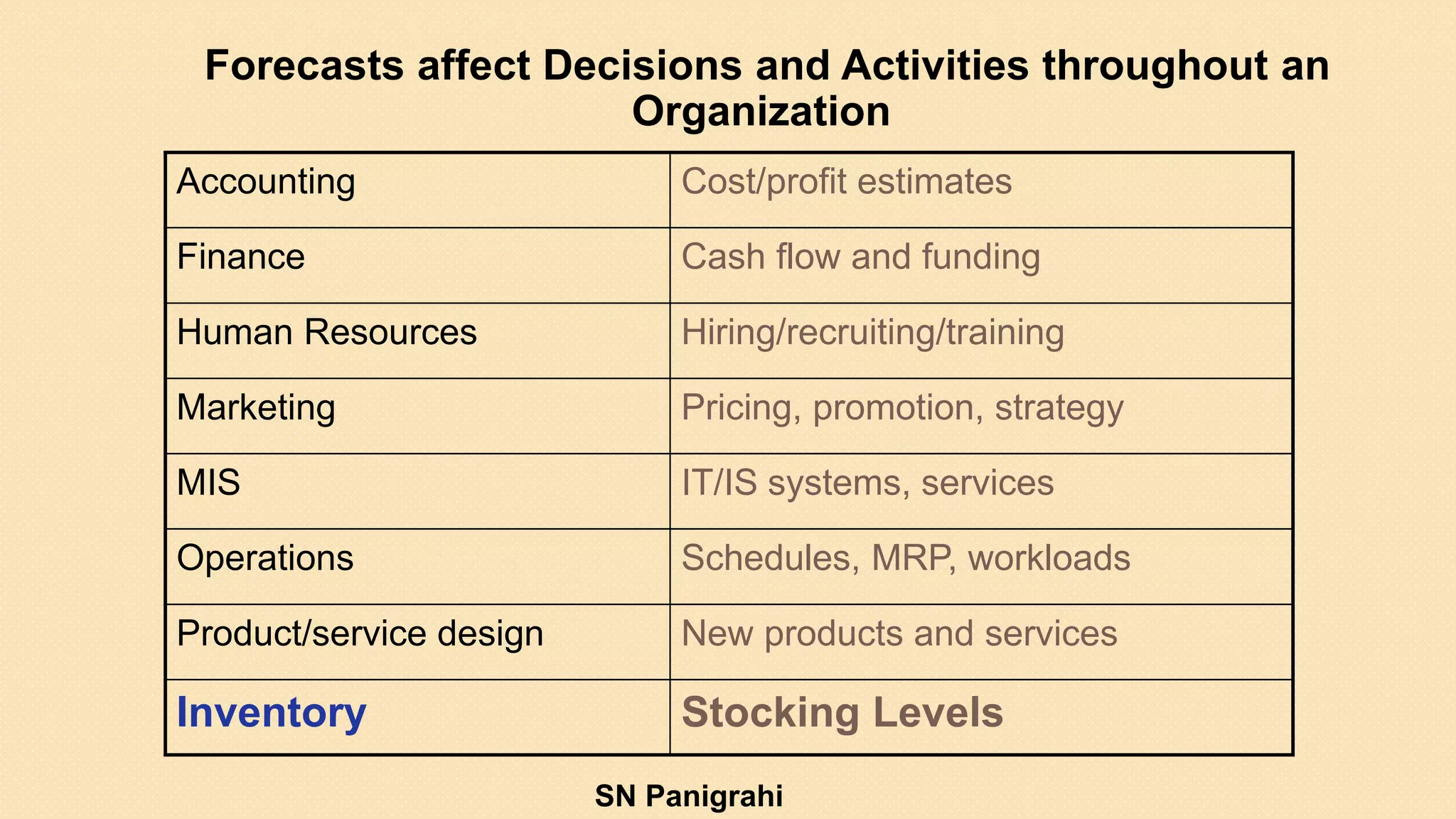
Accounting Cost/profit estimates
Finance Cash flow and funding
Human Resources Hiring/recruiting/training
Marketing Pricing, promotion, strategy
MIS IT/IS systems, services
Operations Schedules, MRP, workloads
Product/service design New products and services
Inventory Stocking Levels
Forecasts affect Decisions and Activities throughout an
Organization
SN Panigrahi
10
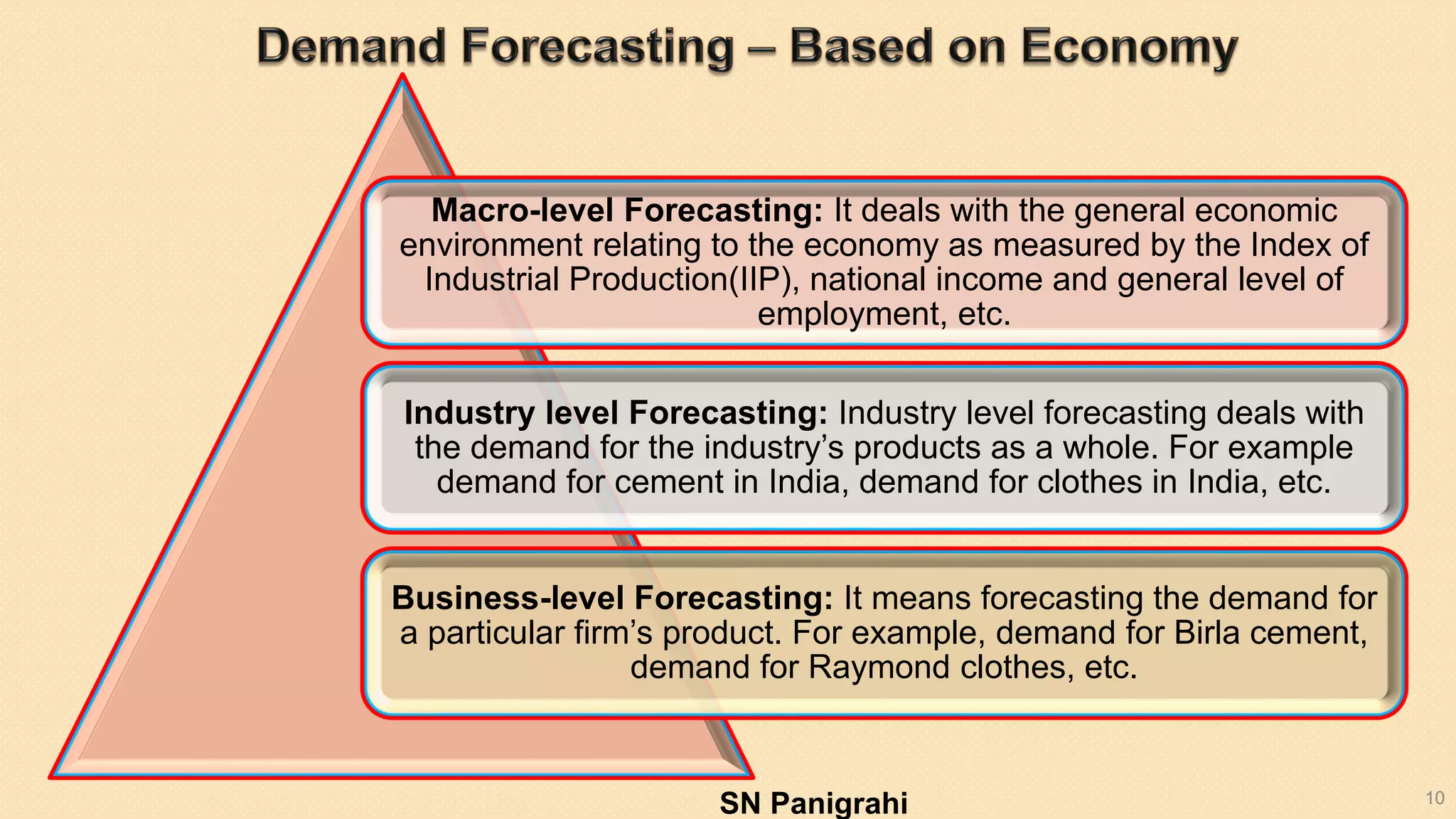
Macro-level Forecasting: It deals with the general economic
environment relating to the economy as measured by the Index of
Industrial Production(IIP), national income and general level of
employment, etc.
Industry level Forecasting: Industry level forecasting deals with
the demand for the industry’s products as a whole. For example
demand for cement in India, demand for clothes in India, etc.
Business-level Forecasting: It means forecasting the demand for
a particular firm’s product. For example, demand for Birla cement,
demand for Raymond clothes, etc.
SN Panigrahi
11
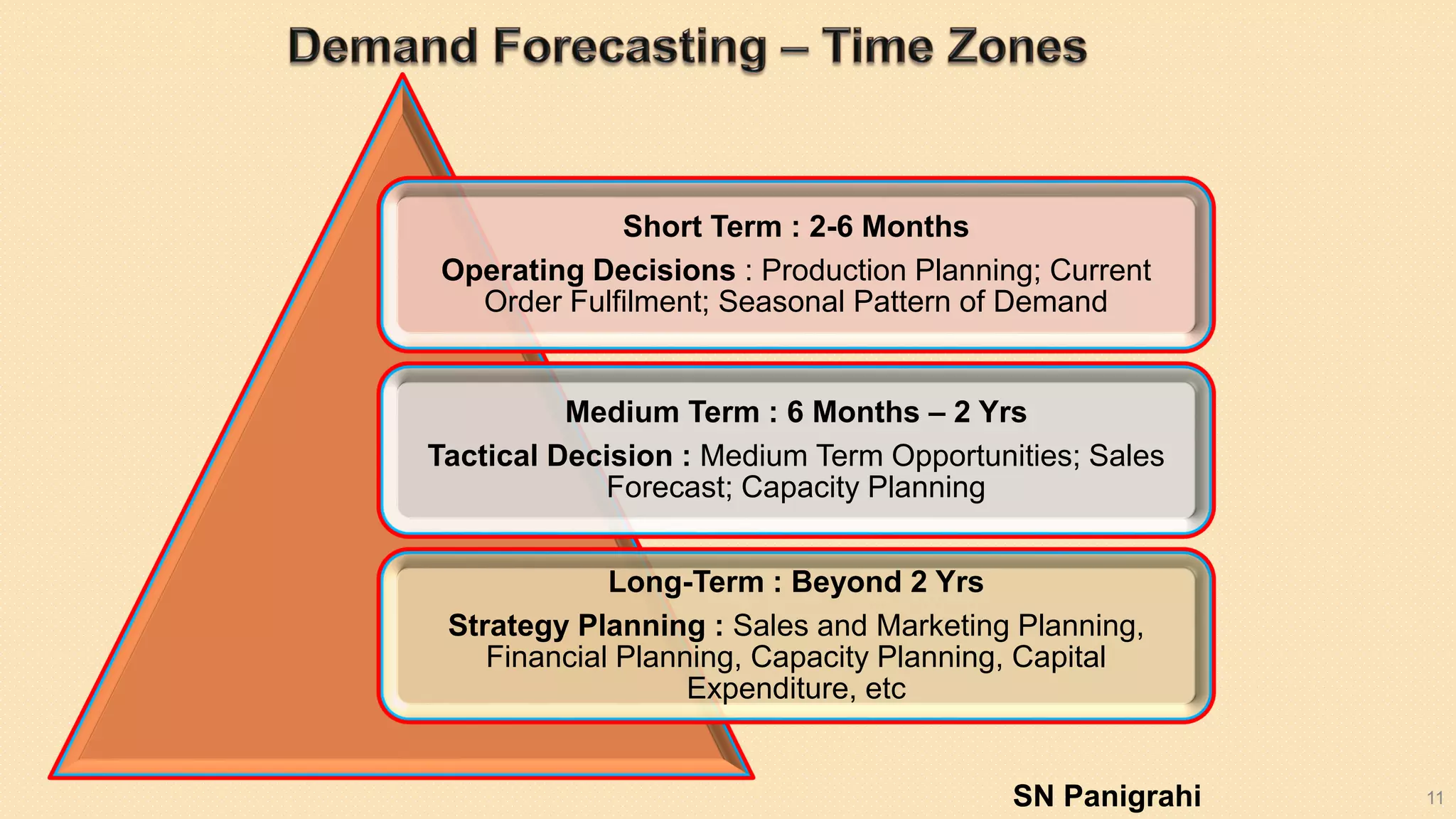
Short Term : 2-6 Months
Operating Decisions : Production Planning; Current
Order Fulfilment; Seasonal Pattern of Demand
Medium Term : 6 Months – 2 Yrs
Tactical Decision : Medium Term Opportunities; Sales
Forecast; Capacity Planning
Long-Term : Beyond 2 Yrs
Strategy Planning : Sales and Marketing Planning,
Financial Planning, Capacity Planning, Capital
Expenditure, etc
SN Panigrahi
12
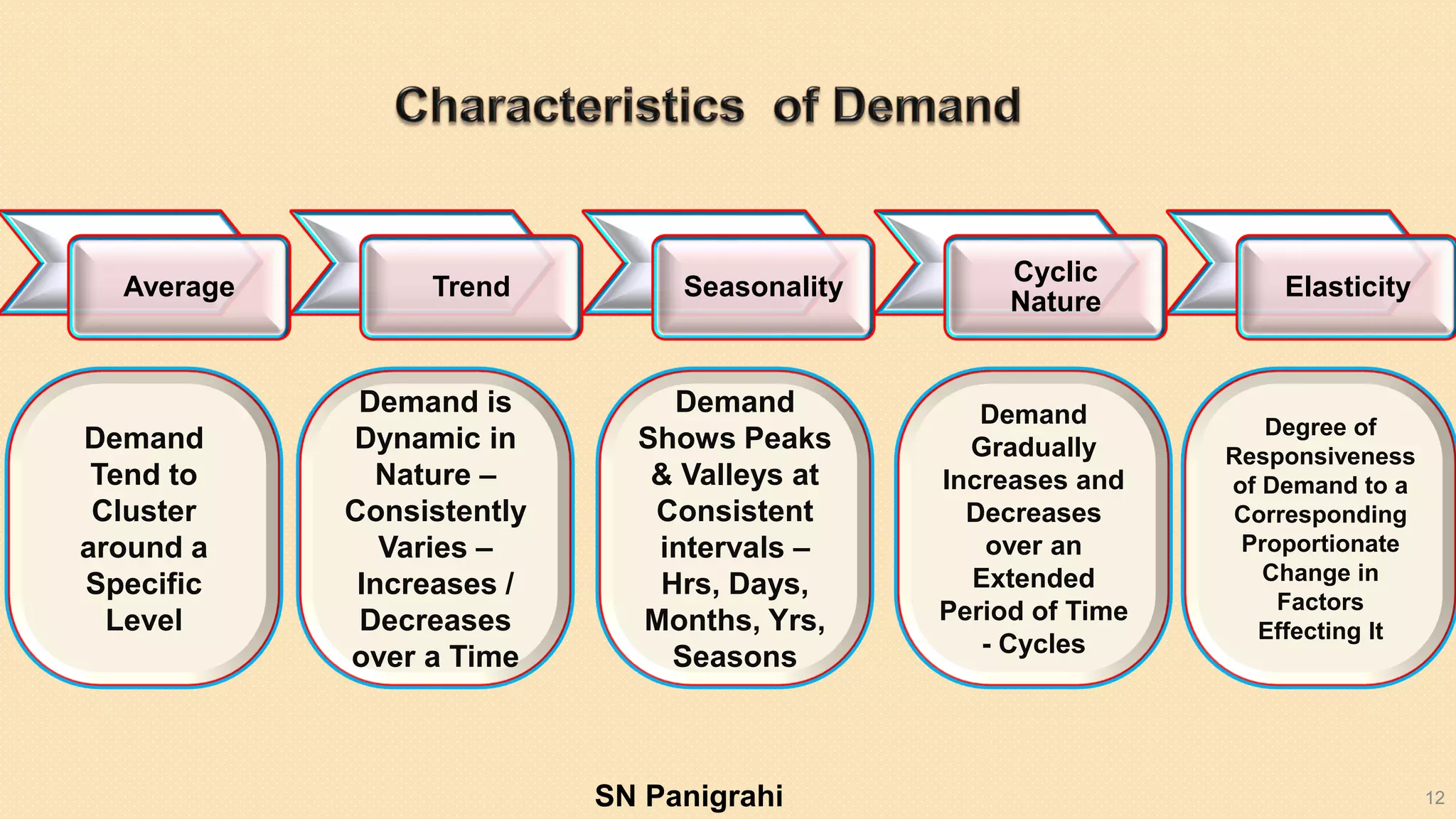
Average Trend Seasonality
Cyclic
Nature
Elasticity
Demand
Tend to
Cluster
around a
Specific
Level
Demand is
Dynamic in
Nature –
Consistently
Varies –
Increases /
Decreases
over a Time
Demand
Shows Peaks
& Valleys at
Consistent
intervals –
Hrs, Days,
Months, Yrs,
Seasons
Demand
Gradually
Increases and
Decreases
over an
Extended
Period of Time
- Cycles
Degree of
Responsiveness
of Demand to a
Corresponding
Proportionate
Change in
Factors
Effecting It
SN Panigrahi
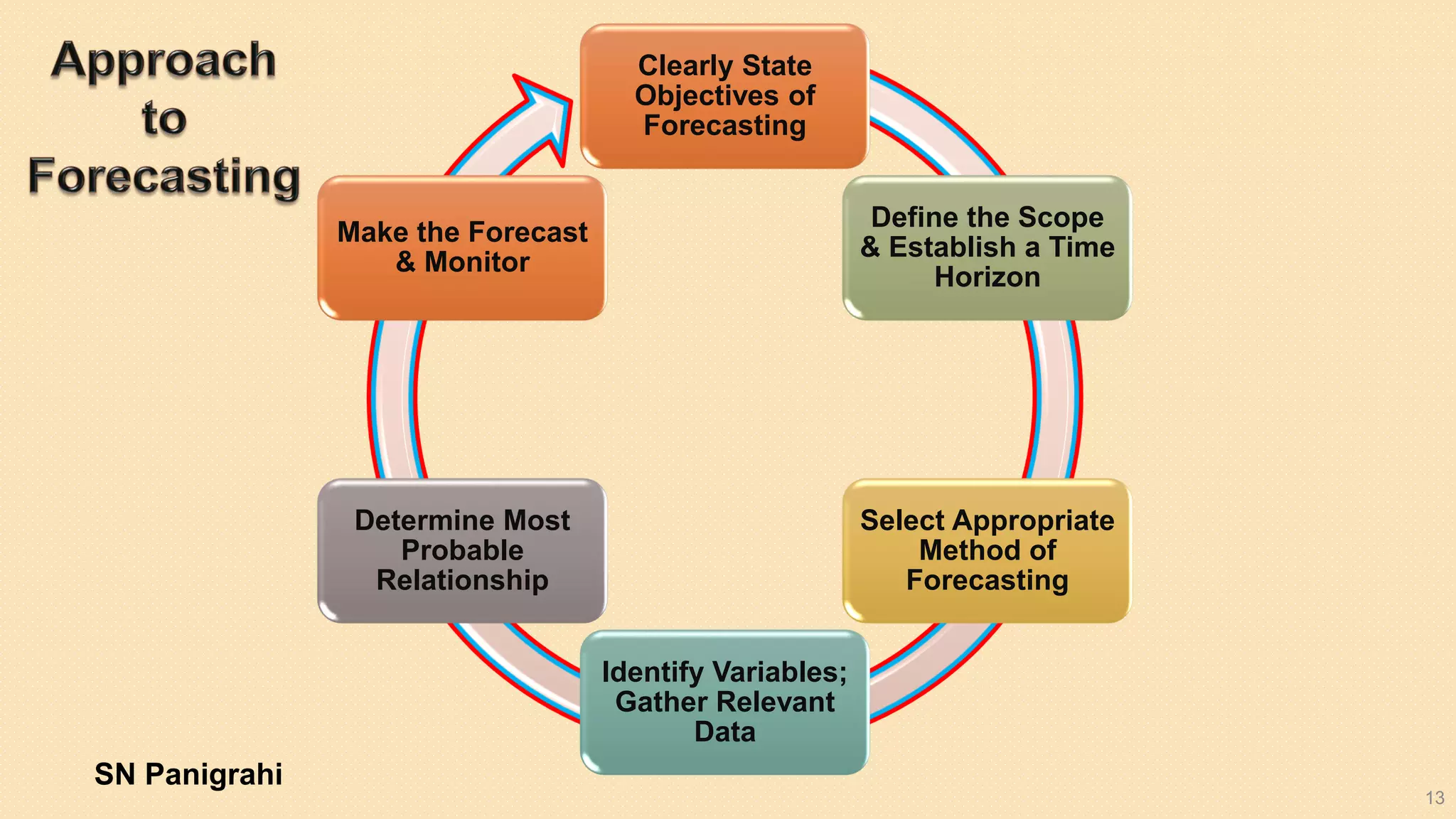
13
Clearly State
Objectives of
Forecasting
Define the Scope
& Establish a Time
Horizon
Select Appropriate
Method of
Forecasting
Identify Variables;
Gather Relevant
Data
Determine Most
Probable
Relationship
Make the Forecast
& Monitor
SN Panigrahi
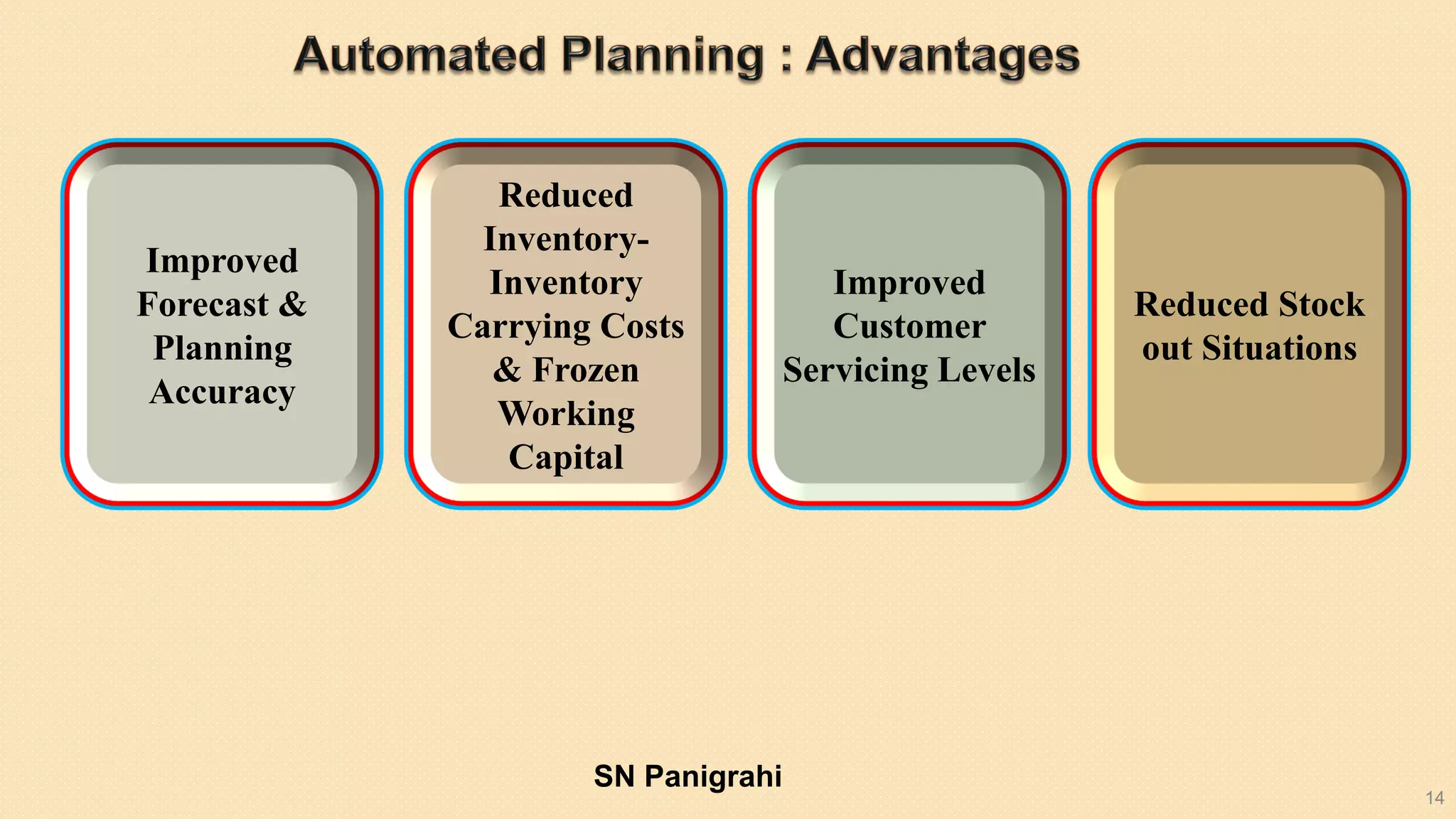
14
Improved
Forecast &
Planning
Accuracy
Reduced
Inventory-
Inventory
Carrying Costs
& Frozen
Working
Capital
Improved
Customer
Servicing Levels
Reduced Stock
out Situations
SN Panigrahi
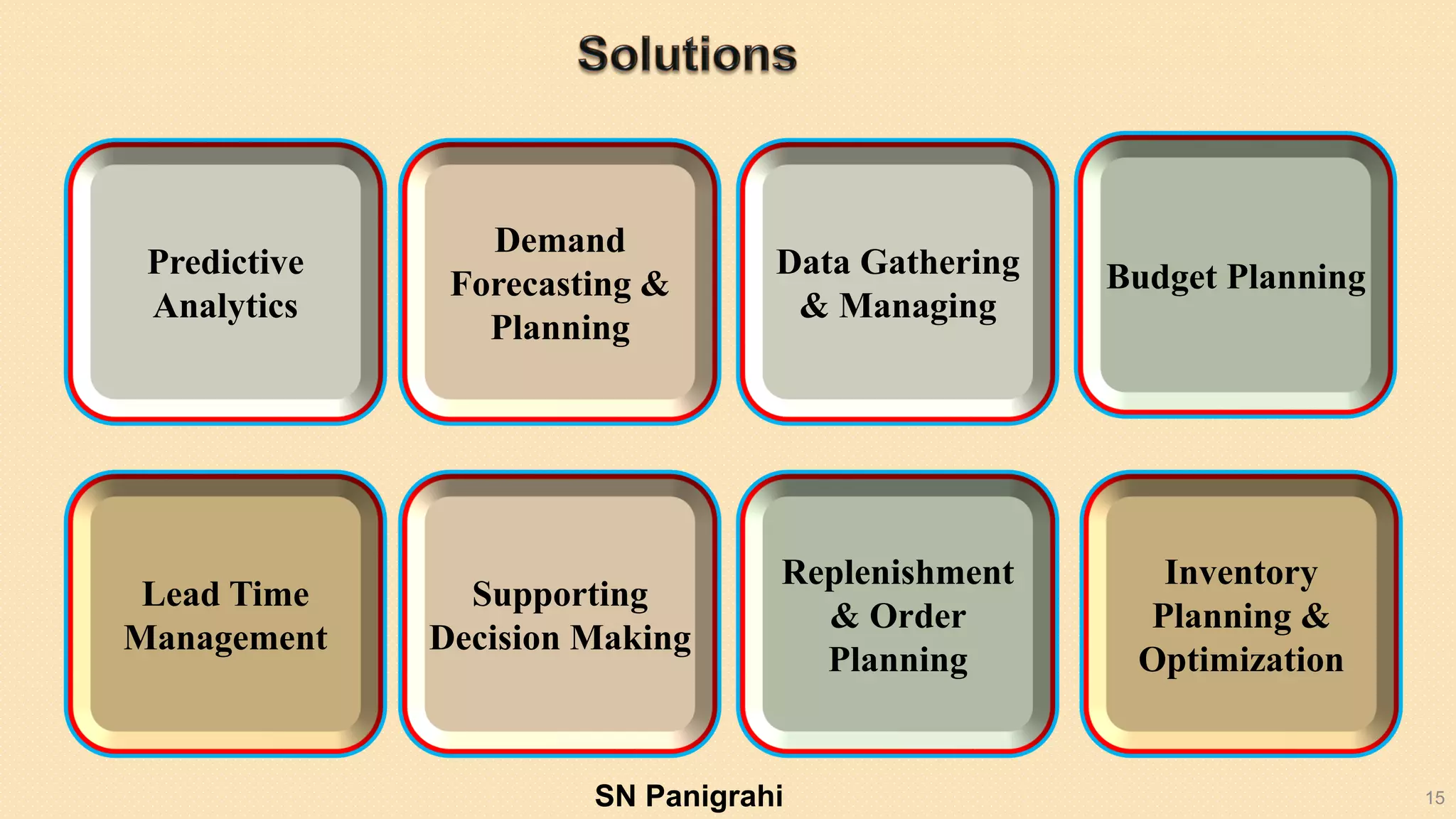
15
Predictive
Analytics
Demand
Forecasting &
Planning
Budget Planning
Inventory
Planning &
Optimization
Data Gathering
& Managing
Supporting
Decision Making
Replenishment
& Order
Planning
Lead Time
Management
SN Panigrahi
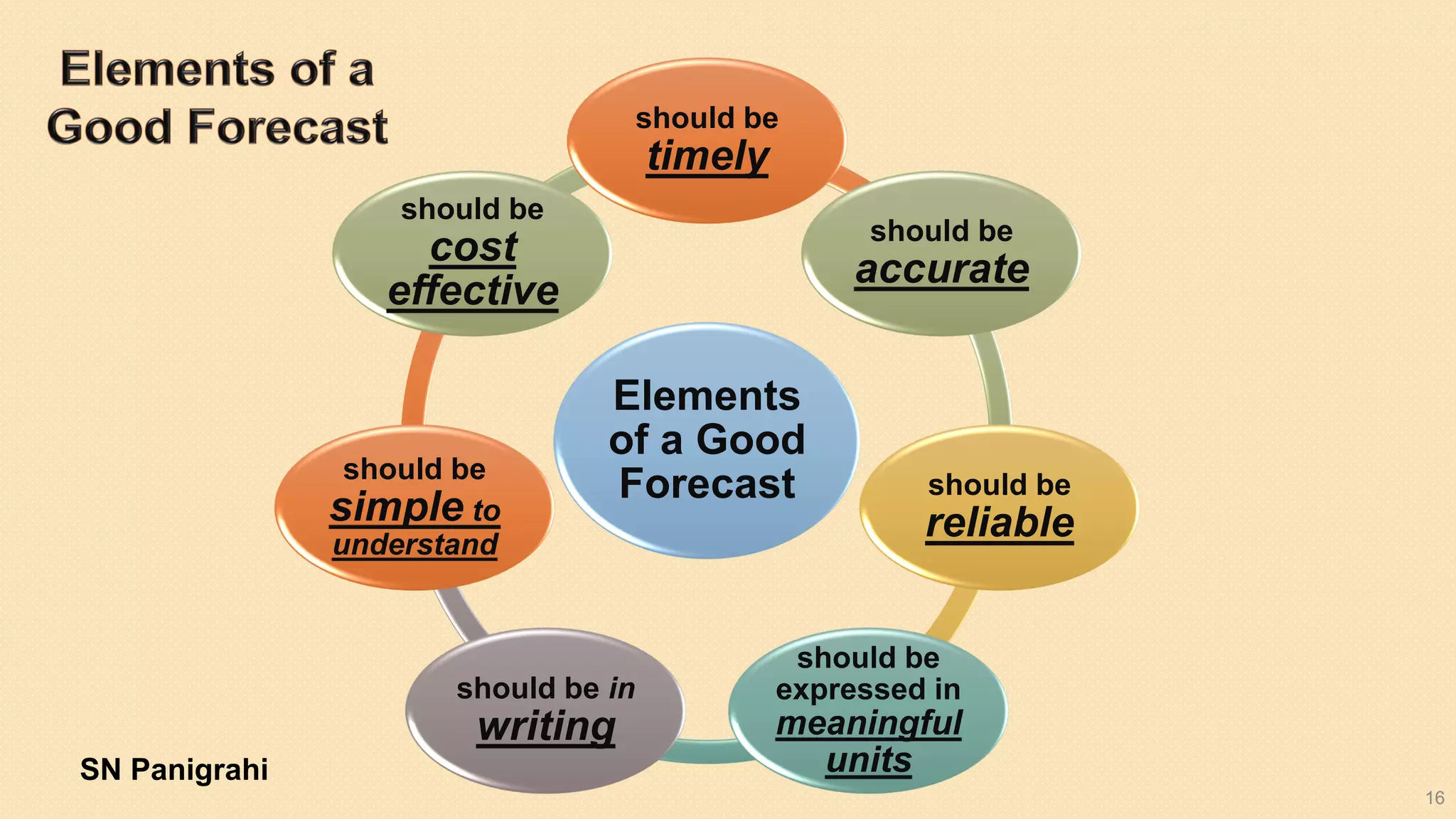
16
Elements
of a Good
Forecast
should be
timely
should be
accurate
should be
reliable
should be
expressed in
meaningful
units
should be in
writing
should be
simple to
understand
should be
cost
effective
SN Panigrahi
17
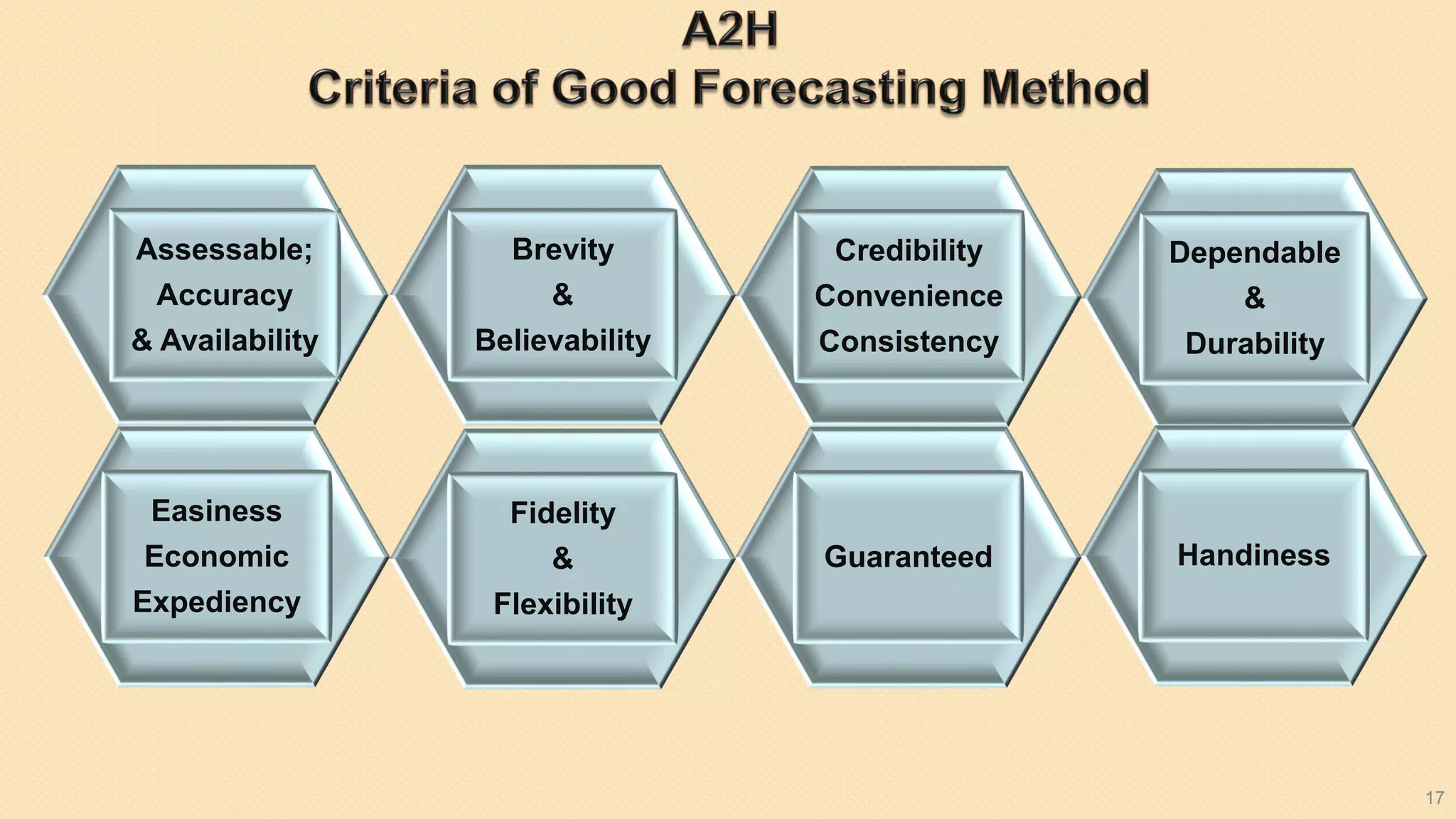
Assessable;
Accuracy
& Availability
Brevity
&
Believability
Dependable
&
Durability
Fidelity
&
Flexibility
Handiness
Easiness
Economic
Expediency
Credibility
Convenience
Consistency
Guaranteed
18
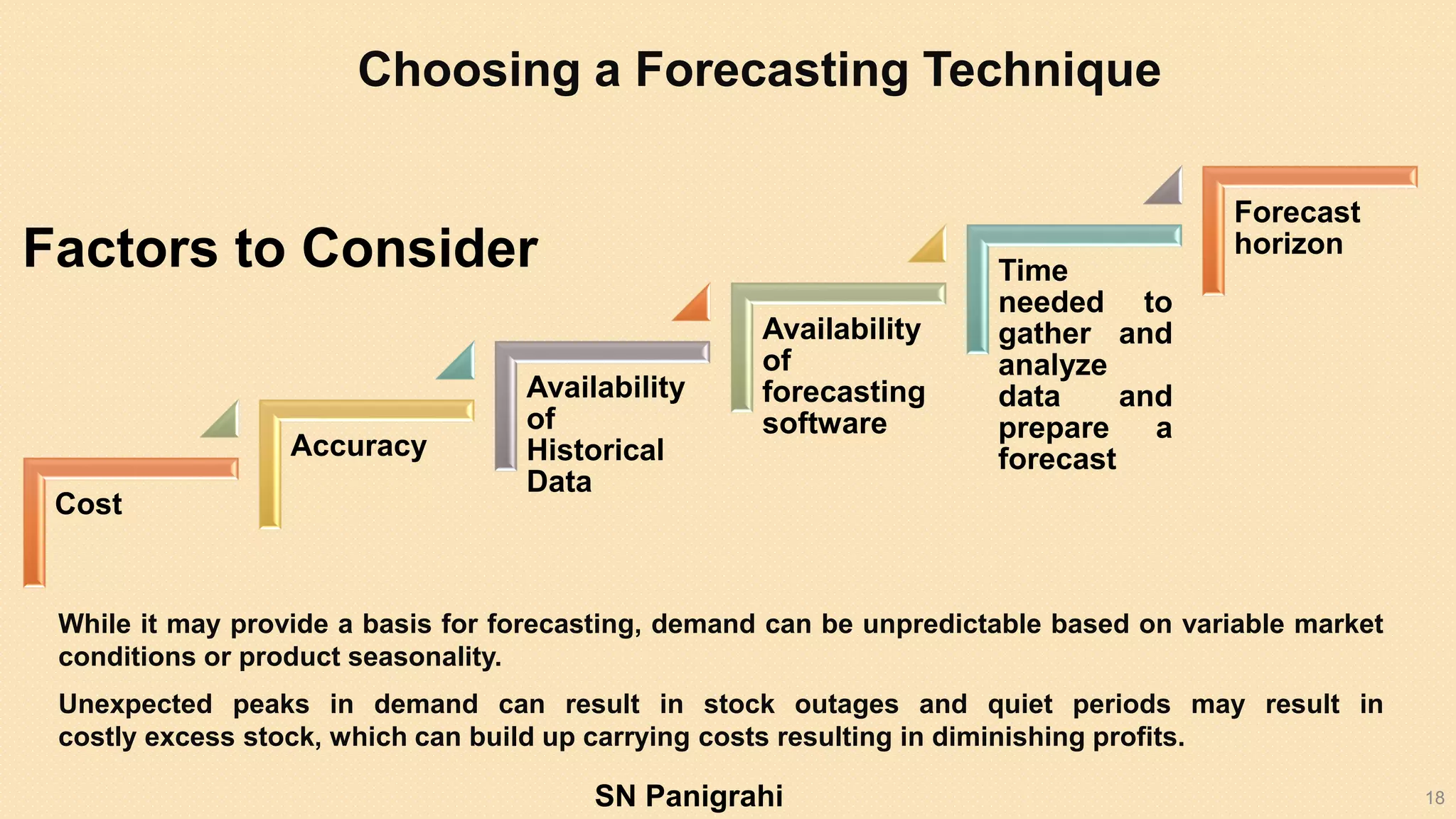
Cost
Accuracy
Availability
of
Historical
Data
Availability
of
forecasting
software
Time
needed to
gather and
analyze
data and
prepare a
forecast
Forecast
horizon
Choosing a Forecasting Technique
Factors to Consider
While it may provide a basis for forecasting, demand can be unpredictable based on variable market
conditions or product seasonality.
Unexpected peaks in demand can result in stock outages and quiet periods may result in
costly excess stock, which can build up carrying costs resulting in diminishing profits.
SN Panigrahi
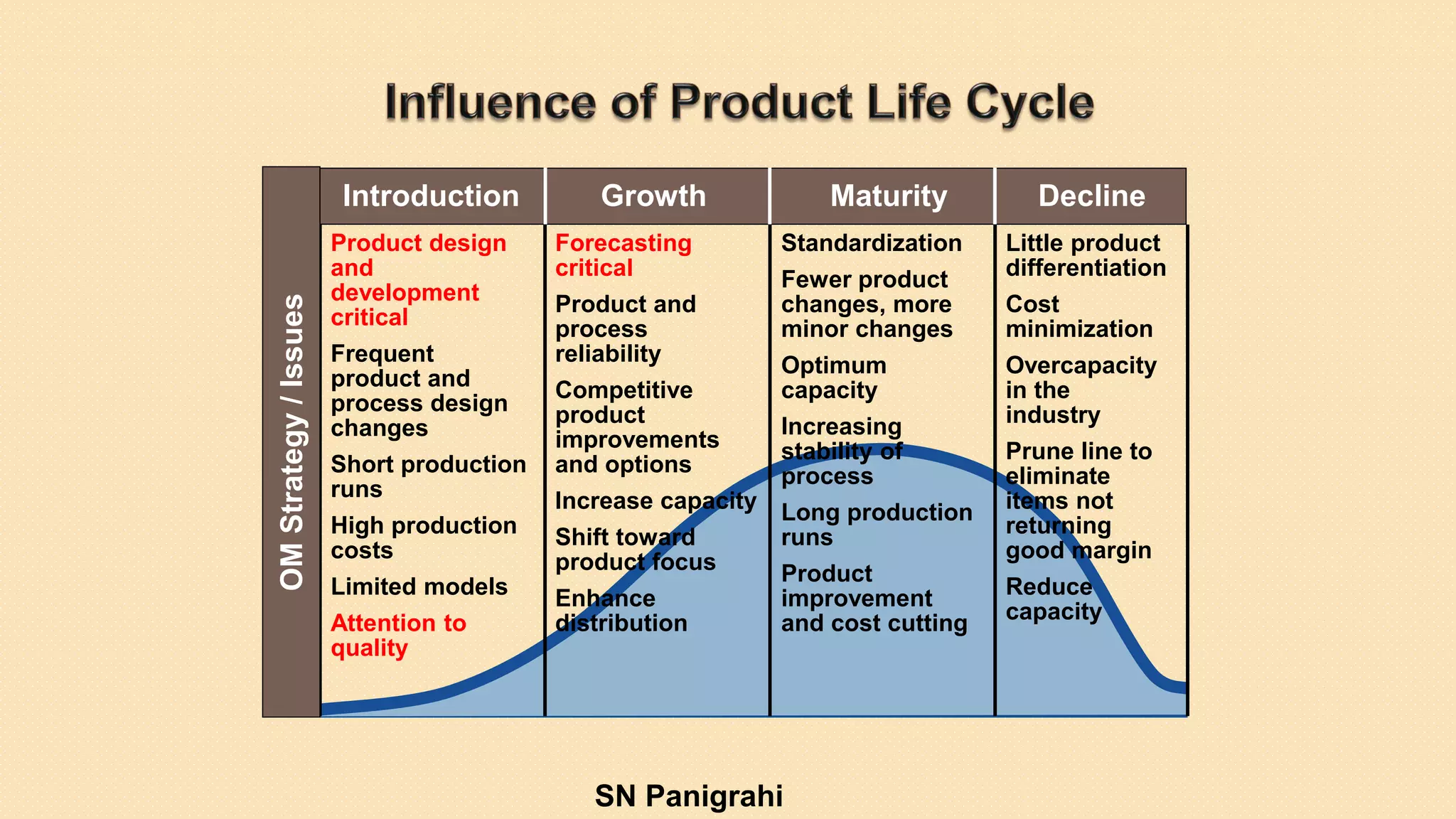
Product design
and
development
critical
Frequent
product and
process design
changes
Short production
runs
High production
costs
Limited models
Attention to
quality
Introduction Growth Maturity Decline
OMStrategy/Issues
Forecasting
critical
Product and
process
reliability
Competitive
product
improvements
and options
Increase capacity
Shift toward
product focus
Enhance
distribution
Standardization
Fewer product
changes, more
minor changes
Optimum
capacity
Increasing
stability of
process
Long production
runs
Product
improvement
and cost cutting
Little product
differentiation
Cost
minimization
Overcapacity
in the
industry
Prune line to
eliminate
items not
returning
good margin
Reduce
capacity
SN Panigrahi
SN Panigrahi 20
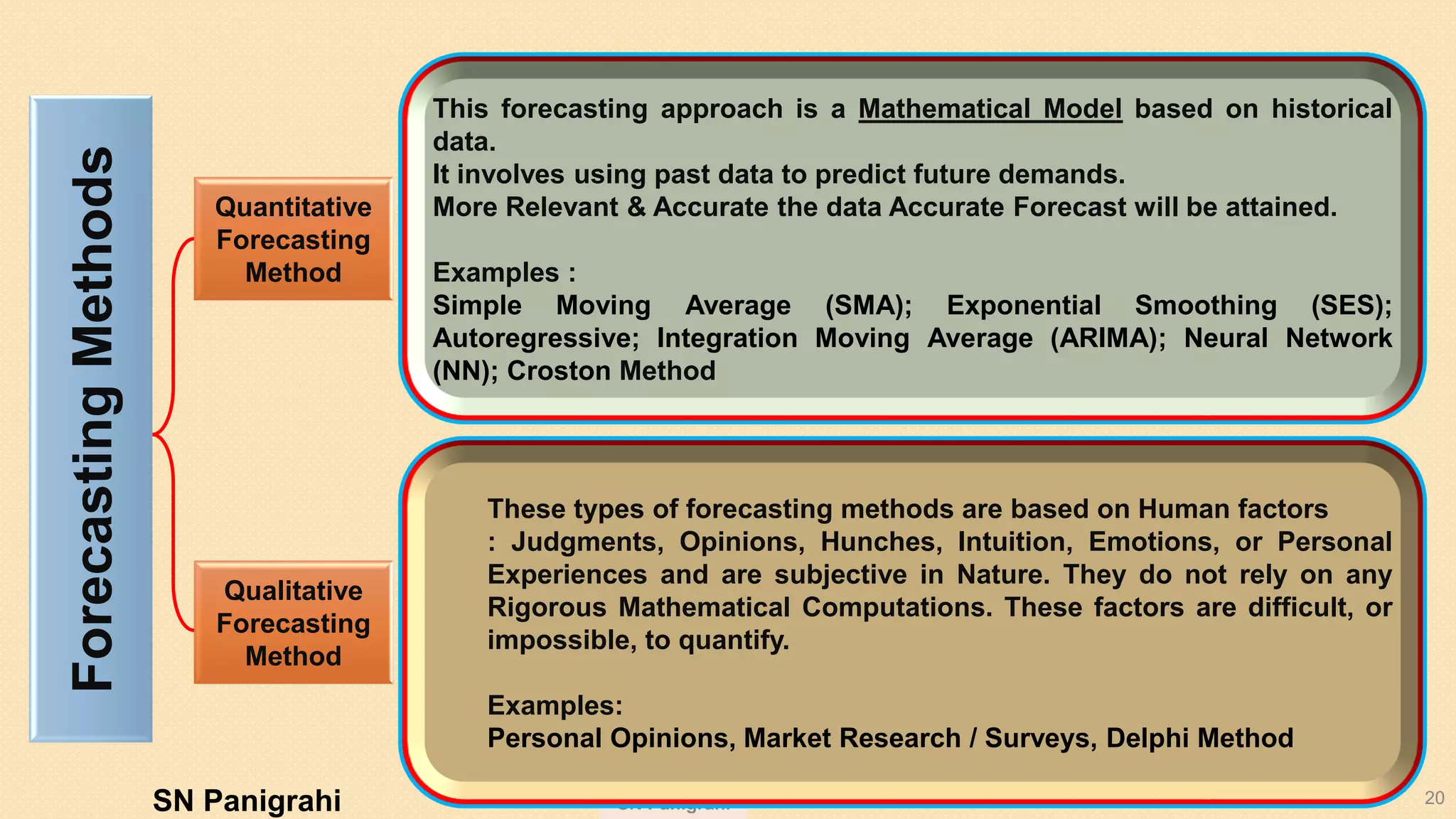
Quantitative
Forecasting
Method
Qualitative
Forecasting
Method
ForecastingMethods This forecasting approach is a Mathematical Model based on historical
data.
It involves using past data to predict future demands.
More Relevant & Accurate the data Accurate Forecast will be attained.
Examples :
Simple Moving Average (SMA); Exponential Smoothing (SES);
Autoregressive; Integration Moving Average (ARIMA); Neural Network
(NN); Croston Method
These types of forecasting methods are based on Human factors
: Judgments, Opinions, Hunches, Intuition, Emotions, or Personal
Experiences and are subjective in Nature. They do not rely on any
Rigorous Mathematical Computations. These factors are difficult, or
impossible, to quantify.
Examples:
Personal Opinions, Market Research / Surveys, Delphi Method
SN Panigrahi
21
Machine Learning/Artificial Intelligence
Machine learning models are a broad set of methodologies that use more complex mathematical techniques to
select variables and optimize fit in instances where there may be complicated interactions between features.
These can be powerful choices, but you’ll want to make sure these obey the integrated, transparent, and
actionable properties
You can achieve the following benefits :
 Greatly improve reliability in product forecasts and demand plans
 Allow full collaboration between all departments involved in demand planning
 Maintain the right inventory levels by product, customer, and location
 Accurately forecast revenue and perform cost/benefit analysis
 Strengthen new/untested marketing campaigns
 Analyze profitability by channel, product, and geography
 Minimize time-to-benefit by utilizing pre-packaged business templates
SN Panigrahi
Inventory is Stock of items kept to meet future demand
Inventory is a physical stock of goods kept for the
future purposes.
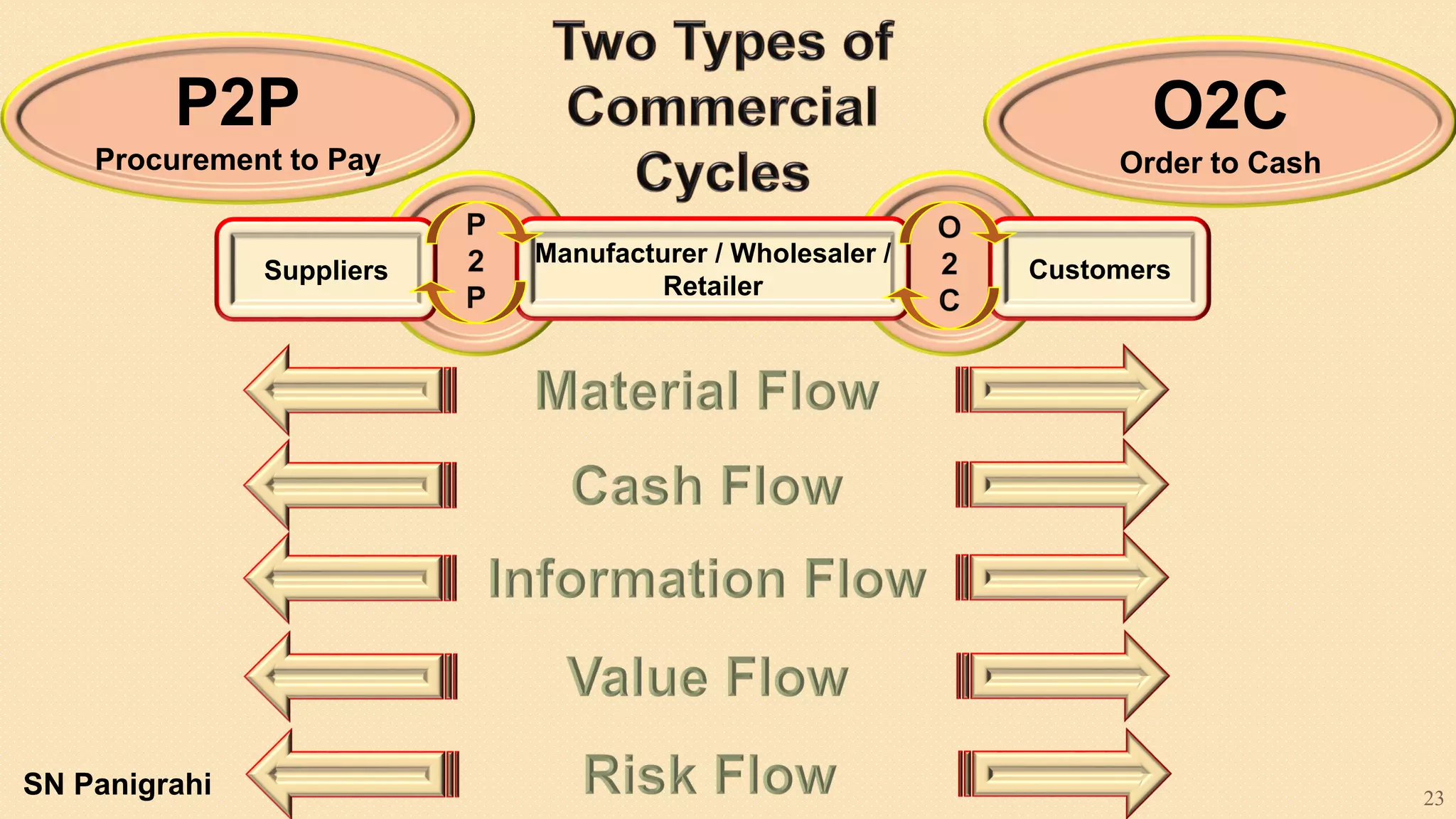
23
Suppliers Customers
Manufacturer / Wholesaler /
Retailer
P2P
Procurement to Pay
O2C
Order to Cash
SN Panigrahi
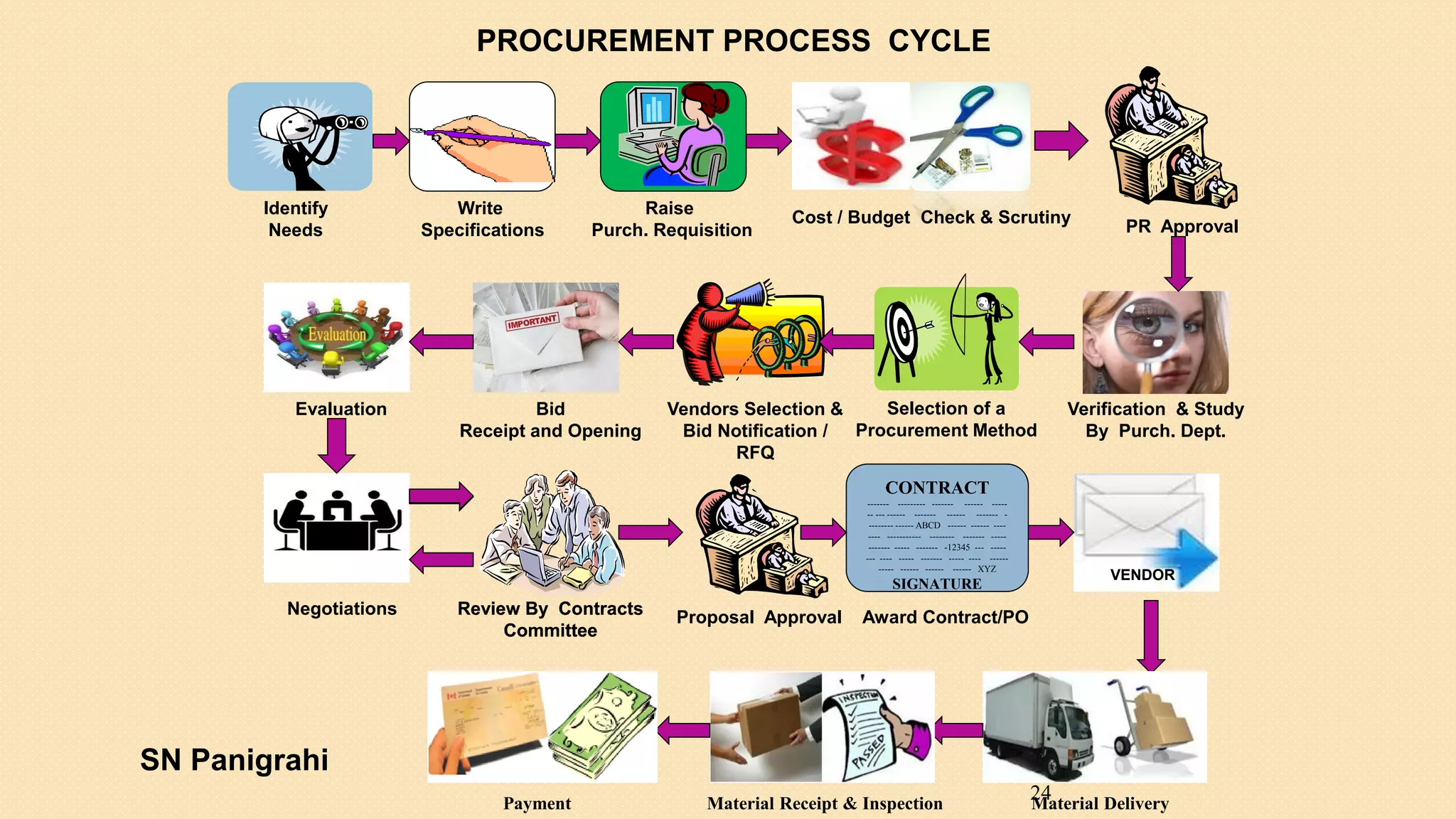
24
Identify
Needs
Write
Specifications
Raise
Purch. Requisition
Selection of a
Procurement Method
Verification & Study
By Purch. Dept.
Cost / Budget Check & Scrutiny
PR Approval
Vendors Selection &
Bid Notification /
RFQ
Bid
Receipt and Opening
Award Contract/POProposal Approval
Evaluation
Review By Contracts
Committee
Negotiations
CONTRACT
------- --------- ------- ------ -----
-- --- ------ ------- ------ ------- -
-------- ------ ABCD ------ ------ ----
---- ----------- -------- ------- -----
------- ----- ------- -12345 --- -----
--- ---- ----- ------- ----- ---- ------
----- ------ ------ ------ XYZ
SIGNATURE
VENDOR
Material DeliveryMaterial Receipt & InspectionPayment
PROCUREMENT PROCESS CYCLE
Review By Contracts
Committee
SN Panigrahi
25
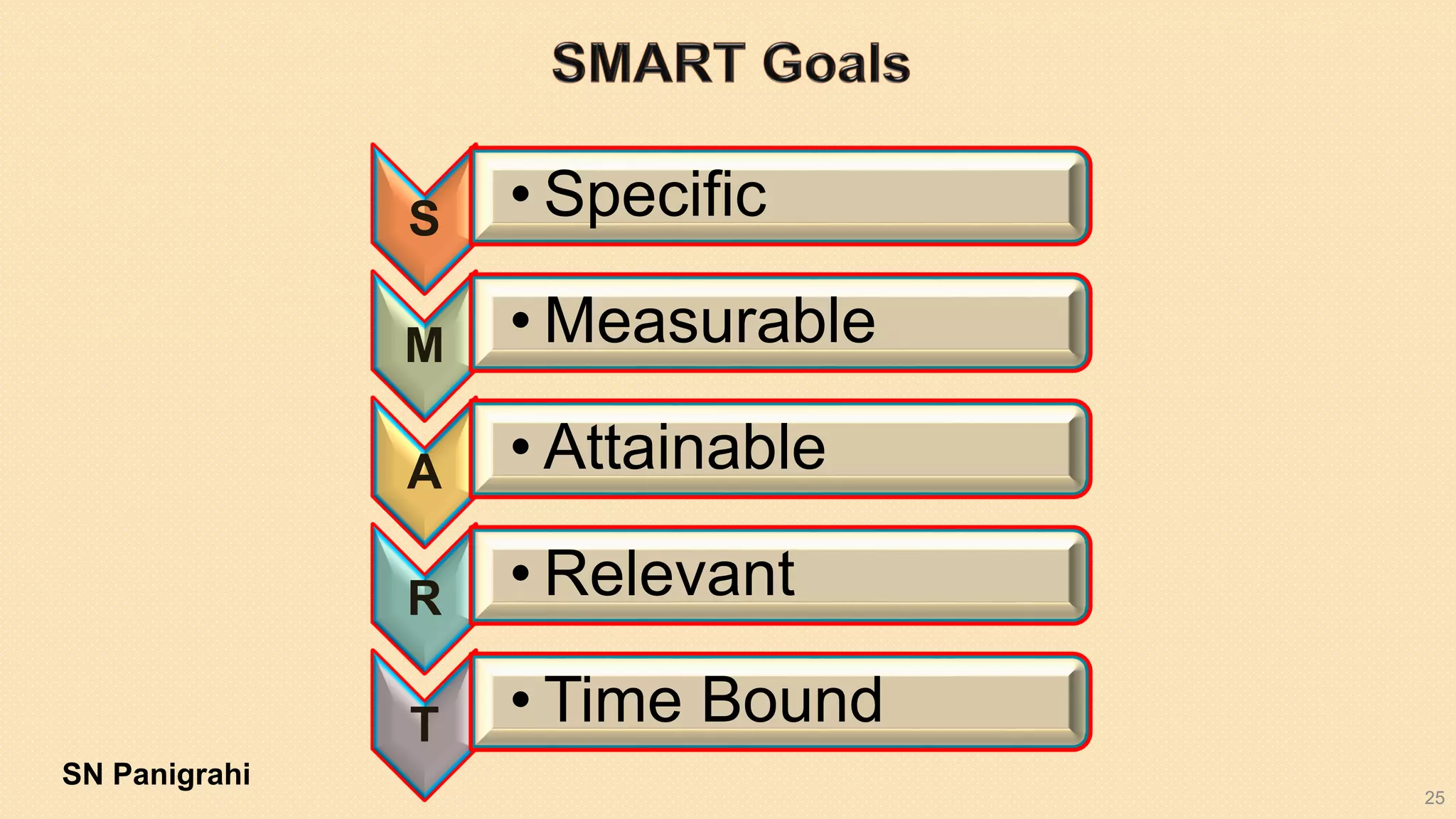
S • Specific
M • Measurable
A • Attainable
R • Relevant
T • Time Bound
SN Panigrahi
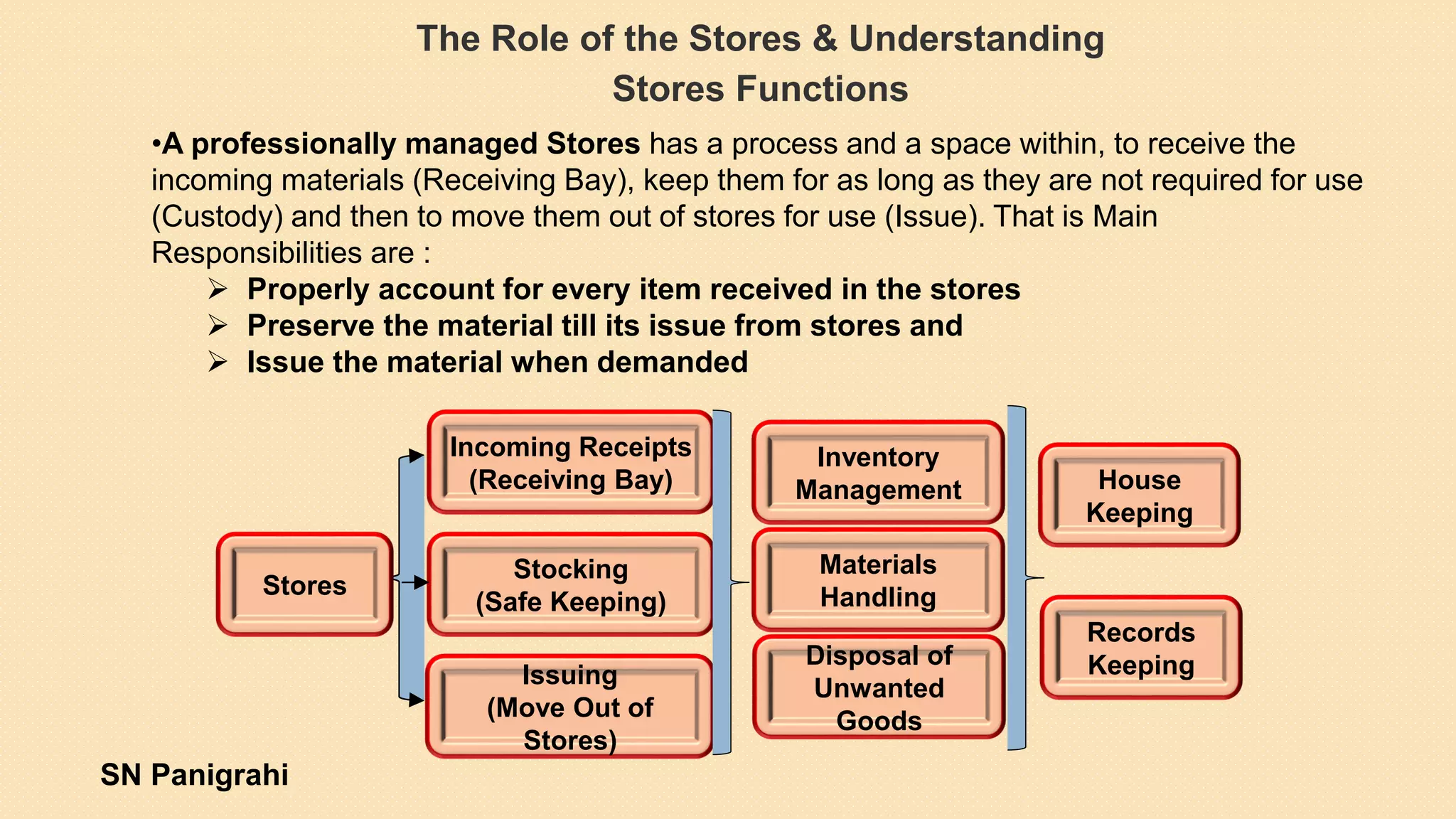
The Role of the Stores & Understanding
Stores Functions
•A professionally managed Stores has a process and a space within, to receive the
incoming materials (Receiving Bay), keep them for as long as they are not required for use
(Custody) and then to move them out of stores for use (Issue). That is Main
Responsibilities are :
 Properly account for every item received in the stores
 Preserve the material till its issue from stores and
 Issue the material when demanded
Incoming Receipts
(Receiving Bay)
Stocking
(Safe Keeping)
Issuing
(Move Out of
Stores)
Inventory
Management
Stores
Materials
Handling
Disposal of
Unwanted
Goods
House
Keeping
Records
Keeping
SN Panigrahi
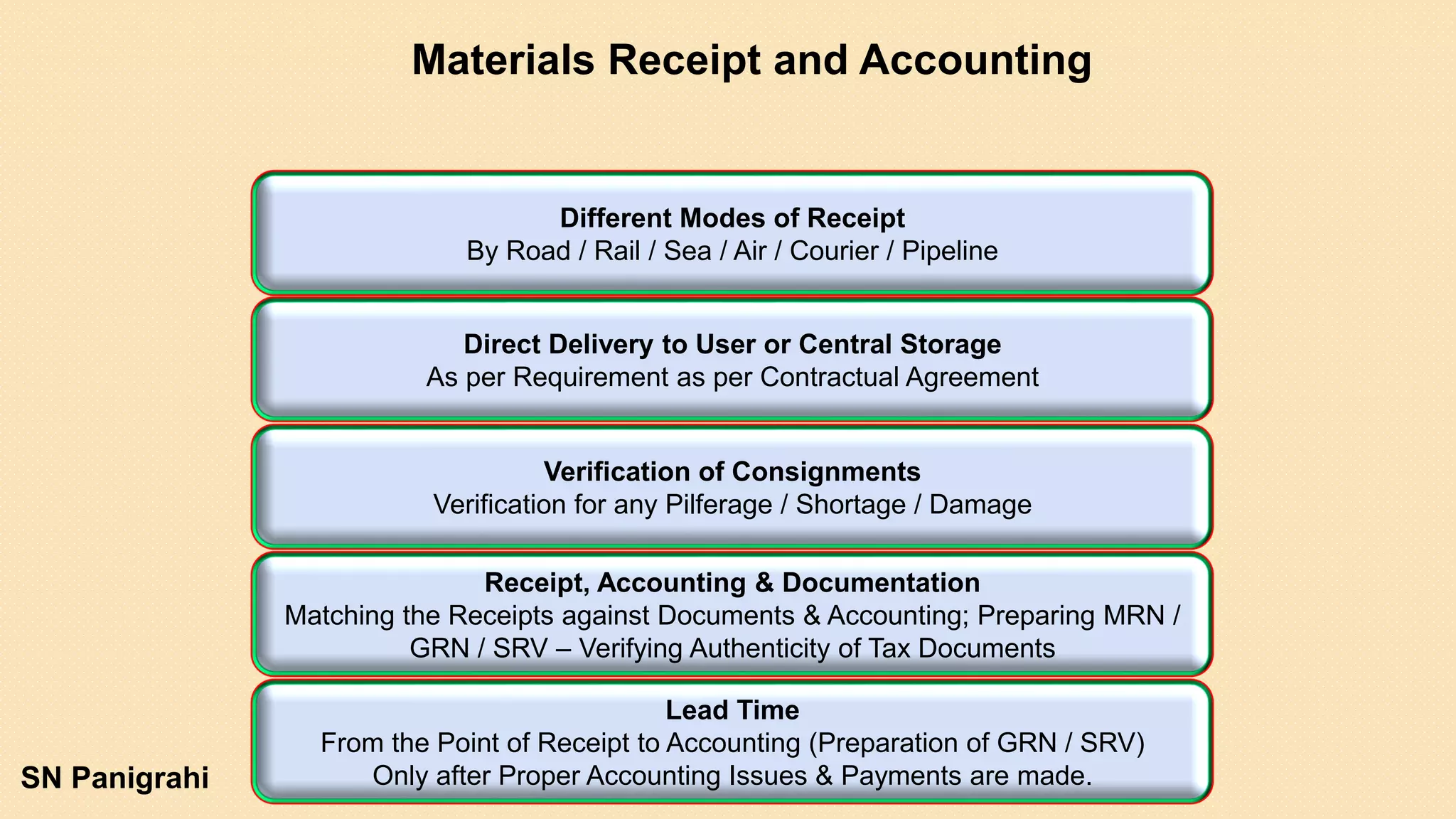
Materials Receipt and Accounting
Different Modes of Receipt
By Road / Rail / Sea / Air / Courier / Pipeline
Verification of Consignments
Verification for any Pilferage / Shortage / Damage
Receipt, Accounting & Documentation
Matching the Receipts against Documents & Accounting; Preparing MRN /
GRN / SRV – Verifying Authenticity of Tax Documents
Direct Delivery to User or Central Storage
As per Requirement as per Contractual Agreement
Lead Time
From the Point of Receipt to Accounting (Preparation of GRN / SRV)
Only after Proper Accounting Issues & Payments are made.SN Panigrahi
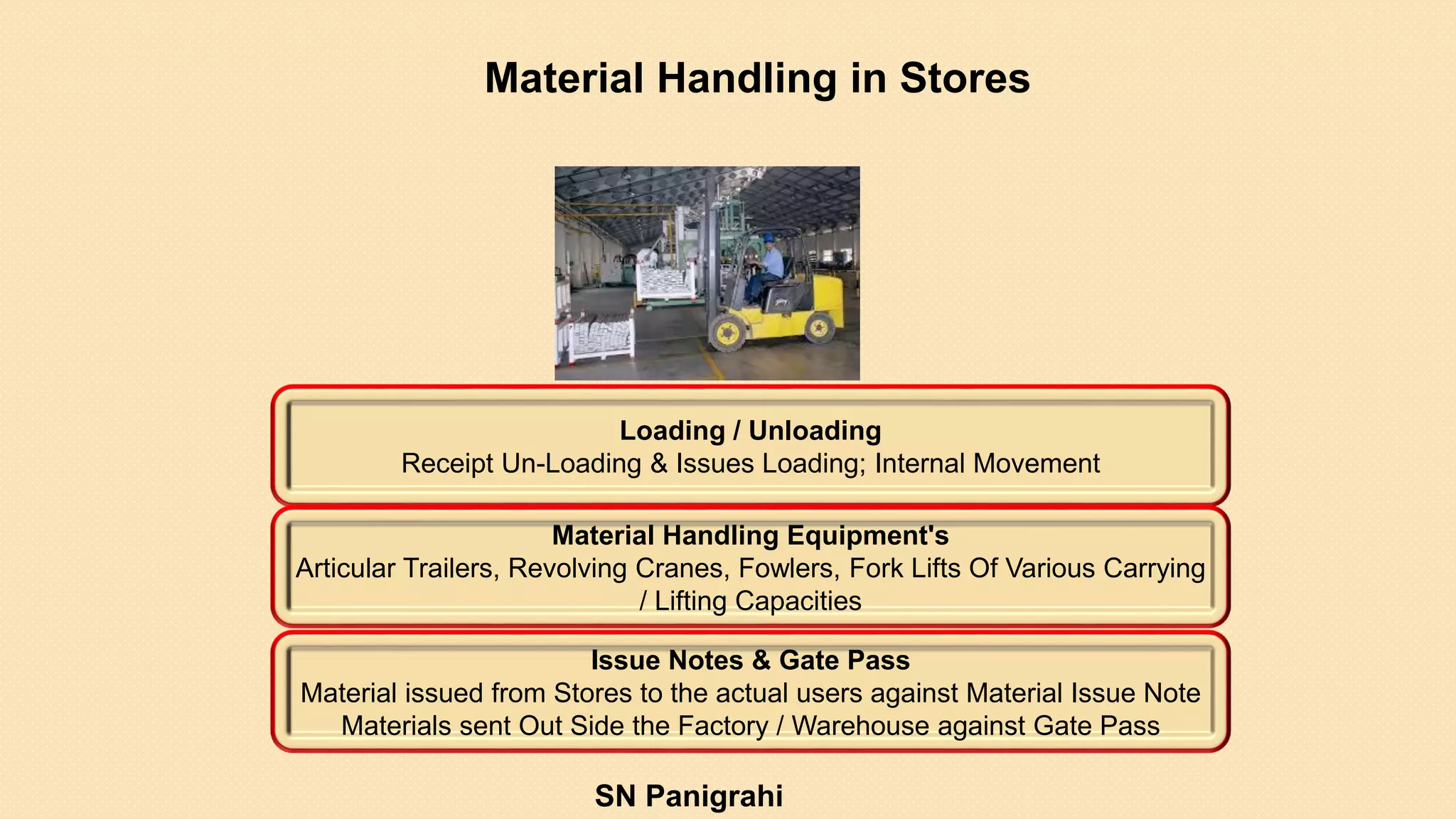
Material Handling in Stores
Loading / Unloading
Receipt Un-Loading & Issues Loading; Internal Movement
Material Handling Equipment's
Articular Trailers, Revolving Cranes, Fowlers, Fork Lifts Of Various Carrying
/ Lifting Capacities
Issue Notes & Gate Pass
Material issued from Stores to the actual users against Material Issue Note
Materials sent Out Side the Factory / Warehouse against Gate Pass
SN Panigrahi
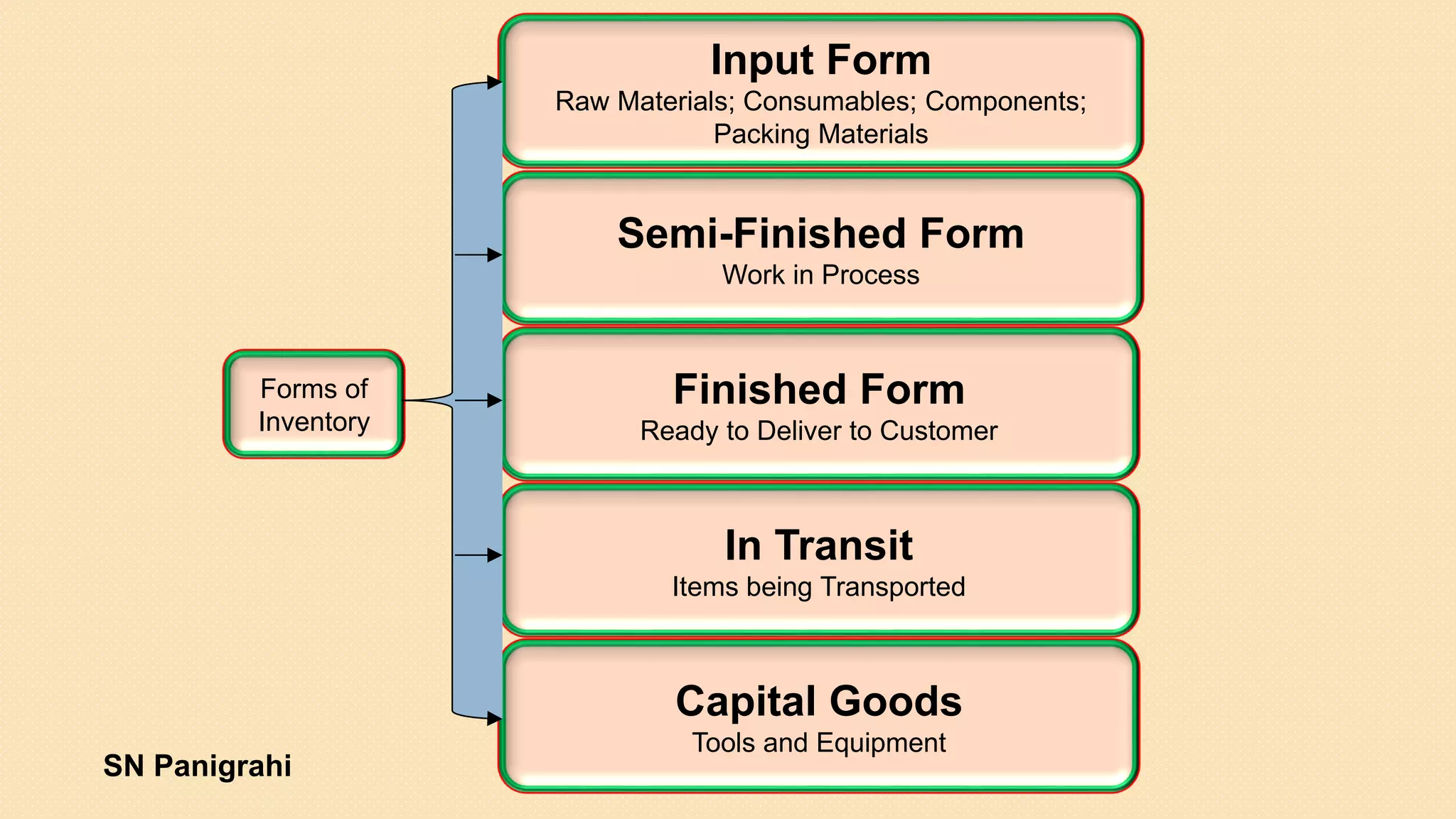
Forms of
Inventory
Input Form
Raw Materials; Consumables; Components;
Packing Materials
Semi-Finished Form
Work in Process
Finished Form
Ready to Deliver to Customer
In Transit
Items being Transported
Capital Goods
Tools and Equipment
SN Panigrahi
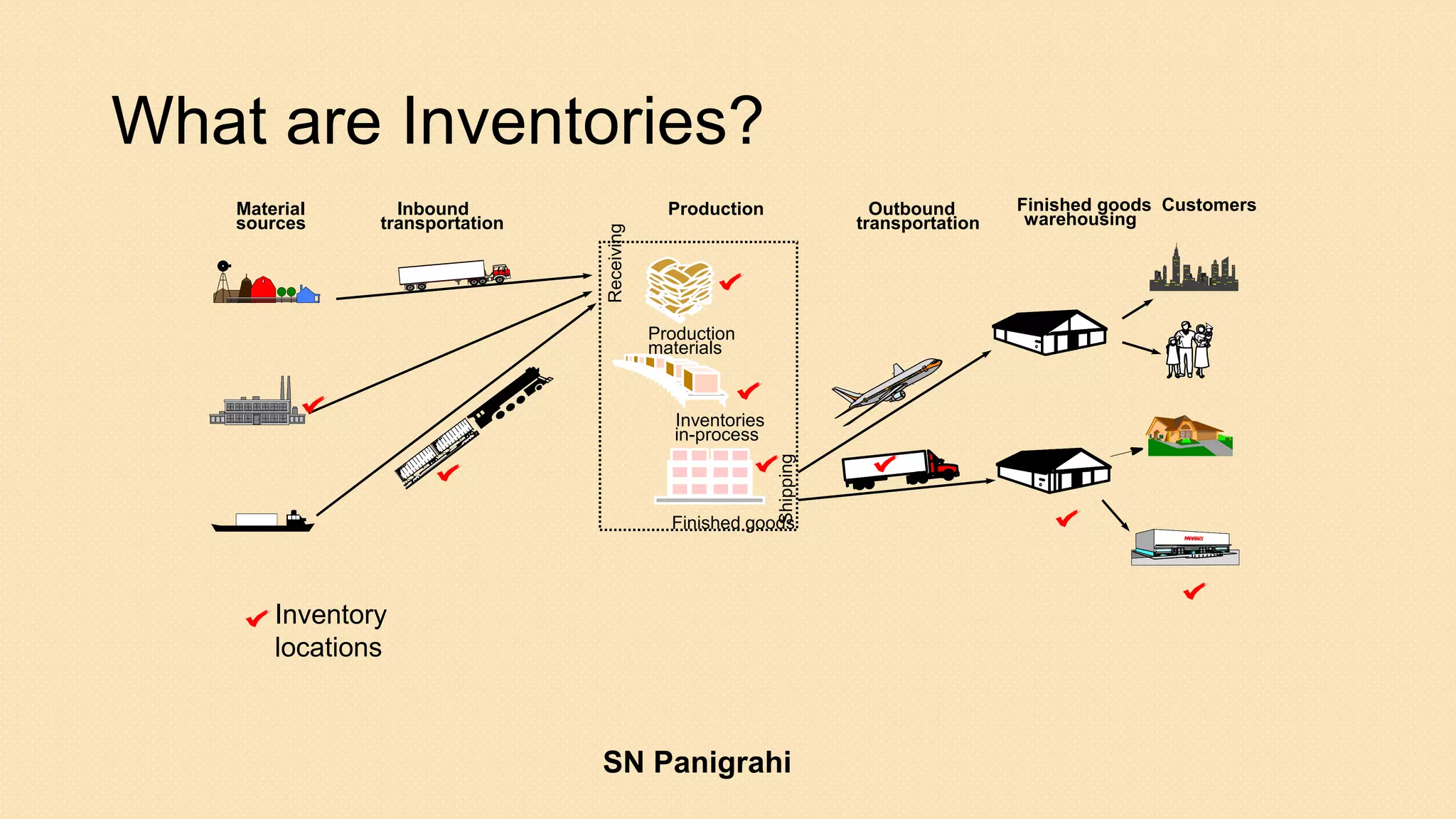
What are Inventories?
Material
sources
Inbound
transportation
Production Outbound
transportation
Finished goods
warehousing
Customers
Inventory
locations
Finished goods
Shipping
Inventories
in-process
Receiving
Production
materials
SN Panigrahi
31
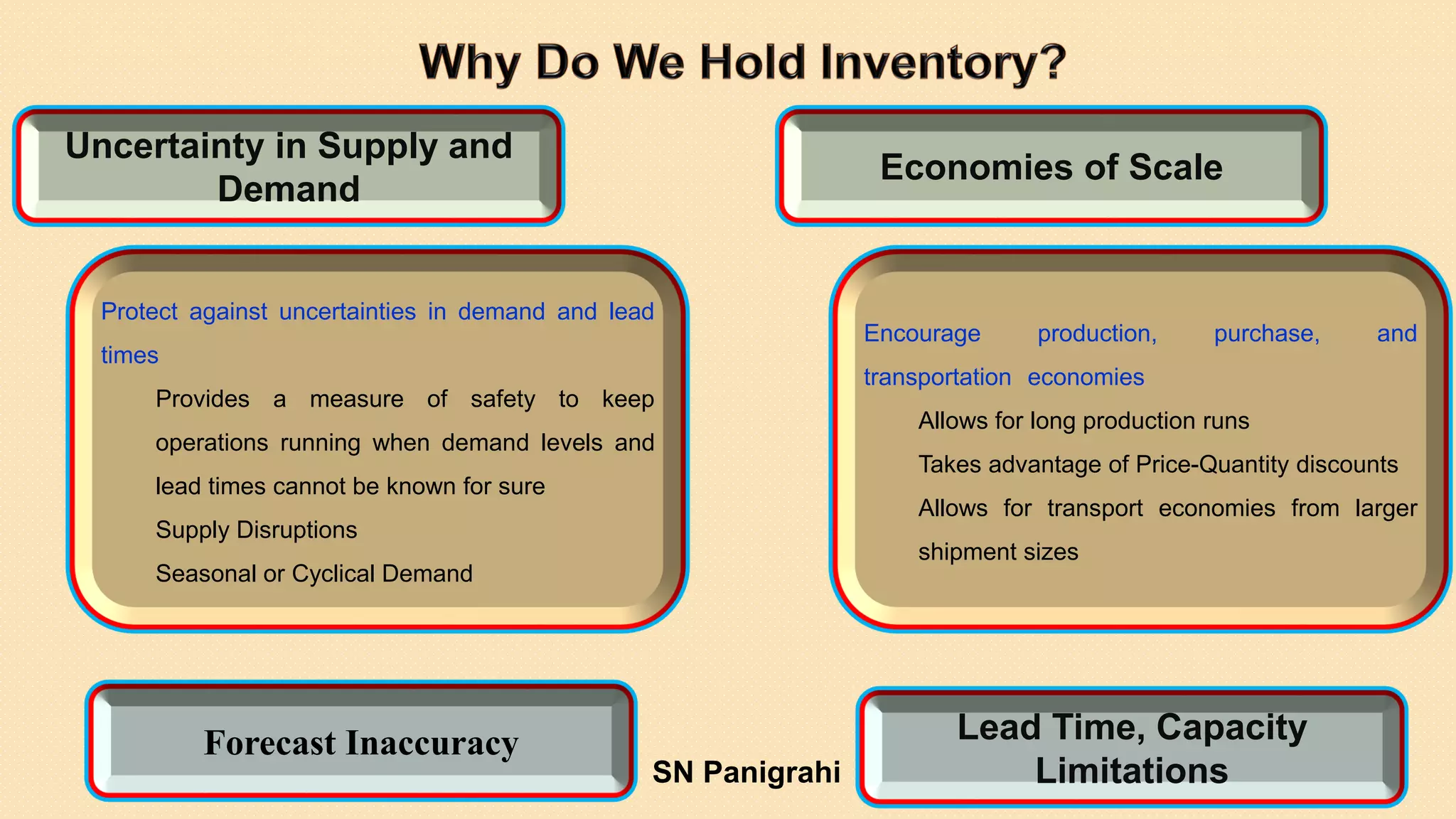
Uncertainty in Supply and
Demand
Protect against uncertainties in demand and lead
times
Provides a measure of safety to keep
operations running when demand levels and
lead times cannot be known for sure
Supply Disruptions
Seasonal or Cyclical Demand
Forecast Inaccuracy Lead Time, Capacity
Limitations
Economies of Scale
Encourage production, purchase, and
transportation economies
Allows for long production runs
Takes advantage of Price-Quantity discounts
Allows for transport economies from larger
shipment sizes
SN Panigrahi
32
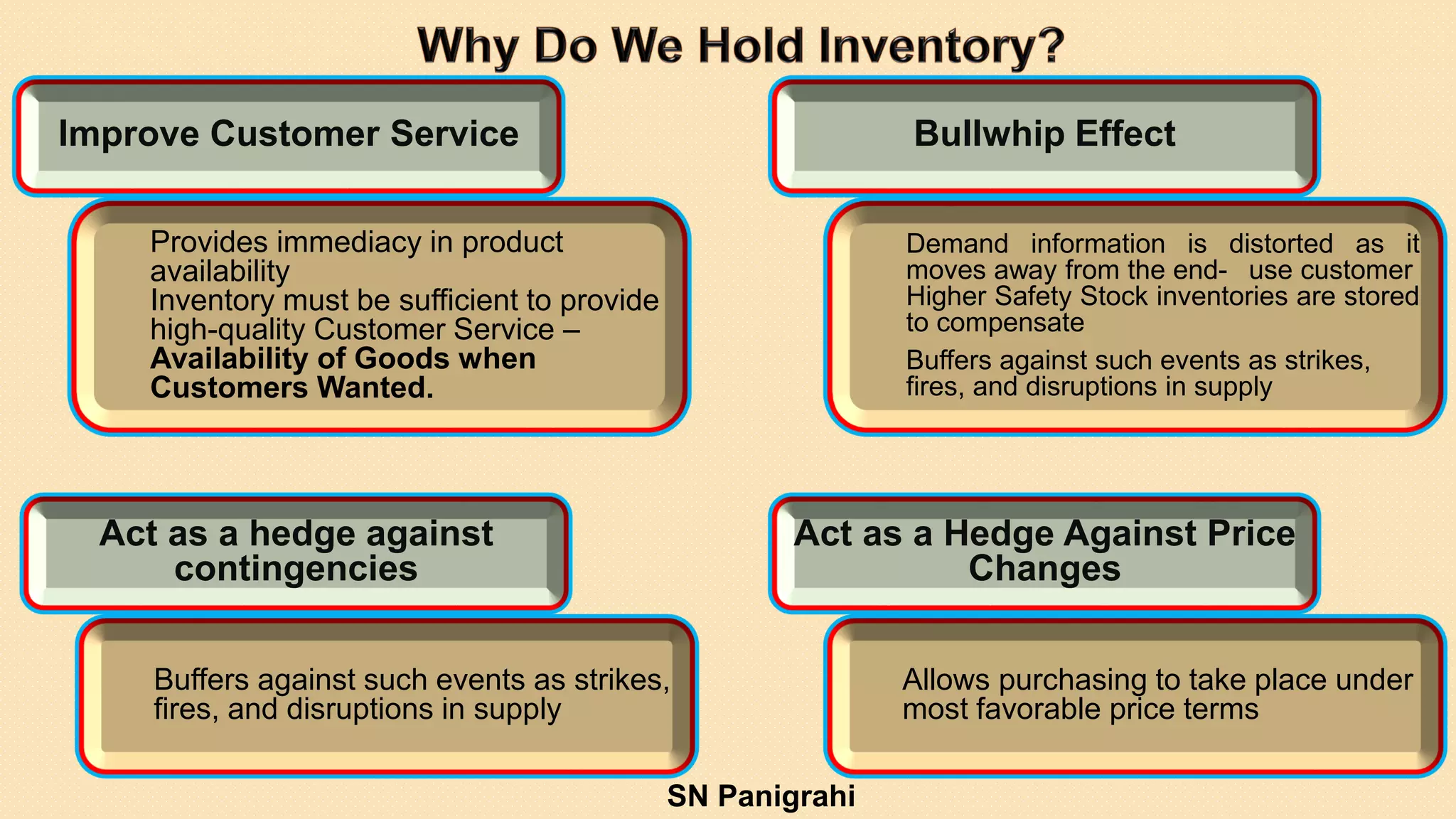
Improve Customer Service
Provides immediacy in product
availability
Inventory must be sufficient to provide
high-quality Customer Service –
Availability of Goods when
Customers Wanted.
Act as a Hedge Against Price
Changes
Allows purchasing to take place under
most favorable price terms
Act as a hedge against
contingencies
Buffers against such events as strikes,
fires, and disruptions in supply
Bullwhip Effect
Demand information is distorted as it
moves away from the end- use customer
Higher Safety Stock inventories are stored
to compensate
Buffers against such events as strikes,
fires, and disruptions in supply
SN Panigrahi
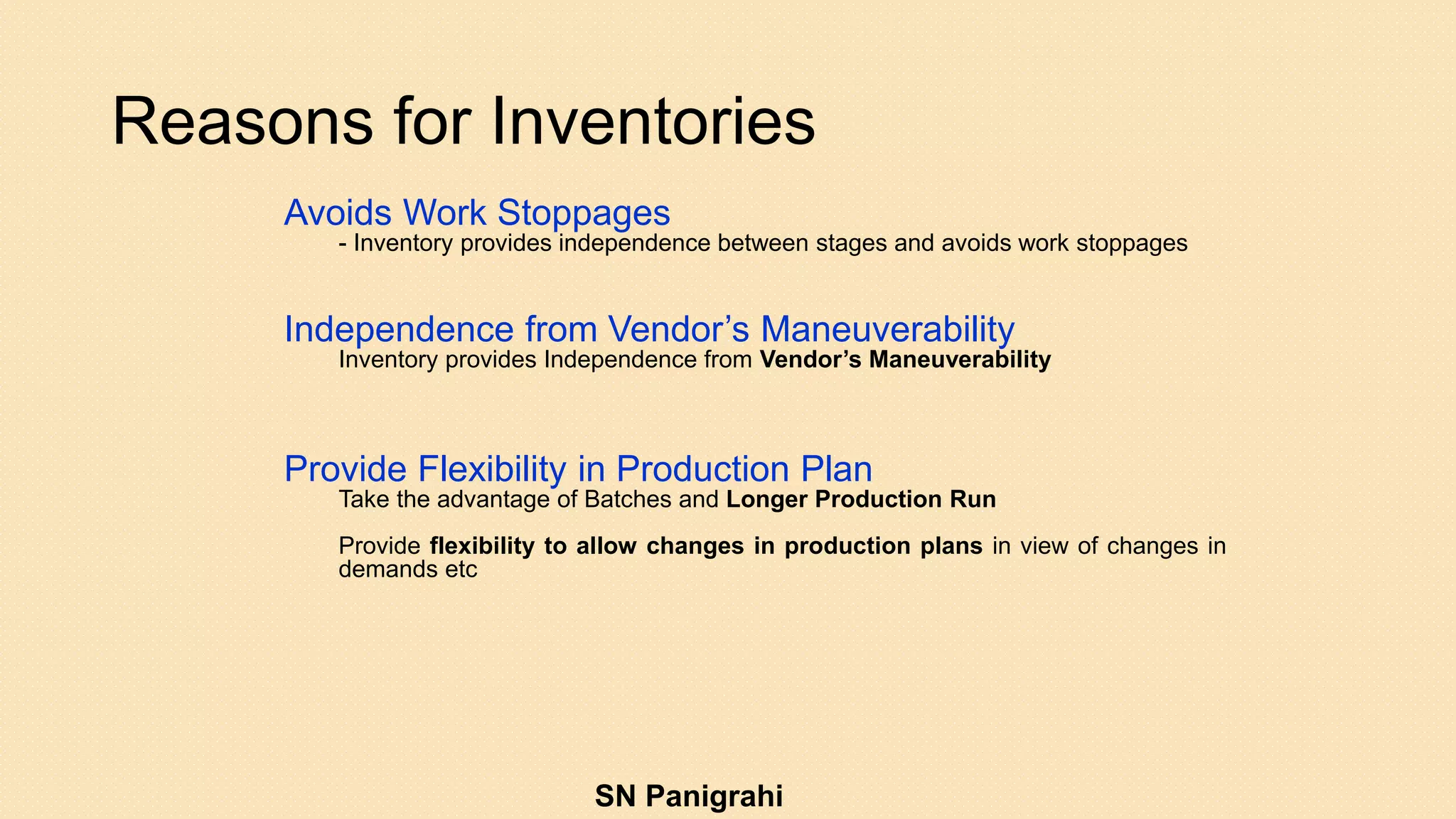
Reasons for Inventories
Avoids Work Stoppages
- Inventory provides independence between stages and avoids work stoppages
Independence from Vendor’s Maneuverability
Inventory provides Independence from Vendor’s Maneuverability
Provide Flexibility in Production Plan
Take the advantage of Batches and Longer Production Run
Provide flexibility to allow changes in production plans in view of changes in
demands etc
SN Panigrahi
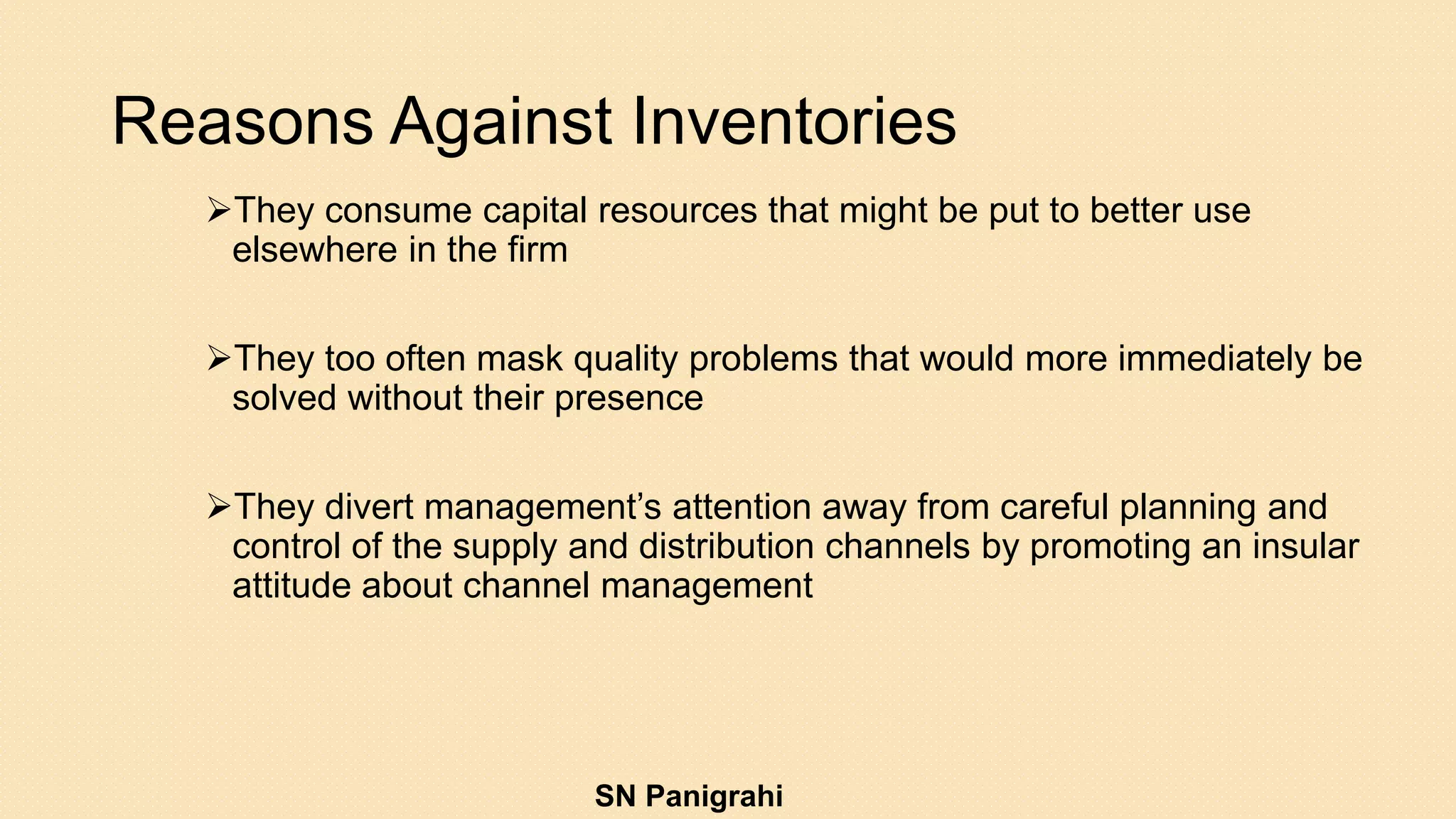
Reasons Against Inventories
They consume capital resources that might be put to better use
elsewhere in the firm
They too often mask quality problems that would more immediately be
solved without their presence
They divert management’s attention away from careful planning and
control of the supply and distribution channels by promoting an insular
attitude about channel management
SN Panigrahi
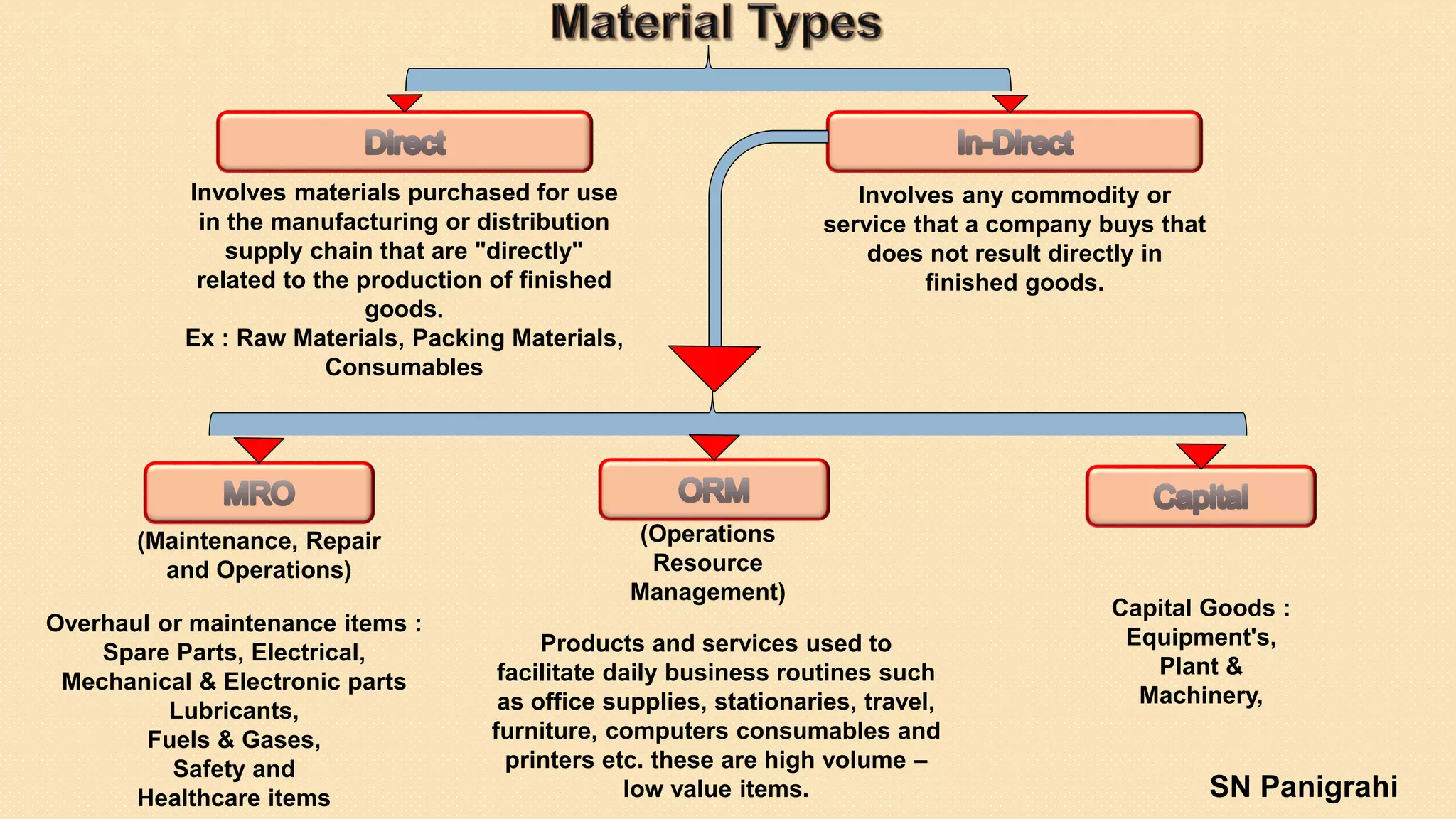
Involves materials purchased for use
in the manufacturing or distribution
supply chain that are "directly"
related to the production of finished
goods.
Ex : Raw Materials, Packing Materials,
Consumables
Involves any commodity or
service that a company buys that
does not result directly in
finished goods.
(Operations
Resource
Management)
(Maintenance, Repair
and Operations)
Products and services used to
facilitate daily business routines such
as office supplies, stationaries, travel,
furniture, computers consumables and
printers etc. these are high volume –
low value items.
Overhaul or maintenance items :
Spare Parts, Electrical,
Mechanical & Electronic parts
Lubricants,
Fuels & Gases,
Safety and
Healthcare items
Capital Goods :
Equipment's,
Plant &
Machinery,
SN Panigrahi
36
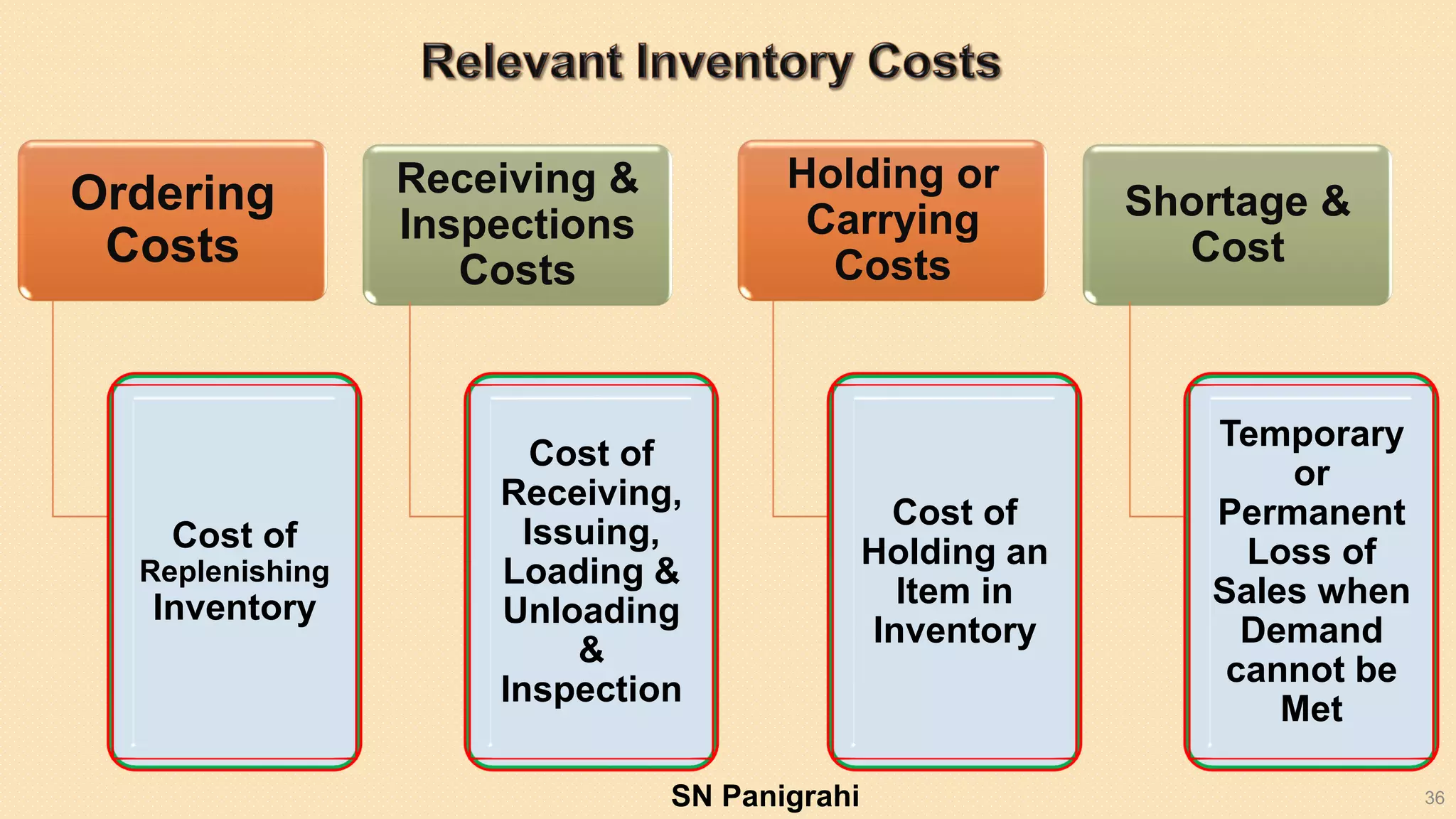
Ordering
Costs
Cost of
Replenishing
Inventory
Receiving &
Inspections
Costs
Cost of
Receiving,
Issuing,
Loading &
Unloading
&
Inspection
Holding or
Carrying
Costs
Cost of
Holding an
Item in
Inventory
Shortage &
Cost
Temporary
or
Permanent
Loss of
Sales when
Demand
cannot be
Met
SN Panigrahi
SN Panigrahi
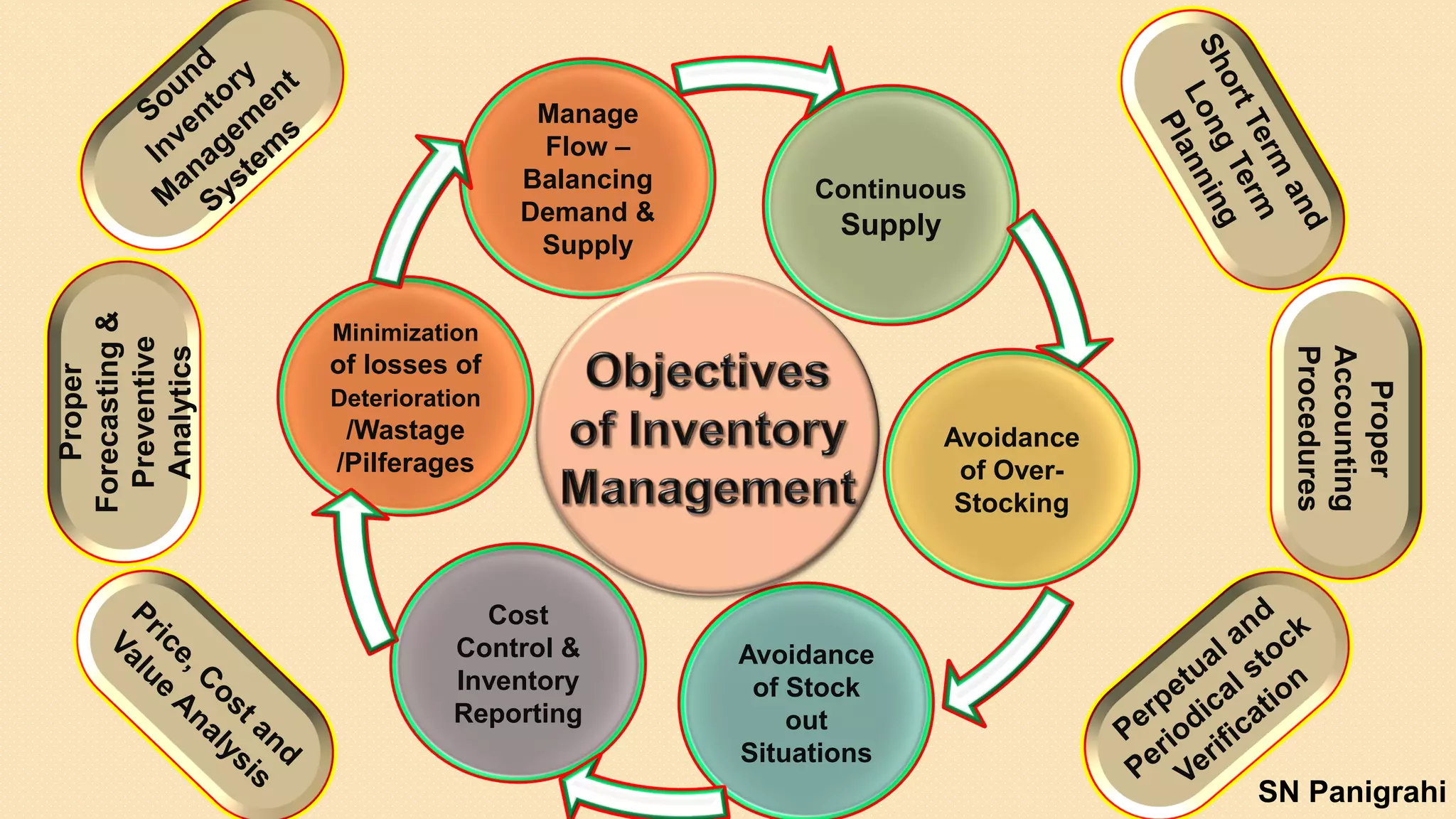
Manage
Flow –
Balancing
Demand &
Supply
Continuous
Supply
Avoidance
of Over-
Stocking
Avoidance
of Stock
out
Situations
Cost
Control &
Inventory
Reporting
Minimization
of losses of
Deterioration
/Wastage
/Pilferages
Proper
Forecasting&
Preventive
Analytics
Proper
Accounting
Procedures
SN Panigrahi
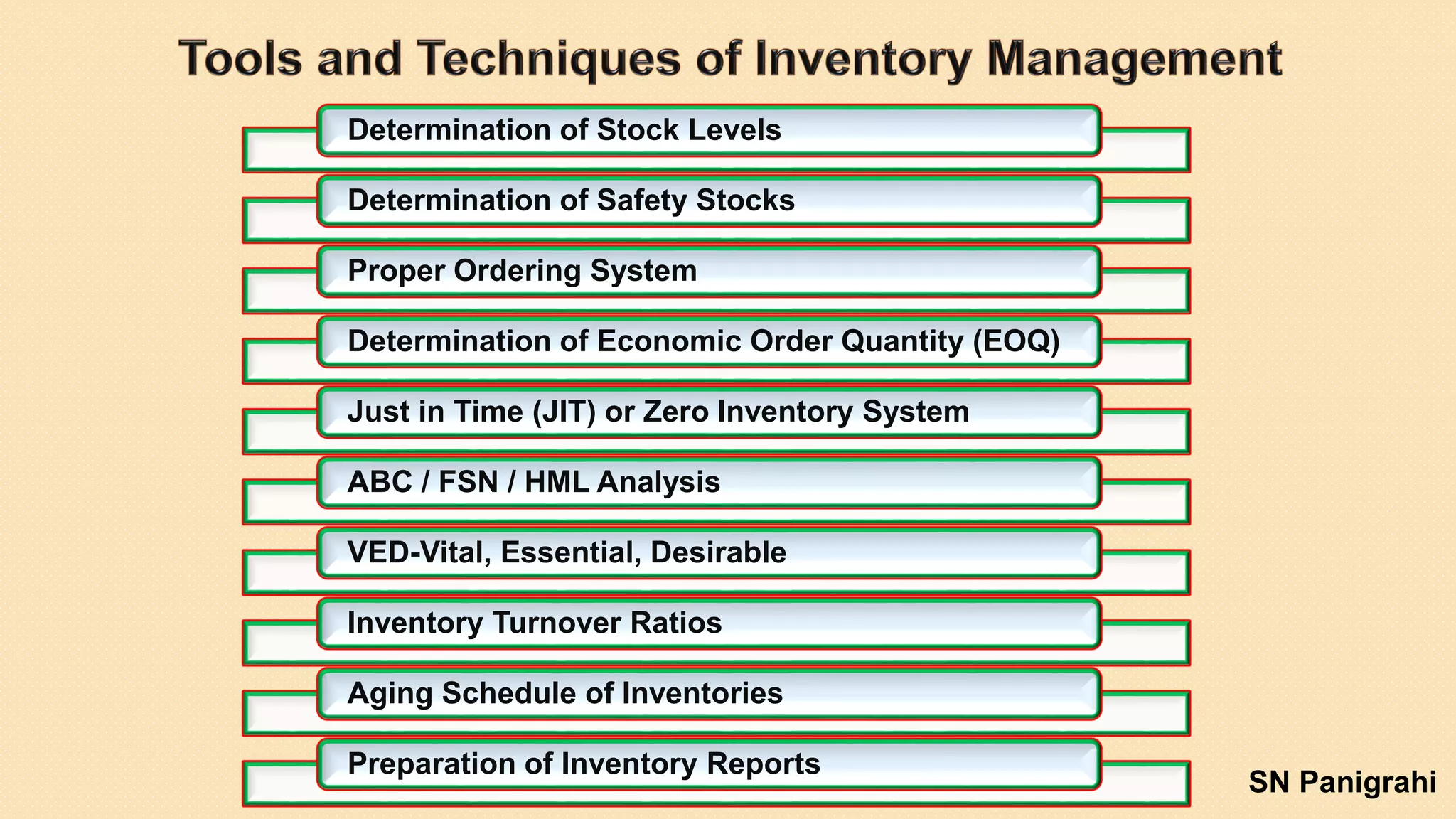
Determination of Stock Levels
Determination of Safety Stocks
Proper Ordering System
Determination of Economic Order Quantity (EOQ)
Just in Time (JIT) or Zero Inventory System
ABC / FSN / HML Analysis
VED-Vital, Essential, Desirable
Inventory Turnover Ratios
Aging Schedule of Inventories
Preparation of Inventory Reports
SN Panigrahi
40
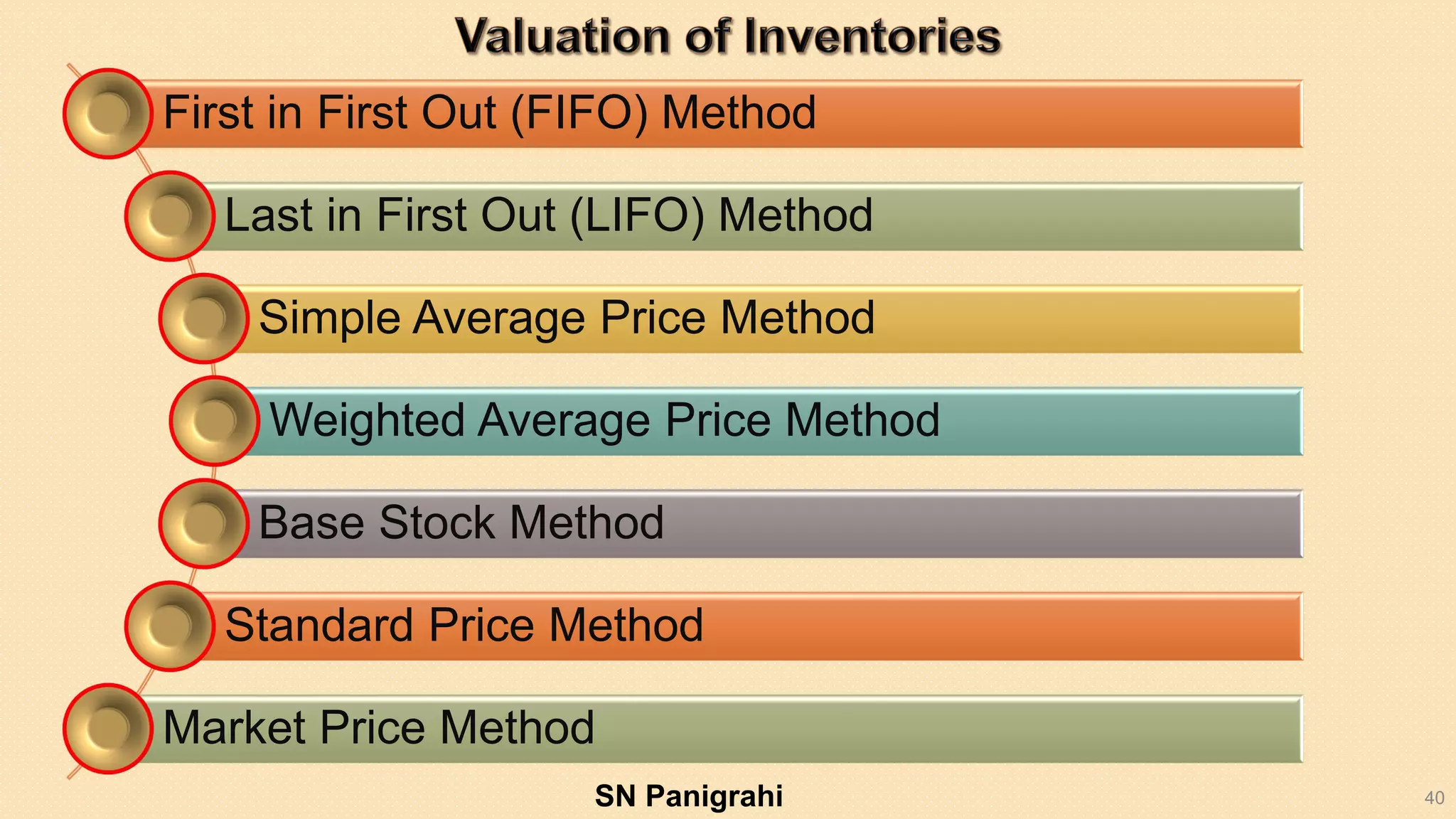
First in First Out (FIFO) Method
Last in First Out (LIFO) Method
Simple Average Price Method
Weighted Average Price Method
Base Stock Method
Standard Price Method
Market Price Method
SN Panigrahi
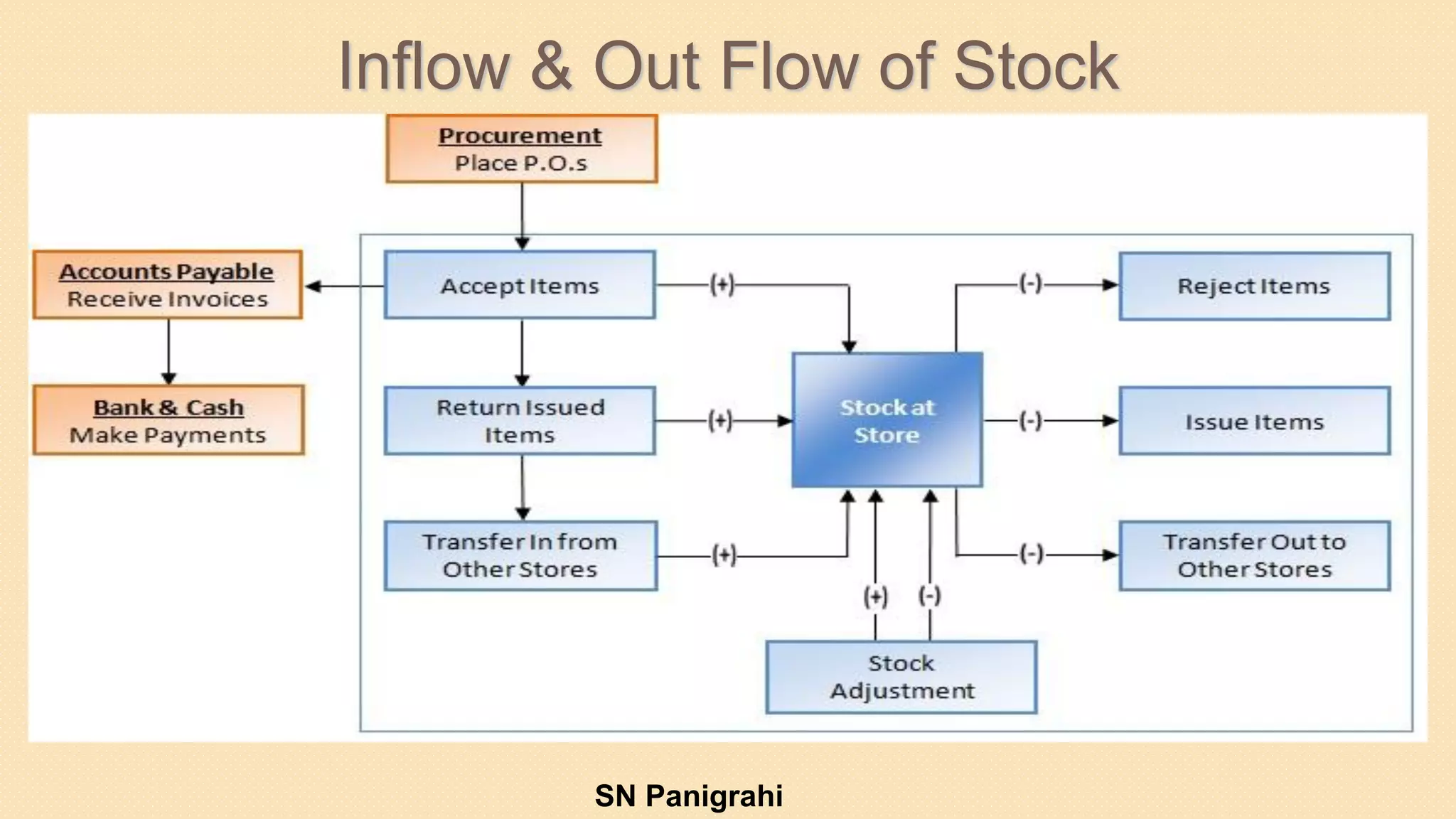
Inflow & Out Flow of Stock
SN Panigrahi
Vendor Managed Inventory
The supplier usually owns the inventory at the customer’s
location
The supplier manages the inventory by any means appropriate
and plans shipment sizes and delivery frequency
The buyer provides point of sale information to the supplier
The buyer pays for the merchandise at the time of sale
The buyer dictates the level of stock availability required
SN Panigrahi
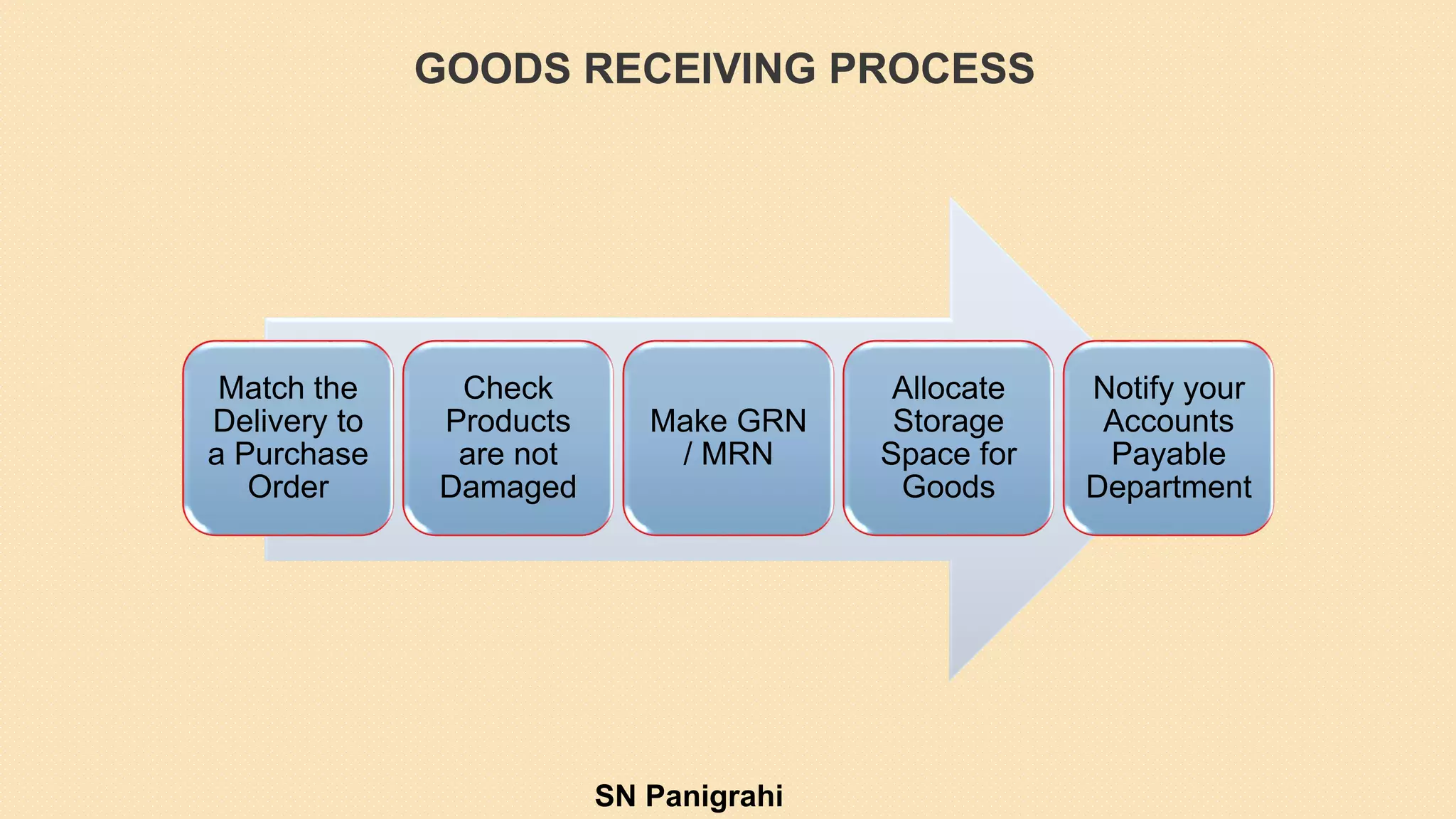
GOODS RECEIVING PROCESS
Match the
Delivery to
a Purchase
Order
Check
Products
are not
Damaged
Make GRN
/ MRN
Allocate
Storage
Space for
Goods
Notify your
Accounts
Payable
Department
SN Panigrahi
Inventory Performance Measurement
SN Panigrahi
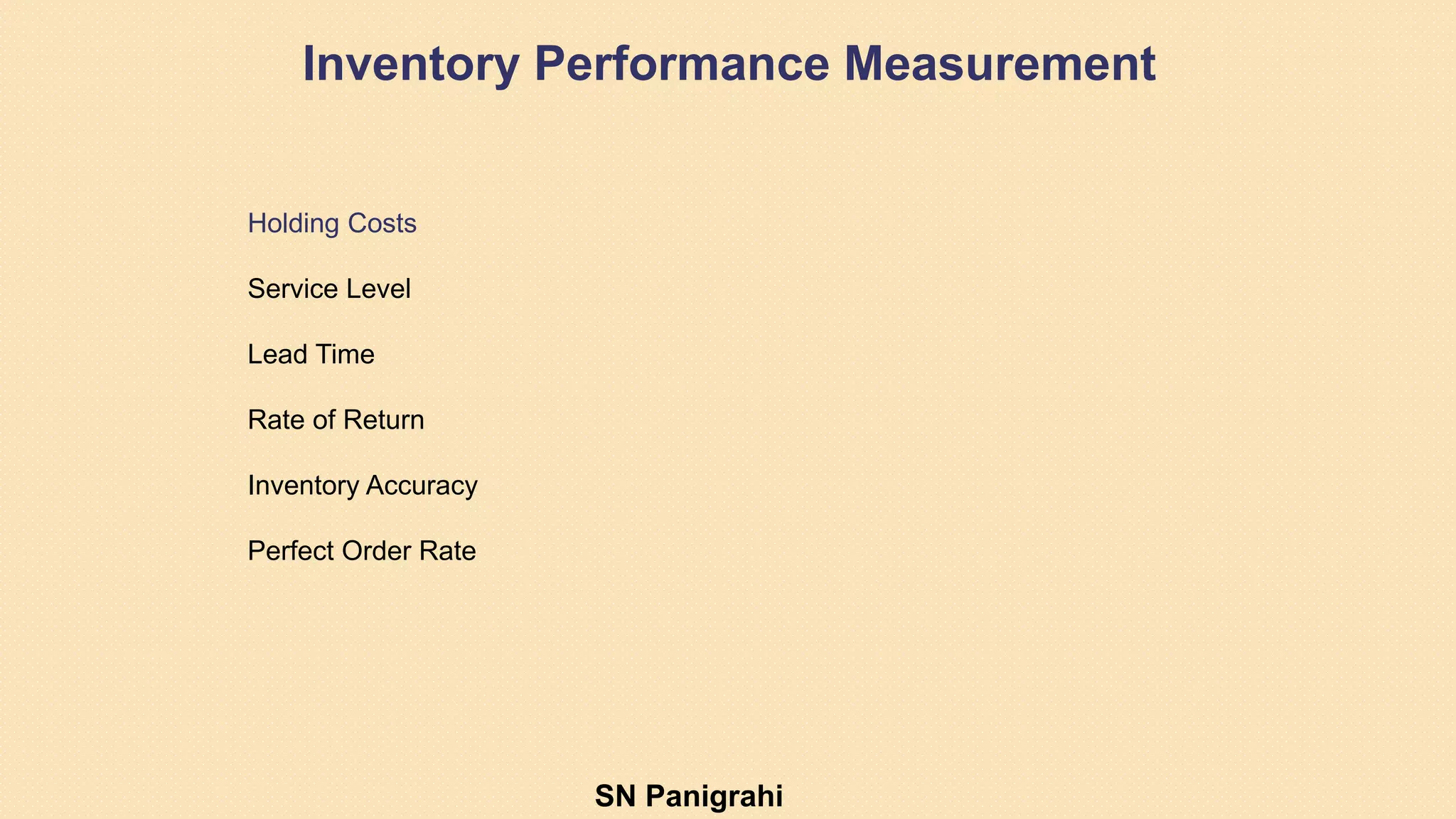
Inventory Performance Measurement
Holding Costs
Service Level
Lead Time
Rate of Return
Inventory Accuracy
Perfect Order Rate
SN Panigrahi
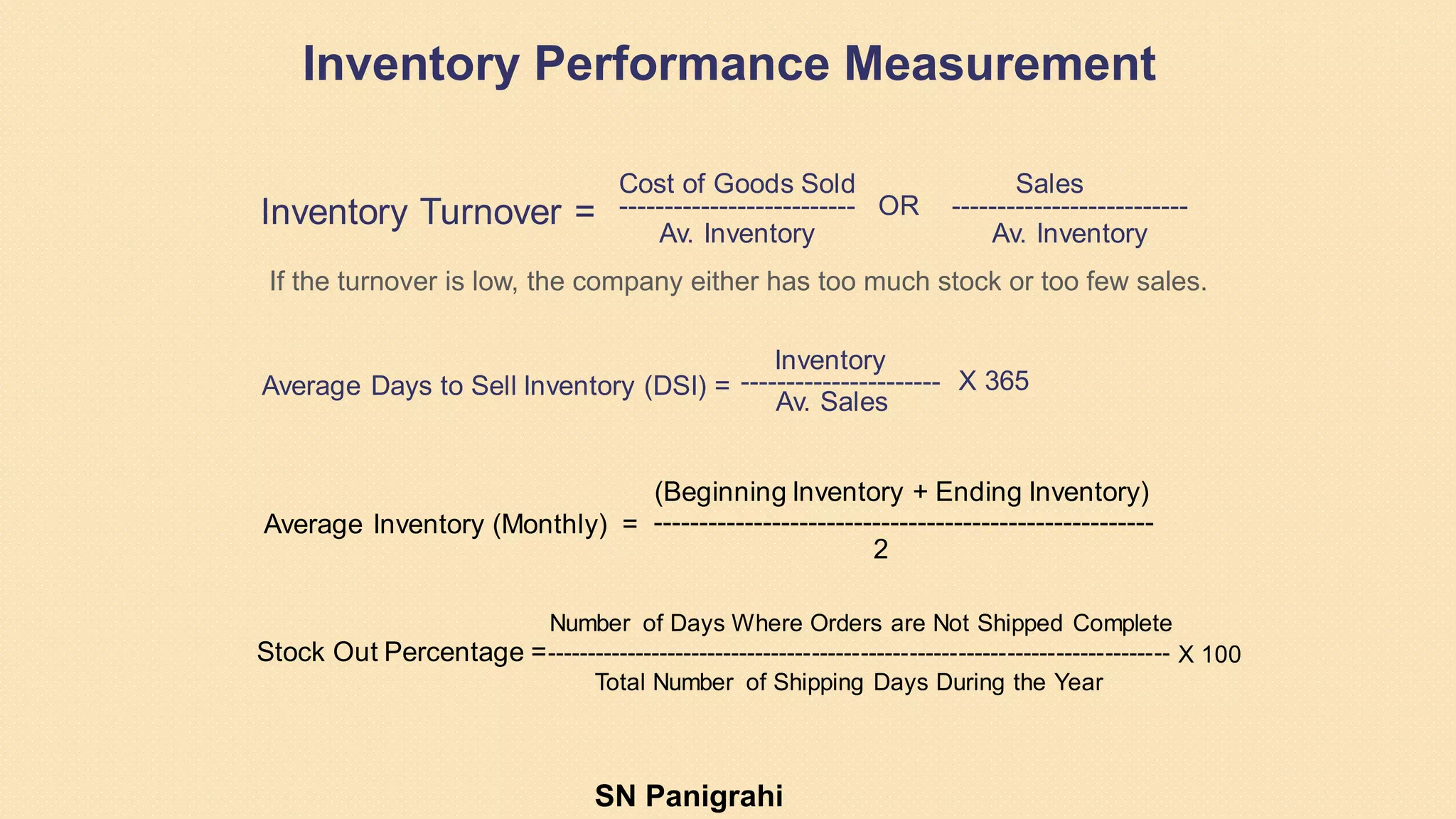
Inventory Performance Measurement
If the turnover is low, the company either has too much stock or too few sales.
SN Panigrahi
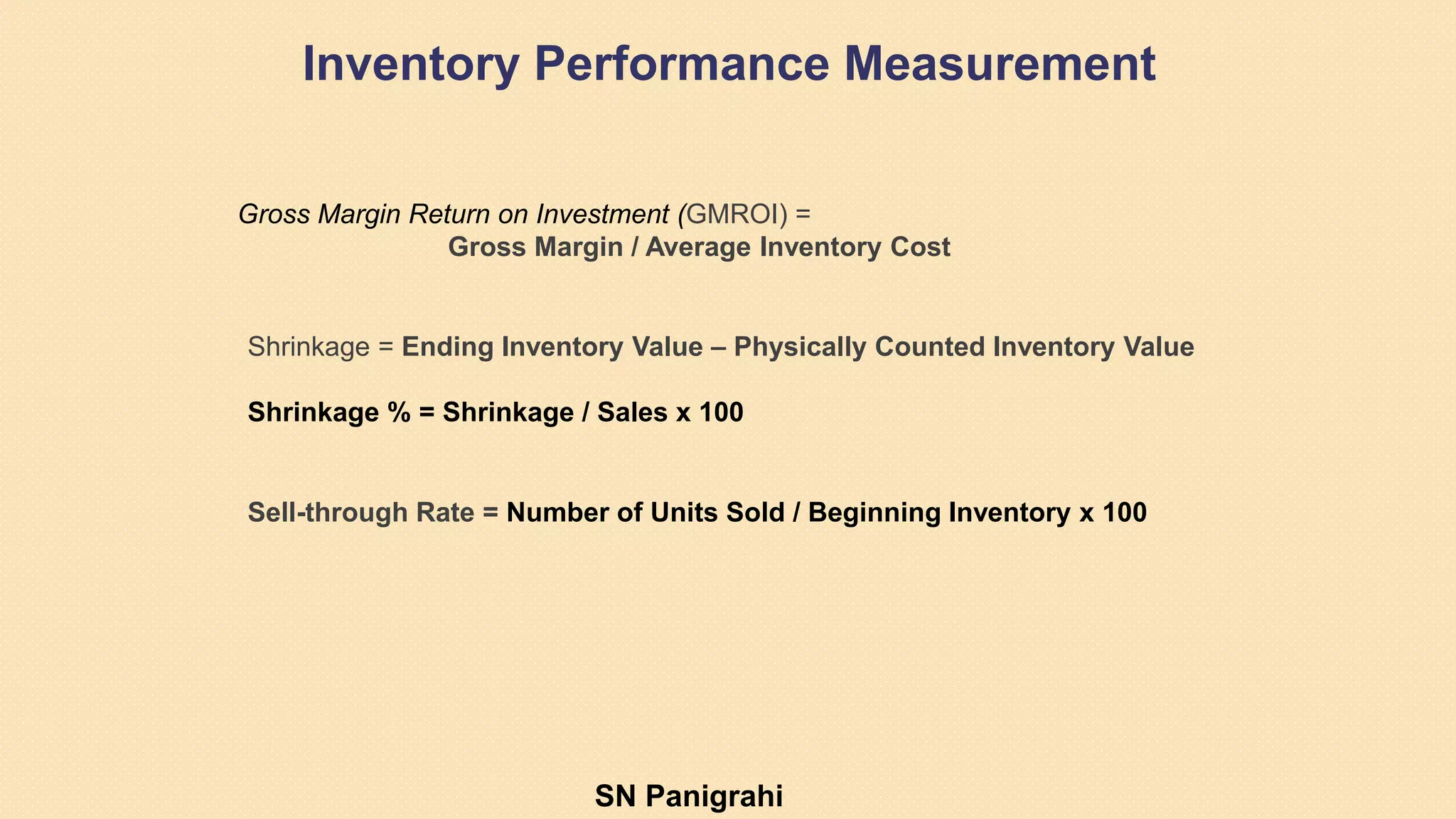
Gross Margin Return on Investment (GMROI) =
Gross Margin / Average Inventory Cost
Inventory Performance Measurement
Shrinkage = Ending Inventory Value – Physically Counted Inventory Value
Shrinkage % = Shrinkage / Sales x 100
Sell-through Rate = Number of Units Sold / Beginning Inventory x 100
SN Panigrahi
48
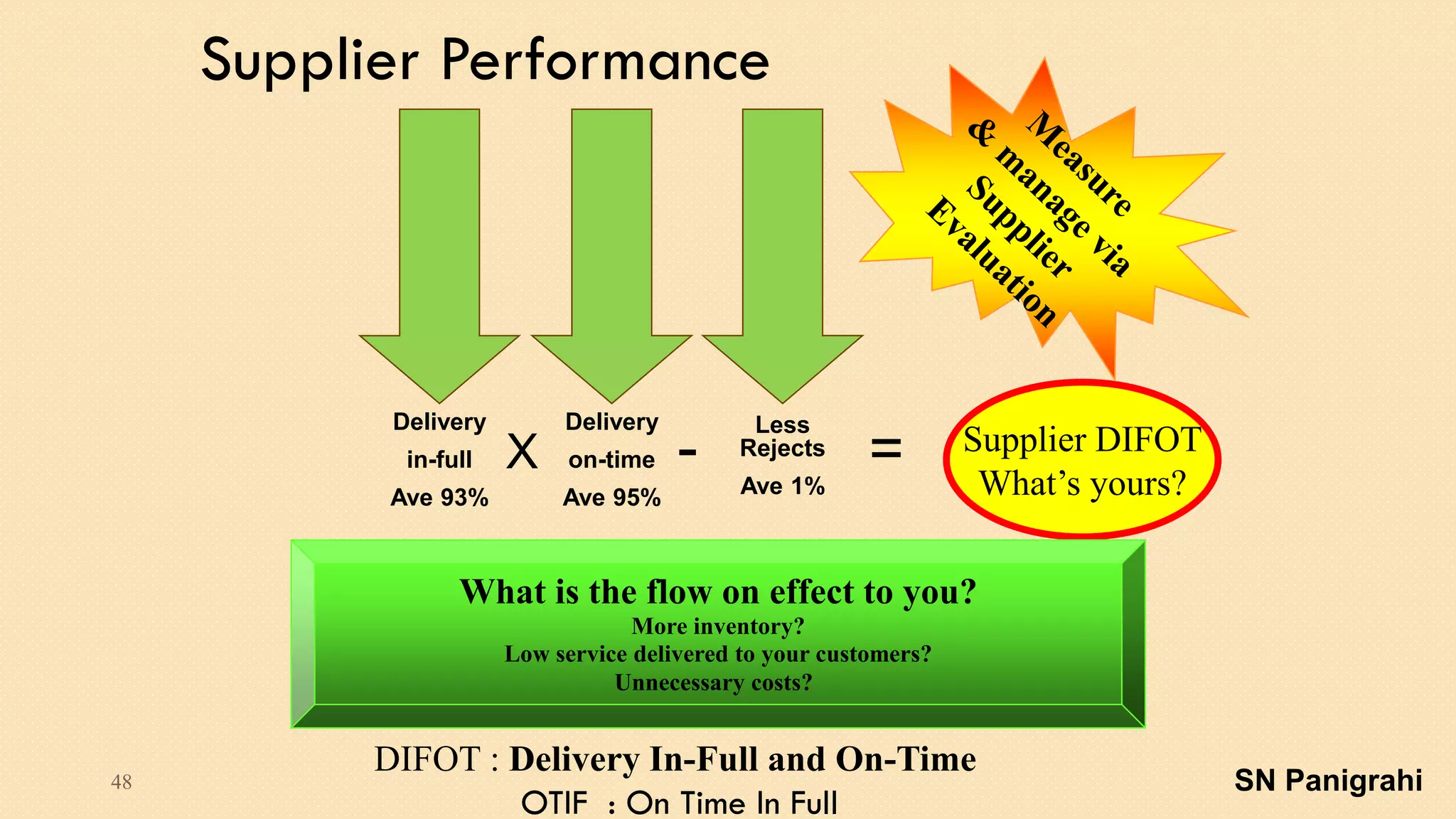
Supplier Performance
Delivery
in-full
Ave 93%
Delivery
on-time
Ave 95%
X -
Less
Rejects
Ave 1%
= Supplier DIFOT
What’s yours?
What is the flow on effect to you?
More inventory?
Low service delivered to your customers?
Unnecessary costs?
DIFOT : Delivery In-Full and On-Time
OTIF : On Time In Full
SN Panigrahi
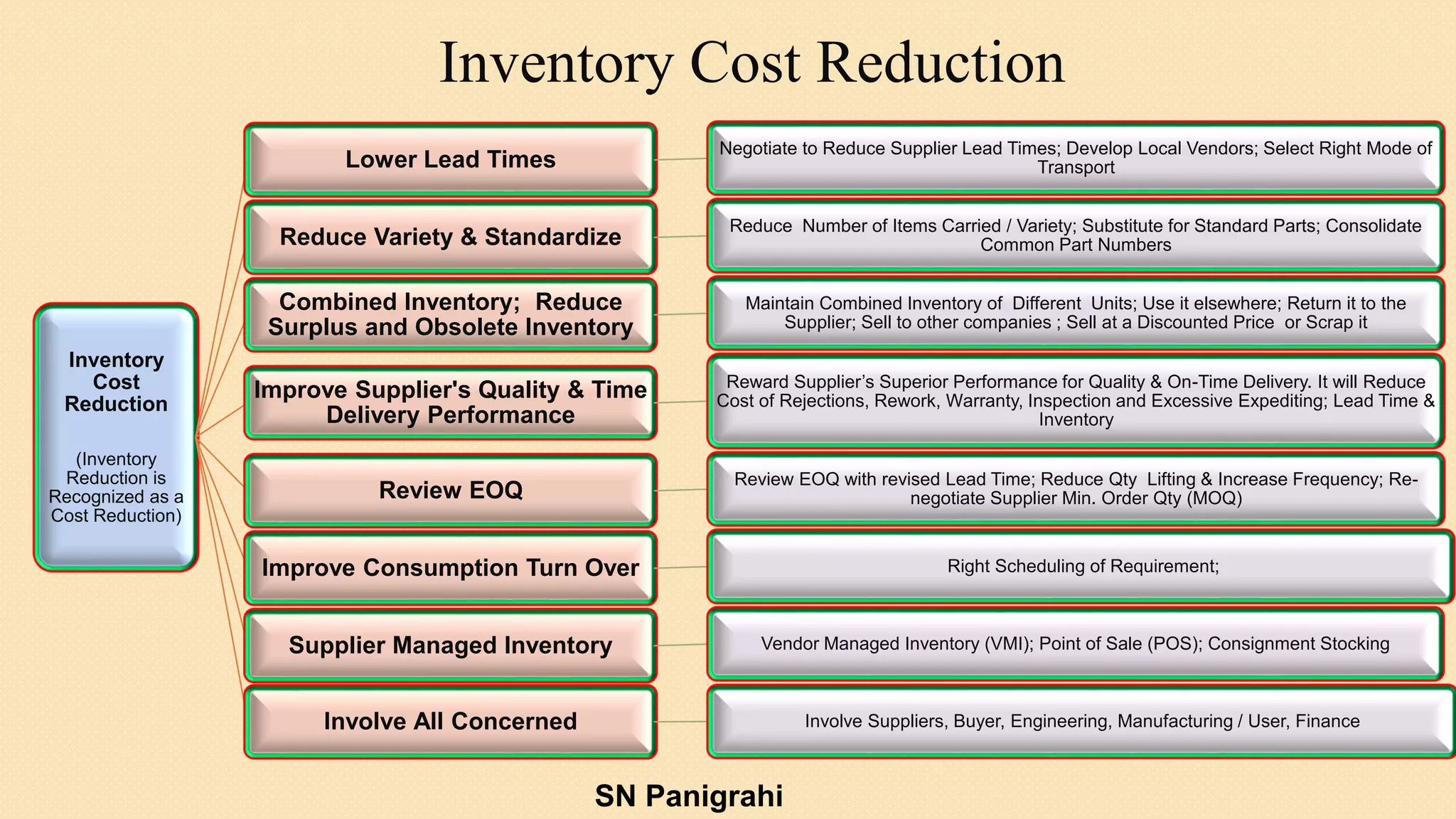
Inventory
Cost
Reduction
(Inventory
Reduction is
Recognized as a
Cost Reduction)
Lower Lead Times
Negotiate to Reduce Supplier Lead Times; Develop Local Vendors; Select Right Mode of
Transport
Reduce Variety & Standardize
Reduce Number of Items Carried / Variety; Substitute for Standard Parts; Consolidate
Common Part Numbers
Combined Inventory; Reduce
Surplus and Obsolete Inventory
Maintain Combined Inventory of Different Units; Use it elsewhere; Return it to the
Supplier; Sell to other companies ; Sell at a Discounted Price or Scrap it
Improve Supplier's Quality & Time
Delivery Performance
Reward Supplier’s Superior Performance for Quality & On-Time Delivery. It will Reduce
Cost of Rejections, Rework, Warranty, Inspection and Excessive Expediting; Lead Time &
Inventory
Review EOQ
Review EOQ with revised Lead Time; Reduce Qty Lifting & Increase Frequency; Re-
negotiate Supplier Min. Order Qty (MOQ)
Improve Consumption Turn Over Right Scheduling of Requirement;
Supplier Managed Inventory Vendor Managed Inventory (VMI); Point of Sale (POS); Consignment Stocking
Involve All Concerned Involve Suppliers, Buyer, Engineering, Manufacturing / User, Finance
Inventory Cost Reduction
SN Panigrahi
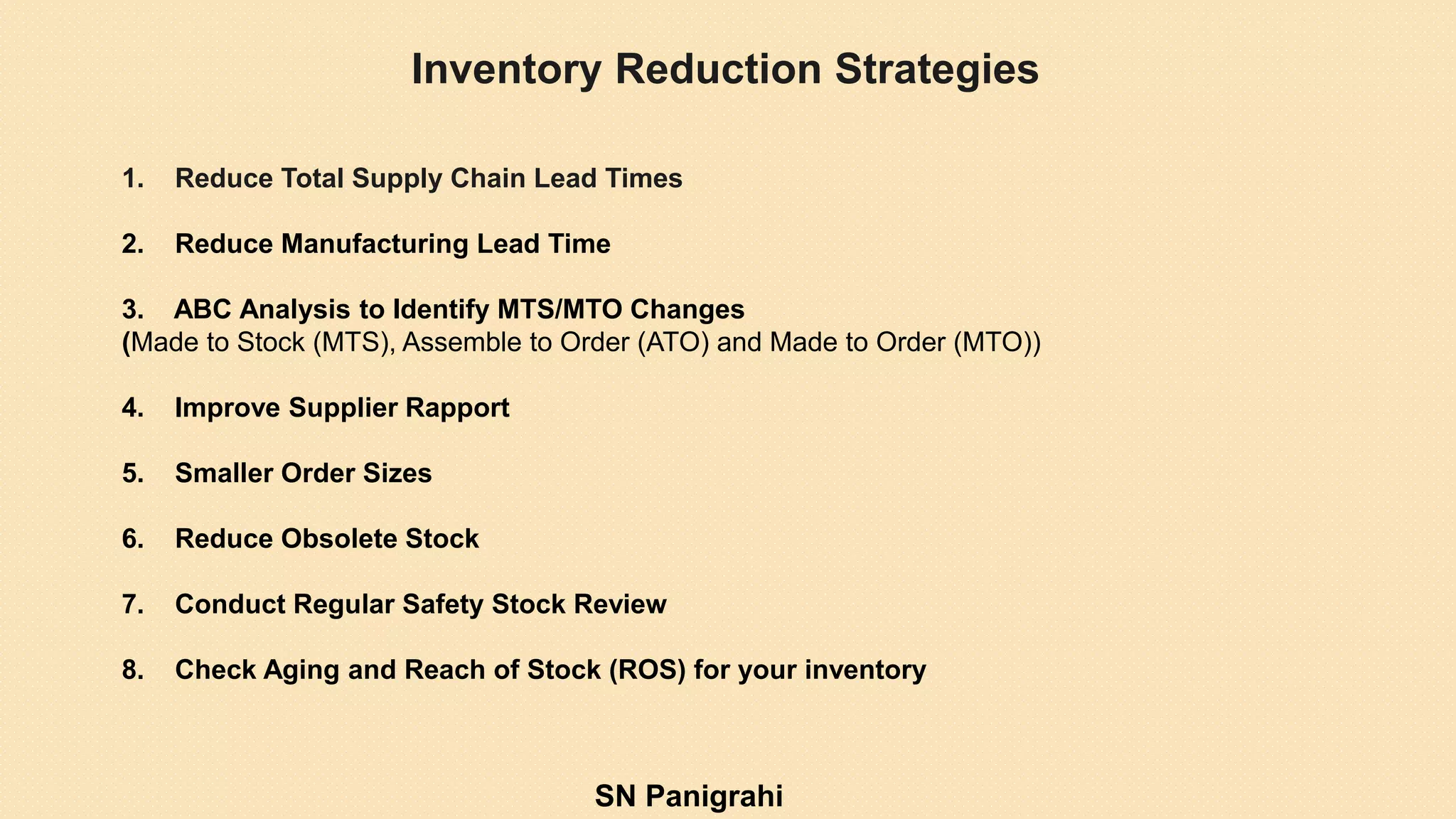
Inventory Reduction Strategies
1. Reduce Total Supply Chain Lead Times
2. Reduce Manufacturing Lead Time
3. ABC Analysis to Identify MTS/MTO Changes
(Made to Stock (MTS), Assemble to Order (ATO) and Made to Order (MTO))
4. Improve Supplier Rapport
5. Smaller Order Sizes
6. Reduce Obsolete Stock
7. Conduct Regular Safety Stock Review
8. Check Aging and Reach of Stock (ROS) for your inventory
SN Panigrahi
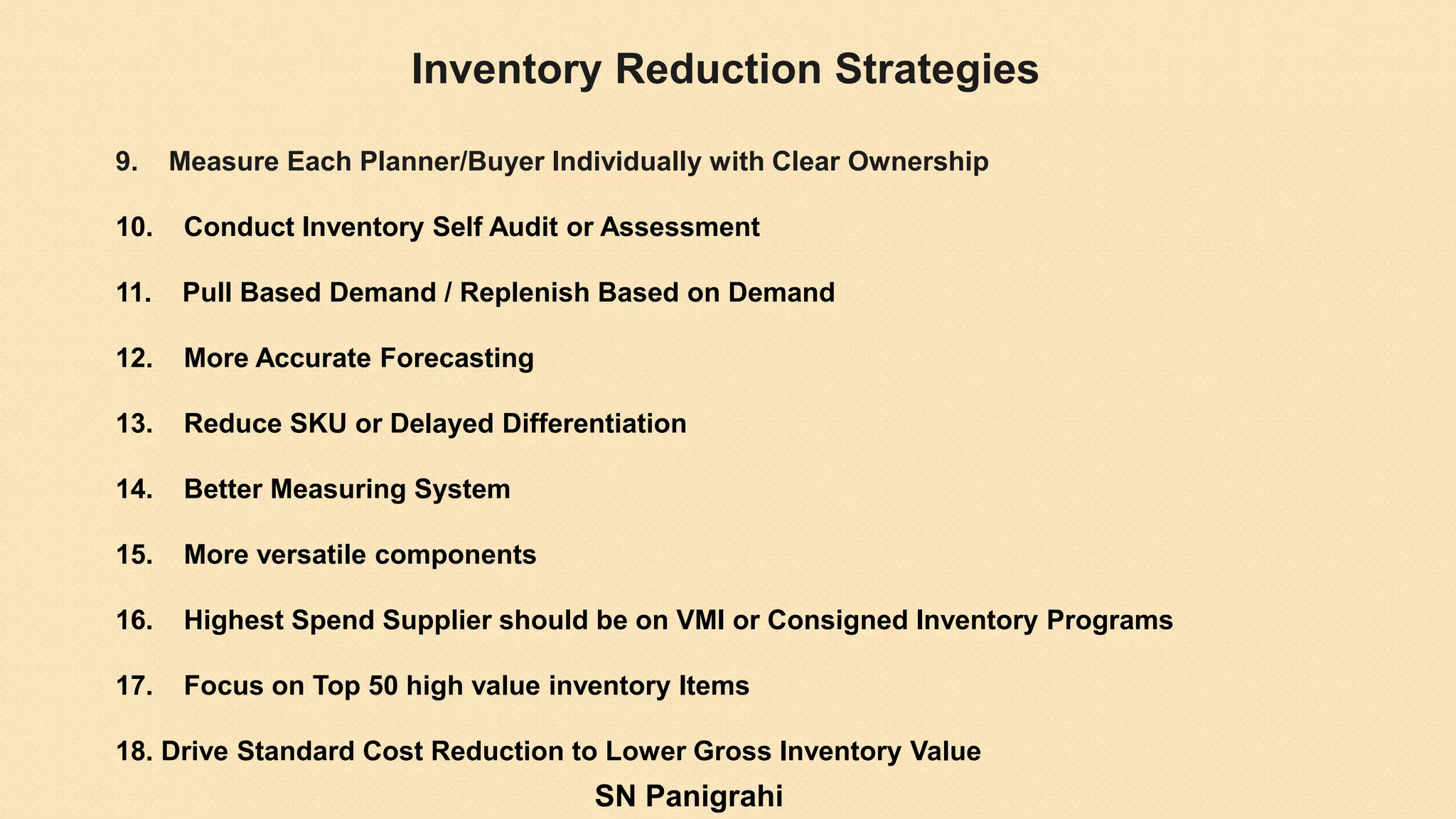
9. Measure Each Planner/Buyer Individually with Clear Ownership
10. Conduct Inventory Self Audit or Assessment
11. Pull Based Demand / Replenish Based on Demand
12. More Accurate Forecasting
13. Reduce SKU or Delayed Differentiation
14. Better Measuring System
15. More versatile components
16. Highest Spend Supplier should be on VMI or Consigned Inventory Programs
17. Focus on Top 50 high value inventory Items
18. Drive Standard Cost Reduction to Lower Gross Inventory Value
Inventory Reduction Strategies
SN Panigrahi
52
https://www.youtube.com/channel/UCVZ
ScNa_leR8XbYINEwTFwQ/videos
SN Panigrahi
53
Contact Details:
SN Panigrahi
9652571117
snpanigrahi1963@gmail.com 54

#Demand Forecasting & Inventory Optimization# By SN Panigrahi

  • 1.
  • 2.
    2 SN Panigrahi isa Versatile Practitioner, Strategist, Energetic Coach, Learning Enabler & Public Speaker. He is an International-Corporate Trainer, Mentor & Author He has diverse experience and expertise in Project Management, Contract Management, Supply Chain Management, Procurement, Strategic Sourcing, Global Sourcing, Logistics, Exports & Imports, Indirect Taxes – GST etc. He had done more than 100 Workshops on above He is an Engineer + MBA +PGD ISO 9000 / TQM with around 29 Yrs of Experience He is a certified PMP® from PMI (USA) and become PMI India Champion Also a Certified Lean Six Sigma Green Belt from Exemplar Global Trained in COD for 31/2 Yrs. on Strategy & Leadership GST Certified – MSME – Tech. Dev. Centre (Govt of India Organization) ZED Consultant – Certified by QCI – MSME (Govt of India Organization) Member Board of Studies, IIMM Co-Chairman, Indirect Tax Committee, FTAPCCI Empanelled Faculty in NI MSME He has shared his domain expertise in various forums as a speaker & presented a number of papers in various national and international public forums and received a number of awards for his writings and contribution to business thoughts. SN Panigrahi 9652571117 snpanigrahi1963@gmail.com Hyderabad
  • 3.
  • 4.
    4 Demand Forecasting isthe Scientific & Analytical Prediction & Estimation of Future Demand for Goods or Services for a Particular Period for the Purpose of Short Term or Long Term Decision & Planning.  It is Necessary for Sound Planning  It Lays the Foundation for Production, Operation & Sales  Basis for Budgeting & Financial Projections  Provides Guidelines for Forecasts of Related Industries SN Panigrahi
  • 5.
    5 It is Necessary forSound Planning Lays Foundation for Production, Operation & Sales Basis for Budgeting & Financial Projections Provides Guidelines for Forecasts of Related Industries SN Panigrahi
  • 6.
    6 Too Many Planning Items (LargeAmount of Items; SKUs; Locations etc & Numerous Constraints Complicated & Time Consuming Process Human Factor Errors Forecast Inaccuracy SN Panigrahi
  • 7.
  • 8.
    8 Reduce Future Un-Certainties Match Operation Levelsto Demand Variations Better Resource Planning Attain Stability in Operations Better Budgeting & Financial Projections Reduced Operating & Inventory Costs Better Pricing & Promotional Policies SN Panigrahi
  • 9.
    Accounting Cost/profit estimates FinanceCash flow and funding Human Resources Hiring/recruiting/training Marketing Pricing, promotion, strategy MIS IT/IS systems, services Operations Schedules, MRP, workloads Product/service design New products and services Inventory Stocking Levels Forecasts affect Decisions and Activities throughout an Organization SN Panigrahi
  • 10.
    10 Macro-level Forecasting: Itdeals with the general economic environment relating to the economy as measured by the Index of Industrial Production(IIP), national income and general level of employment, etc. Industry level Forecasting: Industry level forecasting deals with the demand for the industry’s products as a whole. For example demand for cement in India, demand for clothes in India, etc. Business-level Forecasting: It means forecasting the demand for a particular firm’s product. For example, demand for Birla cement, demand for Raymond clothes, etc. SN Panigrahi
  • 11.
    11 Short Term :2-6 Months Operating Decisions : Production Planning; Current Order Fulfilment; Seasonal Pattern of Demand Medium Term : 6 Months – 2 Yrs Tactical Decision : Medium Term Opportunities; Sales Forecast; Capacity Planning Long-Term : Beyond 2 Yrs Strategy Planning : Sales and Marketing Planning, Financial Planning, Capacity Planning, Capital Expenditure, etc SN Panigrahi
  • 12.
    12 Average Trend Seasonality Cyclic Nature Elasticity Demand Tendto Cluster around a Specific Level Demand is Dynamic in Nature – Consistently Varies – Increases / Decreases over a Time Demand Shows Peaks & Valleys at Consistent intervals – Hrs, Days, Months, Yrs, Seasons Demand Gradually Increases and Decreases over an Extended Period of Time - Cycles Degree of Responsiveness of Demand to a Corresponding Proportionate Change in Factors Effecting It SN Panigrahi
  • 13.
    13 Clearly State Objectives of Forecasting Definethe Scope & Establish a Time Horizon Select Appropriate Method of Forecasting Identify Variables; Gather Relevant Data Determine Most Probable Relationship Make the Forecast & Monitor SN Panigrahi
  • 14.
    14 Improved Forecast & Planning Accuracy Reduced Inventory- Inventory Carrying Costs &Frozen Working Capital Improved Customer Servicing Levels Reduced Stock out Situations SN Panigrahi
  • 15.
    15 Predictive Analytics Demand Forecasting & Planning Budget Planning Inventory Planning& Optimization Data Gathering & Managing Supporting Decision Making Replenishment & Order Planning Lead Time Management SN Panigrahi
  • 16.
    16 Elements of a Good Forecast shouldbe timely should be accurate should be reliable should be expressed in meaningful units should be in writing should be simple to understand should be cost effective SN Panigrahi
  • 17.
  • 18.
    18 Cost Accuracy Availability of Historical Data Availability of forecasting software Time needed to gather and analyze dataand prepare a forecast Forecast horizon Choosing a Forecasting Technique Factors to Consider While it may provide a basis for forecasting, demand can be unpredictable based on variable market conditions or product seasonality. Unexpected peaks in demand can result in stock outages and quiet periods may result in costly excess stock, which can build up carrying costs resulting in diminishing profits. SN Panigrahi
  • 19.
    Product design and development critical Frequent product and processdesign changes Short production runs High production costs Limited models Attention to quality Introduction Growth Maturity Decline OMStrategy/Issues Forecasting critical Product and process reliability Competitive product improvements and options Increase capacity Shift toward product focus Enhance distribution Standardization Fewer product changes, more minor changes Optimum capacity Increasing stability of process Long production runs Product improvement and cost cutting Little product differentiation Cost minimization Overcapacity in the industry Prune line to eliminate items not returning good margin Reduce capacity SN Panigrahi
  • 20.
    SN Panigrahi 20 Quantitative Forecasting Method Qualitative Forecasting Method ForecastingMethodsThis forecasting approach is a Mathematical Model based on historical data. It involves using past data to predict future demands. More Relevant & Accurate the data Accurate Forecast will be attained. Examples : Simple Moving Average (SMA); Exponential Smoothing (SES); Autoregressive; Integration Moving Average (ARIMA); Neural Network (NN); Croston Method These types of forecasting methods are based on Human factors : Judgments, Opinions, Hunches, Intuition, Emotions, or Personal Experiences and are subjective in Nature. They do not rely on any Rigorous Mathematical Computations. These factors are difficult, or impossible, to quantify. Examples: Personal Opinions, Market Research / Surveys, Delphi Method SN Panigrahi
  • 21.
    21 Machine Learning/Artificial Intelligence Machinelearning models are a broad set of methodologies that use more complex mathematical techniques to select variables and optimize fit in instances where there may be complicated interactions between features. These can be powerful choices, but you’ll want to make sure these obey the integrated, transparent, and actionable properties You can achieve the following benefits :  Greatly improve reliability in product forecasts and demand plans  Allow full collaboration between all departments involved in demand planning  Maintain the right inventory levels by product, customer, and location  Accurately forecast revenue and perform cost/benefit analysis  Strengthen new/untested marketing campaigns  Analyze profitability by channel, product, and geography  Minimize time-to-benefit by utilizing pre-packaged business templates SN Panigrahi
  • 22.
    Inventory is Stockof items kept to meet future demand Inventory is a physical stock of goods kept for the future purposes.
  • 23.
    23 Suppliers Customers Manufacturer /Wholesaler / Retailer P2P Procurement to Pay O2C Order to Cash SN Panigrahi
  • 24.
    24 Identify Needs Write Specifications Raise Purch. Requisition Selection ofa Procurement Method Verification & Study By Purch. Dept. Cost / Budget Check & Scrutiny PR Approval Vendors Selection & Bid Notification / RFQ Bid Receipt and Opening Award Contract/POProposal Approval Evaluation Review By Contracts Committee Negotiations CONTRACT ------- --------- ------- ------ ----- -- --- ------ ------- ------ ------- - -------- ------ ABCD ------ ------ ---- ---- ----------- -------- ------- ----- ------- ----- ------- -12345 --- ----- --- ---- ----- ------- ----- ---- ------ ----- ------ ------ ------ XYZ SIGNATURE VENDOR Material DeliveryMaterial Receipt & InspectionPayment PROCUREMENT PROCESS CYCLE Review By Contracts Committee SN Panigrahi
  • 25.
    25 S • Specific M• Measurable A • Attainable R • Relevant T • Time Bound SN Panigrahi
  • 26.
    The Role ofthe Stores & Understanding Stores Functions •A professionally managed Stores has a process and a space within, to receive the incoming materials (Receiving Bay), keep them for as long as they are not required for use (Custody) and then to move them out of stores for use (Issue). That is Main Responsibilities are :  Properly account for every item received in the stores  Preserve the material till its issue from stores and  Issue the material when demanded Incoming Receipts (Receiving Bay) Stocking (Safe Keeping) Issuing (Move Out of Stores) Inventory Management Stores Materials Handling Disposal of Unwanted Goods House Keeping Records Keeping SN Panigrahi
  • 27.
    Materials Receipt andAccounting Different Modes of Receipt By Road / Rail / Sea / Air / Courier / Pipeline Verification of Consignments Verification for any Pilferage / Shortage / Damage Receipt, Accounting & Documentation Matching the Receipts against Documents & Accounting; Preparing MRN / GRN / SRV – Verifying Authenticity of Tax Documents Direct Delivery to User or Central Storage As per Requirement as per Contractual Agreement Lead Time From the Point of Receipt to Accounting (Preparation of GRN / SRV) Only after Proper Accounting Issues & Payments are made.SN Panigrahi
  • 28.
    Material Handling inStores Loading / Unloading Receipt Un-Loading & Issues Loading; Internal Movement Material Handling Equipment's Articular Trailers, Revolving Cranes, Fowlers, Fork Lifts Of Various Carrying / Lifting Capacities Issue Notes & Gate Pass Material issued from Stores to the actual users against Material Issue Note Materials sent Out Side the Factory / Warehouse against Gate Pass SN Panigrahi
  • 29.
    Forms of Inventory Input Form RawMaterials; Consumables; Components; Packing Materials Semi-Finished Form Work in Process Finished Form Ready to Deliver to Customer In Transit Items being Transported Capital Goods Tools and Equipment SN Panigrahi
  • 30.
    What are Inventories? Material sources Inbound transportation ProductionOutbound transportation Finished goods warehousing Customers Inventory locations Finished goods Shipping Inventories in-process Receiving Production materials SN Panigrahi
  • 31.
    31 Uncertainty in Supplyand Demand Protect against uncertainties in demand and lead times Provides a measure of safety to keep operations running when demand levels and lead times cannot be known for sure Supply Disruptions Seasonal or Cyclical Demand Forecast Inaccuracy Lead Time, Capacity Limitations Economies of Scale Encourage production, purchase, and transportation economies Allows for long production runs Takes advantage of Price-Quantity discounts Allows for transport economies from larger shipment sizes SN Panigrahi
  • 32.
    32 Improve Customer Service Providesimmediacy in product availability Inventory must be sufficient to provide high-quality Customer Service – Availability of Goods when Customers Wanted. Act as a Hedge Against Price Changes Allows purchasing to take place under most favorable price terms Act as a hedge against contingencies Buffers against such events as strikes, fires, and disruptions in supply Bullwhip Effect Demand information is distorted as it moves away from the end- use customer Higher Safety Stock inventories are stored to compensate Buffers against such events as strikes, fires, and disruptions in supply SN Panigrahi
  • 33.
    Reasons for Inventories AvoidsWork Stoppages - Inventory provides independence between stages and avoids work stoppages Independence from Vendor’s Maneuverability Inventory provides Independence from Vendor’s Maneuverability Provide Flexibility in Production Plan Take the advantage of Batches and Longer Production Run Provide flexibility to allow changes in production plans in view of changes in demands etc SN Panigrahi
  • 34.
    Reasons Against Inventories Theyconsume capital resources that might be put to better use elsewhere in the firm They too often mask quality problems that would more immediately be solved without their presence They divert management’s attention away from careful planning and control of the supply and distribution channels by promoting an insular attitude about channel management SN Panigrahi
  • 35.
    Involves materials purchasedfor use in the manufacturing or distribution supply chain that are "directly" related to the production of finished goods. Ex : Raw Materials, Packing Materials, Consumables Involves any commodity or service that a company buys that does not result directly in finished goods. (Operations Resource Management) (Maintenance, Repair and Operations) Products and services used to facilitate daily business routines such as office supplies, stationaries, travel, furniture, computers consumables and printers etc. these are high volume – low value items. Overhaul or maintenance items : Spare Parts, Electrical, Mechanical & Electronic parts Lubricants, Fuels & Gases, Safety and Healthcare items Capital Goods : Equipment's, Plant & Machinery, SN Panigrahi
  • 36.
    36 Ordering Costs Cost of Replenishing Inventory Receiving & Inspections Costs Costof Receiving, Issuing, Loading & Unloading & Inspection Holding or Carrying Costs Cost of Holding an Item in Inventory Shortage & Cost Temporary or Permanent Loss of Sales when Demand cannot be Met SN Panigrahi
  • 37.
  • 38.
    Manage Flow – Balancing Demand & Supply Continuous Supply Avoidance ofOver- Stocking Avoidance of Stock out Situations Cost Control & Inventory Reporting Minimization of losses of Deterioration /Wastage /Pilferages Proper Forecasting& Preventive Analytics Proper Accounting Procedures SN Panigrahi
  • 39.
    Determination of StockLevels Determination of Safety Stocks Proper Ordering System Determination of Economic Order Quantity (EOQ) Just in Time (JIT) or Zero Inventory System ABC / FSN / HML Analysis VED-Vital, Essential, Desirable Inventory Turnover Ratios Aging Schedule of Inventories Preparation of Inventory Reports SN Panigrahi
  • 40.
    40 First in FirstOut (FIFO) Method Last in First Out (LIFO) Method Simple Average Price Method Weighted Average Price Method Base Stock Method Standard Price Method Market Price Method SN Panigrahi
  • 41.
    Inflow & OutFlow of Stock SN Panigrahi
  • 42.
    Vendor Managed Inventory Thesupplier usually owns the inventory at the customer’s location The supplier manages the inventory by any means appropriate and plans shipment sizes and delivery frequency The buyer provides point of sale information to the supplier The buyer pays for the merchandise at the time of sale The buyer dictates the level of stock availability required SN Panigrahi
  • 43.
    GOODS RECEIVING PROCESS Matchthe Delivery to a Purchase Order Check Products are not Damaged Make GRN / MRN Allocate Storage Space for Goods Notify your Accounts Payable Department SN Panigrahi
  • 44.
  • 45.
    Inventory Performance Measurement HoldingCosts Service Level Lead Time Rate of Return Inventory Accuracy Perfect Order Rate SN Panigrahi
  • 46.
    Inventory Performance Measurement Ifthe turnover is low, the company either has too much stock or too few sales. SN Panigrahi
  • 47.
    Gross Margin Returnon Investment (GMROI) = Gross Margin / Average Inventory Cost Inventory Performance Measurement Shrinkage = Ending Inventory Value – Physically Counted Inventory Value Shrinkage % = Shrinkage / Sales x 100 Sell-through Rate = Number of Units Sold / Beginning Inventory x 100 SN Panigrahi
  • 48.
    48 Supplier Performance Delivery in-full Ave 93% Delivery on-time Ave95% X - Less Rejects Ave 1% = Supplier DIFOT What’s yours? What is the flow on effect to you? More inventory? Low service delivered to your customers? Unnecessary costs? DIFOT : Delivery In-Full and On-Time OTIF : On Time In Full SN Panigrahi
  • 49.
    Inventory Cost Reduction (Inventory Reduction is Recognized asa Cost Reduction) Lower Lead Times Negotiate to Reduce Supplier Lead Times; Develop Local Vendors; Select Right Mode of Transport Reduce Variety & Standardize Reduce Number of Items Carried / Variety; Substitute for Standard Parts; Consolidate Common Part Numbers Combined Inventory; Reduce Surplus and Obsolete Inventory Maintain Combined Inventory of Different Units; Use it elsewhere; Return it to the Supplier; Sell to other companies ; Sell at a Discounted Price or Scrap it Improve Supplier's Quality & Time Delivery Performance Reward Supplier’s Superior Performance for Quality & On-Time Delivery. It will Reduce Cost of Rejections, Rework, Warranty, Inspection and Excessive Expediting; Lead Time & Inventory Review EOQ Review EOQ with revised Lead Time; Reduce Qty Lifting & Increase Frequency; Re- negotiate Supplier Min. Order Qty (MOQ) Improve Consumption Turn Over Right Scheduling of Requirement; Supplier Managed Inventory Vendor Managed Inventory (VMI); Point of Sale (POS); Consignment Stocking Involve All Concerned Involve Suppliers, Buyer, Engineering, Manufacturing / User, Finance Inventory Cost Reduction SN Panigrahi
  • 50.
    Inventory Reduction Strategies 1.Reduce Total Supply Chain Lead Times 2. Reduce Manufacturing Lead Time 3. ABC Analysis to Identify MTS/MTO Changes (Made to Stock (MTS), Assemble to Order (ATO) and Made to Order (MTO)) 4. Improve Supplier Rapport 5. Smaller Order Sizes 6. Reduce Obsolete Stock 7. Conduct Regular Safety Stock Review 8. Check Aging and Reach of Stock (ROS) for your inventory SN Panigrahi
  • 51.
    9. Measure EachPlanner/Buyer Individually with Clear Ownership 10. Conduct Inventory Self Audit or Assessment 11. Pull Based Demand / Replenish Based on Demand 12. More Accurate Forecasting 13. Reduce SKU or Delayed Differentiation 14. Better Measuring System 15. More versatile components 16. Highest Spend Supplier should be on VMI or Consigned Inventory Programs 17. Focus on Top 50 high value inventory Items 18. Drive Standard Cost Reduction to Lower Gross Inventory Value Inventory Reduction Strategies SN Panigrahi
  • 52.
  • 53.
  • 54.