Demand
Forecasting
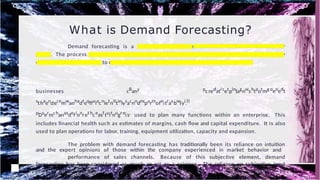
What is Demand Forecasting?
Demand forecasting is a business process that estimates consumer demand for
goods. The process uses sales data over time, market conditions, competitor analysis and input by
experienced professionals to create a forecast that attempts to predict future behavior.
businesses cBany pc redati cetpinlagnwshtaotmg oeoedt
sthaendei nmwanhadteqffuiacnietnittielysacnodnspurmofeitrasbwlyi.ll
pDuermchanasdefionret hceasftuitnugr eis, used to plan many functions within an enterprise. This
includes financial health such as estimates of margins, cash flow and capital expenditure. It is also
used to plan operations for labor, training, equipment utilization, capacity and expansion.
The problem with demand forecasting has traditionally been its reliance on intuition
and the expert opinions of those within the company experienced in market behavior and
performance of sales channels. Because of this subjective element, demand
forecasting has been considered as much an art as a science. The reliance on subjective input
impacts all downstream processes that depends upon it. The result is the introduction of
uncertainty to a process that requires accurate data to produce the best forecasts possible.
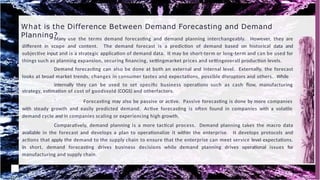
What is the Difference Between Demand Forecasting and Demand
Planning?
Many use the terms demand forecasting and demand planning interchangeably. However, they are
different in scope and content. The demand forecast is a prediction of demand based on historical data and
subjective input and is a strategic application of demand data. It may be short-term or long-term and can be used for
things such as planning expansion, securing financing, settingmarket prices and settingoverall production levels.
Demand forecasting can also be done at both an external and internal level. Externally, the forecast
looks at broad market trends, changes in consumer tastes and expectations, possible disruptors and others. While
internally they can be used to set specific business operations such as cash flow, manufacturing
strategy, estimation of cost of goodssold (COGS) and otherfactors.
` Forecasting may also be passive or active. Passive forecasting is done by more companies
with steady growth and easily predicted demand. Active forecasting is often found in companies with a volatile
demand cycle and in companies scaling or experiencing high growth.
Comparatively, demand planning is a more tactical process. Demand planning takes the macro data
available in the forecast and develops a plan to operationalize it within the enterprise. It develops protocols and
actions that apply the demand to the supply chain to ensure that the enterprise can meet service level expectations.
In short, demand forecasting drives business decisions while demand planning drives operational issues for
manufacturing and supply chain.
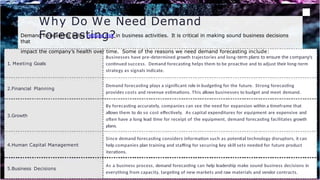
Why Do We Need Demand
Forecasting?
1. Meeting Goals
Businesses have pre-determined growth trajectories and long-term plans to ensure the company’s
continued success. Demand forecasting helps them to be proactive and to adjust their long-term
strategy as signals indicate.
2.Financial Planning
Demand forecasting plays a significant role in budgeting for the future. Strong forecasting
provides costs and revenue estimations. This allows businesses to budget and meet demand.
3.Growth
By forecasting accurately, companies can see the need for expansion within a timeframe that
allows them to do so cost effectively. As capital expenditures for equipment are expensive and
often have a long lead time for receipt of the equipment, demand forecasting facilitates growth
plans.
4.Human Capital Management
Since demand forecasting considers information such as potential technology disruptors, it can
help companies plan training and staffing for securing key skill sets needed for future product
iterations.
5.Business Decisions
As a business process, demand forecasting can help leadership make sound business decisions in
everything from capacity, targeting of new markets and raw materials and vendor contracts.
Demand forecasting helps reduce risk in business activities. It is critical in making sound business decisions
that
impact the company’s health over time. Some of the reasons we need demand forecasting include:
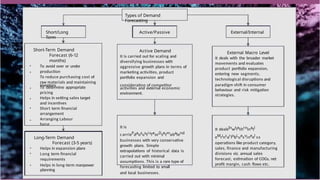
Types of Demand
Forecasting
Short/Long
Term
Active/Passive External/Internal
●
Short-Term Demand
Forecast (6-12
months)
●
To avoid over or under
production
To reduce purchasing cost of
raw materials and maintaining
inventory
●
●
●
To determine appropriate
pricing
Helps in setting sales target
and incentives
●
Short term financial
arrangement
Arranging Labour
force
Long-Term Demand
Forecast (3-5 years)
●
Helps in expansion plans
●
Long term financial
requirements
● Helps in long-term manpower
planning
Active Demand
It is carried out for scaling and
diversifying businesses with
aggressive growth plans in terms of
marketing activities, product
portfolio expansion and
consideration of competitor
activities and external economic
environment.
It is
carriePdaosustivfeorDsetmabalend
businesses with very conservative
growth plans. Simple
extrapolations of historical data is
carried out with minimal
assumptions. This is a rare type of
forecasting limited to small
and local businesses.
External Macro Level
It deals with the broader market
movements and evaluates
product portfolio expansion,
entering new segments,
technological disruptions and
paradigm shift in consumer
behaviour and risk mitigation
strategies.
It dealsInwtiethrninatl
eMrincarlobLuesvineel ss
operations like product category,
sales, finance and manufacturing
divisions viz. annual sales
forecast, estimation of COGs, net
profit margin, cash flows etc.
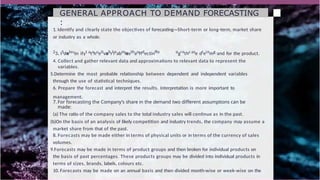
GENERAL APPROACH TO DEMAND FORECASTING
:
1. Identify and clearly state the objectives of forecasting—Short-term or long-term, market share
or industry as a whole.
23. ISdelectn ifyt atshueitvabrlieabmlesthaoffdectinffo ogrethc ase dteinmg.and for the product.
4. Collect and gather relevant data and approximations to relevant data to represent the
variables.
5.Determine the most probable relationship between dependent and independent variables
through the use of statistical techniques.
6. Prepare the forecast and interpret the results. Interpretation is more important to
management.
7. For forecasting the Company’s share in the demand two different assumptions can be
made:
(a) The ratio of the company sales to the total industry sales will continue as in the past.
(b)On the basis of an analysis of likely competition and industry trends, the company may assume a
market share from that of the past.
8. Forecasts may be made either in terms of physical units or in terms of the currency of sales
volumes.
9.Forecasts may be made in terms of product groups and then broken for individual products on
the basis of past percentages. These products groups may be divided into individual products in
terms of sizes, brands, labels, colours etc.
10. Forecasts may be made on an annual basis and then divided month-wise or week-wise on the
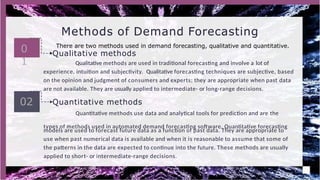
types of methods used in automated demand forecasting software. Quantitative forecasting
models are used to forecast future data as a function of past data. They are appropriate to
use when past numerical data is available and when it is reasonable to assume that some of
the patterns in the data are expected to continue into the future. These methods are usually
applied to short- or intermediate-range decisions.
Methods of Demand Forecasting
0
1
02 Quantitative methods
Quantitative methods use data and analytical tools for prediction and are the
There are two methods used in demand forecasting, qualitative and quantitative.
Qualitative methods
Qualitative methods are used in traditional forecasting and involve a lot of
experience, intuition and subjectivity. Qualitative forecasting techniques are subjective, based
on the opinion and judgment of consumers and experts; they are appropriate when past data
are not available. They are usually applied to intermediate- or long-range decisions.
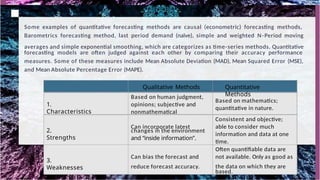
Some examples of quantitative forecasting methods are causal (econometric) forecasting methods,
Barometrics forecasting method, last period demand (naïve), simple and weighted N-Period moving
averages and simple exponential smoothing, which are categorizes as time-series methods. Quantitative
forecasting models are often judged against each other by comparing their accuracy performance
measures. Some of these measures include Mean Absolute Deviation (MAD), Mean Squared Error (MSE),
and Mean Absolute Percentage Error (MAPE).
Quantitative
Methods
1.
Characteristics
Qualitative Methods
Based on human judgment,
opinions; subjective and
nonmathematical
2.
Strengths
Can incorporate latest
changes in the environment
and “inside information”.
3.
Weaknesses
Can bias the forecast and
reduce forecast accuracy.
Based on mathematics;
quantitative in nature.
Consistent and objective;
able to consider much
information and data at one
time.
Often quantifiable data are
not available. Only as good as
the data on which they are
based.
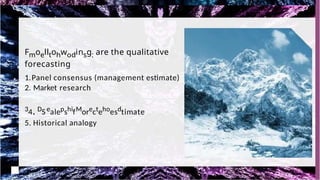
Fmoelltohwodinsg: are the qualitative
forecasting
1.Panel consensus (management estimate)
2. Market research
34. DSealepshifMorectehoesdtimate
5. Historical analogy
1. Panel
Consensus
●
Here, a forecast is developed by asking a group of knowledgeable executives to
discuss their opinions regarding the future values of the items being forecasted.
●
It provides forecast in a relatively short time.
●
Usually used to make long range forecasting for future technologies or future sales of
a new product.
●
Can be used to change an existing forecast to account for unusual events, such as
an unexpected competition.
●
Often the opinion of one person can dominate the forecast if that person has more
power than the other members of the group.
●
In addition, it requires the valuable time of highly paid executives.
2. Market
Research
●
An approach that uses surveys and interviews to determine customer likes, dislikes, and
preferences and to identify new product ideas.
●
Usually, the company hires an outside marketing firm to conduct a market research
study.
●
One of the most common shortcomings of this approach has to do with how the survey
questions are designed.
●
The number of responses compared to the number of nonresponses or incomplete
answers should also be tracked to determine if the data are statistically valid.
3. Delphi
Method
●
●
Questionnaires are generally submitted to the individual experts for their anonymous
responses in successive rounds.
●
These experts do not have to be in the same facility or even in the same country.
●
They do not know who the other panelists are.
●
There is one coordinator who knows all the participants, and all participants only
contact with the coordinator.
●
After responding to the questions in one round, the experts comment on replies from
the previous round.
●
The experts have a chance to revise their own previous opinion.
The answers of experts converge, round by round, upon an increasingly accurate
consensus forecast.
●
Method is time consuming and is best for long-term forecasts, technological change,
and scientific advances in medicine.
4. Sales Force
Estimate
●
●
Sales people are a good source of information regarding customers' future intentions
to buy.
They can help a firm obtain a forecast quickly and inexpensively.
●
Each sales representative is asked to estimate sales in his/her territory.
●
These individual estimates are then combined together by upper managers to develop
regional sales forecast.
5. Historical
Analogy
●
When there are no data on a new product or service, forecasters may study past patterns of
demand for similar product or service to estimate the demand for new product.
● For example, basing demand for the first smart phones on older cell phones sales.
●
Another example could be estimating the demand of a electric cars based on the demand of
petrol/diesel cars.
Common Forecasting Assumptions:
1. Forecasts are rarely, if ever, perfect. It is nearly impossible to 100% accurately
estimate what the future will hold. Firms need to understand and expect some
error in their forecasts.
2. Forecasts tend to be more accurate for groups of items than for individual items
in the group. The popular Fitbit may be producing six different models. Each
model may be offered in several different colours. Each of those colours may
come in small, large and extra large. The forecast for each model will be far
more accurate than the forecast for each specific end item.
3. Forecast accuracy will tend to decrease as the time horizon increases. The
farther away the forecast is from the current date, the more uncertainty it will
contain.
The following are the Quantitative Forecasting Method
Causal (Econometric) Forecasting Methods (Degree)
Some forecasting methods try to identify the underlying factors that might influence the variable that
is being forecast. For example, including information about climate patterns might improve the ability
of a model to predict umbrella sales. Forecasting models often take account of regular seasonal
variations. In addition to climate, such variations can also be due to holidays and customs: for example,
one might predict that sales of college football apparel will be higher during the football season than
during the off-season.
Several informal methods used in causal forecasting do not rely solely on the output of mathematical
algorithms, but instead use the judgment of the forecaster. Some forecasts take account of past
relationships between variables: if one variable has, for example, been approximately linearly related to
another for a long period of time, it may be appropriate to extrapolate such a relationship into the
future, without necessarily understanding the reasons for the relationship.
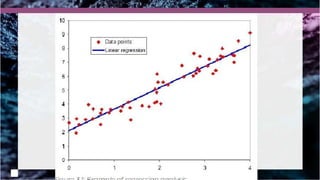
One of the most famous causal models is regression analysis. In statistical modeling, regression
analysis is a set of statistical processes for estimating the relationships among variables. It includes
many techniques for modeling and analyzing several variables, when the focus is on the relationship
between a dependent variable and one or more independent variables (or ‘predict ors’). More
specifically, regression analysis helps one understand how the typical value of the dependent variable
(or ‘criterion variable’) changes when any one of the independent variables is varied, while the other
independent variables are held fixed.
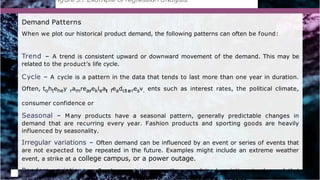
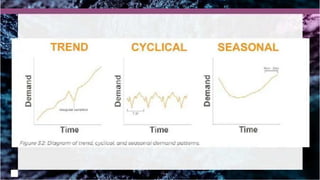
Demand Patterns
When we plot our historical product demand, the following patterns can often be found:
Trend – A trend is consistent upward or downward movement of the demand. This may be
related to the product’s life cycle.
Cycle – A cycle is a pattern in the data that tends to last more than one year in duration.
Often, tohtehey ramrearekleat feadct oresv. ents such as interest rates, the political climate,
consumer confidence or
Seasonal – Many products have a seasonal pattern, generally predictable changes in
demand that are recurring every year. Fashion products and sporting goods are heavily
influenced by seasonality.
Irregular variations – Often demand can be influenced by an event or series of events that
are not expected to be repeated in the future. Examples might include an extreme weather
event, a strike at a college campus, or a power outage.
Random variations – Random variations are the unexplained variations in demand that
Time Series
Methods
Time series methods use historical data as the basis of estimating future
outcomes. A time series is a series of data points indexed (or listed or graphed)
in time order. Most commonly, a time series is a sequence taken at successive
equally spaced points in time. Thus, it is a sequence of discrete-time data.
Examples of time series are heights of ocean tides, counts of sunspots, and the
daily closing value of
the Dow Jones Industrial Average.
Time series are very frequently plotted via line charts. Time series are used in
statistics, signal processing, pattern recognition, econometrics, mathematical
finance, weather forecasting, earthquake prediction, electroencephalography,
control engineering, astronomy, communications engineering, and largely in any
domain of applied science and engineering which involves temporal
measurements.
In the following, we will elaborate more on some of the simpler time-series
methods and go over some numerical examples.
Naïve Method
The simplest forecasting method is the naïve method. In this case,
the forecast for the next period is set at the actual demand for the
previous period. This method of forecasting may often be used as
a benchmark in order to evaluate and compare other forecast
methods.
Simple Moving Average
In this method, we take the average of the last “n” periods and use that as
tmhaenfoagreecmasetnfot rinthoerdneerxttopaecrhioiedv.
eThaemvaolrueeaocfc“unr”atceanfobreecdaestfi.nFeodr ebxyatmh eple, a manager
may decide to use the demand values from the last four periods (i.e., n =
4) to calculate the 4-period moving average forecast for the next period.
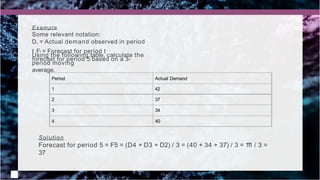
Period Actual Demand
1 42
2 37
3 34
4 40
Example
Some relevant notation:
Dt = Actual demand observed in period
t Ft = Forecast for period t
Using the following table, calculate the
forecast for period 5 based on a 3-
period moving
average.
Solution
Forecast for period 5 = F5 = (D4 + D3 + D2) / 3 = (40 + 34 + 37) / 3 = 1
1
1 / 3 =
37
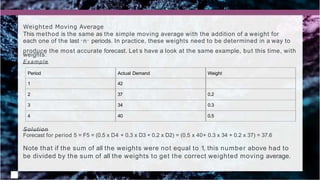
Period Actual Demand Weight
1 42
2 37 0.2
3 34 0.3
4 40 0.5
Weighted Moving Average
This method is the same as the simple moving average with the addition of a weight for
each one of the last “ n” periods. In practice, these weights need to be determined in a way to
produce the most accurate forecast. Let’s have a look at the same example, but this time, with
weights:
Example
Solution
Forecast for period 5 = F5 = (0.5 x D4 + 0.3 x D3 + 0.2 x D2) = (0.5 x 40+ 0.3 x 34 + 0.2 x 37) = 37.6
Note that if the sum of all the weights were not equal to 1, this number above had to
be divided by the sum of all the weights to get the correct weighted moving average.
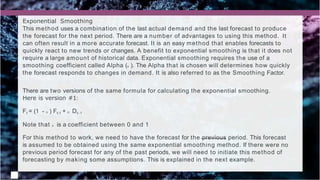
Exponential Smoothing
This method uses a combination of the last actual demand and the last forecast to produce
the forecast for the next period. There are a number of advantages to using this method. It
can often result in a more accurate forecast. It is an easy method that enables forecasts to
quickly react to new trends or changes. A benefit to exponential smoothing is that it does not
require a large amount of historical data. Exponential smoothing requires the use of a
smoothing coefficient called Alpha (α ). The Alpha that is chosen will determines how quickly
the forecast responds to changes in demand. It is also referred to as the Smoothing Factor.
There are two versions of the same formula for calculating the exponential smoothing.
Here is version #1:
Ft = (1 – α ) Ft-1 + α Dt-1
Note that α is a coefficient between 0 and 1
For this method to work, we need to have the forecast for the previous period. This forecast
is assumed to be obtained using the same exponential smoothing method. If there were no
previous period forecast for any of the past periods, we will need to initiate this method of
forecasting by making some assumptions. This is explained in the next example.
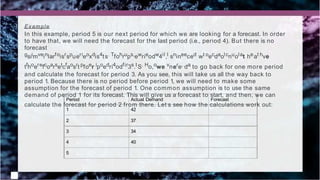
Period
1
Actual Demand
42
Forecast
2 37
3 34
4 40
5
Example
In this example, period 5 is our next period for which we are looking for a forecast. In order
to have that, we will need the forecast for the last period (i.e., period 4). But there is no
forecast
gsiimveinlarfoisrspuerieoxdis4ts. Tfohrups,ewrieodw4il,l snineeced wt oecdaolcnuolat heat hve
tfhoerefcoarsetcfaosrt pfoer ipoedri4odfir3s.tS. Ho,owe vnere, da to go back for one more period
and calculate the forecast for period 3. As you see, this will take us all the way back to
period 1. Because there is no period before period 1, we will need to make some
assumption for the forecast of period 1. One common assumption is to use the same
demand of period 1 for its forecast. This will give us a forecast to start, and then, we can
calculate the forecast for period 2 from there. Let’s see how the calculations work out:
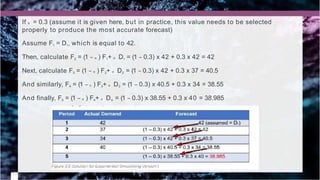
If α = 0.3 (assume it is given here, but in practice, this value needs to be selected
properly to produce the most accurate forecast)
Assume F1 = D1, which is equal to 42.
Then, calculate F2 = (1 – α ) F1+ α D1 = (1 – 0.3) x 42 + 0.3 x 42 = 42
Next, calculate F3 = (1 – α ) F2+ α D2 = (1 – 0.3) x 42 + 0.3 x 37 = 40.5
And similarly, F4 = (1 – α ) F3+ α D3 = (1 – 0.3) x 40.5 + 0.3 x 34 = 38.55
And finally, F5 = (1 – α ) F4+ α D4 = (1 – 0.3) x 38.55 + 0.3 x 40 = 38.985
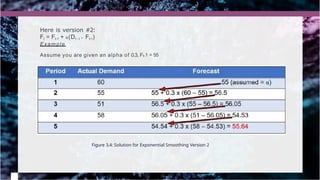
Here is version #2:
Ft = Ft-1 + α(Dt - 1 – Ft-1)
Example
Assume you are given an alpha of 0.3, Ft-1 = 55
Figure 3.4: Solution for Exponential Smoothing Version 2
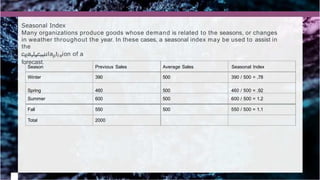
Season Previous Sales Average Sales Seasonal Index
Winter 390 500 390 / 500 = .78
Spring 460 500 460 / 500 = .92
Summer 600 500 600 / 500 = 1.2
Fall 550 500 550 / 500 = 1.1
Total 2000
Seasonal Index
Many organizations produce goods whose demand is related to the seasons, or changes
in weather throughout the year. In these cases, a seasonal index may be used to assist in
the
cEaxlacmulaptl eion of a
forecast.
Forecast Accuracy Measures
In this section, we will calculate forecast accuracy measures such as Mean Absolute
Deviation (MAD), Mean Squared Error (MSE), and Mean Absolute Percentage
Error (MAPE). We will explain the calculations using the next example.
Example
The following actual demand and forecast values are given for the past four periods.
We want to calculate MAD, MSE and MAPE for this forecast to see how well it is doing.
Note that Abs (et) refers to the absolute value of the error in period t (et).
et
2 [Abs (et) / Dt] x 100%
Period Actual Demand Forecast et Abs (et)
1 63 68
2 59 65
3 54 61
4 65 59
Here are what need to do:
Step 1: Calculate the error as et = Dt – Ft (the difference between the actual demand and the
forecast) for any period t and enter the values in the table above.
Step 2: Calculate the absolute value of the errors calculated in step 1 [i.e., Abs (et)], and
enter the values in the table above.
t
Step 3: Calculate the squared error (i.e., e 2) for each period and enter the values in the table
Period Actual Demand Forecast et Abs (et) t
e 2
[Abs (et) / Dt] x
100%
1 63 68 -5 5 25 7.94%
2 59 65 -6 6 36 10.17%
3 54 61 -7 7 49 12.96%
4 65 59 6 6 36 9.23%
above.
Step 4: Calculate [Abs (et) / Dt] x 100% for each period and enter the value under its column
in the table above.
Solution
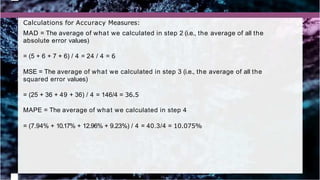
Calculations for Accuracy Measures:
MAD = The average of what we calculated in step 2 (i.e., the average of all the
absolute error values)
= (5 + 6 + 7 + 6) / 4 = 24 / 4 = 6
MSE = The average of what we calculated in step 3 (i.e., the average of all the
squared error values)
= (25 + 36 + 49 + 36) / 4 = 146/4 = 36.5
MAPE = The average of what we calculated in step 4
= (7.94% + 10.17% + 12.96% + 9.23%) / 4 = 40.3/4 = 10.075%
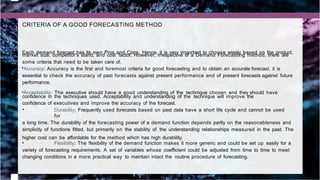
CRITERIA OF A GOOD FORECASTING METHOD
Each demand forecast has its own Pros and Cons. Hence, it is very important to choose wisely based on the product,
market size, competitor’s stand, and cost factor. However, irrespective of a Demand Forecasting method, there are
some criteria that need to be taken care of.
•Accuracy: Accuracy is the first and foremost criteria for good forecasting and to obtain an accurate forecast, it is
essential to check the accuracy of past forecasts against present performance and of present forecasts against future
performance.
•Acceptability: The executive should have a good understanding of the technique chosen and they should have
confidence in the techniques used. Acceptability and understanding of the technique will improve the
confidence of executives and improve the accuracy of the forecast.
• Durability: Frequently used forecasts based on past data have a short life cycle and cannot be used
for
a long time. The durability of the forecasting power of a demand function depends partly on the reasonableness and
simplicity of functions fitted, but primarily on the stability of the understanding relationships measured in the past. The
higher cost can be affordable for the method which has high durability.
• Flexibility: The flexibility of the demand function makes it more generic and could be set up easily for a
variety of forecasting requirements. A set of variables whose coefficient could be adjusted from time to time to meet
changing conditions in a more practical way to maintain intact the routine procedure of forecasting.
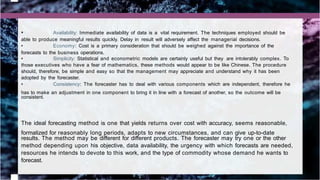
• Availability: Immediate availability of data is a vital requirement. The techniques employed should be
able to produce meaningful results quickly. Delay in result will adversely affect the managerial decisions.
• Economy: Cost is a primary consideration that should be weighed against the importance of the
forecasts to the business operations.
• Simplicity: Statistical and econometric models are certainly useful but they are intolerably complex. To
those executives who have a fear of mathematics, these methods would appear to be like Chinese. The procedure
should, therefore, be simple and easy so that the management may appreciate and understand why it has been
adopted by the forecaster.
• Consistency: The forecaster has to deal with various components which are independent, therefore he
has to make an adjustment in one component to bring it in line with a forecast of another, so the outcome will be
consistent.
The ideal forecasting method is one that yields returns over cost with accuracy, seems reasonable,
formalized for reasonably long periods, adapts to new circumstances, and can give up-to-date
results. The method may be different for different products. The forecaster may try one or the other
method depending upon his objective, data availability, the urgency with which forecasts are needed,
resources he intends to devote to this work, and the type of commodity whose demand he wants to
forecast.
IMPORTANCE OF DEMAND FORECASTING
Demand Forecasting is the pivotal business process around which strategic and operational
plans of a company are devised. Based on the same, strategic and long-range plans of a
business-like budgeting, financial planning, sales and marketing plans, capacity planning, risk
assessment, and mitigation plans are formulated. It is helpful in the following manners.
1.Essential to Produce the Required Quantities at the Right Time: Accurate demand forecasting
is essential for a firm to enable it to produce the required quantities at the right time and
arrange well in advance for the various factors of production. The producer can frame a
suitable production policy. The firm can reduce the costs of purchasing raw materials.
2.To Adopt Suitable Price Policy: It also enables the firm to adopt a suitable price policy. It is
on the basis of demand and sales forecasts that arrangements are made for raw materials,
equipment, machine, accessories, labour and buildings well in advance and at the right time.
3. It is Helpful in the Maximisation of Profit: A firm can maximise its profits only
when it produces on the basis of the demand for its products. There will be no
problem of over and under production and it will reduce or have control over costs,
the profits will certainly go up. The importance of sales forecasting is much more on
a large scale or seasonal industries.
4o.f pImarptoicrutalanrcperforodmuctNsamtioanyaplrPovoiidnet
oafgVuiiedwe:linOenfothredneamtiaonndalfolerveecla, sdtesmfoarnrdelfaotreedcasts
industries. i.e. A demand forecasts for cotton textile may provide an idea of
probable demand for textile machinery, readymade garments, dyestuff industries.
The government on the basis of sales forecasts may decide whether imports are
necessary to meet the deficit in the domestic demand or may provide export
incentives for any surplus. Thus, demand forecasts are useful to the firm, industry
and also to the government.
CREDITS: This presentation template was created by Slidesgo, and
includes icons by Flaticon, and infographics & images by Freepik
Thank
You!!!!!

Demand Forecasrtqywyyevdhusisvdhisisting.pptx

  • 1.
  • 2.
    What is DemandForecasting? Demand forecasting is a business process that estimates consumer demand for goods. The process uses sales data over time, market conditions, competitor analysis and input by experienced professionals to create a forecast that attempts to predict future behavior. businesses cBany pc redati cetpinlagnwshtaotmg oeoedt sthaendei nmwanhadteqffuiacnietnittielysacnodnspurmofeitrasbwlyi.ll pDuermchanasdefionret hceasftuitnugr eis, used to plan many functions within an enterprise. This includes financial health such as estimates of margins, cash flow and capital expenditure. It is also used to plan operations for labor, training, equipment utilization, capacity and expansion. The problem with demand forecasting has traditionally been its reliance on intuition and the expert opinions of those within the company experienced in market behavior and performance of sales channels. Because of this subjective element, demand forecasting has been considered as much an art as a science. The reliance on subjective input impacts all downstream processes that depends upon it. The result is the introduction of uncertainty to a process that requires accurate data to produce the best forecasts possible.
  • 3.
    What is theDifference Between Demand Forecasting and Demand Planning? Many use the terms demand forecasting and demand planning interchangeably. However, they are different in scope and content. The demand forecast is a prediction of demand based on historical data and subjective input and is a strategic application of demand data. It may be short-term or long-term and can be used for things such as planning expansion, securing financing, settingmarket prices and settingoverall production levels. Demand forecasting can also be done at both an external and internal level. Externally, the forecast looks at broad market trends, changes in consumer tastes and expectations, possible disruptors and others. While internally they can be used to set specific business operations such as cash flow, manufacturing strategy, estimation of cost of goodssold (COGS) and otherfactors. ` Forecasting may also be passive or active. Passive forecasting is done by more companies with steady growth and easily predicted demand. Active forecasting is often found in companies with a volatile demand cycle and in companies scaling or experiencing high growth. Comparatively, demand planning is a more tactical process. Demand planning takes the macro data available in the forecast and develops a plan to operationalize it within the enterprise. It develops protocols and actions that apply the demand to the supply chain to ensure that the enterprise can meet service level expectations. In short, demand forecasting drives business decisions while demand planning drives operational issues for manufacturing and supply chain.
  • 4.
    Why Do WeNeed Demand Forecasting? 1. Meeting Goals Businesses have pre-determined growth trajectories and long-term plans to ensure the company’s continued success. Demand forecasting helps them to be proactive and to adjust their long-term strategy as signals indicate. 2.Financial Planning Demand forecasting plays a significant role in budgeting for the future. Strong forecasting provides costs and revenue estimations. This allows businesses to budget and meet demand. 3.Growth By forecasting accurately, companies can see the need for expansion within a timeframe that allows them to do so cost effectively. As capital expenditures for equipment are expensive and often have a long lead time for receipt of the equipment, demand forecasting facilitates growth plans. 4.Human Capital Management Since demand forecasting considers information such as potential technology disruptors, it can help companies plan training and staffing for securing key skill sets needed for future product iterations. 5.Business Decisions As a business process, demand forecasting can help leadership make sound business decisions in everything from capacity, targeting of new markets and raw materials and vendor contracts. Demand forecasting helps reduce risk in business activities. It is critical in making sound business decisions that impact the company’s health over time. Some of the reasons we need demand forecasting include:
  • 5.
    Types of Demand Forecasting Short/Long Term Active/PassiveExternal/Internal ● Short-Term Demand Forecast (6-12 months) ● To avoid over or under production To reduce purchasing cost of raw materials and maintaining inventory ● ● ● To determine appropriate pricing Helps in setting sales target and incentives ● Short term financial arrangement Arranging Labour force Long-Term Demand Forecast (3-5 years) ● Helps in expansion plans ● Long term financial requirements ● Helps in long-term manpower planning Active Demand It is carried out for scaling and diversifying businesses with aggressive growth plans in terms of marketing activities, product portfolio expansion and consideration of competitor activities and external economic environment. It is carriePdaosustivfeorDsetmabalend businesses with very conservative growth plans. Simple extrapolations of historical data is carried out with minimal assumptions. This is a rare type of forecasting limited to small and local businesses. External Macro Level It deals with the broader market movements and evaluates product portfolio expansion, entering new segments, technological disruptions and paradigm shift in consumer behaviour and risk mitigation strategies. It dealsInwtiethrninatl eMrincarlobLuesvineel ss operations like product category, sales, finance and manufacturing divisions viz. annual sales forecast, estimation of COGs, net profit margin, cash flows etc.
  • 6.
    GENERAL APPROACH TODEMAND FORECASTING : 1. Identify and clearly state the objectives of forecasting—Short-term or long-term, market share or industry as a whole. 23. ISdelectn ifyt atshueitvabrlieabmlesthaoffdectinffo ogrethc ase dteinmg.and for the product. 4. Collect and gather relevant data and approximations to relevant data to represent the variables. 5.Determine the most probable relationship between dependent and independent variables through the use of statistical techniques. 6. Prepare the forecast and interpret the results. Interpretation is more important to management. 7. For forecasting the Company’s share in the demand two different assumptions can be made: (a) The ratio of the company sales to the total industry sales will continue as in the past. (b)On the basis of an analysis of likely competition and industry trends, the company may assume a market share from that of the past. 8. Forecasts may be made either in terms of physical units or in terms of the currency of sales volumes. 9.Forecasts may be made in terms of product groups and then broken for individual products on the basis of past percentages. These products groups may be divided into individual products in terms of sizes, brands, labels, colours etc. 10. Forecasts may be made on an annual basis and then divided month-wise or week-wise on the
  • 7.
    types of methodsused in automated demand forecasting software. Quantitative forecasting models are used to forecast future data as a function of past data. They are appropriate to use when past numerical data is available and when it is reasonable to assume that some of the patterns in the data are expected to continue into the future. These methods are usually applied to short- or intermediate-range decisions. Methods of Demand Forecasting 0 1 02 Quantitative methods Quantitative methods use data and analytical tools for prediction and are the There are two methods used in demand forecasting, qualitative and quantitative. Qualitative methods Qualitative methods are used in traditional forecasting and involve a lot of experience, intuition and subjectivity. Qualitative forecasting techniques are subjective, based on the opinion and judgment of consumers and experts; they are appropriate when past data are not available. They are usually applied to intermediate- or long-range decisions.
  • 8.
    Some examples ofquantitative forecasting methods are causal (econometric) forecasting methods, Barometrics forecasting method, last period demand (naïve), simple and weighted N-Period moving averages and simple exponential smoothing, which are categorizes as time-series methods. Quantitative forecasting models are often judged against each other by comparing their accuracy performance measures. Some of these measures include Mean Absolute Deviation (MAD), Mean Squared Error (MSE), and Mean Absolute Percentage Error (MAPE). Quantitative Methods 1. Characteristics Qualitative Methods Based on human judgment, opinions; subjective and nonmathematical 2. Strengths Can incorporate latest changes in the environment and “inside information”. 3. Weaknesses Can bias the forecast and reduce forecast accuracy. Based on mathematics; quantitative in nature. Consistent and objective; able to consider much information and data at one time. Often quantifiable data are not available. Only as good as the data on which they are based.
  • 9.
    Fmoelltohwodinsg: are thequalitative forecasting 1.Panel consensus (management estimate) 2. Market research 34. DSealepshifMorectehoesdtimate 5. Historical analogy
  • 10.
    1. Panel Consensus ● Here, aforecast is developed by asking a group of knowledgeable executives to discuss their opinions regarding the future values of the items being forecasted. ● It provides forecast in a relatively short time. ● Usually used to make long range forecasting for future technologies or future sales of a new product. ● Can be used to change an existing forecast to account for unusual events, such as an unexpected competition. ● Often the opinion of one person can dominate the forecast if that person has more power than the other members of the group. ● In addition, it requires the valuable time of highly paid executives.
  • 11.
    2. Market Research ● An approachthat uses surveys and interviews to determine customer likes, dislikes, and preferences and to identify new product ideas. ● Usually, the company hires an outside marketing firm to conduct a market research study. ● One of the most common shortcomings of this approach has to do with how the survey questions are designed. ● The number of responses compared to the number of nonresponses or incomplete answers should also be tracked to determine if the data are statistically valid.
  • 12.
    3. Delphi Method ● ● Questionnaires aregenerally submitted to the individual experts for their anonymous responses in successive rounds. ● These experts do not have to be in the same facility or even in the same country. ● They do not know who the other panelists are. ● There is one coordinator who knows all the participants, and all participants only contact with the coordinator. ● After responding to the questions in one round, the experts comment on replies from the previous round. ● The experts have a chance to revise their own previous opinion. The answers of experts converge, round by round, upon an increasingly accurate consensus forecast. ● Method is time consuming and is best for long-term forecasts, technological change, and scientific advances in medicine.
  • 13.
    4. Sales Force Estimate ● ● Salespeople are a good source of information regarding customers' future intentions to buy. They can help a firm obtain a forecast quickly and inexpensively. ● Each sales representative is asked to estimate sales in his/her territory. ● These individual estimates are then combined together by upper managers to develop regional sales forecast.
  • 14.
    5. Historical Analogy ● When thereare no data on a new product or service, forecasters may study past patterns of demand for similar product or service to estimate the demand for new product. ● For example, basing demand for the first smart phones on older cell phones sales. ● Another example could be estimating the demand of a electric cars based on the demand of petrol/diesel cars.
  • 15.
    Common Forecasting Assumptions: 1.Forecasts are rarely, if ever, perfect. It is nearly impossible to 100% accurately estimate what the future will hold. Firms need to understand and expect some error in their forecasts. 2. Forecasts tend to be more accurate for groups of items than for individual items in the group. The popular Fitbit may be producing six different models. Each model may be offered in several different colours. Each of those colours may come in small, large and extra large. The forecast for each model will be far more accurate than the forecast for each specific end item. 3. Forecast accuracy will tend to decrease as the time horizon increases. The farther away the forecast is from the current date, the more uncertainty it will contain.
  • 16.
    The following arethe Quantitative Forecasting Method Causal (Econometric) Forecasting Methods (Degree) Some forecasting methods try to identify the underlying factors that might influence the variable that is being forecast. For example, including information about climate patterns might improve the ability of a model to predict umbrella sales. Forecasting models often take account of regular seasonal variations. In addition to climate, such variations can also be due to holidays and customs: for example, one might predict that sales of college football apparel will be higher during the football season than during the off-season. Several informal methods used in causal forecasting do not rely solely on the output of mathematical algorithms, but instead use the judgment of the forecaster. Some forecasts take account of past relationships between variables: if one variable has, for example, been approximately linearly related to another for a long period of time, it may be appropriate to extrapolate such a relationship into the future, without necessarily understanding the reasons for the relationship. One of the most famous causal models is regression analysis. In statistical modeling, regression analysis is a set of statistical processes for estimating the relationships among variables. It includes many techniques for modeling and analyzing several variables, when the focus is on the relationship between a dependent variable and one or more independent variables (or ‘predict ors’). More specifically, regression analysis helps one understand how the typical value of the dependent variable (or ‘criterion variable’) changes when any one of the independent variables is varied, while the other independent variables are held fixed.
  • 18.
    Demand Patterns When weplot our historical product demand, the following patterns can often be found: Trend – A trend is consistent upward or downward movement of the demand. This may be related to the product’s life cycle. Cycle – A cycle is a pattern in the data that tends to last more than one year in duration. Often, tohtehey ramrearekleat feadct oresv. ents such as interest rates, the political climate, consumer confidence or Seasonal – Many products have a seasonal pattern, generally predictable changes in demand that are recurring every year. Fashion products and sporting goods are heavily influenced by seasonality. Irregular variations – Often demand can be influenced by an event or series of events that are not expected to be repeated in the future. Examples might include an extreme weather event, a strike at a college campus, or a power outage. Random variations – Random variations are the unexplained variations in demand that
  • 20.
    Time Series Methods Time seriesmethods use historical data as the basis of estimating future outcomes. A time series is a series of data points indexed (or listed or graphed) in time order. Most commonly, a time series is a sequence taken at successive equally spaced points in time. Thus, it is a sequence of discrete-time data. Examples of time series are heights of ocean tides, counts of sunspots, and the daily closing value of the Dow Jones Industrial Average. Time series are very frequently plotted via line charts. Time series are used in statistics, signal processing, pattern recognition, econometrics, mathematical finance, weather forecasting, earthquake prediction, electroencephalography, control engineering, astronomy, communications engineering, and largely in any domain of applied science and engineering which involves temporal measurements. In the following, we will elaborate more on some of the simpler time-series methods and go over some numerical examples.
  • 21.
    Naïve Method The simplestforecasting method is the naïve method. In this case, the forecast for the next period is set at the actual demand for the previous period. This method of forecasting may often be used as a benchmark in order to evaluate and compare other forecast methods. Simple Moving Average In this method, we take the average of the last “n” periods and use that as tmhaenfoagreecmasetnfot rinthoerdneerxttopaecrhioiedv. eThaemvaolrueeaocfc“unr”atceanfobreecdaestfi.nFeodr ebxyatmh eple, a manager may decide to use the demand values from the last four periods (i.e., n = 4) to calculate the 4-period moving average forecast for the next period.
  • 22.
    Period Actual Demand 142 2 37 3 34 4 40 Example Some relevant notation: Dt = Actual demand observed in period t Ft = Forecast for period t Using the following table, calculate the forecast for period 5 based on a 3- period moving average. Solution Forecast for period 5 = F5 = (D4 + D3 + D2) / 3 = (40 + 34 + 37) / 3 = 1 1 1 / 3 = 37
  • 23.
    Period Actual DemandWeight 1 42 2 37 0.2 3 34 0.3 4 40 0.5 Weighted Moving Average This method is the same as the simple moving average with the addition of a weight for each one of the last “ n” periods. In practice, these weights need to be determined in a way to produce the most accurate forecast. Let’s have a look at the same example, but this time, with weights: Example Solution Forecast for period 5 = F5 = (0.5 x D4 + 0.3 x D3 + 0.2 x D2) = (0.5 x 40+ 0.3 x 34 + 0.2 x 37) = 37.6 Note that if the sum of all the weights were not equal to 1, this number above had to be divided by the sum of all the weights to get the correct weighted moving average.
  • 24.
    Exponential Smoothing This methoduses a combination of the last actual demand and the last forecast to produce the forecast for the next period. There are a number of advantages to using this method. It can often result in a more accurate forecast. It is an easy method that enables forecasts to quickly react to new trends or changes. A benefit to exponential smoothing is that it does not require a large amount of historical data. Exponential smoothing requires the use of a smoothing coefficient called Alpha (α ). The Alpha that is chosen will determines how quickly the forecast responds to changes in demand. It is also referred to as the Smoothing Factor. There are two versions of the same formula for calculating the exponential smoothing. Here is version #1: Ft = (1 – α ) Ft-1 + α Dt-1 Note that α is a coefficient between 0 and 1 For this method to work, we need to have the forecast for the previous period. This forecast is assumed to be obtained using the same exponential smoothing method. If there were no previous period forecast for any of the past periods, we will need to initiate this method of forecasting by making some assumptions. This is explained in the next example.
  • 25.
    Period 1 Actual Demand 42 Forecast 2 37 334 4 40 5 Example In this example, period 5 is our next period for which we are looking for a forecast. In order to have that, we will need the forecast for the last period (i.e., period 4). But there is no forecast gsiimveinlarfoisrspuerieoxdis4ts. Tfohrups,ewrieodw4il,l snineeced wt oecdaolcnuolat heat hve tfhoerefcoarsetcfaosrt pfoer ipoedri4odfir3s.tS. Ho,owe vnere, da to go back for one more period and calculate the forecast for period 3. As you see, this will take us all the way back to period 1. Because there is no period before period 1, we will need to make some assumption for the forecast of period 1. One common assumption is to use the same demand of period 1 for its forecast. This will give us a forecast to start, and then, we can calculate the forecast for period 2 from there. Let’s see how the calculations work out:
  • 26.
    If α =0.3 (assume it is given here, but in practice, this value needs to be selected properly to produce the most accurate forecast) Assume F1 = D1, which is equal to 42. Then, calculate F2 = (1 – α ) F1+ α D1 = (1 – 0.3) x 42 + 0.3 x 42 = 42 Next, calculate F3 = (1 – α ) F2+ α D2 = (1 – 0.3) x 42 + 0.3 x 37 = 40.5 And similarly, F4 = (1 – α ) F3+ α D3 = (1 – 0.3) x 40.5 + 0.3 x 34 = 38.55 And finally, F5 = (1 – α ) F4+ α D4 = (1 – 0.3) x 38.55 + 0.3 x 40 = 38.985
  • 27.
    Here is version#2: Ft = Ft-1 + α(Dt - 1 – Ft-1) Example Assume you are given an alpha of 0.3, Ft-1 = 55 Figure 3.4: Solution for Exponential Smoothing Version 2
  • 28.
    Season Previous SalesAverage Sales Seasonal Index Winter 390 500 390 / 500 = .78 Spring 460 500 460 / 500 = .92 Summer 600 500 600 / 500 = 1.2 Fall 550 500 550 / 500 = 1.1 Total 2000 Seasonal Index Many organizations produce goods whose demand is related to the seasons, or changes in weather throughout the year. In these cases, a seasonal index may be used to assist in the cEaxlacmulaptl eion of a forecast.
  • 29.
    Forecast Accuracy Measures Inthis section, we will calculate forecast accuracy measures such as Mean Absolute Deviation (MAD), Mean Squared Error (MSE), and Mean Absolute Percentage Error (MAPE). We will explain the calculations using the next example. Example The following actual demand and forecast values are given for the past four periods. We want to calculate MAD, MSE and MAPE for this forecast to see how well it is doing. Note that Abs (et) refers to the absolute value of the error in period t (et). et 2 [Abs (et) / Dt] x 100% Period Actual Demand Forecast et Abs (et) 1 63 68 2 59 65 3 54 61 4 65 59
  • 30.
    Here are whatneed to do: Step 1: Calculate the error as et = Dt – Ft (the difference between the actual demand and the forecast) for any period t and enter the values in the table above. Step 2: Calculate the absolute value of the errors calculated in step 1 [i.e., Abs (et)], and enter the values in the table above. t Step 3: Calculate the squared error (i.e., e 2) for each period and enter the values in the table Period Actual Demand Forecast et Abs (et) t e 2 [Abs (et) / Dt] x 100% 1 63 68 -5 5 25 7.94% 2 59 65 -6 6 36 10.17% 3 54 61 -7 7 49 12.96% 4 65 59 6 6 36 9.23% above. Step 4: Calculate [Abs (et) / Dt] x 100% for each period and enter the value under its column in the table above. Solution
  • 31.
    Calculations for AccuracyMeasures: MAD = The average of what we calculated in step 2 (i.e., the average of all the absolute error values) = (5 + 6 + 7 + 6) / 4 = 24 / 4 = 6 MSE = The average of what we calculated in step 3 (i.e., the average of all the squared error values) = (25 + 36 + 49 + 36) / 4 = 146/4 = 36.5 MAPE = The average of what we calculated in step 4 = (7.94% + 10.17% + 12.96% + 9.23%) / 4 = 40.3/4 = 10.075%
  • 32.
    CRITERIA OF AGOOD FORECASTING METHOD Each demand forecast has its own Pros and Cons. Hence, it is very important to choose wisely based on the product, market size, competitor’s stand, and cost factor. However, irrespective of a Demand Forecasting method, there are some criteria that need to be taken care of. •Accuracy: Accuracy is the first and foremost criteria for good forecasting and to obtain an accurate forecast, it is essential to check the accuracy of past forecasts against present performance and of present forecasts against future performance. •Acceptability: The executive should have a good understanding of the technique chosen and they should have confidence in the techniques used. Acceptability and understanding of the technique will improve the confidence of executives and improve the accuracy of the forecast. • Durability: Frequently used forecasts based on past data have a short life cycle and cannot be used for a long time. The durability of the forecasting power of a demand function depends partly on the reasonableness and simplicity of functions fitted, but primarily on the stability of the understanding relationships measured in the past. The higher cost can be affordable for the method which has high durability. • Flexibility: The flexibility of the demand function makes it more generic and could be set up easily for a variety of forecasting requirements. A set of variables whose coefficient could be adjusted from time to time to meet changing conditions in a more practical way to maintain intact the routine procedure of forecasting.
  • 33.
    • Availability: Immediateavailability of data is a vital requirement. The techniques employed should be able to produce meaningful results quickly. Delay in result will adversely affect the managerial decisions. • Economy: Cost is a primary consideration that should be weighed against the importance of the forecasts to the business operations. • Simplicity: Statistical and econometric models are certainly useful but they are intolerably complex. To those executives who have a fear of mathematics, these methods would appear to be like Chinese. The procedure should, therefore, be simple and easy so that the management may appreciate and understand why it has been adopted by the forecaster. • Consistency: The forecaster has to deal with various components which are independent, therefore he has to make an adjustment in one component to bring it in line with a forecast of another, so the outcome will be consistent. The ideal forecasting method is one that yields returns over cost with accuracy, seems reasonable, formalized for reasonably long periods, adapts to new circumstances, and can give up-to-date results. The method may be different for different products. The forecaster may try one or the other method depending upon his objective, data availability, the urgency with which forecasts are needed, resources he intends to devote to this work, and the type of commodity whose demand he wants to forecast.
  • 34.
    IMPORTANCE OF DEMANDFORECASTING Demand Forecasting is the pivotal business process around which strategic and operational plans of a company are devised. Based on the same, strategic and long-range plans of a business-like budgeting, financial planning, sales and marketing plans, capacity planning, risk assessment, and mitigation plans are formulated. It is helpful in the following manners. 1.Essential to Produce the Required Quantities at the Right Time: Accurate demand forecasting is essential for a firm to enable it to produce the required quantities at the right time and arrange well in advance for the various factors of production. The producer can frame a suitable production policy. The firm can reduce the costs of purchasing raw materials. 2.To Adopt Suitable Price Policy: It also enables the firm to adopt a suitable price policy. It is on the basis of demand and sales forecasts that arrangements are made for raw materials, equipment, machine, accessories, labour and buildings well in advance and at the right time.
  • 35.
    3. It isHelpful in the Maximisation of Profit: A firm can maximise its profits only when it produces on the basis of the demand for its products. There will be no problem of over and under production and it will reduce or have control over costs, the profits will certainly go up. The importance of sales forecasting is much more on a large scale or seasonal industries. 4o.f pImarptoicrutalanrcperforodmuctNsamtioanyaplrPovoiidnet oafgVuiiedwe:linOenfothredneamtiaonndalfolerveecla, sdtesmfoarnrdelfaotreedcasts industries. i.e. A demand forecasts for cotton textile may provide an idea of probable demand for textile machinery, readymade garments, dyestuff industries. The government on the basis of sales forecasts may decide whether imports are necessary to meet the deficit in the domestic demand or may provide export incentives for any surplus. Thus, demand forecasts are useful to the firm, industry and also to the government.
  • 36.
    CREDITS: This presentationtemplate was created by Slidesgo, and includes icons by Flaticon, and infographics & images by Freepik Thank You!!!!!