DELTOID CONTUSION
Presented by
UMA MAHESHWARI J
INTRODUCTION
 Contusion is also known as BRUISE.
 Contusion is an injury to tissue or muscle when blood
vessels are ruptured and bleed into the surrounding
tissue.
 This bleeding causes discoloration of skin resulting into
an bruise.
 Contusion is painful to touch , because the blood has
pooled under skin and this causes pressure on nearby
nerve endings.
ANTOMY OF DELTOID MUSCLE
 Deltoid muscle is a thick , triangular shaped, located on
uppermost part of the arm and top of shoulder joint.
 ORIGIN :
Anterior deltoid : from lateral 1/3rd of clavicle.
Middle deltoid : from acromion process of scapula.
Posterior deltoid : from spine of scapula.
 INSERTION :
Inserts into deltoid tuberosity of humerus.
 Nerve supply : axillary nerve [C5 , C6]
 INSERTION :
Inserts into deltoid tuberosity of humerus.
 Nerve supply : axillary nerve [C5 , C6]
 Blood supply : posterior circumflex humeral artery and brachial
artery.
 Function :
Anterior deltoid : flexion and internal rotation of arm.
Middle deltoid : abduction of arm.
Posterior deltoid : extension and external rotation of arm.
DEFINITION
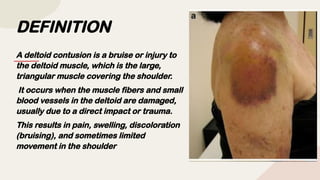
A deltoid contusion is a bruise or injury to
the deltoid muscle, which is the large,
triangular muscle covering the shoulder.
It occurs when the muscle fibers and small
blood vessels in the deltoid are damaged,
usually due to a direct impact or trauma.
This results in pain, swelling, discoloration
(bruising), and sometimes limited
movement in the shoulder
CAUSES
 Direct Impact: A sudden, forceful blow to the shoulder, such as
in contact sports (e.g., football) or an accidental collision.
 Falling: Landing directly on the shoulder or upper arm during a
fall, which can compress the muscle and result in a bruise.
 Blunt Trauma: Being hit by an object like a ball, bat, or heavy
item, which leads to localized muscle damage and bleeding
under the skin.
SYMPTOMS
 Pain: Discomfort or Pain in the shoulder or upper arm, especially when moving.
 Swelling: Swelling around the injured area due to inflammation or bleeding.
 Bruising: Visible discoloration of the skin, ranging from red to purple or blue.
 Limited Range of Motion: Difficulty or stiffness in moving the shoulder or arm.
 Tenderness: Sensitivity when touching or pressing on the bruised area.
 Weakness: Reduced strength or difficulty in using the shoulder or lifting the arm.
DIAGNOSIS
 Physical Examination : Examine the shoulder for pain, swelling,
bruising, tenderness, and range of motion and assess the strength
and function of the deltoid muscle and other shoulder structures.
 Radiographic Tests: To rule out extent of injuries,
X-rays: To check for fractures or bone injuries.
Ultrasound: To check soft tissues, including muscles and tendons.
MRI: For detailed images of soft tissue structures to assess the
extent of the muscle injury.
TREATMENT
SURGICAL TREATMENT :
 Debridement removal : involves Removing of damaged
tissue and blood clots
 Draining : To drain out the accumulated blood.
MEDICAL TREATMENT :
 NSAIDs and CORTICOSTEROIDS : given to reduce pain and
swelling.
PHYSIOTHERAPY TREATMENT
RICE PROTOCOL :
 Rest: Avoid activities that strain the affected shoulder and focus on the
muscle to heal.
 Ice: Apply ice packs to the injured area for 15-20 minutes every 1-2 hours
during the first 48 hours to reduce swelling and pain.
 Compression: Use an elastic bandage to help control swelling, but too much
pressure application should be avoided.
 Elevation: Keep the injured arm elevated to reduce swelling.
 EXERCISES THERAPY : Gentle stretching and strengthening
exercises to deltoid muscle can help restore range of motion and
muscle strength.
 Heat Therapy : After few days, applying heat can help relax the
muscle and improve blood flow. [for 10-20mins hot pack can be
applied]
REFERENCE
 WEBSITE : ORTHOINFO patient education
 SLIDESHARE [contusion]
 WEBSITE : UPSWING HEALTH
deltoid contusion ppt.pptx for physiotherapy study

deltoid contusion ppt.pptx for physiotherapy study

  • 1.
  • 2.
    INTRODUCTION  Contusion isalso known as BRUISE.  Contusion is an injury to tissue or muscle when blood vessels are ruptured and bleed into the surrounding tissue.  This bleeding causes discoloration of skin resulting into an bruise.  Contusion is painful to touch , because the blood has pooled under skin and this causes pressure on nearby nerve endings.
  • 3.
    ANTOMY OF DELTOIDMUSCLE  Deltoid muscle is a thick , triangular shaped, located on uppermost part of the arm and top of shoulder joint.  ORIGIN : Anterior deltoid : from lateral 1/3rd of clavicle. Middle deltoid : from acromion process of scapula. Posterior deltoid : from spine of scapula.  INSERTION : Inserts into deltoid tuberosity of humerus.  Nerve supply : axillary nerve [C5 , C6]
  • 4.
     INSERTION : Insertsinto deltoid tuberosity of humerus.  Nerve supply : axillary nerve [C5 , C6]  Blood supply : posterior circumflex humeral artery and brachial artery.  Function : Anterior deltoid : flexion and internal rotation of arm. Middle deltoid : abduction of arm. Posterior deltoid : extension and external rotation of arm.
  • 5.
    DEFINITION A deltoid contusionis a bruise or injury to the deltoid muscle, which is the large, triangular muscle covering the shoulder. It occurs when the muscle fibers and small blood vessels in the deltoid are damaged, usually due to a direct impact or trauma. This results in pain, swelling, discoloration (bruising), and sometimes limited movement in the shoulder
  • 6.
    CAUSES  Direct Impact:A sudden, forceful blow to the shoulder, such as in contact sports (e.g., football) or an accidental collision.  Falling: Landing directly on the shoulder or upper arm during a fall, which can compress the muscle and result in a bruise.  Blunt Trauma: Being hit by an object like a ball, bat, or heavy item, which leads to localized muscle damage and bleeding under the skin.
  • 7.
    SYMPTOMS  Pain: Discomfortor Pain in the shoulder or upper arm, especially when moving.  Swelling: Swelling around the injured area due to inflammation or bleeding.  Bruising: Visible discoloration of the skin, ranging from red to purple or blue.  Limited Range of Motion: Difficulty or stiffness in moving the shoulder or arm.  Tenderness: Sensitivity when touching or pressing on the bruised area.  Weakness: Reduced strength or difficulty in using the shoulder or lifting the arm.
  • 8.
    DIAGNOSIS  Physical Examination: Examine the shoulder for pain, swelling, bruising, tenderness, and range of motion and assess the strength and function of the deltoid muscle and other shoulder structures.  Radiographic Tests: To rule out extent of injuries, X-rays: To check for fractures or bone injuries. Ultrasound: To check soft tissues, including muscles and tendons. MRI: For detailed images of soft tissue structures to assess the extent of the muscle injury.
  • 9.
    TREATMENT SURGICAL TREATMENT : Debridement removal : involves Removing of damaged tissue and blood clots  Draining : To drain out the accumulated blood. MEDICAL TREATMENT :  NSAIDs and CORTICOSTEROIDS : given to reduce pain and swelling.
  • 10.
    PHYSIOTHERAPY TREATMENT RICE PROTOCOL:  Rest: Avoid activities that strain the affected shoulder and focus on the muscle to heal.  Ice: Apply ice packs to the injured area for 15-20 minutes every 1-2 hours during the first 48 hours to reduce swelling and pain.  Compression: Use an elastic bandage to help control swelling, but too much pressure application should be avoided.  Elevation: Keep the injured arm elevated to reduce swelling.
  • 11.
     EXERCISES THERAPY: Gentle stretching and strengthening exercises to deltoid muscle can help restore range of motion and muscle strength.  Heat Therapy : After few days, applying heat can help relax the muscle and improve blood flow. [for 10-20mins hot pack can be applied]
  • 12.
    REFERENCE  WEBSITE :ORTHOINFO patient education  SLIDESHARE [contusion]  WEBSITE : UPSWING HEALTH