Dr. Purshottam
Assistant Professor (Guest Faculty)
Department of Social Work,
KUK
 A method of explaining and treating
mental and emotional problems by having
the patient talk about dreams, feelings,
memories etc.
 A method of studying the mind and
treating mental and emotional disorders
based on revealing and investigating the
role of the unconscious mind.
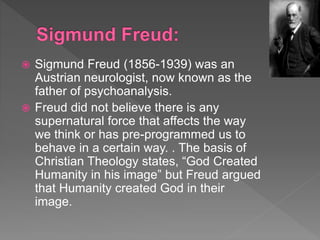
 Sigmund Freud (1856-1939) was an
Austrian neurologist, now known as the
father of psychoanalysis.
 Freud did not believe there is any
supernatural force that affects the way
we think or has pre-programmed us to
behave in a certain way. . The basis of
Christian Theology states, “God Created
Humanity in his image” but Freud argued
that Humanity created God in their
image.
Freud believed that religion is
constructed by the mind.
The idea that religion causes people
to behave in a moral way is incorrect
according to Freud because he
believed that no other force has the
power to control the ways in which
people act. Unconscious desires
motivate people to act accordingly.
 Part of your mind responsible for
logic and reasoning.
 Communicates with outside world &
inner self through speech, pictures,
writing and physical movement.
 Voluntary action
 Aware of things you are doing.
Part of your mind responsible for all
of your involuntary actions.
 Your breathing rate and heart beats
are controlled by your subconscious
mind.
 Emotions are also controlled by your
subconscious mind.
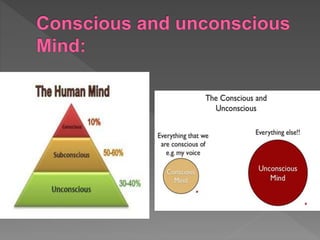
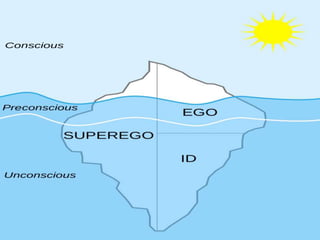
 Unconscious mind are the storage place of
all your memories, emotions and habits.
 Storehouse of all memories & past
experiences, repressed ideas.
 Unconscious mind constantly communicates
with the conscious mind via our
subconscious mind.
 It communicates through feelings, emotions,
imagination, sensations & dreams.
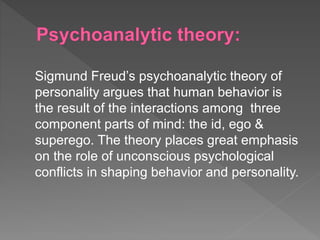
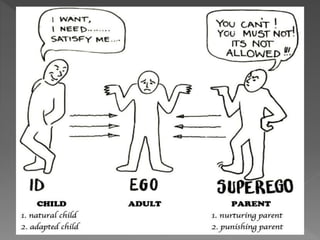
Sigmund Freud’s psychoanalytic theory of
personality argues that human behavior is
the result of the interactions among three
component parts of mind: the id, ego &
superego. The theory places great emphasis
on the role of unconscious psychological
conflicts in shaping behavior and personality.
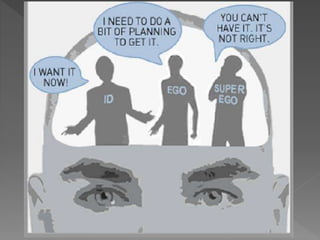
 The id according to Freud is the part of the
unconscious that seeks pleasure.
 It is unconscious part of mind that is based
on desire to seek immediate satisfaction.
 Freud explained id makes people engage in
need- satisfying behavior without any
accordance to what is right or wrong.
 Id is like a child, e.g. (ice-cream)
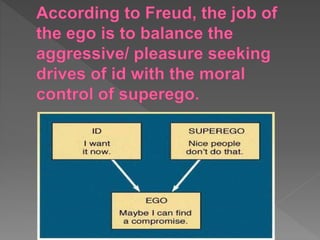
 The ego is responsible for creating balance
between pleasure and pain.
 Ego is opposite of id, which focuses on
morality & justice.
 The ego is judgment portion of the
personality.
 Ego is partly conscious and partly
unconscious.
 Freud named it as ‘self’.
 The superego, which develops around age
four or five, incorporates the morals of
society.
 superego has the ability to distinguish
between reality as well as what is right and
wrong.
 Freud believed people would act out with
aggression and other immoral behaviors
because the mind would have no way of
understanding the difference between right
and wrong.
Freud separates the superego into two
categories; ‘ideal self’ & ‘conscious’.
 The ‘conscious’ contains ideals and
morals that exist within the society that
prevent people from acting out based on
their internal desires.
 The ‘ideal self’ contains images of how
people ought to behave according to
societies ideals.
The aim of psychoanalysis therapy is
to release repressed emotions and
experiences, i.e. make the
Unconscious Conscious.
Psychoanalysis is commonly used to
treat depression and anxiety
disorders.
psychoanalytictheorybysigmundfreud-210604045800.pdf

psychoanalytictheorybysigmundfreud-210604045800.pdf

  • 1.
    Dr. Purshottam Assistant Professor(Guest Faculty) Department of Social Work, KUK
  • 2.
     A methodof explaining and treating mental and emotional problems by having the patient talk about dreams, feelings, memories etc.  A method of studying the mind and treating mental and emotional disorders based on revealing and investigating the role of the unconscious mind.
  • 3.
     Sigmund Freud(1856-1939) was an Austrian neurologist, now known as the father of psychoanalysis.  Freud did not believe there is any supernatural force that affects the way we think or has pre-programmed us to behave in a certain way. . The basis of Christian Theology states, “God Created Humanity in his image” but Freud argued that Humanity created God in their image.
  • 4.
    Freud believed thatreligion is constructed by the mind. The idea that religion causes people to behave in a moral way is incorrect according to Freud because he believed that no other force has the power to control the ways in which people act. Unconscious desires motivate people to act accordingly.
  • 6.
     Part ofyour mind responsible for logic and reasoning.  Communicates with outside world & inner self through speech, pictures, writing and physical movement.  Voluntary action  Aware of things you are doing.
  • 7.
    Part of yourmind responsible for all of your involuntary actions.  Your breathing rate and heart beats are controlled by your subconscious mind.  Emotions are also controlled by your subconscious mind.
  • 8.
     Unconscious mindare the storage place of all your memories, emotions and habits.  Storehouse of all memories & past experiences, repressed ideas.  Unconscious mind constantly communicates with the conscious mind via our subconscious mind.  It communicates through feelings, emotions, imagination, sensations & dreams.
  • 9.
    Sigmund Freud’s psychoanalytictheory of personality argues that human behavior is the result of the interactions among three component parts of mind: the id, ego & superego. The theory places great emphasis on the role of unconscious psychological conflicts in shaping behavior and personality.
  • 13.
     The idaccording to Freud is the part of the unconscious that seeks pleasure.  It is unconscious part of mind that is based on desire to seek immediate satisfaction.  Freud explained id makes people engage in need- satisfying behavior without any accordance to what is right or wrong.  Id is like a child, e.g. (ice-cream)
  • 14.
     The egois responsible for creating balance between pleasure and pain.  Ego is opposite of id, which focuses on morality & justice.  The ego is judgment portion of the personality.  Ego is partly conscious and partly unconscious.  Freud named it as ‘self’.
  • 15.
     The superego,which develops around age four or five, incorporates the morals of society.  superego has the ability to distinguish between reality as well as what is right and wrong.  Freud believed people would act out with aggression and other immoral behaviors because the mind would have no way of understanding the difference between right and wrong.
  • 16.
    Freud separates thesuperego into two categories; ‘ideal self’ & ‘conscious’.  The ‘conscious’ contains ideals and morals that exist within the society that prevent people from acting out based on their internal desires.  The ‘ideal self’ contains images of how people ought to behave according to societies ideals.
  • 18.
    The aim ofpsychoanalysis therapy is to release repressed emotions and experiences, i.e. make the Unconscious Conscious. Psychoanalysis is commonly used to treat depression and anxiety disorders.