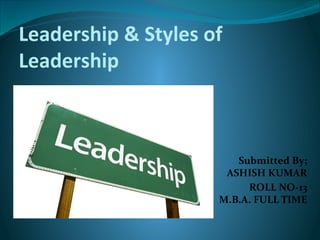
Leadership & Styles of
Leadership
Submitted By;
ASHISH KUMAR
ROLL NO-13
M.B.A. FULL TIME
PRESENTATION OVERVIEW
INTRODUCTION
LEADERSHIP DEFINITION
QUALITIES OF LEADERSHIP
IMPORTANCE OF LEADERSHIP
STYLES OF LEADERSHIP
FACTOR EFFECTING STYLES OF LEADERSHIP
CONCLUSION
REFRENCES
INTRODUCTION
Leadership is an integral part of management and
plays a vital role in managerial operations. It provides
direction, guidance and confidence to the employees
and helps organization in the attainment of goals in
much easier way. It acquires dominance and the
followers accept the directives and control of a leader. It
provides direction and vision for future to an
Organization. In short it induced Individual’s to
contribute optimum towards the attainment of
Organization goal.
DEFINITION
• “ LEADERSHIP is the process of influencing the
activities of an individual or a group in efforts towards
goal achievement in a given situation”.
• It is the art of influencing and inspiring subordinates
to perform their duties willingly, competently and
enthusiastically for achievement of group objectives.
OUALITIES OF LEADERSHIP
KEY LEADERSHIP
QUALITY
CLEAR VISION
QUICKLY SENSE
AND RESPOND TO
THE PROBLEM
POSITIVE SELF IMAGE
INNOVATIVE IDEAS TO
PROBLEM
IMPORTANCE OF LEADERSHIP
Securing Co-operation
Use of power
Co-ordination and command
Maintaining Discipline
Developing group morale
STYLES OF LEADERSHIP
AUTOCRATIC OR DICTATORIAL LEADERSHIP
STYLE
DEMOCRATIC OR PARTICIPATIVE LEADERSHIP
STYLE
LAISSEZ FAIRE OR FREE REIGN LEADERSHIP
STYLE
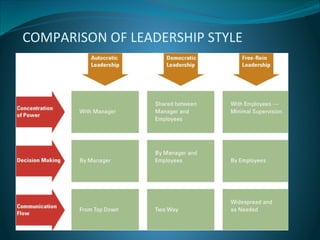
AUTOCRATIC LEADERSHIP STYLE
Autocratic
Advantages:
• Provides strong motivation and reward for the
leader
• Quick decision making takes place as single
person decides for the whole group
• Subordinate are only to carry out the orders of
the leader
• Decision making, planning or organizing need
initiative
• Good in certain circumstances, such as urgent
task or military action.
Disadvantages:
 poor decisions, poor level of employee
motivation
 Leads to frustration, low morale and conflict
among subordinate
 Subordinate tend to shirk responsibility and
initiative.
 Full potential to subordinate and their creative
ideas are not utilized
 Organizational continuity is threatened in the
absence of the leader because subordinate get
no opportunity for development
A leadership style where
the leader makes all
decisions independently or
without consulting with
subordinate
DEMOCRATIC LEADERSHIP STYLE
Democratic
• A leadership style where a leader encourages employee
participation in decision-making
• persuasive or consultative
• Advantages: better decisions, employee motivation
• It improves the job satisfaction and morale of subordinate
• The leader multiply his abilities through the contribution
of his followers.
• It develops positive attitudes and reduces resistance to
change
• Disadvantages: delayed decision, long consultation
• This style may not yield positive result when interaction
of subordinate with leader is minimum.
• This may be used as passing the buck to others and of
abdicating responsibility
• This style need tremendous communicating and
persuasive skills on the part of leader.
LAISSEZ-FAIRE LEADERSHIP STYLE
Laissez-faire
• A leadership style where employees are
encouraged to make their own decisions within
limits
• Advantages: more freedom for employees
• Positive effect on job satisfaction and morale of
subordinates
• Maximum possible scope for development of
subordinates
• Full utilization of potential of subordinates
• Disadvantages: few guidelines, little incentive,
poor motivation, maybe a mess
• Subordinate do not get the guidance and support
of the leader
• It ignores the leader contribution just as
Autocratic style ignores the contribution of the
subordinates
• Subordinates may move in different directions
and may work at cross purpose which may
degenrate into chaos
COMPARISON OF LEADERSHIP STYLE
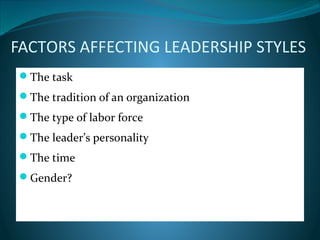
FACTORS AFFECTING LEADERSHIP STYLES
The task
The tradition of an organization
The type of labor force
The leader’s personality
The time
Gender?
MANAGER AS LEADERS
• WHICH LEADERSHIP STYLES IS BEST SUITED FOR
MANAGERS
Depends on function of the leader, subordinates, and
situation
Some leaders can’t work well with high participation of
subordinates
Some employees lack the ability or
desire to assume responsibility
Participative decision making may be better when time
pressure is not acute
MANAGER AS LEADERS con…

Leadership Styles

Autocratic leadership—boss makes decisions on
their own without consulting employees

Democratic leadership—involves subordinates in
making decisions

Free-reign leadership—leader believes in minimal
supervision, leaving most decisions to subordinates
CONCLUSION
“People ask the difference between a leader and a
boss. The leader leads, and the boss drives.”
“Innovation distinguishes between a leader and a
follower.”
REFERENCES
ORGANISATIONAL BEHAVIOUR- JIT S CHANDAN,
FRED LUTHANS AND STEPHEN P. ROBBINS
WIKIPEDIA
GOOGLE SEARCH
leadershipstyles-140704065927-phpapp01.pdf

leadershipstyles-140704065927-phpapp01.pdf

  • 1.
    Leadership & Stylesof Leadership Submitted By; ASHISH KUMAR ROLL NO-13 M.B.A. FULL TIME
  • 2.
    PRESENTATION OVERVIEW INTRODUCTION LEADERSHIP DEFINITION QUALITIESOF LEADERSHIP IMPORTANCE OF LEADERSHIP STYLES OF LEADERSHIP FACTOR EFFECTING STYLES OF LEADERSHIP CONCLUSION REFRENCES
  • 3.
    INTRODUCTION Leadership is anintegral part of management and plays a vital role in managerial operations. It provides direction, guidance and confidence to the employees and helps organization in the attainment of goals in much easier way. It acquires dominance and the followers accept the directives and control of a leader. It provides direction and vision for future to an Organization. In short it induced Individual’s to contribute optimum towards the attainment of Organization goal.
  • 4.
    DEFINITION • “ LEADERSHIPis the process of influencing the activities of an individual or a group in efforts towards goal achievement in a given situation”. • It is the art of influencing and inspiring subordinates to perform their duties willingly, competently and enthusiastically for achievement of group objectives.
  • 5.
    OUALITIES OF LEADERSHIP KEYLEADERSHIP QUALITY CLEAR VISION QUICKLY SENSE AND RESPOND TO THE PROBLEM POSITIVE SELF IMAGE INNOVATIVE IDEAS TO PROBLEM
  • 6.
    IMPORTANCE OF LEADERSHIP SecuringCo-operation Use of power Co-ordination and command Maintaining Discipline Developing group morale
  • 7.
    STYLES OF LEADERSHIP AUTOCRATICOR DICTATORIAL LEADERSHIP STYLE DEMOCRATIC OR PARTICIPATIVE LEADERSHIP STYLE LAISSEZ FAIRE OR FREE REIGN LEADERSHIP STYLE
  • 9.
    AUTOCRATIC LEADERSHIP STYLE Autocratic Advantages: •Provides strong motivation and reward for the leader • Quick decision making takes place as single person decides for the whole group • Subordinate are only to carry out the orders of the leader • Decision making, planning or organizing need initiative • Good in certain circumstances, such as urgent task or military action. Disadvantages:  poor decisions, poor level of employee motivation  Leads to frustration, low morale and conflict among subordinate  Subordinate tend to shirk responsibility and initiative.  Full potential to subordinate and their creative ideas are not utilized  Organizational continuity is threatened in the absence of the leader because subordinate get no opportunity for development A leadership style where the leader makes all decisions independently or without consulting with subordinate
  • 10.
    DEMOCRATIC LEADERSHIP STYLE Democratic •A leadership style where a leader encourages employee participation in decision-making • persuasive or consultative • Advantages: better decisions, employee motivation • It improves the job satisfaction and morale of subordinate • The leader multiply his abilities through the contribution of his followers. • It develops positive attitudes and reduces resistance to change • Disadvantages: delayed decision, long consultation • This style may not yield positive result when interaction of subordinate with leader is minimum. • This may be used as passing the buck to others and of abdicating responsibility • This style need tremendous communicating and persuasive skills on the part of leader.
  • 11.
    LAISSEZ-FAIRE LEADERSHIP STYLE Laissez-faire •A leadership style where employees are encouraged to make their own decisions within limits • Advantages: more freedom for employees • Positive effect on job satisfaction and morale of subordinates • Maximum possible scope for development of subordinates • Full utilization of potential of subordinates • Disadvantages: few guidelines, little incentive, poor motivation, maybe a mess • Subordinate do not get the guidance and support of the leader • It ignores the leader contribution just as Autocratic style ignores the contribution of the subordinates • Subordinates may move in different directions and may work at cross purpose which may degenrate into chaos
  • 12.
  • 13.
    FACTORS AFFECTING LEADERSHIPSTYLES The task The tradition of an organization The type of labor force The leader’s personality The time Gender?
  • 14.
    MANAGER AS LEADERS •WHICH LEADERSHIP STYLES IS BEST SUITED FOR MANAGERS Depends on function of the leader, subordinates, and situation Some leaders can’t work well with high participation of subordinates Some employees lack the ability or desire to assume responsibility Participative decision making may be better when time pressure is not acute
  • 15.
    MANAGER AS LEADERScon…  Leadership Styles  Autocratic leadership—boss makes decisions on their own without consulting employees  Democratic leadership—involves subordinates in making decisions  Free-reign leadership—leader believes in minimal supervision, leaving most decisions to subordinates
  • 16.
    CONCLUSION “People ask thedifference between a leader and a boss. The leader leads, and the boss drives.” “Innovation distinguishes between a leader and a follower.”
  • 17.
    REFERENCES ORGANISATIONAL BEHAVIOUR- JITS CHANDAN, FRED LUTHANS AND STEPHEN P. ROBBINS WIKIPEDIA GOOGLE SEARCH