CHANGES IN ELECTRICAL REACTION
 When there is a disease or injury of motor nerves or muscles then there
will be a changes in their response to the electrical stimulation. These
changes are know as electrical reaction changes .
 These altered electrical response are useful in diagnosis of the injury or
lesion of nerves
 The changes will be in the following :-
¥ neuron
¥ Nerve
¥ Muscle
¥ NMJ
¥ Denervated muscle
NEURON LESION
 A lesion is any abnormality in the tissue of an organism (in
layman's terms, "damage"), usually caused
by disease or trauma. Lesion is derived from the Latin
word laesio meaning injury.
 This lesion are of many type but here we discuss about
LOWER MOTOR NEURON LESION
UPPER MOTOR NEURON LESION
MUSCLE LESION
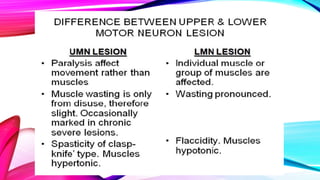
UPPER MOTOR NEURON LESION
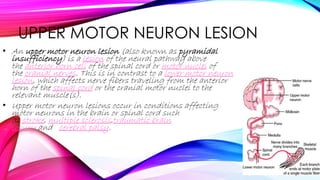
• An upper motor neuron lesion (also known as pyramidal
insufficiency) is a lesion of the neural pathway above
the anterior horn cell of the spinal cord or motor nuclei of
the cranial nerves. This is in contrast to a lower motor neuron
lesion, which affects nerve fibers traveling from the anterior
horn of the spinal cord or the cranial motor nuclei to the
relevant muscle(s).
• Upper motor neuron lesions occur in conditions affecting
motor neurons in the brain or spinal cord such
as stroke, multiple sclerosis,traumatic brain
injury and cerebral palsy.
LOWER MOTOR NEURON
LESION
• A lower motor neuron lesion is a lesion which affects nerve
fibers traveling from the anterior grey column of the spinal
cord to the relevant muscle(s) – the lower motor neuron.[1]
• One major characteristic used to identify a lower motor
neuron lesion is flaccid paralysis – paralysis accompanied
by loss of muscle tone. This is in contrast to an upper motor
neuron lesion, which often presents with spastic paralysis –
paralysis accompanied by severe hypertonia.
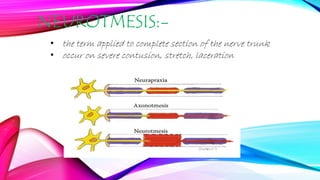
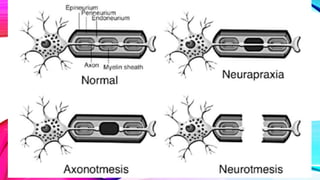
NERVE INJURY
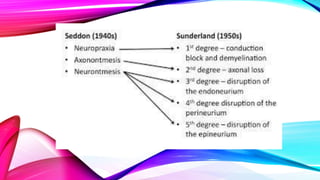
Seddon (1944) described
3 clinical types of nerve injury:
1. NEUROPRAXIA
2. AXONOTEMISIS
3. NEUROTEMISIS
NEUROPRAXIA :-
the term applied to a transient block
paralysis is incomplete, recovery is rapid & complete, &
there is no nerve degeneration
pressure is the most common cause
Mildest form, reversible conduction block (function loss), for
hours or days due to direct mechanical
compression, ischemia, mild burn trauma or stretch
AXONOTMESIS:-
• the term applied to a nerve lesion in which the axons are
damaged but the surrounding connective tissue sheaths
remain intact
• Wallerian degeneration occurs peripherally
• functional recovery is more rapid & more complete than after
complete section of the nerve trunk
• crush injuries, traction, & compression are the most common
causes
NEUROTMESIS:-
• the term applied to complete section of the nerve trunk
• occur on severe contusion, stretch, laceration
NERVE INJURY :-
Sunderland (1951) expanded Seddon’s classification to 5 degrees:
First-degree (Class I)
• Seddon’s Neuropraxia & first-degree are the same
Second-degree (Class II)
• Seddon’s Axonotmesis & second-degree are the same
Third-degree (Class II)
• nerve fiber interruption
• there is a lesion of the endoneurium, but the epineurium & perineurium
remain intact
• recovery from a third-degree injury is possible, but surgical intervention
may be required
• surgical treatment
Fourth-degree (Class II)
only the epineurium remain intact
surgical repair is required
Fifth-degree (Class III)
lesion of complete transection of the nerve
Recovery is not possible without an appropriate
NEURO MUSCULAR JUNCTION
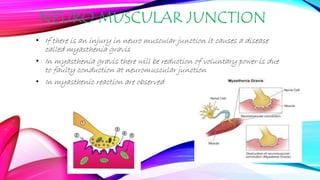
• If there is an injury in neuro muscular junction it causes a disease
called myasthenia gravis
• In myasthenia gravis there will be reduction of voluntary power is due
to faulty conduction at neuromuscular junction
• In myasthenic reaction are observed
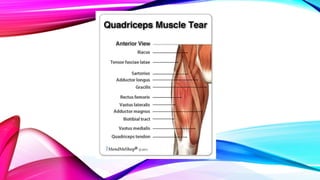
MUSCLE LESIONS :-
• muscular lesion is identifiable by the loss of functionality of
the muscle caused by damage, more or less severe, on a level of
muscular structure or on a level of anatomical sites assigned
to transmit strength
• There will no reaction in the muscle when there is a lesion
when it is stimulated . This absence of reaction is known as
absolute degeneration and may also cause longstanding
denervation
• These is seen in ischemic contractures or in the advanced
stages of myopathies
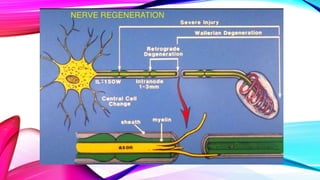
REACTION OF DENERVATION
• The denervated part gets wallerian degeneration below the
site of injury and above it as far as the first node of raniver
• It takes 21 days for the complete regeneration
• The electrical reactions must not be test until after the 3
weeks after the injury
• In span of 3 weeks the damaged the nerve fibre grt
degenerated and muscle becomes innervated
TESTS
The developmental changes are noted may taking the following
tests:-
1. electro myography
2. S.D Curve
3. Faradaic interrupted D.C. method
4. Nerve conduction velocity test
5. Rheo base
6. Chronexia
7. H –reflex
8. F-wave
9. Fatigue test
10.Bio feed back test
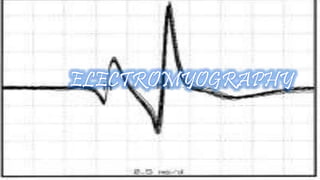
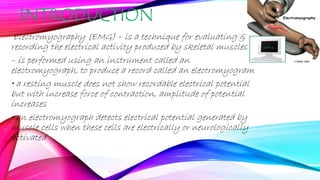
INTRODUCTION
Electromyography (EMG) – is a technique for evaluating &
recording the electrical activity produced by skeletal muscles
– is performed using an instrument called an
electromyograph, to produce a record called an electromyogram
• a resting muscle does not show recordable electrical potential
but with increase force of contraction, amplitude of potential
increases
• an electromyograph detects electrical potential generated by
muscle cells when these cells are electrically or neurologically
activated
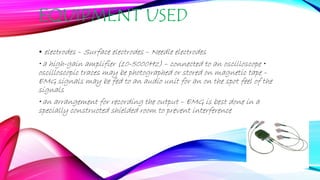
EQUIPMENT USED
• electrodes – Surface electrodes – Needle electrodes
• a high-gain amplifier (10-5000Hz) – connected to an oscilloscope •
oscilloscopic traces may be photographed or stored on magnetic tape –
EMG signals may be fed to an audio unit for an on the spot feel of the
signals
• an arrangement for recording the output – EMG is best done in a
specially constructed shielded room to prevent interference
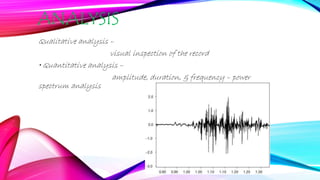
ANALYSIS
Qualitative analysis –
visual inspection of the record
• Quantitative analysis –
amplitude, duration, & frequency – power
spectrum analysis
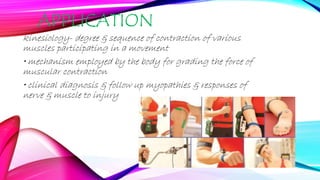
APPLICATION
kinesiology- degree & sequence of contraction of various
muscles participating in a movement
• mechanism employed by the body for grading the force of
muscular contraction
• clinical diagnosis & follow up myopathies & responses of
nerve & muscle to injury
Electrical reaction

Electrical reaction

  • 3.
    CHANGES IN ELECTRICALREACTION  When there is a disease or injury of motor nerves or muscles then there will be a changes in their response to the electrical stimulation. These changes are know as electrical reaction changes .  These altered electrical response are useful in diagnosis of the injury or lesion of nerves  The changes will be in the following :- ¥ neuron ¥ Nerve ¥ Muscle ¥ NMJ ¥ Denervated muscle
  • 4.
    NEURON LESION  Alesion is any abnormality in the tissue of an organism (in layman's terms, "damage"), usually caused by disease or trauma. Lesion is derived from the Latin word laesio meaning injury.  This lesion are of many type but here we discuss about LOWER MOTOR NEURON LESION UPPER MOTOR NEURON LESION MUSCLE LESION
  • 5.
    UPPER MOTOR NEURONLESION • An upper motor neuron lesion (also known as pyramidal insufficiency) is a lesion of the neural pathway above the anterior horn cell of the spinal cord or motor nuclei of the cranial nerves. This is in contrast to a lower motor neuron lesion, which affects nerve fibers traveling from the anterior horn of the spinal cord or the cranial motor nuclei to the relevant muscle(s). • Upper motor neuron lesions occur in conditions affecting motor neurons in the brain or spinal cord such as stroke, multiple sclerosis,traumatic brain injury and cerebral palsy.
  • 6.
    LOWER MOTOR NEURON LESION •A lower motor neuron lesion is a lesion which affects nerve fibers traveling from the anterior grey column of the spinal cord to the relevant muscle(s) – the lower motor neuron.[1] • One major characteristic used to identify a lower motor neuron lesion is flaccid paralysis – paralysis accompanied by loss of muscle tone. This is in contrast to an upper motor neuron lesion, which often presents with spastic paralysis – paralysis accompanied by severe hypertonia.
  • 8.
    NERVE INJURY Seddon (1944)described 3 clinical types of nerve injury: 1. NEUROPRAXIA 2. AXONOTEMISIS 3. NEUROTEMISIS
  • 9.
    NEUROPRAXIA :- the termapplied to a transient block paralysis is incomplete, recovery is rapid & complete, & there is no nerve degeneration pressure is the most common cause Mildest form, reversible conduction block (function loss), for hours or days due to direct mechanical compression, ischemia, mild burn trauma or stretch
  • 10.
    AXONOTMESIS:- • the termapplied to a nerve lesion in which the axons are damaged but the surrounding connective tissue sheaths remain intact • Wallerian degeneration occurs peripherally • functional recovery is more rapid & more complete than after complete section of the nerve trunk • crush injuries, traction, & compression are the most common causes
  • 11.
    NEUROTMESIS:- • the termapplied to complete section of the nerve trunk • occur on severe contusion, stretch, laceration
  • 13.
    NERVE INJURY :- Sunderland(1951) expanded Seddon’s classification to 5 degrees: First-degree (Class I) • Seddon’s Neuropraxia & first-degree are the same Second-degree (Class II) • Seddon’s Axonotmesis & second-degree are the same Third-degree (Class II) • nerve fiber interruption • there is a lesion of the endoneurium, but the epineurium & perineurium remain intact • recovery from a third-degree injury is possible, but surgical intervention may be required • surgical treatment
  • 14.
    Fourth-degree (Class II) onlythe epineurium remain intact surgical repair is required Fifth-degree (Class III) lesion of complete transection of the nerve Recovery is not possible without an appropriate
  • 16.
    NEURO MUSCULAR JUNCTION •If there is an injury in neuro muscular junction it causes a disease called myasthenia gravis • In myasthenia gravis there will be reduction of voluntary power is due to faulty conduction at neuromuscular junction • In myasthenic reaction are observed
  • 17.
    MUSCLE LESIONS :- •muscular lesion is identifiable by the loss of functionality of the muscle caused by damage, more or less severe, on a level of muscular structure or on a level of anatomical sites assigned to transmit strength • There will no reaction in the muscle when there is a lesion when it is stimulated . This absence of reaction is known as absolute degeneration and may also cause longstanding denervation • These is seen in ischemic contractures or in the advanced stages of myopathies
  • 19.
    REACTION OF DENERVATION •The denervated part gets wallerian degeneration below the site of injury and above it as far as the first node of raniver • It takes 21 days for the complete regeneration • The electrical reactions must not be test until after the 3 weeks after the injury • In span of 3 weeks the damaged the nerve fibre grt degenerated and muscle becomes innervated
  • 21.
    TESTS The developmental changesare noted may taking the following tests:- 1. electro myography 2. S.D Curve 3. Faradaic interrupted D.C. method 4. Nerve conduction velocity test 5. Rheo base 6. Chronexia 7. H –reflex 8. F-wave 9. Fatigue test 10.Bio feed back test
  • 23.
    INTRODUCTION Electromyography (EMG) –is a technique for evaluating & recording the electrical activity produced by skeletal muscles – is performed using an instrument called an electromyograph, to produce a record called an electromyogram • a resting muscle does not show recordable electrical potential but with increase force of contraction, amplitude of potential increases • an electromyograph detects electrical potential generated by muscle cells when these cells are electrically or neurologically activated
  • 24.
    EQUIPMENT USED • electrodes– Surface electrodes – Needle electrodes • a high-gain amplifier (10-5000Hz) – connected to an oscilloscope • oscilloscopic traces may be photographed or stored on magnetic tape – EMG signals may be fed to an audio unit for an on the spot feel of the signals • an arrangement for recording the output – EMG is best done in a specially constructed shielded room to prevent interference
  • 25.
    ANALYSIS Qualitative analysis – visualinspection of the record • Quantitative analysis – amplitude, duration, & frequency – power spectrum analysis
  • 26.
    APPLICATION kinesiology- degree &sequence of contraction of various muscles participating in a movement • mechanism employed by the body for grading the force of muscular contraction • clinical diagnosis & follow up myopathies & responses of nerve & muscle to injury