Group #4 Dell Corporation in Brazil
Outline About Brazil About DELL SWOT  Preconditions of entering Brazil DELL strategic position PESTEL analysis Key Success Factors DELL's sub-branding Recommendations
About Brazil  Largest population in Latin America – 180 mln inhabitants Good economy conditions Mercosur custom union with other countries of Latin America (duty-free access to all of the members of union) Exchange rate R$/US$ is increasing (appreciation of R$)
By year 2000 Brazilian economy is growing rapidly Production growth increased  by 11,2%, while predicted rate was only 6,8% Export increased by 13.8% ($8.62 bln.) Import increased by 18.6% ($9.02 bln.) About Brazil
Brazilian PC Market Main segments in PC market: Home Small business Government  Commercial
Gray Market and Firms Imported computers were dismantled and re-assembled receiving a local brand and sold at dramatically low prices Imported parts without duties Workers under table Frequent infringement on copyrights No sales taxes Not required to invest in government programs
DELL Founded in 1984 by Michael Dell Products: Servers, storages and networking Printing and imaging Computers Electronics and accessories Enterprise services Customer services DELL's concept  is that by selling computer systems directly to customers will help to understand their needs better Strategy  contains direct customers model with new distribution channels
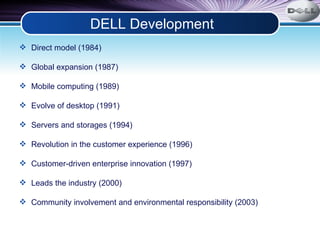
DELL Development Direct model (1984) Global expansion (1987) Mobile computing (1989) Evolve of desktop (1991) Servers and storages (1994) Revolution in the customer experience (1996) Customer-driven enterprise innovation (1997) Leads the industry (2000) Community involvement and environmental responsibility (2003)
Customer-Driven Innovation Listen=> Solve=> Impact   DELL gathers requirements directly through customer interactions daily, organized events, social media venues, and customer panels, which gives a uniquely broad perspective on the computing landscape. The mission is to deliver innovative and cost-effective solutions that meet today's real-life customer challenges and work in existing environments and with other products. Dell is uniquely positioned to impact industry trends
FACTS about DELL Every Fortune 100 company does business with Dell. DELL is the #1 PC provider in the U.S. and #2 worldwide. About 140,000 systems shipped per day, on average – that’s more than one every second. DELL more than 400 product awards in 2007. DELL rank No. 34 among the Fortune 500 24 of the world’s top supercomputers run on Dell. The top 6 Internet service companies run on Dell. Its the first and only computer company offering free computer recycling to consumers worldwide.
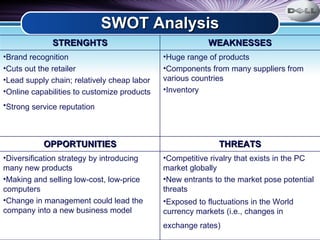
SWOT Analysis STRENGHTS WEAKNESSES Brand recognition  Cuts out the retailer  Lea d  supply chain; relatively cheap labor  Online capabilities to customize products  Strong service reputation   Huge range of products C omponents from many suppliers from various countries  Inventory  OPPORTUNITIES THREATS Diversification strategy by introducing many new products Making and selling low-cost, low-price computers Change in management could lead the company into a new  business model Competitive rivalry that exists in the PC market globally  New entrants to the market pose potential threats  Exposed to fluctuations in the World currency markets (i.e., changes in exchange rates)
Preconditions for Entering Brazil Increasing demand from global clients Long delivery times High delivery costs Customs regulations, tariffs and frequent strikes Import tax rate for PC was 32% in 1998
Dell Strategic Position Threat of  Entrance Rivalry Bargaining Power Suppliers Bargaining Power Buyers Threat of  Substitute Medium High Low High Low
PESTEL Analysis Political Changes of government ideology (policy, etc) Influences of local municipal reform Economic Largest population with GDP factor Well-developed manufacturing, services and other sectors Social Dell Corp. has good international reputation
PESTEL Analysis Technological Computer technology can be used as a tool in production sector of Brazil Environmental El Dorado was located near universities and 4 metropolitan centers Competition for inner city facilities (gray market) Legislative Implemented reserve policy Legislation on product
Key Success Factors Direct Marketing Model Lower Cost Differentiation  Quality Product Customization of Product
Dell’s Sub-Branding Sub-brands : C an fit with local communities  Must  show something similar to the umbrella brand  H elps identify perception of the specific audience  Dell  need  to sure  that the brand connects : E motional and rational aspect
Recommendation and Alternatives DELL must be aware of the benefits they want to realize   Ensure the image  customer satisfaction  consumer awareness  DELL relies on reputation in the Brazil market  award-winning service  high-quality product
THANK YOU FOR YOUR ATTENTION! You are welcome to ask questions

DELL project

  • 1.
    Group #4 DellCorporation in Brazil
  • 2.
    Outline About BrazilAbout DELL SWOT Preconditions of entering Brazil DELL strategic position PESTEL analysis Key Success Factors DELL's sub-branding Recommendations
  • 3.
    About Brazil Largest population in Latin America – 180 mln inhabitants Good economy conditions Mercosur custom union with other countries of Latin America (duty-free access to all of the members of union) Exchange rate R$/US$ is increasing (appreciation of R$)
  • 4.
    By year 2000Brazilian economy is growing rapidly Production growth increased by 11,2%, while predicted rate was only 6,8% Export increased by 13.8% ($8.62 bln.) Import increased by 18.6% ($9.02 bln.) About Brazil
  • 5.
    Brazilian PC MarketMain segments in PC market: Home Small business Government Commercial
  • 6.
    Gray Market andFirms Imported computers were dismantled and re-assembled receiving a local brand and sold at dramatically low prices Imported parts without duties Workers under table Frequent infringement on copyrights No sales taxes Not required to invest in government programs
  • 7.
    DELL Founded in1984 by Michael Dell Products: Servers, storages and networking Printing and imaging Computers Electronics and accessories Enterprise services Customer services DELL's concept is that by selling computer systems directly to customers will help to understand their needs better Strategy contains direct customers model with new distribution channels
  • 8.
    DELL Development Directmodel (1984) Global expansion (1987) Mobile computing (1989) Evolve of desktop (1991) Servers and storages (1994) Revolution in the customer experience (1996) Customer-driven enterprise innovation (1997) Leads the industry (2000) Community involvement and environmental responsibility (2003)
  • 9.
    Customer-Driven Innovation Listen=>Solve=> Impact DELL gathers requirements directly through customer interactions daily, organized events, social media venues, and customer panels, which gives a uniquely broad perspective on the computing landscape. The mission is to deliver innovative and cost-effective solutions that meet today's real-life customer challenges and work in existing environments and with other products. Dell is uniquely positioned to impact industry trends
  • 10.
    FACTS about DELLEvery Fortune 100 company does business with Dell. DELL is the #1 PC provider in the U.S. and #2 worldwide. About 140,000 systems shipped per day, on average – that’s more than one every second. DELL more than 400 product awards in 2007. DELL rank No. 34 among the Fortune 500 24 of the world’s top supercomputers run on Dell. The top 6 Internet service companies run on Dell. Its the first and only computer company offering free computer recycling to consumers worldwide.
  • 11.
    SWOT Analysis STRENGHTSWEAKNESSES Brand recognition Cuts out the retailer Lea d supply chain; relatively cheap labor Online capabilities to customize products Strong service reputation Huge range of products C omponents from many suppliers from various countries Inventory OPPORTUNITIES THREATS Diversification strategy by introducing many new products Making and selling low-cost, low-price computers Change in management could lead the company into a new business model Competitive rivalry that exists in the PC market globally New entrants to the market pose potential threats Exposed to fluctuations in the World currency markets (i.e., changes in exchange rates)
  • 12.
    Preconditions for EnteringBrazil Increasing demand from global clients Long delivery times High delivery costs Customs regulations, tariffs and frequent strikes Import tax rate for PC was 32% in 1998
  • 13.
    Dell Strategic PositionThreat of Entrance Rivalry Bargaining Power Suppliers Bargaining Power Buyers Threat of Substitute Medium High Low High Low
  • 14.
    PESTEL Analysis PoliticalChanges of government ideology (policy, etc) Influences of local municipal reform Economic Largest population with GDP factor Well-developed manufacturing, services and other sectors Social Dell Corp. has good international reputation
  • 15.
    PESTEL Analysis TechnologicalComputer technology can be used as a tool in production sector of Brazil Environmental El Dorado was located near universities and 4 metropolitan centers Competition for inner city facilities (gray market) Legislative Implemented reserve policy Legislation on product
  • 16.
    Key Success FactorsDirect Marketing Model Lower Cost Differentiation Quality Product Customization of Product
  • 17.
    Dell’s Sub-Branding Sub-brands: C an fit with local communities Must show something similar to the umbrella brand H elps identify perception of the specific audience Dell need to sure that the brand connects : E motional and rational aspect
  • 18.
    Recommendation and AlternativesDELL must be aware of the benefits they want to realize Ensure the image customer satisfaction consumer awareness DELL relies on reputation in the Brazil market award-winning service high-quality product
  • 19.
    THANK YOU FORYOUR ATTENTION! You are welcome to ask questions