CLASS- VII
MODULE -1
HISTORY
DELHI SULTANS
By
Mr. P Naik
TGT(SS) Social Science, AECS KAKRAPAR
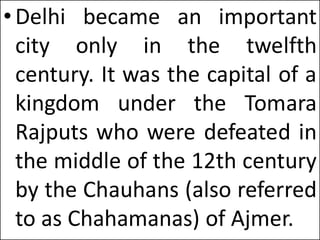
•Delhi became an important
city only in the twelfth
century. It was the capital of a
kingdom under the Tomara
Rajputs who were defeated in
the middle of the 12th century
by the Chauhans (also referred
to as Chahamanas) of Ajmer.
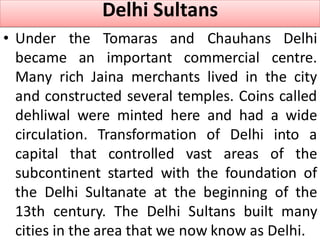
Delhi Sultans
• Under the Tomaras and Chauhans Delhi
became an important commercial centre.
Many rich Jaina merchants lived in the city
and constructed several temples. Coins called
dehliwal were minted here and had a wide
circulation. Transformation of Delhi into a
capital that controlled vast areas of the
subcontinent started with the foundation of
the Delhi Sultanate at the beginning of the
13th century. The Delhi Sultans built many
cities in the area that we now know as Delhi.
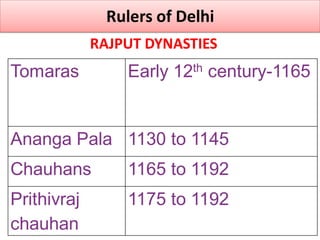
Rulers of Delhi
RAJPUT DYNASTIES
Tomaras Early 12th century-1165
Ananga Pala 1130 to 1145
Chauhans 1165 to 1192
Prithivraj
chauhan
1175 to 1192
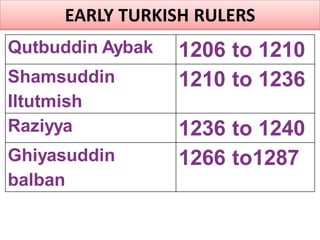
EARLY TURKISH RULERS
Qutbuddin Aybak 1206 to 1210
Shamsuddin
Iltutmish
1210 to 1236
Raziyya 1236 to 1240
Ghiyasuddin
balban
1266 to1287
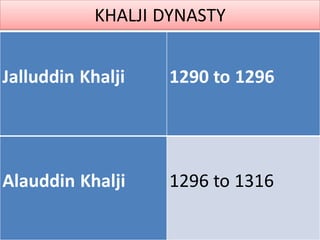
KHALJI DYNASTY
Jalluddin Khalji 1290 to 1296
Alauddin Khalji 1296 to 1316
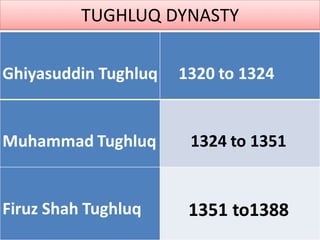
TUGHLUQ DYNASTY
Ghiyasuddin Tughluq 1320 to 1324
Muhammad Tughluq 1324 to 1351
Firuz Shah Tughluq 1351 to1388
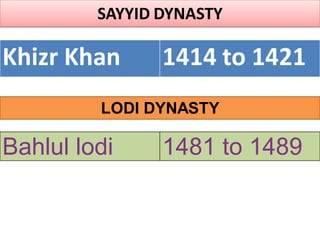
SAYYID DYNASTY
Khizr Khan 1414 to 1421
LODI DYNASTY
Bahlul lodi 1481 to 1489
Finding Out about the Delhi Sultans
Tarikh (singular)/tawarikh (plural) are
valuable histories, written in Persian, the
language of administration under the Delhi
Sultans that provide a lot of information. It
was written by learned men- secretaries,
administrators, poets and courtiers, who
both recounted events and advised rulers
on governance, emphasising the
importance of the just rule.
• Following ideas to keep in mind:
1. the authors of tawarikh lived in cities
(mainly Delhi) and hardly ever in villages.
2. They often wrote their histories for
Sultans in the hope of rich rewards.
3. These authors advised rulers on the
need to preserve an “ideal” social order
based on birthright and gender
distinctions. Their ideas were not shared
by every body.
VII_HIS_L03_M01_DELHI_SULTANS ppt_PPT.pdf

VII_HIS_L03_M01_DELHI_SULTANS ppt_PPT.pdf

  • 1.
    CLASS- VII MODULE -1 HISTORY DELHISULTANS By Mr. P Naik TGT(SS) Social Science, AECS KAKRAPAR
  • 2.
    •Delhi became animportant city only in the twelfth century. It was the capital of a kingdom under the Tomara Rajputs who were defeated in the middle of the 12th century by the Chauhans (also referred to as Chahamanas) of Ajmer.
  • 3.
    Delhi Sultans • Underthe Tomaras and Chauhans Delhi became an important commercial centre. Many rich Jaina merchants lived in the city and constructed several temples. Coins called dehliwal were minted here and had a wide circulation. Transformation of Delhi into a capital that controlled vast areas of the subcontinent started with the foundation of the Delhi Sultanate at the beginning of the 13th century. The Delhi Sultans built many cities in the area that we now know as Delhi.
  • 4.
    Rulers of Delhi RAJPUTDYNASTIES Tomaras Early 12th century-1165 Ananga Pala 1130 to 1145 Chauhans 1165 to 1192 Prithivraj chauhan 1175 to 1192
  • 5.
    EARLY TURKISH RULERS QutbuddinAybak 1206 to 1210 Shamsuddin Iltutmish 1210 to 1236 Raziyya 1236 to 1240 Ghiyasuddin balban 1266 to1287
  • 6.
    KHALJI DYNASTY Jalluddin Khalji1290 to 1296 Alauddin Khalji 1296 to 1316
  • 7.
    TUGHLUQ DYNASTY Ghiyasuddin Tughluq1320 to 1324 Muhammad Tughluq 1324 to 1351 Firuz Shah Tughluq 1351 to1388
  • 8.
    SAYYID DYNASTY Khizr Khan1414 to 1421 LODI DYNASTY Bahlul lodi 1481 to 1489
  • 9.
    Finding Out aboutthe Delhi Sultans Tarikh (singular)/tawarikh (plural) are valuable histories, written in Persian, the language of administration under the Delhi Sultans that provide a lot of information. It was written by learned men- secretaries, administrators, poets and courtiers, who both recounted events and advised rulers on governance, emphasising the importance of the just rule.
  • 10.
    • Following ideasto keep in mind: 1. the authors of tawarikh lived in cities (mainly Delhi) and hardly ever in villages. 2. They often wrote their histories for Sultans in the hope of rich rewards. 3. These authors advised rulers on the need to preserve an “ideal” social order based on birthright and gender distinctions. Their ideas were not shared by every body.