Matrix Organisation
Definition
A matrix structure is one in which both practical and geographic or product
structures are implemented concurrently and resources are shared between the
two structures. The geographic (or product) managers and functional managers
have equal authority within the organization, and employees report to both of
them.
Meaning
Matrix Organisation was presented in USA in the early 1960's. It was used to
crack organization problems in the Aerospace industry.
Matrix Organisation is a combination of two or more organisation structures. For
example, Functional Organisation and Project Organisation.
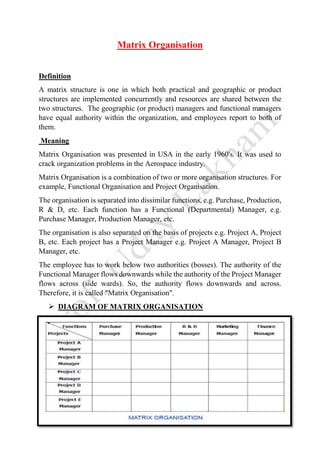
The organisation is separated into dissimilar functions, e.g. Purchase, Production,
R & D, etc. Each function has a Functional (Departmental) Manager, e.g.
Purchase Manager, Production Manager, etc.
The organisation is also separated on the basis of projects e.g. Project A, Project
B, etc. Each project has a Project Manager e.g. Project A Manager, Project B
Manager, etc.
The employee has to work below two authorities (bosses). The authority of the
Functional Manager flows downwards while the authority of the Project Manager
flows across (side wards). So, the authority flows downwards and across.
Therefore, it is called "Matrix Organisation".
 DIAGRAM OF MATRIX ORGANISATION
Features of Matrix Organisation
The characteristics or features of a matrix organisation are:-
1. Hybrid Structure : Matrix organisation is a hybrid structure. This is so,
because it is a combination of two or more organisation structures. It
combines functional organisation with a project organisation. So, it has the
qualities and shortcomings of both these organisation structures.
2. Functional Manager : The Functional Manager has authority over the
technical (functional) aspects of the project.
The responsibilities of functional manager are:-
 He decides how to do the work.
 He distributes the project work among his subordinates.
 He looks after the operational aspects.
3. Project Manager : The Project manager has authority over the
administrative aspects of the project. He has full authority over the
financial and physical resources which he can use for completing the
project.
The responsibilities of project manager are:-
 He/She decides what to do.
 He/She is responsible for scheduling the project work.
 He/She co-ordinates the activities of the different functional
members.
 He/She evaluates the project performance.
4. Problem of Unity of Command : In a matrix organisation, there is a
problem of the harmony of command. This is so, because the assistants
receive orders from two superior’s viz., the Project Manager and the
Functional Manager. This will result in misunderstanding, disorder,
indiscipline, inefficiency, etc. All this will reduce the productivity and
profitability of the project.
5. Specialization : In a Matrix organisation, there is a specialization. The
project manager concentrates on the administrative aspects of the project
while the functional manager concentrates on the technical aspects of the
project.
6. Suitability: Matrix organisation is suitable for multi-project organisations.
It is mainly used by large construction companies that construct huge
residential and commercial projects in different places at the same time.
Each project is looked after (handled) by a project manager. He is
supported by many functional managers and employees of the company.
Benefits of Matrix Organisation
The benefits or merits or advantages of a matrix organization are:-
1. Sound Decisions: In a Matrix Organisation, all decisions are taken by
experts. Therefore, the decision are very good.
2. Development of Skills: It helps the employees to widen their skills.
Marketing people can learn about finance, Finance people can learn about
marketing, etc.
3. Top Management can concentrate on Strategic Planning: The Top
Managers can spend more time on strategic planning. They can delegate
all the routine, repetitive and less important work to the project managers.
4. Responds to Changes in Environment: Matrix Organisation responds to
the negative changes in the environment. This is because it takes quick
decisions.
5. Specialization: In a matrix Organisation, there is a specialization. The
functional managers concentrate on the technical matters while the Project
Manager concentrates on the administrative matters of the project.
6. Optimum Utilization of Resources: In the matrix organization, many
projects are run at the same time. Therefore, it makes optimum use of the
human and physical resources. There is no wastage of resources in a matrix
organization.
7. Motivation: In a matrix organization, the employees work as a team. So,
they are motivated to perform better.
8. Higher Efficiency : The Matrix organisation results in a higher efficiency.
It gives high returns at lower costs.
Limitations of Matrix Organisation
The demerits or disadvantages or limitations of a matrix organisation are:-
1. Increase in Work Load: In a matrix organisation, work load is very high.
The managers and employees not only have to do their regular work, but
also have to manage other additional works like attending numerous
meetings, etc.
2. High Operational Cost: In a matrix organisation, the operational cost is
very high. This is because it involves a lot of paperwork, reports, meetings,
etc.
3. Absence of Unity of Command: In a matrix organisation, there is no unity
of command. This is because, each subordinate has two bosses, viz.,
Functional Manager and Project Manager.
4. Difficulty of Balance: In a matrix organisation, it is not easy to balance
the administrative and technical matters. It is also difficult to balance the
authority and responsibilities of the project manager and functional
manager.
5. Power Struggle: In a matrix organisation, there may be a power struggle
between the project manager and the functional manager. Each one looks
after his own interest, which causes conflicts.
6. Morale: In a matrix organisation, the morale of the employees is very low.
This is because they work on different projects at different times.
7. Complexity: Matrix organisation is very complex and the most difficult
type of organisation.
8. Shifting of Responsibility: If the project fails, the project manager may
shift the responsibility on the functional manager. That is, he will blame
the functional manager for the failure.
Summary
A matrix organization is defined as an organization where people have to report
to more than one boss. The matrix organization structure is a blend of the
projected organization and the functional organization, and tries to blend the best
of both worlds. In an organization, the project manager has all authority and
power while in a functional organization, the functional manager has the
authority. In a matrix organization, they both hold power, and this power sharing
changes according to the type of matrix structure of the organization. A matrix
structure is suited to big organizations which operate in a dynamic environment
and need a quick response to market demand.

Matrix organisation

  • 1.
    Matrix Organisation Definition A matrixstructure is one in which both practical and geographic or product structures are implemented concurrently and resources are shared between the two structures. The geographic (or product) managers and functional managers have equal authority within the organization, and employees report to both of them. Meaning Matrix Organisation was presented in USA in the early 1960's. It was used to crack organization problems in the Aerospace industry. Matrix Organisation is a combination of two or more organisation structures. For example, Functional Organisation and Project Organisation. The organisation is separated into dissimilar functions, e.g. Purchase, Production, R & D, etc. Each function has a Functional (Departmental) Manager, e.g. Purchase Manager, Production Manager, etc. The organisation is also separated on the basis of projects e.g. Project A, Project B, etc. Each project has a Project Manager e.g. Project A Manager, Project B Manager, etc. The employee has to work below two authorities (bosses). The authority of the Functional Manager flows downwards while the authority of the Project Manager flows across (side wards). So, the authority flows downwards and across. Therefore, it is called "Matrix Organisation".  DIAGRAM OF MATRIX ORGANISATION
  • 2.
    Features of MatrixOrganisation The characteristics or features of a matrix organisation are:- 1. Hybrid Structure : Matrix organisation is a hybrid structure. This is so, because it is a combination of two or more organisation structures. It combines functional organisation with a project organisation. So, it has the qualities and shortcomings of both these organisation structures. 2. Functional Manager : The Functional Manager has authority over the technical (functional) aspects of the project. The responsibilities of functional manager are:-  He decides how to do the work.  He distributes the project work among his subordinates.  He looks after the operational aspects. 3. Project Manager : The Project manager has authority over the administrative aspects of the project. He has full authority over the financial and physical resources which he can use for completing the project. The responsibilities of project manager are:-  He/She decides what to do.  He/She is responsible for scheduling the project work.  He/She co-ordinates the activities of the different functional members.  He/She evaluates the project performance. 4. Problem of Unity of Command : In a matrix organisation, there is a problem of the harmony of command. This is so, because the assistants receive orders from two superior’s viz., the Project Manager and the Functional Manager. This will result in misunderstanding, disorder, indiscipline, inefficiency, etc. All this will reduce the productivity and profitability of the project. 5. Specialization : In a Matrix organisation, there is a specialization. The project manager concentrates on the administrative aspects of the project while the functional manager concentrates on the technical aspects of the project. 6. Suitability: Matrix organisation is suitable for multi-project organisations. It is mainly used by large construction companies that construct huge residential and commercial projects in different places at the same time.
  • 3.
    Each project islooked after (handled) by a project manager. He is supported by many functional managers and employees of the company. Benefits of Matrix Organisation The benefits or merits or advantages of a matrix organization are:- 1. Sound Decisions: In a Matrix Organisation, all decisions are taken by experts. Therefore, the decision are very good. 2. Development of Skills: It helps the employees to widen their skills. Marketing people can learn about finance, Finance people can learn about marketing, etc. 3. Top Management can concentrate on Strategic Planning: The Top Managers can spend more time on strategic planning. They can delegate all the routine, repetitive and less important work to the project managers. 4. Responds to Changes in Environment: Matrix Organisation responds to the negative changes in the environment. This is because it takes quick decisions. 5. Specialization: In a matrix Organisation, there is a specialization. The functional managers concentrate on the technical matters while the Project Manager concentrates on the administrative matters of the project. 6. Optimum Utilization of Resources: In the matrix organization, many projects are run at the same time. Therefore, it makes optimum use of the human and physical resources. There is no wastage of resources in a matrix organization. 7. Motivation: In a matrix organization, the employees work as a team. So, they are motivated to perform better. 8. Higher Efficiency : The Matrix organisation results in a higher efficiency. It gives high returns at lower costs. Limitations of Matrix Organisation The demerits or disadvantages or limitations of a matrix organisation are:- 1. Increase in Work Load: In a matrix organisation, work load is very high. The managers and employees not only have to do their regular work, but also have to manage other additional works like attending numerous meetings, etc. 2. High Operational Cost: In a matrix organisation, the operational cost is very high. This is because it involves a lot of paperwork, reports, meetings, etc.
  • 4.
    3. Absence ofUnity of Command: In a matrix organisation, there is no unity of command. This is because, each subordinate has two bosses, viz., Functional Manager and Project Manager. 4. Difficulty of Balance: In a matrix organisation, it is not easy to balance the administrative and technical matters. It is also difficult to balance the authority and responsibilities of the project manager and functional manager. 5. Power Struggle: In a matrix organisation, there may be a power struggle between the project manager and the functional manager. Each one looks after his own interest, which causes conflicts. 6. Morale: In a matrix organisation, the morale of the employees is very low. This is because they work on different projects at different times. 7. Complexity: Matrix organisation is very complex and the most difficult type of organisation. 8. Shifting of Responsibility: If the project fails, the project manager may shift the responsibility on the functional manager. That is, he will blame the functional manager for the failure. Summary A matrix organization is defined as an organization where people have to report to more than one boss. The matrix organization structure is a blend of the projected organization and the functional organization, and tries to blend the best of both worlds. In an organization, the project manager has all authority and power while in a functional organization, the functional manager has the authority. In a matrix organization, they both hold power, and this power sharing changes according to the type of matrix structure of the organization. A matrix structure is suited to big organizations which operate in a dynamic environment and need a quick response to market demand.