Degree of Compounding
Submitted by:
Md. Ziaul Haque
ID: 555181028
Submitted to:
Najmin Ara Sultana
Lecturer, Department of EEE
Hamdard University Bangladesh
1
Index
 Compound generator
 Types of compound generator
 What is diverter ?
 Comparison of generator terminal voltage
A. Cumulative Compound Generator
1. Over compound
2. Flat compound
3. Under compound
B. Differential Compound Generator
2
Compound generator
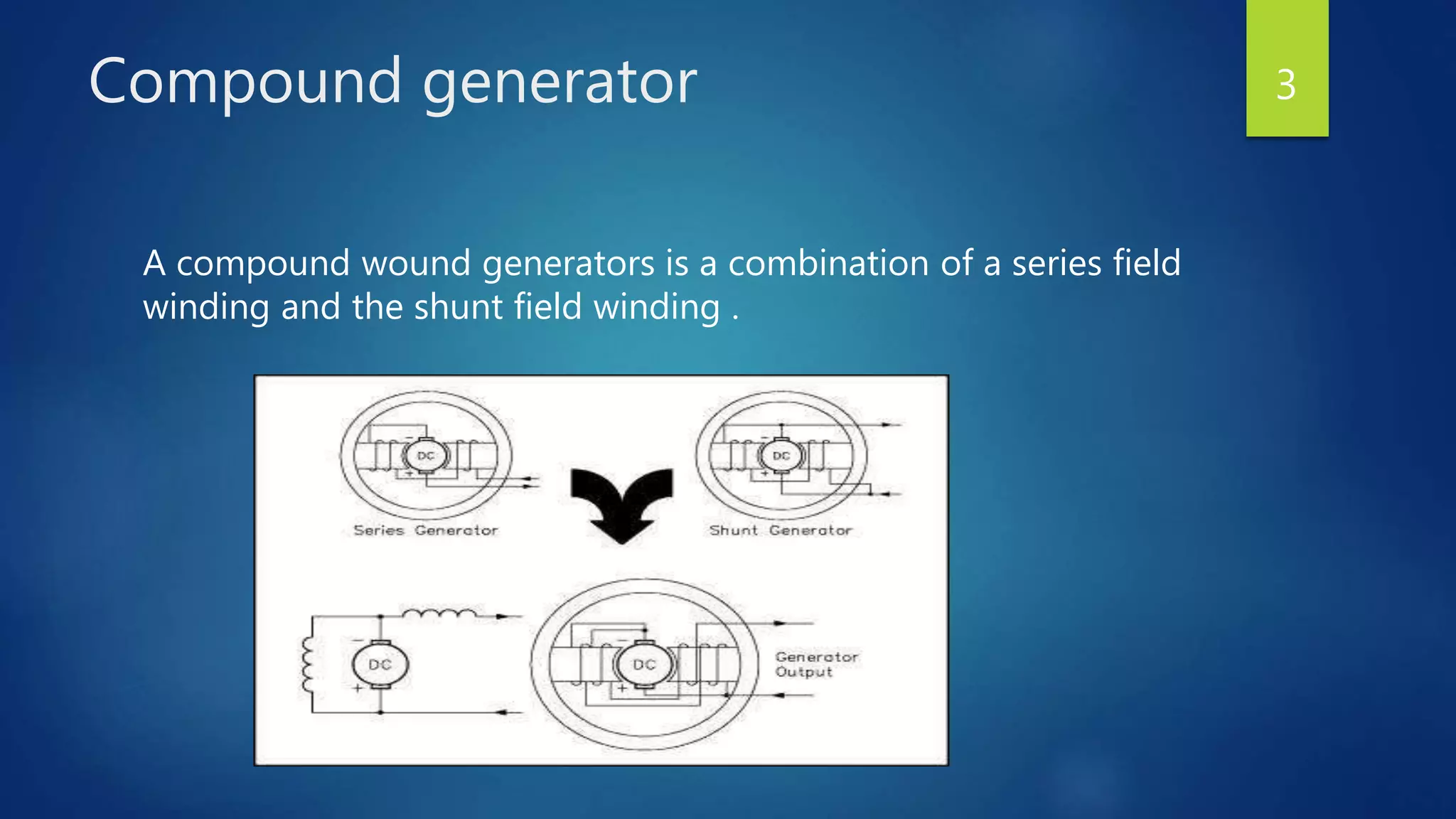
A compound wound generators is a combination of a series field
winding and the shunt field winding .
3
Types of compound generator
There are two types of compound generator-
 Cumulative Compound Generator : When the series field
assists the shunt field, generator is said to be Cumulative
Compound Generator.
 Differential Compound Generator: When the series field
opposes the shunt field, generator is said to be Differential
Compound Wound Generator.
4
What is diverter ?
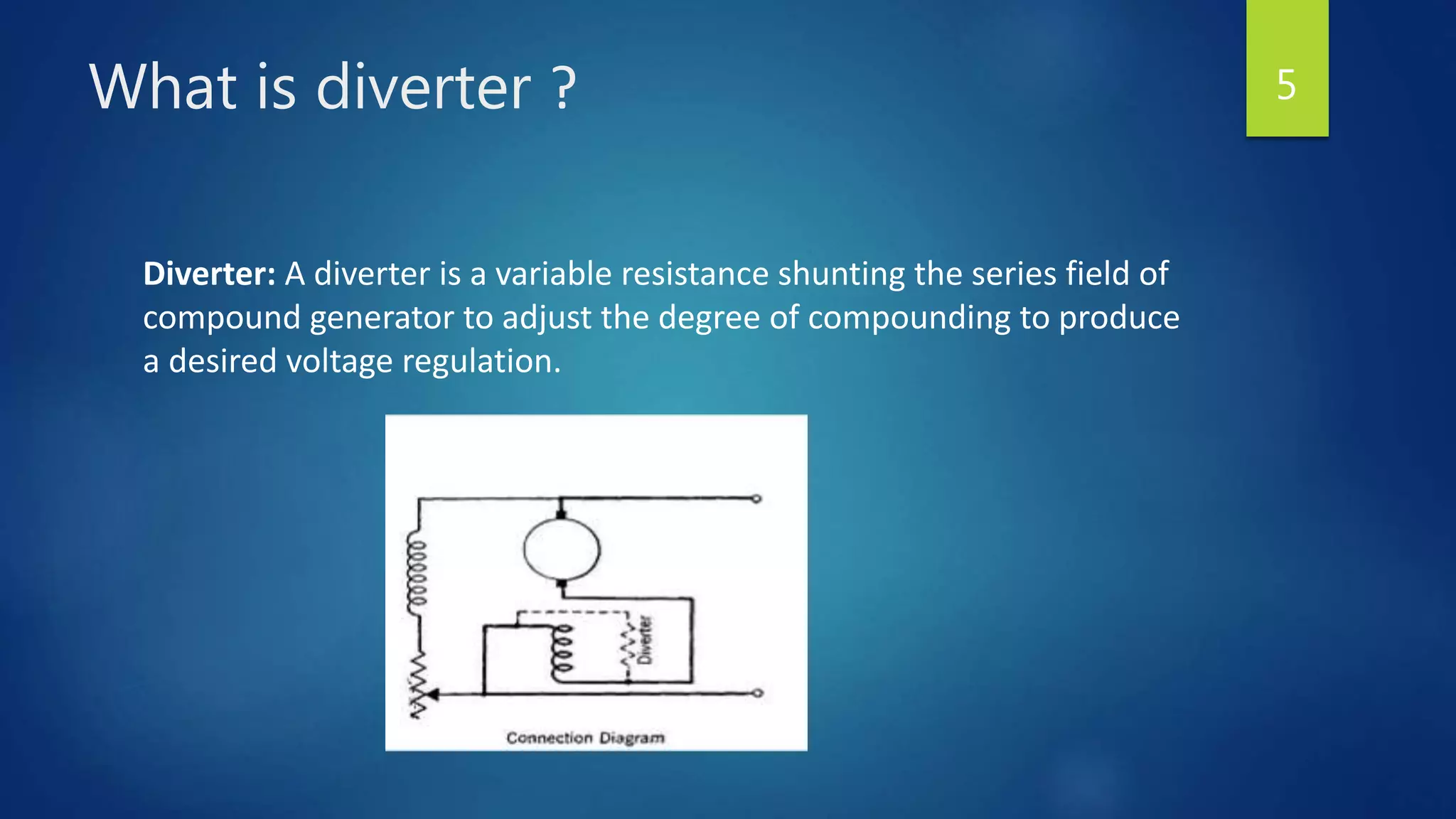
Diverter: A diverter is a variable resistance shunting the series field of
compound generator to adjust the degree of compounding to produce
a desired voltage regulation.
5
Figure…
In this figure-
V = 𝐸𝑔 + 𝑆𝑒𝑟𝑖𝑒𝑠 𝑓𝑖𝑒𝑙𝑑 𝑣𝑜𝑙𝑡𝑎𝑔𝑒 − 𝐷𝑟𝑜𝑝𝑠
6
Using diverter………
By using diverter we can change the terminal voltage convert a compound
generator into over, flat, under compound.
7
Comparison of generator terminal
voltage
1. Cumulative Compound Generator
8
Continue…….
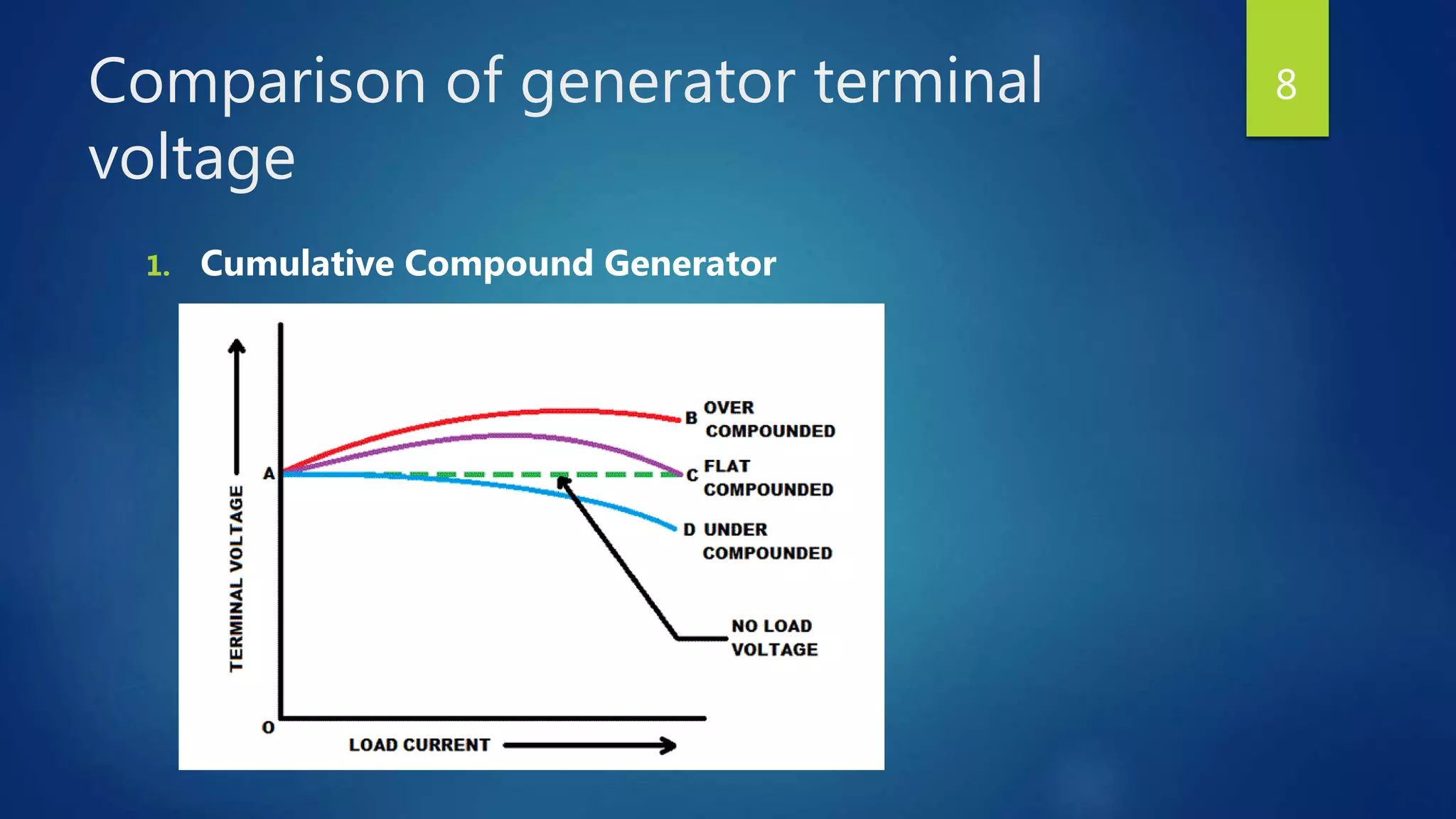
 Over compound : An over-compound generator is one
whose terminal voltage rises with the application of load so
that its full-load voltage exceeds its no-load voltage.
 Flat-compound : A flat compound generator has a load-
voltage characteristic in which the no-load and full-load
voltages are equal.
9
Continue………
 Under compound : In Under compound generator the
terminal voltage is higher than shunt generator but lower than
flat compound generator.
10
Continue…….
 Differential Compound Generator :
When the series field winding creating
magnetic flux that opposes the flux
created by shunt field. The net flux
cut by the armature conductors is less
than the flux at no load resulting in a
lower induced voltage.
11
Thank you
12

Degree of compounding

  • 1.
    Degree of Compounding Submittedby: Md. Ziaul Haque ID: 555181028 Submitted to: Najmin Ara Sultana Lecturer, Department of EEE Hamdard University Bangladesh 1
  • 2.
    Index  Compound generator Types of compound generator  What is diverter ?  Comparison of generator terminal voltage A. Cumulative Compound Generator 1. Over compound 2. Flat compound 3. Under compound B. Differential Compound Generator 2
  • 3.
    Compound generator A compoundwound generators is a combination of a series field winding and the shunt field winding . 3
  • 4.
    Types of compoundgenerator There are two types of compound generator-  Cumulative Compound Generator : When the series field assists the shunt field, generator is said to be Cumulative Compound Generator.  Differential Compound Generator: When the series field opposes the shunt field, generator is said to be Differential Compound Wound Generator. 4
  • 5.
    What is diverter? Diverter: A diverter is a variable resistance shunting the series field of compound generator to adjust the degree of compounding to produce a desired voltage regulation. 5
  • 6.
    Figure… In this figure- V= 𝐸𝑔 + 𝑆𝑒𝑟𝑖𝑒𝑠 𝑓𝑖𝑒𝑙𝑑 𝑣𝑜𝑙𝑡𝑎𝑔𝑒 − 𝐷𝑟𝑜𝑝𝑠 6
  • 7.
    Using diverter……… By usingdiverter we can change the terminal voltage convert a compound generator into over, flat, under compound. 7
  • 8.
    Comparison of generatorterminal voltage 1. Cumulative Compound Generator 8
  • 9.
    Continue…….  Over compound: An over-compound generator is one whose terminal voltage rises with the application of load so that its full-load voltage exceeds its no-load voltage.  Flat-compound : A flat compound generator has a load- voltage characteristic in which the no-load and full-load voltages are equal. 9
  • 10.
    Continue………  Under compound: In Under compound generator the terminal voltage is higher than shunt generator but lower than flat compound generator. 10
  • 11.
    Continue…….  Differential CompoundGenerator : When the series field winding creating magnetic flux that opposes the flux created by shunt field. The net flux cut by the armature conductors is less than the flux at no load resulting in a lower induced voltage. 11
  • 12.