Deforestation is thedeliberate or
natural process of clearing, cutting
down, or destroying forests on a large
scale, mainly due to human activities
such as agriculture, urbanization,
industrial use, and logging. It reduces
forest cover, disrupts ecological
balance, threatens biodiversity, and
contributes to environmental problems
like soil erosion, loss of wildlife
habitat, and climate change.
3.
Agricultural Expansion
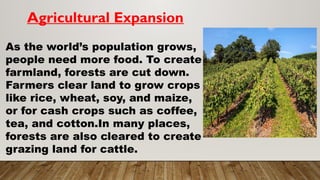
As theworld’s population grows,
people need more food. To create
farmland, forests are cut down.
Farmers clear land to grow crops
like rice, wheat, soy, and maize,
or for cash crops such as coffee,
tea, and cotton.In many places,
forests are also cleared to create
grazing land for cattle.
4.
Urbanization and Infrastructure
Development
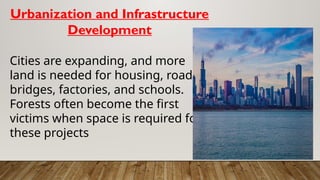
Citiesare expanding, and more
land is needed for housing, roads,
bridges, factories, and schools.
Forests often become the first
victims when space is required for
these projects
5.
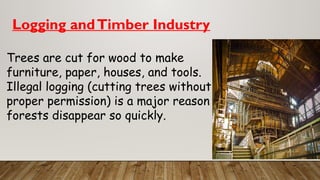
Logging andTimber Industry
Treesare cut for wood to make
furniture, paper, houses, and tools.
Illegal logging (cutting trees without
proper permission) is a major reason
forests disappear so quickly.
6.
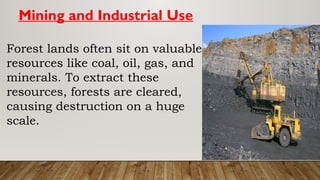
Mining and IndustrialUse
Forest lands often sit on valuable
resources like coal, oil, gas, and
minerals. To extract these
resources, forests are cleared,
causing destruction on a huge
scale.
7.
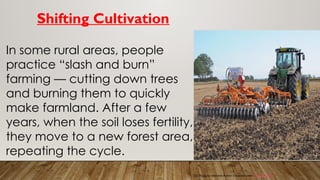
Shifting Cultivation
In somerural areas, people
practice “slash and burn”
farming — cutting down trees
and burning them to quickly
make farmland. After a few
years, when the soil loses fertility,
they move to a new forest area,
repeating the cycle.
This Photo by Unknown Author is licensed under CC BY-NC-ND
8.
Effects of Deforestation
Deforestationdoesn’t just remove trees — it shakes the entire
balance of nature. The effects can be seen in the environment,
climate, animals, and even human life. The effects of
deforestation are the following:
9.
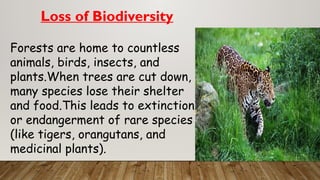
Loss of Biodiversity
Forestsare home to countless
animals, birds, insects, and
plants.When trees are cut down,
many species lose their shelter
and food.This leads to extinction
or endangerment of rare species
(like tigers, orangutans, and
medicinal plants).
10.
Climate Change andGlobal
Warming
Trees absorb carbon dioxide and release
oxygen.When forests are cut, more carbon
dioxide remains in the air.This increases
the “greenhouse effect,” causing global
warming.As a result, ice caps melt, sea
levels rise, and the earth’s temperature
becomes unstable.
11.
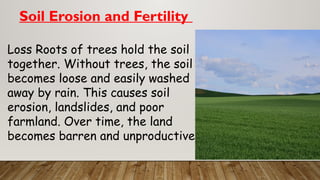
Soil Erosion andFertility
Loss Roots of trees hold the soil
together. Without trees, the soil
becomes loose and easily washed
away by rain. This causes soil
erosion, landslides, and poor
farmland. Over time, the land
becomes barren and unproductive.
12.
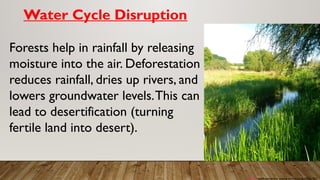
Water Cycle Disruption
Forestshelp in rainfall by releasing
moisture into the air. Deforestation
reduces rainfall, dries up rivers, and
lowers groundwater levels.This can
lead to desertification (turning
fertile land into desert).
This
Photo
by
Unknown
Author
is
licensed
under
CC
BY
13.
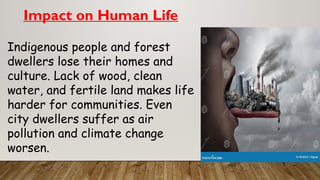
Impact on HumanLife
Indigenous people and forest
dwellers lose their homes and
culture. Lack of wood, clean
water, and fertile land makes life
harder for communities. Even
city dwellers suffer as air
pollution and climate change
worsen.
14.
Deforestation is aman-made problem, so the
solutions must also come from human efforts.
Here are some effective and practical ways to
stop or reduce it:
SOLUTIONS
15.
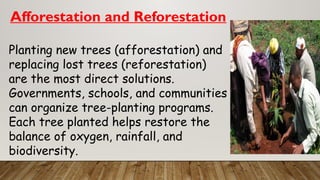
Afforestation and Reforestation
Plantingnew trees (afforestation) and
replacing lost trees (reforestation)
are the most direct solutions.
Governments, schools, and communities
can organize tree-planting programs.
Each tree planted helps restore the
balance of oxygen, rainfall, and
biodiversity.
16.
Sustainable Forest
Management
Instead ofcutting all trees in one
area, selective cutting and
planned logging should be
practiced. Trees should be
harvested in a way that allows
forests to regenerate naturally.
17.
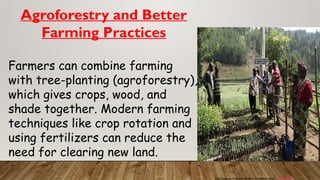
Agroforestry and Better
FarmingPractices
Farmers can combine farming
with tree-planting (agroforestry),
which gives crops, wood, and
shade together. Modern farming
techniques like crop rotation and
using fertilizers can reduce the
need for clearing new land.
This Photo by Unknown Author is licensed under CC BY-SA-NC
18.
Strict Laws andPolicies
Illegal logging and encroachment
into forest areas should be
punished strictly.Forest reserves
and protected areas should be
expanded.International
cooperation is needed, since
forests like the Amazon affect
the entire world.
19.
Awareness and Education
People,especially students,
should be made aware of the
value of forests. Campaigns,
documentaries, and school
programs can build a culture of
forest conservation.
20.
Deforestation may giveus short-term benefits like land, wood,
or development, but in reality, it steals away our future.
Forests are not just trees — they are the lifeline of our
planet, keeping the air clean, the climate stable, and the soil
fertile. If we continue to destroy them, we are actually
destroying our own survival. The good news is, it’s not too late.
By planting more trees, using resources wisely, and protecting
forests with care, we can heal the damage and build a
greener, safer world. After all, saving forests means saving
ourselves.
CONCLUSION



![deforestation.ppt[1]bestpptondeforestation.pptx](https://cdn.slidesharecdn.com/ss_thumbnails/deforestation-250810150959-bc8a3af6-thumbnail.jpg?width=640&height=640&fit=bounds)


