Structure Design
DEFLECTION AND CRACKING

PREPARED BY : PRATIK PATEL( L.D.C.E)
Introduction
DEFLECTION :
A structure member DEFLECTS when it carries load.
It should not adversely affect the appearance or efficiency or finishes of the
structure apart from the structural considerations.

CRACKING:
 The deflection of RC beam is associated with cracking of concrete.

Crack develop at the region where the tensile strength of concrete is
exceeded.
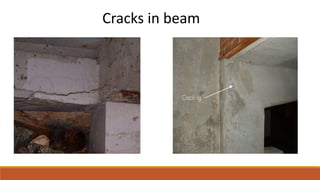
Cracks in beam
Cracking (Codal Provision)
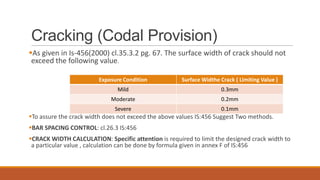
As given in Is-456(2000) cl.35.3.2 pg. 67. The surface width of crack should not
exceed the following value.
Exposure Condition

Surface Widthe Crack ( Limiting Value )

Mild

0.3mm

Moderate

0.2mm

Severe

0.1mm

To assure the crack width does not exceed the above values IS:456 Suggest Two methods.
BAR SPACING CONTROL: cl.26.3 IS:456
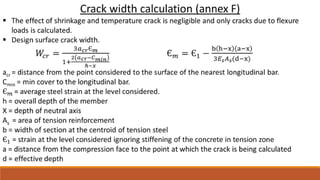
CRACK WIDTH CALCULATION: Specific attention is required to limit the designed crack width to
a particular value , calculation can be done by formula given in annex F of IS:456
Bar spacing control(cl.26.3.2)
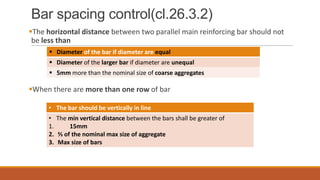
The horizontal distance between two parallel main reinforcing bar should not
be less than
 Diameter of the bar if diameter are equal
 Diameter of the larger bar if diameter are unequal
 5mm more than the nominal size of coarse aggregates

When there are more than one row of bar
• The bar should be vertically in line

• The min vertical distance between the bars shall be greater of
1.
15mm
2. ⅔ of the nominal max size of aggregate
3. Max size of bars
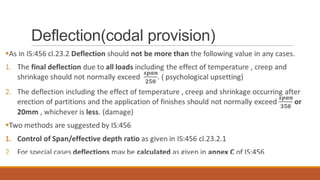
Deflection(codal provision)
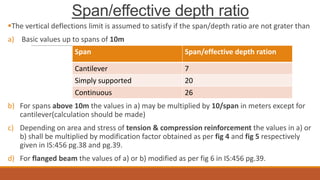
Span/effective depth ratio
The vertical deflections limit is assumed to satisfy if the span/depth ratio are not grater than
a) Basic values up to spans of 10m
Span

Span/effective depth ration

Cantilever
Simply supported
Continuous

7
20
26

b) For spans above 10m the values in a) may be multiplied by 10/span in meters except for
cantilever(calculation should be made)
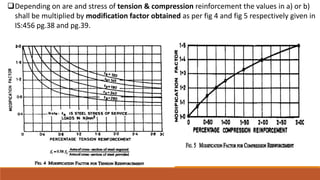
c) Depending on area and stress of tension & compression reinforcement the values in a) or
b) shall be multiplied by modification factor obtained as per fig 4 and fig 5 respectively
given in IS:456 pg.38 and pg.39.
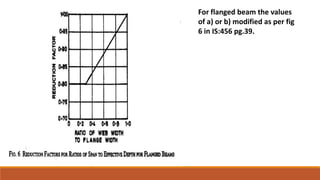
d) For flanged beam the values of a) or b) modified as per fig 6 in IS:456 pg.39.
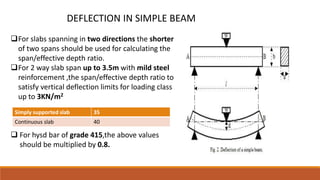
DEFLECTION IN SIMPLE BEAM
For slabs spanning in two directions the shorter
of two spans should be used for calculating the
span/effective depth ratio.
For 2 way slab span up to 3.5m with mild steel
reinforcement ,the span/effective depth ratio to
satisfy vertical deflection limits for loading class
up to 3KN/m2
Simply supported slab

35

Continuous slab

40

 For hysd bar of grade 415,the above values
should be multiplied by 0.8.
Depending on are and stress of tension & compression reinforcement the values in a) or b)
shall be multiplied by modification factor obtained as per fig 4 and fig 5 respectively given in
IS:456 pg.38 and pg.39.
For flanged beam the values
of a) or b) modified as per fig
6 in IS:456 pg.39.
TOTAL DEFLECTION ( annex C)
The total deflection shall be taken as the sum of the short-term deflection and
the long-term deflection.
1. Short term deflection: It is due to loading
2. Long term deflection: It is due to the effect of creep and shrinkage .It is rapid
at the initial period of loading and then slows w.r.t. time. Within 2-3 years the
long term deflections are largely completed.
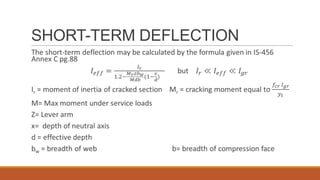
SHORT-TERM DEFLECTION
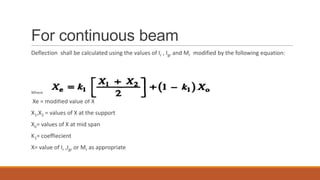
For continuous beam
Deflection shall be calculated using the values of Ir , Igr and Mr modified by the following equation:

Where

Xe = modified value of X
X1,X2 = values of X at the support

Xo= values of X at mid span
K1= coeffiecient
X= value of Ir ,Igr or Mr as appropriate
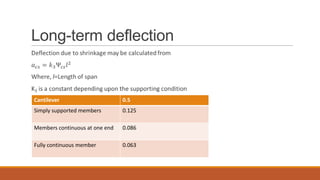
Long-term deflection

Cantilever

0.5

Simply supported members

0.125

Members continuous at one end

0.086

Fully continuous member

0.063
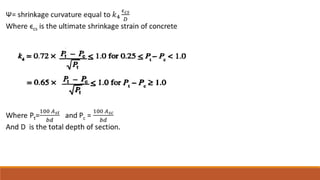
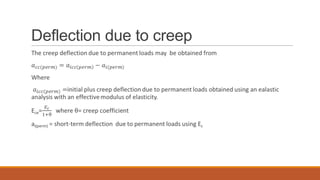
Deflection due to creep
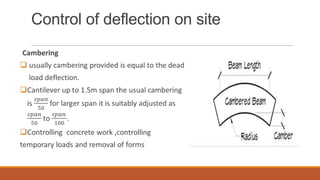
Control of deflection on site
Deflection & cracking of RC structure(limit state method)

Deflection & cracking of RC structure(limit state method)

  • 1.
    Structure Design DEFLECTION ANDCRACKING PREPARED BY : PRATIK PATEL( L.D.C.E)
  • 2.
    Introduction DEFLECTION : A structuremember DEFLECTS when it carries load. It should not adversely affect the appearance or efficiency or finishes of the structure apart from the structural considerations. CRACKING:  The deflection of RC beam is associated with cracking of concrete. Crack develop at the region where the tensile strength of concrete is exceeded.
  • 3.
  • 4.
    Cracking (Codal Provision) Asgiven in Is-456(2000) cl.35.3.2 pg. 67. The surface width of crack should not exceed the following value. Exposure Condition Surface Widthe Crack ( Limiting Value ) Mild 0.3mm Moderate 0.2mm Severe 0.1mm To assure the crack width does not exceed the above values IS:456 Suggest Two methods. BAR SPACING CONTROL: cl.26.3 IS:456 CRACK WIDTH CALCULATION: Specific attention is required to limit the designed crack width to a particular value , calculation can be done by formula given in annex F of IS:456
  • 5.
    Bar spacing control(cl.26.3.2) Thehorizontal distance between two parallel main reinforcing bar should not be less than  Diameter of the bar if diameter are equal  Diameter of the larger bar if diameter are unequal  5mm more than the nominal size of coarse aggregates When there are more than one row of bar • The bar should be vertically in line • The min vertical distance between the bars shall be greater of 1. 15mm 2. ⅔ of the nominal max size of aggregate 3. Max size of bars
  • 7.
  • 8.
    Span/effective depth ratio Thevertical deflections limit is assumed to satisfy if the span/depth ratio are not grater than a) Basic values up to spans of 10m Span Span/effective depth ration Cantilever Simply supported Continuous 7 20 26 b) For spans above 10m the values in a) may be multiplied by 10/span in meters except for cantilever(calculation should be made) c) Depending on area and stress of tension & compression reinforcement the values in a) or b) shall be multiplied by modification factor obtained as per fig 4 and fig 5 respectively given in IS:456 pg.38 and pg.39. d) For flanged beam the values of a) or b) modified as per fig 6 in IS:456 pg.39.
  • 9.
    DEFLECTION IN SIMPLEBEAM For slabs spanning in two directions the shorter of two spans should be used for calculating the span/effective depth ratio. For 2 way slab span up to 3.5m with mild steel reinforcement ,the span/effective depth ratio to satisfy vertical deflection limits for loading class up to 3KN/m2 Simply supported slab 35 Continuous slab 40  For hysd bar of grade 415,the above values should be multiplied by 0.8.
  • 10.
    Depending on areand stress of tension & compression reinforcement the values in a) or b) shall be multiplied by modification factor obtained as per fig 4 and fig 5 respectively given in IS:456 pg.38 and pg.39.
  • 11.
    For flanged beamthe values of a) or b) modified as per fig 6 in IS:456 pg.39.
  • 12.
    TOTAL DEFLECTION (annex C) The total deflection shall be taken as the sum of the short-term deflection and the long-term deflection. 1. Short term deflection: It is due to loading 2. Long term deflection: It is due to the effect of creep and shrinkage .It is rapid at the initial period of loading and then slows w.r.t. time. Within 2-3 years the long term deflections are largely completed.
  • 13.
  • 14.
    For continuous beam Deflectionshall be calculated using the values of Ir , Igr and Mr modified by the following equation: Where Xe = modified value of X X1,X2 = values of X at the support Xo= values of X at mid span K1= coeffiecient X= value of Ir ,Igr or Mr as appropriate
  • 15.
    Long-term deflection Cantilever 0.5 Simply supportedmembers 0.125 Members continuous at one end 0.086 Fully continuous member 0.063
  • 17.
  • 18.