Downloaded 52 times
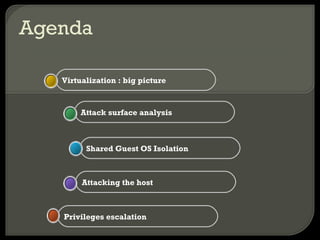
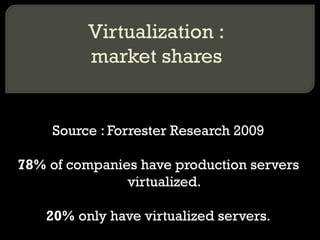
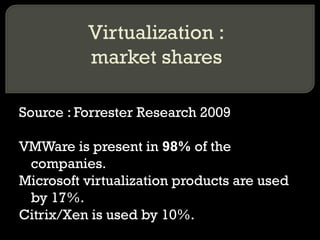
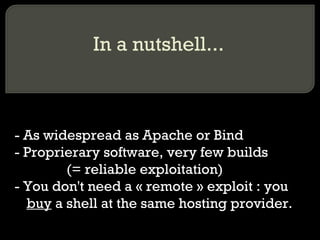
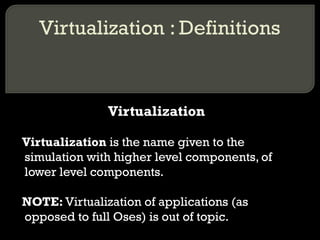
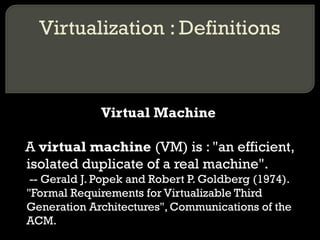
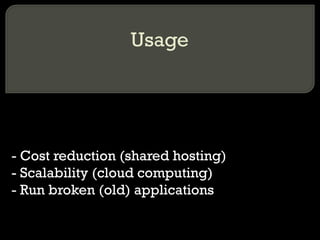
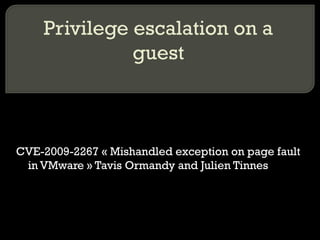
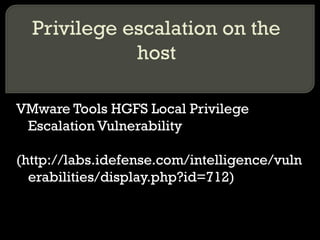
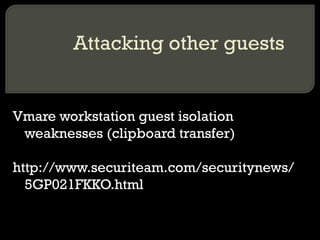
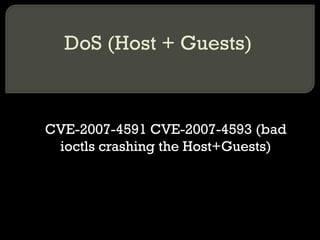
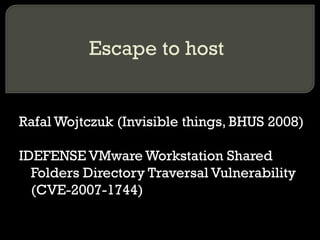
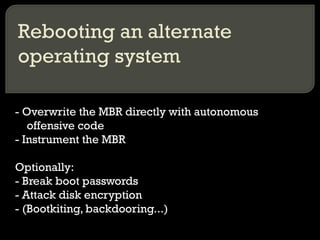
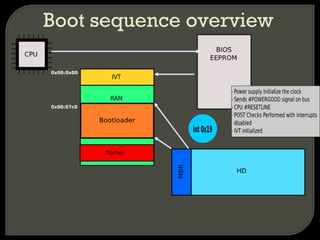
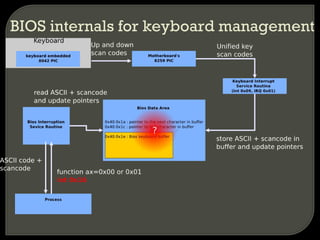
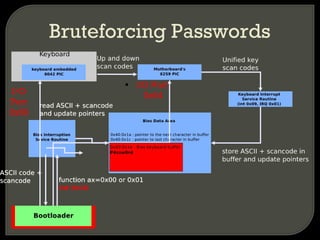
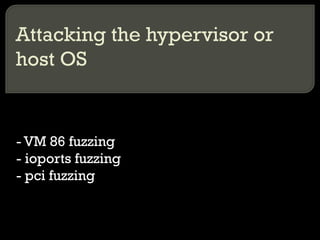
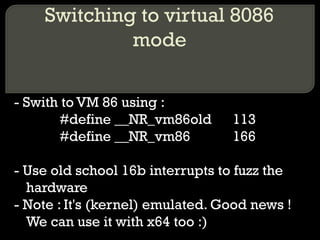
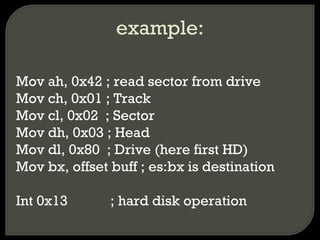
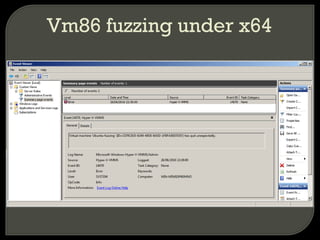
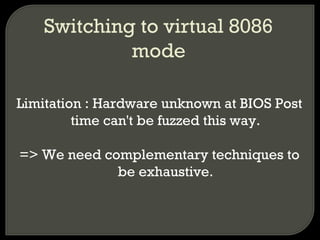
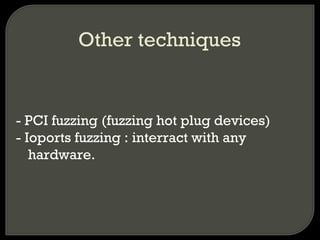
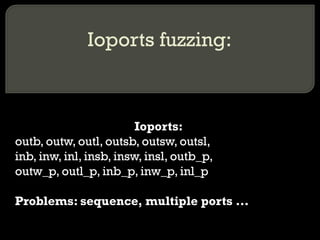
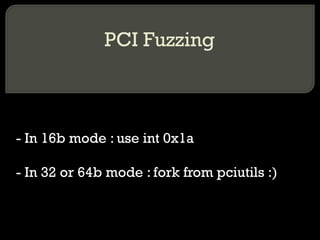
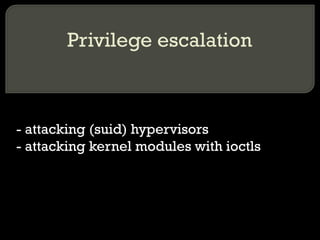


The document discusses various techniques for attacking virtualization systems and escalating privileges. It begins with an overview of virtualization definitions and market shares. It then covers methods such as privilege escalation on guest systems and the host, attacking isolation between guest operating systems, denial of service attacks targeting both the host and guests, and escaping the virtualized environment to the host system. Specific vulnerabilities and research are referenced to illustrate different attack vectors. The document concludes with a discussion of fuzzing the hypervisor or host operating system through techniques like virtual 8086 mode, I/O port fuzzing, and PCI device fuzzing to identify new ways to escalate privileges on the host system.


![[DEFCON 16] Bypassing pre-boot authentication passwords by instrumenting the...](https://cdn.slidesharecdn.com/ss_thumbnails/defcon16brossard-100918053407-phpapp02-thumbnail.jpg?width=640&height=640&fit=bounds)


![[h2hc] Generic exploitation of invalid memory writes](https://cdn.slidesharecdn.com/ss_thumbnails/brossard-h2hc2010-101210130057-phpapp02-thumbnail.jpg?width=640&height=640&fit=bounds)
![[Defcon24] Introduction to the Witchcraft Compiler Collection](https://cdn.slidesharecdn.com/ss_thumbnails/jonathanbrossardwitchractcompilercollectiondefcon242016-160809090309-thumbnail.jpg?width=640&height=640&fit=bounds)


![[1.4] «Ой, не шмогла». Обзор ограничений современных технологий в области ...](https://cdn.slidesharecdn.com/ss_thumbnails/1-141207100155-conversion-gate01-thumbnail.jpg?width=640&height=640&fit=bounds)
![[3.3] Detection & exploitation of Xpath/Xquery Injections - Boris Savkov](https://cdn.slidesharecdn.com/ss_thumbnails/detectionexploitingxinj-150610110751-lva1-app6892-thumbnail.jpg?width=640&height=640&fit=bounds)


![[Ruxcon] Breaking virtualization by switching the cpu to virtual 8086 mode](https://cdn.slidesharecdn.com/ss_thumbnails/brossard-ruxcon2010-101210125202-phpapp02-thumbnail.jpg?width=640&height=640&fit=bounds)


![[USENIX-WOOT] Introduction to Procedural Debugging through Binary Libification](https://cdn.slidesharecdn.com/ss_thumbnails/usenixwootbrossard-240814202232-4ed49968-thumbnail.jpg?width=640&height=640&fit=bounds)
![[USENIX-WOOT] Introduction to Procedural Debugging through Binary Libification](https://cdn.slidesharecdn.com/ss_thumbnails/woot24-brossard1-240814201939-0cc12cfe-thumbnail.jpg?width=640&height=640&fit=bounds)
![[Blackhat2015] FileCry attack against Internet Explorer](https://cdn.slidesharecdn.com/ss_thumbnails/us-15-wang-filecry-the-new-age-of-xxe-ie-wp-150807171939-lva1-app6892-thumbnail.jpg?width=640&height=640&fit=bounds)
![[Blackhat2015] FileCry attack against Java](https://cdn.slidesharecdn.com/ss_thumbnails/us-15-wang-filecry-the-new-age-of-xxe-java-wp-150807171804-lva1-app6892-thumbnail.jpg?width=640&height=640&fit=bounds)
![[Blackhat2015] SMB : SHARING MORE THAN JUST YOUR FILES... #Whitepaper](https://cdn.slidesharecdn.com/ss_thumbnails/us-15-brossard-smbv2-sharing-more-than-just-your-files-wp-150806224329-lva1-app6892-thumbnail.jpg?width=640&height=640&fit=bounds)
![[Blackhat2015] SMB : SHARING MORE THAN JUST YOUR FILES...](https://cdn.slidesharecdn.com/ss_thumbnails/jonathanbrossardblackhat2015-150806012318-lva1-app6891-thumbnail.jpg?width=640&height=640&fit=bounds)
![[2013 syscan360] Jonathan Brossard_katsuni理论介绍以及在沙盒和软件仿真方面的应用](https://cdn.slidesharecdn.com/ss_thumbnails/2013syscan360jonathanbrossardkatsuni-131009200826-phpapp01-thumbnail.jpg?width=640&height=640&fit=bounds)
![[Defcon] Hardware backdooring is practical](https://cdn.slidesharecdn.com/ss_thumbnails/slidesdefcon2012brossard-120729030359-phpapp01-thumbnail.jpg?width=640&height=640&fit=bounds)


![[Hackito2012] Hardware backdooring is practical](https://cdn.slidesharecdn.com/ss_thumbnails/slides-120502051125-phpapp02-thumbnail.jpg?width=640&height=640&fit=bounds)
![[CCC-28c3] Post Memory Corruption Memory Analysis](https://cdn.slidesharecdn.com/ss_thumbnails/28c3-120107122834-phpapp02-thumbnail.jpg?width=640&height=640&fit=bounds)
![[Ruxcon Monthly Sydney 2011] Proprietary Protocols Reverse Engineering : Rese...](https://cdn.slidesharecdn.com/ss_thumbnails/ruxmonfinal-111129234132-phpapp02-thumbnail.jpg?width=640&height=640&fit=bounds)
![[Ruxcon 2011] Post Memory Corruption Memory Analysis](https://cdn.slidesharecdn.com/ss_thumbnails/ruxcon-111127233040-phpapp02-thumbnail.jpg?width=640&height=640&fit=bounds)
![[Kiwicon 2011] Post Memory Corruption Memory Analysis](https://cdn.slidesharecdn.com/ss_thumbnails/kiwiconbrossard-111127232850-phpapp01-thumbnail.jpg?width=640&height=640&fit=bounds)
![[HITB Malaysia 2011] Exploit Automation](https://cdn.slidesharecdn.com/ss_thumbnails/brossardhitb2011-111127232630-phpapp02-thumbnail.jpg?width=640&height=640&fit=bounds)
![[DEFCON] Bypassing preboot authentication passwords by instrumenting the BIOS...](https://cdn.slidesharecdn.com/ss_thumbnails/prebootwhitepaper-100929045158-phpapp02-thumbnail.jpg?width=640&height=640&fit=bounds)