Stealing The Internet
An Internet-Scale
Man In The Middle Attack
Defcon 16, Las Vegas, NV - August 10th
,
2008
Alex Pilosov – Pure Science
Chairman of IP Hijacking BOF
ex-moderator of NANOG mailing list
alex@pilosoft.com
Tony Kapela – Public Speaking Skills
CIO of IP Hijacking BOF
tk@5ninesdata.com
Why Should You Care?
• Because your inbound traffic can be passively
intercepted
• Because your outbound traffic to specific
destinations can also be intercepted
• Because your data can be stored, dropped,
filtered, mutilated, spindled, or modified
• Because this cannot be solved without provider
cooperation
• Because it’s unlikely to be noticed, unless you’re
looking for it
Agenda
• BGP & Internet 101
• Old Hijackings
• The main monkey business
– MITM method, explained
– Graphs, etc
– Live Demo
BGP 101
How is the Internet ‘glued’ together?
• No central “core”
• Individual networks (identified by ASN) interconnect and
“announce” IP space to each other
• Announcement contains IP prefix, AS-PATH,
communities, other attributes
• AS-PATH is a list of who has passed the announcement
along; used to avoid loops (important for our method)
• Fundamental tenet in IP routing: More-specific prefixes
will win – e.g. 10.0.0.0/24 wins over 10.0.0.0/8
..if we had to
whiteboard it
graphic courtesy jungar.net
Network Relationship Norms
• Peer: No money changes hands, routes
are not redistributed to transits and other
peers – 1:1 relationship
• Customer: Pays transit provider to accept
their announcement, sends routes to
peers and transits
On Prefixes…
• Internet routing is inherently trust-based
– No “chain of trust” in IP assignments
• ICANN assigns space to Regional Internet
Registries (RIRs - ARIN/RIPE/AFRINIC)
• RIRs assign to ISPs or LIRs (in RIPE
region)
• No association between ASN and IP for
most assignments (except RIPE)
State The problem
Various levels of sophistication in Route/Prefix Filtering
• Customer:
– Often unfiltered BGP: max-prefix and sometimes AS-
PATH
– Smaller carriers and smaller customers – static prefix-list,
emails or phone calls to update
• Verification by “whois”
– Larger carriers: IRR-sourced inter-AS filters
• Peer:
– Typically none beyond max-prefix and scripts to complain
when announcing something they shouldn’t (rare)
– Many don’t even filter their own internal network
routes coming from external peers
The IRR (Internet Routing Registry)
A Modest Proposal
• Way for ISP’s to register their routes and routing policy
• Distributed servers that mirror each other
• Filtering based on IRR will prevent some ‘accidental’
hijackings
• Caveats
– Your routers might not scale as well when crunching 100k
entry prefix-lists per-peer, for all peers
– Full of cruft - no janitors
– Insecure - anyone can register (nearly) any route
An IRR Update
…Which Should Have Been Questioned
From: db-admin@altdb.net
To: xxx@wyltk-llc.com
ReplyTo: db-admin@altdb.net
Subject: Forwarded mail.... (fwd)
Sent: Aug 7, 2008 9:48 PM
Your transaction has been processed by the
IRRd routing registry system.
Diagnostic output:
--------------------------------------------------
----------
The submission contained the following mail
headers:
- From: xxx@wyltk-llc.com
- Subject: Forwarded mail.... (fwd)
- Date: Thu, 7 Aug 2008 21:48:53 -0400 (EDT)
- Msg-Id: <Pine.LNX.xxx@wyltk-llc.com>
ADD OK: [route] 24.120.56.0/24 AS26627
----------------------------------------
If you have any questions about ALTDB,
please send mail to db-admin@altdb.net.
Traditional Hijacking Uses
• Non-Malicious use: was popular in 2001,
faster than getting IPs legitimately from ARIN
• Fly-by spammers: Announce space, spam,
withdraw, avoid abuse complaints
• Malicious DoS or outage - silence your
competitors
• Target impersonation - could hijack
128.121.146.0/24 (twitter) and put up
something else
Criminality
• If nobody is using it, is it really illegal?
• IP prefix is just a number
• No prosecutions for non-malicious
announcements that we are aware of
• Worst case scenario for non-malicious
hijack: ARIN/RIPE pull PTR records and
transits shut you off (eventually)
How-To Hijack
• Full hijacking, apparent authority to announce
– This was cool in 2001
– Find IP Network (using whois) with contact email
address in @hotmail.com or at domain that has
expired
– Register domain/email
– Change contact
• Or just announce the network since nobody is
filtering anyway
– Upstream providers too busy & big to care
– You’re paying them to accept routes, so they do
Historical Hijackings
• AS7007 – ’97, accidental bgp->rip->bgp redistribution
broke Internet (tens of thousands of new
announcements filled router memory, etc)
• 146.20/16 – Erie Forge and Steel (how apropos)
• 166.188/16 – Carabineros De Chile (Chile Police) –
hijacked twice, by registered “Carabineros De Chile LLC,
Nevada Corporation”
• More details available on completewhois.com
• Accidental hijackings happen frequently – low chance of
getting caught
02/08 Youtube Hijack Saga
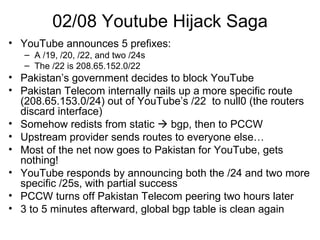
• YouTube announces 5 prefixes:
– A /19, /20, /22, and two /24s
– The /22 is 208.65.152.0/22
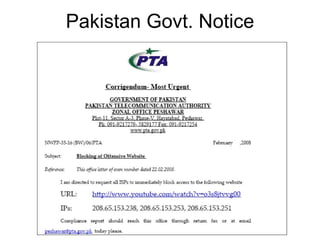
• Pakistan’s government decides to block YouTube
• Pakistan Telecom internally nails up a more specific route
(208.65.153.0/24) out of YouTube’s /22 to null0 (the routers
discard interface)
• Somehow redists from static  bgp, then to PCCW
• Upstream provider sends routes to everyone else…
• Most of the net now goes to Pakistan for YouTube, gets
nothing!
• YouTube responds by announcing both the /24 and two more
specific /25s, with partial success
• PCCW turns off Pakistan Telecom peering two hours later
• 3 to 5 minutes afterward, global bgp table is clean again
Pakistan Govt. Notice
Of Interest…
IP Hijacking BoF
• Un-official event at NANOG conference
• We test security of Internet routing
infrastructure
• Recent exercises:
– Hijacked 1.0.0.0/8: 90% success
– Hijacked 146.20.0.0/16: 95% success
– Attempted to announce networks longer than /
24: from /25 down to /32 with cooperation of
large CDN’s. 40% successful overall
Routing Security Is Complicated
• No answer yet, due to lack of chain of trust from ICANN
on down
• “Weakest link” problem: Until everyone filters everyone
perfectly, this door is still open
• Best practice today is “Alerting” systems that look for
rogue announcements (PHAS, RIPE MyASN, Renesys,
etc)
• Register your AS and your prefix in RIR (no immediate
effect, but eventually someone will use them)
• No anonymity – if you hijack, everyone knows it’s you
(due to AS-PATH)
• If things still work, who complains?
How To Resolve A Hijacking
• Once rogue announcement is
identified, work begins. Contact the
upstreams and scream.
–May take minutes, hours (if you are
Youtube-sized), or possibly days
• About as easy as getting DDoS
stopped (or not)
What This Means
• Rootkits + 0day  rogue announcements 
Man-in-middle attacks, with our clues applied
– No need for three-way-handshake when you’re in-line
– Nearly invisible exploitation potential, globally
• Endpoint enumeration - direct discovery of who
and what your network talks to
• Can be accomplished globally, any-to-any
• How would you know if this isn’t happening right
now to your traffic at DEFCON?
BGP MITM Hijack Concept
• We originate the route like we always did
– Win through usual means (prefix length, shorter as-
path w/ several origin points, etc)
• “Win” is some definition of “most of the internet chooses
your route”
• We return the packets somehow
– Coordinating delivery was non-trivial
– Vpn/tunnel involve untenable coordination at target
• Then it clicked – use the Internet itself as reply
path, but how?
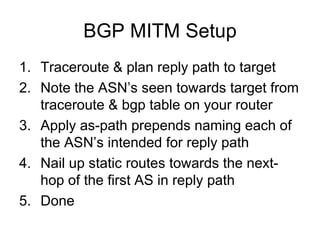
BGP MITM Setup
1. Traceroute & plan reply path to target
2. Note the ASN’s seen towards target from
traceroute & bgp table on your router
3. Apply as-path prepends naming each of
the ASN’s intended for reply path
4. Nail up static routes towards the next-
hop of the first AS in reply path
5. Done
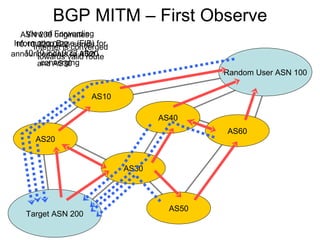
BGP MITM – First Observe
Random User ASN 100
Target ASN 200
AS20
AS10
AS30
AS60
AS40
AS50
ASN 200 originates
10.10.220.0/22, sends
announcements to AS20
and AS30
Internet is converged
towards valid route
View of Forwarding
Information Base (FIB) for
10.10.220.0/22 after
converging
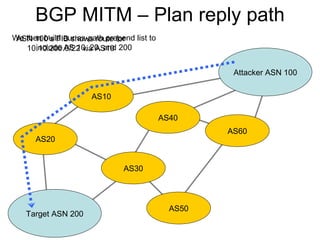
BGP MITM – Plan reply path
Attacker ASN 100
Target ASN 200
AS20
AS10
AS30
AS60
AS40
AS50
ASN 100’s FIB shows route for
10.10.200.0/22 via AS10
We then build our as-path prepend list to
include AS 10, 20, and 200
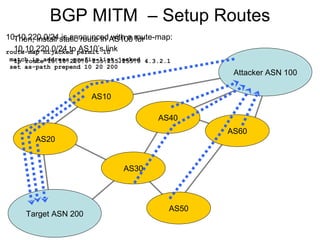
BGP MITM – Setup Routes
Attacker ASN 100
Target ASN 200
AS20
AS10
AS30
AS60
AS40
AS50
10.10.220.0/24 is announced with a route-map:
route-map hijacked permit 10
match ip address prefix-list jacked
set as-path prepend 10 20 200
Then, install static route in AS100 for
10.10.220.0/24 to AS10’s link
ip route 10.10.220.0 255.255.255.0 4.3.2.1
Anonymzing The Hijacker
• We adjust TTL of packets in transit
• Effectively ‘hides’ the IP devices handling
the hijacked inbound traffic (ttl additive)
• Also hides the ‘outbound’ networks
towards the target (ttl additive)
• Result: presence of the hijacker isn’t
revealed
Without TTL adjustment
2 12.87.94.9 [AS 7018] 4 msec 4 msec 8 msec
3 tbr1.cgcil.ip.att.net (12.122.99.38) [AS 7018] 4 msec 8 msec 4 msec
4 ggr2.cgcil.ip.att.net (12.123.6.29) [AS 7018] 8 msec 4 msec 8 msec
5 192.205.35.42 [AS 7018] 4 msec 8 msec 4 msec
6 cr2-loopback.chd.savvis.net (208.172.2.71) [AS 3561] 24 msec 16 msec 28 msec
7 cr2-pos-0-0-5-0.NewYork.savvis.net (204.70.192.110) [AS 3561] 28 msec 28 msec 28 msec
8 204.70.196.70 [AS 3561] 28 msec 32 msec 32 msec
9 208.175.194.10 [AS 3561] 28 msec 32 msec 32 msec
10 colo-69-31-40-107.pilosoft.com (69.31.40.107) [AS 26627] 32 msec 28 msec 28 msec
11 tge2-3-103.ar1.nyc3.us.nlayer.net (69.31.95.97) [AS 4436] 32 msec 32 msec 32 msec
12 * * * (missing from trace, 198.32.160.134 – exchange point)
13 tge1-2.fr4.ord.llnw.net (69.28.171.193) [AS 22822] 32 msec 32 msec 40 msec
14 ve6.fr3.ord.llnw.net (69.28.172.41) [AS 22822] 36 msec 32 msec 40 msec
15 tge1-3.fr4.sjc.llnw.net (69.28.171.66) [AS 22822] 84 msec 84 msec 84 msec
16 ve5.fr3.sjc.llnw.net (69.28.171.209) [AS 22822] 96 msec 96 msec 80 msec
17 tge1-1.fr4.lax.llnw.net (69.28.171.117) [AS 22822] 88 msec 92 msec 92 msec
18 tge2-4.fr3.las.llnw.net (69.28.172.85) [AS 22822] 96 msec 96 msec 100 msec
19 switch.ge3-1.fr3.las.llnw.net (208.111.176.2) [AS 22822] 84 msec 88 msec 88 msec
20 gig5-1.esw03.las.switchcommgroup.com (66.209.64.186) [AS 23005] 84 msec 88 msec 88 msec
21 66.209.64.85 [AS 23005] 88 msec 88 msec 88 msec
22 gig0-2.esw07.las.switchcommgroup.com (66.209.64.178) [AS 23005] 88 msec 88 msec 88 msec
23 acs-wireless.demarc.switchcommgroup.com (66.209.64.70) [AS 23005] 88 msec 84 msec 84 msec
With TTL Adjustments
2 12.87.94.9 [AS 7018] 8 msec 8 msec 4 msec
3 tbr1.cgcil.ip.att.net (12.122.99.38) [AS 7018] 4 msec 8 msec 8 msec
4 ggr2.cgcil.ip.att.net (12.123.6.29) [AS 7018] 4 msec 8 msec 4 msec
5 192.205.35.42 [AS 7018] 8 msec 4 msec 8 msec
6 cr2-loopback.chd.savvis.net (208.172.2.71) [AS 3561] 16 msec 12 msec *
7 cr2-pos-0-0-5-0.NewYork.savvis.net (204.70.192.110) [AS 3561] 28 msec 32 msec 32 msec
8 204.70.196.70 [AS 3561] 28 msec 32 msec 32 msec
9 208.175.194.10 [AS 3561] 32 msec 32 msec 32 msec
10 gig5-1.esw03.las.switchcommgroup.com (66.209.64.186) [AS 23005] 88 msec 88 msec 84 msec
11 66.209.64.85 [AS 23005] 88 msec 88 msec 88 msec
12 gig0-2.esw07.las.switchcommgroup.com (66.209.64.178) [AS 23005] 84 msec 84 msec 88 msec
13 acs-wireless.demarc.switchcommgroup.com (66.209.64.70) [AS 23005] 88 msec 88 msec 88 msec
Compare Original BGP & Route Path
Hijacked:
2 12.87.94.9 [AS 7018] 8 msec 8 msec 4 msec
3 tbr1.cgcil.ip.att.net (12.122.99.38) [AS 7018] 4 msec 8 msec 8 msec
4 ggr2.cgcil.ip.att.net (12.123.6.29) [AS 7018] 4 msec 8 msec 4 msec
5 192.205.35.42 [AS 7018] 8 msec 4 msec 8 msec
6 cr2-loopback.chd.savvis.net (208.172.2.71) [AS 3561] 16 msec 12 msec *
7 cr2-pos-0-0-5-0.NewYork.savvis.net (204.70.192.110) [AS 3561] 28 msec 32 msec 32 msec
8 204.70.196.70 [AS 3561] 28 msec 32 msec 32 msec
9 208.175.194.10 [AS 3561] 32 msec 32 msec 32 msec
10 gig5-1.esw03.las.switchcommgroup.com (66.209.64.186) [AS 23005] 88 msec 88 msec 84 msec
11 66.209.64.85 [AS 23005] 88 msec 88 msec 88 msec
12 gig0-2.esw07.las.switchcommgroup.com (66.209.64.178) [AS 23005] 84 msec 84 msec 88 msec
13 acs-wireless.demarc.switchcommgroup.com (66.209.64.70) [AS 23005] 88 msec 88 msec 88 msec
Original:
2 12.87.94.9 [AS 7018] 8 msec 8 msec 4 msec
3 tbr1.cgcil.ip.att.net (12.122.99.38) [AS 7018] 8 msec 8 msec 8 msec
4 12.122.99.17 [AS 7018] 8 msec 4 msec 8 msec
5 12.86.156.10 [AS 7018] 12 msec 8 msec 4 msec
6 tge1-3.fr4.sjc.llnw.net (69.28.171.66) [AS 22822] 68 msec 56 msec 68 msec
7 ve5.fr3.sjc.llnw.net (69.28.171.209) [AS 22822] 56 msec 68 msec 56 msec
8 tge1-1.fr4.lax.llnw.net (69.28.171.117) [AS 22822] 64 msec 64 msec 72 msec
9 tge2-4.fr3.las.llnw.net (69.28.172.85) [AS 22822] 68 msec 72 msec 72 msec
10 switch.ge3-1.fr3.las.llnw.net (208.111.176.2) [AS 22822] 60 msec 60 msec 60 msec
11 gig5-1.esw03.las.switchcommgroup.com (66.209.64.186) [AS 23005] 60 msec 60 msec 60 msec
12 66.209.64.85 [AS 23005] 64 msec 60 msec 60 msec
13 gig0-2.esw07.las.switchcommgroup.com (66.209.64.178) [AS 23005] 60 msec 64 msec 60 msec
14 acs-wireless.demarc.switchcommgroup.com (66.209.64.70) [AS 23005] 60 msec 60 msec 60 msec
In conclusion
• We learned that any arbitrary prefix can be
hijacked, without breaking end-to-end
• We saw it can happen nearly invisibly
• We noted the BGP as-path does reveal
the attacker
• Shields up; filter your customers.
Thanks & Praise
• Felix "FX" Lindner
• Jay Beale
• Dan Kaminsky
• Defcon Speaker Goons & Staff
• Todd Underwood

Defcon 16-pilosov-kapela

  • 1.
    Stealing The Internet AnInternet-Scale Man In The Middle Attack Defcon 16, Las Vegas, NV - August 10th , 2008 Alex Pilosov – Pure Science Chairman of IP Hijacking BOF ex-moderator of NANOG mailing list alex@pilosoft.com Tony Kapela – Public Speaking Skills CIO of IP Hijacking BOF tk@5ninesdata.com
  • 2.
    Why Should YouCare? • Because your inbound traffic can be passively intercepted • Because your outbound traffic to specific destinations can also be intercepted • Because your data can be stored, dropped, filtered, mutilated, spindled, or modified • Because this cannot be solved without provider cooperation • Because it’s unlikely to be noticed, unless you’re looking for it
  • 3.
    Agenda • BGP &Internet 101 • Old Hijackings • The main monkey business – MITM method, explained – Graphs, etc – Live Demo
  • 4.
    BGP 101 How isthe Internet ‘glued’ together? • No central “core” • Individual networks (identified by ASN) interconnect and “announce” IP space to each other • Announcement contains IP prefix, AS-PATH, communities, other attributes • AS-PATH is a list of who has passed the announcement along; used to avoid loops (important for our method) • Fundamental tenet in IP routing: More-specific prefixes will win – e.g. 10.0.0.0/24 wins over 10.0.0.0/8
  • 5.
    ..if we hadto whiteboard it graphic courtesy jungar.net
  • 6.
    Network Relationship Norms •Peer: No money changes hands, routes are not redistributed to transits and other peers – 1:1 relationship • Customer: Pays transit provider to accept their announcement, sends routes to peers and transits
  • 7.
    On Prefixes… • Internetrouting is inherently trust-based – No “chain of trust” in IP assignments • ICANN assigns space to Regional Internet Registries (RIRs - ARIN/RIPE/AFRINIC) • RIRs assign to ISPs or LIRs (in RIPE region) • No association between ASN and IP for most assignments (except RIPE)
  • 8.
    State The problem Variouslevels of sophistication in Route/Prefix Filtering • Customer: – Often unfiltered BGP: max-prefix and sometimes AS- PATH – Smaller carriers and smaller customers – static prefix-list, emails or phone calls to update • Verification by “whois” – Larger carriers: IRR-sourced inter-AS filters • Peer: – Typically none beyond max-prefix and scripts to complain when announcing something they shouldn’t (rare) – Many don’t even filter their own internal network routes coming from external peers
  • 9.
    The IRR (InternetRouting Registry) A Modest Proposal • Way for ISP’s to register their routes and routing policy • Distributed servers that mirror each other • Filtering based on IRR will prevent some ‘accidental’ hijackings • Caveats – Your routers might not scale as well when crunching 100k entry prefix-lists per-peer, for all peers – Full of cruft - no janitors – Insecure - anyone can register (nearly) any route
  • 10.
    An IRR Update …WhichShould Have Been Questioned From: db-admin@altdb.net To: xxx@wyltk-llc.com ReplyTo: db-admin@altdb.net Subject: Forwarded mail.... (fwd) Sent: Aug 7, 2008 9:48 PM Your transaction has been processed by the IRRd routing registry system. Diagnostic output: -------------------------------------------------- ---------- The submission contained the following mail headers: - From: xxx@wyltk-llc.com - Subject: Forwarded mail.... (fwd) - Date: Thu, 7 Aug 2008 21:48:53 -0400 (EDT) - Msg-Id: <Pine.LNX.xxx@wyltk-llc.com> ADD OK: [route] 24.120.56.0/24 AS26627 ---------------------------------------- If you have any questions about ALTDB, please send mail to db-admin@altdb.net.
  • 11.
    Traditional Hijacking Uses •Non-Malicious use: was popular in 2001, faster than getting IPs legitimately from ARIN • Fly-by spammers: Announce space, spam, withdraw, avoid abuse complaints • Malicious DoS or outage - silence your competitors • Target impersonation - could hijack 128.121.146.0/24 (twitter) and put up something else
  • 12.
    Criminality • If nobodyis using it, is it really illegal? • IP prefix is just a number • No prosecutions for non-malicious announcements that we are aware of • Worst case scenario for non-malicious hijack: ARIN/RIPE pull PTR records and transits shut you off (eventually)
  • 13.
    How-To Hijack • Fullhijacking, apparent authority to announce – This was cool in 2001 – Find IP Network (using whois) with contact email address in @hotmail.com or at domain that has expired – Register domain/email – Change contact • Or just announce the network since nobody is filtering anyway – Upstream providers too busy & big to care – You’re paying them to accept routes, so they do
  • 14.
    Historical Hijackings • AS7007– ’97, accidental bgp->rip->bgp redistribution broke Internet (tens of thousands of new announcements filled router memory, etc) • 146.20/16 – Erie Forge and Steel (how apropos) • 166.188/16 – Carabineros De Chile (Chile Police) – hijacked twice, by registered “Carabineros De Chile LLC, Nevada Corporation” • More details available on completewhois.com • Accidental hijackings happen frequently – low chance of getting caught
  • 15.
    02/08 Youtube HijackSaga • YouTube announces 5 prefixes: – A /19, /20, /22, and two /24s – The /22 is 208.65.152.0/22 • Pakistan’s government decides to block YouTube • Pakistan Telecom internally nails up a more specific route (208.65.153.0/24) out of YouTube’s /22 to null0 (the routers discard interface) • Somehow redists from static  bgp, then to PCCW • Upstream provider sends routes to everyone else… • Most of the net now goes to Pakistan for YouTube, gets nothing! • YouTube responds by announcing both the /24 and two more specific /25s, with partial success • PCCW turns off Pakistan Telecom peering two hours later • 3 to 5 minutes afterward, global bgp table is clean again
  • 16.
  • 17.
    Of Interest… IP HijackingBoF • Un-official event at NANOG conference • We test security of Internet routing infrastructure • Recent exercises: – Hijacked 1.0.0.0/8: 90% success – Hijacked 146.20.0.0/16: 95% success – Attempted to announce networks longer than / 24: from /25 down to /32 with cooperation of large CDN’s. 40% successful overall
  • 18.
    Routing Security IsComplicated • No answer yet, due to lack of chain of trust from ICANN on down • “Weakest link” problem: Until everyone filters everyone perfectly, this door is still open • Best practice today is “Alerting” systems that look for rogue announcements (PHAS, RIPE MyASN, Renesys, etc) • Register your AS and your prefix in RIR (no immediate effect, but eventually someone will use them) • No anonymity – if you hijack, everyone knows it’s you (due to AS-PATH) • If things still work, who complains?
  • 19.
    How To ResolveA Hijacking • Once rogue announcement is identified, work begins. Contact the upstreams and scream. –May take minutes, hours (if you are Youtube-sized), or possibly days • About as easy as getting DDoS stopped (or not)
  • 20.
    What This Means •Rootkits + 0day  rogue announcements  Man-in-middle attacks, with our clues applied – No need for three-way-handshake when you’re in-line – Nearly invisible exploitation potential, globally • Endpoint enumeration - direct discovery of who and what your network talks to • Can be accomplished globally, any-to-any • How would you know if this isn’t happening right now to your traffic at DEFCON?
  • 21.
    BGP MITM HijackConcept • We originate the route like we always did – Win through usual means (prefix length, shorter as- path w/ several origin points, etc) • “Win” is some definition of “most of the internet chooses your route” • We return the packets somehow – Coordinating delivery was non-trivial – Vpn/tunnel involve untenable coordination at target • Then it clicked – use the Internet itself as reply path, but how?
  • 22.
    BGP MITM Setup 1.Traceroute & plan reply path to target 2. Note the ASN’s seen towards target from traceroute & bgp table on your router 3. Apply as-path prepends naming each of the ASN’s intended for reply path 4. Nail up static routes towards the next- hop of the first AS in reply path 5. Done
  • 23.
    BGP MITM –First Observe Random User ASN 100 Target ASN 200 AS20 AS10 AS30 AS60 AS40 AS50 ASN 200 originates 10.10.220.0/22, sends announcements to AS20 and AS30 Internet is converged towards valid route View of Forwarding Information Base (FIB) for 10.10.220.0/22 after converging
  • 24.
    BGP MITM –Plan reply path Attacker ASN 100 Target ASN 200 AS20 AS10 AS30 AS60 AS40 AS50 ASN 100’s FIB shows route for 10.10.200.0/22 via AS10 We then build our as-path prepend list to include AS 10, 20, and 200
  • 25.
    BGP MITM –Setup Routes Attacker ASN 100 Target ASN 200 AS20 AS10 AS30 AS60 AS40 AS50 10.10.220.0/24 is announced with a route-map: route-map hijacked permit 10 match ip address prefix-list jacked set as-path prepend 10 20 200 Then, install static route in AS100 for 10.10.220.0/24 to AS10’s link ip route 10.10.220.0 255.255.255.0 4.3.2.1
  • 26.
    Anonymzing The Hijacker •We adjust TTL of packets in transit • Effectively ‘hides’ the IP devices handling the hijacked inbound traffic (ttl additive) • Also hides the ‘outbound’ networks towards the target (ttl additive) • Result: presence of the hijacker isn’t revealed
  • 27.
    Without TTL adjustment 212.87.94.9 [AS 7018] 4 msec 4 msec 8 msec 3 tbr1.cgcil.ip.att.net (12.122.99.38) [AS 7018] 4 msec 8 msec 4 msec 4 ggr2.cgcil.ip.att.net (12.123.6.29) [AS 7018] 8 msec 4 msec 8 msec 5 192.205.35.42 [AS 7018] 4 msec 8 msec 4 msec 6 cr2-loopback.chd.savvis.net (208.172.2.71) [AS 3561] 24 msec 16 msec 28 msec 7 cr2-pos-0-0-5-0.NewYork.savvis.net (204.70.192.110) [AS 3561] 28 msec 28 msec 28 msec 8 204.70.196.70 [AS 3561] 28 msec 32 msec 32 msec 9 208.175.194.10 [AS 3561] 28 msec 32 msec 32 msec 10 colo-69-31-40-107.pilosoft.com (69.31.40.107) [AS 26627] 32 msec 28 msec 28 msec 11 tge2-3-103.ar1.nyc3.us.nlayer.net (69.31.95.97) [AS 4436] 32 msec 32 msec 32 msec 12 * * * (missing from trace, 198.32.160.134 – exchange point) 13 tge1-2.fr4.ord.llnw.net (69.28.171.193) [AS 22822] 32 msec 32 msec 40 msec 14 ve6.fr3.ord.llnw.net (69.28.172.41) [AS 22822] 36 msec 32 msec 40 msec 15 tge1-3.fr4.sjc.llnw.net (69.28.171.66) [AS 22822] 84 msec 84 msec 84 msec 16 ve5.fr3.sjc.llnw.net (69.28.171.209) [AS 22822] 96 msec 96 msec 80 msec 17 tge1-1.fr4.lax.llnw.net (69.28.171.117) [AS 22822] 88 msec 92 msec 92 msec 18 tge2-4.fr3.las.llnw.net (69.28.172.85) [AS 22822] 96 msec 96 msec 100 msec 19 switch.ge3-1.fr3.las.llnw.net (208.111.176.2) [AS 22822] 84 msec 88 msec 88 msec 20 gig5-1.esw03.las.switchcommgroup.com (66.209.64.186) [AS 23005] 84 msec 88 msec 88 msec 21 66.209.64.85 [AS 23005] 88 msec 88 msec 88 msec 22 gig0-2.esw07.las.switchcommgroup.com (66.209.64.178) [AS 23005] 88 msec 88 msec 88 msec 23 acs-wireless.demarc.switchcommgroup.com (66.209.64.70) [AS 23005] 88 msec 84 msec 84 msec
  • 28.
    With TTL Adjustments 212.87.94.9 [AS 7018] 8 msec 8 msec 4 msec 3 tbr1.cgcil.ip.att.net (12.122.99.38) [AS 7018] 4 msec 8 msec 8 msec 4 ggr2.cgcil.ip.att.net (12.123.6.29) [AS 7018] 4 msec 8 msec 4 msec 5 192.205.35.42 [AS 7018] 8 msec 4 msec 8 msec 6 cr2-loopback.chd.savvis.net (208.172.2.71) [AS 3561] 16 msec 12 msec * 7 cr2-pos-0-0-5-0.NewYork.savvis.net (204.70.192.110) [AS 3561] 28 msec 32 msec 32 msec 8 204.70.196.70 [AS 3561] 28 msec 32 msec 32 msec 9 208.175.194.10 [AS 3561] 32 msec 32 msec 32 msec 10 gig5-1.esw03.las.switchcommgroup.com (66.209.64.186) [AS 23005] 88 msec 88 msec 84 msec 11 66.209.64.85 [AS 23005] 88 msec 88 msec 88 msec 12 gig0-2.esw07.las.switchcommgroup.com (66.209.64.178) [AS 23005] 84 msec 84 msec 88 msec 13 acs-wireless.demarc.switchcommgroup.com (66.209.64.70) [AS 23005] 88 msec 88 msec 88 msec
  • 29.
    Compare Original BGP& Route Path Hijacked: 2 12.87.94.9 [AS 7018] 8 msec 8 msec 4 msec 3 tbr1.cgcil.ip.att.net (12.122.99.38) [AS 7018] 4 msec 8 msec 8 msec 4 ggr2.cgcil.ip.att.net (12.123.6.29) [AS 7018] 4 msec 8 msec 4 msec 5 192.205.35.42 [AS 7018] 8 msec 4 msec 8 msec 6 cr2-loopback.chd.savvis.net (208.172.2.71) [AS 3561] 16 msec 12 msec * 7 cr2-pos-0-0-5-0.NewYork.savvis.net (204.70.192.110) [AS 3561] 28 msec 32 msec 32 msec 8 204.70.196.70 [AS 3561] 28 msec 32 msec 32 msec 9 208.175.194.10 [AS 3561] 32 msec 32 msec 32 msec 10 gig5-1.esw03.las.switchcommgroup.com (66.209.64.186) [AS 23005] 88 msec 88 msec 84 msec 11 66.209.64.85 [AS 23005] 88 msec 88 msec 88 msec 12 gig0-2.esw07.las.switchcommgroup.com (66.209.64.178) [AS 23005] 84 msec 84 msec 88 msec 13 acs-wireless.demarc.switchcommgroup.com (66.209.64.70) [AS 23005] 88 msec 88 msec 88 msec Original: 2 12.87.94.9 [AS 7018] 8 msec 8 msec 4 msec 3 tbr1.cgcil.ip.att.net (12.122.99.38) [AS 7018] 8 msec 8 msec 8 msec 4 12.122.99.17 [AS 7018] 8 msec 4 msec 8 msec 5 12.86.156.10 [AS 7018] 12 msec 8 msec 4 msec 6 tge1-3.fr4.sjc.llnw.net (69.28.171.66) [AS 22822] 68 msec 56 msec 68 msec 7 ve5.fr3.sjc.llnw.net (69.28.171.209) [AS 22822] 56 msec 68 msec 56 msec 8 tge1-1.fr4.lax.llnw.net (69.28.171.117) [AS 22822] 64 msec 64 msec 72 msec 9 tge2-4.fr3.las.llnw.net (69.28.172.85) [AS 22822] 68 msec 72 msec 72 msec 10 switch.ge3-1.fr3.las.llnw.net (208.111.176.2) [AS 22822] 60 msec 60 msec 60 msec 11 gig5-1.esw03.las.switchcommgroup.com (66.209.64.186) [AS 23005] 60 msec 60 msec 60 msec 12 66.209.64.85 [AS 23005] 64 msec 60 msec 60 msec 13 gig0-2.esw07.las.switchcommgroup.com (66.209.64.178) [AS 23005] 60 msec 64 msec 60 msec 14 acs-wireless.demarc.switchcommgroup.com (66.209.64.70) [AS 23005] 60 msec 60 msec 60 msec
  • 30.
    In conclusion • Welearned that any arbitrary prefix can be hijacked, without breaking end-to-end • We saw it can happen nearly invisibly • We noted the BGP as-path does reveal the attacker • Shields up; filter your customers.
  • 31.
    Thanks & Praise •Felix "FX" Lindner • Jay Beale • Dan Kaminsky • Defcon Speaker Goons & Staff • Todd Underwood