V0.13, Anders Rundgren, WebPKI.org 2008
Two-factor Authentication in the Enterprise
It is sometimes claimed that a single enterprise credential can cover all
authentication needs of an employee. This has in practice shown to be fairly
theoretical for reasons like technical limitations in the infrastructure outside of
the enterprise (a smart card typically doesn’t work in public terminals) to
privacy reasons (merchants do not really need your company or government
ID, they rather need a verified binding to the purchasing organization or
simply a valid payment).
Currently two-factor authentication schemes like OTP, PKI, and more recently
Microsoft’s CardSpace® are handled by completely disparate issuing,
distribution, and usage processes making it difficult for organizations
deploying multiple credentials addressing the situation described above.
This presentation outlines a “united” enterprise multi-credential vision in part
based on a work-in-progress called KeyGen2.
V0.13, Anders Rundgren, WebPKI.org 2008
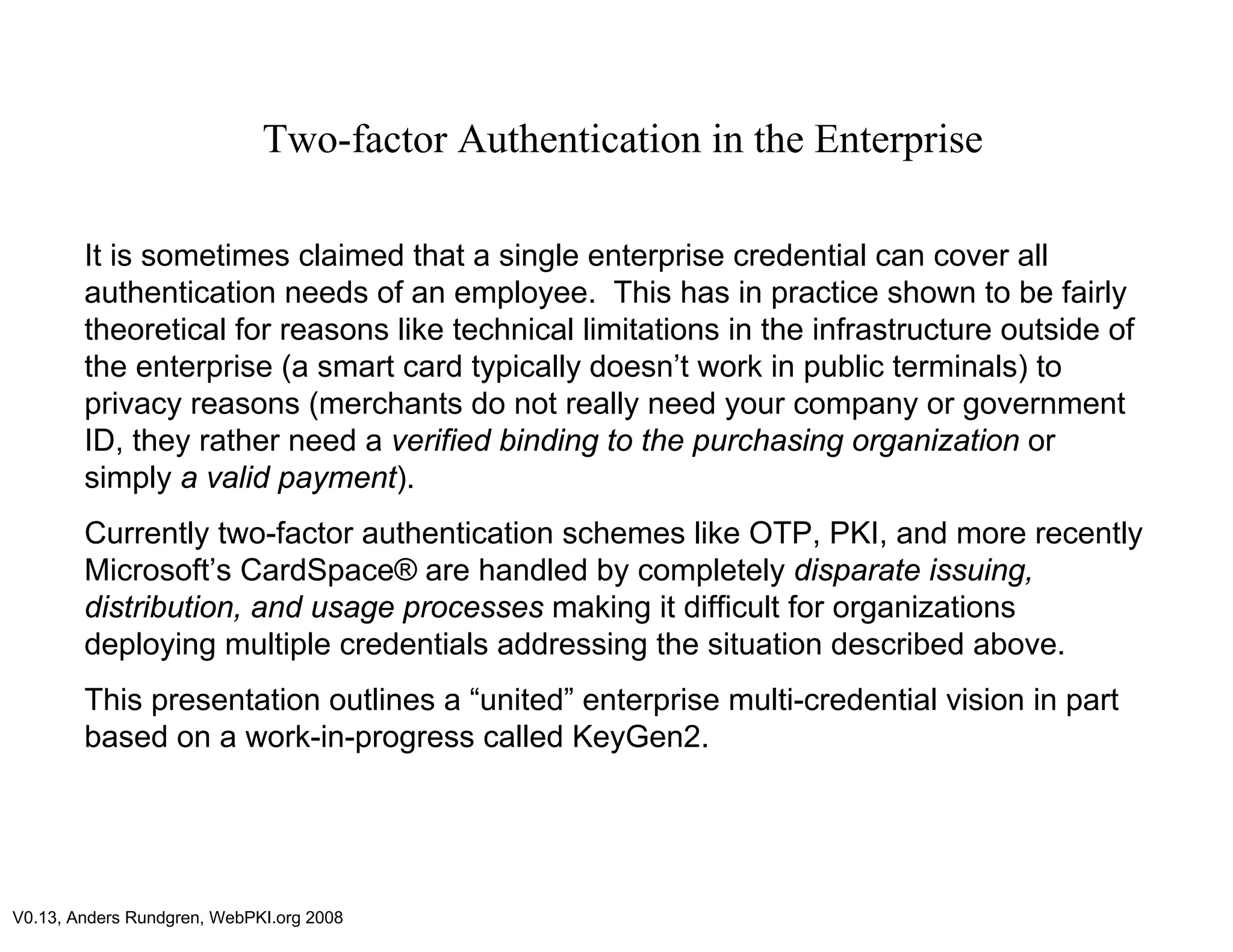
Select Card XSelect Card X
Enhanced TLS or Kerberos client using
PKI for authentication to the Acme intranet
Information Card using PKI for
authenticating to the Acme IdP
Direct Mode Federated Mode
One GUI Paradigm* - Multiple Credentials and Scenarios
John Doe
ID
03450184
*) Client-side PKI in TLS
can be regarded as
managed cards running
in self-issued mode Purchasing Card
John Doe
V0.13, Anders Rundgren, WebPKI.org 2008
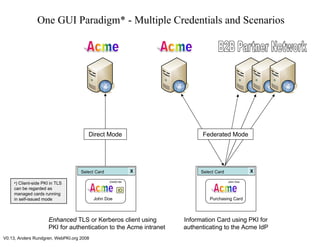
One Time Password
SmartPhone with OTP application support,
“emulating” OTP token devices
Direct Mode
Ubiquitous Enterprise Web Access - An OTP “Killer Application”
0453245
John Doe
Standard “PC” (Windows, Linux, Mac)
without any additional authentication
middleware or hardware
Although not shown, OTP token
selection can be performed using
an Information Card GUI as well
V0.13, Anders Rundgren, WebPKI.org 2008
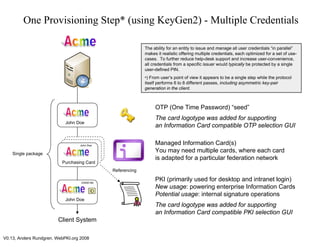
One Provisioning Step* (using KeyGen2) - Multiple Credentials
The ability for an entity to issue and manage all user credentials “in parallel”
makes it realistic offering multiple credentials, each optimized for a set of use-
cases. To further reduce help-desk support and increase user-convenience,
all credentials from a specific issuer would typically be protected by a single
user-defined PIN.
*) From user’s point of view it appears to be a single step while the protocol
itself performs 6 to 8 different passes, including asymmetric key-pair
generation in the client.
OTP (One Time Password) “seed”
The card logotype was added for supporting
an Information Card compatible OTP selection GUI
Managed Information Card(s)
You may need multiple cards, where each card
is adapted for a particular federation network
PKI (primarily used for desktop and intranet login)
New usage: powering enterprise Information Cards
Potential usage: internal signature operations
The card logotype was added for supporting
an Information Card compatible PKI selection GUI
Client System
John Doe
ID
03450184
Referencing
John Doe
Single package
Purchasing Card
John Doe
V0.13, Anders Rundgren, WebPKI.org 2008
And in What Should We Keep All these Credentials?
http://middleware.internet2.edu/idtrust/2008/slides/03-pekka-roaming-identity.ppt
Maybe these guys are on to something?

Multiple credentials-in-the-enterprise

  • 1.
    V0.13, Anders Rundgren,WebPKI.org 2008 Two-factor Authentication in the Enterprise It is sometimes claimed that a single enterprise credential can cover all authentication needs of an employee. This has in practice shown to be fairly theoretical for reasons like technical limitations in the infrastructure outside of the enterprise (a smart card typically doesn’t work in public terminals) to privacy reasons (merchants do not really need your company or government ID, they rather need a verified binding to the purchasing organization or simply a valid payment). Currently two-factor authentication schemes like OTP, PKI, and more recently Microsoft’s CardSpace® are handled by completely disparate issuing, distribution, and usage processes making it difficult for organizations deploying multiple credentials addressing the situation described above. This presentation outlines a “united” enterprise multi-credential vision in part based on a work-in-progress called KeyGen2.
  • 2.
    V0.13, Anders Rundgren,WebPKI.org 2008 Select Card XSelect Card X Enhanced TLS or Kerberos client using PKI for authentication to the Acme intranet Information Card using PKI for authenticating to the Acme IdP Direct Mode Federated Mode One GUI Paradigm* - Multiple Credentials and Scenarios John Doe ID 03450184 *) Client-side PKI in TLS can be regarded as managed cards running in self-issued mode Purchasing Card John Doe
  • 3.
    V0.13, Anders Rundgren,WebPKI.org 2008 One Time Password SmartPhone with OTP application support, “emulating” OTP token devices Direct Mode Ubiquitous Enterprise Web Access - An OTP “Killer Application” 0453245 John Doe Standard “PC” (Windows, Linux, Mac) without any additional authentication middleware or hardware Although not shown, OTP token selection can be performed using an Information Card GUI as well
  • 4.
    V0.13, Anders Rundgren,WebPKI.org 2008 One Provisioning Step* (using KeyGen2) - Multiple Credentials The ability for an entity to issue and manage all user credentials “in parallel” makes it realistic offering multiple credentials, each optimized for a set of use- cases. To further reduce help-desk support and increase user-convenience, all credentials from a specific issuer would typically be protected by a single user-defined PIN. *) From user’s point of view it appears to be a single step while the protocol itself performs 6 to 8 different passes, including asymmetric key-pair generation in the client. OTP (One Time Password) “seed” The card logotype was added for supporting an Information Card compatible OTP selection GUI Managed Information Card(s) You may need multiple cards, where each card is adapted for a particular federation network PKI (primarily used for desktop and intranet login) New usage: powering enterprise Information Cards Potential usage: internal signature operations The card logotype was added for supporting an Information Card compatible PKI selection GUI Client System John Doe ID 03450184 Referencing John Doe Single package Purchasing Card John Doe
  • 5.
    V0.13, Anders Rundgren,WebPKI.org 2008 And in What Should We Keep All these Credentials? http://middleware.internet2.edu/idtrust/2008/slides/03-pekka-roaming-identity.ppt Maybe these guys are on to something?