Deepening Pedagogy with OER
CUNY/SUNY OER Showcase
Lehman College Faculty
3/23
Sharon Jordan, PhD
Assistant Professor
Art Department
OER Course: Introduction to the History of Modern Art
ARH141: Introduction to
the History of Modern Art
Sharon Jordan, Assistant Professor,
Art Dept. Lehman College, CUNY
• OER class
• Hybrid class
• Pathways Distribution Area 4:
Creative Expressions
Wordpress class site on the CUNY Academic Commons:
https://arh141.commons.gc.cuny.edu
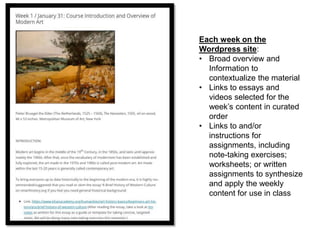
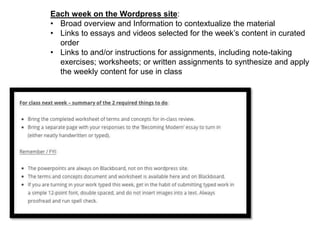
Each week on the
Wordpress site:
• Broad overview and
Information to
contextualize the material
• Links to essays and
videos selected for the
week’s content in curated
order
• Links to and/or
instructions for
assignments, including
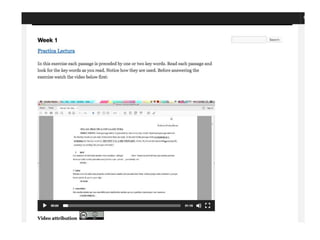
note-taking exercises;
worksheets; or written
assignments to synthesize
and apply the weekly
content for use in class
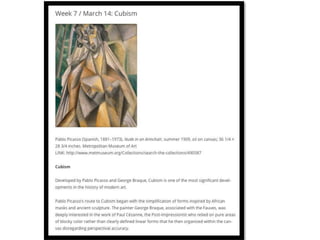
Each week on the Wordpress site:
• Broad overview and Information to contextualize the material
• Links to essays and videos selected for the week’s content in curated
order
• Links to and/or instructions for assignments, including note-taking
exercises; worksheets; or written assignments to synthesize and apply
the weekly content for use in class
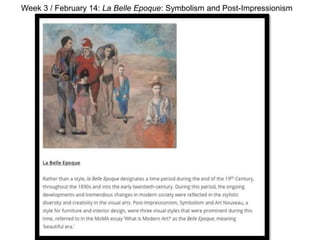
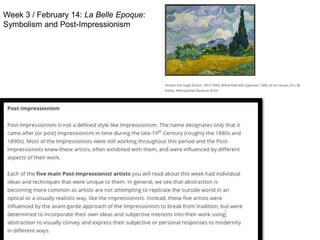
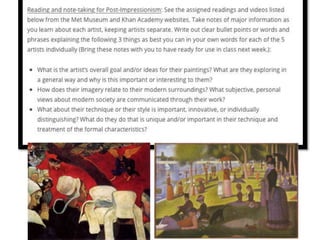
Week 3 / February 14: La Belle Epoque: Symbolism and Post-Impressionism
Week 3 / February 14: La Belle Epoque:
Symbolism and Post-Impressionism
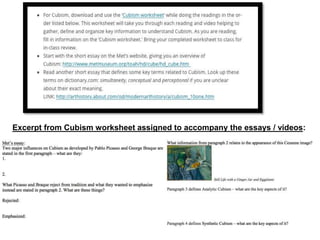
Excerpt from Cubism worksheet assigned to accompany the essays / videos:
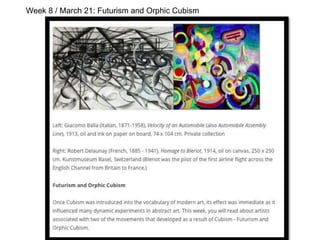
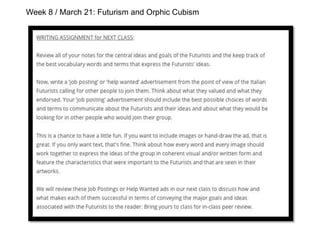
Week 8 / March 21: Futurism and Orphic Cubism
Yuri Gorokhovich, PhD
Associate Professor
Earth, Environmental, and Geospatial Science
Department
OER Course: Data Acquisition and Integration for GIS
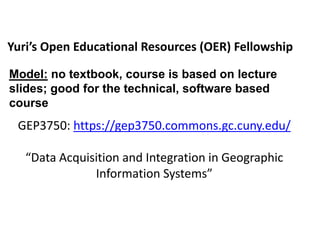
Yuri’s Open Educational Resources (OER) Fellowship
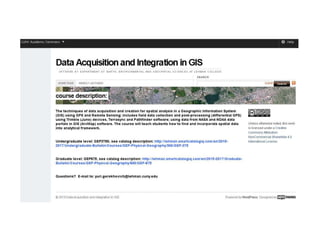
GEP3750: https://gep3750.commons.gc.cuny.edu/
“Data Acquisition and Integration in Geographic
Information Systems”
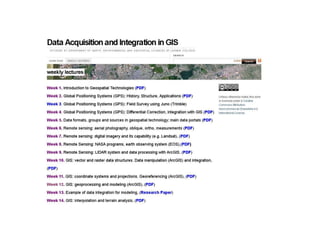
Model: no textbook, course is based on lecture
slides; good for the technical, software based
course
Analysis of OER Experience
1. No need to order books every semester; textbooks are FREE for students
2. No need to argue with students regarding their inability to get textbooks in time
3. All documents are available instantaneously
4. Feed-back from peers (I got just one from my friends)
5. No need to remember where lecture slides are 
6. Easy to incorporate any new material
7. CUNY Commons automatically checks and reports broken web links
8. No need to check/edit page numbers in lectures and labs
9. Instead of being confined to just the textbook content I can expand
my range of topics and materials
10. I can use my own papers and research as examples
11. Automatic backup of the course
12. Use of original governmental sites with updates
OER: positive
OER: negative
1. CUNY Commons could be improved for OER creation and editing (which is happening)
2. Search for OER materials can be lengthy and painful
3. Students still do not read materials on the web site!!!!!!!
6. Hard to develop a good model for class work: I lean toward the flipped class.
Alexander Nunez Torres, PhD
Assistant Professor
Department of Economics and Business
OER Course: Principles of Macroeconomics
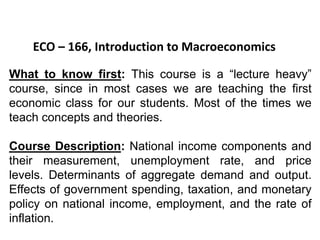
ECO – 166, Introduction to Macroeconomics
What to know first: This course is a “lecture heavy”
course, since in most cases we are teaching the first
economic class for our students. Most of the times we
teach concepts and theories.
Course Description: National income components and
their measurement, unemployment rate, and price
levels. Determinants of aggregate demand and output.
Effects of government spending, taxation, and monetary
policy on national income, employment, and the rate of
inflation.
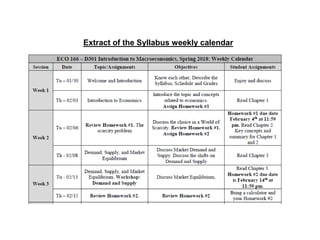
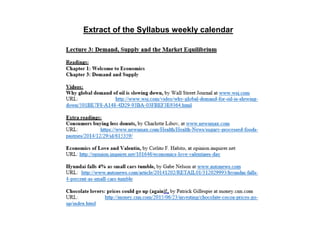
Extract of the Syllabus weekly calendar
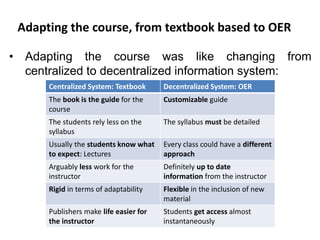
Adapting the course, from textbook based to OER
• Adapting the course was like changing from
centralized to decentralized information system:
Centralized System: Textbook Decentralized System: OER
The book is the guide for the
course
Customizable guide
The students rely less on the
syllabus
The syllabus must be detailed
Usually the students know what
to expect: Lectures
Every class could have a different
approach
Arguably less work for the
instructor
Definitely up to date
information from the instructor
Rigid in terms of adaptability Flexible in the inclusion of new
material
Publishers make life easier for
the instructor
Students get access almost
instantaneously
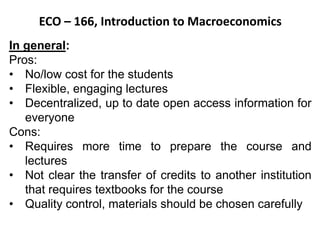
ECO – 166, Introduction to Macroeconomics
In general:
Pros:
• No/low cost for the students
• Flexible, engaging lectures
• Decentralized, up to date open access information for
everyone
Cons:
• Requires more time to prepare the course and
lectures
• Not clear the transfer of credits to another institution
that requires textbooks for the course
• Quality control, materials should be chosen carefully
Dhipinder Walia, MFA
Lecturer
English Department
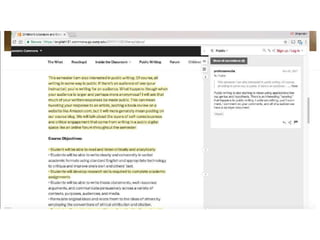
OER Course: English Composition
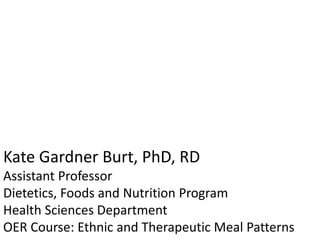
Kate Gardner Burt, PhD, RD
Assistant Professor
Dietetics, Foods and Nutrition Program
Health Sciences Department
OER Course: Ethnic and Therapeutic Meal Patterns
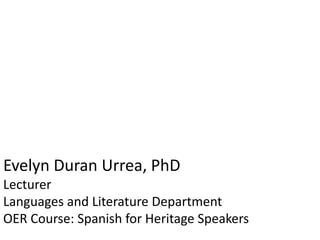
Evelyn Duran Urrea, PhD
Lecturer
Languages and Literature Department
OER Course: Spanish for Heritage Speakers
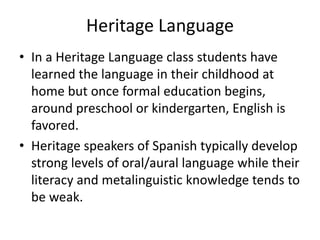
Heritage Language
• In a Heritage Language class students have
learned the language in their childhood at
home but once formal education begins,
around preschool or kindergarten, English is
favored.
• Heritage speakers of Spanish typically develop
strong levels of oral/aural language while their
literacy and metalinguistic knowledge tends to
be weak.
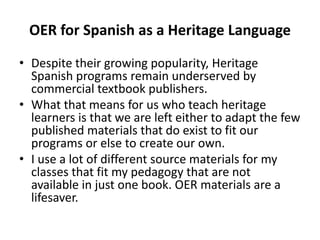
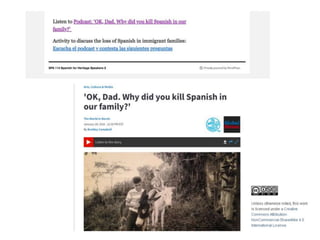
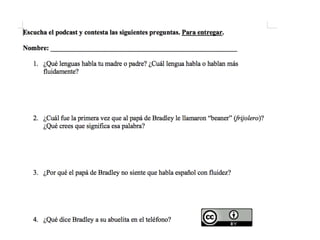
OER for Spanish as a Heritage Language
• Despite their growing popularity, Heritage
Spanish programs remain underserved by
commercial textbook publishers.
• What that means for us who teach heritage
learners is that we are left either to adapt the few
published materials that do exist to fit our
programs or else to create our own.
• I use a lot of different source materials for my
classes that fit my pedagogy that are not
available in just one book. OER materials are a
lifesaver.
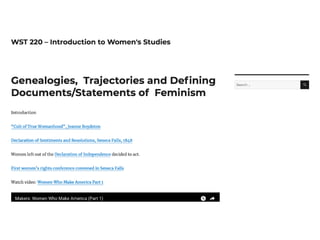
Bertrade Ngo-Ngijol Banoum, PhD
Assistant Professor
Women’s Studies Department
OER Course: Introduction to Women’s Studies
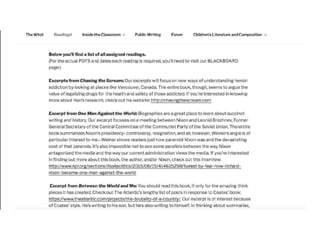
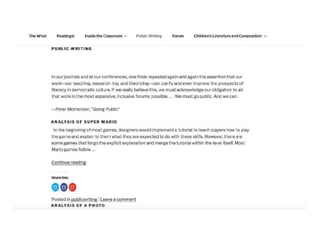
Deepening Pedagogy with OER

Deepening Pedagogy with OER

  • 1.
    Deepening Pedagogy withOER CUNY/SUNY OER Showcase Lehman College Faculty 3/23
  • 2.
    Sharon Jordan, PhD AssistantProfessor Art Department OER Course: Introduction to the History of Modern Art
  • 3.
    ARH141: Introduction to theHistory of Modern Art Sharon Jordan, Assistant Professor, Art Dept. Lehman College, CUNY • OER class • Hybrid class • Pathways Distribution Area 4: Creative Expressions Wordpress class site on the CUNY Academic Commons: https://arh141.commons.gc.cuny.edu
  • 4.
    Each week onthe Wordpress site: • Broad overview and Information to contextualize the material • Links to essays and videos selected for the week’s content in curated order • Links to and/or instructions for assignments, including note-taking exercises; worksheets; or written assignments to synthesize and apply the weekly content for use in class
  • 5.
    Each week onthe Wordpress site: • Broad overview and Information to contextualize the material • Links to essays and videos selected for the week’s content in curated order • Links to and/or instructions for assignments, including note-taking exercises; worksheets; or written assignments to synthesize and apply the weekly content for use in class
  • 6.
    Week 3 /February 14: La Belle Epoque: Symbolism and Post-Impressionism
  • 7.
    Week 3 /February 14: La Belle Epoque: Symbolism and Post-Impressionism
  • 10.
    Excerpt from Cubismworksheet assigned to accompany the essays / videos:
  • 11.
    Week 8 /March 21: Futurism and Orphic Cubism
  • 12.
    Week 8 /March 21: Futurism and Orphic Cubism
  • 13.
    Yuri Gorokhovich, PhD AssociateProfessor Earth, Environmental, and Geospatial Science Department OER Course: Data Acquisition and Integration for GIS
  • 14.
    Yuri’s Open EducationalResources (OER) Fellowship GEP3750: https://gep3750.commons.gc.cuny.edu/ “Data Acquisition and Integration in Geographic Information Systems” Model: no textbook, course is based on lecture slides; good for the technical, software based course
  • 17.
    Analysis of OERExperience
  • 18.
    1. No needto order books every semester; textbooks are FREE for students 2. No need to argue with students regarding their inability to get textbooks in time 3. All documents are available instantaneously 4. Feed-back from peers (I got just one from my friends) 5. No need to remember where lecture slides are  6. Easy to incorporate any new material 7. CUNY Commons automatically checks and reports broken web links 8. No need to check/edit page numbers in lectures and labs 9. Instead of being confined to just the textbook content I can expand my range of topics and materials 10. I can use my own papers and research as examples 11. Automatic backup of the course 12. Use of original governmental sites with updates OER: positive
  • 19.
    OER: negative 1. CUNYCommons could be improved for OER creation and editing (which is happening) 2. Search for OER materials can be lengthy and painful 3. Students still do not read materials on the web site!!!!!!! 6. Hard to develop a good model for class work: I lean toward the flipped class.
  • 20.
    Alexander Nunez Torres,PhD Assistant Professor Department of Economics and Business OER Course: Principles of Macroeconomics
  • 21.
    ECO – 166,Introduction to Macroeconomics What to know first: This course is a “lecture heavy” course, since in most cases we are teaching the first economic class for our students. Most of the times we teach concepts and theories. Course Description: National income components and their measurement, unemployment rate, and price levels. Determinants of aggregate demand and output. Effects of government spending, taxation, and monetary policy on national income, employment, and the rate of inflation.
  • 22.
    Extract of theSyllabus weekly calendar
  • 23.
    Extract of theSyllabus weekly calendar
  • 24.
    Adapting the course,from textbook based to OER • Adapting the course was like changing from centralized to decentralized information system: Centralized System: Textbook Decentralized System: OER The book is the guide for the course Customizable guide The students rely less on the syllabus The syllabus must be detailed Usually the students know what to expect: Lectures Every class could have a different approach Arguably less work for the instructor Definitely up to date information from the instructor Rigid in terms of adaptability Flexible in the inclusion of new material Publishers make life easier for the instructor Students get access almost instantaneously
  • 25.
    ECO – 166,Introduction to Macroeconomics In general: Pros: • No/low cost for the students • Flexible, engaging lectures • Decentralized, up to date open access information for everyone Cons: • Requires more time to prepare the course and lectures • Not clear the transfer of credits to another institution that requires textbooks for the course • Quality control, materials should be chosen carefully
  • 26.
    Dhipinder Walia, MFA Lecturer EnglishDepartment OER Course: English Composition
  • 34.
    Kate Gardner Burt,PhD, RD Assistant Professor Dietetics, Foods and Nutrition Program Health Sciences Department OER Course: Ethnic and Therapeutic Meal Patterns
  • 35.
    Evelyn Duran Urrea,PhD Lecturer Languages and Literature Department OER Course: Spanish for Heritage Speakers
  • 36.
    Heritage Language • Ina Heritage Language class students have learned the language in their childhood at home but once formal education begins, around preschool or kindergarten, English is favored. • Heritage speakers of Spanish typically develop strong levels of oral/aural language while their literacy and metalinguistic knowledge tends to be weak.
  • 37.
    OER for Spanishas a Heritage Language • Despite their growing popularity, Heritage Spanish programs remain underserved by commercial textbook publishers. • What that means for us who teach heritage learners is that we are left either to adapt the few published materials that do exist to fit our programs or else to create our own. • I use a lot of different source materials for my classes that fit my pedagogy that are not available in just one book. OER materials are a lifesaver.
  • 42.
    Bertrade Ngo-Ngijol Banoum,PhD Assistant Professor Women’s Studies Department OER Course: Introduction to Women’s Studies