Dr. Tommaso Infusino,
Cardiologo Elettrofisiologo
Consulente per l’Urologia del Prof. Luca Carmignani
Policlinico San Donato
San Donato 7 Marzo 2014
GESTIONE DELLA TERAPIA ANTICOAGULANTE
NELL’INTERVENTISTICA UROLOGICA
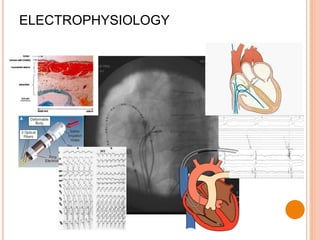
ELECTROPHYSIOLOGY
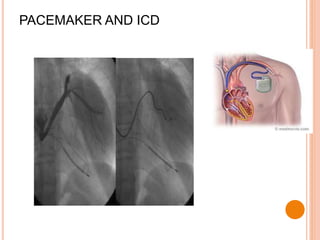
PACEMAKER AND ICD
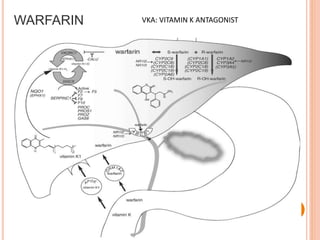
WARFARIN VKA: VITAMIN K ANTAGONIST
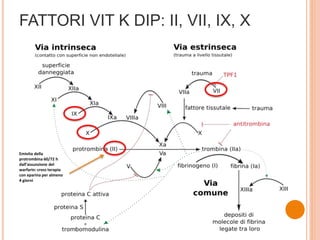
FATTORI VIT K DIP: II, VII, IX, X
Emivita della
protrombina 60/72 h
dall’assunzione del
warfarin: cross terapia
con eparina per almeno
4 giorni
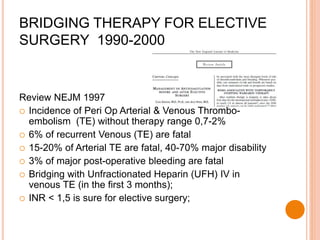
Review NEJM 1997
 Incidence of Peri Op Arterial & Venous Thrombo-
embolism (TE) without therapy range 0,7-2%
 6% of recurrent Venous (TE) are fatal
 15-20% of Arterial TE are fatal, 40-70% major disability
 3% of major post-operative bleeding are fatal
 Bridging with Unfractionated Heparin (UFH) IV in
venous TE (in the first 3 months);
 INR < 1,5 is sure for elective surgery;
BRIDGING THERAPY FOR ELECTIVE
SURGERY 1990-2000
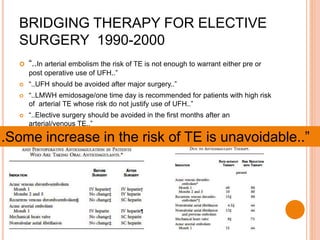
 “..In arterial embolism the risk of TE is not enough to warrant either pre or
post operative use of UFH..”
 “..UFH should be avoided after major surgery..”
 “..LMWH emidosage/one time day is recommended for patients with high risk
of arterial TE whose risk do not justify use of UFH..”
 “..Elective surgery should be avoided in the first months after an
arterial/venous TE..”
BRIDGING THERAPY FOR ELECTIVE
SURGERY 1990-2000
..Some increase in the risk of TE is unavoidable..”
BRIDGING THERAPY FOR ELECTIVE
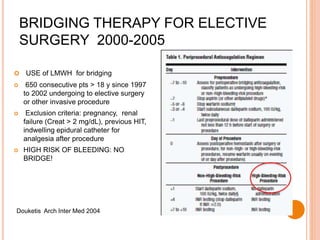
SURGERY 2000-2005
BRIDGING THERAPY FOR ELECTIVE
SURGERY 2000-2005
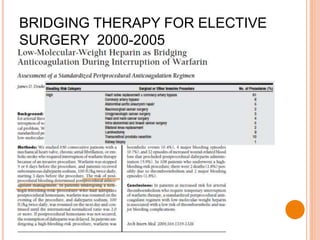
 USE of LMWH for bridging
 650 consecutive pts > 18 y since 1997
to 2002 undergoing to elective surgery
or other invasive procedure
 Exclusion criteria: pregnancy, renal
failure (Creat > 2 mg/dL), previous HIT,
indwelling epidural catheter for
analgesia after procedure
 HIGH RISK OF BLEEDING: NO
BRIDGE!
Douketis Arch Inter Med 2004
BRIDGING THERAPY FOR ELECTIVE
SURGERY 2000-2005
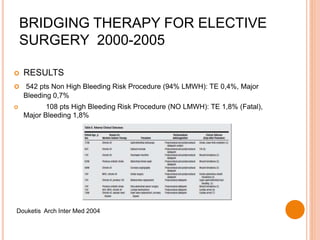
 RESULTS
 542 pts Non High Bleeding Risk Procedure (94% LMWH): TE 0,4%, Major
Bleeding 0,7%
 108 pts High Bleeding Risk Procedure (NO LMWH): TE 1,8% (Fatal),
Major Bleeding 1,8%
Douketis Arch Inter Med 2004
 Circulation 2009
BRIDGING THERAPY FOR ELECTIVE
SURGERY: ITALY 2009
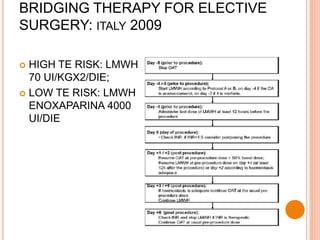
 HIGH TE RISK: LMWH
70 UI/KGX2/DIE;
 LOW TE RISK: LMWH
ENOXAPARINA 4000
UI/DIE
BRIDGING THERAPY FOR ELECTIVE
SURGERY: ITALY 2009
BRIDGING THERAPY FOR ELECTIVE
SURGERY:GUIDELINES 2012
BRIDGING THERAPY FOR ELECTIVE
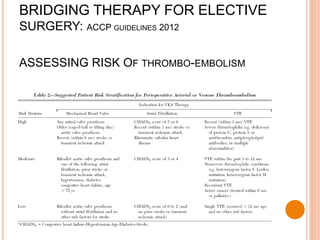
SURGERY: ACCP GUIDELINES 2012
ASSESSING RISK OF THROMBO-EMBOLISM
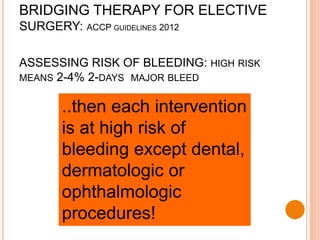
ASSESSING RISK OF BLEEDING: HIGH RISK
MEANS 2-4% 2-DAYS MAJOR BLEED
BRIDGING THERAPY FOR ELECTIVE
SURGERY: ACCP GUIDELINES 2012
..then each intervention
is at high risk of
bleeding except dental,
dermatologic or
ophthalmologic
procedures!
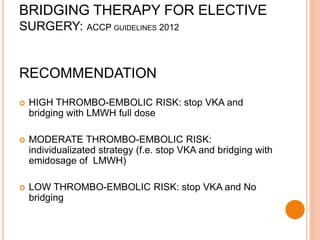
RECOMMENDATION
 HIGH THROMBO-EMBOLIC RISK: stop VKA and
bridging with LMWH full dose
 MODERATE THROMBO-EMBOLIC RISK:
individualizated strategy (f.e. stop VKA and bridging with
emidosage of LMWH)
 LOW THROMBO-EMBOLIC RISK: stop VKA and No
bridging
BRIDGING THERAPY FOR ELECTIVE
SURGERY: ACCP GUIDELINES 2012
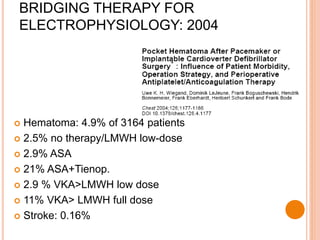
 Hematoma: 4.9% of 3164 patients
 2.5% no therapy/LMWH low-dose
 2.9% ASA
 21% ASA+Tienop.
 2.9 % VKA>LMWH low dose
 11% VKA> LMWH full dose
 Stroke: 0.16%
BRIDGING THERAPY FOR
ELECTROPHYSIOLOGY: 2004
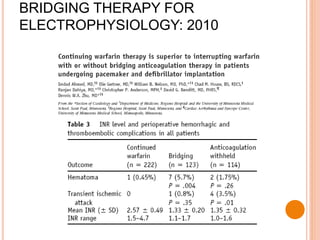
BRIDGING THERAPY FOR
ELECTROPHYSIOLOGY: 2010
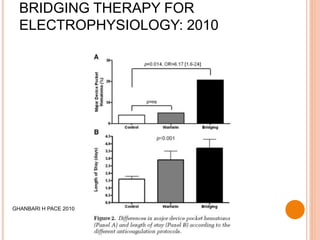
BRIDGING THERAPY FOR
ELECTROPHYSIOLOGY: 2010
GHANBARI H PACE 2010
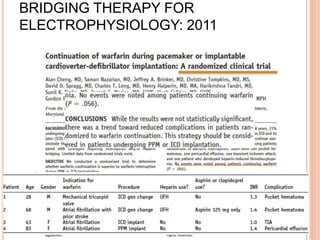
BRIDGING THERAPY FOR
ELECTROPHYSIOLOGY: 2011
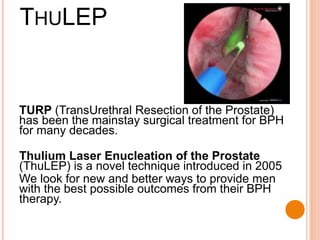
TURP (TransUrethral Resection of the Prostate)
has been the mainstay surgical treatment for BPH
for many decades.
Thulium Laser Enucleation of the Prostate
(ThuLEP) is a novel technique introduced in 2005
We look for new and better ways to provide men
with the best possible outcomes from their BPH
therapy.
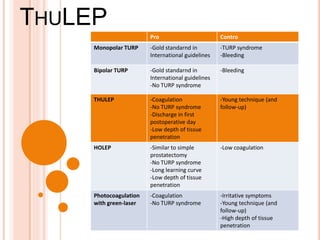
THULEP
Pro Contro
Monopolar TURP -Gold standarnd in
International guidelines
-TURP syndrome
-Bleeding
Bipolar TURP -Gold standarnd in
International guidelines
-No TURP syndrome
-Bleeding
THULEP -Coagulation
-No TURP syndrome
-Discharge in first
postoperative day
-Low depth of tissue
penetration
-Young technique (and
follow-up)
HOLEP -Similar to simple
prostatectomy
-No TURP syndrome
-Long learning curve
-Low depth of tissue
penetration
-Low coagulation
Photocoagulation
with green-laser
-Coagulation
-No TURP syndrome
-Irritative symptoms
-Young technique (and
follow-up)
-High depth of tissue
penetration
THULEP
BACKGROUND: EXPERIENCE IN UROLOGY
HOLMIUM LASER ENUCLEATION
 Holmium laser enucleation of the prostate in
patients on anticoagulant therapy or with
bleeding disorders. Elzayat E J Urol. 2006
 Safety of holmium laser enucleation of the
prostate in anticoagulated patients. Tyson MB J
Endourol. 2009
 Holmium laser enucleation of the prostate
(HoLEP) in patients with continuous oral
anticoagulation: first reported cases in Japan].
Hirayama T Nihon Hinyokika Gakkai Zasshi. 2010
PURPOSE
 Nowdays bridging therapy with LMWH in chronic
anticoagulated patients with vitamin K antagonist (VKA)
undergoing to transurethral resection of the prostate
(TURP) has been considered a gold standard.
 The current management recognized by the Italian and
European guidelines in this subgroup is the suspension
of VKA from 7 to 5 days before surgery to switch to
LMWH before and after surgery, followed by restarting
VKA from the 1-2 postoperative day untill reacing
therapeutic INR.
 Recent evidence from randomized single-center clinical
trials in interventional other branches of medicine, have
shown an increased incidence of peri-operative bleeding
with LMWH treatment bridge with respect to the
continuation of the TAO.
 In view of the good safety profile of ThuLEP
(Thulium laser enucleation of the prostate)
in term of LOW peri-operative bleeding and
on the base of INCREASED BLEEDING
RISK without protection from THROMBO-
EMBOLIC RISK by FULL BRIDGING, we
have designed a new protocol for the
perioperative management of patients on
the base of TE risk with the AIM TO
MINIMIZE or AVOID BRIDGING LMWH.
PURPOSE
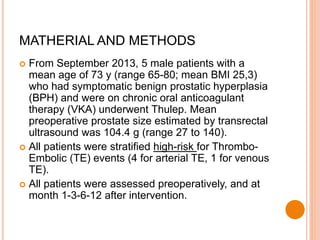
 From September 2013, 5 male patients with a
mean age of 73 y (range 65-80; mean BMI 25,3)
who had symptomatic benign prostatic hyperplasia
(BPH) and were on chronic oral anticoagulant
therapy (VKA) underwent Thulep. Mean
preoperative prostate size estimated by transrectal
ultrasound was 104.4 g (range 27 to 140).
 All patients were stratified high-risk for Thrombo-
Embolic (TE) events (4 for arterial TE, 1 for venous
TE).
 All patients were assessed preoperatively, and at
month 1-3-6-12 after intervention.
MATHERIAL AND METHODS
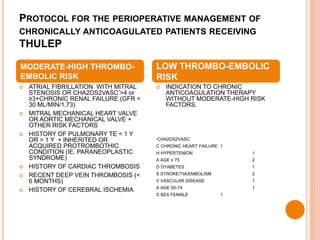
PROTOCOL FOR THE PERIOPERATIVE MANAGEMENT OF
CHRONICALLY ANTICOAGULATED PATIENTS RECEIVING
THULEP
 ATRIAL FIBRILLATION WITH MITRAL
STENOSIS OR CHA2DS2VASC*>4 or
≥3+CHRONIC RENAL FAILURE (GFR <
30 ML/MIN/1.73)
 MITRAL MECHANICAL HEART VALVE
OR AORTIC MECHANICAL VALVE +
OTHER RISK FACTORS
 HISTORY OF PULMONARY TE < 1 Y
OR > 1 Y + INHERITED OR
ACQUIRED PROTROMBOTHIC
CONDITION (IE. PARANEOPLASTIC
SYNDROME)
 HISTORY OF CARDIAC THROMBOSIS
 RECENT DEEP VEIN THROMBOSIS (<
6 MONTHS)
 HISTORY OF CEREBRAL ISCHEMIA
 INDICATION TO CHRONIC
ANTICOAGULATION THERAPY
WITHOUT MODERATE-HIGH RISK
FACTORS.
*CHA2DS2VASC
C CHRONIC HEART FAILURE 1
H HYPERTENION 1
A AGE ≥ 75 2
D DYABETES 1
S STROKE/TIA/EMBOLISM 2
V VASCULAR DISEASE 1
A AGE 65-74 1
S SEX FEMALE 1
MODERATE-HIGH THROMBO-
EMBOLIC RISK
LOW THROMBO-EMBOLIC
RISK
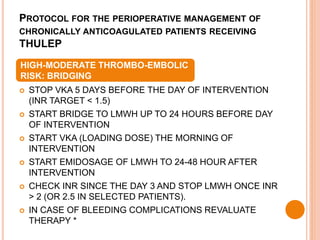
PROTOCOL FOR THE PERIOPERATIVE MANAGEMENT OF
CHRONICALLY ANTICOAGULATED PATIENTS RECEIVING
THULEP
 STOP VKA 5 DAYS BEFORE THE DAY OF INTERVENTION
(INR TARGET < 1.5)
 START BRIDGE TO LMWH UP TO 24 HOURS BEFORE DAY
OF INTERVENTION
 START VKA (LOADING DOSE) THE MORNING OF
INTERVENTION
 START EMIDOSAGE OF LMWH TO 24-48 HOUR AFTER
INTERVENTION
 CHECK INR SINCE THE DAY 3 AND STOP LMWH ONCE INR
> 2 (OR 2.5 IN SELECTED PATIENTS).
 IN CASE OF BLEEDING COMPLICATIONS REVALUATE
THERAPY *
HIGH-MODERATE THROMBO-EMBOLIC
RISK: BRIDGING
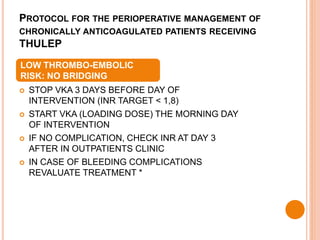
PROTOCOL FOR THE PERIOPERATIVE MANAGEMENT OF
CHRONICALLY ANTICOAGULATED PATIENTS RECEIVING
THULEP
 STOP VKA 3 DAYS BEFORE DAY OF
INTERVENTION (INR TARGET < 1,8)
 START VKA (LOADING DOSE) THE MORNING DAY
OF INTERVENTION
 IF NO COMPLICATION, CHECK INR AT DAY 3
AFTER IN OUTPATIENTS CLINIC
 IN CASE OF BLEEDING COMPLICATIONS
REVALUATE TREATMENT *
LOW THROMBO-EMBOLIC
RISK: NO BRIDGING
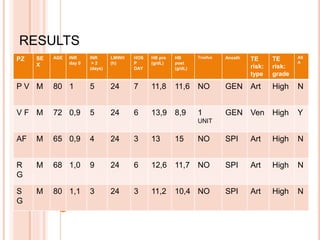
PZ SE
X
AGE INR
day 0
INR
> 2
(days)
LMWH
(h)
HOS
P
DAY
HB pre
(g/dL)
HB
post
(g/dL)
Trasfus Anesth TE
risk:
type
TE
risk:
grade
AS
A
P V M 80 1 5 24 7 11,8 11,6 NO GEN Art High N
V F M 72 0,9 5 24 6 13,9 8,9 1
UNIT
GEN Ven High Y
AF M 65 0,9 4 24 3 13 15 NO SPI Art High N
R
G
M 68 1,0 9 24 6 12,6 11,7 NO SPI Art High N
S
G
M 80 1,1 3 24 3 11,2 10,4 NO SPI Art High N
RESULTS
RESULTS 2
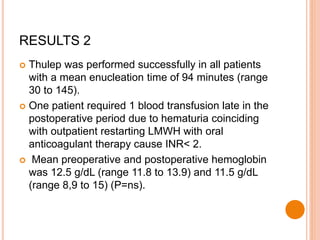
 Thulep was performed successfully in all patients
with a mean enucleation time of 94 minutes (range
30 to 145).
 One patient required 1 blood transfusion late in the
postoperative period due to hematuria coinciding
with outpatient restarting LMWH with oral
anticoagulant therapy cause INR< 2.
 Mean preoperative and postoperative hemoglobin
was 12.5 g/dL (range 11.8 to 13.9) and 11.5 g/dL
(range 8,9 to 15) (P=ns).
RESULTS 3
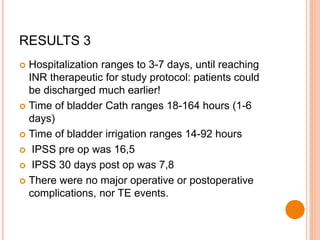
 Hospitalization ranges to 3-7 days, until reaching
INR therapeutic for study protocol: patients could
be discharged much earlier!
 Time of bladder Cath ranges 18-164 hours (1-6
days)
 Time of bladder irrigation ranges 14-92 hours
 IPSS pre op was 16,5
 IPSS 30 days post op was 7,8
 There were no major operative or postoperative
complications, nor TE events.
CONCLUSION 1
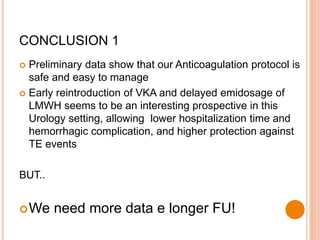
 Preliminary data show that our Anticoagulation protocol is
safe and easy to manage
 Early reintroduction of VKA and delayed emidosage of
LMWH seems to be an interesting prospective in this
Urology setting, allowing lower hospitalization time and
hemorrhagic complication, and higher protection against
TE events
BUT..
We need more data e longer FU!
COMMENTS 1
 There are several explanations for why continuing
warfarin could be safer then bridging:
- Cautery property of ThuLEP: Pts are fully
anticoagulated and develop oozing at the time of the
procedures will have likely that cauterized before the
incision is closed (avoiding subclinical bleeding that is
only later unmasked when anticoagulation is reinitiated)
- The amount of time during which the patient is
not anticoagulated is minimized
- Continuing warfarin avoids the heparin and the
need for increased at the risk of bleeding
associated particularly with postprocedural
administration.
COMMENTS 2
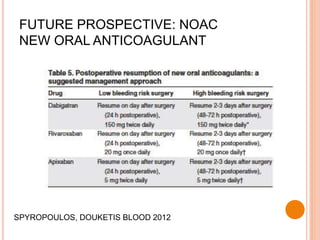
FUTURE PROSPECTIVE: NOAC
NEW ORAL ANTICOAGULANT
SPYROPOULOS, DOUKETIS BLOOD 2012
YES V K A!!
THANKS FOR YOUR
ATTENTION!

Anemo 2014 - Infusino - Protocol anticoagulation in urology

  • 1.
    Dr. Tommaso Infusino, CardiologoElettrofisiologo Consulente per l’Urologia del Prof. Luca Carmignani Policlinico San Donato San Donato 7 Marzo 2014 GESTIONE DELLA TERAPIA ANTICOAGULANTE NELL’INTERVENTISTICA UROLOGICA
  • 2.
  • 3.
  • 4.
  • 5.
    FATTORI VIT KDIP: II, VII, IX, X Emivita della protrombina 60/72 h dall’assunzione del warfarin: cross terapia con eparina per almeno 4 giorni
  • 6.
    Review NEJM 1997 Incidence of Peri Op Arterial & Venous Thrombo- embolism (TE) without therapy range 0,7-2%  6% of recurrent Venous (TE) are fatal  15-20% of Arterial TE are fatal, 40-70% major disability  3% of major post-operative bleeding are fatal  Bridging with Unfractionated Heparin (UFH) IV in venous TE (in the first 3 months);  INR < 1,5 is sure for elective surgery; BRIDGING THERAPY FOR ELECTIVE SURGERY 1990-2000
  • 7.
     “..In arterialembolism the risk of TE is not enough to warrant either pre or post operative use of UFH..”  “..UFH should be avoided after major surgery..”  “..LMWH emidosage/one time day is recommended for patients with high risk of arterial TE whose risk do not justify use of UFH..”  “..Elective surgery should be avoided in the first months after an arterial/venous TE..” BRIDGING THERAPY FOR ELECTIVE SURGERY 1990-2000 ..Some increase in the risk of TE is unavoidable..”
  • 8.
    BRIDGING THERAPY FORELECTIVE SURGERY 2000-2005
  • 9.
    BRIDGING THERAPY FORELECTIVE SURGERY 2000-2005  USE of LMWH for bridging  650 consecutive pts > 18 y since 1997 to 2002 undergoing to elective surgery or other invasive procedure  Exclusion criteria: pregnancy, renal failure (Creat > 2 mg/dL), previous HIT, indwelling epidural catheter for analgesia after procedure  HIGH RISK OF BLEEDING: NO BRIDGE! Douketis Arch Inter Med 2004
  • 10.
    BRIDGING THERAPY FORELECTIVE SURGERY 2000-2005  RESULTS  542 pts Non High Bleeding Risk Procedure (94% LMWH): TE 0,4%, Major Bleeding 0,7%  108 pts High Bleeding Risk Procedure (NO LMWH): TE 1,8% (Fatal), Major Bleeding 1,8% Douketis Arch Inter Med 2004
  • 11.
     Circulation 2009 BRIDGINGTHERAPY FOR ELECTIVE SURGERY: ITALY 2009
  • 12.
     HIGH TERISK: LMWH 70 UI/KGX2/DIE;  LOW TE RISK: LMWH ENOXAPARINA 4000 UI/DIE BRIDGING THERAPY FOR ELECTIVE SURGERY: ITALY 2009
  • 13.
    BRIDGING THERAPY FORELECTIVE SURGERY:GUIDELINES 2012
  • 14.
    BRIDGING THERAPY FORELECTIVE SURGERY: ACCP GUIDELINES 2012 ASSESSING RISK OF THROMBO-EMBOLISM
  • 15.
    ASSESSING RISK OFBLEEDING: HIGH RISK MEANS 2-4% 2-DAYS MAJOR BLEED BRIDGING THERAPY FOR ELECTIVE SURGERY: ACCP GUIDELINES 2012 ..then each intervention is at high risk of bleeding except dental, dermatologic or ophthalmologic procedures!
  • 16.
    RECOMMENDATION  HIGH THROMBO-EMBOLICRISK: stop VKA and bridging with LMWH full dose  MODERATE THROMBO-EMBOLIC RISK: individualizated strategy (f.e. stop VKA and bridging with emidosage of LMWH)  LOW THROMBO-EMBOLIC RISK: stop VKA and No bridging BRIDGING THERAPY FOR ELECTIVE SURGERY: ACCP GUIDELINES 2012
  • 17.
     Hematoma: 4.9%of 3164 patients  2.5% no therapy/LMWH low-dose  2.9% ASA  21% ASA+Tienop.  2.9 % VKA>LMWH low dose  11% VKA> LMWH full dose  Stroke: 0.16% BRIDGING THERAPY FOR ELECTROPHYSIOLOGY: 2004
  • 18.
  • 19.
    BRIDGING THERAPY FOR ELECTROPHYSIOLOGY:2010 GHANBARI H PACE 2010
  • 20.
  • 21.
    TURP (TransUrethral Resectionof the Prostate) has been the mainstay surgical treatment for BPH for many decades. Thulium Laser Enucleation of the Prostate (ThuLEP) is a novel technique introduced in 2005 We look for new and better ways to provide men with the best possible outcomes from their BPH therapy. THULEP
  • 22.
    Pro Contro Monopolar TURP-Gold standarnd in International guidelines -TURP syndrome -Bleeding Bipolar TURP -Gold standarnd in International guidelines -No TURP syndrome -Bleeding THULEP -Coagulation -No TURP syndrome -Discharge in first postoperative day -Low depth of tissue penetration -Young technique (and follow-up) HOLEP -Similar to simple prostatectomy -No TURP syndrome -Long learning curve -Low depth of tissue penetration -Low coagulation Photocoagulation with green-laser -Coagulation -No TURP syndrome -Irritative symptoms -Young technique (and follow-up) -High depth of tissue penetration THULEP
  • 23.
    BACKGROUND: EXPERIENCE INUROLOGY HOLMIUM LASER ENUCLEATION  Holmium laser enucleation of the prostate in patients on anticoagulant therapy or with bleeding disorders. Elzayat E J Urol. 2006  Safety of holmium laser enucleation of the prostate in anticoagulated patients. Tyson MB J Endourol. 2009  Holmium laser enucleation of the prostate (HoLEP) in patients with continuous oral anticoagulation: first reported cases in Japan]. Hirayama T Nihon Hinyokika Gakkai Zasshi. 2010
  • 24.
    PURPOSE  Nowdays bridgingtherapy with LMWH in chronic anticoagulated patients with vitamin K antagonist (VKA) undergoing to transurethral resection of the prostate (TURP) has been considered a gold standard.  The current management recognized by the Italian and European guidelines in this subgroup is the suspension of VKA from 7 to 5 days before surgery to switch to LMWH before and after surgery, followed by restarting VKA from the 1-2 postoperative day untill reacing therapeutic INR.  Recent evidence from randomized single-center clinical trials in interventional other branches of medicine, have shown an increased incidence of peri-operative bleeding with LMWH treatment bridge with respect to the continuation of the TAO.
  • 25.
     In viewof the good safety profile of ThuLEP (Thulium laser enucleation of the prostate) in term of LOW peri-operative bleeding and on the base of INCREASED BLEEDING RISK without protection from THROMBO- EMBOLIC RISK by FULL BRIDGING, we have designed a new protocol for the perioperative management of patients on the base of TE risk with the AIM TO MINIMIZE or AVOID BRIDGING LMWH. PURPOSE
  • 26.
     From September2013, 5 male patients with a mean age of 73 y (range 65-80; mean BMI 25,3) who had symptomatic benign prostatic hyperplasia (BPH) and were on chronic oral anticoagulant therapy (VKA) underwent Thulep. Mean preoperative prostate size estimated by transrectal ultrasound was 104.4 g (range 27 to 140).  All patients were stratified high-risk for Thrombo- Embolic (TE) events (4 for arterial TE, 1 for venous TE).  All patients were assessed preoperatively, and at month 1-3-6-12 after intervention. MATHERIAL AND METHODS
  • 27.
    PROTOCOL FOR THEPERIOPERATIVE MANAGEMENT OF CHRONICALLY ANTICOAGULATED PATIENTS RECEIVING THULEP  ATRIAL FIBRILLATION WITH MITRAL STENOSIS OR CHA2DS2VASC*>4 or ≥3+CHRONIC RENAL FAILURE (GFR < 30 ML/MIN/1.73)  MITRAL MECHANICAL HEART VALVE OR AORTIC MECHANICAL VALVE + OTHER RISK FACTORS  HISTORY OF PULMONARY TE < 1 Y OR > 1 Y + INHERITED OR ACQUIRED PROTROMBOTHIC CONDITION (IE. PARANEOPLASTIC SYNDROME)  HISTORY OF CARDIAC THROMBOSIS  RECENT DEEP VEIN THROMBOSIS (< 6 MONTHS)  HISTORY OF CEREBRAL ISCHEMIA  INDICATION TO CHRONIC ANTICOAGULATION THERAPY WITHOUT MODERATE-HIGH RISK FACTORS. *CHA2DS2VASC C CHRONIC HEART FAILURE 1 H HYPERTENION 1 A AGE ≥ 75 2 D DYABETES 1 S STROKE/TIA/EMBOLISM 2 V VASCULAR DISEASE 1 A AGE 65-74 1 S SEX FEMALE 1 MODERATE-HIGH THROMBO- EMBOLIC RISK LOW THROMBO-EMBOLIC RISK
  • 28.
    PROTOCOL FOR THEPERIOPERATIVE MANAGEMENT OF CHRONICALLY ANTICOAGULATED PATIENTS RECEIVING THULEP  STOP VKA 5 DAYS BEFORE THE DAY OF INTERVENTION (INR TARGET < 1.5)  START BRIDGE TO LMWH UP TO 24 HOURS BEFORE DAY OF INTERVENTION  START VKA (LOADING DOSE) THE MORNING OF INTERVENTION  START EMIDOSAGE OF LMWH TO 24-48 HOUR AFTER INTERVENTION  CHECK INR SINCE THE DAY 3 AND STOP LMWH ONCE INR > 2 (OR 2.5 IN SELECTED PATIENTS).  IN CASE OF BLEEDING COMPLICATIONS REVALUATE THERAPY * HIGH-MODERATE THROMBO-EMBOLIC RISK: BRIDGING
  • 29.
    PROTOCOL FOR THEPERIOPERATIVE MANAGEMENT OF CHRONICALLY ANTICOAGULATED PATIENTS RECEIVING THULEP  STOP VKA 3 DAYS BEFORE DAY OF INTERVENTION (INR TARGET < 1,8)  START VKA (LOADING DOSE) THE MORNING DAY OF INTERVENTION  IF NO COMPLICATION, CHECK INR AT DAY 3 AFTER IN OUTPATIENTS CLINIC  IN CASE OF BLEEDING COMPLICATIONS REVALUATE TREATMENT * LOW THROMBO-EMBOLIC RISK: NO BRIDGING
  • 30.
    PZ SE X AGE INR day0 INR > 2 (days) LMWH (h) HOS P DAY HB pre (g/dL) HB post (g/dL) Trasfus Anesth TE risk: type TE risk: grade AS A P V M 80 1 5 24 7 11,8 11,6 NO GEN Art High N V F M 72 0,9 5 24 6 13,9 8,9 1 UNIT GEN Ven High Y AF M 65 0,9 4 24 3 13 15 NO SPI Art High N R G M 68 1,0 9 24 6 12,6 11,7 NO SPI Art High N S G M 80 1,1 3 24 3 11,2 10,4 NO SPI Art High N RESULTS
  • 31.
    RESULTS 2  Thulepwas performed successfully in all patients with a mean enucleation time of 94 minutes (range 30 to 145).  One patient required 1 blood transfusion late in the postoperative period due to hematuria coinciding with outpatient restarting LMWH with oral anticoagulant therapy cause INR< 2.  Mean preoperative and postoperative hemoglobin was 12.5 g/dL (range 11.8 to 13.9) and 11.5 g/dL (range 8,9 to 15) (P=ns).
  • 32.
    RESULTS 3  Hospitalizationranges to 3-7 days, until reaching INR therapeutic for study protocol: patients could be discharged much earlier!  Time of bladder Cath ranges 18-164 hours (1-6 days)  Time of bladder irrigation ranges 14-92 hours  IPSS pre op was 16,5  IPSS 30 days post op was 7,8  There were no major operative or postoperative complications, nor TE events.
  • 33.
    CONCLUSION 1  Preliminarydata show that our Anticoagulation protocol is safe and easy to manage  Early reintroduction of VKA and delayed emidosage of LMWH seems to be an interesting prospective in this Urology setting, allowing lower hospitalization time and hemorrhagic complication, and higher protection against TE events BUT.. We need more data e longer FU!
  • 34.
    COMMENTS 1  Thereare several explanations for why continuing warfarin could be safer then bridging: - Cautery property of ThuLEP: Pts are fully anticoagulated and develop oozing at the time of the procedures will have likely that cauterized before the incision is closed (avoiding subclinical bleeding that is only later unmasked when anticoagulation is reinitiated)
  • 35.
    - The amountof time during which the patient is not anticoagulated is minimized - Continuing warfarin avoids the heparin and the need for increased at the risk of bleeding associated particularly with postprocedural administration. COMMENTS 2
  • 36.
    FUTURE PROSPECTIVE: NOAC NEWORAL ANTICOAGULANT SPYROPOULOS, DOUKETIS BLOOD 2012
  • 37.
    YES V KA!! THANKS FOR YOUR ATTENTION!

Editor's Notes

  • #5 VKA blocca la riduzione della vit K, cofattore della carbossilazione dell’N glutammato presente all estremità ammino terminale delle prot coag vit dip che permette l adesione al substrato fosfolipido velocizzando il processo coagulativo. Inibisce lo stesso enzima nelle ossa ed è teratogeno. Velocemente assorbito dal tratto GE come miscela racemica, con picco max plasmatico dopo 90 min dall’assunzione, emivita di 36-42 ore, si accumula nel fegato.
  • #6 Mutazione del propeptide IX nel 1,5 % della popolazione: riduzioen del fattore dopo inizio del warfarin con PT poco modificato e rischio emorragico. Effetto anticoagulante essenzialmente dal blocco fatt X. Effeto antitrombotico si ottine ecmq dopo 6 giorni perché il fatt II (protrombina) ha emiìvita di 60-72 h
  • #9 Dal Canada. 650 pazienti studiati consecutivamente. Il rischio emorragico dell’intervento determinava il protocollo anticoagulante da seguire.
  • #11 Basso rischio di eventi tromboembolici e emorragici nella bridging ma molte procedure a basso rischio tipo cateterismi cardiaci
  • #19 AHMED dal Regina Hospital St Paul Minnesota, 222 vka, vs 123 brid vs 114 in wo
  • #21 Cheng e Nazarian dalla Jhons Hopkins: il primo trial randomizzato diversificando l trattamento in base al rischioTE. Moderato-basso prosecuzione VKA vs wo, Alto prosecuzione VKA vs bridging