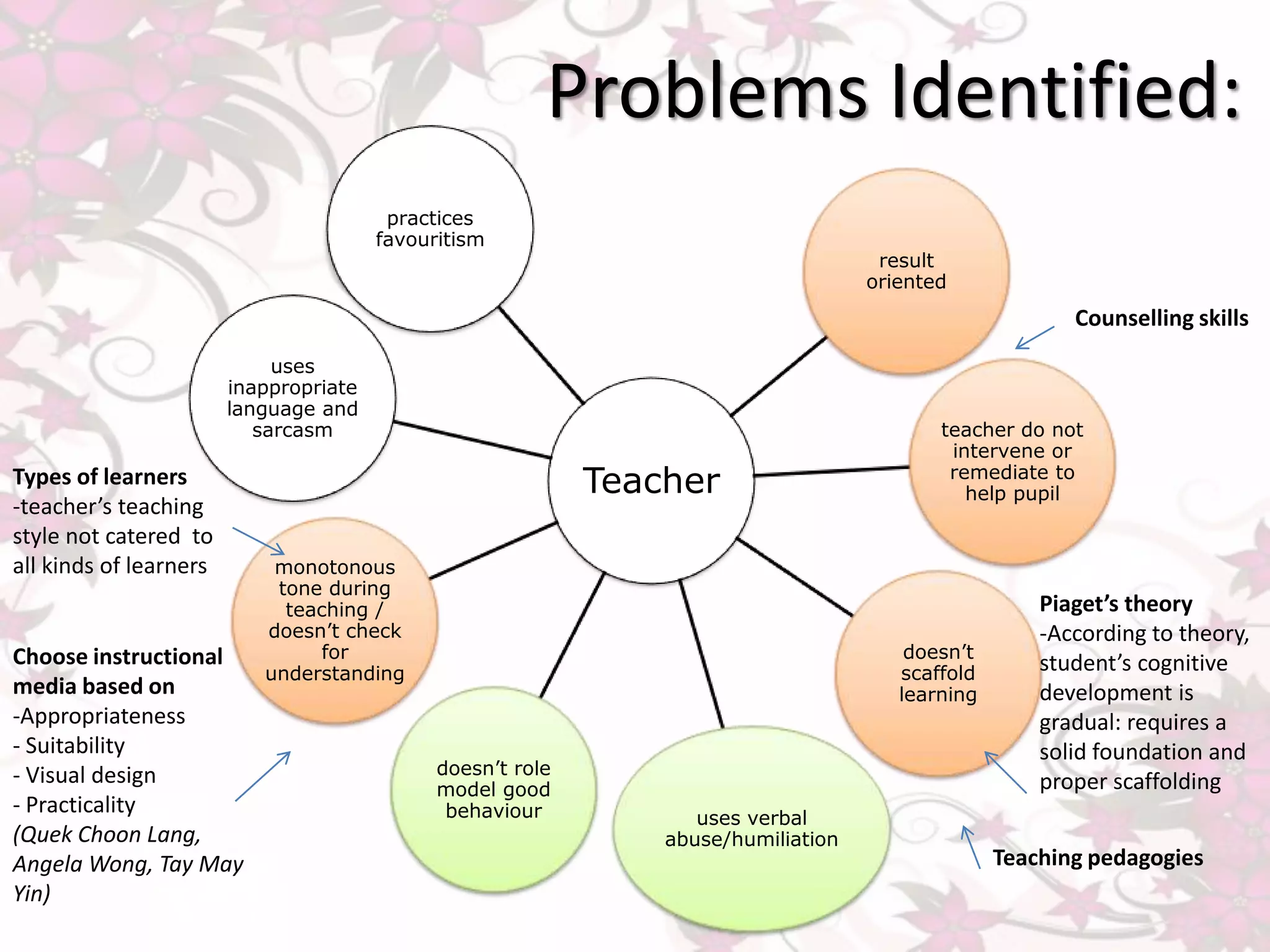
Teacher
practices
favouritism
result
oriented
teacher do not
intervene or
remediate to
help pupil
doesn’t
scaffold
learning
uses verbal
abuse/humiliation
doesn’t role
model good
behaviour
monotonous
tone during
teaching /
doesn’t check
for
understanding
uses
inappropriate
language and
sarcasm
Counselling skills
Teaching pedagogies
Piaget’s theory
-According to theory,
student’s cognitive
development is
gradual: requires a
solid foundation and
proper scaffolding
Types of learners
-teacher’s teaching
style not catered to
all kinds of learners
Choose instructional
media based on
-Appropriateness
- Suitability
- Visual design
- Practicality
(Quek Choon Lang,
Angela Wong, Tay May
Yin)
Problems Identified:
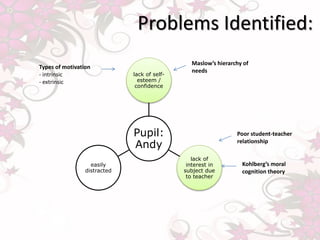
Pupil:
Andy
lack of self-
esteem /
confidence
lack of
interest in
subject due
to teacher
easily
distracted
Types of motivation
- intrinsic
- extrinsic
Kohlberg’s moral
cognition theory
Maslow’s hierarchy of
needs
Poor student-teacher
relationship
Problems Identified:
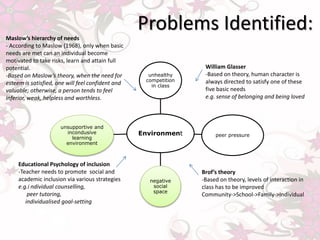
Environment
unhealthy
competition
in class
peer pressure
negative
social
space
unsupportive and
incondusive
learning
environment
Educational Psychology of inclusion
-Teacher needs to promote social and
academic inclusion via various strategies
e.g.i ndividual counselling,
peer tutoring,
individualised goal-setting
Brof’s theory
-Based on theory, levels of interaction in
class has to be improved
Community->School->Family->Individual
Maslow’s hierarchy of needs
- According to Maslow (1968), only when basic
needs are met can an individual become
motivated to take risks, learn and attain full
potential.
-Based on Maslow’s theory, when the need for
esteem is satisfied, one will feel confident and
valuable; otherwise, a person tends to feel
inferior, weak, helpless and worthless.
William Glasser
-Based on theory, human character is
always directed to satisfy one of these
five basic needs
e.g. sense of belonging and being loved
Problems Identified:

Ded 100 mindmap

  • 1.
    Teacher practices favouritism result oriented teacher do not interveneor remediate to help pupil doesn’t scaffold learning uses verbal abuse/humiliation doesn’t role model good behaviour monotonous tone during teaching / doesn’t check for understanding uses inappropriate language and sarcasm Counselling skills Teaching pedagogies Piaget’s theory -According to theory, student’s cognitive development is gradual: requires a solid foundation and proper scaffolding Types of learners -teacher’s teaching style not catered to all kinds of learners Choose instructional media based on -Appropriateness - Suitability - Visual design - Practicality (Quek Choon Lang, Angela Wong, Tay May Yin) Problems Identified:
  • 2.
    Pupil: Andy lack of self- esteem/ confidence lack of interest in subject due to teacher easily distracted Types of motivation - intrinsic - extrinsic Kohlberg’s moral cognition theory Maslow’s hierarchy of needs Poor student-teacher relationship Problems Identified:
  • 3.
    Environment unhealthy competition in class peer pressure negative social space unsupportiveand incondusive learning environment Educational Psychology of inclusion -Teacher needs to promote social and academic inclusion via various strategies e.g.i ndividual counselling, peer tutoring, individualised goal-setting Brof’s theory -Based on theory, levels of interaction in class has to be improved Community->School->Family->Individual Maslow’s hierarchy of needs - According to Maslow (1968), only when basic needs are met can an individual become motivated to take risks, learn and attain full potential. -Based on Maslow’s theory, when the need for esteem is satisfied, one will feel confident and valuable; otherwise, a person tends to feel inferior, weak, helpless and worthless. William Glasser -Based on theory, human character is always directed to satisfy one of these five basic needs e.g. sense of belonging and being loved Problems Identified: