The Declaration of 
Independence 
10th Grade American History
Learning Targets 
● I can explain the grievances listed in the 
Declaration of Independence. 
● I can compare the D of I to its 
relationship with the Enlightenment 
ideas of natural rights and the social 
contract.
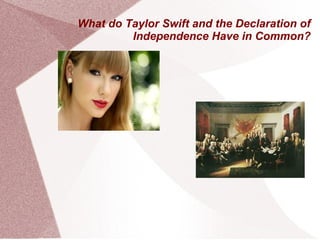
What do Taylor Swift and the Declaration of 
Independence Have in Common?
Writing a “Break-up” Letter 
● You will be writing a “break-up” letter 
– Include your “grievances.” (4) 
– Explain how you have “grown apart.” 
– Explain why it is time to move on. 
– Describe the other options that you wish to 
explore with your life. 
● Declaration "Too Late to Apologize"
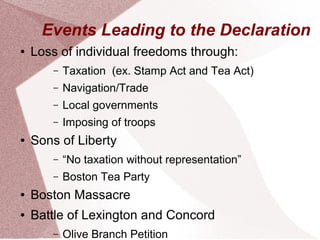
Events Leading to the Declaration 
● Loss of individual freedoms through: 
– Taxation (ex. Stamp Act and Tea Act) 
– Navigation/Trade 
– Local governments 
– Imposing of troops 
● Sons of Liberty 
– “No taxation without representation” 
– Boston Tea Party 
● Boston Massacre 
● Battle of Lexington and Concord 
– Olive Branch Petition
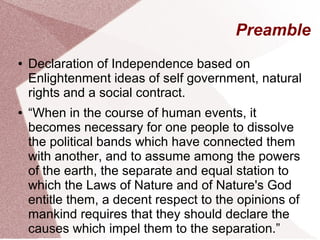
Preamble 
● Declaration of Independence based on 
Enlightenment ideas of self government, natural 
rights and a social contract. 
● “When in the course of human events, it 
becomes necessary for one people to dissolve 
the political bands which have connected them 
with another, and to assume among the powers 
of the earth, the separate and equal station to 
which the Laws of Nature and of Nature's God 
entitle them, a decent respect to the opinions of 
mankind requires that they should declare the 
causes which impel them to the separation.”
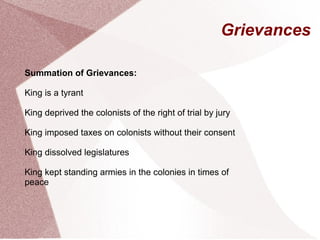
Grievances 
Summation of Grievances: 
King is a tyrant 
King deprived the colonists of the right of trial by jury 
King imposed taxes on colonists without their consent 
King dissolved legislatures 
King kept standing armies in the colonies in times of 
peace
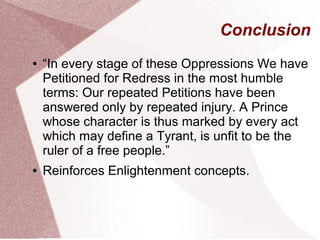
Conclusion 
● “In every stage of these Oppressions We have 
Petitioned for Redress in the most humble 
terms: Our repeated Petitions have been 
answered only by repeated injury. A Prince 
whose character is thus marked by every act 
which may define a Tyrant, is unfit to be the 
ruler of a free people.” 
● Reinforces Enlightenment concepts.

Declaration of independence

  • 1.
    The Declaration of Independence 10th Grade American History
  • 2.
    Learning Targets ●I can explain the grievances listed in the Declaration of Independence. ● I can compare the D of I to its relationship with the Enlightenment ideas of natural rights and the social contract.
  • 3.
    What do TaylorSwift and the Declaration of Independence Have in Common?
  • 4.
    Writing a “Break-up”Letter ● You will be writing a “break-up” letter – Include your “grievances.” (4) – Explain how you have “grown apart.” – Explain why it is time to move on. – Describe the other options that you wish to explore with your life. ● Declaration "Too Late to Apologize"
  • 5.
    Events Leading tothe Declaration ● Loss of individual freedoms through: – Taxation (ex. Stamp Act and Tea Act) – Navigation/Trade – Local governments – Imposing of troops ● Sons of Liberty – “No taxation without representation” – Boston Tea Party ● Boston Massacre ● Battle of Lexington and Concord – Olive Branch Petition
  • 6.
    Preamble ● Declarationof Independence based on Enlightenment ideas of self government, natural rights and a social contract. ● “When in the course of human events, it becomes necessary for one people to dissolve the political bands which have connected them with another, and to assume among the powers of the earth, the separate and equal station to which the Laws of Nature and of Nature's God entitle them, a decent respect to the opinions of mankind requires that they should declare the causes which impel them to the separation.”
  • 7.
    Grievances Summation ofGrievances: King is a tyrant King deprived the colonists of the right of trial by jury King imposed taxes on colonists without their consent King dissolved legislatures King kept standing armies in the colonies in times of peace
  • 8.
    Conclusion ● “Inevery stage of these Oppressions We have Petitioned for Redress in the most humble terms: Our repeated Petitions have been answered only by repeated injury. A Prince whose character is thus marked by every act which may define a Tyrant, is unfit to be the ruler of a free people.” ● Reinforces Enlightenment concepts.