Decision Support Systems Deliverer:  Dr Les Ball
What’s the module about and not about? ABOUT, finding IT solutions To facilitate and support the decision making process So they feed into the human decision process too NOT about machines making decisions This is far, far too dangerous As they are not as good as us!!!!! Not specifically about databases, though they are one mechanism that can feed the process We are at a deeper and more abstract level of thinking
Learning Outcomes Critically examine knowledge engineering techniques and reasoning strategies for organisational decision making.  Analyse the cognitive decision making processes.  Critically asses the "support" aspect of a Decision Support System.
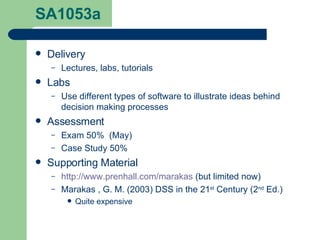
SA1053a Delivery Lectures, labs, tutorials Labs Use different types of software to illustrate ideas behind decision making processes Assessment Exam 50%  (May) Case Study 50% Supporting Material http://www.prenhall.com/marakas  (but limited now) Marakas , G. M. (2003) DSS in the 21 st  Century (2 nd  Ed.) Quite expensive
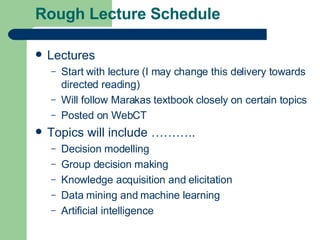
Rough Lecture Schedule Lectures Start with lecture (I may change this delivery towards directed reading) Will follow Marakas textbook closely on certain topics Posted on WebCT Topics will include ……….. Decision modelling Group decision making Knowledge acquisition and elicitation Data mining and machine learning Artificial intelligence
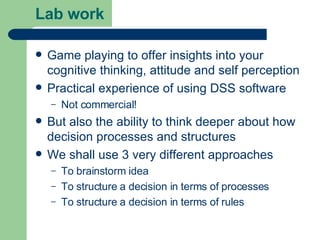
Lab work Game playing to offer insights into your cognitive thinking, attitude and self perception Practical experience of using DSS software Not commercial! But also the ability to think deeper about how decision processes and structures We shall use 3 very different approaches To brainstorm idea To structure a decision in terms of processes  To structure a decision in terms of rules
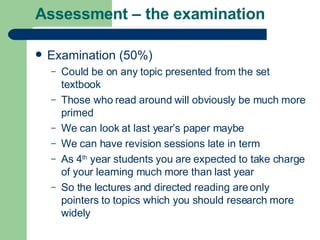
Assessment – the examination Examination (50%) Could be on any topic presented from the set textbook Those who read around will obviously be much more primed We can look at last year’s paper maybe We can have revision sessions late in term As 4 th  year students you are expected to take charge of your learning much more than last year So the lectures and directed reading are only pointers to topics which you should research more widely
Assessment – the Practical Will be based around the lab experiences you receive  You will need to develop your expertise into areas of your choice (probably!) Some of the work will be group driven As part of the module is to se how you go about consensus etc in groups Working together is therefore important (even with limited students!) However you will be assessed individually for the most part
A bit about the software DECISION EXPLORER A brainstorming tool to map decisions and consequences JUNIPER A research tool to map decision processes hierarchically RESOLVER A decision tree tool to structure rules
First week Directed Reading The paper you have is a seminal work by two of the most acknowledged authors in the field Kahneman and Tversky (hand out in lab) Should be a challenge and whet your appetite for this kind of module – see what you think of it. Marakas Chapters 1 & 3 Chapter 1 covers the Introduction to Decision Support Systems Chapter 3 covers decision making in the organisation Brief overview of these now
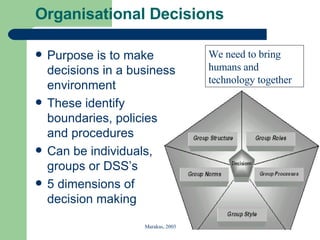
Organisational Decisions Purpose is to make decisions in a business environment These identify boundaries, policies and procedures Can be individuals, groups or DSS’s 5 dimensions of decision making Marakas, 2003 We need to bring humans and technology together
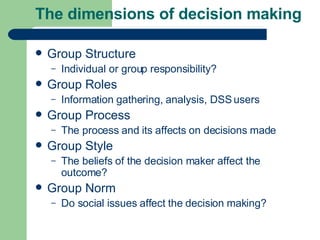
The dimensions of decision making Group Structure Individual or group responsibility? Group Roles Information gathering, analysis, DSS users Group Process The process and its affects on decisions made Group Style The beliefs of the decision maker affect the outcome? Group Norm Do social issues affect the decision making?
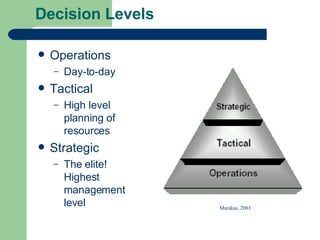
Decision Levels Operations Day-to-day Tactical High level planning of resources Strategic The elite!  Highest management  level Marakas, 2003
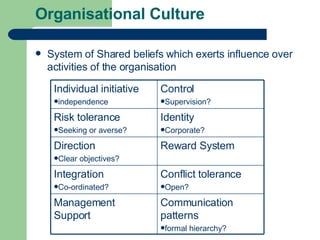
Organisational Culture System of Shared beliefs which exerts influence over activities of the organisation Individual initiative independence Control Supervision? Risk tolerance Seeking or averse? Identity Corporate? Direction Clear objectives? Reward System Integration Co-ordinated? Conflict tolerance Open? Management Support Communication patterns formal hierarchy?
Power and Politics Power is Sharing, authority, informal power, influence, politics And used to decide on Jobs, products, new investments, setting of prices, withholding dividends Politics Essential for strategic decision making Negotiation, consensus, influence These increase certainty by reducing factors that contribute to uncertainty
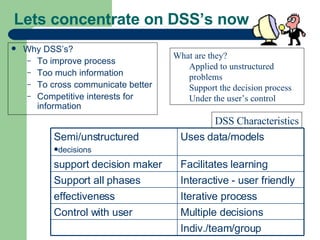
Lets concentrate on DSS’s now Why DSS’s? To improve process Too much information To cross communicate better Competitive interests for information What are they? Applied to unstructured problems Support the decision process Under the user’s control DSS Characteristics Semi/unstructured decisions Uses data/models support decision maker Facilitates learning Support all phases Interactive - user friendly effectiveness Iterative process Control with user Multiple decisions Indiv./team/group
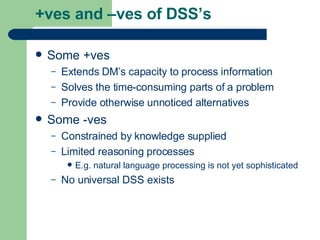
+ves and –ves of DSS’s Some +ves Extends DM’s capacity to process information Solves the time-consuming parts of a problem Provide otherwise unnoticed alternatives Some -ves Constrained by knowledge supplied Limited reasoning processes E.g. natural language processing is not yet sophisticated No universal DSS exists
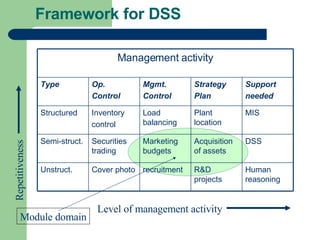
Framework for DSS Level of management activity Repetitiveness Module domain Management activity Type Op. Control Mgmt. Control Strategy Plan Support needed Structured Inventory control Load balancing Plant location MIS Semi-struct. Securities trading Marketing budgets Acquisition of assets DSS Unstruct. Cover photo recruitment R&D projects Human reasoning
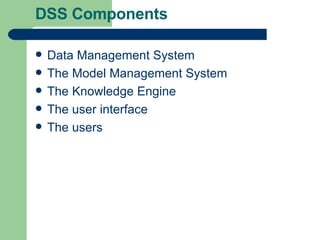
DSS Components Data Management System The Model Management System The Knowledge Engine The user interface The users
The DBMS Storage/access Independence between data and applications Functions Data definition Querying Data integrity Access control Concurrency Transaction recovery
The Model Base Differentiates DSSs from other Info. Systems A simplified view to aid study of an event Stores models as opposed to data Functions Creates decision models Stores a library of models/descriptions Manipulation (similar to DBMS) but makes changes to the models
The Knowledge Base Requires reasoning (and info.) The DSS store Consists of raw data, rules , heuristics, constraints , past history etc The knowledge is problem-specific Stores two groups of information: Facts Relationships between the facts
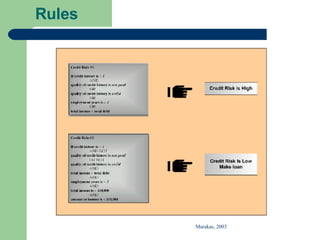
Rules Marakas, 2003
Knowledge Acquisition/Retrieval Knowledge engineers gather information for input to the knowledge base Involves extraction of explicit and tacet knowledge from experts Inference engine extracts the information required by the user by applying rules etc
User Interfaces A component to access the internal components of a system Use a common and established interface to reduce training Requires communication language Variety of interactions with DSS, input formats, support, previous dialogues And a presentation language Various styles of presenting data, reports, views
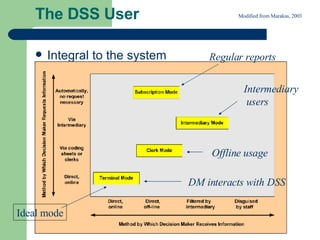
The DSS User Integral to the system Modified from Marakas, 2003 Regular reports DM interacts with DSS Offline usage Intermediary users Ideal mode
Summary Organisational decisions Types of decisions DSS characteristics The DBMS and MBMS Knowledge Base and Rules Acquisition and Retrieval The users Don't forget to read both Chapters 1 and 3 to supprt this lecture Your strategy here is to start priming early for the exam but to increase you awareness of decision maling processes generally
These all involve decision processes  What is the likelihood that it will rain today? What are the processes you think you will need to go through to get the degree classification you are chasing? If the fire alarm suddenly goes off during this lecture what are the possible outcomes? Which investment strategy should I undertake?

Decision Support System

  • 1.
    Decision Support SystemsDeliverer: Dr Les Ball
  • 2.
    What’s the moduleabout and not about? ABOUT, finding IT solutions To facilitate and support the decision making process So they feed into the human decision process too NOT about machines making decisions This is far, far too dangerous As they are not as good as us!!!!! Not specifically about databases, though they are one mechanism that can feed the process We are at a deeper and more abstract level of thinking
  • 3.
    Learning Outcomes Criticallyexamine knowledge engineering techniques and reasoning strategies for organisational decision making. Analyse the cognitive decision making processes. Critically asses the "support" aspect of a Decision Support System.
  • 4.
    SA1053a Delivery Lectures,labs, tutorials Labs Use different types of software to illustrate ideas behind decision making processes Assessment Exam 50% (May) Case Study 50% Supporting Material http://www.prenhall.com/marakas (but limited now) Marakas , G. M. (2003) DSS in the 21 st Century (2 nd Ed.) Quite expensive
  • 5.
    Rough Lecture ScheduleLectures Start with lecture (I may change this delivery towards directed reading) Will follow Marakas textbook closely on certain topics Posted on WebCT Topics will include ……….. Decision modelling Group decision making Knowledge acquisition and elicitation Data mining and machine learning Artificial intelligence
  • 6.
    Lab work Gameplaying to offer insights into your cognitive thinking, attitude and self perception Practical experience of using DSS software Not commercial! But also the ability to think deeper about how decision processes and structures We shall use 3 very different approaches To brainstorm idea To structure a decision in terms of processes To structure a decision in terms of rules
  • 7.
    Assessment – theexamination Examination (50%) Could be on any topic presented from the set textbook Those who read around will obviously be much more primed We can look at last year’s paper maybe We can have revision sessions late in term As 4 th year students you are expected to take charge of your learning much more than last year So the lectures and directed reading are only pointers to topics which you should research more widely
  • 8.
    Assessment – thePractical Will be based around the lab experiences you receive You will need to develop your expertise into areas of your choice (probably!) Some of the work will be group driven As part of the module is to se how you go about consensus etc in groups Working together is therefore important (even with limited students!) However you will be assessed individually for the most part
  • 9.
    A bit aboutthe software DECISION EXPLORER A brainstorming tool to map decisions and consequences JUNIPER A research tool to map decision processes hierarchically RESOLVER A decision tree tool to structure rules
  • 10.
    First week DirectedReading The paper you have is a seminal work by two of the most acknowledged authors in the field Kahneman and Tversky (hand out in lab) Should be a challenge and whet your appetite for this kind of module – see what you think of it. Marakas Chapters 1 & 3 Chapter 1 covers the Introduction to Decision Support Systems Chapter 3 covers decision making in the organisation Brief overview of these now
  • 11.
    Organisational Decisions Purposeis to make decisions in a business environment These identify boundaries, policies and procedures Can be individuals, groups or DSS’s 5 dimensions of decision making Marakas, 2003 We need to bring humans and technology together
  • 12.
    The dimensions ofdecision making Group Structure Individual or group responsibility? Group Roles Information gathering, analysis, DSS users Group Process The process and its affects on decisions made Group Style The beliefs of the decision maker affect the outcome? Group Norm Do social issues affect the decision making?
  • 13.
    Decision Levels OperationsDay-to-day Tactical High level planning of resources Strategic The elite! Highest management level Marakas, 2003
  • 14.
    Organisational Culture Systemof Shared beliefs which exerts influence over activities of the organisation Individual initiative independence Control Supervision? Risk tolerance Seeking or averse? Identity Corporate? Direction Clear objectives? Reward System Integration Co-ordinated? Conflict tolerance Open? Management Support Communication patterns formal hierarchy?
  • 15.
    Power and PoliticsPower is Sharing, authority, informal power, influence, politics And used to decide on Jobs, products, new investments, setting of prices, withholding dividends Politics Essential for strategic decision making Negotiation, consensus, influence These increase certainty by reducing factors that contribute to uncertainty
  • 16.
    Lets concentrate onDSS’s now Why DSS’s? To improve process Too much information To cross communicate better Competitive interests for information What are they? Applied to unstructured problems Support the decision process Under the user’s control DSS Characteristics Semi/unstructured decisions Uses data/models support decision maker Facilitates learning Support all phases Interactive - user friendly effectiveness Iterative process Control with user Multiple decisions Indiv./team/group
  • 17.
    +ves and –vesof DSS’s Some +ves Extends DM’s capacity to process information Solves the time-consuming parts of a problem Provide otherwise unnoticed alternatives Some -ves Constrained by knowledge supplied Limited reasoning processes E.g. natural language processing is not yet sophisticated No universal DSS exists
  • 18.
    Framework for DSSLevel of management activity Repetitiveness Module domain Management activity Type Op. Control Mgmt. Control Strategy Plan Support needed Structured Inventory control Load balancing Plant location MIS Semi-struct. Securities trading Marketing budgets Acquisition of assets DSS Unstruct. Cover photo recruitment R&D projects Human reasoning
  • 19.
    DSS Components DataManagement System The Model Management System The Knowledge Engine The user interface The users
  • 20.
    The DBMS Storage/accessIndependence between data and applications Functions Data definition Querying Data integrity Access control Concurrency Transaction recovery
  • 21.
    The Model BaseDifferentiates DSSs from other Info. Systems A simplified view to aid study of an event Stores models as opposed to data Functions Creates decision models Stores a library of models/descriptions Manipulation (similar to DBMS) but makes changes to the models
  • 22.
    The Knowledge BaseRequires reasoning (and info.) The DSS store Consists of raw data, rules , heuristics, constraints , past history etc The knowledge is problem-specific Stores two groups of information: Facts Relationships between the facts
  • 23.
  • 24.
    Knowledge Acquisition/Retrieval Knowledgeengineers gather information for input to the knowledge base Involves extraction of explicit and tacet knowledge from experts Inference engine extracts the information required by the user by applying rules etc
  • 25.
    User Interfaces Acomponent to access the internal components of a system Use a common and established interface to reduce training Requires communication language Variety of interactions with DSS, input formats, support, previous dialogues And a presentation language Various styles of presenting data, reports, views
  • 26.
    The DSS UserIntegral to the system Modified from Marakas, 2003 Regular reports DM interacts with DSS Offline usage Intermediary users Ideal mode
  • 27.
    Summary Organisational decisionsTypes of decisions DSS characteristics The DBMS and MBMS Knowledge Base and Rules Acquisition and Retrieval The users Don't forget to read both Chapters 1 and 3 to supprt this lecture Your strategy here is to start priming early for the exam but to increase you awareness of decision maling processes generally
  • 28.
    These all involvedecision processes What is the likelihood that it will rain today? What are the processes you think you will need to go through to get the degree classification you are chasing? If the fire alarm suddenly goes off during this lecture what are the possible outcomes? Which investment strategy should I undertake?