Objectives Identify the differences between Analytical Decision Making and Intuitive Decision Making  Describe basic design and delivery requirements for Tactical Decision Games (TDGS) Demonstrate how Sand Table Exercises (STEX) can be used to deliver TDGS
How We Decide Part I
Observations on Decision Making Observation #1 Decision making skills are developed through practice
Observations on Decision Making Observation #2 The lower the echelon of command the simpler, faster, more direct and accelerated the decision process
Observations on Decision Making Observation #3 The ability to rapidly develop solutions to new problems is based on pattern recognition
The Decision Making Process Intuitive Decision Making (reactive) Pattern recognition based on previous experience Analytical Decision Making (planned) Calculated selection of alternatives
Intuitive Decison Making Rely on experience to recognize the essence of a given situation or problem Utilize pattern recognition from previous actions, observations, and training to develop the solution
Intuitive Decison Making Best way to improve decision making is to improve pattern recognition, the best way to improve pattern recognition is to improve. . .  Situation Awareness
Intuitive Decision Making  In the Fire Environment Rarely is there only “one right” answer “ A good plan executed now is better than the perfect plan executed too late”
Analytical Decision Making Identify possible options Analyze all options according to a set criteria Calculate a value for all criteria of each option Choose the option with highest total criteria values
Analytical Decision Making In Theory . . . . . The highest value option will provide the most optimal solution
Analytical Decision Making  In the Fire Environment In Reality . . . . . The environment is constantly changing and information can quickly become outdated Lack of time can hamper the ability to conduct an accurate analysis
Decision Making Summary Both analytical and intuitive decision making are used on the fireground Firefighters at the tactical level rely primarily on intuitive decision making Decision making skills can be improved with  practice
So why spend time playing games when there is work to do . . .
Why do TDGS / STEX ?  TDGS and STEX provide a simple, adaptable, and repeatable method of challenging a firefighter to make decisions in situations they will face on the fireground
Practice making decisions in an operational context Practice communicating those decisions in the form of briefings or instructions Sit in the “hot seat” and build pattern recognitions skills Intent of TDGS/STEX
Facilitator provides information or a briefing describing a scenario Student plays the role of a leader in a dilemma that requires a decision Requires interactive two-way communication between role players What is a Tactical Decision Game
Utilizes a 3-D terrain model to help visually develop and present a TDGS Ideally suited for group exercises Low tech simulation method What is a Sand Table Exercise
Suspend disbelief Induce stress Create dilemmas Observe behaviors What is a Simulation
Designing  TDGS Part II
Put participants in role-play situations Provide limited information Apply time constraints Face a dilemma Conduct an After Action Review (AAR) How TDGS Work
Enforce a time limit so players feel some of the stress that would be present in a real fireground situation Require decisions be communicated in the the form of real time instructions There are no “School Solutions” Rules of TDGS
Takes place prior to designing a TDGS Facilitator identifies the goal of the TDGS It can be a very specific objective:  “Practice standard report on conditions procedure with dispatch” Or it can be a more comprehensive:  “Let’s work   on initial attack operations” Develop a Training Objective
Start with a problem, not a solution Start general, then get specific Create uncertainty Create time pressure Create competing priorities Create interaction between resources or subordinates Guidelines For Designing TDGS
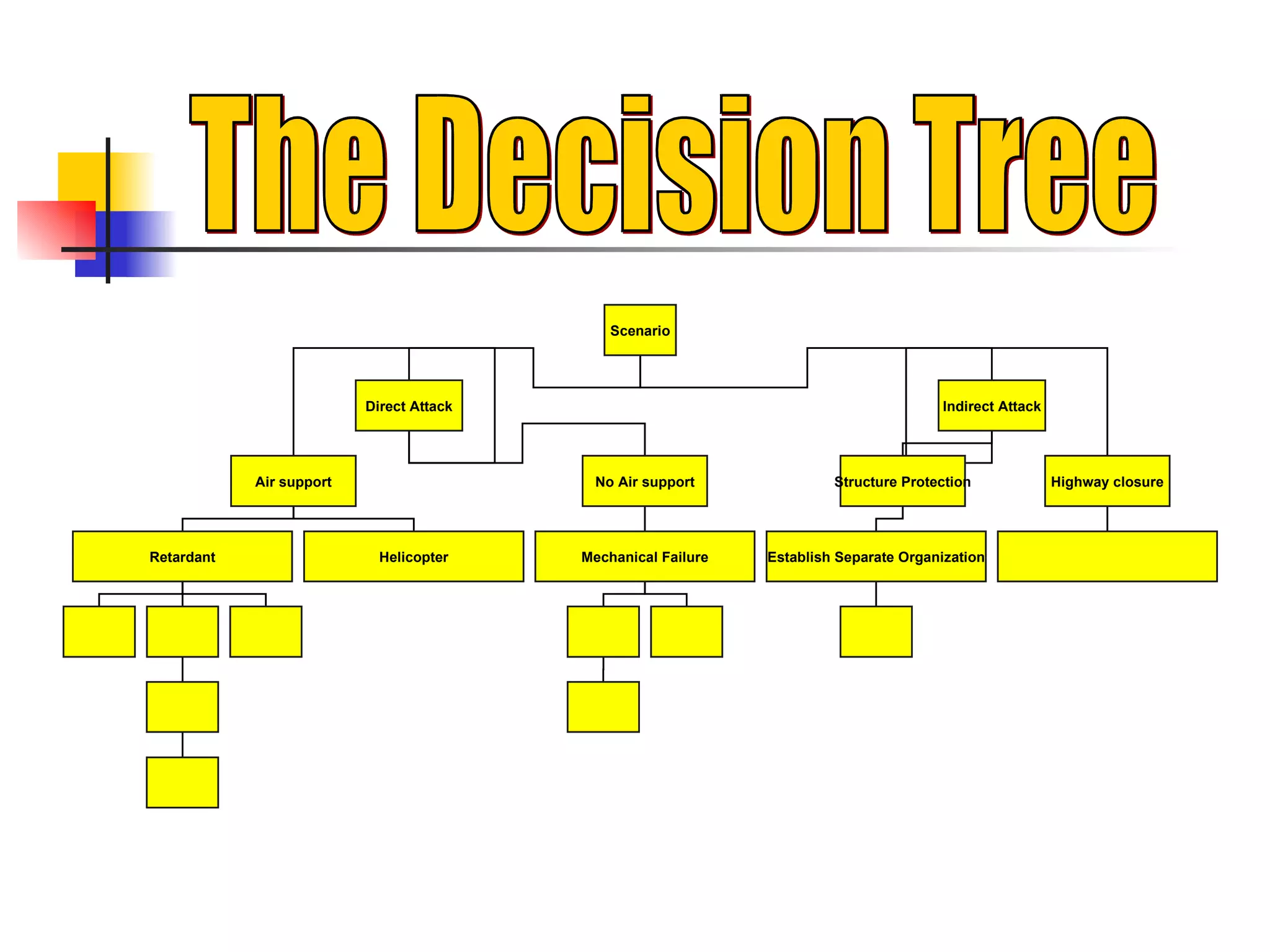
Guidelines For Designing TDGS Build to a single dilemma that requires an immediate decision OR Identify multiple decision points and script a dynamic simulation  (Decision Tree)
The Decision Tree Scenario Direct Attack Indirect Attack Air support No Air support Retardant Helicopter Mechanical Failure Structure Protection Highway closure Establish Separate Organization
Delivering  TDGS  using Sandtables  Part III
How We Learn “ Tell me  and I will forget,  Show me  and I may remember, but  involve me  and I will understand” –  Chinese proverb
Enthusiastic Tactically knowledgeable Thinks quickly on feet Keeps it moving Able to summarize lessons Critiques without being critical Involves all players TDGS/STEX Facilitor Characteristics
Respectful - identify good ideas Confrontational - keep the pressure on Try to achieve a balance! TDGS/STEX Environment
Brief group with all players assuming they are the designated leader Provide a short time for players to develop their decision and instructions Select a player to issue instructions verbally as they would on the fireground Have more than one player take the hot seat and issue instructions TDGS/STEX Facilitation
Paint a good picture of the environment in the briefing Control the tempo with time tags and piece movement Murphy invented TDGS…insert uncertainty and adversity into the game with pre-planned inputs Utilize IRPG and other SOPs TDGS/STEX Facilitation
Always AAR…focus on decision making As the facilitator, you should not be doing most of the talking Ask the players to think aloud – describe situational awareness, how decision was made, etc Avoid leading questions, ask open-ended questions TDGS/STEX Facilitation
General form: Asking about  X , where  X  is a specific subject and where there is more than one “right way” to answer. Examples:   HOW  would you  have handled the situation? WHY  is it important to _________? WHY NOT  just simplify things and only __________? WHAT  are some experiences you’ve had in the past that are similar to this situation? WHAT  would you do  IF  _________? Open-Ended Questions
Concentrate on decision making,  NOT  on tactics Stick with the training objectives Emphasize effective communication Utilize standard local unit identifiers Utilize IPRG, SOPs, and other job aids Create a level of positive stress Conduct an After Action Review TDGS/STEX Summary
Adaptable Tool  Briefing After Action Review Planning  Training (TDGS, Topo Interp, etc) Full scale simulations

Decision

  • 1.
  • 2.
    Objectives Identify thedifferences between Analytical Decision Making and Intuitive Decision Making Describe basic design and delivery requirements for Tactical Decision Games (TDGS) Demonstrate how Sand Table Exercises (STEX) can be used to deliver TDGS
  • 3.
  • 4.
    Observations on DecisionMaking Observation #1 Decision making skills are developed through practice
  • 5.
    Observations on DecisionMaking Observation #2 The lower the echelon of command the simpler, faster, more direct and accelerated the decision process
  • 6.
    Observations on DecisionMaking Observation #3 The ability to rapidly develop solutions to new problems is based on pattern recognition
  • 7.
    The Decision MakingProcess Intuitive Decision Making (reactive) Pattern recognition based on previous experience Analytical Decision Making (planned) Calculated selection of alternatives
  • 8.
    Intuitive Decison MakingRely on experience to recognize the essence of a given situation or problem Utilize pattern recognition from previous actions, observations, and training to develop the solution
  • 9.
    Intuitive Decison MakingBest way to improve decision making is to improve pattern recognition, the best way to improve pattern recognition is to improve. . . Situation Awareness
  • 10.
    Intuitive Decision Making In the Fire Environment Rarely is there only “one right” answer “ A good plan executed now is better than the perfect plan executed too late”
  • 11.
    Analytical Decision MakingIdentify possible options Analyze all options according to a set criteria Calculate a value for all criteria of each option Choose the option with highest total criteria values
  • 12.
    Analytical Decision MakingIn Theory . . . . . The highest value option will provide the most optimal solution
  • 13.
    Analytical Decision Making In the Fire Environment In Reality . . . . . The environment is constantly changing and information can quickly become outdated Lack of time can hamper the ability to conduct an accurate analysis
  • 14.
    Decision Making SummaryBoth analytical and intuitive decision making are used on the fireground Firefighters at the tactical level rely primarily on intuitive decision making Decision making skills can be improved with practice
  • 15.
    So why spendtime playing games when there is work to do . . .
  • 16.
    Why do TDGS/ STEX ? TDGS and STEX provide a simple, adaptable, and repeatable method of challenging a firefighter to make decisions in situations they will face on the fireground
  • 17.
    Practice making decisionsin an operational context Practice communicating those decisions in the form of briefings or instructions Sit in the “hot seat” and build pattern recognitions skills Intent of TDGS/STEX
  • 18.
    Facilitator provides informationor a briefing describing a scenario Student plays the role of a leader in a dilemma that requires a decision Requires interactive two-way communication between role players What is a Tactical Decision Game
  • 19.
    Utilizes a 3-Dterrain model to help visually develop and present a TDGS Ideally suited for group exercises Low tech simulation method What is a Sand Table Exercise
  • 20.
    Suspend disbelief Inducestress Create dilemmas Observe behaviors What is a Simulation
  • 21.
  • 22.
    Put participants inrole-play situations Provide limited information Apply time constraints Face a dilemma Conduct an After Action Review (AAR) How TDGS Work
  • 23.
    Enforce a timelimit so players feel some of the stress that would be present in a real fireground situation Require decisions be communicated in the the form of real time instructions There are no “School Solutions” Rules of TDGS
  • 24.
    Takes place priorto designing a TDGS Facilitator identifies the goal of the TDGS It can be a very specific objective: “Practice standard report on conditions procedure with dispatch” Or it can be a more comprehensive: “Let’s work on initial attack operations” Develop a Training Objective
  • 25.
    Start with aproblem, not a solution Start general, then get specific Create uncertainty Create time pressure Create competing priorities Create interaction between resources or subordinates Guidelines For Designing TDGS
  • 26.
    Guidelines For DesigningTDGS Build to a single dilemma that requires an immediate decision OR Identify multiple decision points and script a dynamic simulation (Decision Tree)
  • 27.
    The Decision TreeScenario Direct Attack Indirect Attack Air support No Air support Retardant Helicopter Mechanical Failure Structure Protection Highway closure Establish Separate Organization
  • 28.
    Delivering TDGS using Sandtables Part III
  • 29.
    How We Learn“ Tell me and I will forget, Show me and I may remember, but involve me and I will understand” – Chinese proverb
  • 30.
    Enthusiastic Tactically knowledgeableThinks quickly on feet Keeps it moving Able to summarize lessons Critiques without being critical Involves all players TDGS/STEX Facilitor Characteristics
  • 31.
    Respectful - identifygood ideas Confrontational - keep the pressure on Try to achieve a balance! TDGS/STEX Environment
  • 32.
    Brief group withall players assuming they are the designated leader Provide a short time for players to develop their decision and instructions Select a player to issue instructions verbally as they would on the fireground Have more than one player take the hot seat and issue instructions TDGS/STEX Facilitation
  • 33.
    Paint a goodpicture of the environment in the briefing Control the tempo with time tags and piece movement Murphy invented TDGS…insert uncertainty and adversity into the game with pre-planned inputs Utilize IRPG and other SOPs TDGS/STEX Facilitation
  • 34.
    Always AAR…focus ondecision making As the facilitator, you should not be doing most of the talking Ask the players to think aloud – describe situational awareness, how decision was made, etc Avoid leading questions, ask open-ended questions TDGS/STEX Facilitation
  • 35.
    General form: Askingabout X , where X is a specific subject and where there is more than one “right way” to answer. Examples: HOW would you have handled the situation? WHY is it important to _________? WHY NOT just simplify things and only __________? WHAT are some experiences you’ve had in the past that are similar to this situation? WHAT would you do IF _________? Open-Ended Questions
  • 36.
    Concentrate on decisionmaking, NOT on tactics Stick with the training objectives Emphasize effective communication Utilize standard local unit identifiers Utilize IPRG, SOPs, and other job aids Create a level of positive stress Conduct an After Action Review TDGS/STEX Summary
  • 37.
    Adaptable Tool Briefing After Action Review Planning Training (TDGS, Topo Interp, etc) Full scale simulations