Dr. Madhavi Peddada
Definition
• A decision can be defined as a course of action purposely chosen
from a set of alternatives to achieve organizational or managerial
objectives or goals.
• According to Drucker – “Whatever a manager does he does through
making decisions.”
• According to Terry, decision-making “as the selection of one
behaviour alternative from two or more possible alternatives.”
Meaning
• Decision-making is the cognitive process of selecting a course of
action from various alternatives.
• Decision-making is about discovering and selecting the best
alternative among several options. It typically involves considering
factors such as the likelihood of success and the alignment of goals,
desires, and values.
• The goal is to make the best choice possible given the available
information, even though complete certainty is rarely achievable. This
means that decision-making involves some level of risk, with some
decisions carrying higher risks than others.
Decision Making
Decision-making can be defined as the cognitive process of choosing a
course of action from multiple alternatives. It involves evaluating
these alternatives based on the decision maker's values and
preferences, ultimately resulting in a final choice, which can be seen as
an opinion.
Characteristics
• Goal-oriented
• Alternative
• Analytical-Intellectual
• Dynamic Process
• Pervasive Function
• Continuous Activity
• Commitment of Resources
• Human and Social Process
• Integral Part of Planning
Importance
1. Achieving Goals
2. Problem Solving
3. Innovation and Growth
4. Resource Management
5. Risk Management
6. Conflict Resolution
7. Improving Efficiency
8. Personal Development
9. Building Trust and Confidence
10. Adaptability
Decision-making is essential for achieving success, managing challenges,
and making progress towards desired outcomes
Types
• Strategic Decision-making
• Tactical Decision-making
• Operational Decision-making
• Programmed Decision-making
• Non-programmed Decision-
making
• Individual Decision-making
• Group Decision-making
• Rational Decision-making
• Intuitive Decision-making
• Emotional Decision-making
Each type of decision-making has its own strengths and
weaknesses, and the most appropriate approach depends on
the specific situation and context.
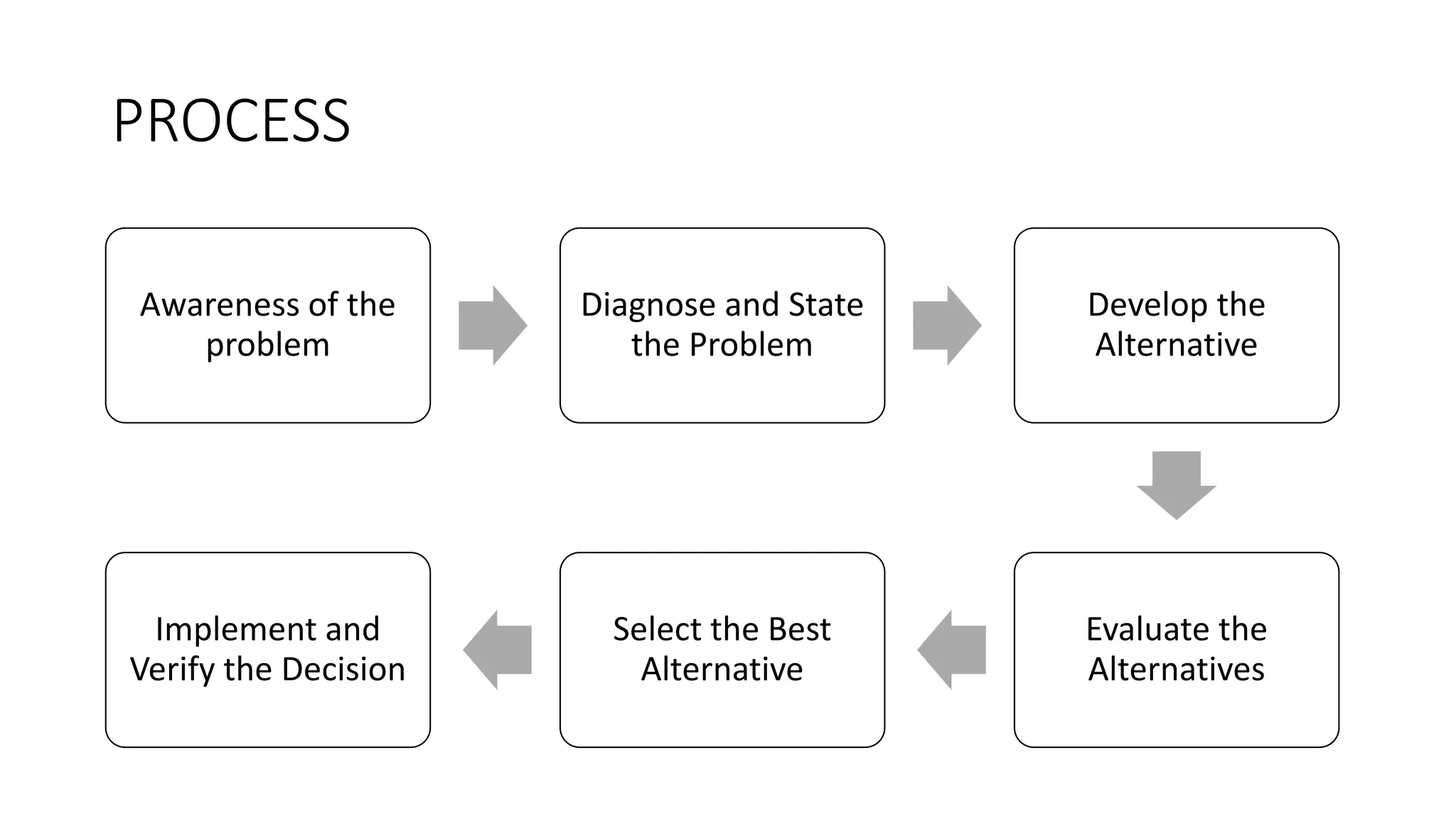
PROCESS
Awareness of the
problem
Diagnose and State
the Problem
Develop the
Alternative
Evaluate the
Alternatives
Select the Best
Alternative
Implement and
Verify the Decision
Risk
• Risk in decision-making refers to
the possibility of an outcome
that differs from what is
expected or desired. It involves
situations where the
probabilities of different
outcomes are known.
Uncertainty
• Uncertainty, on the other hand,
refers to situations where the
probabilities of different
outcomes are unknown. It
involves ambiguity and lack of
information, making it difficult to
predict outcomes accurately.
1. Categorical Interpretation
2. Application of Limiting Factor
3. Adequate Information
4. Considering Others' Views
5. Timeliness
Guidelines for Making Effective Decision
Tools & Techniques
• Decision Matrix
• Pareto Analysis
• Decision Trees
• SWOT Analysis
• Cost-Benefit Analysis
• Brainstorming
• Decision Support Systems (DSS)
• Scenario Analysis
• Game Theory
• Probability and Statistics
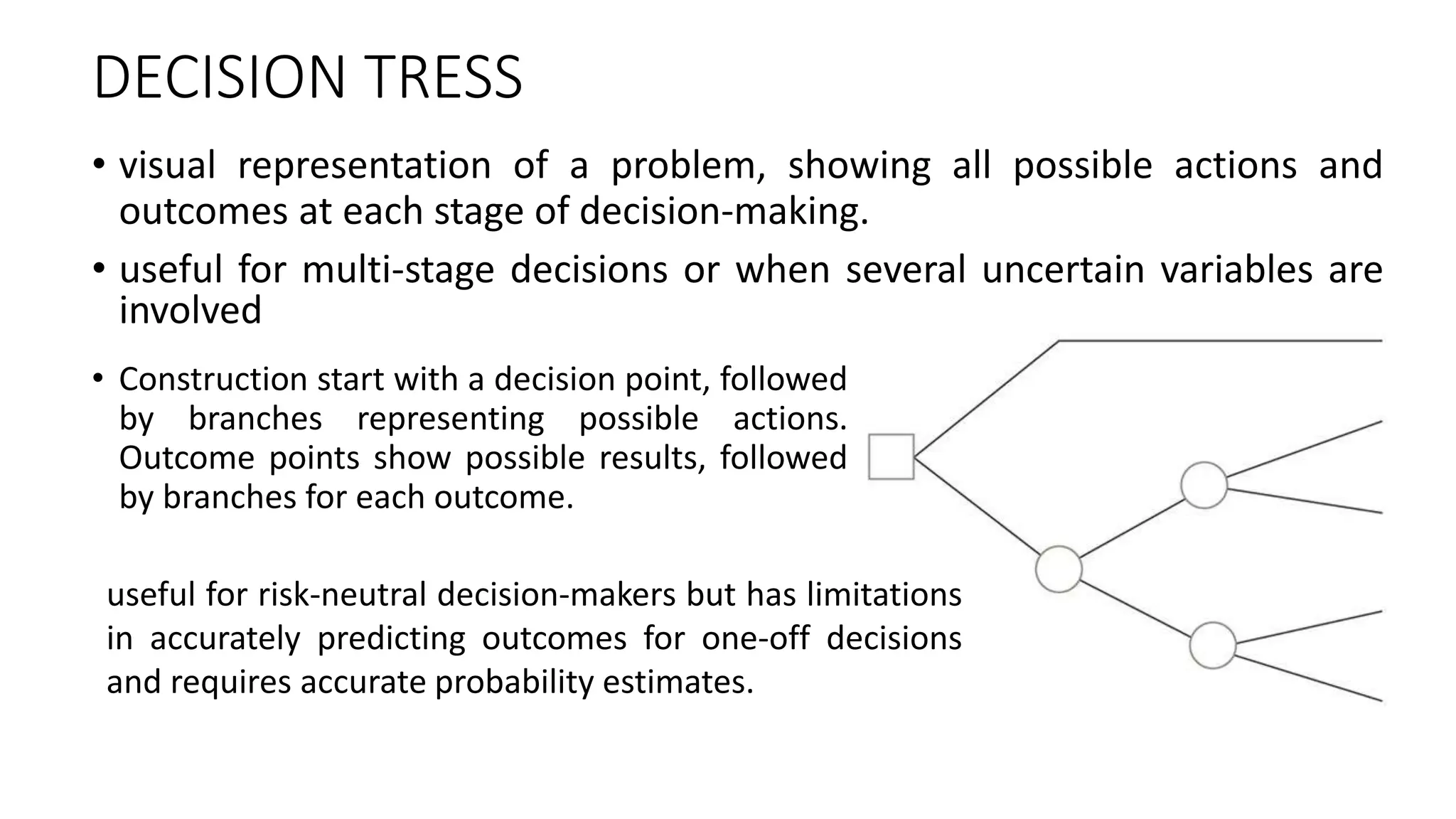
DECISION TRESS
• visual representation of a problem, showing all possible actions and
outcomes at each stage of decision-making.
• useful for multi-stage decisions or when several uncertain variables are
involved
• Construction start with a decision point, followed
by branches representing possible actions.
Outcome points show possible results, followed
by branches for each outcome.
useful for risk-neutral decision-makers but has limitations
in accurately predicting outcomes for one-off decisions
and requires accurate probability estimates.
Decision-making in Functions of Management.pptx

Decision-making in Functions of Management.pptx

  • 1.
  • 2.
    Definition • A decisioncan be defined as a course of action purposely chosen from a set of alternatives to achieve organizational or managerial objectives or goals. • According to Drucker – “Whatever a manager does he does through making decisions.” • According to Terry, decision-making “as the selection of one behaviour alternative from two or more possible alternatives.”
  • 3.
    Meaning • Decision-making isthe cognitive process of selecting a course of action from various alternatives. • Decision-making is about discovering and selecting the best alternative among several options. It typically involves considering factors such as the likelihood of success and the alignment of goals, desires, and values. • The goal is to make the best choice possible given the available information, even though complete certainty is rarely achievable. This means that decision-making involves some level of risk, with some decisions carrying higher risks than others.
  • 4.
    Decision Making Decision-making canbe defined as the cognitive process of choosing a course of action from multiple alternatives. It involves evaluating these alternatives based on the decision maker's values and preferences, ultimately resulting in a final choice, which can be seen as an opinion.
  • 5.
    Characteristics • Goal-oriented • Alternative •Analytical-Intellectual • Dynamic Process • Pervasive Function • Continuous Activity • Commitment of Resources • Human and Social Process • Integral Part of Planning
  • 6.
    Importance 1. Achieving Goals 2.Problem Solving 3. Innovation and Growth 4. Resource Management 5. Risk Management 6. Conflict Resolution 7. Improving Efficiency 8. Personal Development 9. Building Trust and Confidence 10. Adaptability Decision-making is essential for achieving success, managing challenges, and making progress towards desired outcomes
  • 7.
    Types • Strategic Decision-making •Tactical Decision-making • Operational Decision-making • Programmed Decision-making • Non-programmed Decision- making • Individual Decision-making • Group Decision-making • Rational Decision-making • Intuitive Decision-making • Emotional Decision-making Each type of decision-making has its own strengths and weaknesses, and the most appropriate approach depends on the specific situation and context.
  • 8.
    PROCESS Awareness of the problem Diagnoseand State the Problem Develop the Alternative Evaluate the Alternatives Select the Best Alternative Implement and Verify the Decision
  • 9.
    Risk • Risk indecision-making refers to the possibility of an outcome that differs from what is expected or desired. It involves situations where the probabilities of different outcomes are known. Uncertainty • Uncertainty, on the other hand, refers to situations where the probabilities of different outcomes are unknown. It involves ambiguity and lack of information, making it difficult to predict outcomes accurately. 1. Categorical Interpretation 2. Application of Limiting Factor 3. Adequate Information 4. Considering Others' Views 5. Timeliness Guidelines for Making Effective Decision
  • 10.
    Tools & Techniques •Decision Matrix • Pareto Analysis • Decision Trees • SWOT Analysis • Cost-Benefit Analysis • Brainstorming • Decision Support Systems (DSS) • Scenario Analysis • Game Theory • Probability and Statistics
  • 11.
    DECISION TRESS • visualrepresentation of a problem, showing all possible actions and outcomes at each stage of decision-making. • useful for multi-stage decisions or when several uncertain variables are involved • Construction start with a decision point, followed by branches representing possible actions. Outcome points show possible results, followed by branches for each outcome. useful for risk-neutral decision-makers but has limitations in accurately predicting outcomes for one-off decisions and requires accurate probability estimates.