Decision Making Styles
Taylor Wilson
What is a
decision
making style?
• Reflects how a manager perceives and responds
to information.
• There are 4 general decision making styles:
• Directive
• Analytical
• Conceptual
• Behavioral
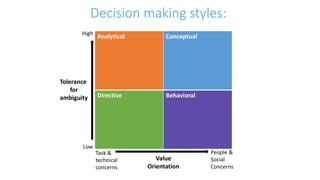
Decision making styles:
Analytical Conceptual
Directive Behavioral
High
Low
Tolerance
for
ambiguity
Value
Orientation
Task &
technical
concerns
People &
Social
Concerns
Value Orientation and Tolerance for Ambiguity
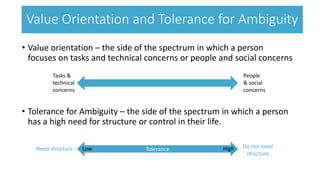
• Value orientation – the side of the spectrum in which a person
focuses on tasks and technical concerns or people and social concerns
• Tolerance for Ambiguity – the side of the spectrum in which a person
has a high need for structure or control in their life.
Tasks &
technical
concerns
People
& social
concerns
ToleranceLow HighNeed structure Do not need
structure
The Directive
Style
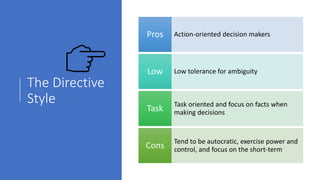
Action-oriented decision makersPros
Low tolerance for ambiguityLow
Task oriented and focus on facts when
making decisionsTask
Tend to be autocratic, exercise power and
control, and focus on the short-termCons
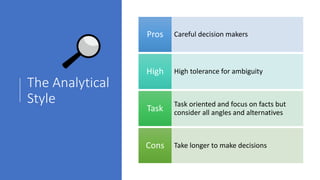
The Analytical
Style
Careful decision makersPros
High tolerance for ambiguityHigh
Task oriented and focus on facts but
consider all angles and alternativesTask
Take longer to make decisionsCons
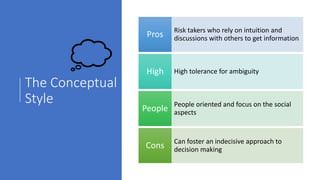
The Conceptual
Style
Risk takers who rely on intuition and
discussions with others to get informationPros
High tolerance for ambiguityHigh
People oriented and focus on the social
aspectsPeople
Can foster an indecisive approach to
decision makingCons
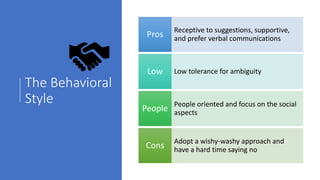
The Behavioral
Style
Receptive to suggestions, supportive,
and prefer verbal communicationsPros
Low tolerance for ambiguityLow
People oriented and focus on the social
aspectsPeople
Adopt a wishy-washy approach and
have a hard time saying noCons
Recommendation
Company’s most
important
requirement: high
performance & results
I recommend a
Directive Style for
decision making
Ensures systematic
approach to drive fast
results
References
1. Kinicki, A., & Williams, B. K. (2018). Management: a practical introduction
(8th ed.). New York, NY: McGraw-Hill Education.

Decision Making Styles

  • 1.
  • 2.
    What is a decision makingstyle? • Reflects how a manager perceives and responds to information. • There are 4 general decision making styles: • Directive • Analytical • Conceptual • Behavioral
  • 3.
    Decision making styles: AnalyticalConceptual Directive Behavioral High Low Tolerance for ambiguity Value Orientation Task & technical concerns People & Social Concerns
  • 4.
    Value Orientation andTolerance for Ambiguity • Value orientation – the side of the spectrum in which a person focuses on tasks and technical concerns or people and social concerns • Tolerance for Ambiguity – the side of the spectrum in which a person has a high need for structure or control in their life. Tasks & technical concerns People & social concerns ToleranceLow HighNeed structure Do not need structure
  • 5.
    The Directive Style Action-oriented decisionmakersPros Low tolerance for ambiguityLow Task oriented and focus on facts when making decisionsTask Tend to be autocratic, exercise power and control, and focus on the short-termCons
  • 6.
    The Analytical Style Careful decisionmakersPros High tolerance for ambiguityHigh Task oriented and focus on facts but consider all angles and alternativesTask Take longer to make decisionsCons
  • 7.
    The Conceptual Style Risk takerswho rely on intuition and discussions with others to get informationPros High tolerance for ambiguityHigh People oriented and focus on the social aspectsPeople Can foster an indecisive approach to decision makingCons
  • 8.
    The Behavioral Style Receptive tosuggestions, supportive, and prefer verbal communicationsPros Low tolerance for ambiguityLow People oriented and focus on the social aspectsPeople Adopt a wishy-washy approach and have a hard time saying noCons
  • 9.
    Recommendation Company’s most important requirement: high performance& results I recommend a Directive Style for decision making Ensures systematic approach to drive fast results
  • 10.
    References 1. Kinicki, A.,& Williams, B. K. (2018). Management: a practical introduction (8th ed.). New York, NY: McGraw-Hill Education.

Editor's Notes

  • #3 A decision making style is a direct reflection on how a manager perceived and responds to new information. There are 4 general decision making styles: directive, analytical, conceptual, and behavioral. We will discuss them further in the next slides.
  • #4 This is a visual chart that shows the ranges for each decision making style. Depending on the persons high or low tolerance for ambiguity and their preference for task or people oriented values will determine their decision making style.
  • #5 Value orientation is defined as the side of the spectrum in which a person focuses on tasks and technical concerns or people and social concerns. It is possible to be somewhere in the middle but most managers will lean one way or the other. Tolerance for ambiguity is defined as the side of the spectrum in which ha person has a high need for structure or control in their life. If one has a low tolerance they require structure and are stressed out in ambiguous situations. If one has a high tolerance, then they do not require a lot of structure and can thrive on ambiguous situations.
  • #6 The firs style we will discuss is the directive style. This style’s pros are that they are action oriented decision makers. They tend to have a low tolerance for ambiguity and require structure in day to day activities. They are very much task oriented and focus on the facts when making decisions. The cons to this style are that they tend to be autocratic, exercise power and control, and focus mostly on the short-term.
  • #7 The second style we will discuss is the analytical style. The pros for this style are that they are very careful and thought out decision makers. They have a high tolerance for ambiguity which makes them more flexible than the directive style. The are very task oriented and focus on the facts when making decisions but tend to consider all angles and alternatives, more so than the directive style. The cons of this style are that they take longer to make decisions.
  • #8 The third style we will discuss is the conceptual style. The pros of this style are that they are not afraid to take risks to reap a reward and they rely on intuition and discussions will fellow peers to get information. They have a high tolerance for ambiguity which makes them flexible and they are extremely people oriented and focus on the social aspects of decision making. The cons are that this style can foster an indecisive approach to decision making.
  • #9 The last style we will discuss is the behavioral style. The pros of this style is that they are very reception to suggestions, supportive of others, and prefer face-to-face, verbal communications. They have a low tolerance for ambiguity and are people oriented through and through. The cons of this style are that they can adopt a wishy-washy approach to decision making and sometimes they can have a hard time saying no due to their “people pleasing” nature.
  • #10 My final recommendation after analyzing the 4 decision making styles is to adopt a directive style. I chose this because our company’s most important requirement for management is high performance and quick results. This style will ensure a systematic approach to drive fast results.