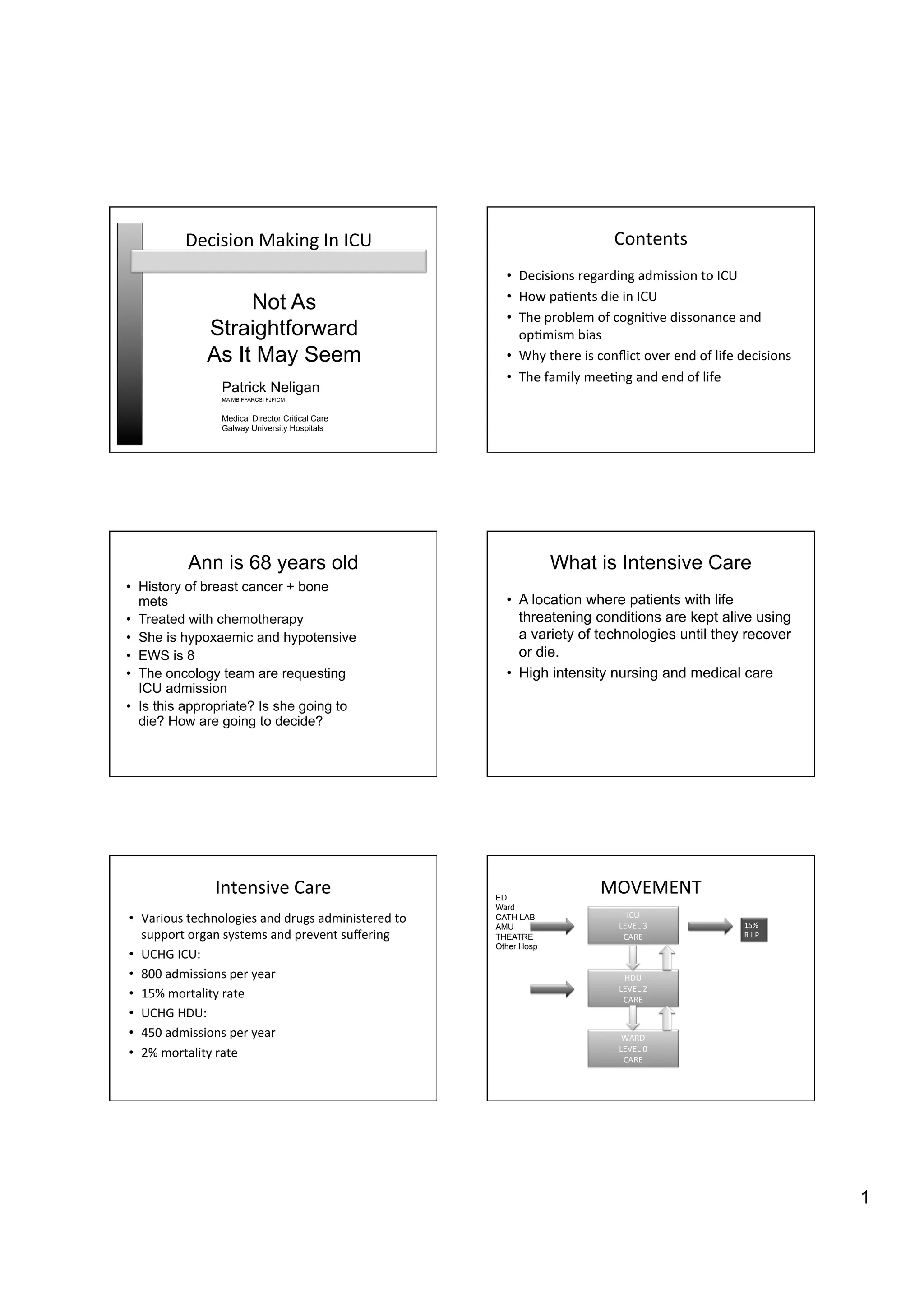
1
Decision	
  Making	
  In	
  ICU	
  
Patrick Neligan
MA MB FFARCSI FJFICM
Not As
Straightforward
As It May Seem
Medical Director Critical Care
Galway University Hospitals
Contents	
  
•  Decisions	
  regarding	
  admission	
  to	
  ICU	
  
•  How	
  pa7ents	
  die	
  in	
  ICU	
  
•  The	
  problem	
  of	
  cogni7ve	
  dissonance	
  and	
  
op7mism	
  bias	
  
•  Why	
  there	
  is	
  conflict	
  over	
  end	
  of	
  life	
  decisions	
  
•  The	
  family	
  mee7ng	
  and	
  end	
  of	
  life	
  
Ann is 68 years old
•  History of breast cancer + bone
mets
•  Treated with chemotherapy
•  She is hypoxaemic and hypotensive
•  EWS is 8
•  The oncology team are requesting
ICU admission
•  Is this appropriate? Is she going to
die? How are going to decide?
What is Intensive Care
•  A location where patients with life
threatening conditions are kept alive using
a variety of technologies until they recover
or die.
•  High intensity nursing and medical care
Intensive	
  Care	
  
•  Various	
  technologies	
  and	
  drugs	
  administered	
  to	
  
support	
  organ	
  systems	
  and	
  prevent	
  suffering	
  
•  UCHG	
  ICU:	
  
•  800	
  admissions	
  per	
  year	
  
•  15%	
  mortality	
  rate	
  
•  UCHG	
  HDU:	
  
•  450	
  admissions	
  per	
  year	
  
•  2%	
  mortality	
  rate	
  
MOVEMENT	
  
ICU	
  
LEVEL	
  3	
  
CARE	
  
HDU	
  
LEVEL	
  2	
  	
  
CARE	
  
WARD	
  	
  
LEVEL	
  0	
  	
  
CARE	
  
15%	
  
R.I.P.	
  
ED
Ward
CATH LAB
AMU
THEATRE
Other Hosp
2
Care Levels
Level 0
WARD
Nursing
level 1:6
Level 1
More
Monitoring
1:3 or 1:4
PACU
Labour Ward
Level 2 HDU
Single Organ
Failure
1:2 Nursing
NIV/Pressors
Level 3 ICU
Multi Organ
Failure
1:1 Nursing
IPPV/CRRT
Who Goes To ICU
NEONATES	
  
INFANTS	
  TODDLERS	
  
ELDERLY	
  
Congenital	
  
Respiratory	
  Disease	
  
Meningi7s	
  
Surgery	
  
Cardiovascular	
  Disease	
  
Pneumonia	
  
PREGNANT	
  WOMEN	
  
Postpartum	
  Haemorrhage	
  
Eclampsia	
  /	
  AFE	
  /	
  FLP	
  
Sepsis	
  
ALL	
  AGES	
  
Trauma,	
  Poisoning	
  
Self	
  Harm	
  
Lifestyle	
  associated	
  
ICU Interventions
•  Respiratory support
– NIV / IPPV / Tracheostomy
– ECMO
•  Cardiovascular support
– Inotropes, vaspressors, IABP, VAD
– Renal support
•  CRRT / IHD
– Neurological Support
– Induced coma / ventriculostomy
Other stuff
•  Monitoring devices
•  Antimicrobials
•  Nutrition – EN / TPN
•  SCDs
•  Vac dressings
•  Rotating beds
•  Induced hypothermia
•  Etc etc etc
UCHG	
  ICU	
  
•  Average	
  age	
  of	
  admission	
  =	
  59-­‐60	
  
•  Average	
  age	
  of	
  death	
  =	
  68-­‐69	
  
•  Average	
  dura7on	
  of	
  admission	
  =	
  3.5	
  days	
  
•  Average	
  dura7on	
  prior	
  to	
  death	
  =	
  5.5	
  days	
  
RIP with LOS < 7
days
RIP with LOS 7-14
days
RIP with LOS 14-21
days
RIP with LOS > 21
days
<7 days
3
Who Dies in ICU?
•  Patients with insufficient physiologic
reserve to recover from multi-organ failure
•  Usually elderly patients
•  Brain injured patients
•  Patients with chronic diseases – cirrhosis,
liver failure, COPD
Scenario
•  The Patient has had
a massive stroke and
the family are really
angry
•  Threatening to sue
me
•  Can you admit to ICU
•  I think it will calm
them down?
“Commision” Bias
•  A tendency towards
action rather than
inaction
•  “To be seen to be doing
something”
•  You haven’t died properly
unless you’ve died in ICU
Death In ICU
•  Brain Death
•  Cardiac Arrest
– Failure to resuscitate
– Decision not to resuscitate
•  Witholding life sustaining therapy
•  Withdrawing life sustaining therapy
•  Actively ending life
C
O
N
T
R
O
V
E
R
S
Y
Withdrawing versus
Witholding
Life Sustaining Therapy
Martin 81 years
•  Background history of COPD
•  Home oxygen therapy
•  Admitted with confusion, tachycardia and
hypotension
– 3qSOFA criteria
•  Given antibiotics and 3 Litres of CSL
•  BP does not respond
•  Is she for critical care?
4
Witholding
•  A decision is made to admit but to LIMIT
(NOT TO ESCALATE) therapy
•  Usually on non invasive ventilation – not
for intubation (for HDU not ICU)
•  Not for dialysis
•  Limit set on vasopressor therapy
•  Not for CPR
•  Huge risk of OMISSION BIAS
Limits
Fluids
Antibiotics
Pressors
Inotropes
NIV
Intubation
IPPV
Dialysis
CPR
Day 3
LIMITS	
  SET	
  
ON	
  INTERVENTIONS	
  
DETERIORATING	
  
RECOVERING	
  
END	
  OF	
  LIFE	
  CARE	
  
SPECIFY	
  PLEASE	
  
CAN	
  HAVE	
  
•  Fluids	
  
•  Enteral	
  feeds	
  
•  Vaspressors	
  
•  Inotropes	
  
•  An7bio7cs	
  
•  An7arrhythmics	
  
•  High	
  flow	
  nasal	
  oxygen	
  
•  Non	
  Invasive	
  Ven7la7on	
  
CANNOT	
  HAVE	
  
•  Endotracheal	
  intuba7on	
  
•  Mechanical	
  Ven7la7on	
  
•  Renal	
  replacement	
  
therapies	
  
•  Blood	
  Products	
  
•  Invasive	
  cardiovascular	
  
devices	
  
•  CPR	
  in	
  event	
  of	
  cardiac	
  
arrest	
  (or	
  drugs	
  but	
  no	
  
shock	
  etc)	
  
Withdrawal
•  Gradual removal of life sustaining
therapies that will usually result in EOL
•  Weaning MV and extubation
•  Discontinuation of vasopressor therapy
•  Discontinuation of renal replacement
therapy
•  Stopping of therapeutic interventions:
– Antibiotics, anti-thrombotics, diuretics etc
– Controversial – feeds and fluids
Simultaneously
•  “Anti-Suffering” medicines are
administered to minimize symptoms
•  Non Controversial:
– Opioids
– Anti-cholinergics
•  Partially Controversial
– Benzodiazepines / Propofol
•  Highly Controversial
– Muscle Relaxants
5
Withdrawal [Cook 2001]
•  Withholding or withdrawing….can be
orchestrated to occur quickly or slowly,
changing the tempo of the dying process
•  PACE and SEQUENCE based on:
•  1. Potential suffering of patient
•  2. Vicarious suffering by others
•  3. Speed of death
EPILAT STUDY – France 2015
6
EPILAT Study
•  43 French ICUs in first half of 2013
•  Nearly all
withdrawal
patients die in
ICU.
•  Only 50% of
witheld
patients die in
ICU
•  2/3 are
discharged
alive from
hospital Big	
  Decision:	
  DO	
  NOT	
  INTUBATE!	
  
Ann	
  
•  Breast	
  Cancer	
  
•  Sep7c	
  Shock	
  
•  Lives	
  with	
  daughter	
  Carmel	
  
•  Son	
  Brian	
  lives	
  nearby	
  
•  Daughter	
  Barbara	
  in	
  England	
  
•  Family	
  and	
  team	
  want	
  us	
  to:	
  
•  DO	
  EVERYTHING	
  
Optimism Bias
•  Cognitive Dissonance
•  Despite all of the signs you can’t bring
yourself around to facing the truth
•  E.g. police officer/prosecutor – where
convicted is proven innocent by DNA
•  “we know he did it, he’ll be back in”
•  ICU doctors should be dispassionate
Ann	
  
•  Intubated	
  and	
  mechanically	
  ven7lated	
  
•  Lines	
  
•  An7bio7cs	
  &	
  vasopressors	
  &	
  fluids	
  
•  AKI	
  -­‐>	
  CRRT	
  
•  Progressively	
  increasing	
  pressor	
  and	
  oxygen	
  
requirement	
  over	
  96	
  hours	
  
•  MULTI-­‐ORGAN	
  FAILURE	
  
Mixed	
  Messages	
  
•  Be	
  aware	
  of	
  the	
  problem	
  of	
  MIXED	
  MESSAGES	
  
from	
  healthcare	
  providers	
  
•  The	
  bedside	
  nurse	
  is	
  saying	
  something	
  
different	
  from	
  the	
  intensivist	
  who	
  is	
  saying	
  
something	
  different	
  from	
  the	
  primary	
  care	
  
team	
  
•  And	
  various	
  other	
  healthcare	
  “visitors”	
  may	
  
be	
  giving	
  different	
  messages	
  also	
  
7
Family
•  Need to overcome Optimism bias
•  1. Denial that the patient is dying
•  2. Disbelief that treatment options have
run out
•  3. Disagreements amongst themselves
Doctors	
  
•  Also	
  need	
  to	
  overcome	
  op7mism	
  bias	
  
•  Loss	
  of	
  self	
  esteem	
  if	
  pa7ent	
  (on	
  whom	
  one	
  
operated)	
  dies	
  
•  Concern	
  about	
  “league	
  tables”	
  and	
  BLAME	
  
culture	
  
•  Shame	
  at	
  giving	
  the	
  wrong	
  message	
  
EOL - decision
•  Futility is determined by
•  Decision support tools - unhelpful
•  Heuristics
– Background medical condition
– Severity of injury
– Number of organs failed
– Age
– Quality of life
– Support network
Quality of Life
•  Hospital doctors are notoriously bad at
judging patients’ quality of life (QOL)
•  Patients perceived as having poor QOL
often want more life sustaining therapy
than doctors expect
Moral Hazards
NEGATIVE
•  Bed Shortage – and
patients lining up
•  Nurses are distressed
•  Duration of care is
prolonged – loss of interest
•  Escalating cost (inadequate
insurance)
•  No chronic vent or rehab
facilites
•  Self fulfilling prophesies
POSITIVE
•  Religious, Ethnic Issues
•  Optimism Bias
–  By family
–  By healthare providers
•  Excess empathy
•  Guilt
•  Legal threats
8
The Negotiation
•  Nurse “he’s doing badly, do you
really think he is going to make it?”
•  “I think he is suffering a lot”
•  “I think he’s had enough”
•  “Will you not talk with them and stop
this”
•  “I think what we are doing
here is just plain wrong”
The Antagonist
•  ICU Doctor / Primary Doctor / Family
– Optimism bias
– Status quo bias
– Discontinuity of care
•  Leading to conflict
•  Which may be worse if EOL decision
made and then reversed
Communication Skills
•  Doctors receive minimal training in dealing
with EOL
•  Major mistakes:
– Talking too much and not listening
– Very short meetings
– Using euphemisms rather than direct terms
– Failure to use the term “dying” or “dead”
Communication Process
•  Informal information at bedside by nurse
•  Early formal family meeting to set the scene
•  Continued informal updates by nurses and
doctors at the bedside or small group
meetings with main surrogates
•  Major family end of life discussion
•  Follow up meeting with “stragglers”
•  Structured and well explained EOL process
Improving Family Care in ICU
•  1. The Nurse-Doctor Liaison Pair
– Nurses and doctors should inform the family
together
•  2. Regular Multidisciplinary Debriefing
Meetings
– Nurses and doctors exchange views
•  3. Shared decisions between nurses and
doctors
•  4. Shared decisions with the family
Azoulzy et al Annals of Intensive Care 2014 4:37
Information vs Communication
•  4. Let the family talk
•  5. Open up visiting hours
– 24 hour visiting should not be a problem
•  6. Have a “quick chat” with family on
admission
•  7. Formal meeting on the third day
9
Proactive Family Conference
•  V – A – L – U – E
•  Value and appreciate what family
members say
•  Acknowledge their emotions
•  Listen to their concerns
•  Understand who the patient was in active
life by asking questions
•  Elicit questions from the family
Group Theory
•  For decades we have known that, when
placed in a group situation, participants
will favor their group over other groups
•  Thus, if you construct a “them vs
us” (relatives versus ICU team) scenario –
this may result in negative interaction
Bargaining Theory
•  Shared decision making
•  Importance of avoiding the perception of
coercion
•  Never ever mention costs or money
•  Never make threats
•  Ultimately there should be a feeling of
consensus
Group Theory
•  “Divide and Conquor”
•  Invite the most powerful and persuasive
members of the hostile group (family) into
your group
•  This give them status
•  This leads to them delivering your
message (for which they develop
ownership) to their group
WHEN	
  DO	
  WE	
  NEED	
  THE	
  SUPPORT	
  OF	
  
A	
  PALLIATIVE	
  CARE	
  TEAM	
  
•  1.	
  Where	
  witholding	
  life	
  sustaining	
  therapy	
  
does	
  not	
  result	
  in	
  early	
  death	
  
•  2.	
  Where	
  death	
  inevitable	
  but	
  not	
  immediate	
  
aker	
  withdrawal	
  (anoxic	
  brain	
  injury)	
  
•  3.	
  Where	
  pa7ents	
  go	
  out	
  the	
  ward.	
  
10
SUMMARY
•  15% of patients admitted to mixed med-
surg ICU will die
•  Usually within 7 days
•  Majority of patients die consequent of
withdrawing or witholding life support
•  Limited resuscitative strategies are both
ethical and effective
Decisions
•  A variety of different cognitive biases
impede the decision making process
•  A well structured end of life strategy is
essential
•  Key to this is the family meeting:
– Let them talk
– Avoid euphemisms

'Decision making in the ICU (intensive care unit)' by Dr. Patrick Neligan (Presentation at HFH 2016 conference)

  • 1.
    1 Decision  Making  In  ICU   Patrick Neligan MA MB FFARCSI FJFICM Not As Straightforward As It May Seem Medical Director Critical Care Galway University Hospitals Contents   •  Decisions  regarding  admission  to  ICU   •  How  pa7ents  die  in  ICU   •  The  problem  of  cogni7ve  dissonance  and   op7mism  bias   •  Why  there  is  conflict  over  end  of  life  decisions   •  The  family  mee7ng  and  end  of  life   Ann is 68 years old •  History of breast cancer + bone mets •  Treated with chemotherapy •  She is hypoxaemic and hypotensive •  EWS is 8 •  The oncology team are requesting ICU admission •  Is this appropriate? Is she going to die? How are going to decide? What is Intensive Care •  A location where patients with life threatening conditions are kept alive using a variety of technologies until they recover or die. •  High intensity nursing and medical care Intensive  Care   •  Various  technologies  and  drugs  administered  to   support  organ  systems  and  prevent  suffering   •  UCHG  ICU:   •  800  admissions  per  year   •  15%  mortality  rate   •  UCHG  HDU:   •  450  admissions  per  year   •  2%  mortality  rate   MOVEMENT   ICU   LEVEL  3   CARE   HDU   LEVEL  2     CARE   WARD     LEVEL  0     CARE   15%   R.I.P.   ED Ward CATH LAB AMU THEATRE Other Hosp
  • 2.
    2 Care Levels Level 0 WARD Nursing level1:6 Level 1 More Monitoring 1:3 or 1:4 PACU Labour Ward Level 2 HDU Single Organ Failure 1:2 Nursing NIV/Pressors Level 3 ICU Multi Organ Failure 1:1 Nursing IPPV/CRRT Who Goes To ICU NEONATES   INFANTS  TODDLERS   ELDERLY   Congenital   Respiratory  Disease   Meningi7s   Surgery   Cardiovascular  Disease   Pneumonia   PREGNANT  WOMEN   Postpartum  Haemorrhage   Eclampsia  /  AFE  /  FLP   Sepsis   ALL  AGES   Trauma,  Poisoning   Self  Harm   Lifestyle  associated   ICU Interventions •  Respiratory support – NIV / IPPV / Tracheostomy – ECMO •  Cardiovascular support – Inotropes, vaspressors, IABP, VAD – Renal support •  CRRT / IHD – Neurological Support – Induced coma / ventriculostomy Other stuff •  Monitoring devices •  Antimicrobials •  Nutrition – EN / TPN •  SCDs •  Vac dressings •  Rotating beds •  Induced hypothermia •  Etc etc etc UCHG  ICU   •  Average  age  of  admission  =  59-­‐60   •  Average  age  of  death  =  68-­‐69   •  Average  dura7on  of  admission  =  3.5  days   •  Average  dura7on  prior  to  death  =  5.5  days   RIP with LOS < 7 days RIP with LOS 7-14 days RIP with LOS 14-21 days RIP with LOS > 21 days <7 days
  • 3.
    3 Who Dies inICU? •  Patients with insufficient physiologic reserve to recover from multi-organ failure •  Usually elderly patients •  Brain injured patients •  Patients with chronic diseases – cirrhosis, liver failure, COPD Scenario •  The Patient has had a massive stroke and the family are really angry •  Threatening to sue me •  Can you admit to ICU •  I think it will calm them down? “Commision” Bias •  A tendency towards action rather than inaction •  “To be seen to be doing something” •  You haven’t died properly unless you’ve died in ICU Death In ICU •  Brain Death •  Cardiac Arrest – Failure to resuscitate – Decision not to resuscitate •  Witholding life sustaining therapy •  Withdrawing life sustaining therapy •  Actively ending life C O N T R O V E R S Y Withdrawing versus Witholding Life Sustaining Therapy Martin 81 years •  Background history of COPD •  Home oxygen therapy •  Admitted with confusion, tachycardia and hypotension – 3qSOFA criteria •  Given antibiotics and 3 Litres of CSL •  BP does not respond •  Is she for critical care?
  • 4.
    4 Witholding •  A decisionis made to admit but to LIMIT (NOT TO ESCALATE) therapy •  Usually on non invasive ventilation – not for intubation (for HDU not ICU) •  Not for dialysis •  Limit set on vasopressor therapy •  Not for CPR •  Huge risk of OMISSION BIAS Limits Fluids Antibiotics Pressors Inotropes NIV Intubation IPPV Dialysis CPR Day 3 LIMITS  SET   ON  INTERVENTIONS   DETERIORATING   RECOVERING   END  OF  LIFE  CARE   SPECIFY  PLEASE   CAN  HAVE   •  Fluids   •  Enteral  feeds   •  Vaspressors   •  Inotropes   •  An7bio7cs   •  An7arrhythmics   •  High  flow  nasal  oxygen   •  Non  Invasive  Ven7la7on   CANNOT  HAVE   •  Endotracheal  intuba7on   •  Mechanical  Ven7la7on   •  Renal  replacement   therapies   •  Blood  Products   •  Invasive  cardiovascular   devices   •  CPR  in  event  of  cardiac   arrest  (or  drugs  but  no   shock  etc)   Withdrawal •  Gradual removal of life sustaining therapies that will usually result in EOL •  Weaning MV and extubation •  Discontinuation of vasopressor therapy •  Discontinuation of renal replacement therapy •  Stopping of therapeutic interventions: – Antibiotics, anti-thrombotics, diuretics etc – Controversial – feeds and fluids Simultaneously •  “Anti-Suffering” medicines are administered to minimize symptoms •  Non Controversial: – Opioids – Anti-cholinergics •  Partially Controversial – Benzodiazepines / Propofol •  Highly Controversial – Muscle Relaxants
  • 5.
    5 Withdrawal [Cook 2001] • Withholding or withdrawing….can be orchestrated to occur quickly or slowly, changing the tempo of the dying process •  PACE and SEQUENCE based on: •  1. Potential suffering of patient •  2. Vicarious suffering by others •  3. Speed of death EPILAT STUDY – France 2015
  • 6.
    6 EPILAT Study •  43French ICUs in first half of 2013 •  Nearly all withdrawal patients die in ICU. •  Only 50% of witheld patients die in ICU •  2/3 are discharged alive from hospital Big  Decision:  DO  NOT  INTUBATE!   Ann   •  Breast  Cancer   •  Sep7c  Shock   •  Lives  with  daughter  Carmel   •  Son  Brian  lives  nearby   •  Daughter  Barbara  in  England   •  Family  and  team  want  us  to:   •  DO  EVERYTHING   Optimism Bias •  Cognitive Dissonance •  Despite all of the signs you can’t bring yourself around to facing the truth •  E.g. police officer/prosecutor – where convicted is proven innocent by DNA •  “we know he did it, he’ll be back in” •  ICU doctors should be dispassionate Ann   •  Intubated  and  mechanically  ven7lated   •  Lines   •  An7bio7cs  &  vasopressors  &  fluids   •  AKI  -­‐>  CRRT   •  Progressively  increasing  pressor  and  oxygen   requirement  over  96  hours   •  MULTI-­‐ORGAN  FAILURE   Mixed  Messages   •  Be  aware  of  the  problem  of  MIXED  MESSAGES   from  healthcare  providers   •  The  bedside  nurse  is  saying  something   different  from  the  intensivist  who  is  saying   something  different  from  the  primary  care   team   •  And  various  other  healthcare  “visitors”  may   be  giving  different  messages  also  
  • 7.
    7 Family •  Need toovercome Optimism bias •  1. Denial that the patient is dying •  2. Disbelief that treatment options have run out •  3. Disagreements amongst themselves Doctors   •  Also  need  to  overcome  op7mism  bias   •  Loss  of  self  esteem  if  pa7ent  (on  whom  one   operated)  dies   •  Concern  about  “league  tables”  and  BLAME   culture   •  Shame  at  giving  the  wrong  message   EOL - decision •  Futility is determined by •  Decision support tools - unhelpful •  Heuristics – Background medical condition – Severity of injury – Number of organs failed – Age – Quality of life – Support network Quality of Life •  Hospital doctors are notoriously bad at judging patients’ quality of life (QOL) •  Patients perceived as having poor QOL often want more life sustaining therapy than doctors expect Moral Hazards NEGATIVE •  Bed Shortage – and patients lining up •  Nurses are distressed •  Duration of care is prolonged – loss of interest •  Escalating cost (inadequate insurance) •  No chronic vent or rehab facilites •  Self fulfilling prophesies POSITIVE •  Religious, Ethnic Issues •  Optimism Bias –  By family –  By healthare providers •  Excess empathy •  Guilt •  Legal threats
  • 8.
    8 The Negotiation •  Nurse“he’s doing badly, do you really think he is going to make it?” •  “I think he is suffering a lot” •  “I think he’s had enough” •  “Will you not talk with them and stop this” •  “I think what we are doing here is just plain wrong” The Antagonist •  ICU Doctor / Primary Doctor / Family – Optimism bias – Status quo bias – Discontinuity of care •  Leading to conflict •  Which may be worse if EOL decision made and then reversed Communication Skills •  Doctors receive minimal training in dealing with EOL •  Major mistakes: – Talking too much and not listening – Very short meetings – Using euphemisms rather than direct terms – Failure to use the term “dying” or “dead” Communication Process •  Informal information at bedside by nurse •  Early formal family meeting to set the scene •  Continued informal updates by nurses and doctors at the bedside or small group meetings with main surrogates •  Major family end of life discussion •  Follow up meeting with “stragglers” •  Structured and well explained EOL process Improving Family Care in ICU •  1. The Nurse-Doctor Liaison Pair – Nurses and doctors should inform the family together •  2. Regular Multidisciplinary Debriefing Meetings – Nurses and doctors exchange views •  3. Shared decisions between nurses and doctors •  4. Shared decisions with the family Azoulzy et al Annals of Intensive Care 2014 4:37 Information vs Communication •  4. Let the family talk •  5. Open up visiting hours – 24 hour visiting should not be a problem •  6. Have a “quick chat” with family on admission •  7. Formal meeting on the third day
  • 9.
    9 Proactive Family Conference • V – A – L – U – E •  Value and appreciate what family members say •  Acknowledge their emotions •  Listen to their concerns •  Understand who the patient was in active life by asking questions •  Elicit questions from the family Group Theory •  For decades we have known that, when placed in a group situation, participants will favor their group over other groups •  Thus, if you construct a “them vs us” (relatives versus ICU team) scenario – this may result in negative interaction Bargaining Theory •  Shared decision making •  Importance of avoiding the perception of coercion •  Never ever mention costs or money •  Never make threats •  Ultimately there should be a feeling of consensus Group Theory •  “Divide and Conquor” •  Invite the most powerful and persuasive members of the hostile group (family) into your group •  This give them status •  This leads to them delivering your message (for which they develop ownership) to their group WHEN  DO  WE  NEED  THE  SUPPORT  OF   A  PALLIATIVE  CARE  TEAM   •  1.  Where  witholding  life  sustaining  therapy   does  not  result  in  early  death   •  2.  Where  death  inevitable  but  not  immediate   aker  withdrawal  (anoxic  brain  injury)   •  3.  Where  pa7ents  go  out  the  ward.  
  • 10.
    10 SUMMARY •  15% ofpatients admitted to mixed med- surg ICU will die •  Usually within 7 days •  Majority of patients die consequent of withdrawing or witholding life support •  Limited resuscitative strategies are both ethical and effective Decisions •  A variety of different cognitive biases impede the decision making process •  A well structured end of life strategy is essential •  Key to this is the family meeting: – Let them talk – Avoid euphemisms