MARKET VENKATASAI KIRAN B IBS-S-8011
The debt market is any market situation where trading  debt instruments  take place. Examples of debt instruments include mortgages, promissory notes, bonds, and Certificates of Deposit   A debt market establishes a structured environment where these types of debt can be traded with ease between interested parties. INTRODUCTION
The debt market often goes by other names, based on the types of debt instruments that are traded In the event that the market deals mainly with the trading of corporate bond issues, the debt market may be known as a  bond market . If mortgages and notes are the main focus of the trading, the debt market may be known as a  credit market   When fixed rates are connected with the debt instruments, the market may be known as a fixed income market.
CLASSIFIACTION OF INDIAN DEBT MARKET Government Securities Market (G-Sec Market):   It consists of central and state government securities. It means that, loans are being taken by the central and state government. It is also the most dominant category in the India debt market.  Bond Market:   It consists of Financial Institutions bonds, Corporate bonds and debentures and Public Sector Units bonds. These bonds are issued to meet financial requirements at a fixed cost and hence remove uncertainty in financial costs.
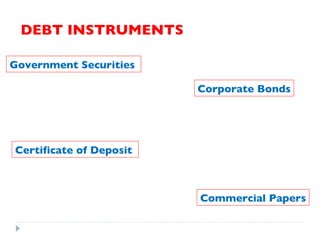
DEBT INSTRUMENTS Government Securities   Corporate Bonds Certificate of Deposit   Commercial Papers
Government Securities It is the Reserve Bank of India that issues Government Securities or G-Secs on behalf of the Government of India. These securities have a maturity period of 1 to 30 years. G-Secs offer fixed interest rate, where interests are payable semi-annually. For shorter term, there are Treasury Bills or T-Bills, which are issued by the RBI for 91 days, 182 days and 364 days
Corporate Bonds These bonds come from PSUs and private corporations and are offered for an extensive range of tenures up to 15 years. Comparing to G-Secs, corporate bonds carry higher risks, which depend upon the corporation, the industry where the corporation is currently operating, the current market conditions, and the rating of the corporation
Certificate of Deposit Certificate of Deposits (CDs), which usually offer higher returns than Bank term deposits, are issued in demat form    Banks can offer CDs which have maturity between 7 days and  1 year.  CDs from financial institutions have maturity between 1 and 3 years Commercial Papers There are short term securities with maturity of 7 to 365 days.
Structured Debt structured debt is some type of debt instrument that the  lender   has created and adapted to fit the needs and circumstances of  the borrower A debt package of this type usually includes one or more incentives that encourage the debtor to do business with the lender, rather than seeking to develop a working relationship with other lenders.   While the overall structure of the debt is adapted to the needs of the borrower, the terms also benefit the lender in the long term.
The main goal of structured debt is to create a debt situation that provides the debtor with as many benefits as possible, while also keeping the overall debt load as low as possible At the same time, the lender receives an equitable return for the structured debt arrangement
Analysis : China's yuan move ups ante on U.S. bond  market risks
http://www.wisegeek.com/what-is-the-debt-market.htm http://business.mapsofindia.com/india-market/debt.html REFERENCE http://www.reuters.com/article/idUSTRE65M5E220100623

Debt market

  • 1.
  • 2.
    The debt marketis any market situation where trading  debt instruments take place. Examples of debt instruments include mortgages, promissory notes, bonds, and Certificates of Deposit   A debt market establishes a structured environment where these types of debt can be traded with ease between interested parties. INTRODUCTION
  • 3.
    The debt marketoften goes by other names, based on the types of debt instruments that are traded In the event that the market deals mainly with the trading of corporate bond issues, the debt market may be known as a  bond market . If mortgages and notes are the main focus of the trading, the debt market may be known as a credit market   When fixed rates are connected with the debt instruments, the market may be known as a fixed income market.
  • 4.
    CLASSIFIACTION OF INDIANDEBT MARKET Government Securities Market (G-Sec Market):   It consists of central and state government securities. It means that, loans are being taken by the central and state government. It is also the most dominant category in the India debt market.  Bond Market:   It consists of Financial Institutions bonds, Corporate bonds and debentures and Public Sector Units bonds. These bonds are issued to meet financial requirements at a fixed cost and hence remove uncertainty in financial costs.
  • 5.
    DEBT INSTRUMENTS GovernmentSecurities   Corporate Bonds Certificate of Deposit   Commercial Papers
  • 6.
    Government Securities Itis the Reserve Bank of India that issues Government Securities or G-Secs on behalf of the Government of India. These securities have a maturity period of 1 to 30 years. G-Secs offer fixed interest rate, where interests are payable semi-annually. For shorter term, there are Treasury Bills or T-Bills, which are issued by the RBI for 91 days, 182 days and 364 days
  • 7.
    Corporate Bonds Thesebonds come from PSUs and private corporations and are offered for an extensive range of tenures up to 15 years. Comparing to G-Secs, corporate bonds carry higher risks, which depend upon the corporation, the industry where the corporation is currently operating, the current market conditions, and the rating of the corporation
  • 8.
    Certificate of DepositCertificate of Deposits (CDs), which usually offer higher returns than Bank term deposits, are issued in demat form    Banks can offer CDs which have maturity between 7 days and 1 year.  CDs from financial institutions have maturity between 1 and 3 years Commercial Papers There are short term securities with maturity of 7 to 365 days.
  • 9.
    Structured Debt structureddebt is some type of debt instrument that the lender   has created and adapted to fit the needs and circumstances of the borrower A debt package of this type usually includes one or more incentives that encourage the debtor to do business with the lender, rather than seeking to develop a working relationship with other lenders.   While the overall structure of the debt is adapted to the needs of the borrower, the terms also benefit the lender in the long term.
  • 10.
    The main goalof structured debt is to create a debt situation that provides the debtor with as many benefits as possible, while also keeping the overall debt load as low as possible At the same time, the lender receives an equitable return for the structured debt arrangement
  • 11.
    Analysis : China'syuan move ups ante on U.S. bond market risks
  • 12.