


INDIAN DEBT MARKET ANALYSISBusiness Club, IIT Kanpur
OBJECTIVESTo study characteristics of Indian Bond Market and account the same.To study Bond Distribution data and develop the statistics of the same.To study challenges and suggest various reforms that would help the corporate bond market to prosper in India.
WHY AN INCLINATION TO THIS PROJECT?Underdevelopment of Indian Bond MarketThe corporate bond market has not yet flourished as compared to government bond market.
BONDS : CONCEPTUALIZATIONIndian debt Market mainly comprises trading of bonds.In finance, a bond is a debt security, in which the issuer owes the holders a debt and is obliged to pay interest(the coupon) to use and/or to repay the principal at a later date, termed maturity.
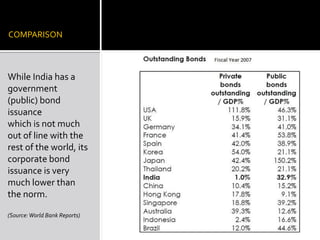
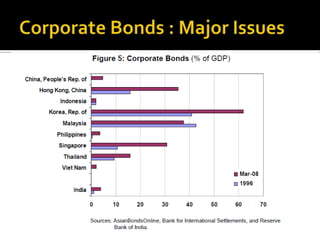
COMPARISONWhile India has a government (public) bond issuancewhich is not much out of line with the rest of the world, its corporate bondissuance is very much lower than the norm.(Source: World Bank Reports)
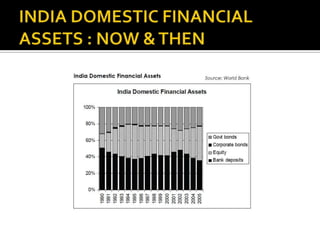
INDIA DOMESTIC FINANCIAL ASSETS : NOW & THEN
INDIA DOMESTIC FINANCIAL ASSETS : NOW & THENThere has been a gradual, but consistent, reduction in the relative importance of bank deposits from 44% in 1990 at the start of the reform program to 28% in the 2005.Over the whole period, government bonds have declined from 31% to 22% of domestic financial assets.Corporate bonds briefly became visible on the graph in the mid to late 90s but almost disappeared in 2004-05.
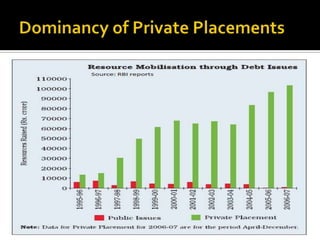
PLACEMENTS OF BONDSThere are almost no public issues in India.That is, where they are offered to a wide range of investors and conform to the regulatory standards required of public issues of bonds.
PLACEMENTS OF BONDSAlmost all corporate bond issues are made as private placements.Offered only to qualified Institutional Buyers (professional investors)Limited disclosure requirements.Lower regulatory hurdles.
Dominancy of Private Placements
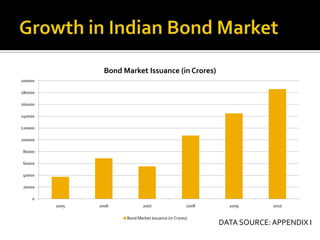
Growth in Indian Bond MarketDATA SOURCE: APPENDIX I
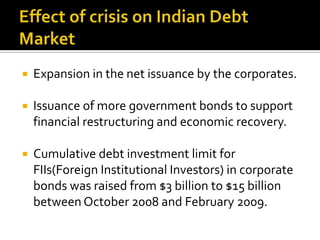
Effect of crisis on Indian Debt MarketExpansion in the net issuance by the corporates.Issuance of more government bonds to support financial restructuring and economic recovery.Cumulative debt investment limit for FIIs(Foreign Institutional Investors) in corporate bonds was raised from $3 billion to $15 billion between October 2008 and February 2009.
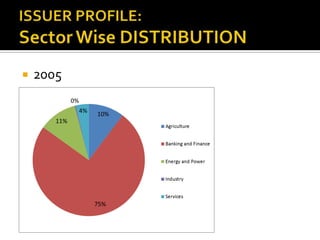
ISSUER PROFILE: Sector Wise DISTRIBUTION2005
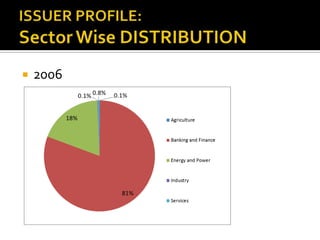
ISSUER PROFILE: Sector Wise DISTRIBUTION2006
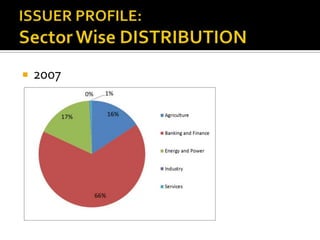
ISSUER PROFILE: Sector Wise DISTRIBUTION2007
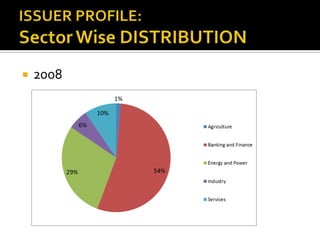
ISSUER PROFILE: Sector Wise DISTRIBUTION2008
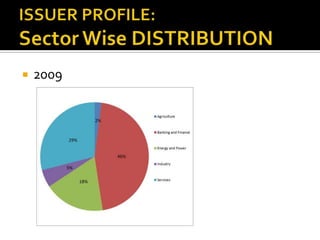
ISSUER PROFILE: Sector Wise DISTRIBUTION2009
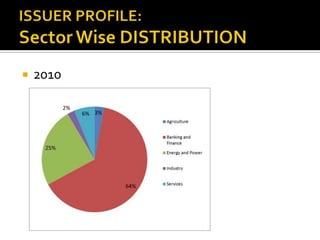
ISSUER PROFILE: Sector Wise DISTRIBUTION2010
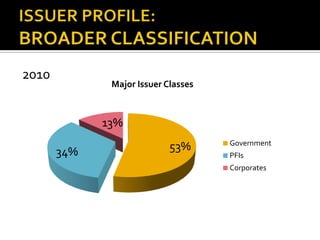
ISSUER PROFILE:BROADER CLASSIFICATION2010
ISSUER PROFILE : CONCLUSIONMAJOR ISSUERS:Public Financial Institutes Energy & Power Industries(G-Sec) Ministry of Power, Government of India projects to invest $100 billion in the near future. (Source: Plenary Session 4, Ministry of Power, New Delhi)
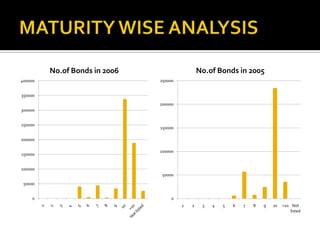
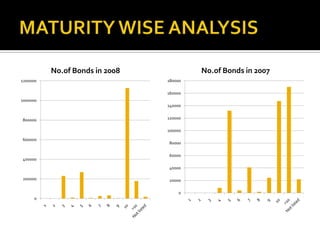
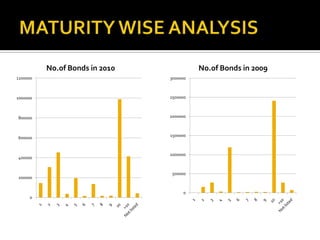
MATURITY WISE ANALYSIS
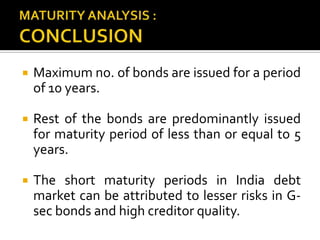
MATURITY ANALYSIS : CONCLUSIONMaximum no. of bonds are issued for a period of 10 years.Rest of the bonds are predominantly issued for maturity period of less than or equal to 5 years.The short maturity periods in India debt market can be attributed to lesser risks in G-sec bonds and high creditor quality.
Indian Debt Market:Understanding  Investor ProfileTraditionally, the Banks have been the largest category of investors in G-secs. More than 60% of the transaction in the Wholesale Debt Market. Required to maintain 25% of their net time and demand liabilities as SLR.Invest 10% to 15% more than the normal requirement.Risk Free nature of the Government Securities.Greater returns in G-Secs as compared to other investments of comparable nature
Indian Debt Market:Understanding  Investor ProfileInvestor profile in IDM can be understood by studying major markets for bonds trading:Wholesale Debt Market (WDM)- Major Investors: Banks, Financial Institutions, the RBI, Insurance companies, Provident Funds, MFs, Corporates and FIIs.Retail Debt Market(RDM)- Major Investors:individual investors, Small trusts and wholesale investors.
Understanding Investor Profile:Wholesale Debt MarketLarge investors and a high average trade value.Informal market with most of the trades directly negotiated and struck between various participants.The commencement of WDM by NSE(1994) and BSE(2001) has brought greater transparency.
Understanding Investor Profile:Retail Debt MarketIntroduction of trading in government securities for retail investors by the Government, RBI and SEBI. Wider participation of all classes of investors across the country.High potential because of presence of powerful investors.Investors same as that of equity market.
BOND MARKET : MAIN ROADBLOCKSReasons for not getting Developed :-Regulatory  Issues
Issues regarding Placement of Bonds.
FII related Issues.
Limited Demand for Corporate Bonds.
Cumbersome Trading Practices.Regulatory IssuesMost Issues are not Corporate Bonds but Private Placements.
Prospectuses for bond issues are reported to be several hundred pages long.
There is no provision for shelf registration.Regulatory IssuesExpensive Public IssuesIssuing process is reportedly slow, at times      taking Several Months.
 High marketing and other costs.Corporate Bonds : Major Issues
Corporate Bonds : Major IssuesMost of the Corporate Bonds are much like “Syndicated Loans”.As most of the Bonds are purchased by a single entity (which in most of the cases is Financial Institution like Banks).Corporate Bonds : Major IssuesDemand for Corporate Finance is limited.Mostly needed at the time of Corporate Restructuring.Corporates prefer borrowing from banks.
Issues Regarding Trading of BondsWholesale Trading is Over-the-CounterTrading process is cumbersome Only with some Major Banks acting as unofficial Market  Makers.The exchange-trading platforms provided by BSE are mainly used by a small number of retail participants.
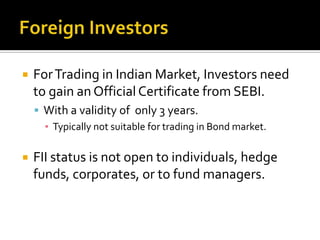
Foreign Investors Typically seen as a source of funds but they are also catalysts for overall development of the Financial Market.But various governing regulations have made their operations difficult.Foreign InvestorsFor Trading in Indian Market, Investors need to gain an Official Certificate from SEBI.With a validity of  only 3 years.Typically not suitable for trading in Bond market.FII status is not open to individuals, hedge funds, corporates, or to fund managers.
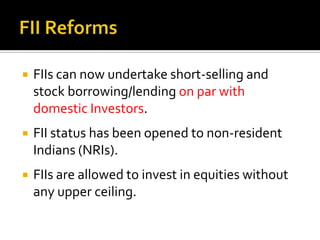
FII ReformsFIIs can now undertake short-selling and stock borrowing/lending on par with domestic Investors.FII status has been opened to non-resident Indians (NRIs).FIIs are allowed to invest in equities without any upper ceiling.
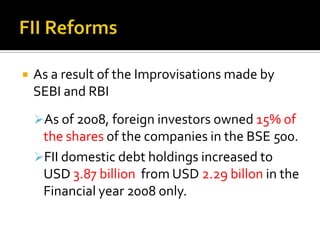
FII ReformsAs a result of the Improvisations made by SEBI and RBIAs of 2008, foreign investors owned 15% of the shares of the companies in the BSE 500.
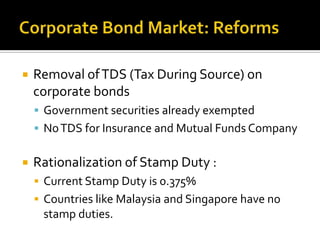
FII domestic debt holdings increased to USD 3.87 billion  from USD 2.29 billonin the Financial year 2008 only.Corporate Bond Market: ReformsRemoval of TDS (Tax During Source) on corporate bondsGovernment securities already exemptedNo TDS for Insurance and Mutual Funds CompanyRationalization of Stamp Duty :Current Stamp Duty is 0.375%Countries like Malaysia and Singapore have no stamp duties.
Corporate Bond Market: ReformsGiving flexibility to investors:Financial Institutions(provident and pension funds) are not allowed to hold anything below top rated bonds.Debt Based Mutual Funds are also based on government securities.
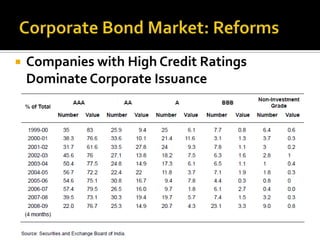
Corporate Bond Market: ReformsCompanies with High Credit Ratings Dominate Corporate Issuance
Corporate Bond Market: ReformsMaking corporate bonds more liquid.Corporate Bonds so far can not be used as a collateral to carry out repo transitions.Need for securitization in India.
Securitization: ConceptualizationIt the process of creation and transfer of securities backed by a pool of usually non-tradable assets.Bank loans of various kinds, mortgages and receivables are the typical asset classes that are securitized.
Securitization : Encouraging Retail InvestorsThe process creates liquidity by enabling smaller investors to purchase shares in a larger asset pool.It enables individual retail investor to purchase portions of a mortgage as a type of bond.Without the securitization of mortgages, retail investors may not be able to afford to buy into a large pool of mortgages.
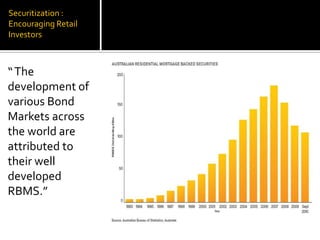
Securitization : Encouraging Retail Investors“ The development of various Bond Markets across the world are attributed to their well developed RBMS.”

Indian debt market analysis

  • 1.
    INDIAN DEBT MARKETANALYSISBusiness Club, IIT Kanpur
  • 2.
    OBJECTIVESTo study characteristicsof Indian Bond Market and account the same.To study Bond Distribution data and develop the statistics of the same.To study challenges and suggest various reforms that would help the corporate bond market to prosper in India.
  • 3.
    WHY AN INCLINATIONTO THIS PROJECT?Underdevelopment of Indian Bond MarketThe corporate bond market has not yet flourished as compared to government bond market.
  • 4.
    BONDS : CONCEPTUALIZATIONIndiandebt Market mainly comprises trading of bonds.In finance, a bond is a debt security, in which the issuer owes the holders a debt and is obliged to pay interest(the coupon) to use and/or to repay the principal at a later date, termed maturity.
  • 5.
    COMPARISONWhile India hasa government (public) bond issuancewhich is not much out of line with the rest of the world, its corporate bondissuance is very much lower than the norm.(Source: World Bank Reports)
  • 6.
    INDIA DOMESTIC FINANCIALASSETS : NOW & THEN
  • 7.
    INDIA DOMESTIC FINANCIALASSETS : NOW & THENThere has been a gradual, but consistent, reduction in the relative importance of bank deposits from 44% in 1990 at the start of the reform program to 28% in the 2005.Over the whole period, government bonds have declined from 31% to 22% of domestic financial assets.Corporate bonds briefly became visible on the graph in the mid to late 90s but almost disappeared in 2004-05.
  • 8.
    PLACEMENTS OF BONDSThereare almost no public issues in India.That is, where they are offered to a wide range of investors and conform to the regulatory standards required of public issues of bonds.
  • 9.
    PLACEMENTS OF BONDSAlmostall corporate bond issues are made as private placements.Offered only to qualified Institutional Buyers (professional investors)Limited disclosure requirements.Lower regulatory hurdles.
  • 10.
  • 11.
    Growth in IndianBond MarketDATA SOURCE: APPENDIX I
  • 12.
    Effect of crisison Indian Debt MarketExpansion in the net issuance by the corporates.Issuance of more government bonds to support financial restructuring and economic recovery.Cumulative debt investment limit for FIIs(Foreign Institutional Investors) in corporate bonds was raised from $3 billion to $15 billion between October 2008 and February 2009.
  • 13.
    ISSUER PROFILE: SectorWise DISTRIBUTION2005
  • 14.
    ISSUER PROFILE: SectorWise DISTRIBUTION2006
  • 15.
    ISSUER PROFILE: SectorWise DISTRIBUTION2007
  • 16.
    ISSUER PROFILE: SectorWise DISTRIBUTION2008
  • 17.
    ISSUER PROFILE: SectorWise DISTRIBUTION2009
  • 18.
    ISSUER PROFILE: SectorWise DISTRIBUTION2010
  • 19.
  • 20.
    ISSUER PROFILE :CONCLUSIONMAJOR ISSUERS:Public Financial Institutes Energy & Power Industries(G-Sec) Ministry of Power, Government of India projects to invest $100 billion in the near future. (Source: Plenary Session 4, Ministry of Power, New Delhi)
  • 21.
  • 22.
  • 23.
  • 24.
    MATURITY ANALYSIS :CONCLUSIONMaximum no. of bonds are issued for a period of 10 years.Rest of the bonds are predominantly issued for maturity period of less than or equal to 5 years.The short maturity periods in India debt market can be attributed to lesser risks in G-sec bonds and high creditor quality.
  • 25.
    Indian Debt Market:Understanding Investor ProfileTraditionally, the Banks have been the largest category of investors in G-secs. More than 60% of the transaction in the Wholesale Debt Market. Required to maintain 25% of their net time and demand liabilities as SLR.Invest 10% to 15% more than the normal requirement.Risk Free nature of the Government Securities.Greater returns in G-Secs as compared to other investments of comparable nature
  • 26.
    Indian Debt Market:Understanding Investor ProfileInvestor profile in IDM can be understood by studying major markets for bonds trading:Wholesale Debt Market (WDM)- Major Investors: Banks, Financial Institutions, the RBI, Insurance companies, Provident Funds, MFs, Corporates and FIIs.Retail Debt Market(RDM)- Major Investors:individual investors, Small trusts and wholesale investors.
  • 27.
    Understanding Investor Profile:WholesaleDebt MarketLarge investors and a high average trade value.Informal market with most of the trades directly negotiated and struck between various participants.The commencement of WDM by NSE(1994) and BSE(2001) has brought greater transparency.
  • 28.
    Understanding Investor Profile:RetailDebt MarketIntroduction of trading in government securities for retail investors by the Government, RBI and SEBI. Wider participation of all classes of investors across the country.High potential because of presence of powerful investors.Investors same as that of equity market.
  • 29.
    BOND MARKET :MAIN ROADBLOCKSReasons for not getting Developed :-Regulatory Issues
  • 30.
  • 31.
  • 32.
    Limited Demand forCorporate Bonds.
  • 33.
    Cumbersome Trading Practices.RegulatoryIssuesMost Issues are not Corporate Bonds but Private Placements.
  • 34.
    Prospectuses for bondissues are reported to be several hundred pages long.
  • 35.
    There is noprovision for shelf registration.Regulatory IssuesExpensive Public IssuesIssuing process is reportedly slow, at times taking Several Months.
  • 36.
    High marketingand other costs.Corporate Bonds : Major Issues
  • 37.
    Corporate Bonds :Major IssuesMost of the Corporate Bonds are much like “Syndicated Loans”.As most of the Bonds are purchased by a single entity (which in most of the cases is Financial Institution like Banks).Corporate Bonds : Major IssuesDemand for Corporate Finance is limited.Mostly needed at the time of Corporate Restructuring.Corporates prefer borrowing from banks.
  • 38.
    Issues Regarding Tradingof BondsWholesale Trading is Over-the-CounterTrading process is cumbersome Only with some Major Banks acting as unofficial Market Makers.The exchange-trading platforms provided by BSE are mainly used by a small number of retail participants.
  • 39.
    Foreign Investors Typicallyseen as a source of funds but they are also catalysts for overall development of the Financial Market.But various governing regulations have made their operations difficult.Foreign InvestorsFor Trading in Indian Market, Investors need to gain an Official Certificate from SEBI.With a validity of only 3 years.Typically not suitable for trading in Bond market.FII status is not open to individuals, hedge funds, corporates, or to fund managers.
  • 40.
    FII ReformsFIIs cannow undertake short-selling and stock borrowing/lending on par with domestic Investors.FII status has been opened to non-resident Indians (NRIs).FIIs are allowed to invest in equities without any upper ceiling.
  • 41.
    FII ReformsAs aresult of the Improvisations made by SEBI and RBIAs of 2008, foreign investors owned 15% of the shares of the companies in the BSE 500.
  • 42.
    FII domestic debtholdings increased to USD 3.87 billion from USD 2.29 billonin the Financial year 2008 only.Corporate Bond Market: ReformsRemoval of TDS (Tax During Source) on corporate bondsGovernment securities already exemptedNo TDS for Insurance and Mutual Funds CompanyRationalization of Stamp Duty :Current Stamp Duty is 0.375%Countries like Malaysia and Singapore have no stamp duties.
  • 43.
    Corporate Bond Market:ReformsGiving flexibility to investors:Financial Institutions(provident and pension funds) are not allowed to hold anything below top rated bonds.Debt Based Mutual Funds are also based on government securities.
  • 44.
    Corporate Bond Market:ReformsCompanies with High Credit Ratings Dominate Corporate Issuance
  • 45.
    Corporate Bond Market:ReformsMaking corporate bonds more liquid.Corporate Bonds so far can not be used as a collateral to carry out repo transitions.Need for securitization in India.
  • 46.
    Securitization: ConceptualizationIt theprocess of creation and transfer of securities backed by a pool of usually non-tradable assets.Bank loans of various kinds, mortgages and receivables are the typical asset classes that are securitized.
  • 47.
    Securitization : EncouragingRetail InvestorsThe process creates liquidity by enabling smaller investors to purchase shares in a larger asset pool.It enables individual retail investor to purchase portions of a mortgage as a type of bond.Without the securitization of mortgages, retail investors may not be able to afford to buy into a large pool of mortgages.
  • 48.
    Securitization : EncouragingRetail Investors“ The development of various Bond Markets across the world are attributed to their well developed RBMS.”