Presented By:-
 Gurjeet Kaur     Presented To:-
M.Com 3sem       Mr. Swinder Singh
Meaning of debt securities
The debt market is
any market where
trading of debt
instruments/ securities
 take place.
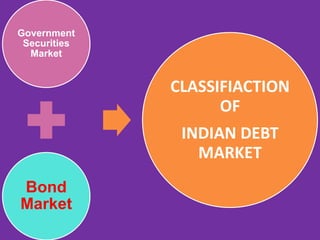
Government
 Securities
  Market


              CLASSIFIACTION
                    OF
               INDIAN DEBT
                 MARKET
Bond
Market
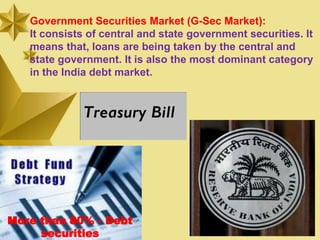
Government Securities Market (G-Sec Market):
   It consists of central and state government securities. It
   means that, loans are being taken by the central and
   state government. It is also the most dominant category
   in the India debt market.


More than 80% - Debt
     securities
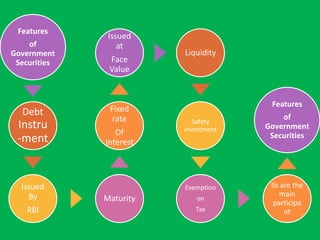
Features
               Issued
    of            at
Government               Liquidity
 Securities    Face
               Value


                                       Features
  Debt         Fixed
                rate                      of
                            Safety
 Instru                  investment   Government
                 Of                    Securities
 -ment        Interest


  Issued                 Exemption     IIs are the
    By                                    main
              Maturity      on
                                        participa
    RBI                     Tax             nt
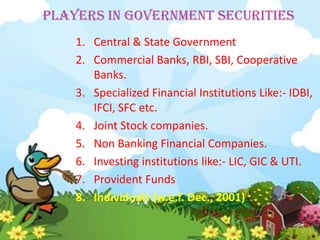
Players in Government Securities
    1. Central & State Government
    2. Commercial Banks, RBI, SBI, Cooperative
       Banks.
    3. Specialized Financial Institutions Like:- IDBI,
       IFCI, SFC etc.
    4. Joint Stock companies.
    5. Non Banking Financial Companies.
    6. Investing institutions like:- LIC, GIC & UTI.
    7. Provident Funds
    8. Individuals (w.e.f. Dec., 2001)
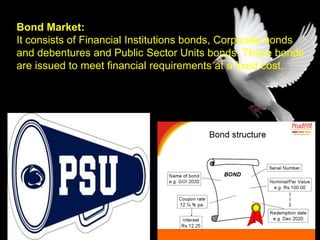
Bond Market:
It consists of Financial Institutions bonds, Corporate bonds
and debentures and Public Sector Units bonds. These bonds
are issued to meet financial requirements at a fixed cost.
Features of Bond Instruments
           1.  Higher Risky
           2.  High Rate of Return
           3.  Taxable
           •   Bonds issued by corporations
               or government are usually
               taxable
           • Bonds issued by state
               governments or
               municipalities are usually
               exempt from tax
           4. Maturity
           5. INTEREST RATES
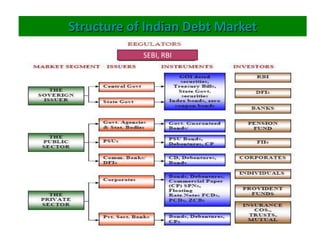
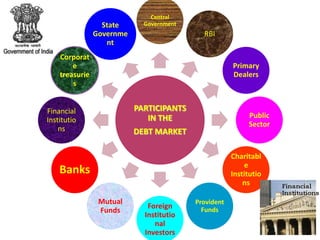
Structure of Indian Debt Market
            SEBI, RBI
Central
                  State      Government
                Governme                    RBI
                   nt
    Corporat
        e                                             Primary
    treasurie                                         Dealers
        s


Financial                  PARTICIPANTS
                              IN THE                       Public
Institutio
                                                           Sector
    ns                     DEBT MARKET

                                                      Charitabl
                                                          e
    Banks                                             Institutio
                                                          ns

                 Mutual                   Provident
                              Foreign       Funds
                 Funds
                             Institutio
                                nal
                             Investors
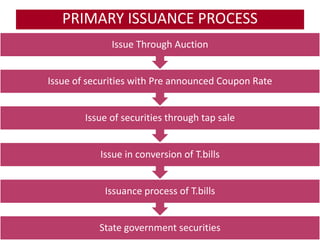
PRIMARY ISSUANCE PROCESS
              Issue Through Auction


Issue of securities with Pre announced Coupon Rate


        Issue of securities through tap sale


           Issue in conversion of T.bills


            Issuance process of T.bills


           State government securities
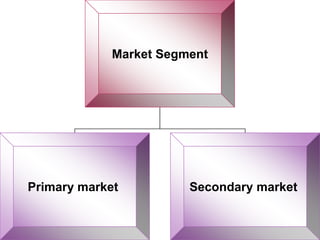
Market Segment


Primary market          Secondary market
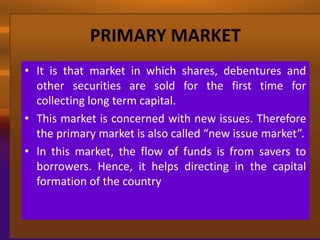
PRIMARY MARKET
• It is that market in which shares, debentures and
  other securities are sold for the first time for
  collecting long term capital.
• This market is concerned with new issues. Therefore
  the primary market is also called “new issue market”.
• In this market, the flow of funds is from savers to
  borrowers. Hence, it helps directing in the capital
  formation of the country
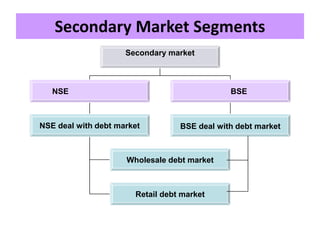
Secondary Market Segments
                     Secondary market


   NSE                                        BSE


NSE deal with debt market         BSE deal with debt market


                     Wholesale debt market


                       Retail debt market
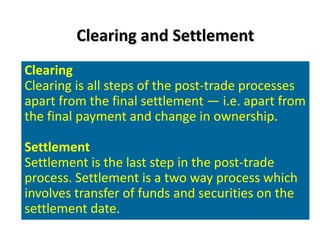
Clearing and Settlement
Clearing
Clearing is all steps of the post-trade processes
apart from the final settlement — i.e. apart from
the final payment and change in ownership.

Settlement
Settlement is the last step in the post-trade
process. Settlement is a two way process which
involves transfer of funds and securities on the
settlement date.
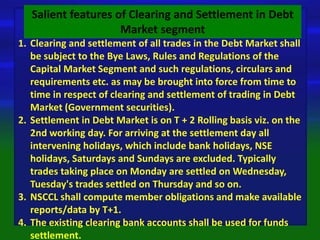
Salient features of Clearing and Settlement in Debt
                     Market segment
1. Clearing and settlement of all trades in the Debt Market shall
   be subject to the Bye Laws, Rules and Regulations of the
   Capital Market Segment and such regulations, circulars and
   requirements etc. as may be brought into force from time to
   time in respect of clearing and settlement of trading in Debt
   Market (Government securities).
2. Settlement in Debt Market is on T + 2 Rolling basis viz. on the
   2nd working day. For arriving at the settlement day all
   intervening holidays, which include bank holidays, NSE
   holidays, Saturdays and Sundays are excluded. Typically
   trades taking place on Monday are settled on Wednesday,
   Tuesday's trades settled on Thursday and so on.
3. NSCCL shall compute member obligations and make available
   reports/data by T+1.
4. The existing clearing bank accounts shall be used for funds
   settlement.
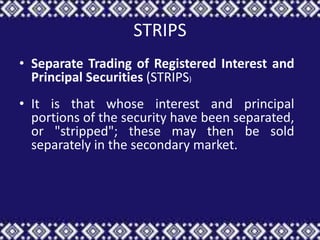
STRIPS
• Separate Trading of Registered Interest and
  Principal Securities (STRIPS)
• It is that whose interest and principal
  portions of the security have been separated,
  or "stripped"; these may then be sold
  separately in the secondary market.
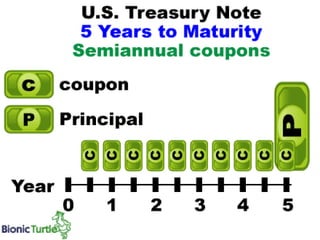
Example
• a Treasury note with 10 years remaining to
  maturity consists of a single principal
  payment, due at maturity, and 20 interest
  payments, one every six months over a10 year
  duration. When this note is converted to
  STRIPS form, each of the 20 interest payments
  and the principal payment becomes a
  separate security.
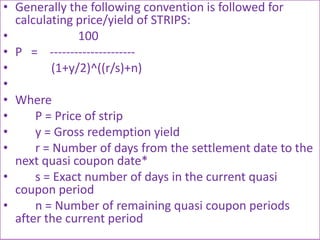
• Generally the following convention is followed for
  calculating price/yield of STRIPS:
•              100
• P = ---------------------
•         (1+y/2)^((r/s)+n)
•
• Where
•     P = Price of strip
•     y = Gross redemption yield
•     r = Number of days from the settlement date to the
  next quasi coupon date*
•     s = Exact number of days in the current quasi
  coupon period
•     n = Number of remaining quasi coupon periods
  after the current period
Features of STRIPS

• STRIPS let investors hold and trade the individual
  interest and principal components of eligible
  Treasury notes and bonds as separate securities.
• STRIPS are popular with investors who want to
  receive a known payment on a specific future date.
• It is issued at discount.
• These are zero coupon instrument with single
  maturity value.
CONCLUSION

• The debt markets play an important role in
  efficient mobilization and allocation of resources
  in the economy , financing the development
  activities of the Government ,transmitting signals
  for implementation of the monetary policy,
  facilitating liquidity management in tune with
  overall short term and long term objectives.
Debt market, komal walia

Debt market, komal walia

  • 1.
    Presented By:- GurjeetKaur Presented To:- M.Com 3sem Mr. Swinder Singh
  • 2.
    Meaning of debtsecurities The debt market is any market where trading of debt instruments/ securities take place.
  • 6.
    Government Securities Market CLASSIFIACTION OF INDIAN DEBT MARKET Bond Market
  • 7.
    Government Securities Market(G-Sec Market): It consists of central and state government securities. It means that, loans are being taken by the central and state government. It is also the most dominant category in the India debt market. More than 80% - Debt securities
  • 8.
    Features Issued of at Government Liquidity Securities Face Value Features Debt Fixed rate of Safety Instru investment Government Of Securities -ment Interest Issued Exemption IIs are the By main Maturity on participa RBI Tax nt
  • 9.
    Players in GovernmentSecurities 1. Central & State Government 2. Commercial Banks, RBI, SBI, Cooperative Banks. 3. Specialized Financial Institutions Like:- IDBI, IFCI, SFC etc. 4. Joint Stock companies. 5. Non Banking Financial Companies. 6. Investing institutions like:- LIC, GIC & UTI. 7. Provident Funds 8. Individuals (w.e.f. Dec., 2001)
  • 10.
    Bond Market: It consistsof Financial Institutions bonds, Corporate bonds and debentures and Public Sector Units bonds. These bonds are issued to meet financial requirements at a fixed cost.
  • 11.
    Features of BondInstruments 1. Higher Risky 2. High Rate of Return 3. Taxable • Bonds issued by corporations or government are usually taxable • Bonds issued by state governments or municipalities are usually exempt from tax 4. Maturity 5. INTEREST RATES
  • 12.
    Structure of IndianDebt Market SEBI, RBI
  • 13.
    Central State Government Governme RBI nt Corporat e Primary treasurie Dealers s Financial PARTICIPANTS IN THE Public Institutio Sector ns DEBT MARKET Charitabl e Banks Institutio ns Mutual Provident Foreign Funds Funds Institutio nal Investors
  • 14.
    PRIMARY ISSUANCE PROCESS Issue Through Auction Issue of securities with Pre announced Coupon Rate Issue of securities through tap sale Issue in conversion of T.bills Issuance process of T.bills State government securities
  • 15.
  • 16.
    PRIMARY MARKET • Itis that market in which shares, debentures and other securities are sold for the first time for collecting long term capital. • This market is concerned with new issues. Therefore the primary market is also called “new issue market”. • In this market, the flow of funds is from savers to borrowers. Hence, it helps directing in the capital formation of the country
  • 17.
    Secondary Market Segments Secondary market NSE BSE NSE deal with debt market BSE deal with debt market Wholesale debt market Retail debt market
  • 18.
    Clearing and Settlement Clearing Clearingis all steps of the post-trade processes apart from the final settlement — i.e. apart from the final payment and change in ownership. Settlement Settlement is the last step in the post-trade process. Settlement is a two way process which involves transfer of funds and securities on the settlement date.
  • 19.
    Salient features ofClearing and Settlement in Debt Market segment 1. Clearing and settlement of all trades in the Debt Market shall be subject to the Bye Laws, Rules and Regulations of the Capital Market Segment and such regulations, circulars and requirements etc. as may be brought into force from time to time in respect of clearing and settlement of trading in Debt Market (Government securities). 2. Settlement in Debt Market is on T + 2 Rolling basis viz. on the 2nd working day. For arriving at the settlement day all intervening holidays, which include bank holidays, NSE holidays, Saturdays and Sundays are excluded. Typically trades taking place on Monday are settled on Wednesday, Tuesday's trades settled on Thursday and so on. 3. NSCCL shall compute member obligations and make available reports/data by T+1. 4. The existing clearing bank accounts shall be used for funds settlement.
  • 20.
    STRIPS • Separate Tradingof Registered Interest and Principal Securities (STRIPS) • It is that whose interest and principal portions of the security have been separated, or "stripped"; these may then be sold separately in the secondary market.
  • 21.
    Example • a Treasurynote with 10 years remaining to maturity consists of a single principal payment, due at maturity, and 20 interest payments, one every six months over a10 year duration. When this note is converted to STRIPS form, each of the 20 interest payments and the principal payment becomes a separate security.
  • 23.
    • Generally thefollowing convention is followed for calculating price/yield of STRIPS: • 100 • P = --------------------- • (1+y/2)^((r/s)+n) • • Where • P = Price of strip • y = Gross redemption yield • r = Number of days from the settlement date to the next quasi coupon date* • s = Exact number of days in the current quasi coupon period • n = Number of remaining quasi coupon periods after the current period
  • 24.
    Features of STRIPS •STRIPS let investors hold and trade the individual interest and principal components of eligible Treasury notes and bonds as separate securities. • STRIPS are popular with investors who want to receive a known payment on a specific future date. • It is issued at discount. • These are zero coupon instrument with single maturity value.
  • 25.
    CONCLUSION • The debtmarkets play an important role in efficient mobilization and allocation of resources in the economy , financing the development activities of the Government ,transmitting signals for implementation of the monetary policy, facilitating liquidity management in tune with overall short term and long term objectives.