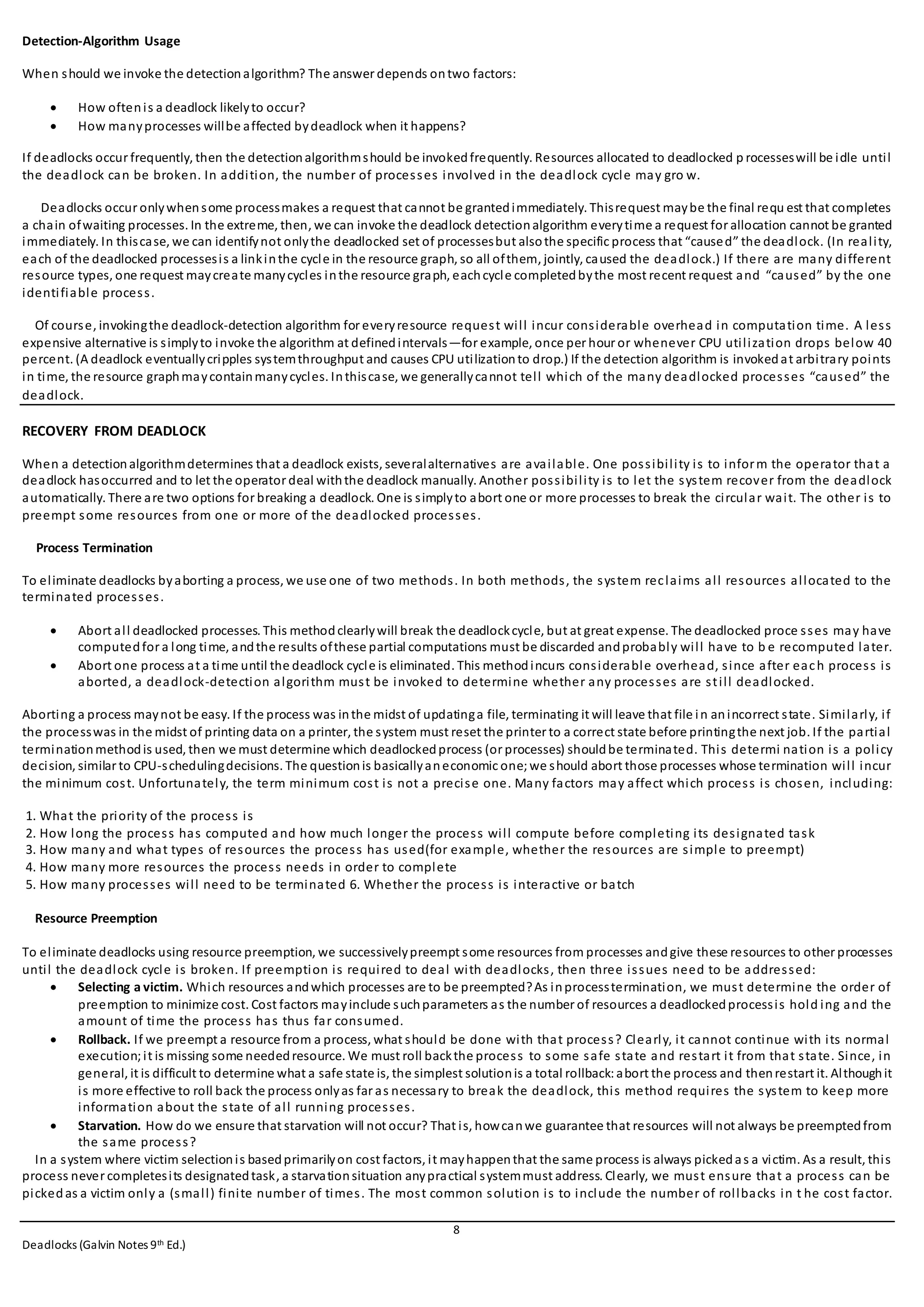
This document summarizes key concepts related to deadlocks in operating systems. It defines the four necessary conditions for deadlock to occur: mutual exclusion, hold and wait, no preemption, and circular wait. It describes methods for handling deadlocks, including deadlock prevention, avoidance, detection, and recovery. Deadlock prevention techniques aim to ensure that at least one of the necessary conditions does not hold, such as imposing an ordering on how resources can be requested. Deadlock avoidance uses additional information to determine if a request could lead to a deadlocked state. Detection and recovery methods allow deadlocks to occur but provide algorithms for identifying and resolving deadlocked processes.



![7
Deadlocks (Galvin Notes 9th Ed.)
DEADLOCK DETECTION
If a systemdoesnot employeither a deadlock-preventionor a deadlockavoidance algorithm, thena deadlocksituationmayoccur. Inthis environment,
the system may provide:
An algorithm that examines the state of the system to determine whether a deadlock has occurred
An algorithm to recover from the deadlock
In the followingdiscussion, we elaborate onthese two requirements as theypertainto systems withonlya single instance of eachresource type, as well
as to systems with several instancesof eachresource type. At this point, however,we note that a detection -and-recoveryscheme requiresoverheadthat
includes not onlythe run-time costs of maintaining the necessaryinformationandexecuting the detection algorithm but also the potential losses
inherent in recovering from a deadlock.
Single Instance of Each Resource Type
If all resources have onlya single instance, then we candefine a deadlock detectionalgorithmthat usesa variant of the resource-allocation graph, called
a wait-for graph. We obtainthisgraphfrom the resource-allocation graph byremoving the resource nodes andcollapsing the appropriate edges. More
precisely, anedge from Pi to Pj in a wait-for graph implies that process Pi is waitingfor processPj to release a resource that Pi needs. An edge Pi → Pj
exists ina wait-for graphifandonlyif the correspondingresource allocationgraphcontains two edges Pi → Rq and Rq → Pj for some resource Rq . In
Figure 7.9, we present a resource-allocation graph and the corresponding wait-for graph.
As before, a deadlock exists in the system if andonlyif the wait-for graphcontains a cycle. To detect deadlocks, the system needs to maintain the
wait for graphandperiodicallyinvoke analgorithm that searches for a cycle inthe graph. An algorithmto detect a cycle in a graphrequires an order of
n2 operations, where n is the number of vertices in the graph.
Several Instances of a Resource Type
The wait-for graph scheme is not applicable to a resource-allocation system withmultiple instances ofeachresource type. We turn now to a deadlock
detection algorithm that is applicable to sucha system. The algorithm employs several time-varyingdata structures that are similar to those used inthe
banker’s algorithm:
• Available. A vector of length m indicates the number of available resources ofeachtype.
• Allocation. An n × m matrix defines the number of resources of each type currentlyallocated to each process.
• Request. An n × m matrix indicates the current request of each process. If Request[i][j] equals k, thenprocess Pi is requesting k more instances of
resource type Rj .
The ≤ relation betweentwo vectors is defined as in Section7.5.3. To simplifynotation, we again treat the rows in the matricesAllocationand Request as
vectors;we refer to them as Allocationi and Requesti . The detectionalgorithm describedhere simply investigateseverypossible allocationsequence for
the processes that remainto be completed. Compare this algorithm withthe banker’s algorithm of Section7.5.3.](https://image.slidesharecdn.com/deadlocksfinal-161019122008/75/Deadlocks-final-7-2048.jpg)