The document discusses deadlocks in operating systems. It defines deadlock as when a process waits for a resource held by another waiting process, forming a circular chain of processes waiting for each other. It characterizes deadlock by the conditions of mutual exclusion, hold and wait, no preemption, and circular wait. The document outlines strategies to handle deadlocks through prevention, avoidance, and detection and recovery. It describes resource allocation graphs to model deadlocks and the conditions for deadlocks using AND and OR resource allocation. Finally, it discusses different techniques for deadlock prevention, detection, and recovery in a system.
Deadlock
In an operatingsystem, a deadlock occurs when a process or thread enters a
waiting state because a requested system resource is held by another waiting
process, which in turn is waiting for another resource held by another waiting
process.
4
Deadlock Characterization (cont...)
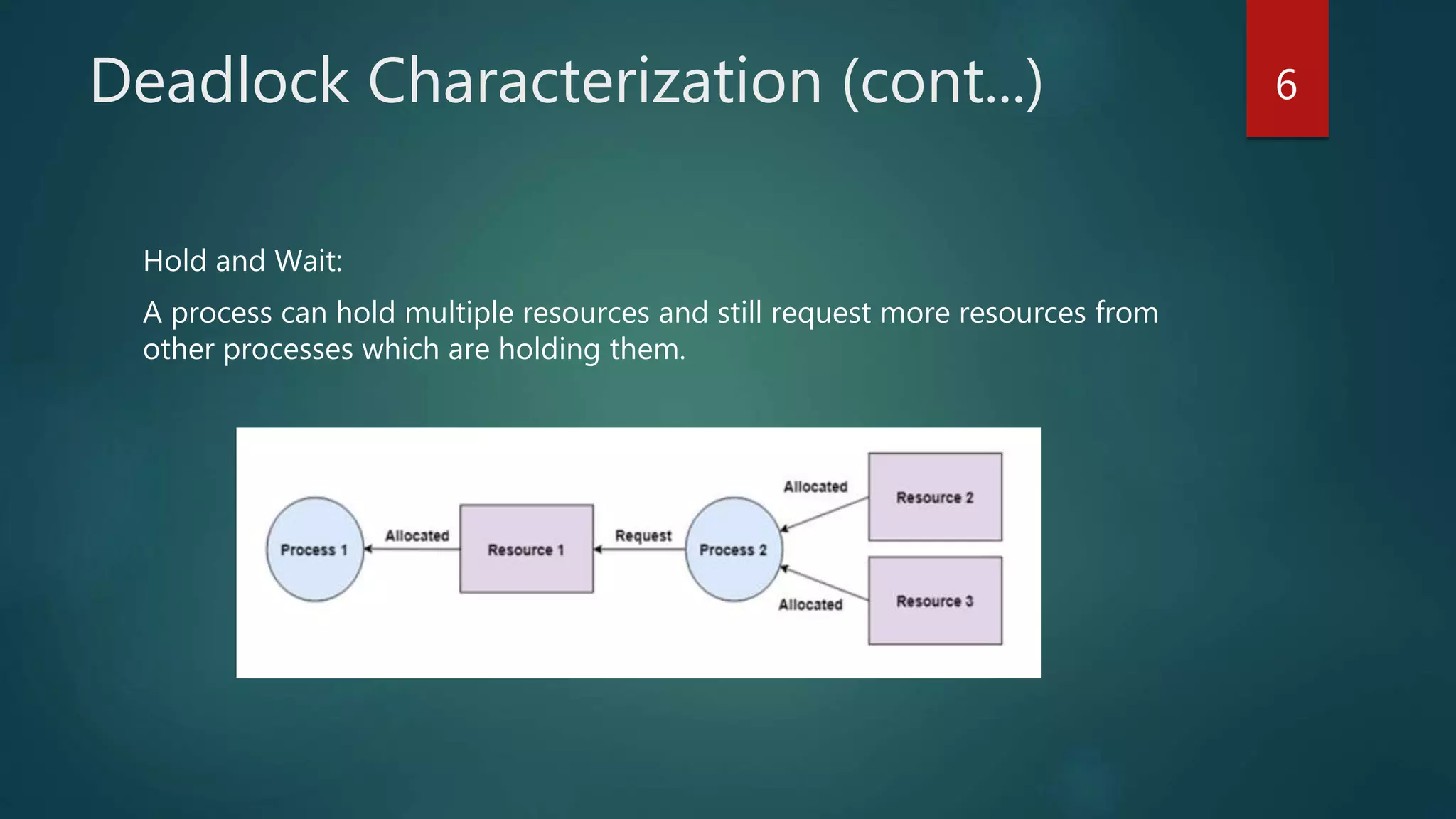
Holdand Wait:
A process can hold multiple resources and still request more resources from
other processes which are holding them.
6
7.
Deadlock Characterization (cont...)
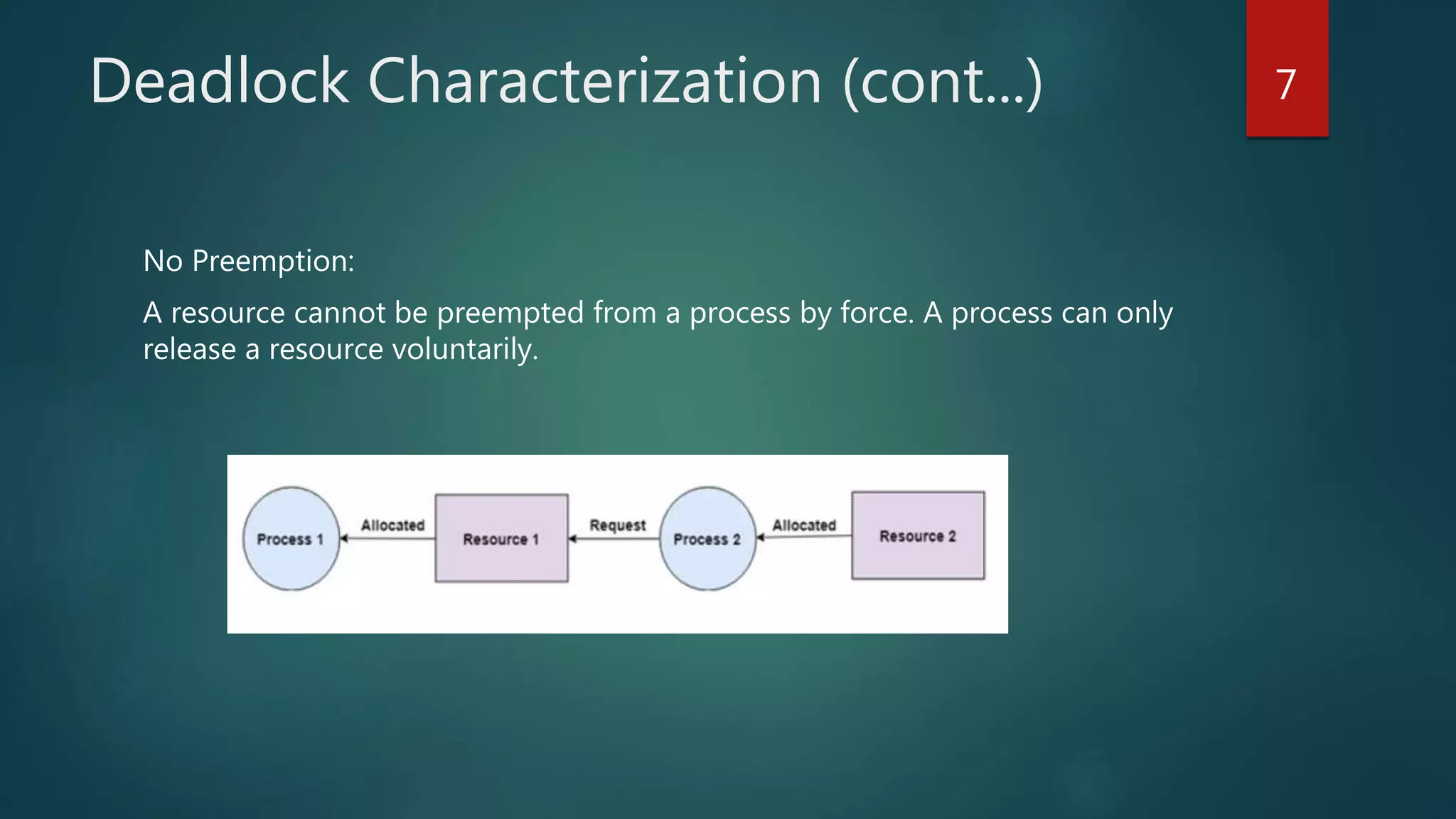
NoPreemption:
A resource cannot be preempted from a process by force. A process can only
release a resource voluntarily.
7
8.
Deadlock Characterization (cont...)
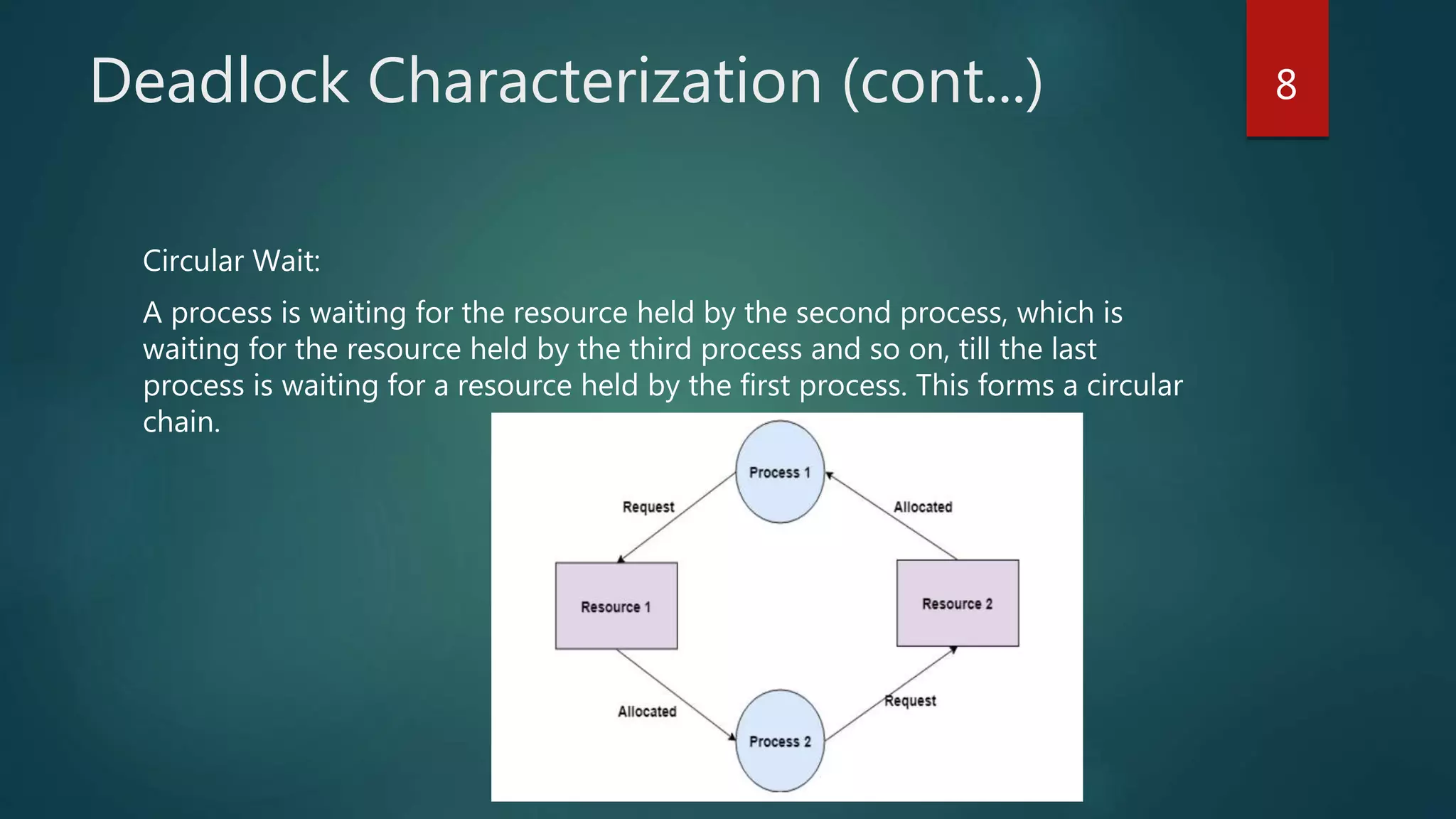
CircularWait:
A process is waiting for the resource held by the second process, which is
waiting for the resource held by the third process and so on, till the last
process is waiting for a resource held by the first process. This forms a circular
chain.
8
9.
Strategies for handlingdeadlocks
Deadlock prevention. Prevents deadlocks by restraining requests made to
ensure that at least one of the four deadlock conditions cannot occur.
Deadlock avoidance. Dynamically grants a resource to a process if the
resulting state is safe. A state is safe if there is at least one execution
sequence that allows all processes to run to completion.
Deadlock detection and recovery. Allows deadlocks to form; then finds and
breaks them.
9
Two types ofdeadlocks
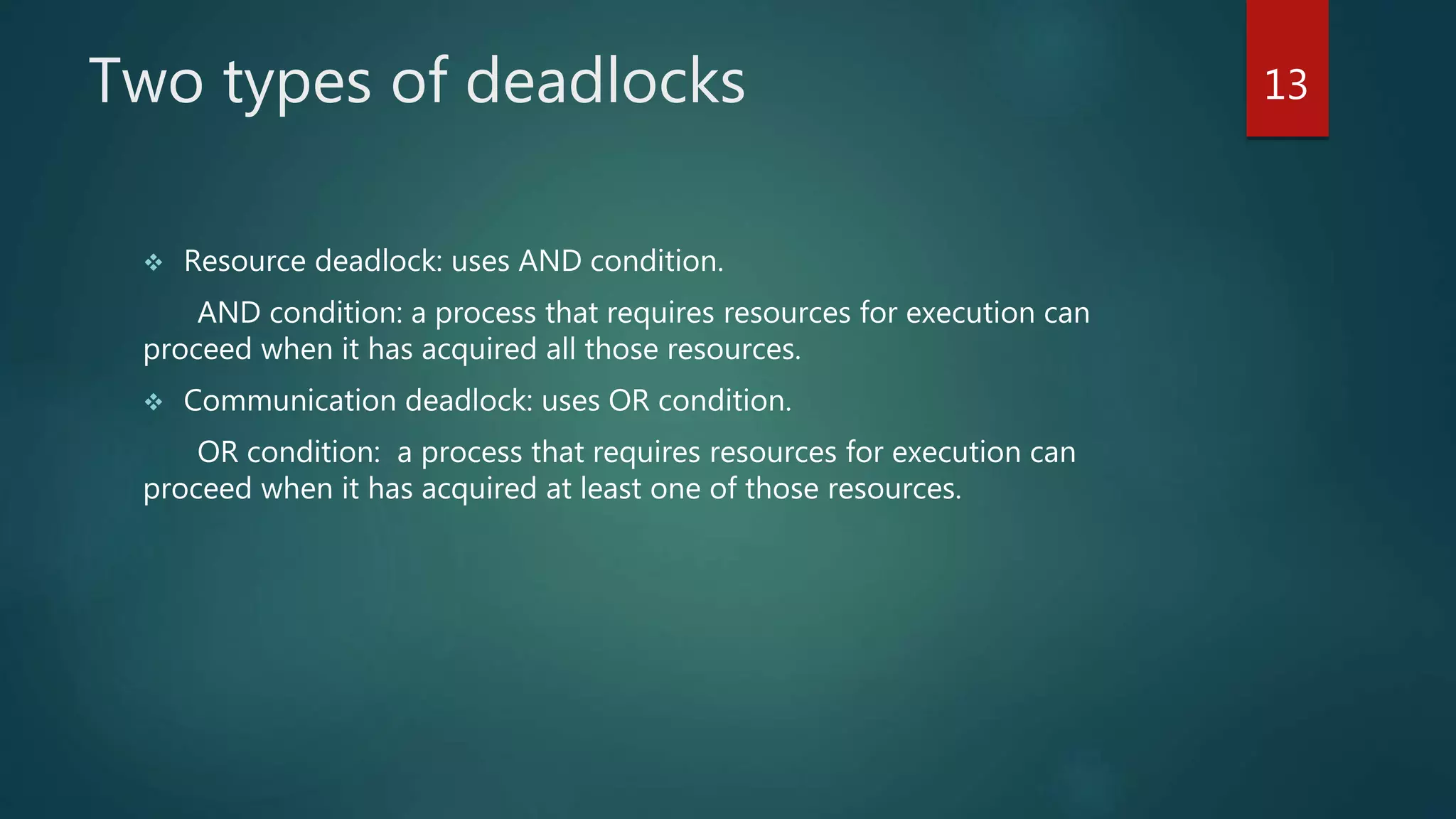
Resource deadlock: uses AND condition.
AND condition: a process that requires resources for execution can
proceed when it has acquired all those resources.
Communication deadlock: uses OR condition.
OR condition: a process that requires resources for execution can
proceed when it has acquired at least one of those resources.
13
14.
Deadlock conditions
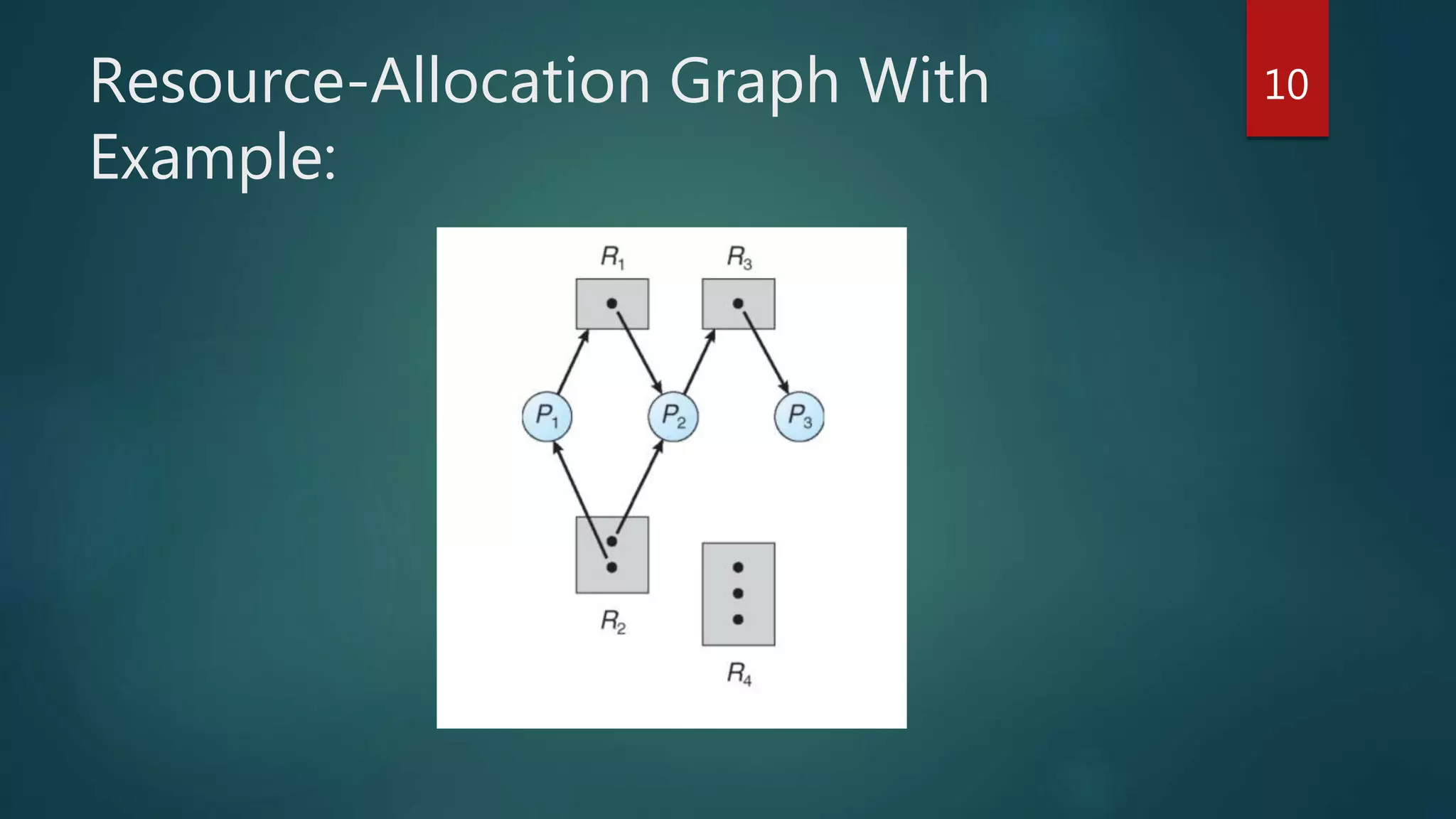
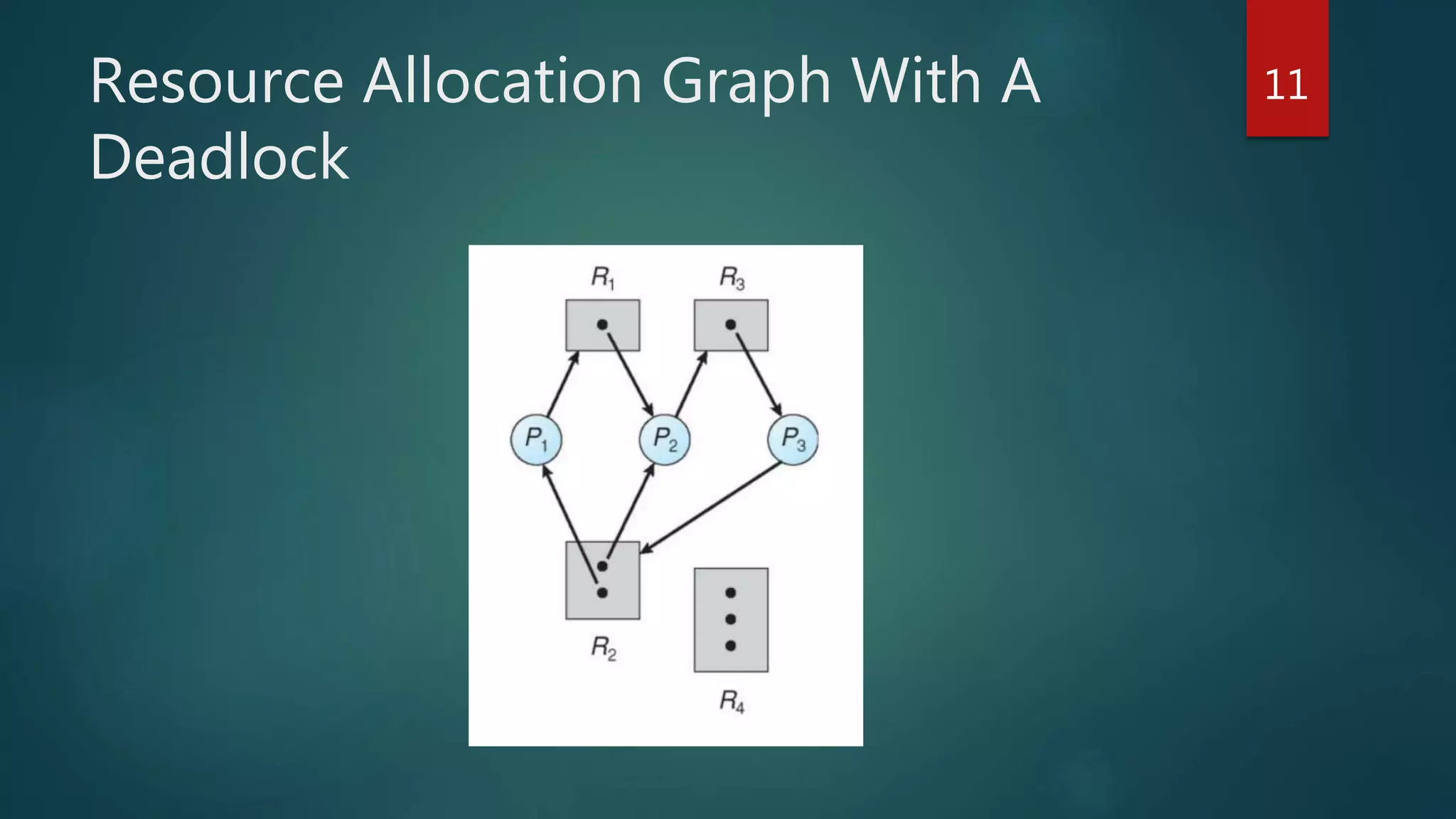
The conditionfor deadlock in a system using the AND condition is the
existence of a cycle.
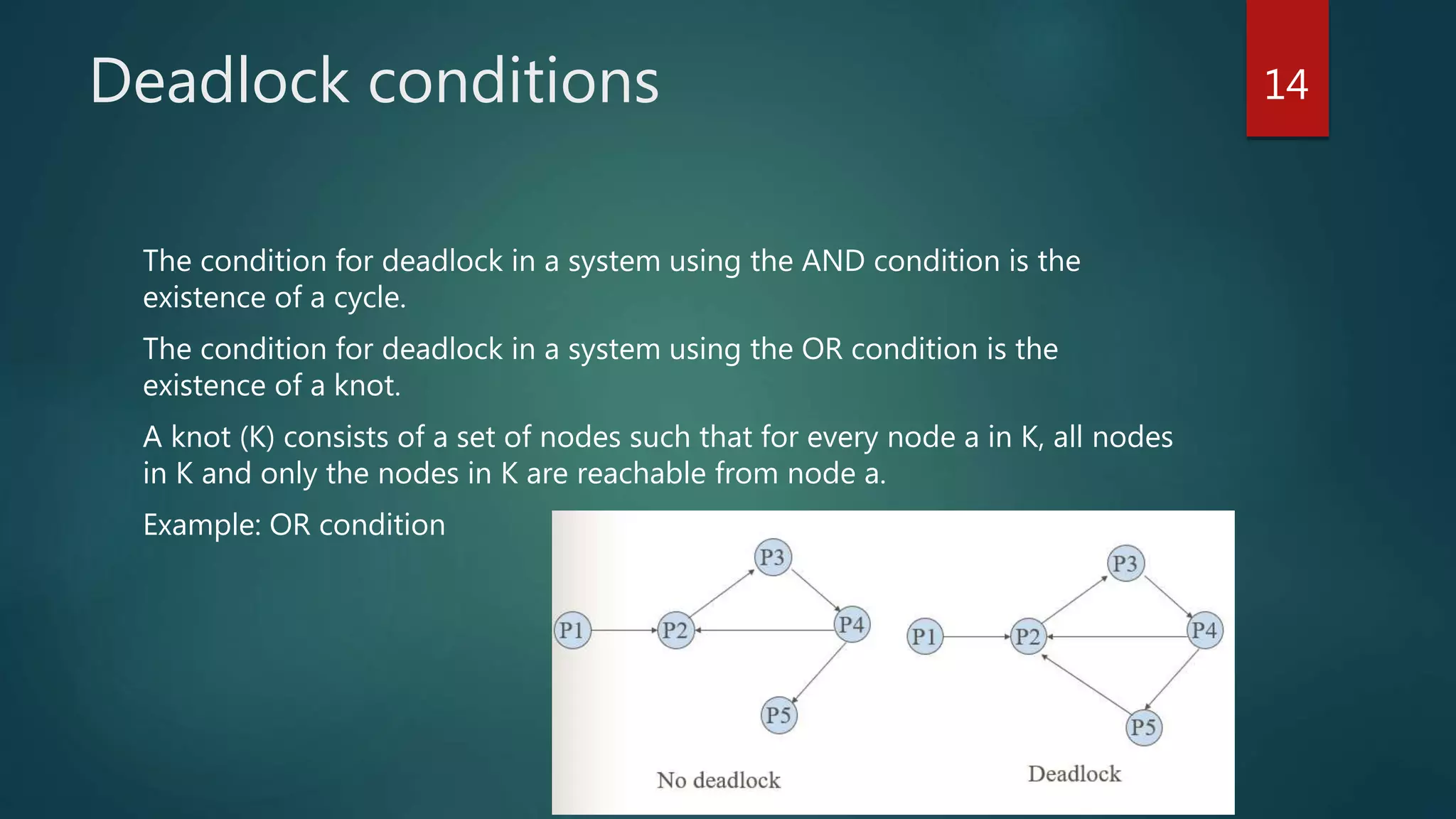
The condition for deadlock in a system using the OR condition is the
existence of a knot.
A knot (K) consists of a set of nodes such that for every node a in K, all nodes
in K and only the nodes in K are reachable from node a.
Example: OR condition
14
15.
Deadlock Prevention
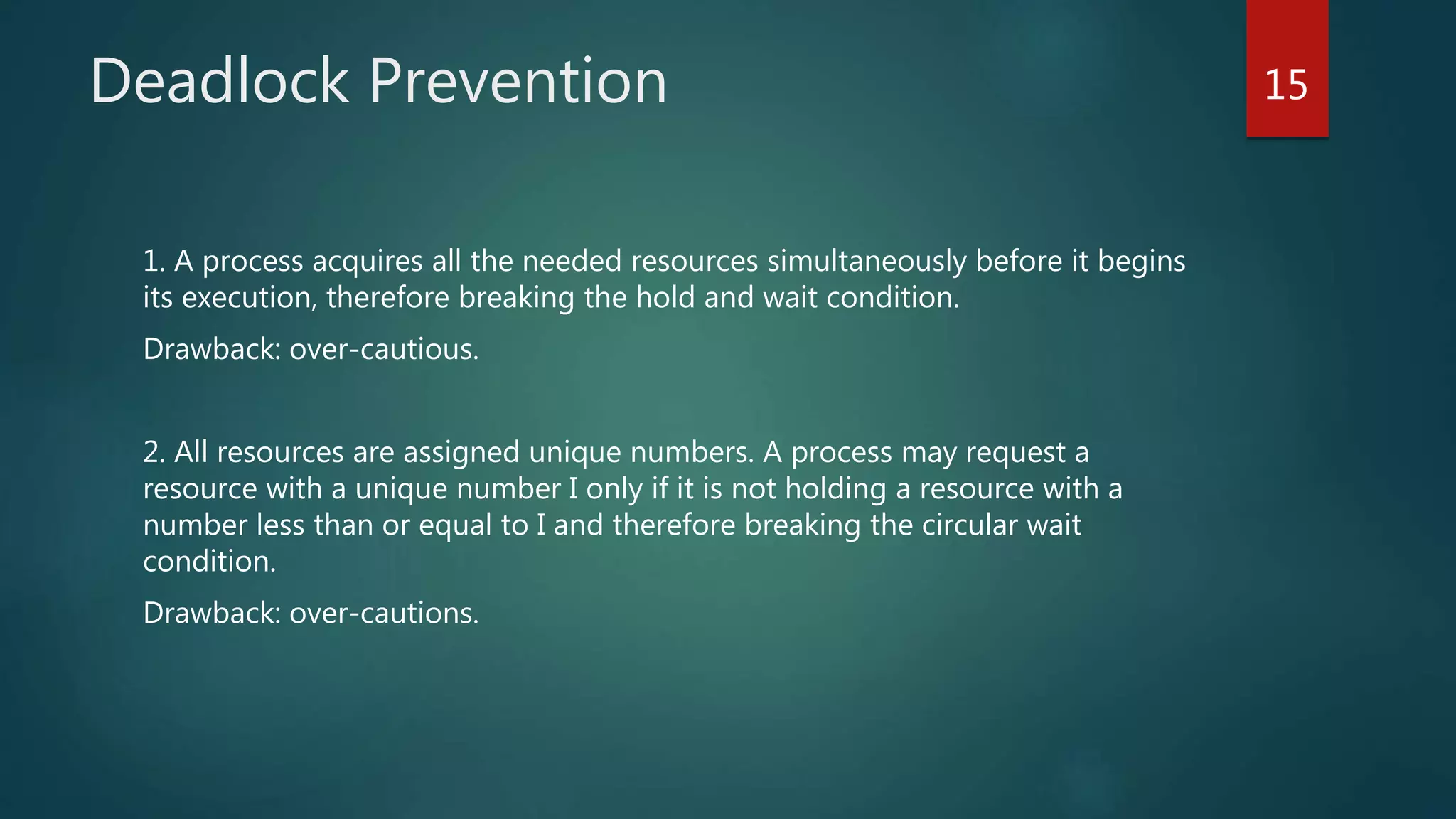
1. Aprocess acquires all the needed resources simultaneously before it begins
its execution, therefore breaking the hold and wait condition.
Drawback: over-cautious.
2. All resources are assigned unique numbers. A process may request a
resource with a unique number I only if it is not holding a resource with a
number less than or equal to I and therefore breaking the circular wait
condition.
Drawback: over-cautions.
15
16.
Deadlock Prevention (Cont…)
3.Each process is assigned a unique priority number. The priority numbers
decide whether process Pi should wait for process Pj and therefore break the
non-preemption condition.
Drawback: starvation. The lower priority one may always be rolled back.
Solution is to raise the priority every time it is victimized.
4. Practically it is impossible to provide a method to break the mutual
exclusion condition since most resources are intrinsically non-sharable,
16
17.
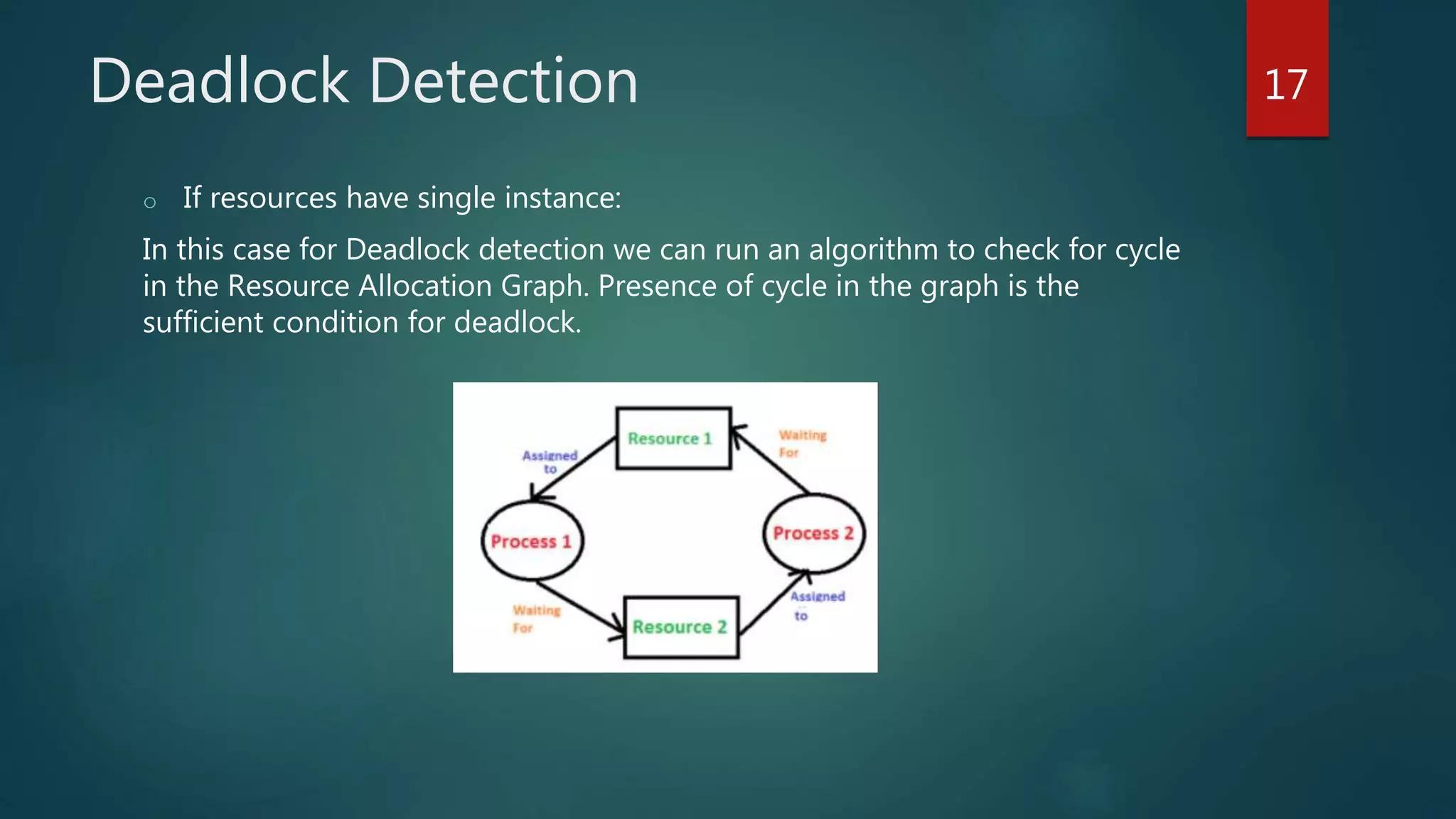
Deadlock Detection
o Ifresources have single instance:
In this case for Deadlock detection we can run an algorithm to check for cycle
in the Resource Allocation Graph. Presence of cycle in the graph is the
sufficient condition for deadlock.
17
18.
Deadlock Detection (Cont…)
oIf there are multiple instances of resources:
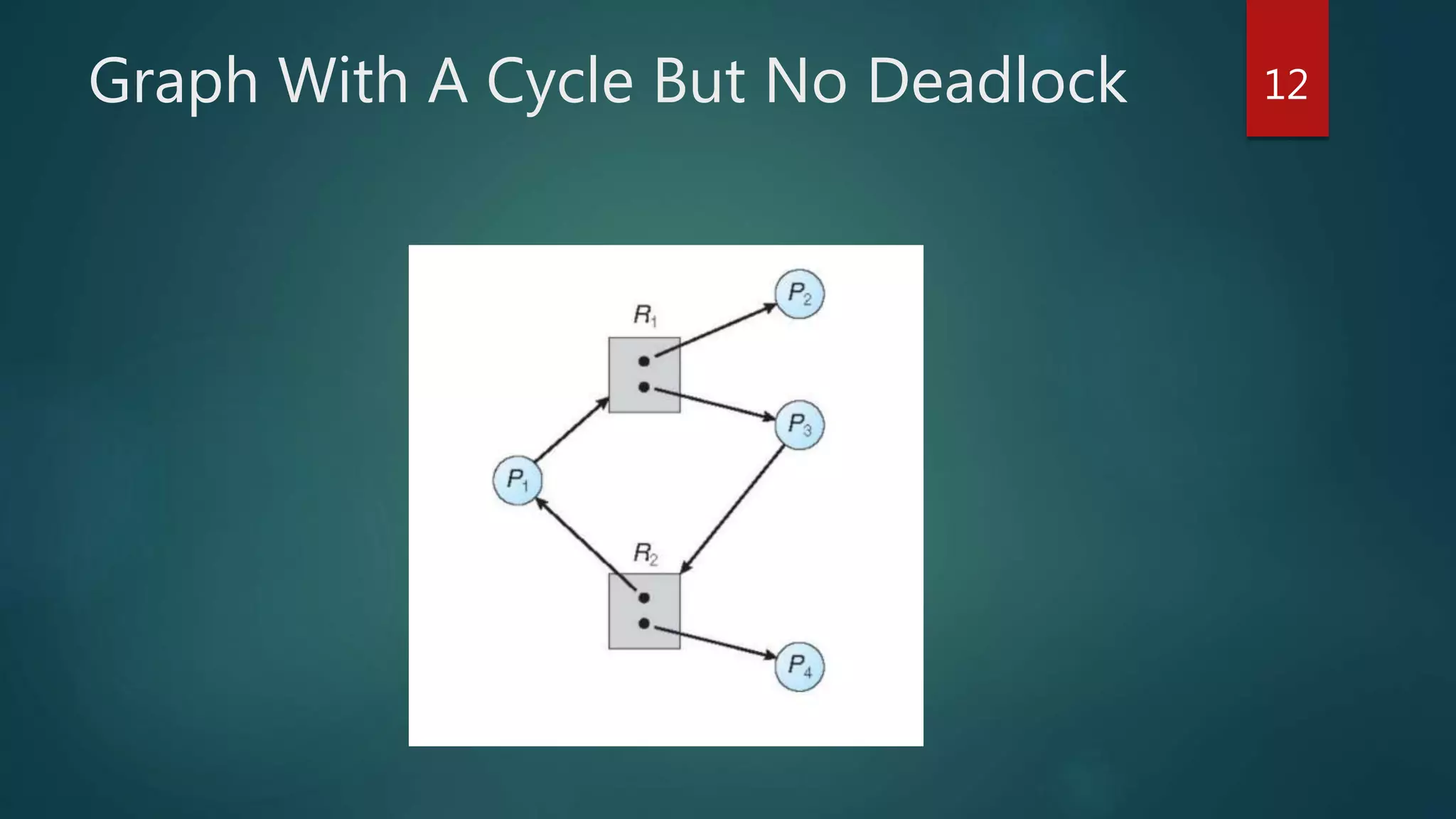
Detection of the cycle is necessary but not sufficient condition for
deadlock detection, in this case, the system may or may not be in deadlock
varies according to different situations.
18
19.
Deadlock Recovery
Recovery method>>
Killing the process: killing all the process involved in the deadlock. Killing
process one by one. After killing each process check for deadlock again keep
repeating the process till system recover from deadlock.
Resource Preemption: Resources are preempted from the processes involved
in the deadlock, preempted resources are allocated to other processes so that
there is a possibility of recovering the system from deadlock. In this case, the
system goes into starvation.
19