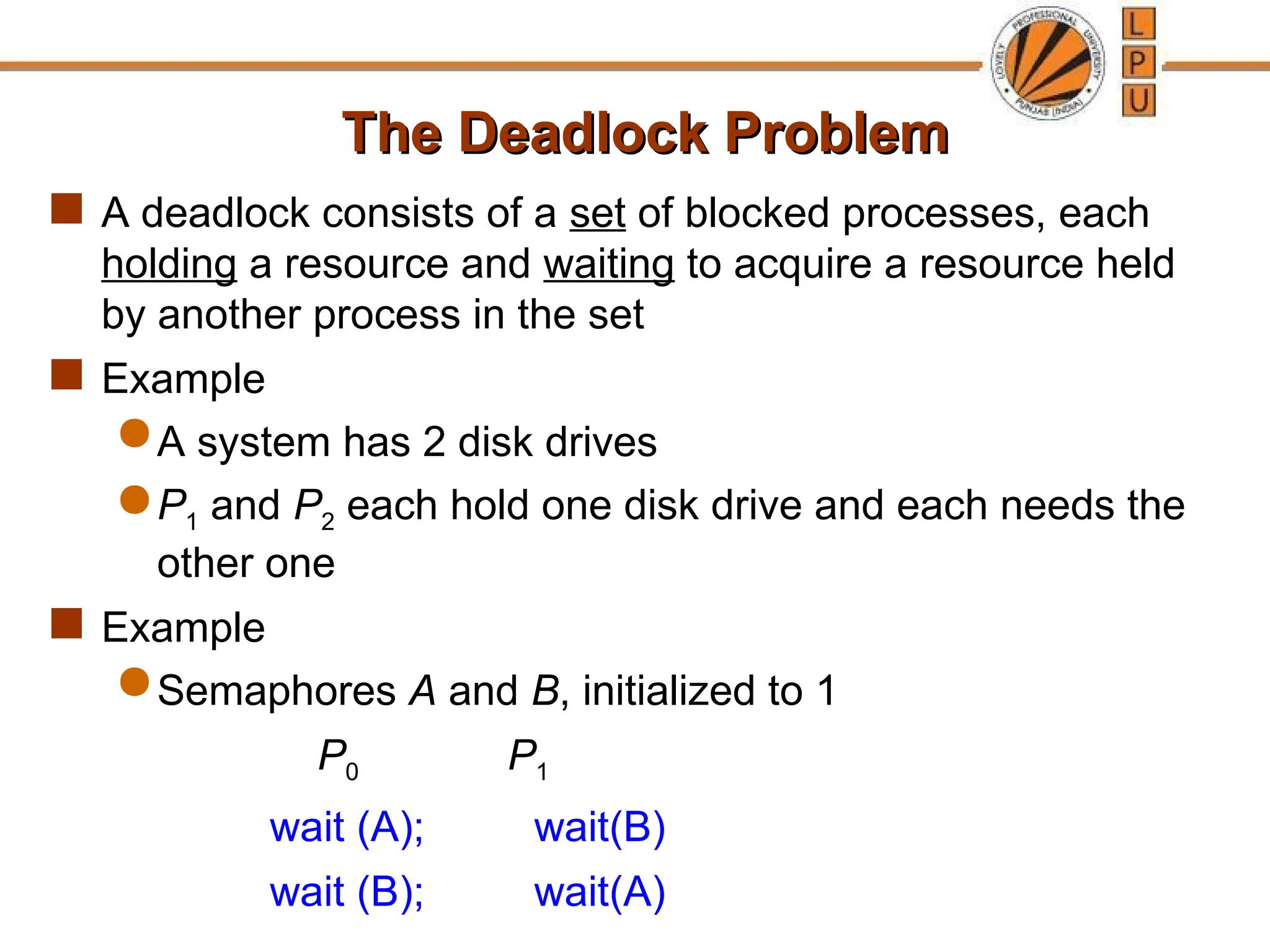
The Deadlock Problem
TheDeadlock Problem
A deadlock consists of a set of blocked processes, each
holding a resource and waiting to acquire a resource held
by another process in the set
Example
A system has 2 disk drives
P1 and P2 each hold one disk drive and each needs the
other one
Example
Semaphores A and B, initialized to 1
P0 P1
wait (A); wait(B)
wait (B); wait(A)
3.
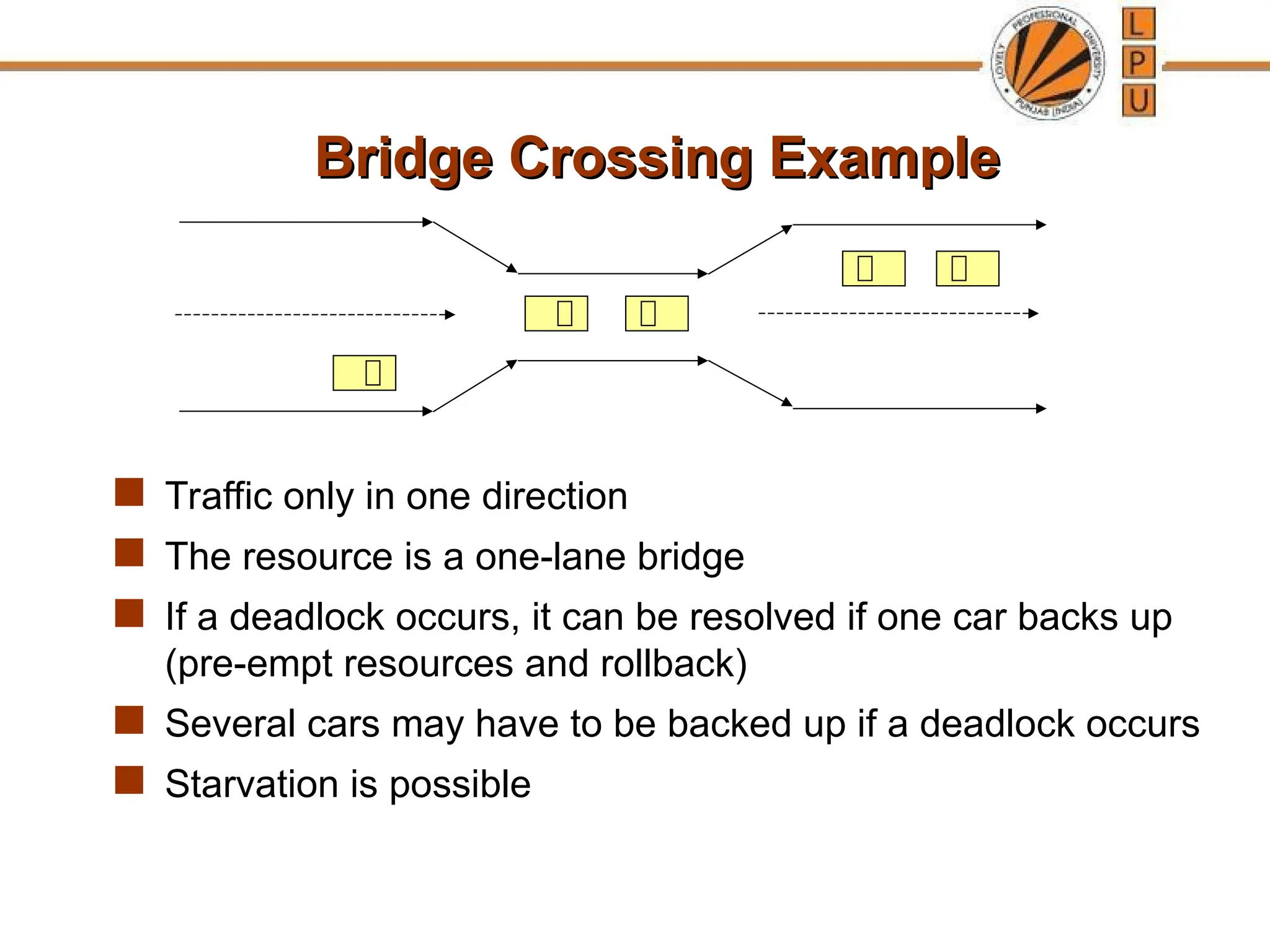
Bridge Crossing Example
BridgeCrossing Example
Traffic only in one direction
The resource is a one-lane bridge
If a deadlock occurs, it can be resolved if one car backs up
(pre-empt resources and rollback)
Several cars may have to be backed up if a deadlock occurs
Starvation is possible
4.
System Model
System Model
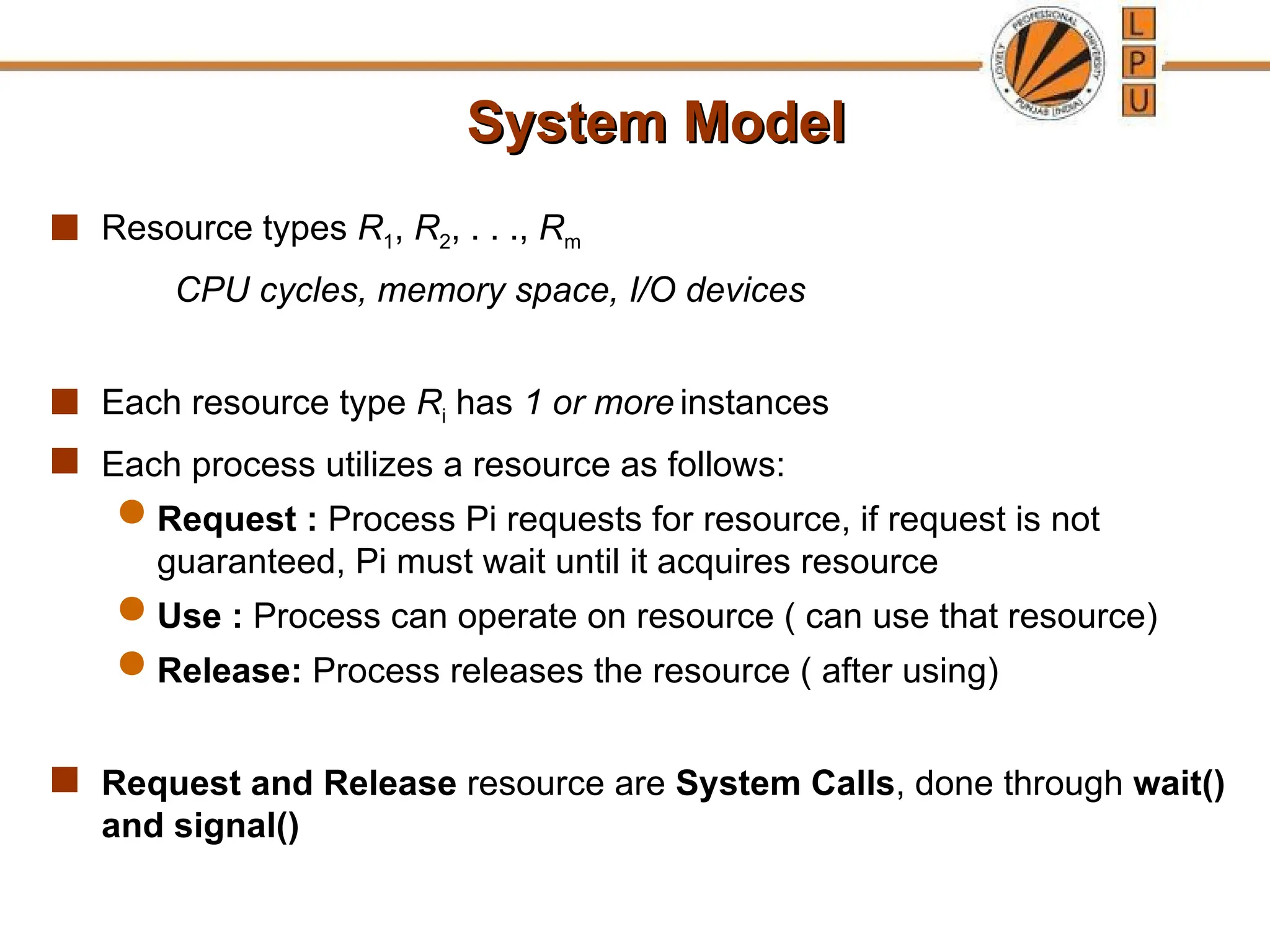
Resource types R1, R2, . . ., Rm
CPU cycles, memory space, I/O devices
Each resource type Ri has 1 or more instances
Each process utilizes a resource as follows:
Request : Process Pi requests for resource, if request is not
guaranteed, Pi must wait until it acquires resource
Use : Process can operate on resource ( can use that resource)
Release: Process releases the resource ( after using)
Request and Release resource are System Calls, done through wait()
and signal()
5.
Deadlock Characterization
Deadlock Characterization
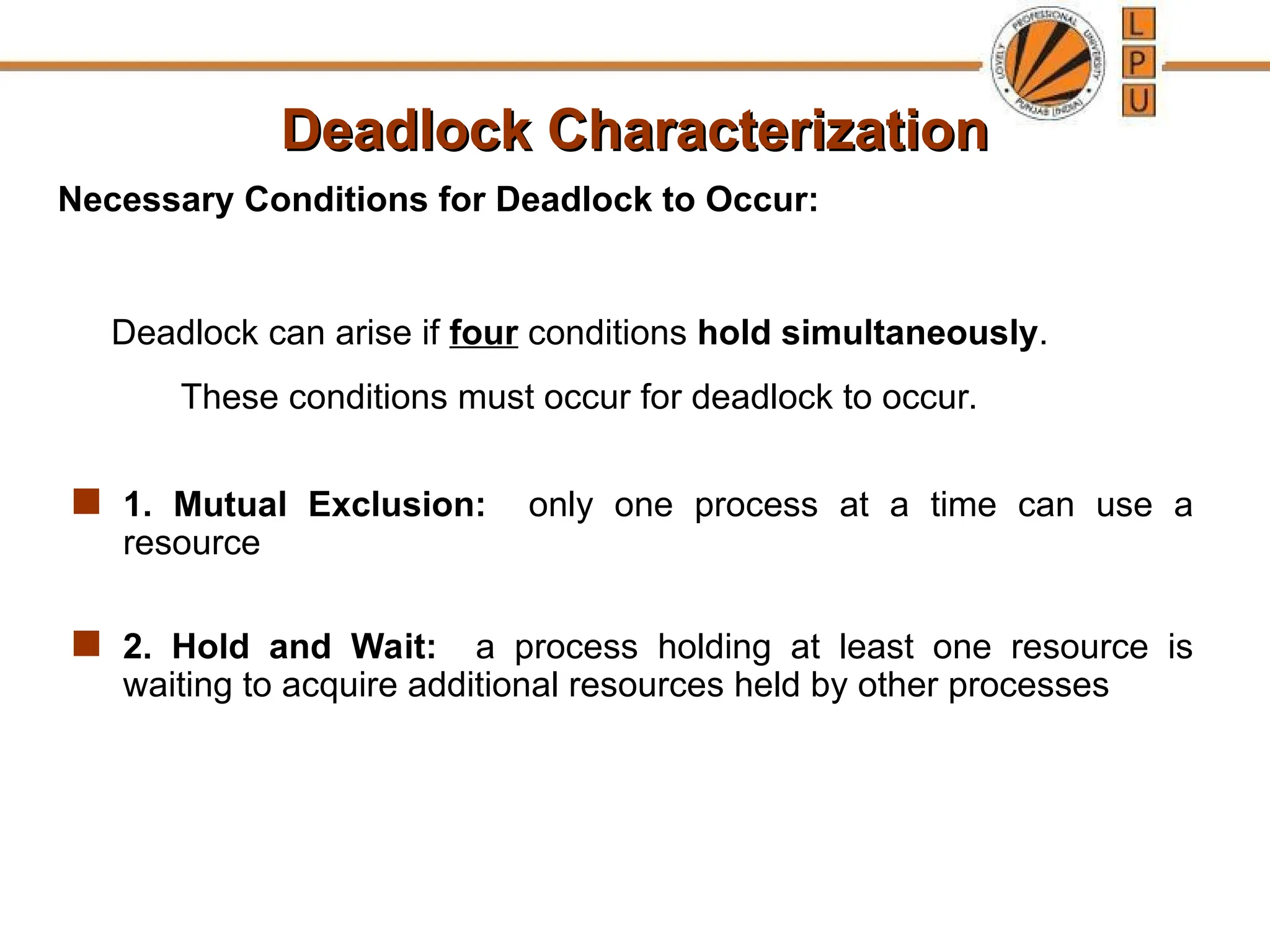
1. Mutual Exclusion: only one process at a time can use a
resource
2. Hold and Wait: a process holding at least one resource is
waiting to acquire additional resources held by other processes
Necessary Conditions for Deadlock to Occur:
Deadlock can arise if four conditions hold simultaneously.
These conditions must occur for deadlock to occur.
6.
Deadlock Characterization
Deadlock Characterization
3. No Pre-emption: a resource can be released only voluntarily by
the process holding it after that process has completed its task,
resources can’t be pre-empted
4. Circular Wait: There exists a set {P0, P1, …, P0} of waiting
processes such that P0 is waiting for a resource that is held by P1, P1
is waiting for a resource that is held by P2, …, Pn–1 is waiting for a
resource that is held by
Pn, and Pn is waiting for a resource that is held by P0.
Necessary Conditions for Deadlock to Occur:
Deadlock can arise if four conditions hold simultaneously.
7.
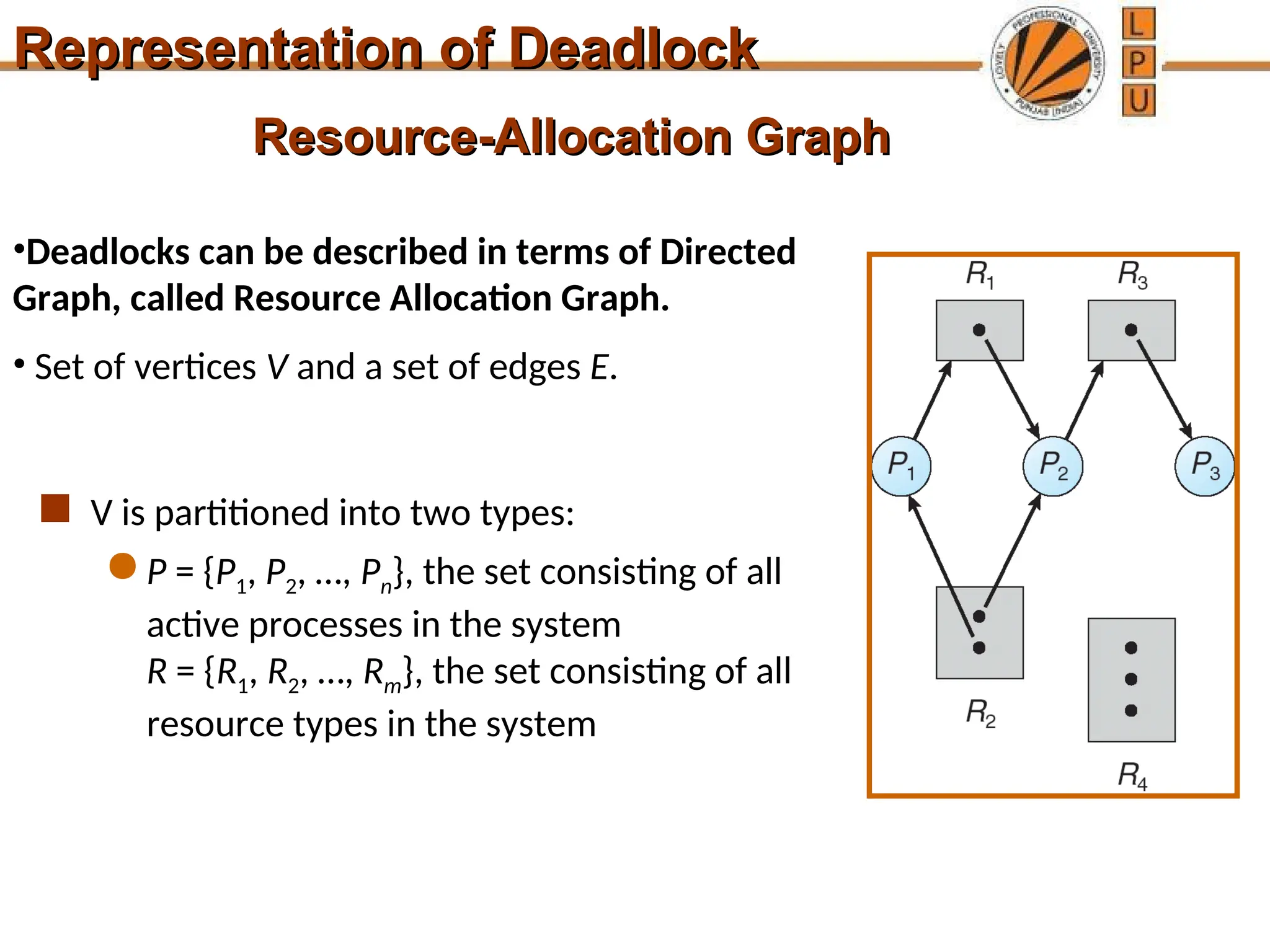
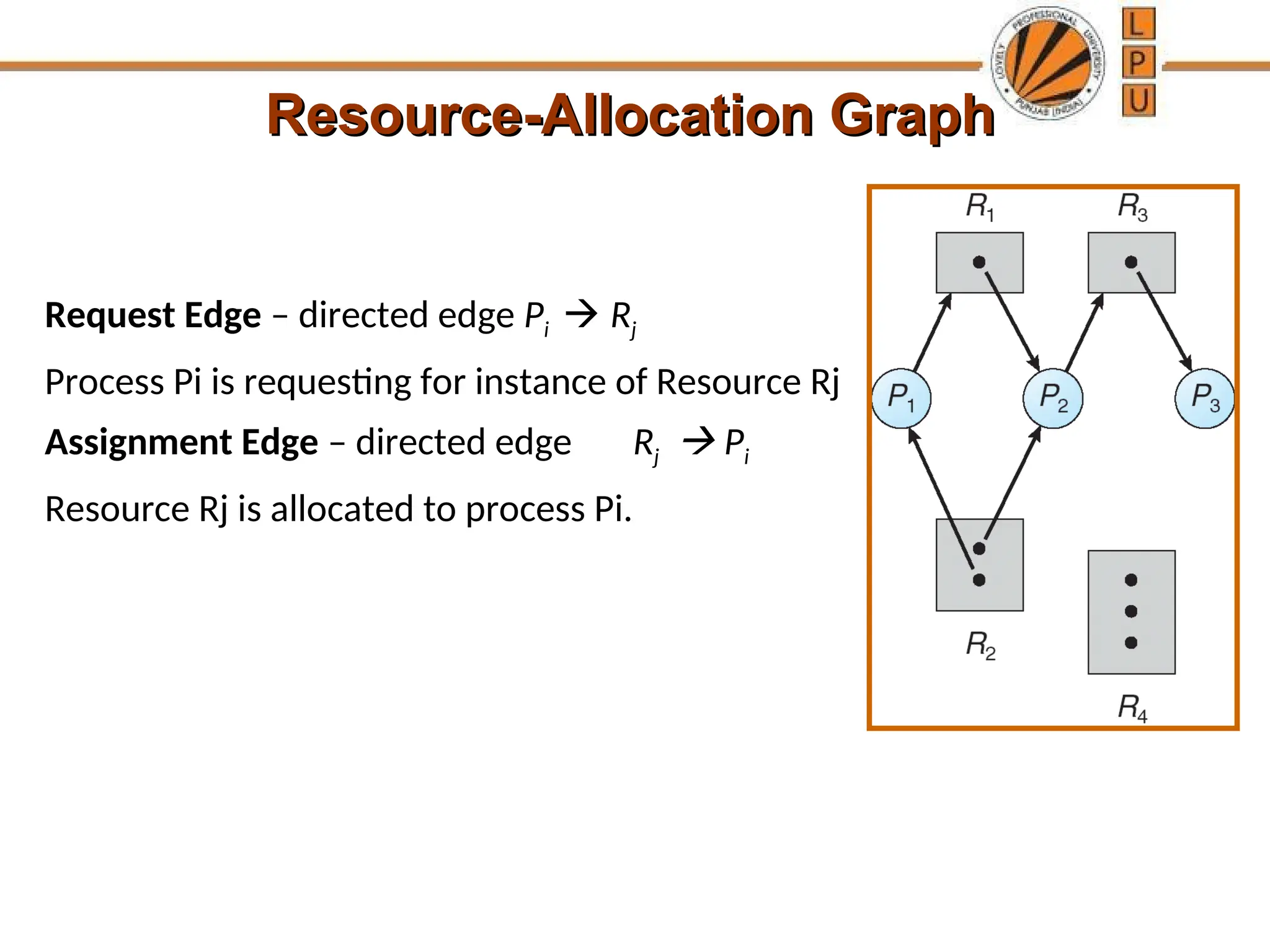
Resource-Allocation Graph
Resource-Allocation Graph
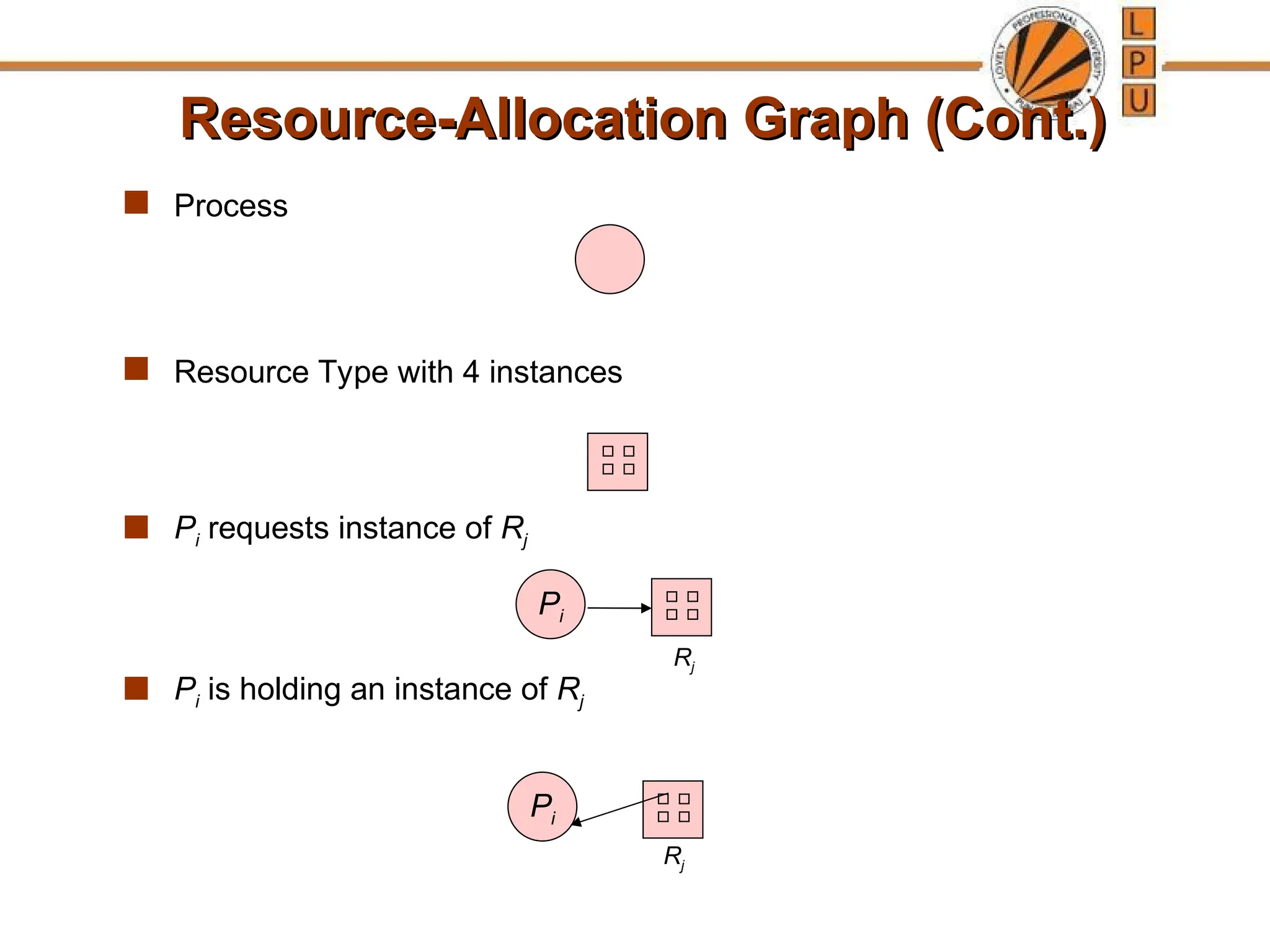
V is partitioned into two types:
P = {P1, P2, …, Pn}, the set consisting of all
active processes in the system
R = {R1, R2, …, Rm}, the set consisting of all
resource types in the system
•Deadlocks can be described in terms of Directed
Graph, called Resource Allocation Graph.
• Set of vertices V and a set of edges E.
Representation of Deadlock
Representation of Deadlock
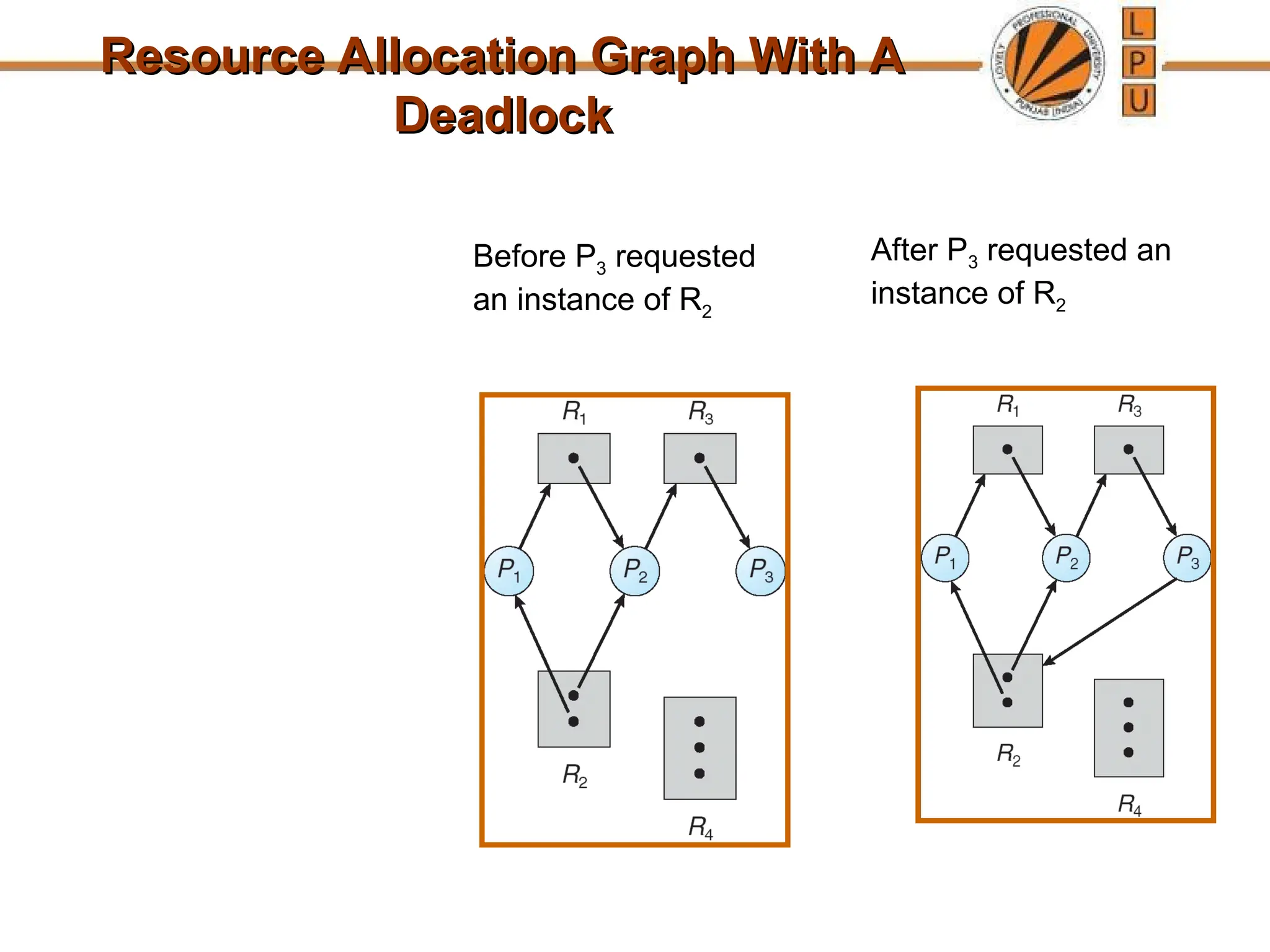
Resource Allocation GraphWith A
Resource Allocation Graph With A
Deadlock
Deadlock
Before P3 requested
an instance of R2
After P3 requested an
instance of R2
11.
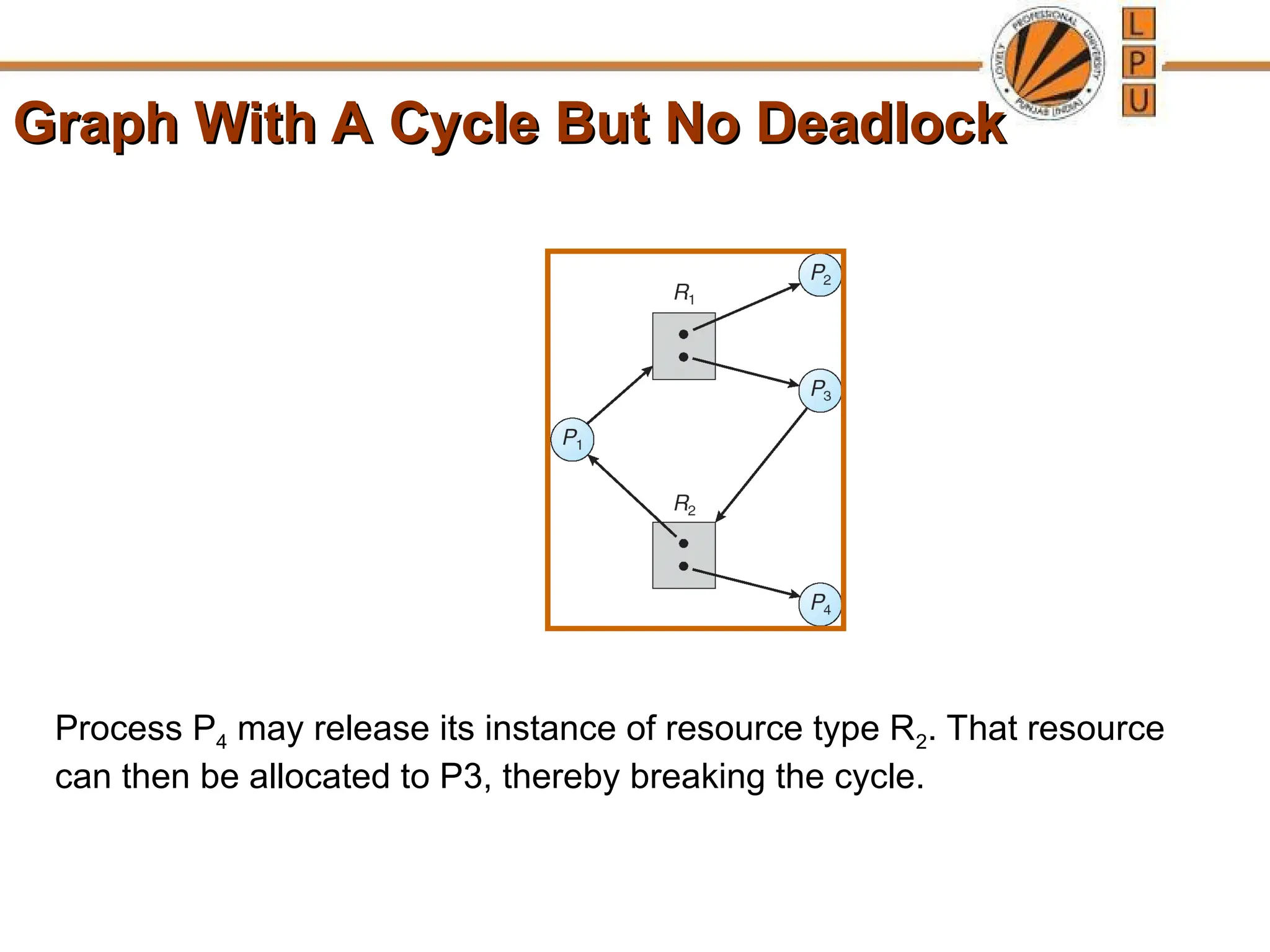
Graph With ACycle But No Deadlock
Graph With A Cycle But No Deadlock
Process P4 may release its instance of resource type R2. That resource
can then be allocated to P3, thereby breaking the cycle.
12.
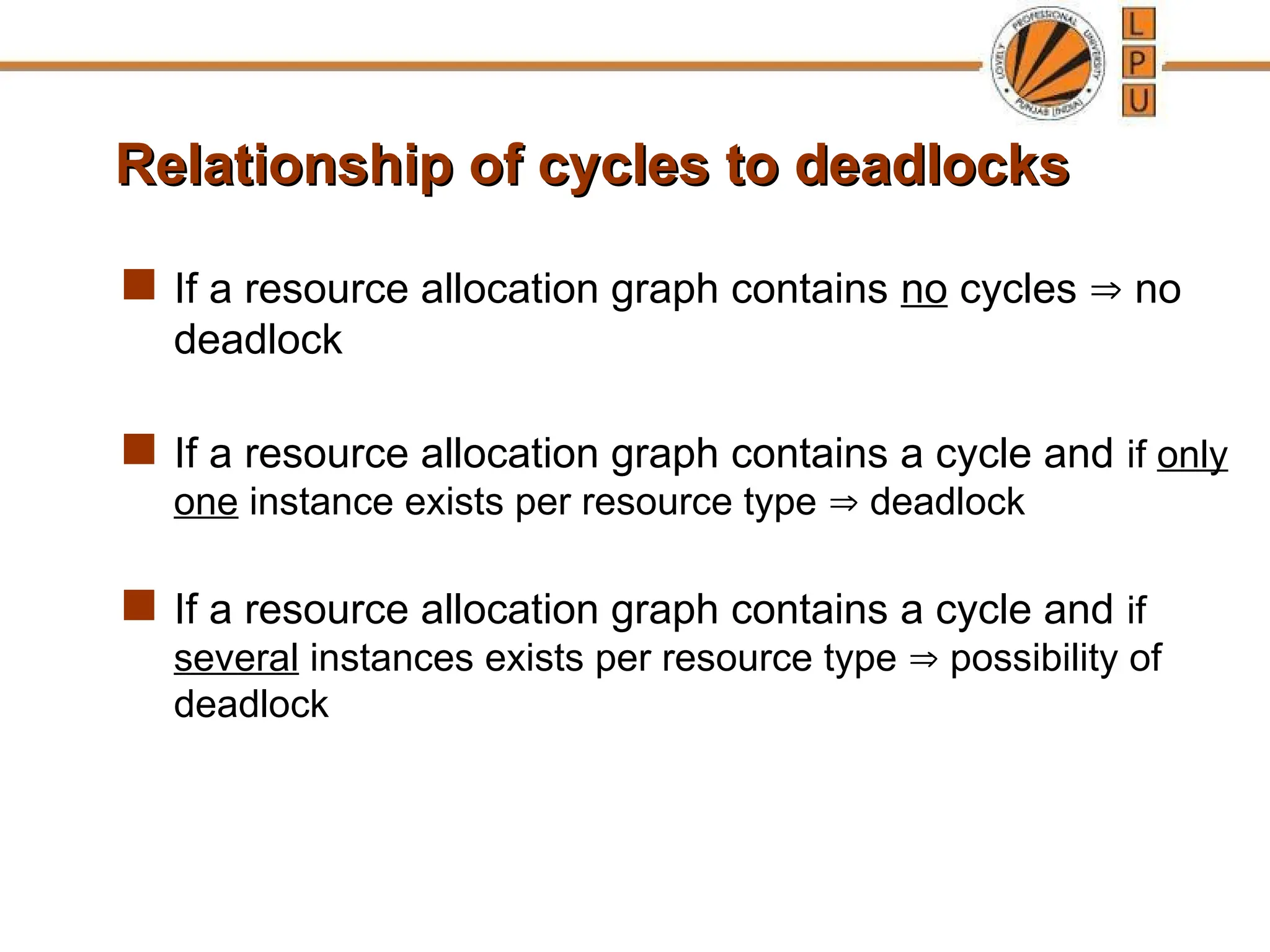
Relationship of cyclesto deadlocks
Relationship of cycles to deadlocks
If a resource allocation graph contains no cycles no
deadlock
If a resource allocation graph contains a cycle and if only
one instance exists per resource type deadlock
If a resource allocation graph contains a cycle and if
several instances exists per resource type possibility of
deadlock
13.
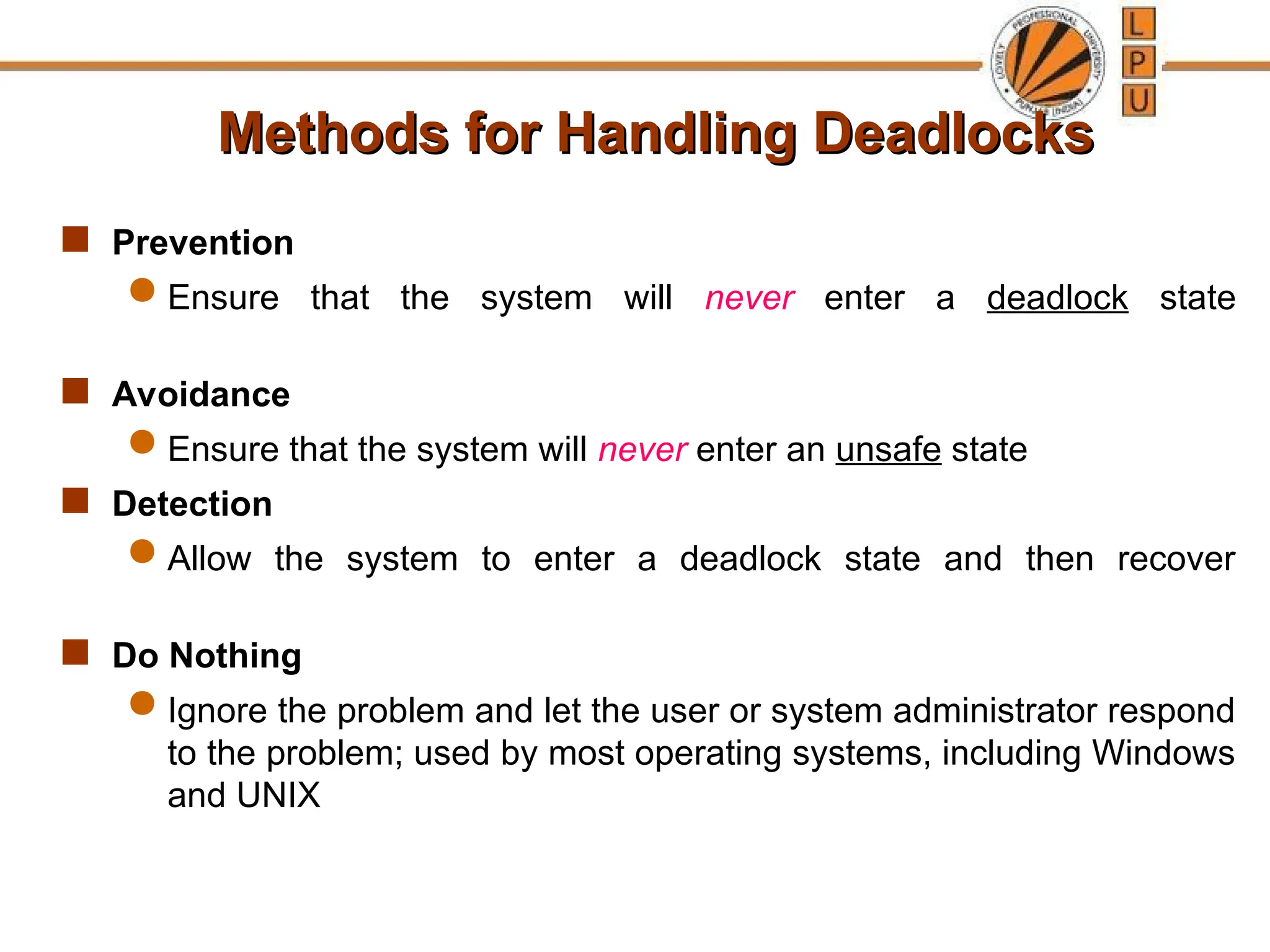
Methods for HandlingDeadlocks
Methods for Handling Deadlocks
Prevention
Ensure that the system will never enter a deadlock state
Avoidance
Ensure that the system will never enter an unsafe state
Detection
Allow the system to enter a deadlock state and then recover
Do Nothing
Ignore the problem and let the user or system administrator respond
to the problem; used by most operating systems, including Windows
and UNIX
14.
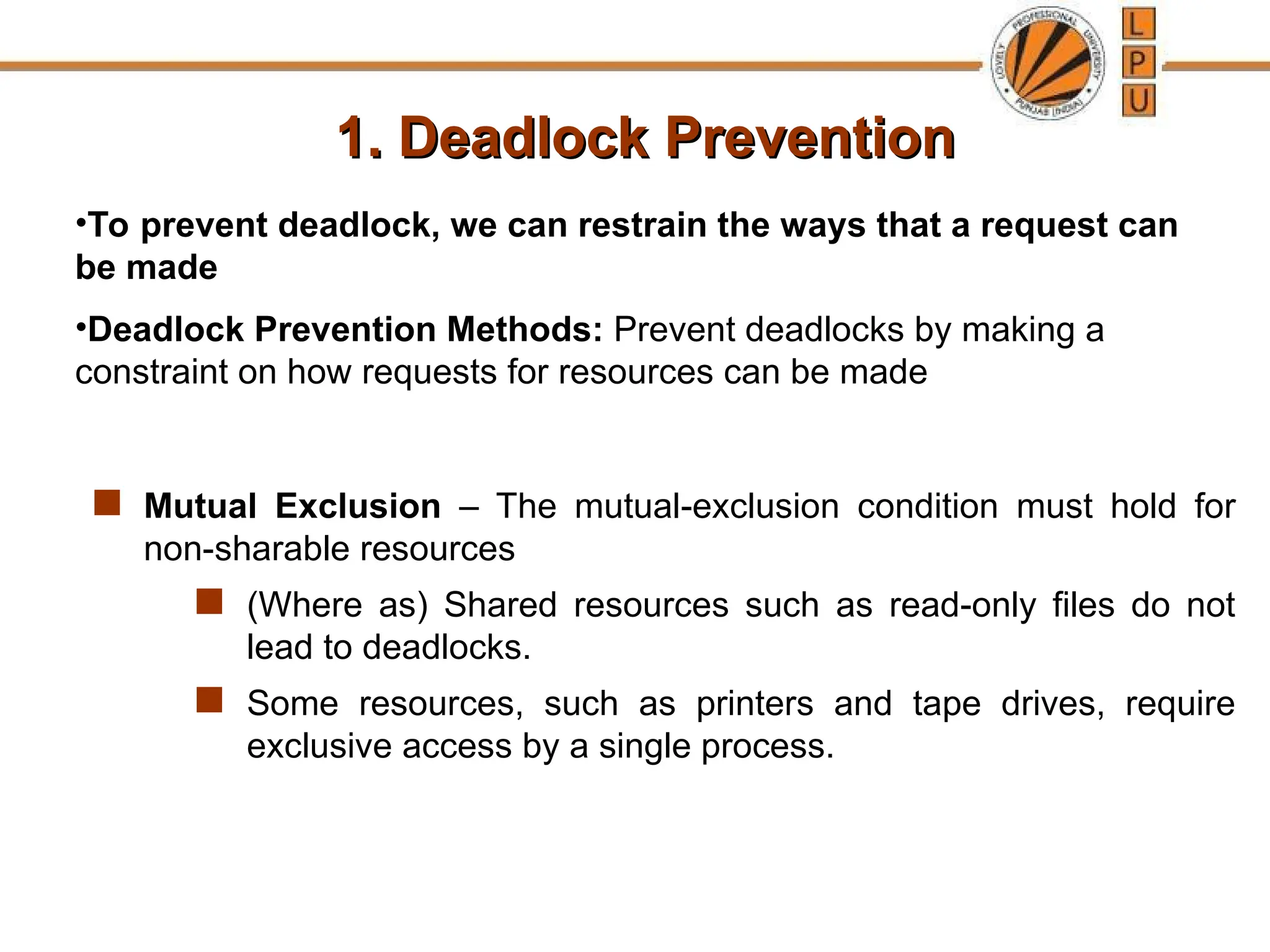
1. Deadlock Prevention
1.Deadlock Prevention
Mutual Exclusion – The mutual-exclusion condition must hold for
non-sharable resources
(Where as) Shared resources such as read-only files do not
lead to deadlocks.
Some resources, such as printers and tape drives, require
exclusive access by a single process.
•To prevent deadlock, we can restrain the ways that a request can
be made
•Deadlock Prevention Methods: Prevent deadlocks by making a
constraint on how requests for resources can be made
15.
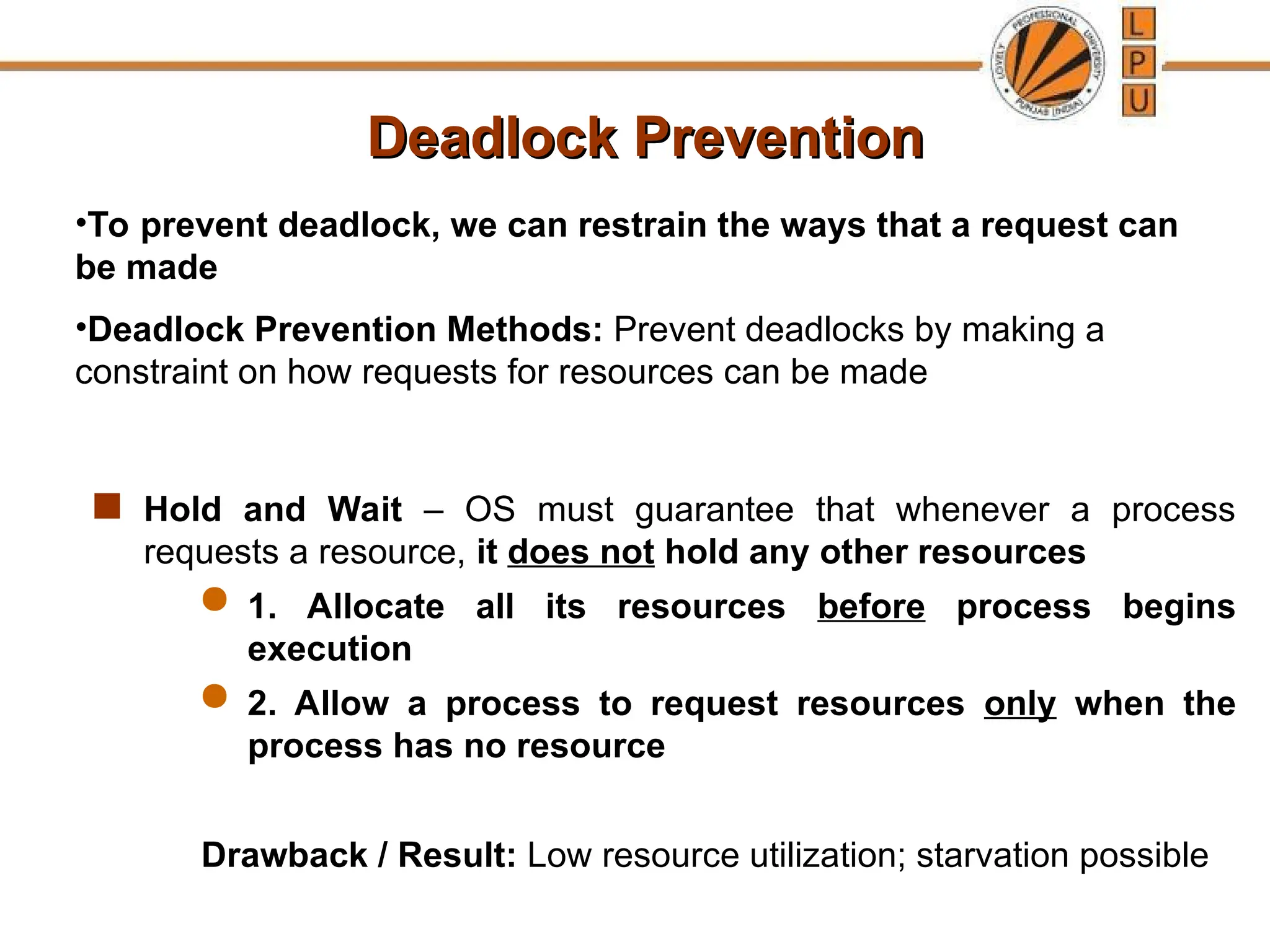
Deadlock Prevention
Deadlock Prevention
Hold and Wait – OS must guarantee that whenever a process
requests a resource, it does not hold any other resources
1. Allocate all its resources before process begins
execution
2. Allow a process to request resources only when the
process has no resource
Drawback / Result: Low resource utilization; starvation possible
•To prevent deadlock, we can restrain the ways that a request can
be made
•Deadlock Prevention Methods: Prevent deadlocks by making a
constraint on how requests for resources can be made
16.
Deadlock Prevention (Cont.)
DeadlockPrevention (Cont.)
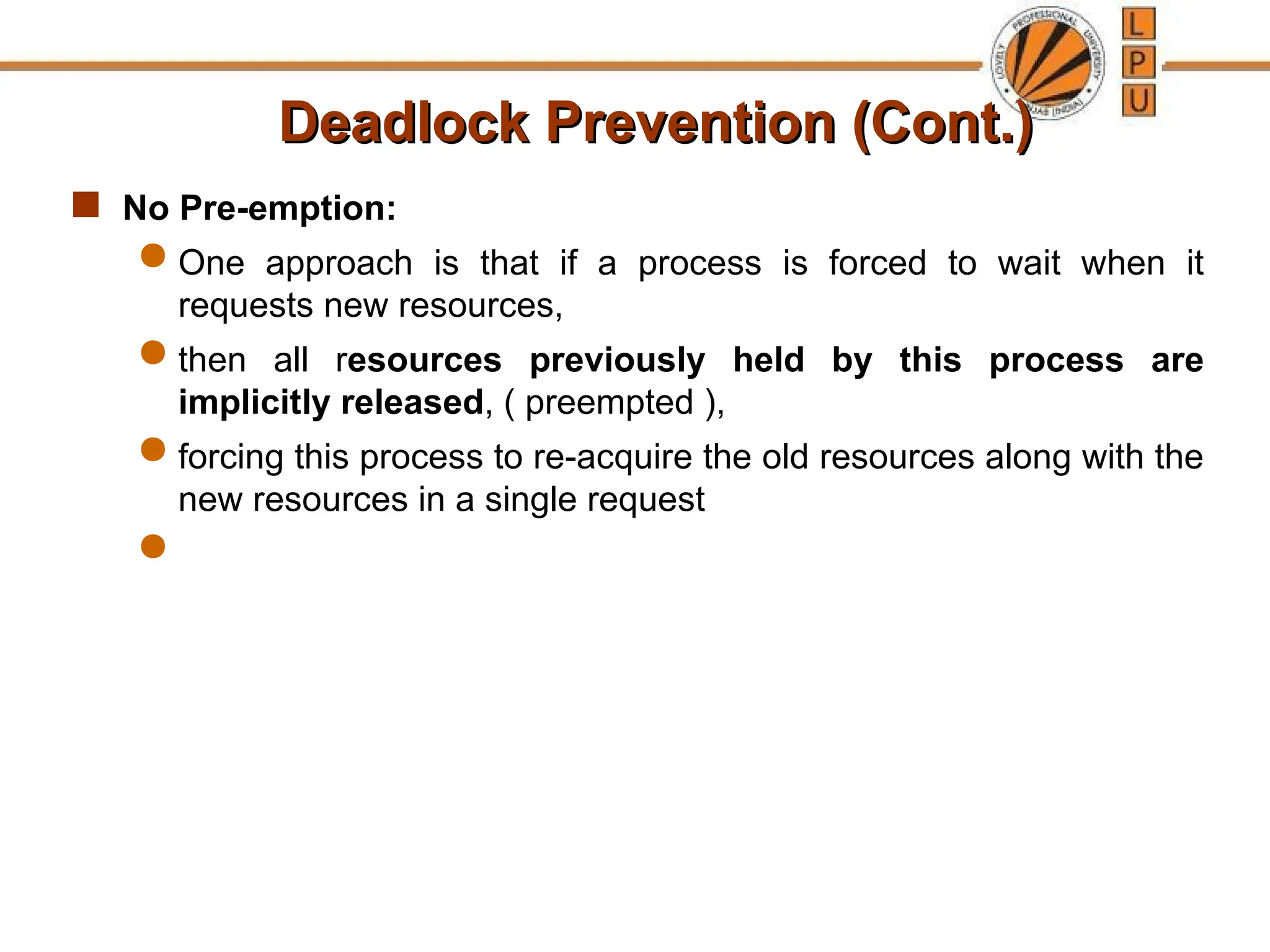
No Pre-emption:
One approach is that if a process is forced to wait when it
requests new resources,
then all resources previously held by this process are
implicitly released, ( preempted ),
forcing this process to re-acquire the old resources along with the
new resources in a single request
17.
Deadlock Prevention (Cont.)
DeadlockPrevention (Cont.)
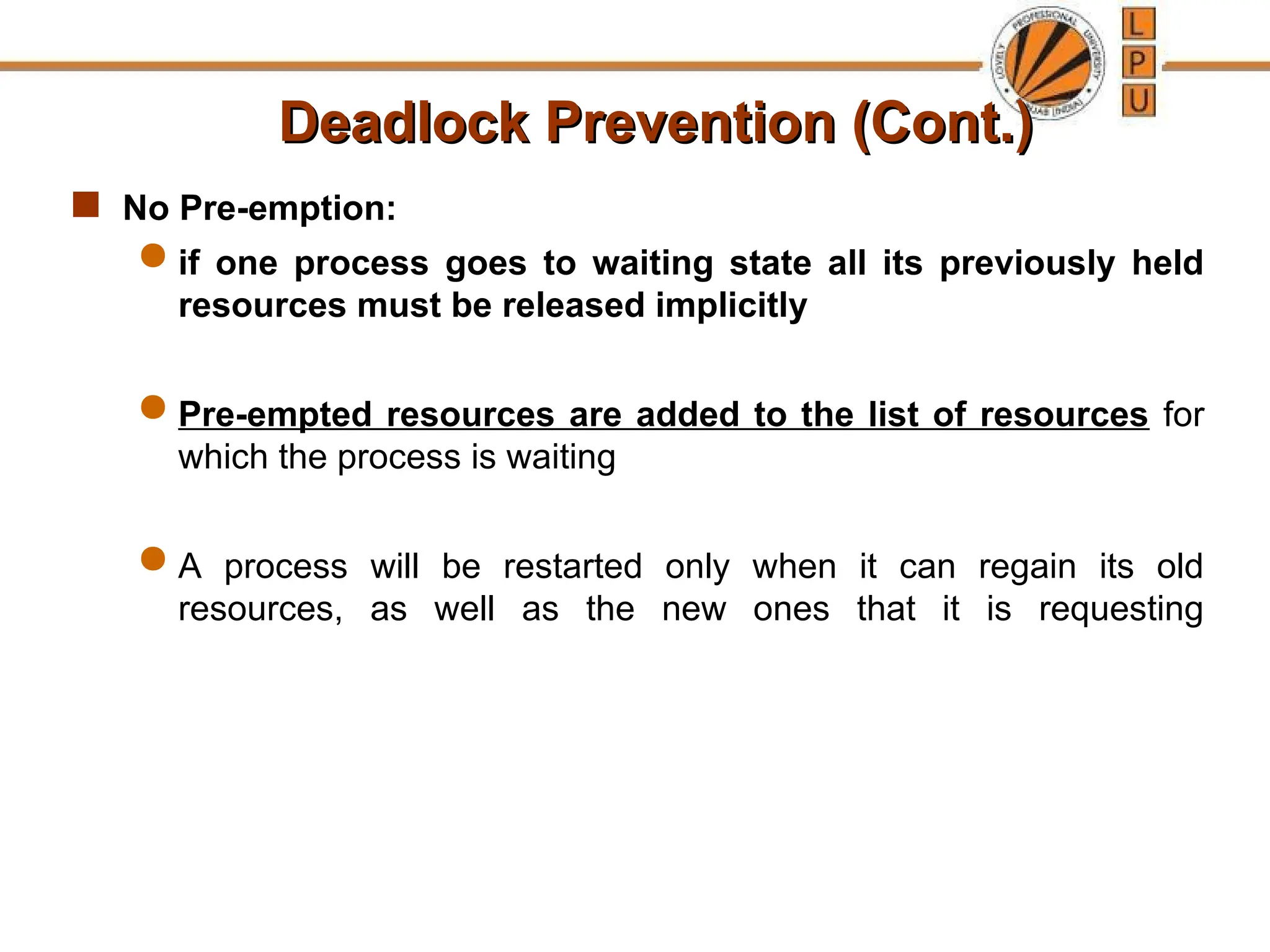
No Pre-emption:
if one process goes to waiting state all its previously held
resources must be released implicitly
Pre-empted resources are added to the list of resources for
which the process is waiting
A process will be restarted only when it can regain its old
resources, as well as the new ones that it is requesting
18.
Deadlock Prevention (Cont.)
DeadlockPrevention (Cont.)
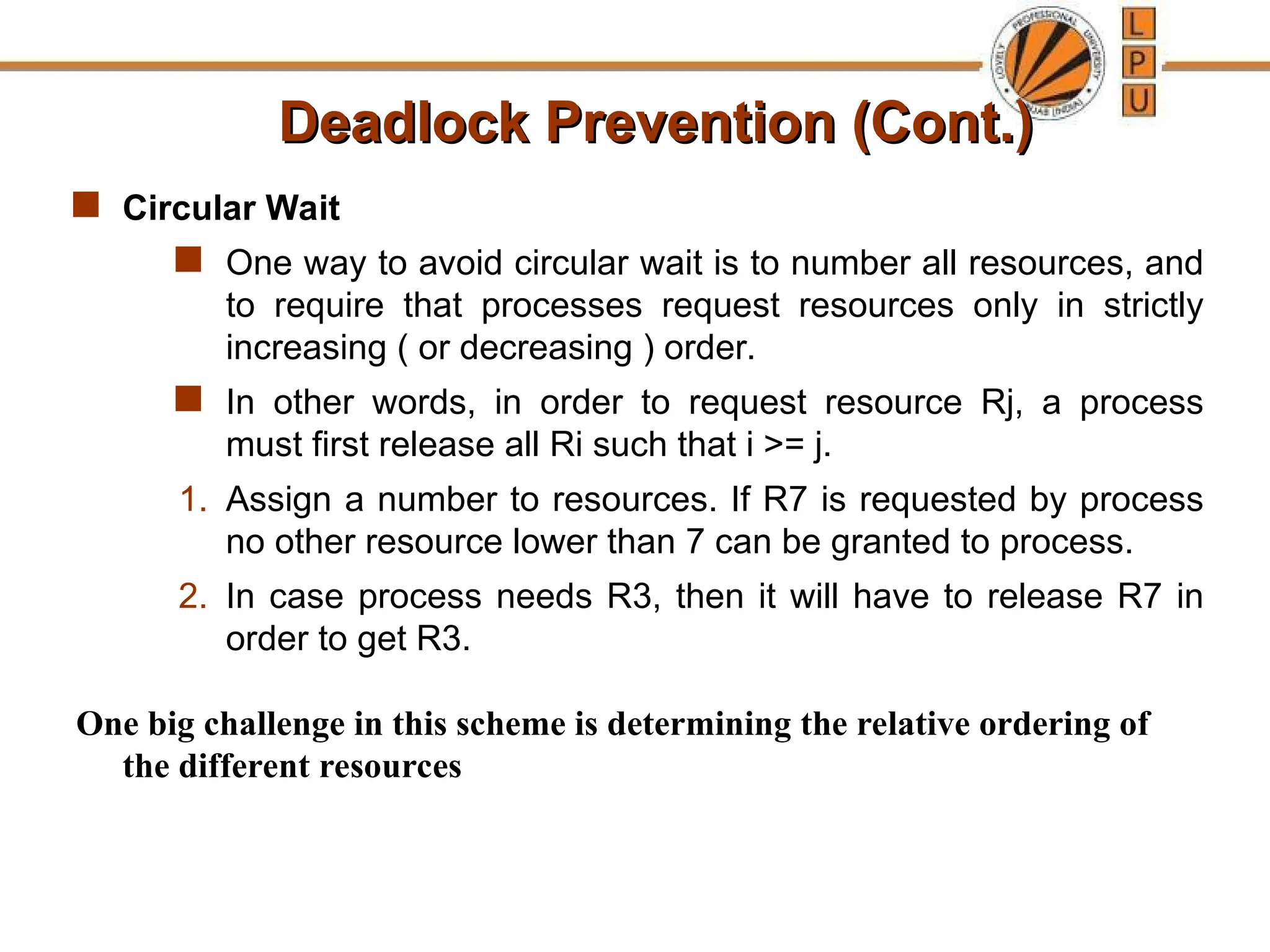
Circular Wait
One way to avoid circular wait is to number all resources, and
to require that processes request resources only in strictly
increasing ( or decreasing ) order.
In other words, in order to request resource Rj, a process
must first release all Ri such that i >= j.
1. Assign a number to resources. If R7 is requested by process
no other resource lower than 7 can be granted to process.
2. In case process needs R3, then it will have to release R7 in
order to get R3.
One big challenge in this scheme is determining the relative ordering of
the different resources
19.
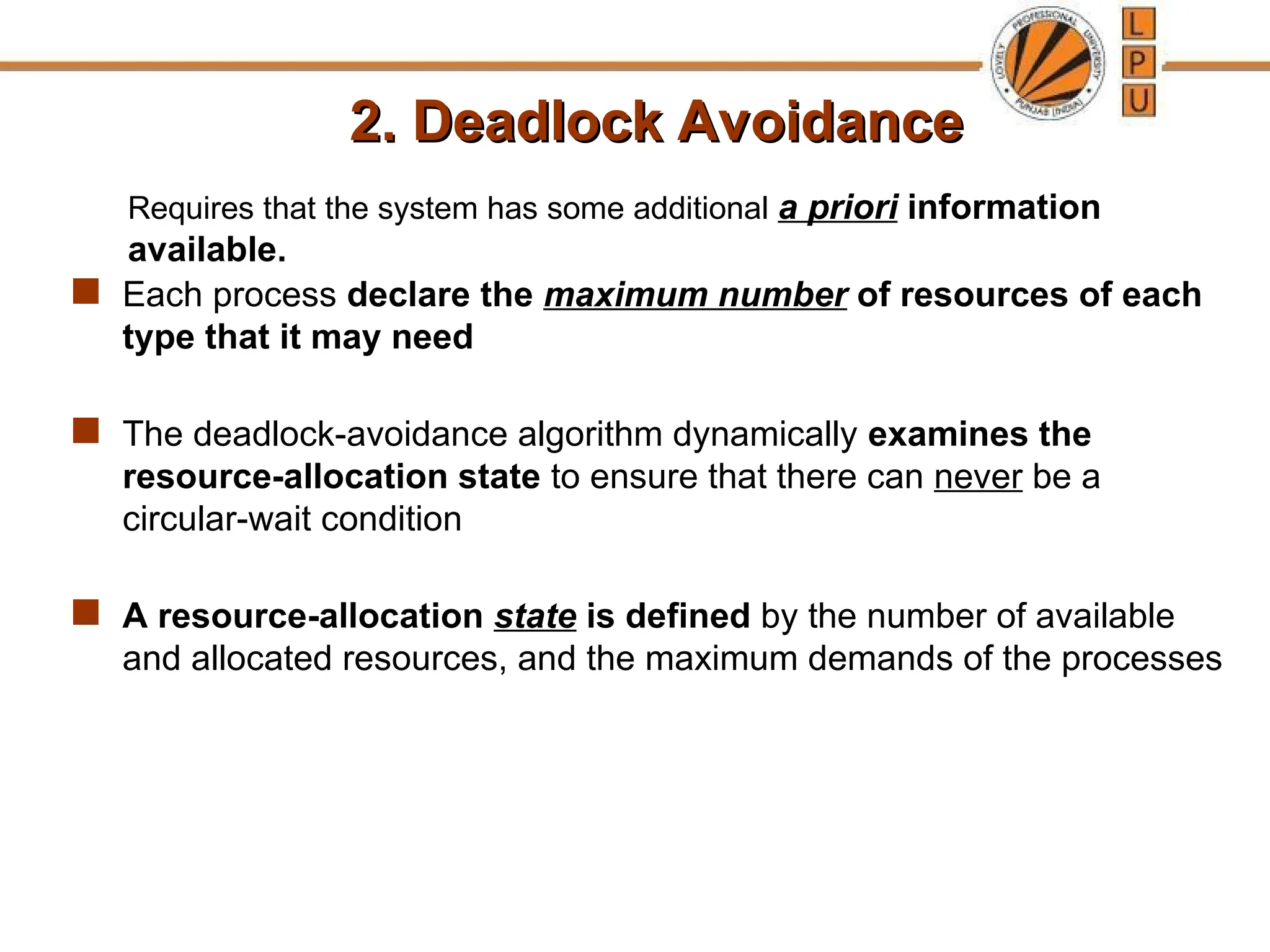
2. Deadlock Avoidance
2.Deadlock Avoidance
Each process declare the maximum number of resources of each
type that it may need
The deadlock-avoidance algorithm dynamically examines the
resource-allocation state to ensure that there can never be a
circular-wait condition
A resource-allocation state is defined by the number of available
and allocated resources, and the maximum demands of the processes
Requires that the system has some additional a priori information
available.
20.
State and SafeState
State: State of system represents currently allocated resources to the
process. (data held by process at sometime)
Safe State: If the system can allocate available resources to the
process in some order to avoid deadlock.
Unsafe State:
OS can not prevent processes from requesting the resources
Allocating the resources, which may leads to deadlock.
21.
Safe State
Asystem is in a safe state only if there exists a safe sequence
if resources are allocated to the process in that sequence deadlock
doesnot occur.
A sequence of processes <P1, P2, …, Pn> is a safe sequence,
If request made by process can be satisfied with the available resources
+ already held resources
22.
Safe State (continued)
SafeState (continued)
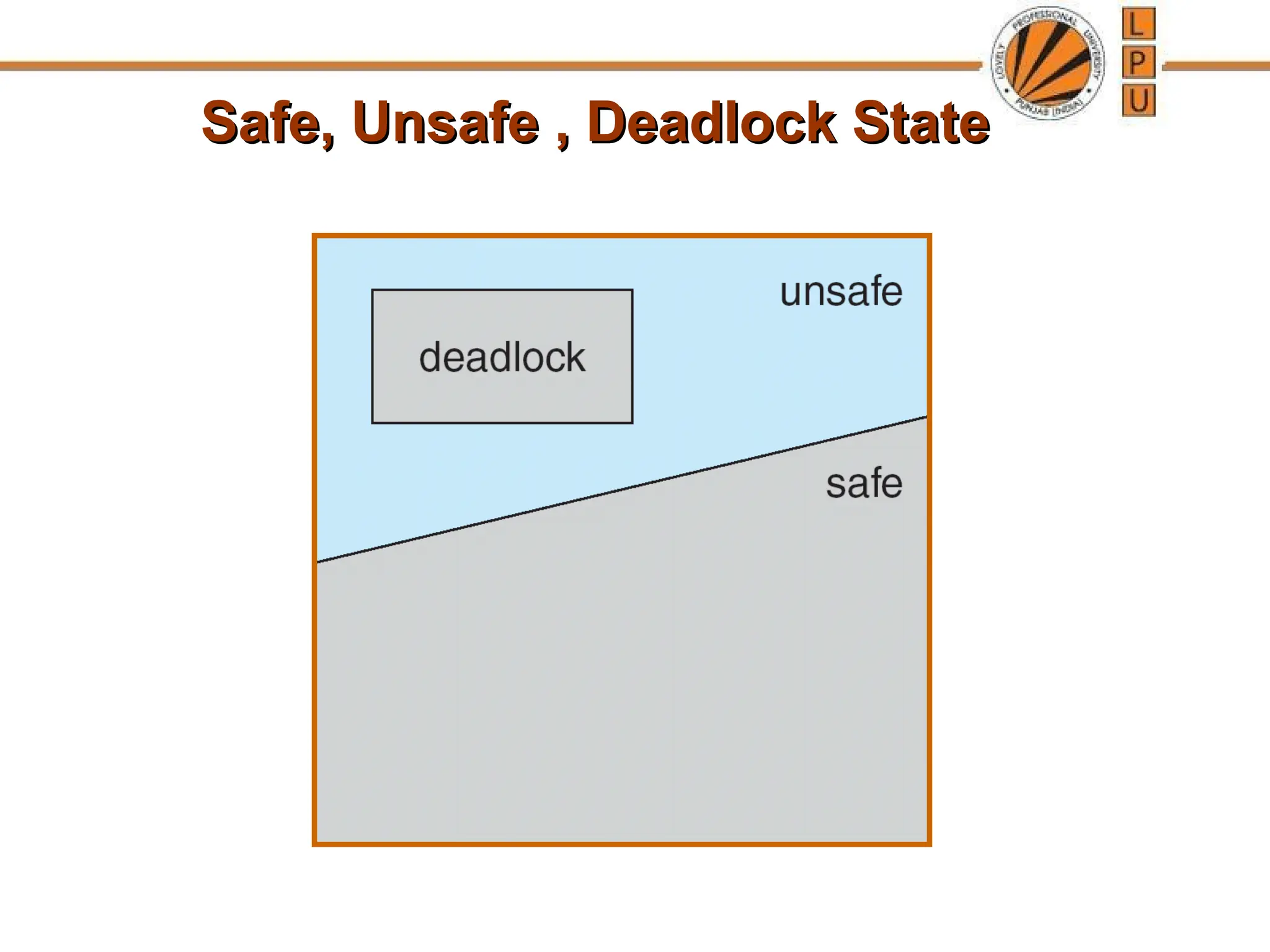
If a system is in safe state no deadlocks
If a system is in unsafe state possibility of deadlock
Avoidance ensure that a system will never enter an
unsafe state
23.
Safe, Unsafe ,Deadlock State
Safe, Unsafe , Deadlock State
24.
Example of safeand unsafe state
Example of safe and unsafe state
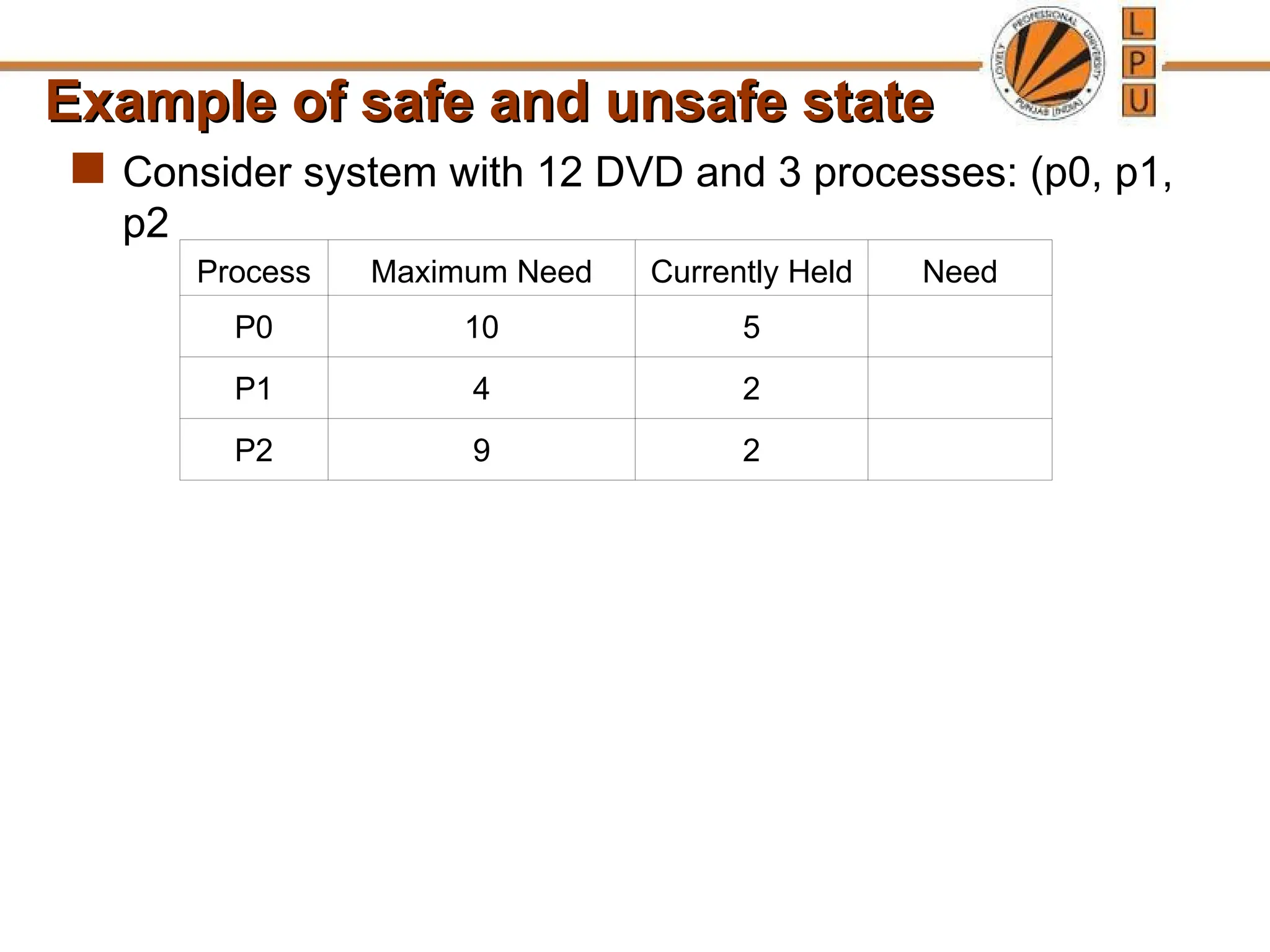
Consider system with 12 DVD and 3 processes: (p0, p1,
p2
Process Maximum Need Currently Held Need
P0 10 5
P1 4 2
P2 9 2
26.
Avoidance algorithms
Avoidance algorithms
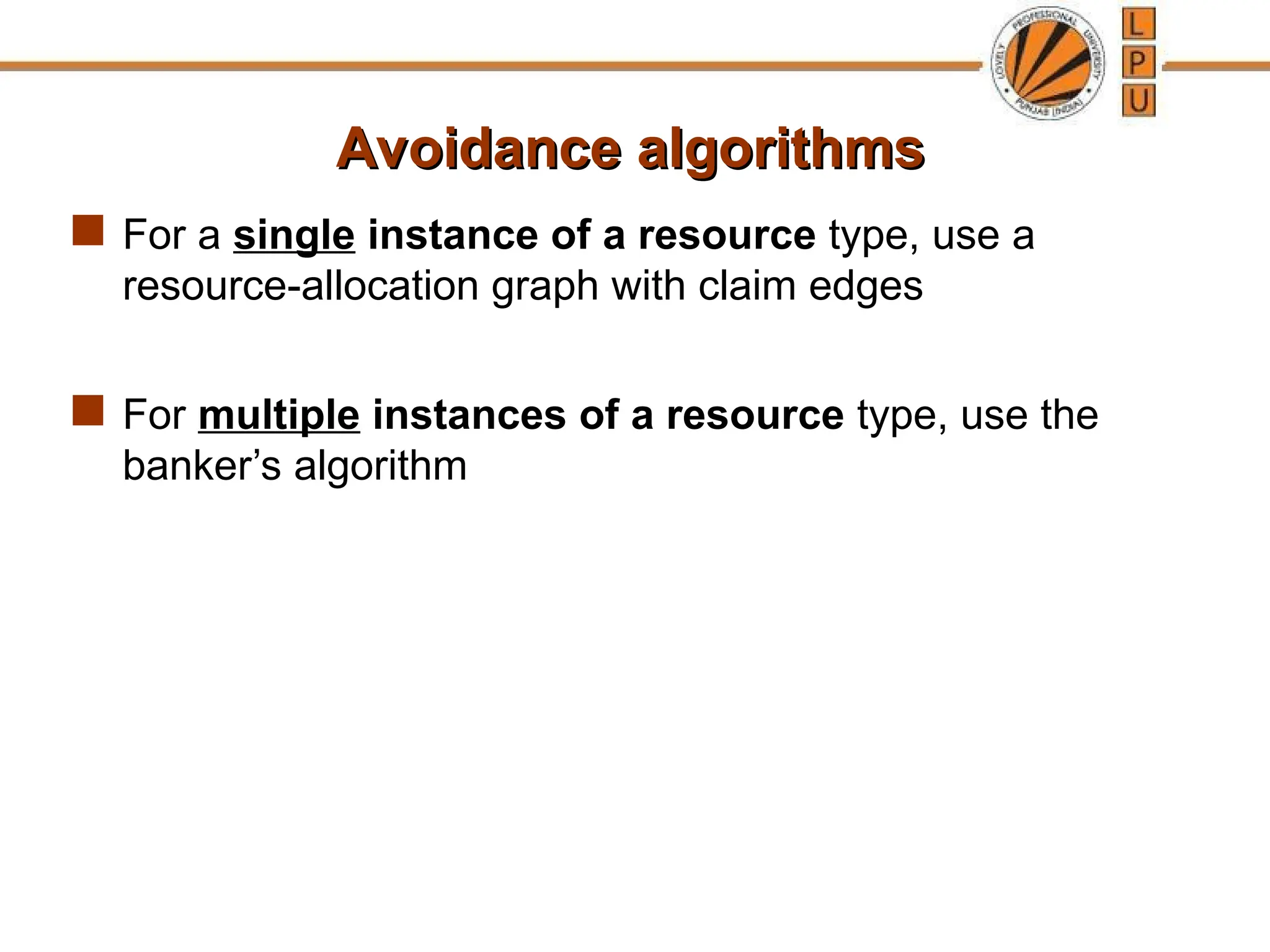
For a single instance of a resource type, use a
resource-allocation graph with claim edges
For multiple instances of a resource type, use the
banker’s algorithm
27.
Resource-Allocation Graph Scheme:For Single
Resource-Allocation Graph Scheme: For Single
Instance
Instance
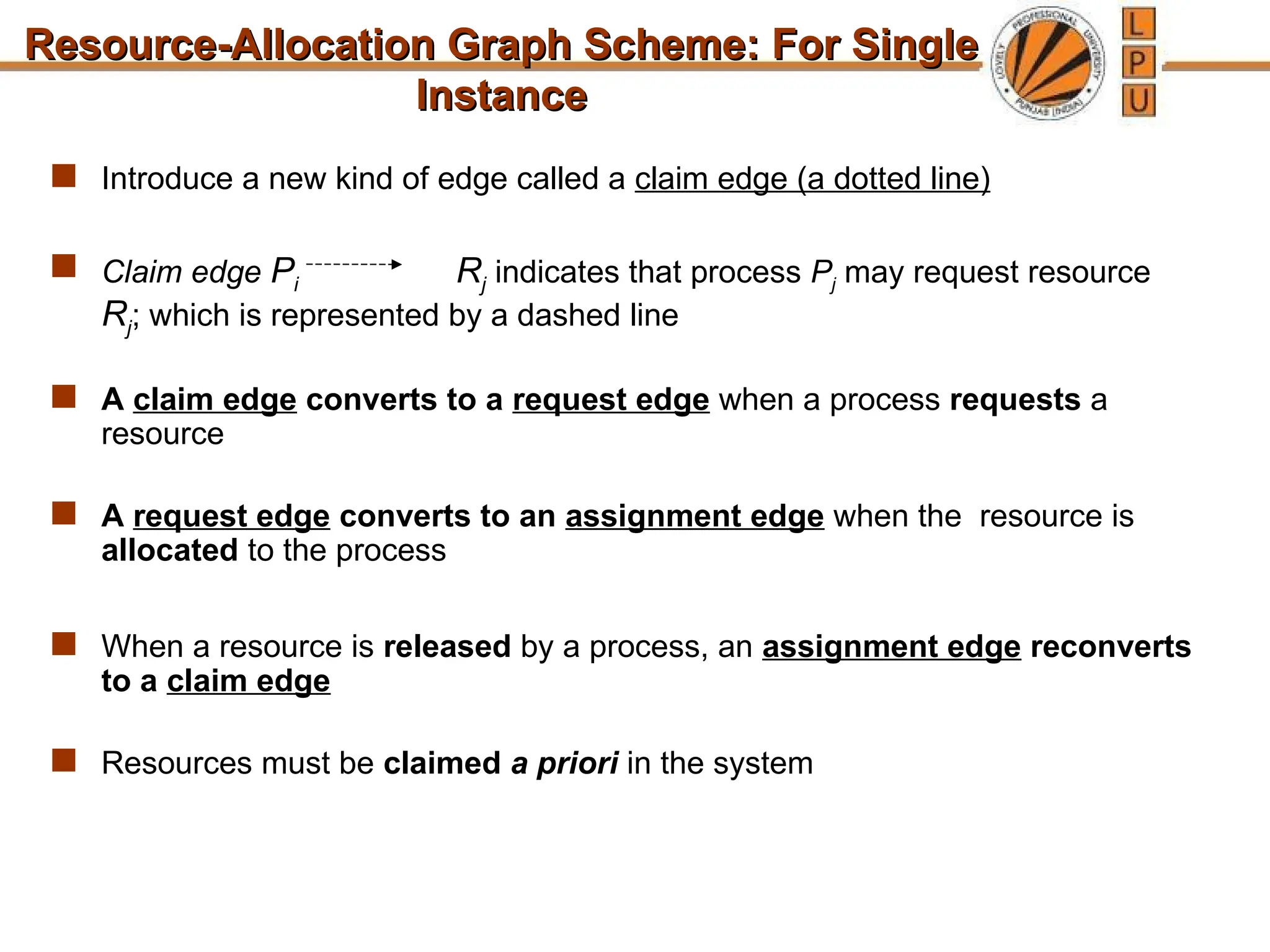
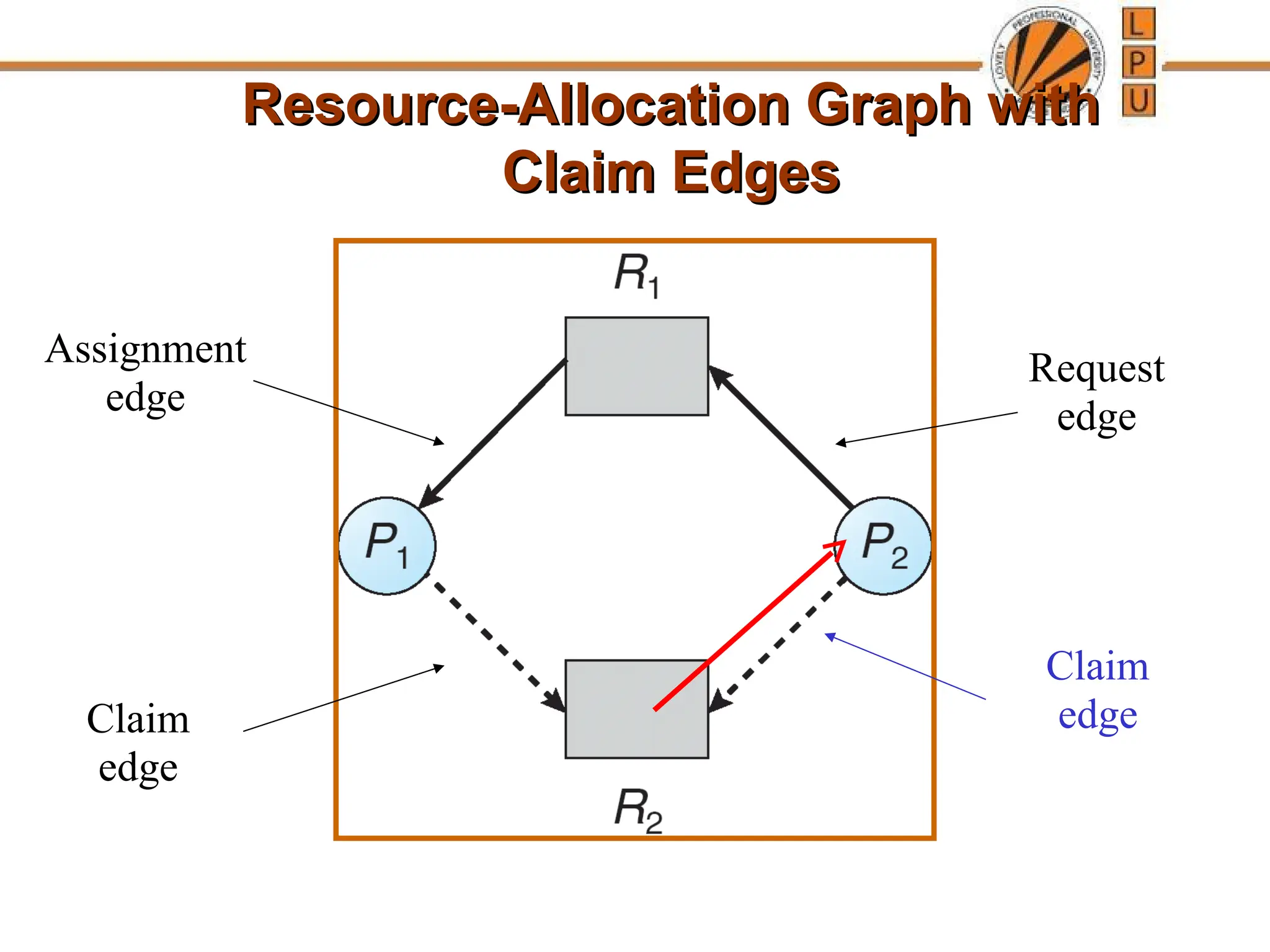
Introduce a new kind of edge called a claim edge (a dotted line)
Claim edge Pi Rj indicates that process Pj may request resource
Rj; which is represented by a dashed line
A claim edge converts to a request edge when a process requests a
resource
A request edge converts to an assignment edge when the resource is
allocated to the process
When a resource is released by a process, an assignment edge reconverts
to a claim edge
Resources must be claimed a priori in the system
28.
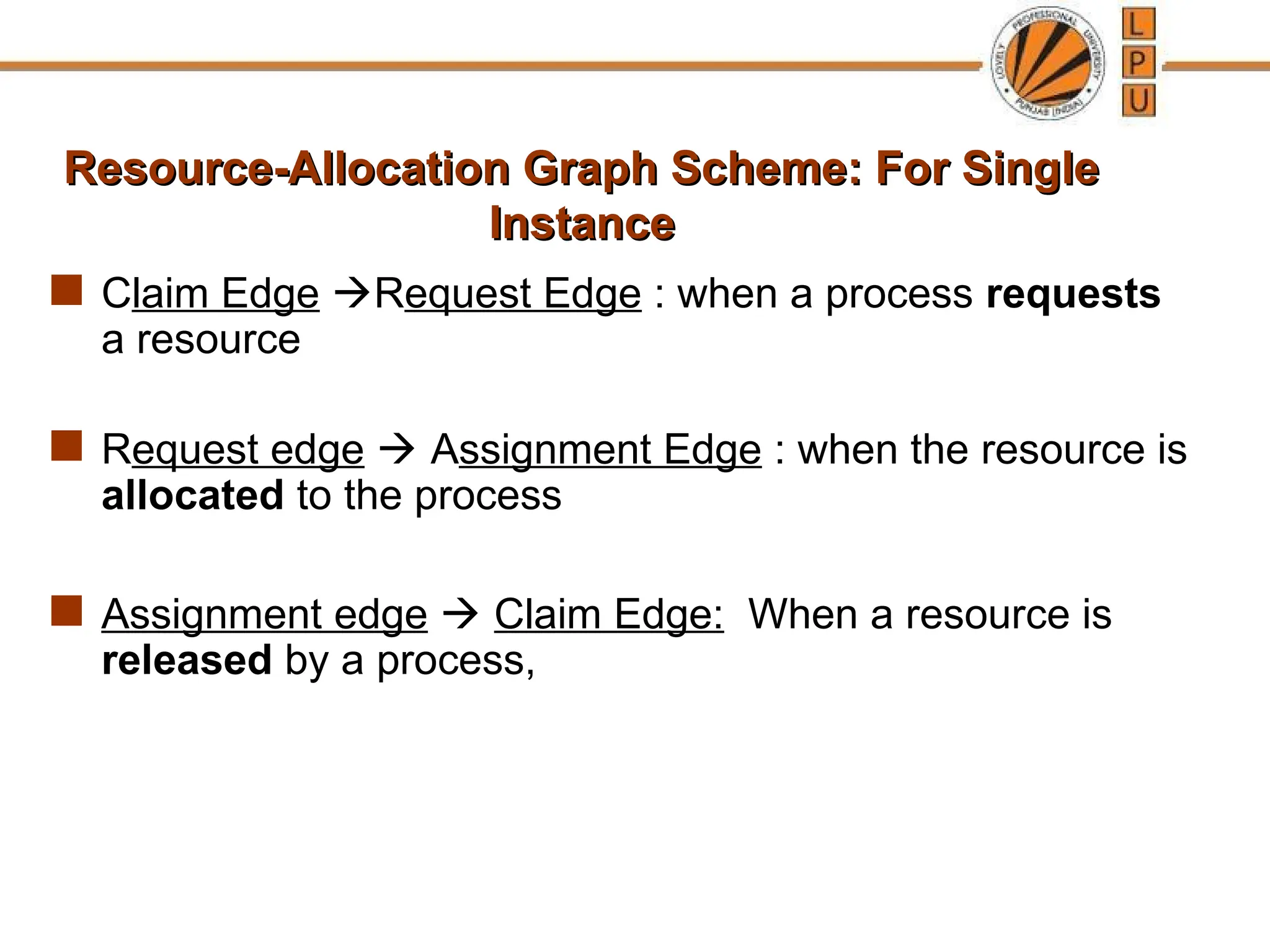
Claim EdgeRequest Edge : when a process requests
a resource
Request edge Assignment Edge : when the resource is
allocated to the process
Assignment edge Claim Edge: When a resource is
released by a process,
Resource-Allocation Graph Scheme: For Single
Resource-Allocation Graph Scheme: For Single
Instance
Instance
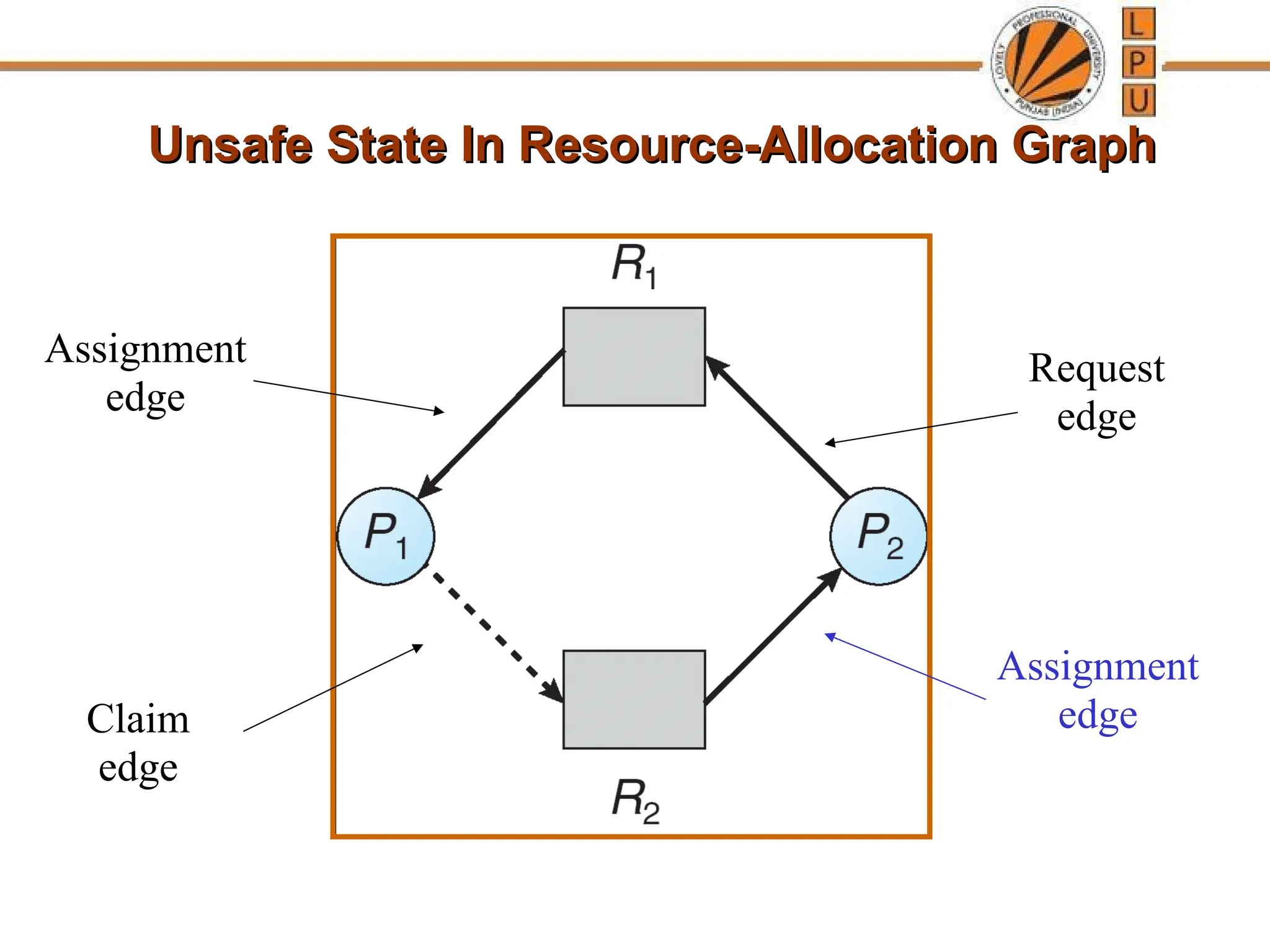
Unsafe State InResource-Allocation Graph
Unsafe State In Resource-Allocation Graph
Assignment
edge
Request
edge
Assignment
edge
Claim
edge
31.
Banker’s Algorithm
Banker’s Algorithm
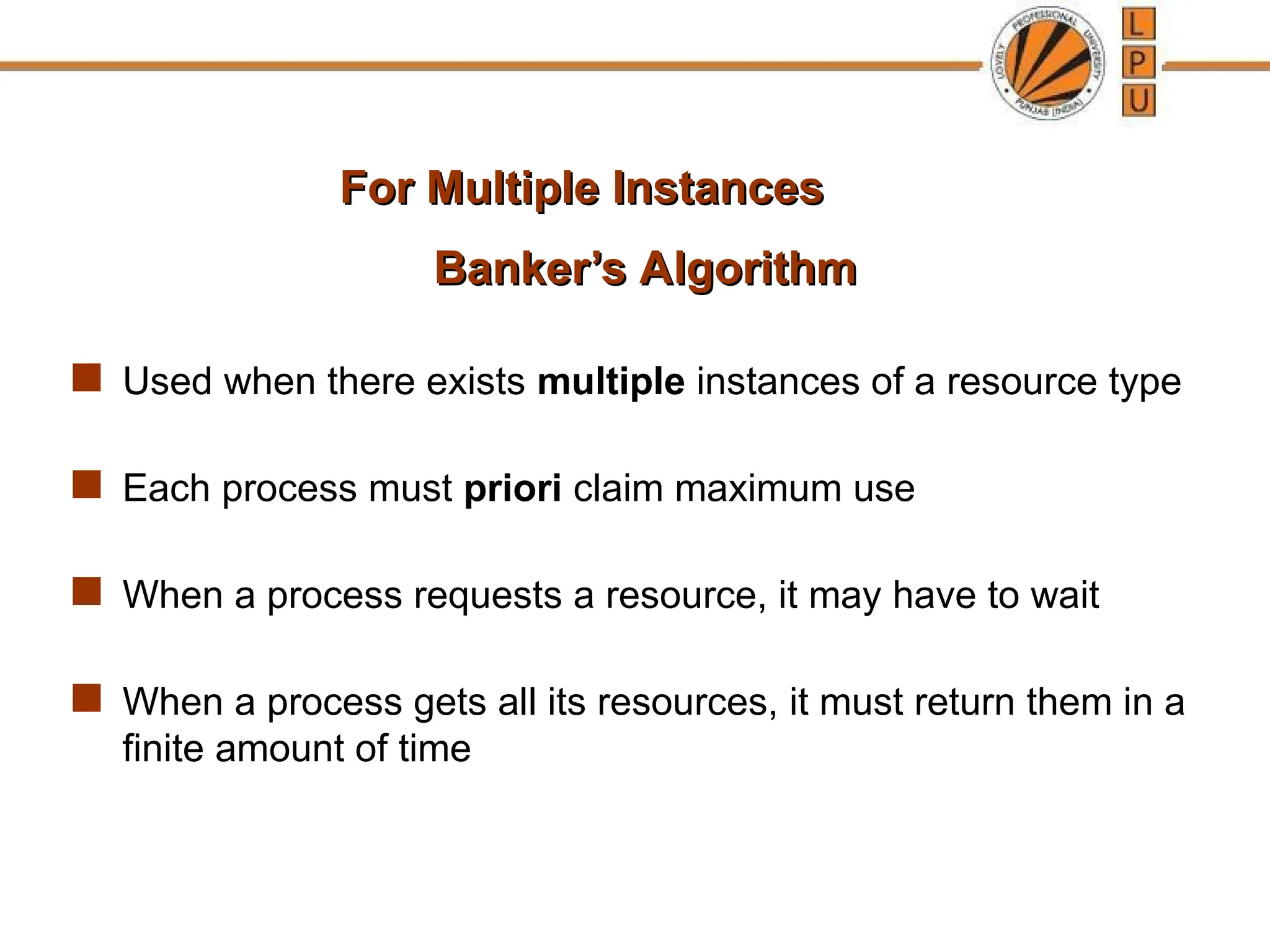
Used when there exists multiple instances of a resource type
Each process must priori claim maximum use
When a process requests a resource, it may have to wait
When a process gets all its resources, it must return them in a
finite amount of time
For Multiple Instances
For Multiple Instances
32.
Data Structures forthe Banker’s Algorithm
Data Structures for the Banker’s Algorithm
Available: Vector of length m.
If available [ j ] = k, there are k instances of resource type Rj
available.
Max: Maximum available resources that a process can
request.
If Max [ i , j ] = k, then process Pi may request at most k
instances of resource type Rj.
Let n = number of processes, and m = number of resources types.
i: Process and j: Resource instances
33.
Data Structures forthe Banker’s Algorithm
Data Structures for the Banker’s Algorithm
Allocation: Resources that can be allocated
If Allocation[ i , j ] = k then Pi is currently allocated k
instances of R j.
Need: if Need[ i, j ] = k, then Pi may need k more
instances of Rj to complete its task.
Need[i,j] = Max[i,j] – Allocation [i,j]
Let n = number of processes, and m = number of resources types.
34.
Bankers Algorithm
Let Requestbe the request vector for process Pi.
If Requesti[j] = k then process Pi wants k instances of
resource type Rj
1. If Requesti Needi go to step 2. Otherwise, raise
error condition, since process has exceeded its maximum
claim
2. If Requesti Available, go to step 3. Otherwise Pi
must wait, since resources are not available
35.
Bankers Algorithm
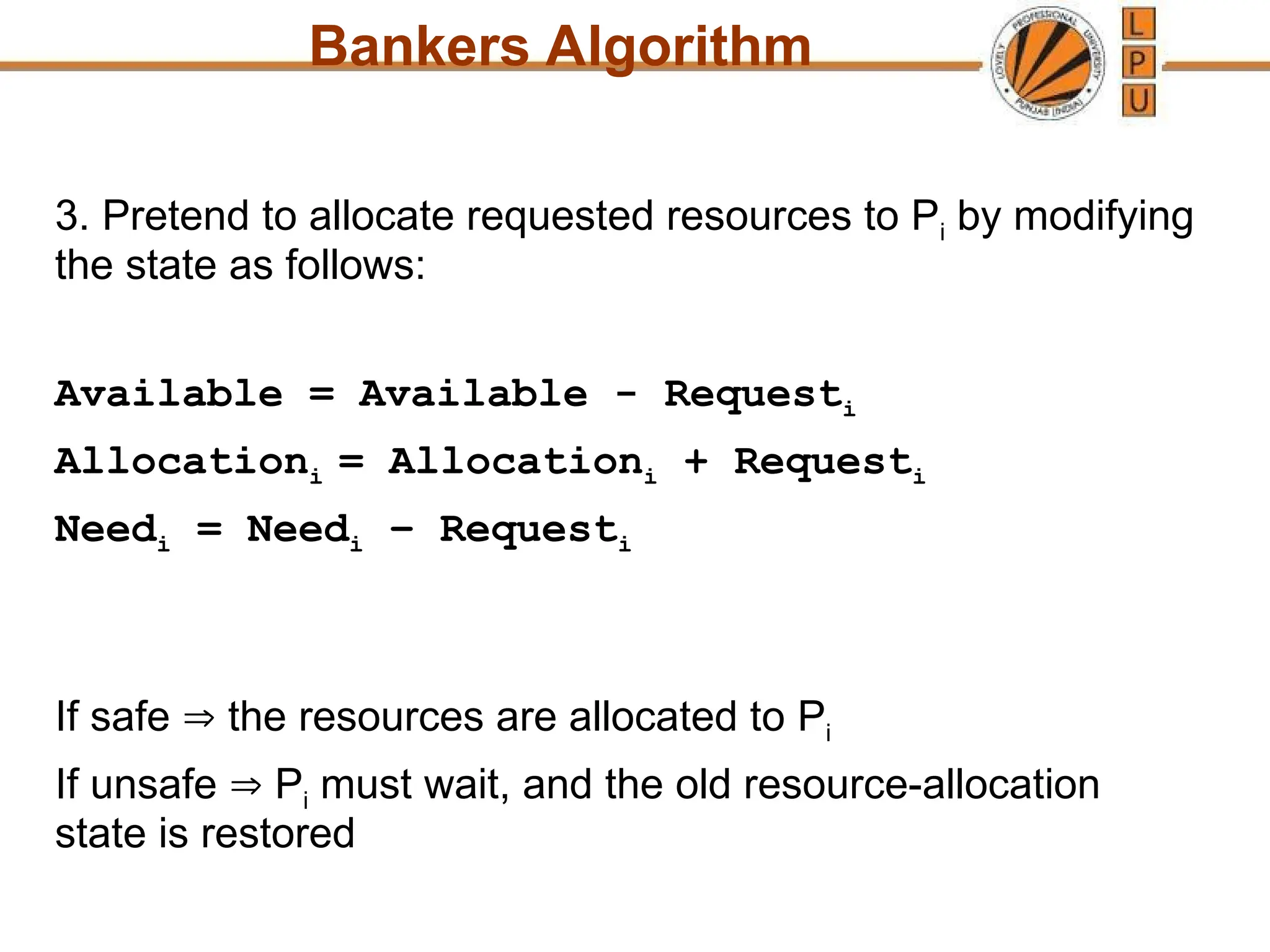
3. Pretendto allocate requested resources to Pi by modifying
the state as follows:
Available = Available - Requesti
Allocationi = Allocationi + Requesti
Needi = Needi – Requesti
If safe the resources are allocated to Pi
If unsafe Pi must wait, and the old resource-allocation
state is restored
36.
Safety Algorithm
1. LetWork and Finish be vectors of length m and n, respectively.
Initialize:
Work = Available
Finish[i] = false for i=0,1,..,n
//{Process I needs resources, resources are still
available}
2. Find an i such that
Finish[i] = false AND Needi Work
If no such i exists, go to step 4
3. Work = Work + Allocationi
Finish[i] = true
go to step 2
4. If Finish[i] == true for all i, then the system is in a safe state
37.
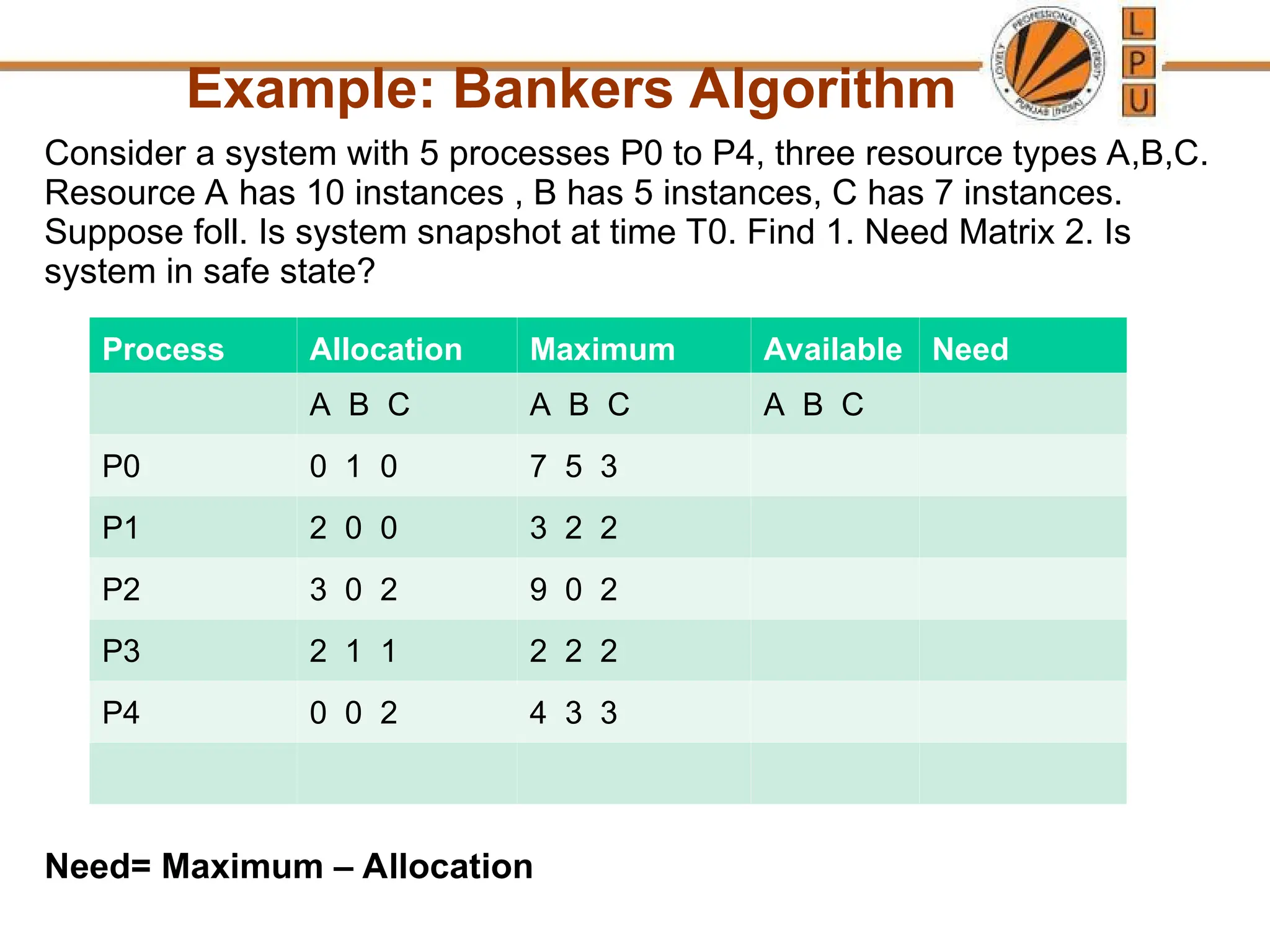
Example: Bankers Algorithm
Considera system with 5 processes P0 to P4, three resource types A,B,C.
Resource A has 10 instances , B has 5 instances, C has 7 instances.
Suppose foll. Is system snapshot at time T0. Find 1. Need Matrix 2. Is
system in safe state?
Need= Maximum – Allocation
Process Allocation Maximum Available Need
A B C A B C A B C
P0 0 1 0 7 5 3
P1 2 0 0 3 2 2
P2 3 0 2 9 0 2
P3 2 1 1 2 2 2
P4 0 0 2 4 3 3
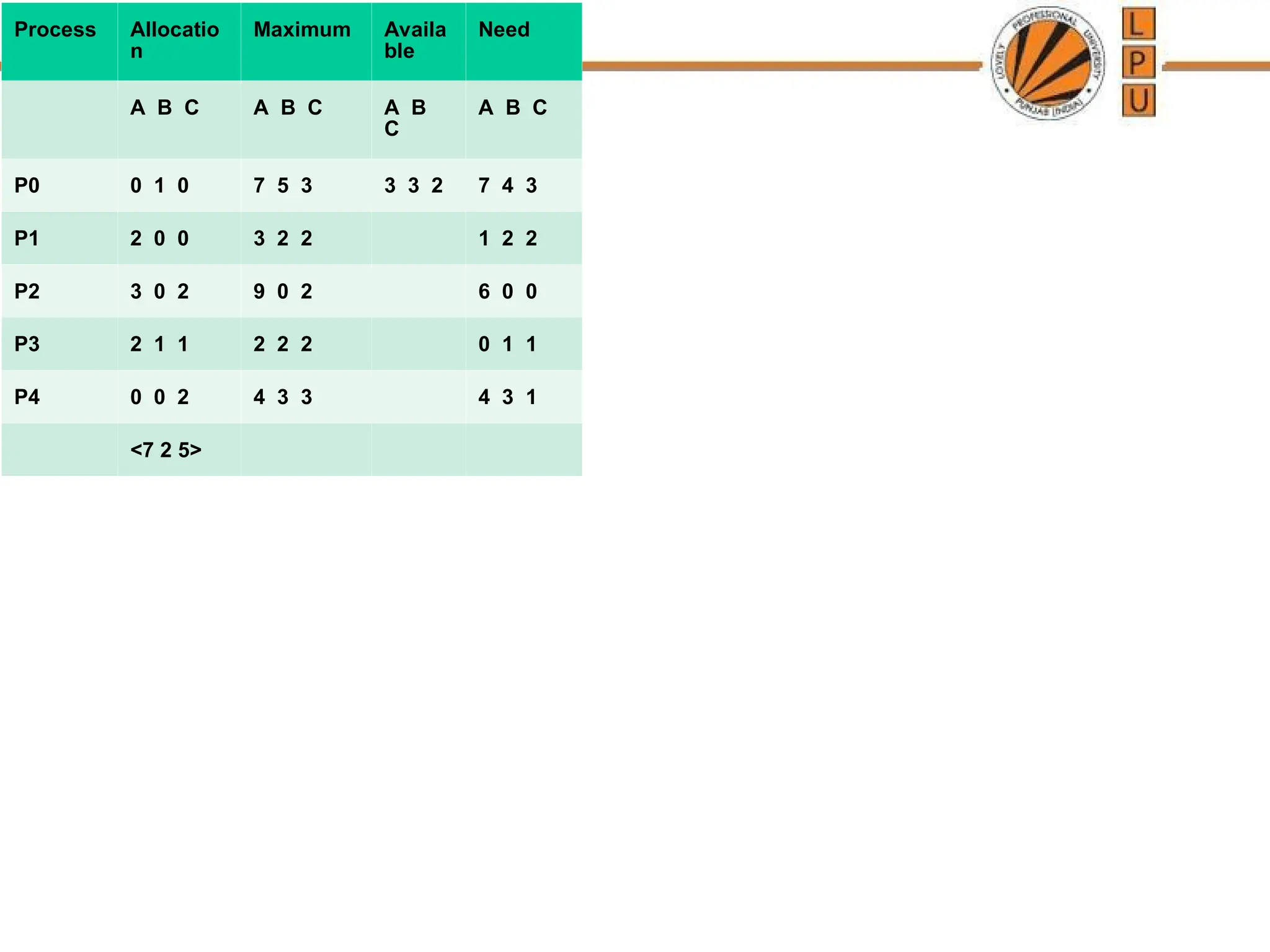
38.
Example: Bankers Algorithm
Considera system with 5 processes P0 to P4, three resource types A,B,C. Resource
A has 10 instances , B has 5 instances, C has 7 instances. Suppose foll. Is system
snapshot at time T0. Find 1. Need Matrix 2. Is system in safe state?
Available= [(10-7), (5-2), (7-5)] = < 3 3 2>
Need= Maximum – Allocation
Available = Available + Allocated
Safe Sequence<P1, P3, P4, P0, P2>
Process Allocation Maximum Available Need
A B C A B C A B C
P0 0 1 0 7 5 3 3 3 2
P1 2 0 0 3 2 2
P2 3 0 2 9 0 2
P3 2 1 1 2 2 2
P4 0 0 2 4 3 3
<7 2 5>
40.
Process Allocatio
n
Maximum Availa
ble
Need
AB C A B C A B
C
A B C
P0 0 1 0 7 5 3 3 3 2 7 4 3
P1 2 0 0 3 2 2 1 2 2
P2 3 0 2 9 0 2 6 0 0
P3 2 1 1 2 2 2 0 1 1
P4 0 0 2 4 3 3 4 3 1
<7 2 5>
41.
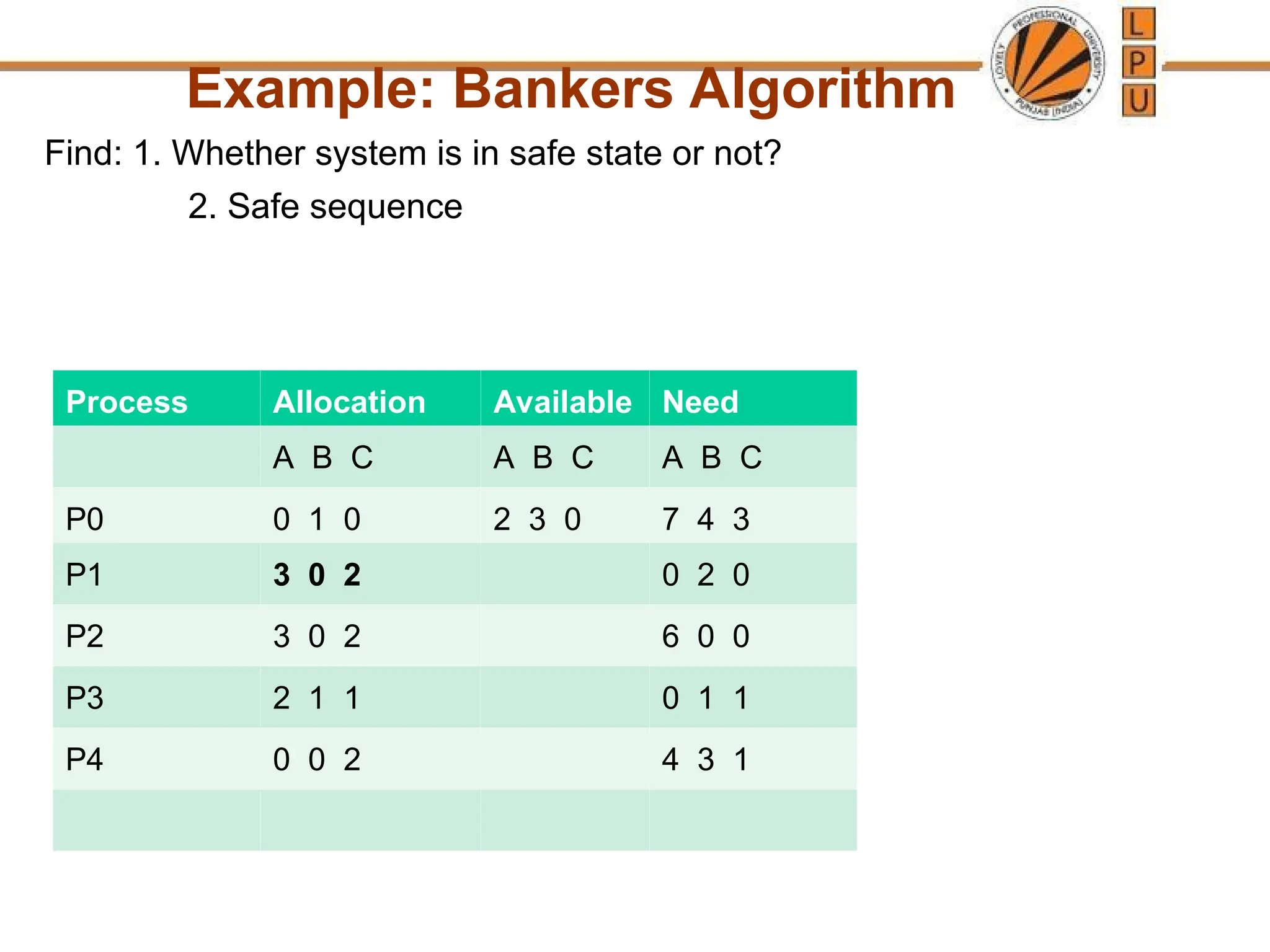
Example: Bankers Algorithm
Find:1. Whether system is in safe state or not?
2. Safe sequence
Process Allocation Available Need
A B C A B C A B C
P0 0 1 0 2 3 0 7 4 3
P1 3 0 2 0 2 0
P2 3 0 2 6 0 0
P3 2 1 1 0 1 1
P4 0 0 2 4 3 1
Deadlock Detection
Deadlock Detection
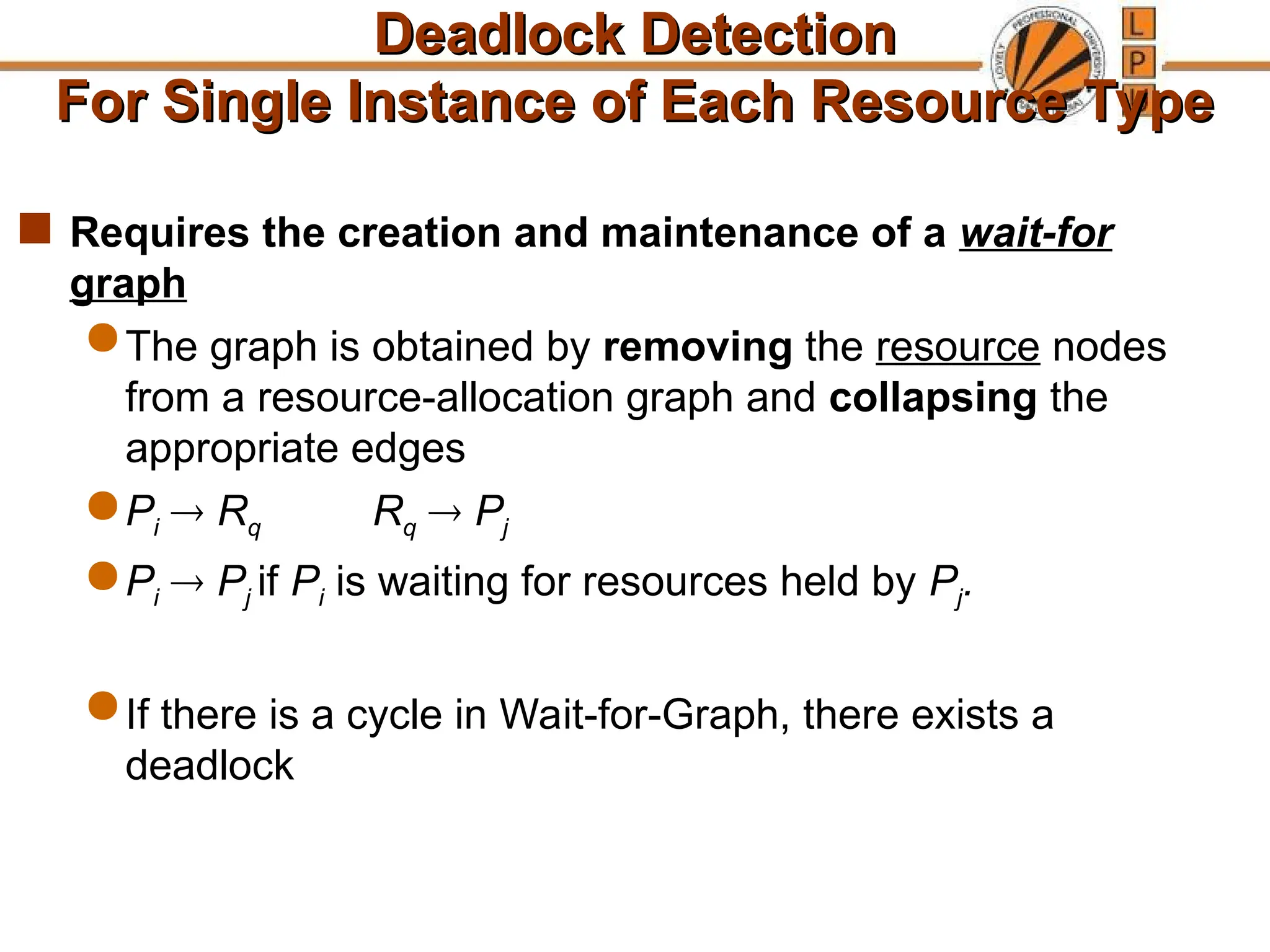
For deadlock detection, the system must
provide
An algorithm that examines the state of the
system to detect whether a deadlock has occurred
An algorithm to recover from the deadlock
44.
Deadlock Detection
Deadlock Detection
ForSingle Instance of Each Resource Type
For Single Instance of Each Resource Type
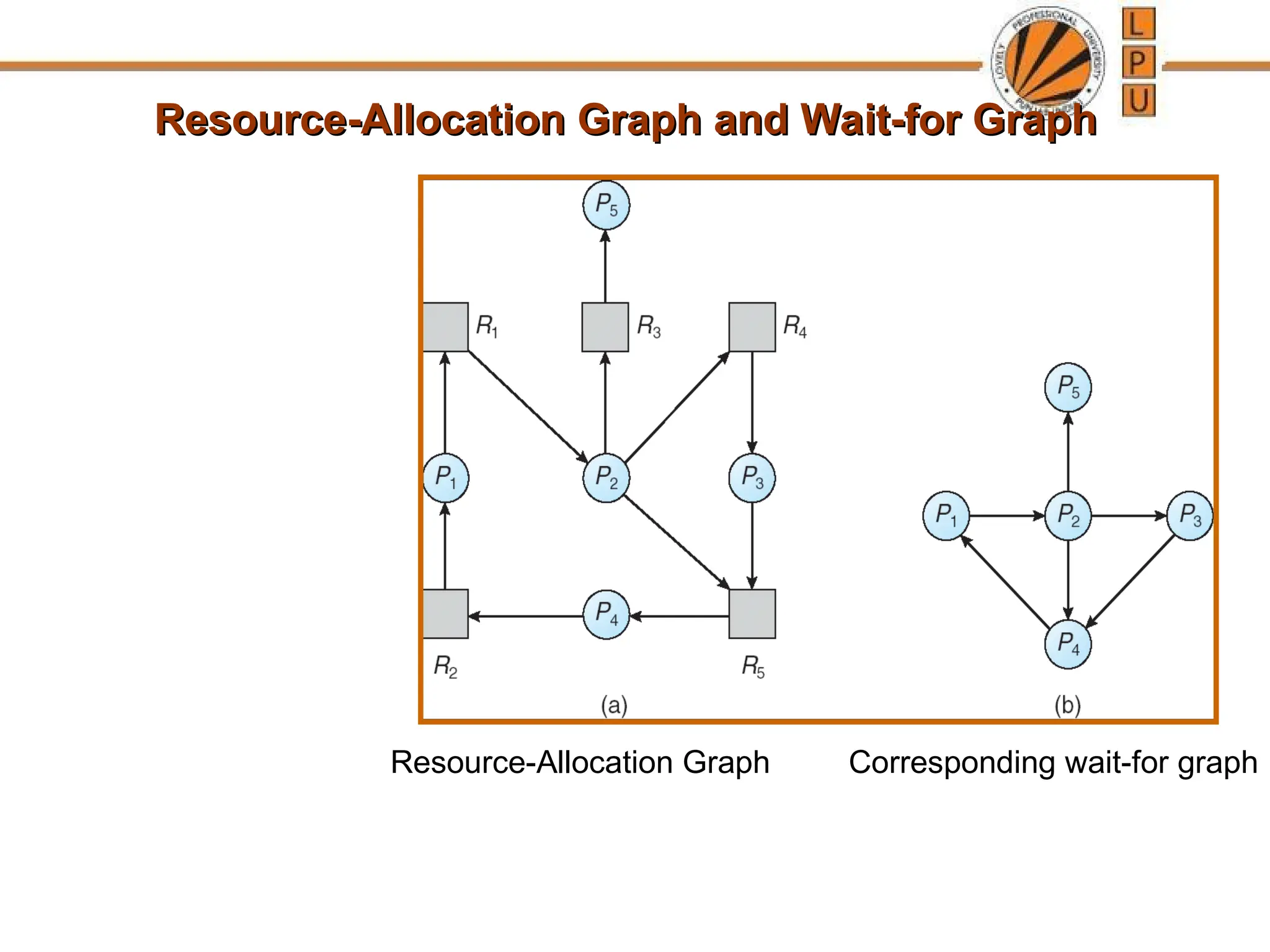
Requires the creation and maintenance of a wait-for
graph
The graph is obtained by removing the resource nodes
from a resource-allocation graph and collapsing the
appropriate edges
Pi Rq Rq Pj
Pi Pj if Pi is waiting for resources held by Pj.
If there is a cycle in Wait-for-Graph, there exists a
deadlock
Deadlock Detection
Deadlock Detection
ForMultiple Instances of a Resource
For Multiple Instances of a Resource
Type
Type
Available: A vector of length m indicates the number of available
resources of each resource type.
Allocation: An n x m matrix defines the number of resources of
each type currently allocated to each process.
Request: An n x m matrix indicates the current request of each
process. If Request [ i , j ] = k, then process P i is requesting k more
instances of resource type. R j.
Required data structures:
47.
Detection Algorithm
1. LetWork and Finish be vectors of length m and n, respectively. Initialize:
Work = Availablem
Finish[i] = false if Allocation !=0
= true if Allocation = 0
Requesti
Work
2. Find an i such that
Finish[i] = false AND Requesti Work
If no such i exists, go to step 4
If resources are available:
3. Work = Work + Allocationi
Finish[i] = true
go to step 2
4. If Finish[i] == False for some i then there is a deadlock.
48.
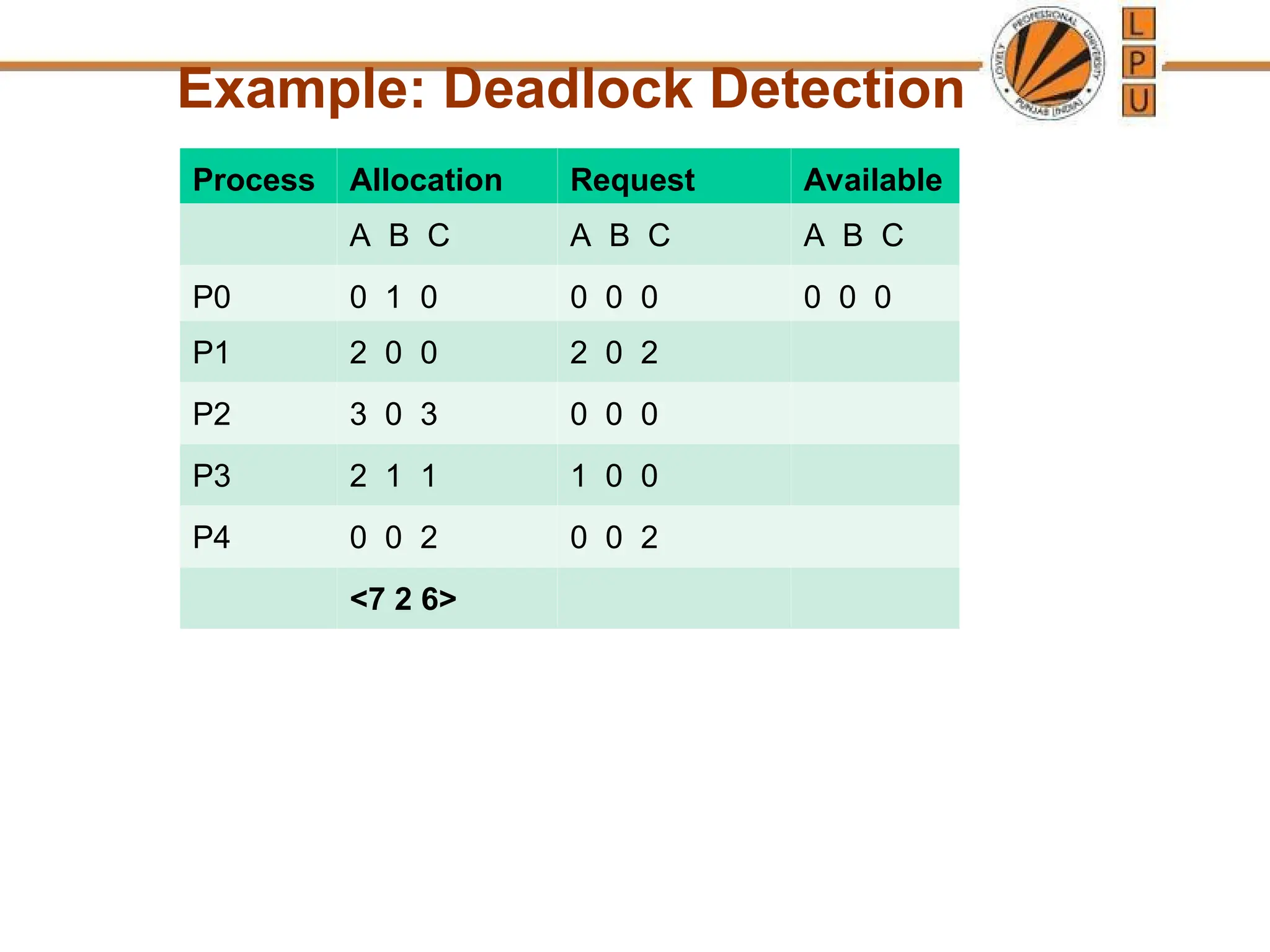
Example: Deadlock Detection
ProcessAllocation Request Available
A B C A B C A B C
P0 0 1 0 0 0 0 0 0 0
P1 2 0 0 2 0 2
P2 3 0 3 0 0 0
P3 2 1 1 1 0 0
P4 0 0 2 0 0 2
<7 2 6>
49.
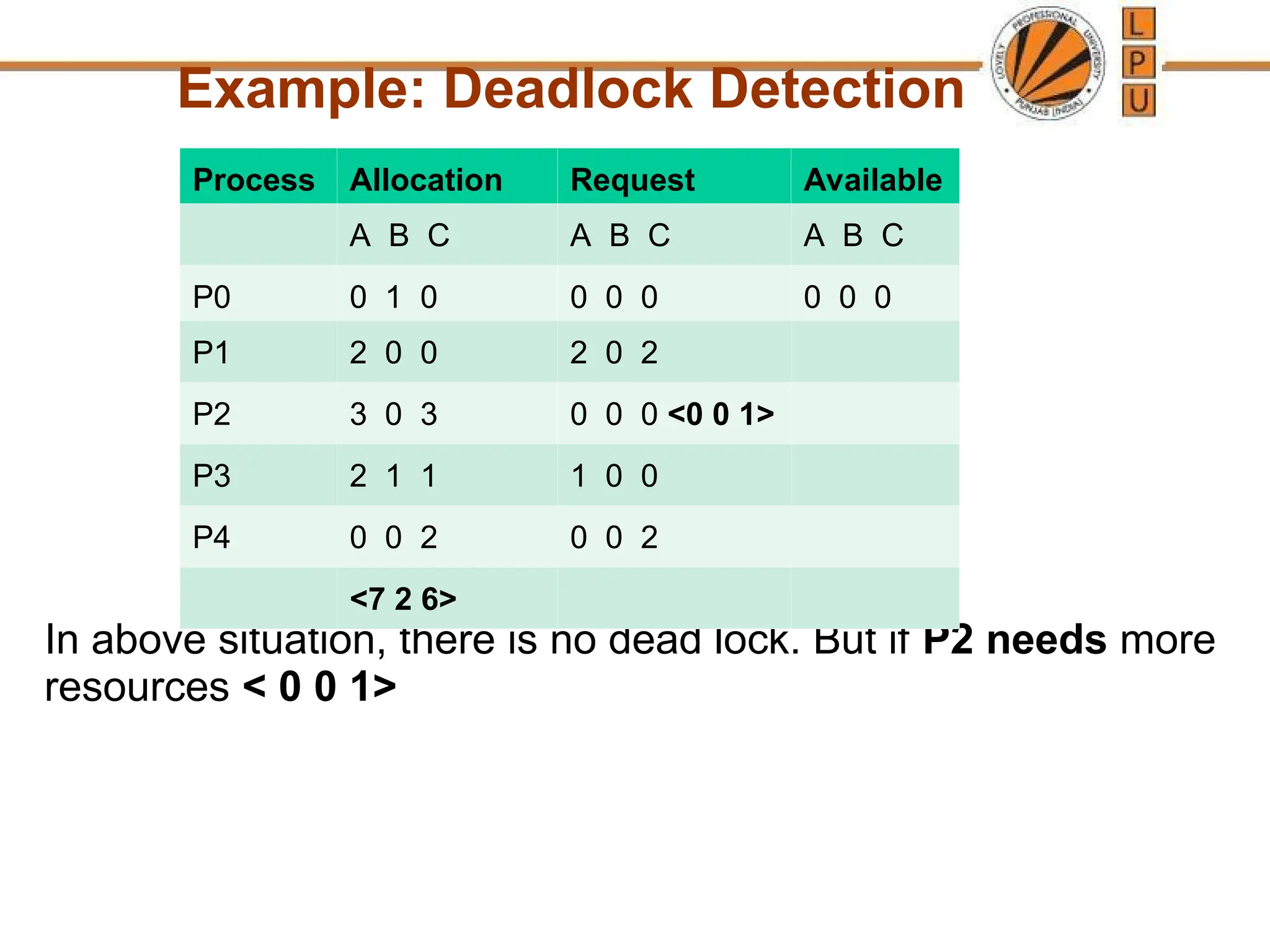
Example: Deadlock Detection
Inabove situation, there is no dead lock. But if P2 needs more
resources < 0 0 1>
Process Allocation Request Available
A B C A B C A B C
P0 0 1 0 0 0 0 0 0 0
P1 2 0 0 2 0 2
P2 3 0 3 0 0 0 <0 0 1>
P3 2 1 1 1 0 0
P4 0 0 2 0 0 2
<7 2 6>
50.
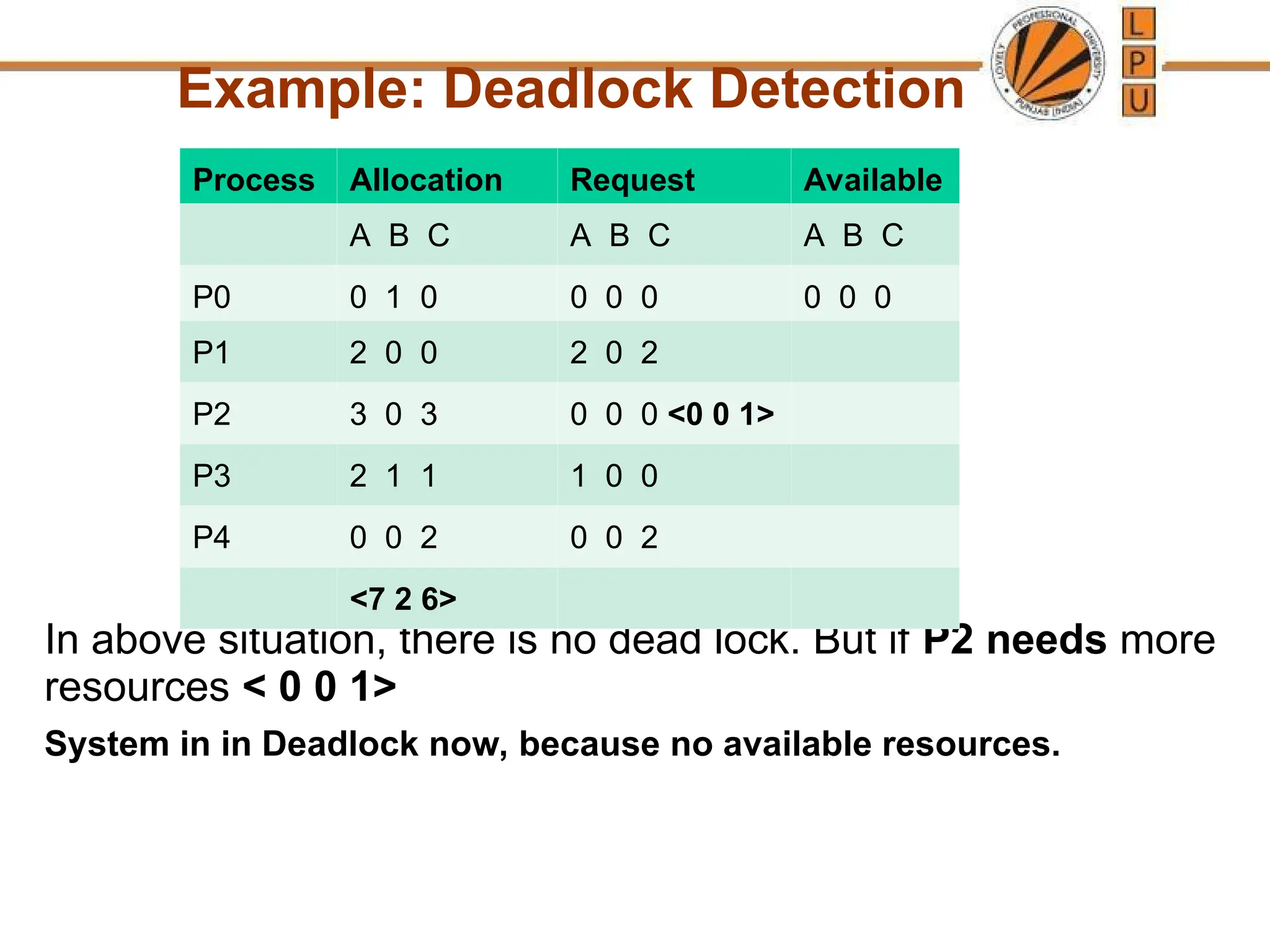
Example: Deadlock Detection
Inabove situation, there is no dead lock. But if P2 needs more
resources < 0 0 1>
System in in Deadlock now, because no available resources.
Process Allocation Request Available
A B C A B C A B C
P0 0 1 0 0 0 0 0 0 0
P1 2 0 0 2 0 2
P2 3 0 3 0 0 0 <0 0 1>
P3 2 1 1 1 0 0
P4 0 0 2 0 0 2
<7 2 6>
51.
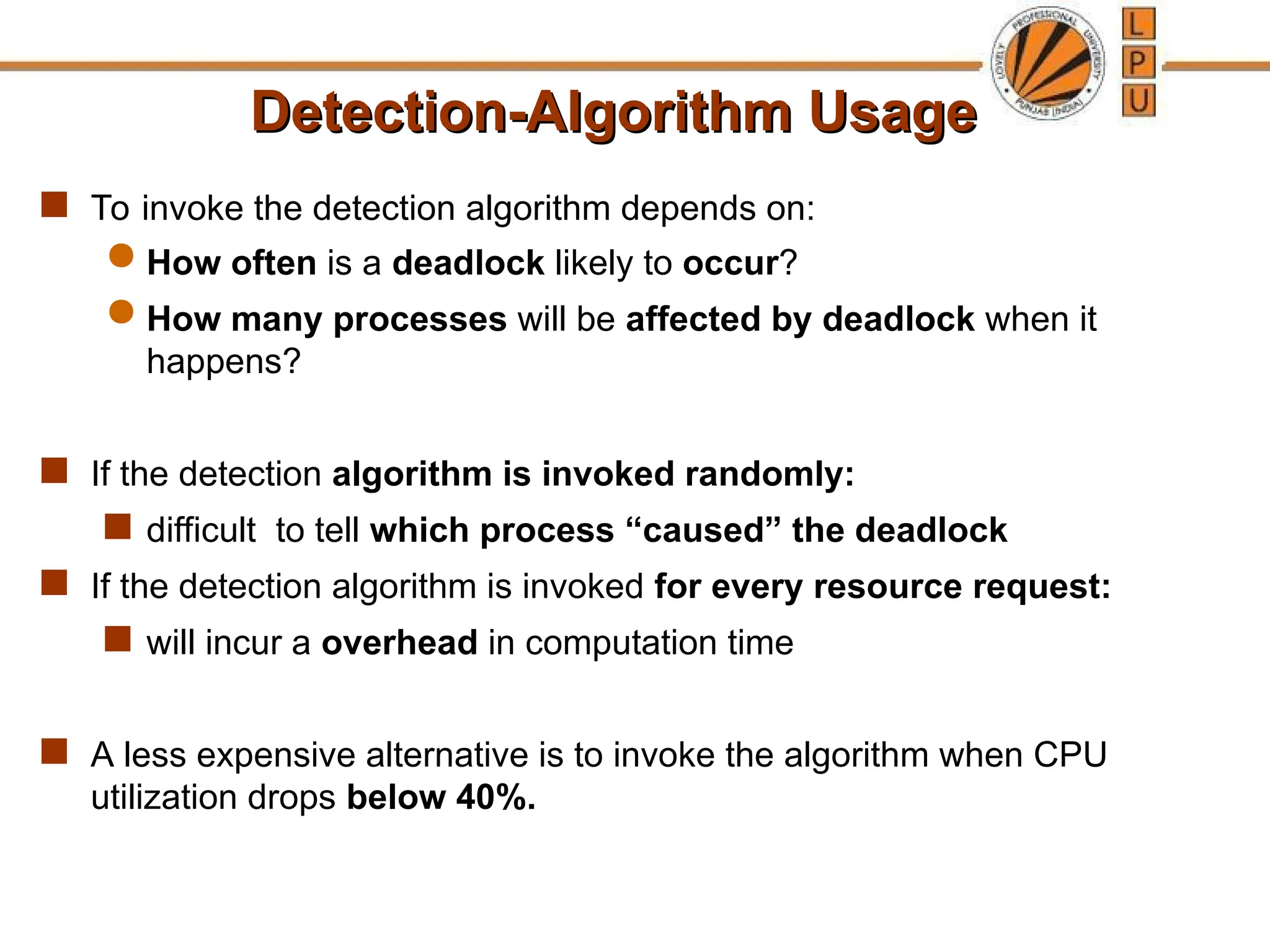
Detection-Algorithm Usage
Detection-Algorithm Usage
To invoke the detection algorithm depends on:
How often is a deadlock likely to occur?
How many processes will be affected by deadlock when it
happens?
If the detection algorithm is invoked randomly:
difficult to tell which process “caused” the deadlock
If the detection algorithm is invoked for every resource request:
will incur a overhead in computation time
A less expensive alternative is to invoke the algorithm when CPU
utilization drops below 40%.
Recovery from Deadlock
Recoveryfrom Deadlock
Let the user or system administrator respond to the
problem
Two Approaches:
Process termination : terminate processes to break the circular
wait.
Resource Pre-emption : Pre-empt resources from deadlocked
processes
54.
Process Termination
Process Termination
Abort all deadlocked processes
This approach will break the deadlock, but at great expense
Abort one process at a time until the deadlock cycle is
eliminated
After each process is aborted, a deadlock-detection algorithm must be re-
invoked to determine whether any processes are still deadlocked
Many factors may affect which process is chosen for termination
What is the priority of the process?
How much process has run and how much time it needs to complete?
How many and what type of resources has the process used?
How many more resources does the process need in order to finish its
task?
How many processes will need to be terminated?
Is the process interactive or batch?
55.
Resource Pre-emption
Resource Pre-emption
Pre-empt some resources from processes and give these resources to
other processes until the deadlock cycle is broken
When pre-emption is required to deal with deadlocks, then three issues
need to be addressed:
Selecting a victim – Which resources and which processes are to
be pre-empted?
Rollback – If we pre-empt a resource from a process, what should
be done with that process?
Starvation – How do we ensure that starvation will not occur?
That is, how can we guarantee that resources will not always be pre-
empted from the same process?
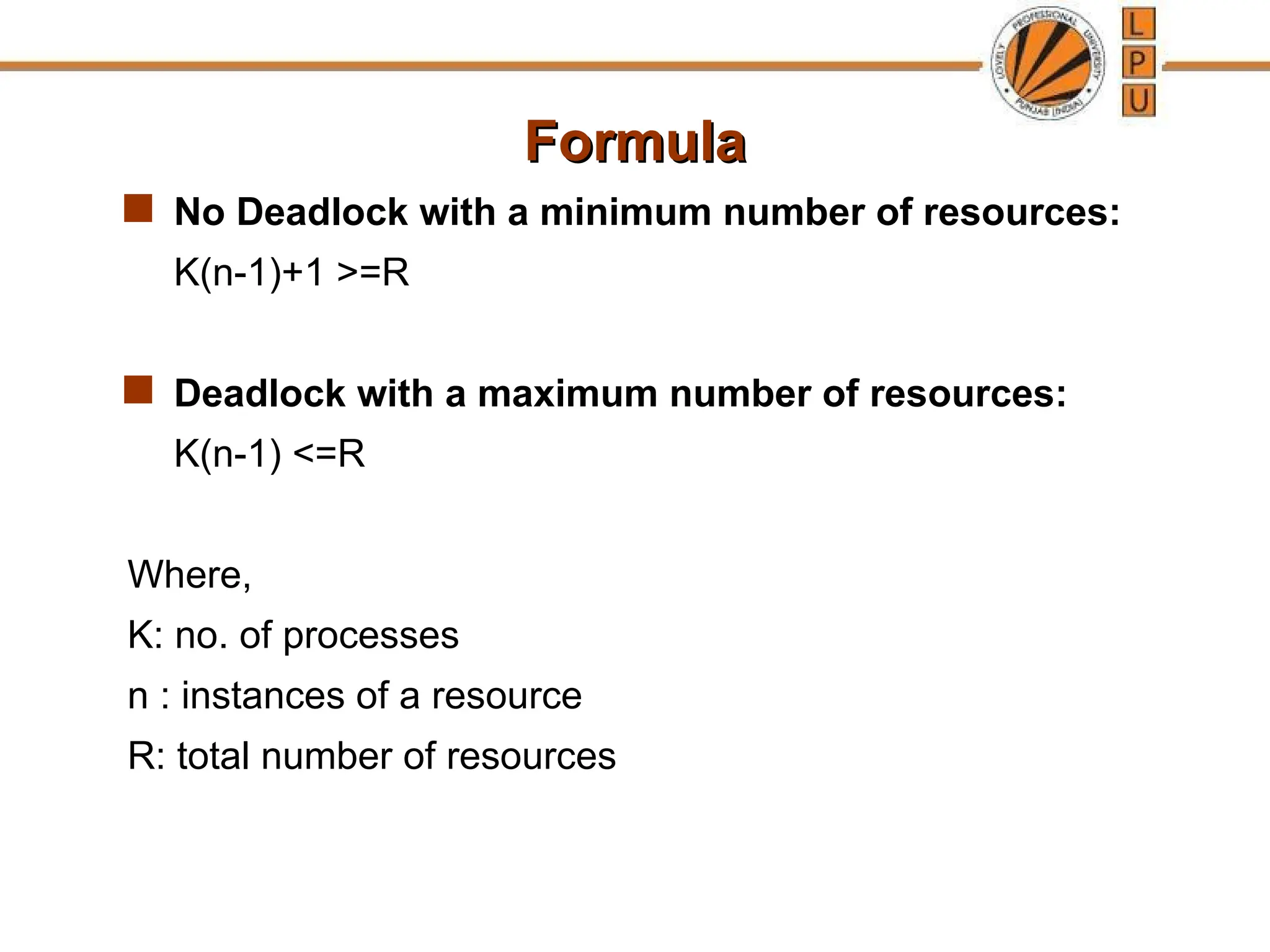
Formula
Formula
No Deadlockwith a minimum number of resources:
K(n-1)+1 >=R
Deadlock with a maximum number of resources:
K(n-1) <=R
Where,
K: no. of processes
n : instances of a resource
R: total number of resources
59.
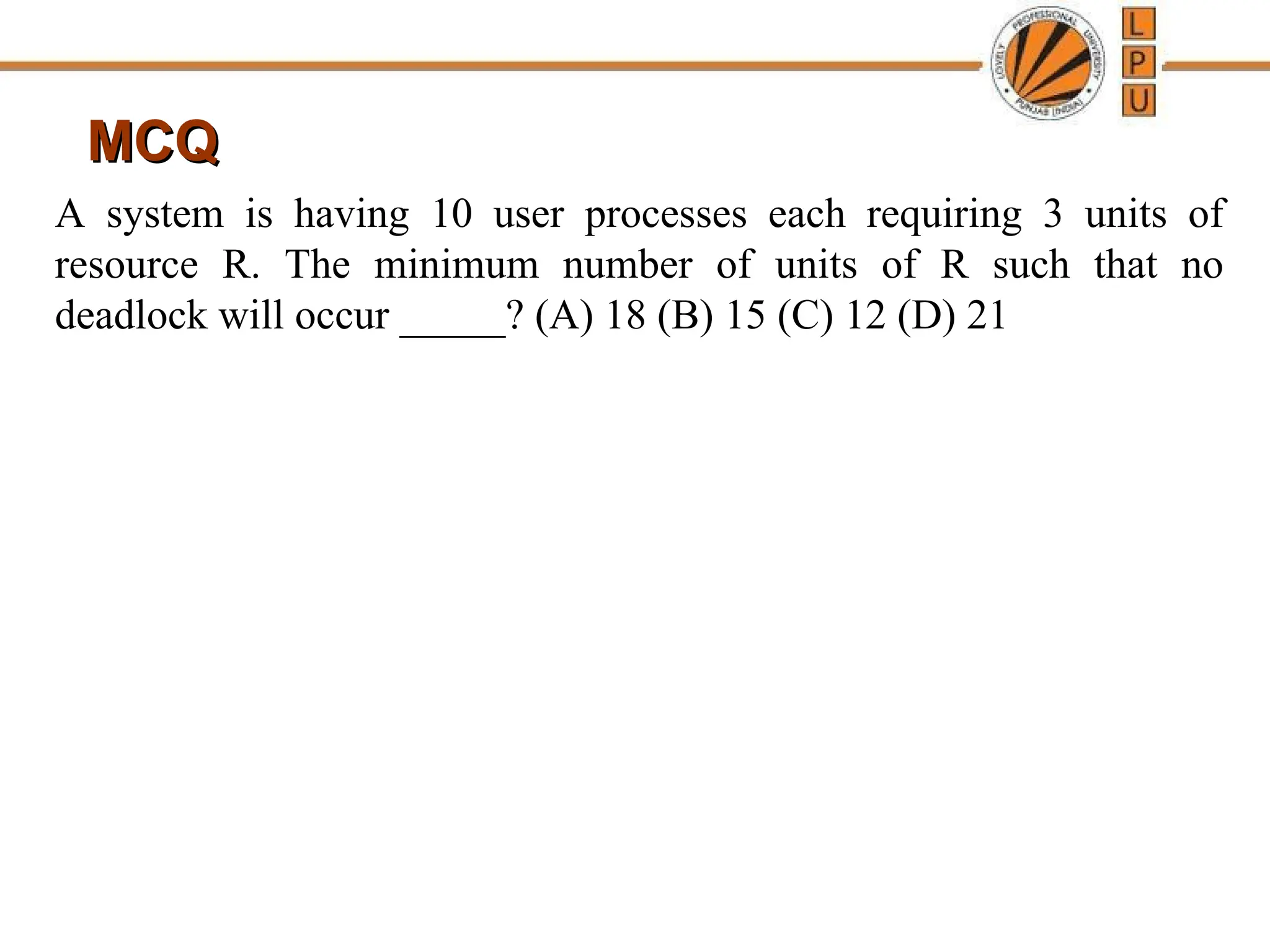
MCQ
MCQ
A system ishaving 10 user processes each requiring 3 units of
resource R. The minimum number of units of R such that no
deadlock will occur _____? (A) 18 (B) 15 (C) 12 (D) 21
60.
MCQ
MCQ
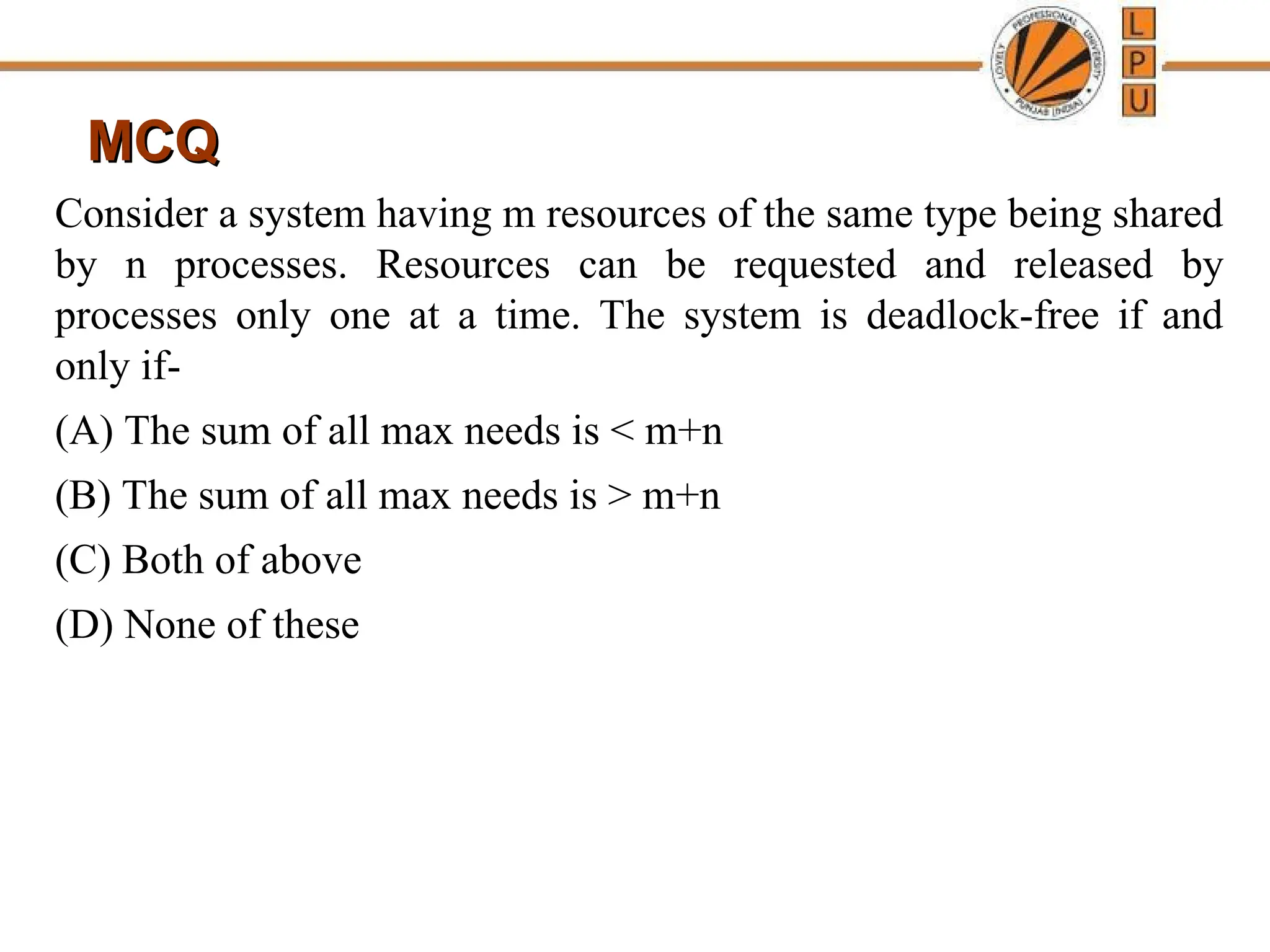
Consider a systemhaving m resources of the same type being shared
by n processes. Resources can be requested and released by
processes only one at a time. The system is deadlock-free if and
only if-
(A) The sum of all max needs is < m+n
(B) The sum of all max needs is > m+n
(C) Both of above
(D) None of these
61.
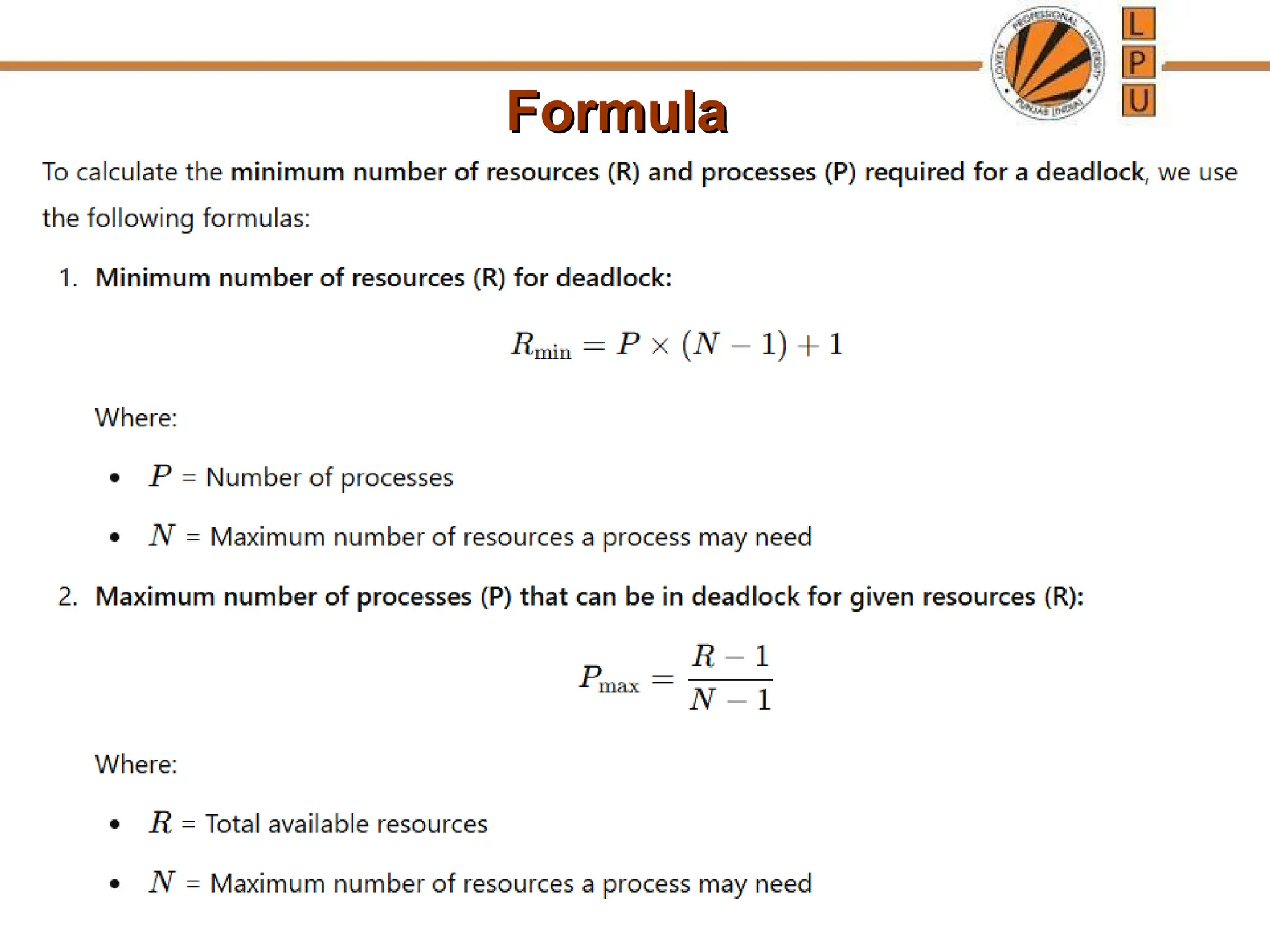
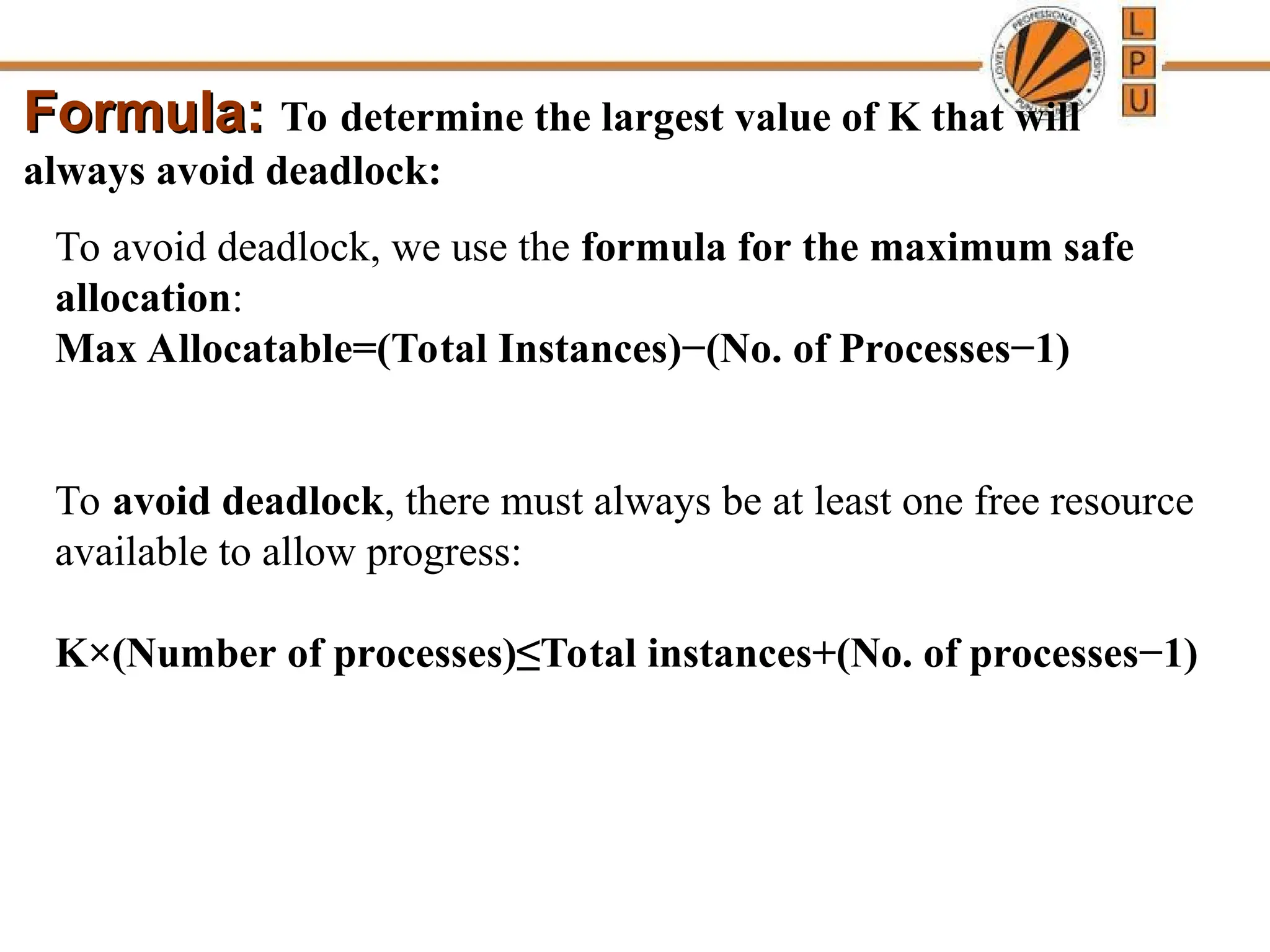
Formula:
Formula: To determinethe largest value of K that will
always avoid deadlock:
To avoid deadlock, we use the formula for the maximum safe
allocation:
Max Allocatable=(Total Instances)−(No. of Processes−1)
To avoid deadlock, there must always be at least one free resource
available to allow progress:
K×(Number of processes)≤Total instances+(No. of processes−1)
62.
MCQ
MCQ
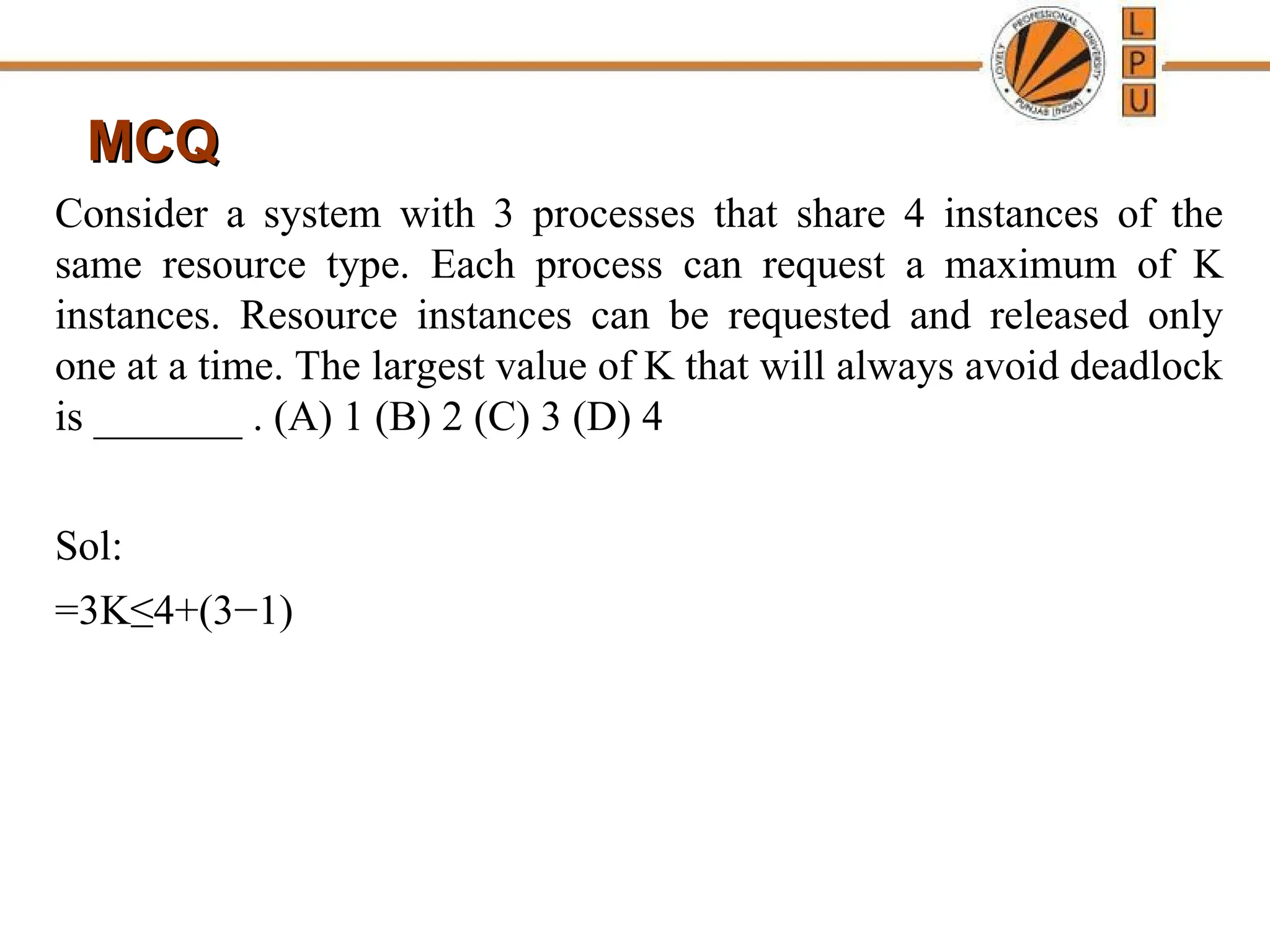
Consider a systemwith 3 processes that share 4 instances of the
same resource type. Each process can request a maximum of K
instances. Resource instances can be requested and released only
one at a time. The largest value of K that will always avoid deadlock
is _______ . (A) 1 (B) 2 (C) 3 (D) 4
Sol:
=3K≤4+(3−1)
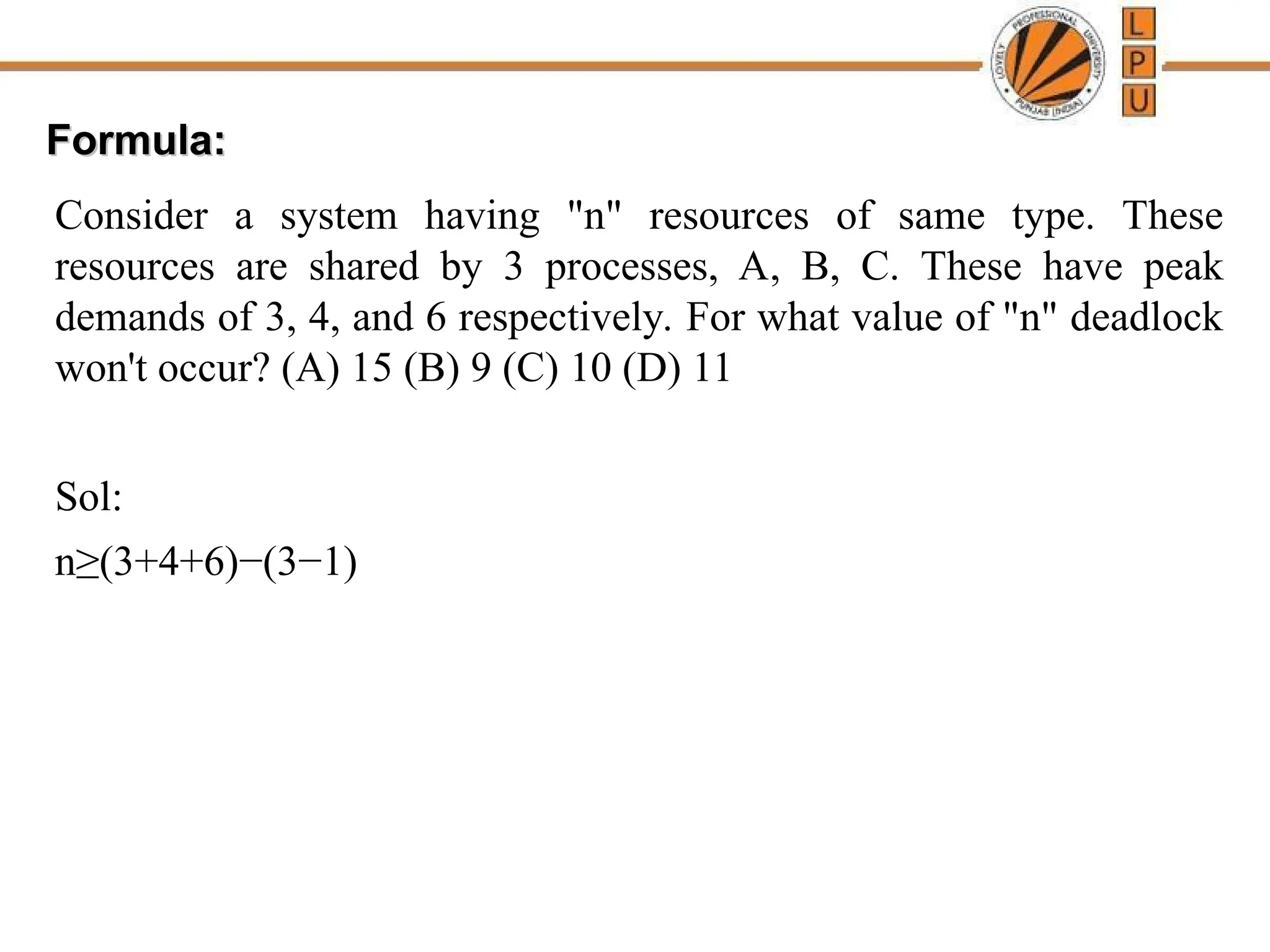
Formula:
Formula:
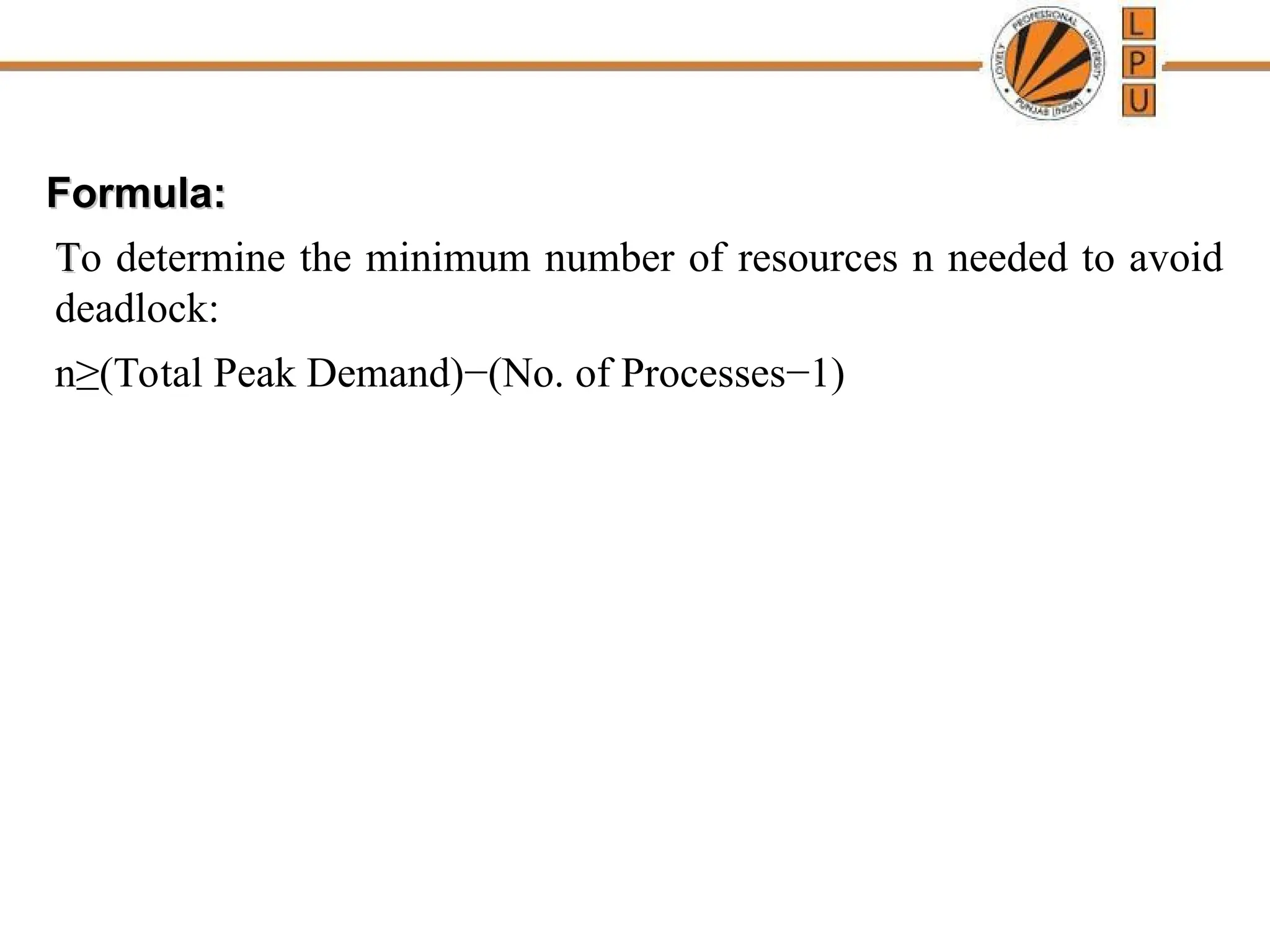
Consider a systemhaving "n" resources of same type. These
resources are shared by 3 processes, A, B, C. These have peak
demands of 3, 4, and 6 respectively. For what value of "n" deadlock
won't occur? (A) 15 (B) 9 (C) 10 (D) 11
Sol:
n≥(3+4+6)−(3−1)


![Data Structures for the Banker’s Algorithm
Data Structures for the Banker’s Algorithm
Available: Vector of length m.
If available [ j ] = k, there are k instances of resource type Rj
available.
Max: Maximum available resources that a process can
request.
If Max [ i , j ] = k, then process Pi may request at most k
instances of resource type Rj.
Let n = number of processes, and m = number of resources types.
i: Process and j: Resource instances](https://image.slidesharecdn.com/deadlocks24252-250423033708-b0c803ad/75/A-ppt-on-deadlock-in-operating-systems-for-the-better-explanation-32-2048.jpg)
![Data Structures for the Banker’s Algorithm
Data Structures for the Banker’s Algorithm
Allocation: Resources that can be allocated
If Allocation[ i , j ] = k then Pi is currently allocated k
instances of R j.
Need: if Need[ i, j ] = k, then Pi may need k more
instances of Rj to complete its task.
Need[i,j] = Max[i,j] – Allocation [i,j]
Let n = number of processes, and m = number of resources types.](https://image.slidesharecdn.com/deadlocks24252-250423033708-b0c803ad/75/A-ppt-on-deadlock-in-operating-systems-for-the-better-explanation-33-2048.jpg)
![Bankers Algorithm
Let Request be the request vector for process Pi.
If Requesti[j] = k then process Pi wants k instances of
resource type Rj
1. If Requesti Needi go to step 2. Otherwise, raise
error condition, since process has exceeded its maximum
claim
2. If Requesti Available, go to step 3. Otherwise Pi
must wait, since resources are not available](https://image.slidesharecdn.com/deadlocks24252-250423033708-b0c803ad/75/A-ppt-on-deadlock-in-operating-systems-for-the-better-explanation-34-2048.jpg)
![Safety Algorithm
1. Let Work and Finish be vectors of length m and n, respectively.
Initialize:
Work = Available
Finish[i] = false for i=0,1,..,n
//{Process I needs resources, resources are still
available}
2. Find an i such that
Finish[i] = false AND Needi Work
If no such i exists, go to step 4
3. Work = Work + Allocationi
Finish[i] = true
go to step 2
4. If Finish[i] == true for all i, then the system is in a safe state](https://image.slidesharecdn.com/deadlocks24252-250423033708-b0c803ad/75/A-ppt-on-deadlock-in-operating-systems-for-the-better-explanation-36-2048.jpg)
![Example: Bankers Algorithm
Consider a system with 5 processes P0 to P4, three resource types A,B,C. Resource
A has 10 instances , B has 5 instances, C has 7 instances. Suppose foll. Is system
snapshot at time T0. Find 1. Need Matrix 2. Is system in safe state?
Available= [(10-7), (5-2), (7-5)] = < 3 3 2>
Need= Maximum – Allocation
Available = Available + Allocated
Safe Sequence<P1, P3, P4, P0, P2>
Process Allocation Maximum Available Need
A B C A B C A B C
P0 0 1 0 7 5 3 3 3 2
P1 2 0 0 3 2 2
P2 3 0 2 9 0 2
P3 2 1 1 2 2 2
P4 0 0 2 4 3 3
<7 2 5>](https://image.slidesharecdn.com/deadlocks24252-250423033708-b0c803ad/75/A-ppt-on-deadlock-in-operating-systems-for-the-better-explanation-38-2048.jpg)

![Deadlock Detection
Deadlock Detection
For Multiple Instances of a Resource
For Multiple Instances of a Resource
Type
Type
Available: A vector of length m indicates the number of available
resources of each resource type.
Allocation: An n x m matrix defines the number of resources of
each type currently allocated to each process.
Request: An n x m matrix indicates the current request of each
process. If Request [ i , j ] = k, then process P i is requesting k more
instances of resource type. R j.
Required data structures:](https://image.slidesharecdn.com/deadlocks24252-250423033708-b0c803ad/75/A-ppt-on-deadlock-in-operating-systems-for-the-better-explanation-46-2048.jpg)
![Detection Algorithm
1. Let Work and Finish be vectors of length m and n, respectively. Initialize:
Work = Availablem
Finish[i] = false if Allocation !=0
= true if Allocation = 0
Requesti
Work
2. Find an i such that
Finish[i] = false AND Requesti Work
If no such i exists, go to step 4
If resources are available:
3. Work = Work + Allocationi
Finish[i] = true
go to step 2
4. If Finish[i] == False for some i then there is a deadlock.](https://image.slidesharecdn.com/deadlocks24252-250423033708-b0c803ad/75/A-ppt-on-deadlock-in-operating-systems-for-the-better-explanation-47-2048.jpg)