LOUIS VUITTON IN JAPAN
Presented
By
Arukwe Chioma J.
Egbunonu Obiora
Ekpuyama Edirin
Mbah Justice C.
Osarumwense Annette
AGENDA
• Case synopsis
• Industry overview
• The Louis Vuitton brand
• Key issues
• Competitive landscape
• Positioning map
• Marketing mix
• SWOT analysis
• PESTEL analysis
• Porters 5 forces
• Recommendations to key issues
• Alternative scenarios
• Recommended strategy
• Potential risks
• Mitigation of risks
• Additional areas of exploration
• Louis Vuitton 2016
• Key learnings
• Conclusion
• References
MISSION STATEMENT
Represent the most refined qualities of
Western Art de Vire
around the world
SYNOPSIS
• Japan appeared to be a very attractive market for louis Vuitton to enter.
• 1977 – Louis Vuitton opened its first stores in Tokyo and Osaka.
• LV entered the Japanese market without a local distributor.
• 1980 - 20 million Japanese women owned a bag of the brand
• 2007- with the expansion the company controlled 54 stores through directly
owned shop network in japan.
• 55% of LV revenue came from Japanese consumers
• Louis Vuitton has an exclusive distribution strategy
SYNOPSIS CONTD
This case deals with the opportunities and challenges of Louis Vuitton in japan , a
top player in the European luxury fashion industry, taking into account the unique
features of brand management ,integrating culture and consumer behaviour.
SYNOPSIS CONTD
• 2002 - decrease in sales in luxury item globally.
• Louis Vuitton was forced to adjust its products offering and approach to local
consumers.
• A new marketing strategy – “limited edition”.
• Collaboration with Japanese artist Takashi Murakami who recreated a colourful
pop version of LV monogram in 33 colours.
• 2003- Profit increased by 10 percent.

• 2006- Change in management
oEstablishing an internet business
oExpanding the range of lv products for children.
SYNOPSIS CONTD
• 2009- Global economic crisis resulted in a decline in sales. Facing a weak
economy and a shift in consumer preferences.
• Different approaches were implemented in Japan
o 7% price reduction
o Market dilution
• In Japan, Louis Vuitton has lots of competitors which make the market saturated
INDUSTRY OVERVIEW
• Market weight
oWorld second largest luxury market (www.McKinsie.com)
o12% - 40% of worldwide sales for luxury brand (HSBC Feb, 2009)
oThe market is Worth $15 billion -$20 (www.McKinsie.com)
• Nature of market
oMature and concentrated market
oWorld highest per capita spending for luxury goods
CONTD
• Categories of buyers
oSenior citizens >65
oYoung working women between 20-35
oHomogenous consumers
• Key success factors
oQuality
oBrand reputation
• The growth rate in Japan stated to decline in 2006
THE LOUIS VUITTON BRAND
• Louis Vuitton Malletier the company's founder was born in 1821 in Anchay, Jura,
France
• Headquarters : Paris, France
• Established: 1854
• In 1854 it launched its first product- Flat Bottom Trunks with Trianon Cavases
• Regional involvement: Global
• In 1885 the firm opened its first overseas firm in London England
THE LOUIS VUITTON BRAND CONTD
• In 1888 its logo Marque Louis Vuitton deposèe was created
• In 1896 George Vuitton created the Monogram Canvas and attained worldwide
trademarks on it to limit counterfeiting
• Revenue in Japan (year end 1st October, 2015)- €25.3 billion (www.lvmh.com)
• Growth in revenue: 18% (www.lvmh.com)
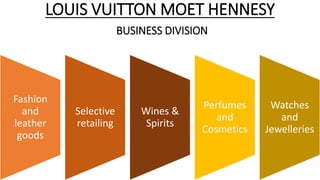
LOUIS VUITTON MOET HENNESY
BUSINESS DIVISION
Fashion
and
leather
goods
Selective
retailing
Wines &
Spirits
Perfumes
and
Cosmetics
Watches
and
Jewelleries
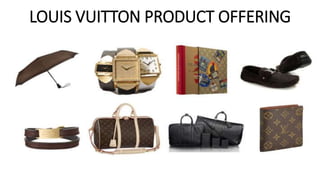
LOUIS VUITTON PRODUCT OFFERING
KEY ISSUES
• 2008 Economic Crisis
• Counterfeiting
• Over dependence on the Japanese market
• Changes in consumer preferences
• Keeping control of its Multinational business
• Market dilution
COMPETITIVE LANDSCAPE
• 11 luxury brands in Japan as at 2005
• 2 main competitors- PRADA and GUCCI
oLong-standing
oWell-established luxury brands that cater to the high-end market
oHigh Quality Materials and Fine Craftsmanship
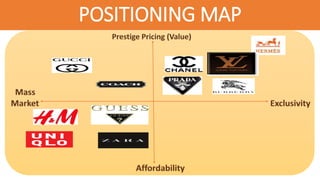
• The brand positioning of Louis Vuitton in Japan as compared to Prada, Gucci and
other fashion brands is based on prestige pricing (value) and exclusivity
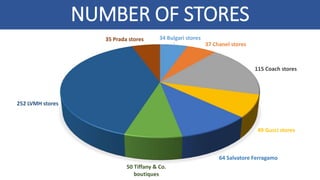
NUMBER OF STORES
34 Bulgari stores
37 Chanel stores
115 Coach stores
49 Gucci stores
64 Salvatore Ferragamo
50 Tiffany & Co.
boutiques
252 LVMH stores
35 Prada stores
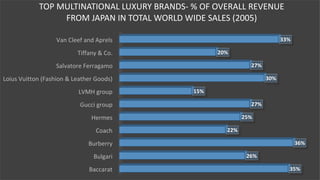
Baccarat
Bulgari
Burberry
Coach
Hermes
Gucci group
LVMH group
Loius Vuitton (Fashion & Leather Goods)
Salvatore Ferragamo
Tiffany & Co.
Van Cleef and Aprels
35%
26%
36%
22%
25%
27%
15%
30%
27%
20%
33%
TOP MULTINATIONAL LUXURY BRANDS- % OF OVERALL REVENUE
FROM JAPAN IN TOTAL WORLD WIDE SALES (2005)
POSITIONING MAP
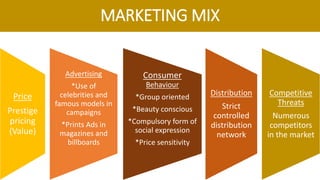
MARKETING MIX
Price
Prestige
pricing
(Value)
Advertising
*Use of
celebrities and
famous models in
campaigns
*Prints Ads in
magazines and
billboards
Consumer
Behaviour
*Group oriented
*Beauty conscious
*Compulsory form of
social expression
*Price sensitivity
Distribution
Strict
controlled
distribution
network
Competitive
Threats
Numerous
competitors
in the market
S.W.O.T ANALYSIS
STRENGTH
• World’s Number one luxury Brand
• Popular and profitable in Japanese market
• Recognizable brand and logo
• Efficient management practices
• Quality products and Lifetime free repairs
• High Productivity and quality control standard
• Teamwork efficiency
STRENGTH CONTD
• Consumer loyalty
• Successful advertising strategy
• Collaboration with well known Japanese Artists
• Strong presence of Louis Vuitton stores in Japanese cities
WEAKNESS
• Expensive and not readily available due to exclusivity
• Brand product not affordable to the average consumer
• Challenges in controlling multinational business
• Marketing strategies are focused on accessing higher income groups
• Large number of luxury competitors
• Decline in sales due to global economic recession
• Falsification of LV logo and market dilution
OPPORTUNITIES
• Consumer’s Long time attachment to Louis Vuitton brand
• Employing highly experienced personnel
• Evolution of ageing of Japanese population
• Increasing demand for high fashion
• Socio Cultural relations with fashion
• Constant innovation and support
THREATS
• World wide Counterfeiting
• High competitive brands
• Challenges arising out of global recession and impact on Japanese customers
• Over dependence on the Japanese market
• Changing taste of customer preferences
• Possible departure of Marc Jacobs
• Keeping control of multinational business
P.E.S.T.E.L. ANALYSIS
POLITICAL FACTORS
• Stable Political environment
• Multi party parliamentary representatives
• Low sales and high cooperate tax rate of 30% (World bank)
• Emerging market
• Member of WTO, APEC, OECD, G-20, G-8
• Open to investment with foreign entrants
ECONOMIC FACTORS
• Annually growing GDP- 4.210 trillion (2015) 0.8% growth rate
• High per capita income – $33,223 (2015)
• Population – 126,422,104 as of Sunday, February 7, 2016, based on the latest
United Nations estimates
• Growing middle class
• Low rate of inflation – 3.2% (may 2014)
• Population below poverty line – 16% (2010)
• Labor force – 65.93 million World Bank
CONTD
• Exports – $697 billion
• Japan Luxury industry annual growth rate – 6%
• Rise of stock price due to economic policy
• Exchange rate - constant exchange rate measurement
• Competitive luxury industry
World Bank
SOCIAL FACTORS
• Group oriented culture
• Exclusive life style
• High demand for luxury goods- mostly women
• Japanese consumers are beauty driven
• Ageing population
• Declining labor force
• Change in consumer preference
TECHNOLOGICAL FACTORS
• Rapid development of Internet
• Most advanced cellular networks – ( source, euro technology)
• Internet users – 122, 799, 736
• High Trend in mobile devices-
oLV is also reckoning its odds in a potential partnership with a technology
company to launch its first smartwatch series (Reisinger, 2014)
World Bank
ENVIRONMENTAL FACTORS
• Mountainous, volcanic island country
• Strong environmental policies
• Inadequate natural resources
• Natural disasters
• Global warming
• Nuclear power threat
• Air pollution
• Acid rain
LEGAL FACTORS
• Intellectual property right protection
• High regulatory hurdles
• Rigid and slow legal process
• No 1 for resolving insolvency in the world
PORTERS 5 FORCES
BARGAINING POWER OF BUYERS/
CONSUMERS (LOW)
• Buyer are insensitive to the price
• Brand loyalty
• High product differentiation
BARGAINING POWER OF SUPPLIERS (LOW)
• Numerous no of suppliers
• Purchasing raw materials from their supplier on the bases of consignment
• Acquisition of key suppliers of leather products
• Manufacturing of products in different locations
• Large pool of suppliers due to strong brand value
THREAT OF NEW ENTRANTS (LOW)
• High barrier into the industry due to the amount of resources required (Capital
expenditure)
• The industry is driven by brand recognition and loyalty and this takes a long time
to build
• Sustainability is also difficult
THREAT OF SUSBSTITUTE PRODUCTS
(MODERATE)
• Large number of relatively low priced products
• As a result of the target group, middle and high class individual who seek luxury
brands to display affluence will still patronise brand regardless of price
• Counterfeiting is a huge problem in the industry
THREAT OF COMPETITORS (MODERATE)
• Several competitors in the market
• Consumer perception of the industry is not based on price alone but image and
quality
OUR RECOMMENDATIONS
• Louis Vuitton should leverage its competitive advantage in building luxury brands
(expansion/diversification)
• Should expand to smaller cities in Japan
• Consider alternative manufacturing sites
• Collaborate with the Japanese and other neighbouring country government to
combat counterfeiting
• Reduce over dependence on the Japanese market and tap into emerging markets
WHAT STEP DO WE TAKE FROM HERE
How could Louis Vuitton reinvent itself and regain what used to
be its well-attested fame in Japan
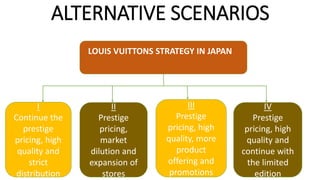
ALTERNATIVE SCENARIOS
LOUIS VUITTONS STRATEGY IN JAPAN
I
Continue the
prestige
pricing, high
quality and
strict
distribution
II
Prestige
pricing,
market
dilution and
expansion of
stores
III
Prestige
pricing, high
quality, more
product
offering and
promotions
IV
Prestige
pricing, high
quality and
continue with
the limited
edition
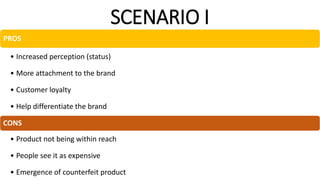
SCENARIO I
PROS
• Increased perception (status)
• More attachment to the brand
• Customer loyalty
• Help differentiate the brand
CONS
• Product not being within reach
• People see it as expensive
• Emergence of counterfeit product
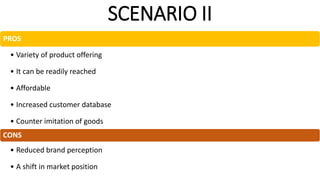
SCENARIO II
PROS
• Variety of product offering
• It can be readily reached
• Affordable
• Increased customer database
• Counter imitation of goods
CONS
• Reduced brand perception
• A shift in market position
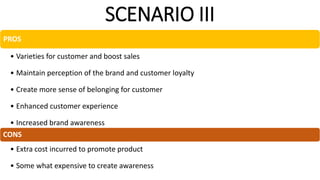
SCENARIO III
PROS
• Varieties for customer and boost sales
• Maintain perception of the brand and customer loyalty
• Create more sense of belonging for customer
• Enhanced customer experience
• Increased brand awareness
CONS
• Extra cost incurred to promote product
• Some what expensive to create awareness
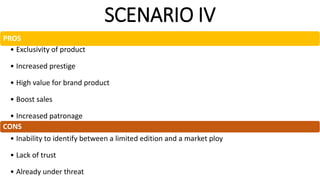
SCENARIO IV
PROS
• Exclusivity of product
• Increased prestige
• High value for brand product
• Boost sales
• Increased patronage
CONS
• Inability to identify between a limited edition and a market ploy
• Lack of trust
• Already under threat
RECOMMENDED STRATEGY
Scenario III
• Prestige pricing (Value)
• High quality
• More product offering
• Promotions
POTENTIAL RISKS
• Loss of customers due to price sensitivity
• Continuous counterfeiting resulting from emerging technological know-how
• Reduction in sales (cyclical) i.e. people waiting for promotion periods
• Increased cost incurred in running promotions
• Recurrent strategy i.e. Competitors imitating louis Vuitton brand strategy
HOW TO MINIMIZE THE IMPACT OF THESE
RISKS
• Superior innovative promotional ideas
• The fashion industry should better collaborate with the Japanese and other
neighbouring country government to combat counterfeiting
• Increase rental option to minimize counterfeiting and instill more sense of
belonging in the Japanese citizens
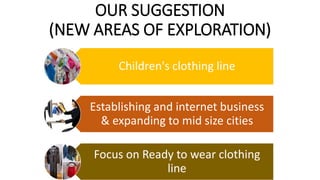
OUR SUGGESTION
(NEW AREAS OF EXPLORATION)
Children's clothing line
Establishing and internet business
& expanding to mid size cities
Focus on Ready to wear clothing
line
WHERE IS LOUIS VUITTON TODAY
• Louis Vuitton continues to provide quality goods for the fashion industry with
uncompromised traditional craftsmanship. LVMH also seeks to provide more
innovative products through collaboration with brands in the other industries.
• The partnership between Louis Vuitton and the German car-maker BMW to
create an exclusive collection of suitcases and bags exemplifies Louis Vuitton's
dedication to the art of travel.
• Louis Vuitton also engages in fighting counterfeits and providing a safer online
shopping experience with Google and eBay in a collaborative effort to protect
CONTD
Intellectual property rights and preserve the value of trusted brands (LVMH,
2014/ Market Watch, 2014)
• LVMH Moët Hennessy Louis Vuitton, the world’s leading luxury products group,
recorded an 18% increase in revenue, reaching €25.3 billion, for the first nine
months of 2015 (www.lvmh.com)
• The Group continues to deliver strong growth in Europe and the United States,
and is seeing an acceleration in Japan.
TEAMS KEY LEARNINGS
• The issues associated with over independence on a particular market
• Brand management, value and positioning
• Use of various market strategy to thrive in an industry/market
• Consumer behaviour and how it impacts the success of a brand
• Change is inevitable
• Key success factors in Japan (centralized system and proximity of stores)
• Exclusivity, brand image and how to maintain customer loyalty in changing economic
environment
CONCLUSION
• Due to the experiences and lessons learnt in Japan, Louis Vuitton has been
building its Global strategy
• The brand is now expanding its strategy towards mid sized and smaller cities
REFERENCES
Louis Vuitton in Japan Ivey 9B10M067
HSBC Feb, 2009
www.McKinsie.com
World bank
www.lvmh.com
QUESTIONS/COMMENTS
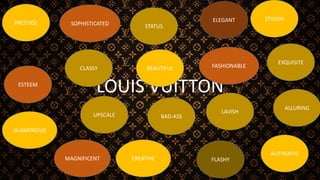
SO! ANYWHERE, WHEN NEXT YOU & I HEAR LOUIS
VUITTON, WHAT SHOULD COME TO OUR MINDS
LOUIS VUITTON
PRESTIGE
LAVISH
CLASSY
ELEGANT
GLAMOROUS
ALLURING
MAGNIFICENT
SOPHISTICATED
FASHIONABLE
UPSCALE
ESTEEM
AUTHENTIC
EXQUISITE
STATUS
FLASHY
BEAUTIFUL
STYLISH
BAD-ASS
CREATIVE

MAJOR LOUIS VUITTON IN JAPAN CLASS PRESENTATION

  • 1.
  • 2.
    Presented By Arukwe Chioma J. EgbunonuObiora Ekpuyama Edirin Mbah Justice C. Osarumwense Annette
  • 3.
    AGENDA • Case synopsis •Industry overview • The Louis Vuitton brand • Key issues • Competitive landscape • Positioning map • Marketing mix • SWOT analysis • PESTEL analysis • Porters 5 forces • Recommendations to key issues • Alternative scenarios • Recommended strategy • Potential risks • Mitigation of risks • Additional areas of exploration • Louis Vuitton 2016 • Key learnings • Conclusion • References
  • 5.
    MISSION STATEMENT Represent themost refined qualities of Western Art de Vire around the world
  • 6.
    SYNOPSIS • Japan appearedto be a very attractive market for louis Vuitton to enter. • 1977 – Louis Vuitton opened its first stores in Tokyo and Osaka. • LV entered the Japanese market without a local distributor. • 1980 - 20 million Japanese women owned a bag of the brand • 2007- with the expansion the company controlled 54 stores through directly owned shop network in japan. • 55% of LV revenue came from Japanese consumers • Louis Vuitton has an exclusive distribution strategy
  • 7.
    SYNOPSIS CONTD This casedeals with the opportunities and challenges of Louis Vuitton in japan , a top player in the European luxury fashion industry, taking into account the unique features of brand management ,integrating culture and consumer behaviour.
  • 8.
    SYNOPSIS CONTD • 2002- decrease in sales in luxury item globally. • Louis Vuitton was forced to adjust its products offering and approach to local consumers. • A new marketing strategy – “limited edition”. • Collaboration with Japanese artist Takashi Murakami who recreated a colourful pop version of LV monogram in 33 colours. • 2003- Profit increased by 10 percent. • 2006- Change in management oEstablishing an internet business oExpanding the range of lv products for children.
  • 9.
    SYNOPSIS CONTD • 2009-Global economic crisis resulted in a decline in sales. Facing a weak economy and a shift in consumer preferences. • Different approaches were implemented in Japan o 7% price reduction o Market dilution • In Japan, Louis Vuitton has lots of competitors which make the market saturated
  • 10.
    INDUSTRY OVERVIEW • Marketweight oWorld second largest luxury market (www.McKinsie.com) o12% - 40% of worldwide sales for luxury brand (HSBC Feb, 2009) oThe market is Worth $15 billion -$20 (www.McKinsie.com) • Nature of market oMature and concentrated market oWorld highest per capita spending for luxury goods
  • 11.
    CONTD • Categories ofbuyers oSenior citizens >65 oYoung working women between 20-35 oHomogenous consumers • Key success factors oQuality oBrand reputation • The growth rate in Japan stated to decline in 2006
  • 12.
    THE LOUIS VUITTONBRAND • Louis Vuitton Malletier the company's founder was born in 1821 in Anchay, Jura, France • Headquarters : Paris, France • Established: 1854 • In 1854 it launched its first product- Flat Bottom Trunks with Trianon Cavases • Regional involvement: Global • In 1885 the firm opened its first overseas firm in London England
  • 13.
    THE LOUIS VUITTONBRAND CONTD • In 1888 its logo Marque Louis Vuitton deposèe was created • In 1896 George Vuitton created the Monogram Canvas and attained worldwide trademarks on it to limit counterfeiting • Revenue in Japan (year end 1st October, 2015)- €25.3 billion (www.lvmh.com) • Growth in revenue: 18% (www.lvmh.com)
  • 14.
    LOUIS VUITTON MOETHENNESY BUSINESS DIVISION Fashion and leather goods Selective retailing Wines & Spirits Perfumes and Cosmetics Watches and Jewelleries
  • 15.
  • 16.
    KEY ISSUES • 2008Economic Crisis • Counterfeiting • Over dependence on the Japanese market • Changes in consumer preferences • Keeping control of its Multinational business • Market dilution
  • 17.
    COMPETITIVE LANDSCAPE • 11luxury brands in Japan as at 2005 • 2 main competitors- PRADA and GUCCI oLong-standing oWell-established luxury brands that cater to the high-end market oHigh Quality Materials and Fine Craftsmanship • The brand positioning of Louis Vuitton in Japan as compared to Prada, Gucci and other fashion brands is based on prestige pricing (value) and exclusivity
  • 18.
    NUMBER OF STORES 34Bulgari stores 37 Chanel stores 115 Coach stores 49 Gucci stores 64 Salvatore Ferragamo 50 Tiffany & Co. boutiques 252 LVMH stores 35 Prada stores
  • 19.
    Baccarat Bulgari Burberry Coach Hermes Gucci group LVMH group LoiusVuitton (Fashion & Leather Goods) Salvatore Ferragamo Tiffany & Co. Van Cleef and Aprels 35% 26% 36% 22% 25% 27% 15% 30% 27% 20% 33% TOP MULTINATIONAL LUXURY BRANDS- % OF OVERALL REVENUE FROM JAPAN IN TOTAL WORLD WIDE SALES (2005)
  • 20.
  • 21.
    MARKETING MIX Price Prestige pricing (Value) Advertising *Use of celebritiesand famous models in campaigns *Prints Ads in magazines and billboards Consumer Behaviour *Group oriented *Beauty conscious *Compulsory form of social expression *Price sensitivity Distribution Strict controlled distribution network Competitive Threats Numerous competitors in the market
  • 23.
  • 24.
    STRENGTH • World’s Numberone luxury Brand • Popular and profitable in Japanese market • Recognizable brand and logo • Efficient management practices • Quality products and Lifetime free repairs • High Productivity and quality control standard • Teamwork efficiency
  • 25.
    STRENGTH CONTD • Consumerloyalty • Successful advertising strategy • Collaboration with well known Japanese Artists • Strong presence of Louis Vuitton stores in Japanese cities
  • 26.
    WEAKNESS • Expensive andnot readily available due to exclusivity • Brand product not affordable to the average consumer • Challenges in controlling multinational business • Marketing strategies are focused on accessing higher income groups • Large number of luxury competitors • Decline in sales due to global economic recession • Falsification of LV logo and market dilution
  • 27.
    OPPORTUNITIES • Consumer’s Longtime attachment to Louis Vuitton brand • Employing highly experienced personnel • Evolution of ageing of Japanese population • Increasing demand for high fashion • Socio Cultural relations with fashion • Constant innovation and support
  • 28.
    THREATS • World wideCounterfeiting • High competitive brands • Challenges arising out of global recession and impact on Japanese customers • Over dependence on the Japanese market • Changing taste of customer preferences • Possible departure of Marc Jacobs • Keeping control of multinational business
  • 29.
  • 30.
    POLITICAL FACTORS • StablePolitical environment • Multi party parliamentary representatives • Low sales and high cooperate tax rate of 30% (World bank) • Emerging market • Member of WTO, APEC, OECD, G-20, G-8 • Open to investment with foreign entrants
  • 31.
    ECONOMIC FACTORS • Annuallygrowing GDP- 4.210 trillion (2015) 0.8% growth rate • High per capita income – $33,223 (2015) • Population – 126,422,104 as of Sunday, February 7, 2016, based on the latest United Nations estimates • Growing middle class • Low rate of inflation – 3.2% (may 2014) • Population below poverty line – 16% (2010) • Labor force – 65.93 million World Bank
  • 32.
    CONTD • Exports –$697 billion • Japan Luxury industry annual growth rate – 6% • Rise of stock price due to economic policy • Exchange rate - constant exchange rate measurement • Competitive luxury industry World Bank
  • 33.
    SOCIAL FACTORS • Grouporiented culture • Exclusive life style • High demand for luxury goods- mostly women • Japanese consumers are beauty driven • Ageing population • Declining labor force • Change in consumer preference
  • 34.
    TECHNOLOGICAL FACTORS • Rapiddevelopment of Internet • Most advanced cellular networks – ( source, euro technology) • Internet users – 122, 799, 736 • High Trend in mobile devices- oLV is also reckoning its odds in a potential partnership with a technology company to launch its first smartwatch series (Reisinger, 2014) World Bank
  • 35.
    ENVIRONMENTAL FACTORS • Mountainous,volcanic island country • Strong environmental policies • Inadequate natural resources • Natural disasters • Global warming • Nuclear power threat • Air pollution • Acid rain
  • 36.
    LEGAL FACTORS • Intellectualproperty right protection • High regulatory hurdles • Rigid and slow legal process • No 1 for resolving insolvency in the world
  • 37.
  • 38.
    BARGAINING POWER OFBUYERS/ CONSUMERS (LOW) • Buyer are insensitive to the price • Brand loyalty • High product differentiation
  • 39.
    BARGAINING POWER OFSUPPLIERS (LOW) • Numerous no of suppliers • Purchasing raw materials from their supplier on the bases of consignment • Acquisition of key suppliers of leather products • Manufacturing of products in different locations • Large pool of suppliers due to strong brand value
  • 40.
    THREAT OF NEWENTRANTS (LOW) • High barrier into the industry due to the amount of resources required (Capital expenditure) • The industry is driven by brand recognition and loyalty and this takes a long time to build • Sustainability is also difficult
  • 41.
    THREAT OF SUSBSTITUTEPRODUCTS (MODERATE) • Large number of relatively low priced products • As a result of the target group, middle and high class individual who seek luxury brands to display affluence will still patronise brand regardless of price • Counterfeiting is a huge problem in the industry
  • 42.
    THREAT OF COMPETITORS(MODERATE) • Several competitors in the market • Consumer perception of the industry is not based on price alone but image and quality
  • 43.
    OUR RECOMMENDATIONS • LouisVuitton should leverage its competitive advantage in building luxury brands (expansion/diversification) • Should expand to smaller cities in Japan • Consider alternative manufacturing sites • Collaborate with the Japanese and other neighbouring country government to combat counterfeiting • Reduce over dependence on the Japanese market and tap into emerging markets
  • 44.
    WHAT STEP DOWE TAKE FROM HERE How could Louis Vuitton reinvent itself and regain what used to be its well-attested fame in Japan
  • 45.
    ALTERNATIVE SCENARIOS LOUIS VUITTONSSTRATEGY IN JAPAN I Continue the prestige pricing, high quality and strict distribution II Prestige pricing, market dilution and expansion of stores III Prestige pricing, high quality, more product offering and promotions IV Prestige pricing, high quality and continue with the limited edition
  • 46.
    SCENARIO I PROS • Increasedperception (status) • More attachment to the brand • Customer loyalty • Help differentiate the brand CONS • Product not being within reach • People see it as expensive • Emergence of counterfeit product
  • 47.
    SCENARIO II PROS • Varietyof product offering • It can be readily reached • Affordable • Increased customer database • Counter imitation of goods CONS • Reduced brand perception • A shift in market position
  • 48.
    SCENARIO III PROS • Varietiesfor customer and boost sales • Maintain perception of the brand and customer loyalty • Create more sense of belonging for customer • Enhanced customer experience • Increased brand awareness CONS • Extra cost incurred to promote product • Some what expensive to create awareness
  • 49.
    SCENARIO IV PROS • Exclusivityof product • Increased prestige • High value for brand product • Boost sales • Increased patronage CONS • Inability to identify between a limited edition and a market ploy • Lack of trust • Already under threat
  • 50.
    RECOMMENDED STRATEGY Scenario III •Prestige pricing (Value) • High quality • More product offering • Promotions
  • 51.
    POTENTIAL RISKS • Lossof customers due to price sensitivity • Continuous counterfeiting resulting from emerging technological know-how • Reduction in sales (cyclical) i.e. people waiting for promotion periods • Increased cost incurred in running promotions • Recurrent strategy i.e. Competitors imitating louis Vuitton brand strategy
  • 52.
    HOW TO MINIMIZETHE IMPACT OF THESE RISKS • Superior innovative promotional ideas • The fashion industry should better collaborate with the Japanese and other neighbouring country government to combat counterfeiting • Increase rental option to minimize counterfeiting and instill more sense of belonging in the Japanese citizens
  • 53.
    OUR SUGGESTION (NEW AREASOF EXPLORATION) Children's clothing line Establishing and internet business & expanding to mid size cities Focus on Ready to wear clothing line
  • 54.
    WHERE IS LOUISVUITTON TODAY • Louis Vuitton continues to provide quality goods for the fashion industry with uncompromised traditional craftsmanship. LVMH also seeks to provide more innovative products through collaboration with brands in the other industries. • The partnership between Louis Vuitton and the German car-maker BMW to create an exclusive collection of suitcases and bags exemplifies Louis Vuitton's dedication to the art of travel. • Louis Vuitton also engages in fighting counterfeits and providing a safer online shopping experience with Google and eBay in a collaborative effort to protect
  • 55.
    CONTD Intellectual property rightsand preserve the value of trusted brands (LVMH, 2014/ Market Watch, 2014) • LVMH Moët Hennessy Louis Vuitton, the world’s leading luxury products group, recorded an 18% increase in revenue, reaching €25.3 billion, for the first nine months of 2015 (www.lvmh.com) • The Group continues to deliver strong growth in Europe and the United States, and is seeing an acceleration in Japan.
  • 56.
    TEAMS KEY LEARNINGS •The issues associated with over independence on a particular market • Brand management, value and positioning • Use of various market strategy to thrive in an industry/market • Consumer behaviour and how it impacts the success of a brand • Change is inevitable • Key success factors in Japan (centralized system and proximity of stores) • Exclusivity, brand image and how to maintain customer loyalty in changing economic environment
  • 57.
    CONCLUSION • Due tothe experiences and lessons learnt in Japan, Louis Vuitton has been building its Global strategy • The brand is now expanding its strategy towards mid sized and smaller cities
  • 58.
    REFERENCES Louis Vuitton inJapan Ivey 9B10M067 HSBC Feb, 2009 www.McKinsie.com World bank www.lvmh.com
  • 59.
  • 60.
    SO! ANYWHERE, WHENNEXT YOU & I HEAR LOUIS VUITTON, WHAT SHOULD COME TO OUR MINDS
  • 61.