Group 4
Rhythm Malhotra
Rajat Verma
Rohan Dabas
Pramey zode
Rahul Bose
Sai Charan
De Beers
Symbiosis Institute of Business Management, Bengaluru 1
History : De Beers and the Diamond Cartel
Symbiosis Institute of Business Management, Bengaluru 2
1866 : Accidental discovery of diamonds in South Africa
1869 : Around 10000 miners rushed to Cape Province to stake their claim
1872 : Five separate mines were established in Cape Province
1874 : Steam powered pumps arrived at Kimberly mine
Symbiosis Institute of Business Management, Bengaluru 3
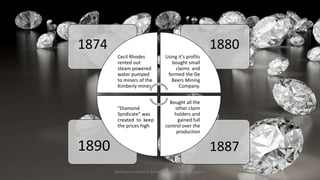
Evolution of De Beers
Symbiosis Institute of Business Management, Bengaluru 4
Cecil Rhodes
rented out
steam powered
water pumped
to miners of the
Kimberly mines.
Using it’s profits
bought small
claims and
formed the De
Beers Mining
Company.
Bought all the
other claim
holders and
gained full
control over the
production
“Diamond
Syndicate” was
created to keep
the prices high
1874 1880
1890 1887
Symbiosis Institute of Business Management, Bengaluru 5
Causes for emergence of De Beers Monopoly
Symbiosis Institute of Business Management, Bengaluru 6
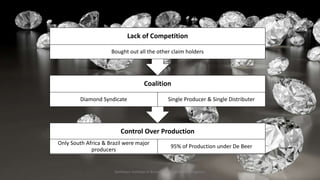
Control Over Production
Only South Africa & Brazil were major
producers
95% of Production under De Beer
Coalition
Diamond Syndicate Single Producer & Single Distributer
Lack of Competition
Bought out all the other claim holders
Symbiosis Institute of Business Management, Bengaluru 7
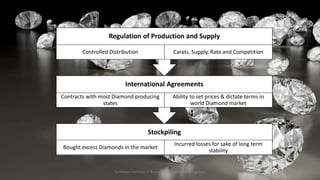
Stockpiling
Bought excess Diamonds in the market
Incurred losses for sake of long term
stability
International Agreements
Contracts with most Diamond producing
states
Ability to set prices & dictate terms in
world Diamond market
Regulation of Production and Supply
Controlled Distribution Carats, Supply, Rate and Competition
Symbiosis Institute of Business Management, Bengaluru 8
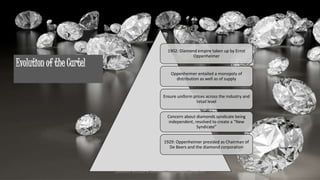
1902: Diamond empire taken up by Ernst
Oppenheimer
Oppenheimer entailed a monopoly of
distribution as well as of supply
Ensure uniform prices across the industry and
retail level
Concern about diamonds syndicate being
independent, resolved to create a “New
Syndicate”
1929: Oppenheimer presided as Chairman of
De Beers and the diamond corporation
Evolution of the Cartel
Symbiosis Institute of Business Management, Bengaluru 9
Cartel in Action
Symbiosis Institute of Business Management, Bengaluru 10
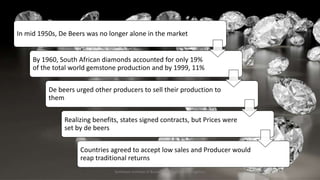
In mid 1950s, De Beers was no longer alone in the market
By 1960, South African diamonds accounted for only 19%
of the total world gemstone production and by 1999, 11%
De beers urged other producers to sell their production to
them
Realizing benefits, states signed contracts, but Prices were
set by de beers
Countries agreed to accept low sales and Producer would
reap traditional returns
Symbiosis Institute of Business Management, Bengaluru 11
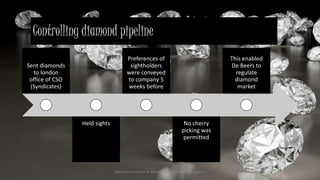
Controlling diamond pipeline
Sent diamonds
to london
office of CSO
(Syndicates)
Held sights
Preferences of
sightholders
were conveyed
to company 5
weeks before
No cherry
picking was
permitted
This enabled
De Beers to
regulate
diamond
market
Symbiosis Institute of Business Management, Bengaluru 12
Stockpiling
Whenever market weakened, De Beers would buy up excess stones
Whenever outside diamonds found their way to market, De Beers would buy them
Always ensured that supply-demand balance did not flatter
Symbiosis Institute of Business Management, Bengaluru 13
Reasons for loss of De Beers monopoly
Symbiosis Institute of Business Management, Bengaluru 14
1977: Trouble from Israel's soaring inflation who hoarded their diamonds
and drove prices up
1981: Zaire threatened to destabilize the industry
Soviets and Russians threatened periodically to withdraw from the De Beers
structure
1992: double blow of Russian and Angolan defections, who leaked
diamonds onto the world market
The stockpile continued to grow
1997: Asian crisis swept through the far East
Symbiosis Institute of Business Management, Bengaluru 15
Diamond sales in Japan fell from 33% to 18% between 1997 and 1998
Depressed De Beers sales and the share price
Brought a new wave of value investors from the united states who saw
opportunity for financial gain in the depressed share prices.
Accountants started prying into De Beer’s financial management and
scrutinized the ever growing weight of the stock piles.
March 1998, De beers and Anglo-American became two distinct firms.
After isolation, it moved to the world market
Symbiosis Institute of Business Management, Bengaluru 16
Strategic Review
Outside perspective
New investors criticized De Beers
Its accounting methods could not be understood
Heavily invested in Anglo-American
Significant legal issues in US
Followed traditional business model
Stockpiling
Symbiosis Institute of Business Management, Bengaluru 17
Strengths
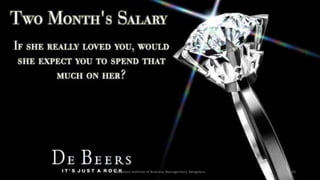
Tremendous brand name – one of the world’s best recognized
Brilliant history of marketing
Spent less than 1% on advertising
Advertised diamonds on behalf of the entire industry
Symbiosis Institute of Business Management, Bengaluru 18
Symbiosis Institute of Business Management, Bengaluru 19
Symbiosis Institute of Business Management, Bengaluru 20
Millennial Campaign
It was the first attempt to brand gems, to sell a “De Beers diamond”
rather that a regular diamond
The campaign occurred at a time of rapid change
The campaign was centered in the US
Symbiosis Institute of Business Management, Bengaluru 21
Power of the brand
Innovative branding strategy
Emphasized the De Beers name in advertisements
Etched microscopic logo on to the stones
 De Beers was worth anywhere from $175m in rough stones up to
$1.25b at retail jewelry level
Create a De Beers luxury store or a line of high end fashion
assessments
De Beers “single channel marketing” brought social goals and
benefits to all involved
Symbiosis Institute of Business Management, Bengaluru 22
U.S. Anti-trust law
Symbiosis Institute of Business Management, Bengaluru 23
De Beers violated the fundamental underpinnings of capitalism as
practiced in US
1890: The Sherman Act
It made illegal “Every contract, combination in the form of trust or
otherwise, or conspiracy, in restraint of trade or commerce”
1914: Clayton Act
It broadened the definition of unacceptable behavior and prohibiting
any illegal behavior that might “substantially lessen competition or
tend to create a monopoly in any line of commerce”
Symbiosis Institute of Business Management, Bengaluru 24
Despite the facts that De Beers retained no US presence and was
completely run by South African nationals it was still subject to reach
of the US law
The justice department had tried on several occasions to prosecute
De Beers for violating US antitrust law
In 1945, investigation ordered against De Beers
The suit failed as maintaining a bank account did not constitute
sufficient “doing of business” to warrant jurisdiction
1976: civil and criminal suit against the firm. It paid a small fine and
signed a consent agreeing to forego monopolistic practices
Symbiosis Institute of Business Management, Bengaluru 25
In 1984, Justice Department filed a suit against De Beers and GE, for
price fixing in industry diamonds market
Spring of 1992, GE and De Beers raised their prices on industrial
diamonds
The government argued that the exchange of price information
between GE and De Beers was a part of conspiracy to fixed prices
But there was no evidence of collusion
GE was acquitted
De Beers never appeared in court to defend itself
De Beers had simply come up with series of ingenious strategies for
remaining beyond the departments’ grasp
Symbiosis Institute of Business Management, Bengaluru 26
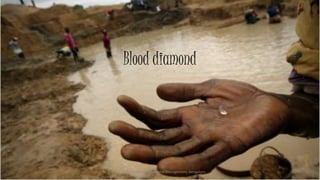
Blood diamond
Symbiosis Institute of Business Management, Bengaluru 27
Blood diamonds, also called conflict diamonds is a term used for a diamond mined in a
war zone and sold to finance an insurgency, an invading army's war efforts, or a warlord
's activity.
Blood
Diamond
Diamonds mined in Africa
are prone to being traded
in exchange for arms
which are used in civil
wars
Africa with its rich and
varied mineral wealth is
also a target of
‘colonizing’ corporations.
These are backed up by
governments of several
developed economies and
plundering African politicians.
Since the atrocities of
wars financed by illegal
diamond trade have been
publicized the diamond
trade has become a
heavily albeit imperfectly
regulated business.
Symbiosis Institute of Business Management, Bengaluru 28
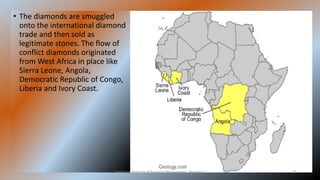
• The diamonds are smuggled
onto the international diamond
trade and then sold as
legitimate stones. The flow of
conflict diamonds originated
from West Africa in place like
Sierra Leone, Angola,
Democratic Republic of Congo,
Liberia and Ivory Coast.
Symbiosis Institute of Business Management, Bengaluru 29
Diamonds
that are
mined are
sold to
middlemen
The money
paid for the
diamond ends
up financing
the war
(buying guns
and ammo,
recruiting
soldiers)
This war is
waged for
control over
more diamonds
The money
doesn't reach
the local
population who
the warlord
claim to
represent.
Instead the
money lines the
pockets of
corrupt officials
This plundering
of natural
mineral wealth
leaves the
nation poor
and bereft of
benefits
Symbiosis Institute of Business Management, Bengaluru 30
The diamond and jewellery industry has been very
aware of the conflict diamond problem for a number
of years now.
The Diamond Council has been working to ensure that
only legitimate diamonds, which are conflict free,
come into the diamond industry.
With this in mind the Kimberley process was set up
through the United Nations in the year 2000 when
approximately 4% of the worlds trade involved conflict
diamonds, now that figure is less than 1% and by
working together.
Symbiosis Institute of Business Management, Bengaluru 31
Kimberley
Process
Certification
System
A System of Warranties
to further assure
consumers of their
diamonds
Once imported, a
written statement must
accompany all invoices,
guaranteeing that the
diamonds being sold are
from legitimate sources. Under this system, every
buyer and seller of
polished diamonds and
jewellery containing
diamonds must provide
a assurance statement
on all invoices.
Symbiosis Institute of Business Management, Bengaluru 32
thank you
Symbiosis Institute of Business Management, Bengaluru 33

Harvard Business School Case Study | De Beers Monopoly

  • 1.
    Group 4 Rhythm Malhotra RajatVerma Rohan Dabas Pramey zode Rahul Bose Sai Charan De Beers Symbiosis Institute of Business Management, Bengaluru 1
  • 2.
    History : DeBeers and the Diamond Cartel Symbiosis Institute of Business Management, Bengaluru 2
  • 3.
    1866 : Accidentaldiscovery of diamonds in South Africa 1869 : Around 10000 miners rushed to Cape Province to stake their claim 1872 : Five separate mines were established in Cape Province 1874 : Steam powered pumps arrived at Kimberly mine Symbiosis Institute of Business Management, Bengaluru 3
  • 4.
    Evolution of DeBeers Symbiosis Institute of Business Management, Bengaluru 4
  • 5.
    Cecil Rhodes rented out steampowered water pumped to miners of the Kimberly mines. Using it’s profits bought small claims and formed the De Beers Mining Company. Bought all the other claim holders and gained full control over the production “Diamond Syndicate” was created to keep the prices high 1874 1880 1890 1887 Symbiosis Institute of Business Management, Bengaluru 5
  • 6.
    Causes for emergenceof De Beers Monopoly Symbiosis Institute of Business Management, Bengaluru 6
  • 7.
    Control Over Production OnlySouth Africa & Brazil were major producers 95% of Production under De Beer Coalition Diamond Syndicate Single Producer & Single Distributer Lack of Competition Bought out all the other claim holders Symbiosis Institute of Business Management, Bengaluru 7
  • 8.
    Stockpiling Bought excess Diamondsin the market Incurred losses for sake of long term stability International Agreements Contracts with most Diamond producing states Ability to set prices & dictate terms in world Diamond market Regulation of Production and Supply Controlled Distribution Carats, Supply, Rate and Competition Symbiosis Institute of Business Management, Bengaluru 8
  • 9.
    1902: Diamond empiretaken up by Ernst Oppenheimer Oppenheimer entailed a monopoly of distribution as well as of supply Ensure uniform prices across the industry and retail level Concern about diamonds syndicate being independent, resolved to create a “New Syndicate” 1929: Oppenheimer presided as Chairman of De Beers and the diamond corporation Evolution of the Cartel Symbiosis Institute of Business Management, Bengaluru 9
  • 10.
    Cartel in Action SymbiosisInstitute of Business Management, Bengaluru 10
  • 11.
    In mid 1950s,De Beers was no longer alone in the market By 1960, South African diamonds accounted for only 19% of the total world gemstone production and by 1999, 11% De beers urged other producers to sell their production to them Realizing benefits, states signed contracts, but Prices were set by de beers Countries agreed to accept low sales and Producer would reap traditional returns Symbiosis Institute of Business Management, Bengaluru 11
  • 12.
    Controlling diamond pipeline Sentdiamonds to london office of CSO (Syndicates) Held sights Preferences of sightholders were conveyed to company 5 weeks before No cherry picking was permitted This enabled De Beers to regulate diamond market Symbiosis Institute of Business Management, Bengaluru 12
  • 13.
    Stockpiling Whenever market weakened,De Beers would buy up excess stones Whenever outside diamonds found their way to market, De Beers would buy them Always ensured that supply-demand balance did not flatter Symbiosis Institute of Business Management, Bengaluru 13
  • 14.
    Reasons for lossof De Beers monopoly Symbiosis Institute of Business Management, Bengaluru 14
  • 15.
    1977: Trouble fromIsrael's soaring inflation who hoarded their diamonds and drove prices up 1981: Zaire threatened to destabilize the industry Soviets and Russians threatened periodically to withdraw from the De Beers structure 1992: double blow of Russian and Angolan defections, who leaked diamonds onto the world market The stockpile continued to grow 1997: Asian crisis swept through the far East Symbiosis Institute of Business Management, Bengaluru 15
  • 16.
    Diamond sales inJapan fell from 33% to 18% between 1997 and 1998 Depressed De Beers sales and the share price Brought a new wave of value investors from the united states who saw opportunity for financial gain in the depressed share prices. Accountants started prying into De Beer’s financial management and scrutinized the ever growing weight of the stock piles. March 1998, De beers and Anglo-American became two distinct firms. After isolation, it moved to the world market Symbiosis Institute of Business Management, Bengaluru 16
  • 17.
    Strategic Review Outside perspective Newinvestors criticized De Beers Its accounting methods could not be understood Heavily invested in Anglo-American Significant legal issues in US Followed traditional business model Stockpiling Symbiosis Institute of Business Management, Bengaluru 17
  • 18.
    Strengths Tremendous brand name– one of the world’s best recognized Brilliant history of marketing Spent less than 1% on advertising Advertised diamonds on behalf of the entire industry Symbiosis Institute of Business Management, Bengaluru 18
  • 19.
    Symbiosis Institute ofBusiness Management, Bengaluru 19
  • 20.
    Symbiosis Institute ofBusiness Management, Bengaluru 20
  • 21.
    Millennial Campaign It wasthe first attempt to brand gems, to sell a “De Beers diamond” rather that a regular diamond The campaign occurred at a time of rapid change The campaign was centered in the US Symbiosis Institute of Business Management, Bengaluru 21
  • 22.
    Power of thebrand Innovative branding strategy Emphasized the De Beers name in advertisements Etched microscopic logo on to the stones  De Beers was worth anywhere from $175m in rough stones up to $1.25b at retail jewelry level Create a De Beers luxury store or a line of high end fashion assessments De Beers “single channel marketing” brought social goals and benefits to all involved Symbiosis Institute of Business Management, Bengaluru 22
  • 23.
    U.S. Anti-trust law SymbiosisInstitute of Business Management, Bengaluru 23
  • 24.
    De Beers violatedthe fundamental underpinnings of capitalism as practiced in US 1890: The Sherman Act It made illegal “Every contract, combination in the form of trust or otherwise, or conspiracy, in restraint of trade or commerce” 1914: Clayton Act It broadened the definition of unacceptable behavior and prohibiting any illegal behavior that might “substantially lessen competition or tend to create a monopoly in any line of commerce” Symbiosis Institute of Business Management, Bengaluru 24
  • 25.
    Despite the factsthat De Beers retained no US presence and was completely run by South African nationals it was still subject to reach of the US law The justice department had tried on several occasions to prosecute De Beers for violating US antitrust law In 1945, investigation ordered against De Beers The suit failed as maintaining a bank account did not constitute sufficient “doing of business” to warrant jurisdiction 1976: civil and criminal suit against the firm. It paid a small fine and signed a consent agreeing to forego monopolistic practices Symbiosis Institute of Business Management, Bengaluru 25
  • 26.
    In 1984, JusticeDepartment filed a suit against De Beers and GE, for price fixing in industry diamonds market Spring of 1992, GE and De Beers raised their prices on industrial diamonds The government argued that the exchange of price information between GE and De Beers was a part of conspiracy to fixed prices But there was no evidence of collusion GE was acquitted De Beers never appeared in court to defend itself De Beers had simply come up with series of ingenious strategies for remaining beyond the departments’ grasp Symbiosis Institute of Business Management, Bengaluru 26
  • 27.
    Blood diamond Symbiosis Instituteof Business Management, Bengaluru 27
  • 28.
    Blood diamonds, alsocalled conflict diamonds is a term used for a diamond mined in a war zone and sold to finance an insurgency, an invading army's war efforts, or a warlord 's activity. Blood Diamond Diamonds mined in Africa are prone to being traded in exchange for arms which are used in civil wars Africa with its rich and varied mineral wealth is also a target of ‘colonizing’ corporations. These are backed up by governments of several developed economies and plundering African politicians. Since the atrocities of wars financed by illegal diamond trade have been publicized the diamond trade has become a heavily albeit imperfectly regulated business. Symbiosis Institute of Business Management, Bengaluru 28
  • 29.
    • The diamondsare smuggled onto the international diamond trade and then sold as legitimate stones. The flow of conflict diamonds originated from West Africa in place like Sierra Leone, Angola, Democratic Republic of Congo, Liberia and Ivory Coast. Symbiosis Institute of Business Management, Bengaluru 29
  • 30.
    Diamonds that are mined are soldto middlemen The money paid for the diamond ends up financing the war (buying guns and ammo, recruiting soldiers) This war is waged for control over more diamonds The money doesn't reach the local population who the warlord claim to represent. Instead the money lines the pockets of corrupt officials This plundering of natural mineral wealth leaves the nation poor and bereft of benefits Symbiosis Institute of Business Management, Bengaluru 30
  • 31.
    The diamond andjewellery industry has been very aware of the conflict diamond problem for a number of years now. The Diamond Council has been working to ensure that only legitimate diamonds, which are conflict free, come into the diamond industry. With this in mind the Kimberley process was set up through the United Nations in the year 2000 when approximately 4% of the worlds trade involved conflict diamonds, now that figure is less than 1% and by working together. Symbiosis Institute of Business Management, Bengaluru 31
  • 32.
    Kimberley Process Certification System A System ofWarranties to further assure consumers of their diamonds Once imported, a written statement must accompany all invoices, guaranteeing that the diamonds being sold are from legitimate sources. Under this system, every buyer and seller of polished diamonds and jewellery containing diamonds must provide a assurance statement on all invoices. Symbiosis Institute of Business Management, Bengaluru 32
  • 33.
    thank you Symbiosis Instituteof Business Management, Bengaluru 33