Data flow modelling
Modeling the Dataflow way
• Uses statements that defines the actual flow of
data.....
such as,
x <= y -- this is NOT less than equal
This assigns the boolean signal x to the value of
boolean signal y... i.e. x = y
this will occur whenever y changes....
Concurrent Statements
● Concurrent statements are executed at the same time,
independent of the order in which they appear
architecture……
Begin
A<=B;
Z<=A;
End;
Process model(in behavioral modeling)
for this
Architecture..
Begin
process (B)
A<=B;
Z<=A;
end process;
end;
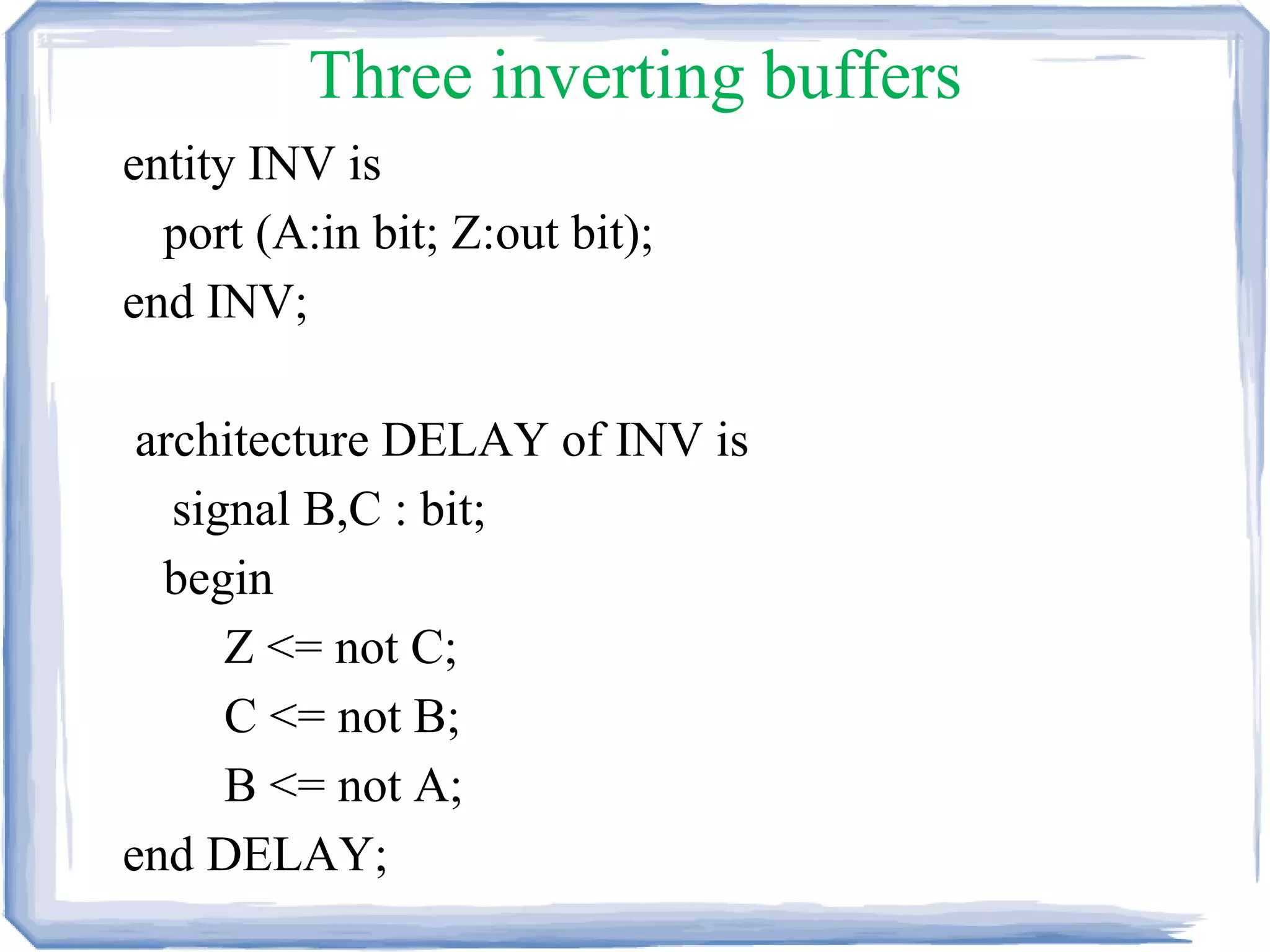
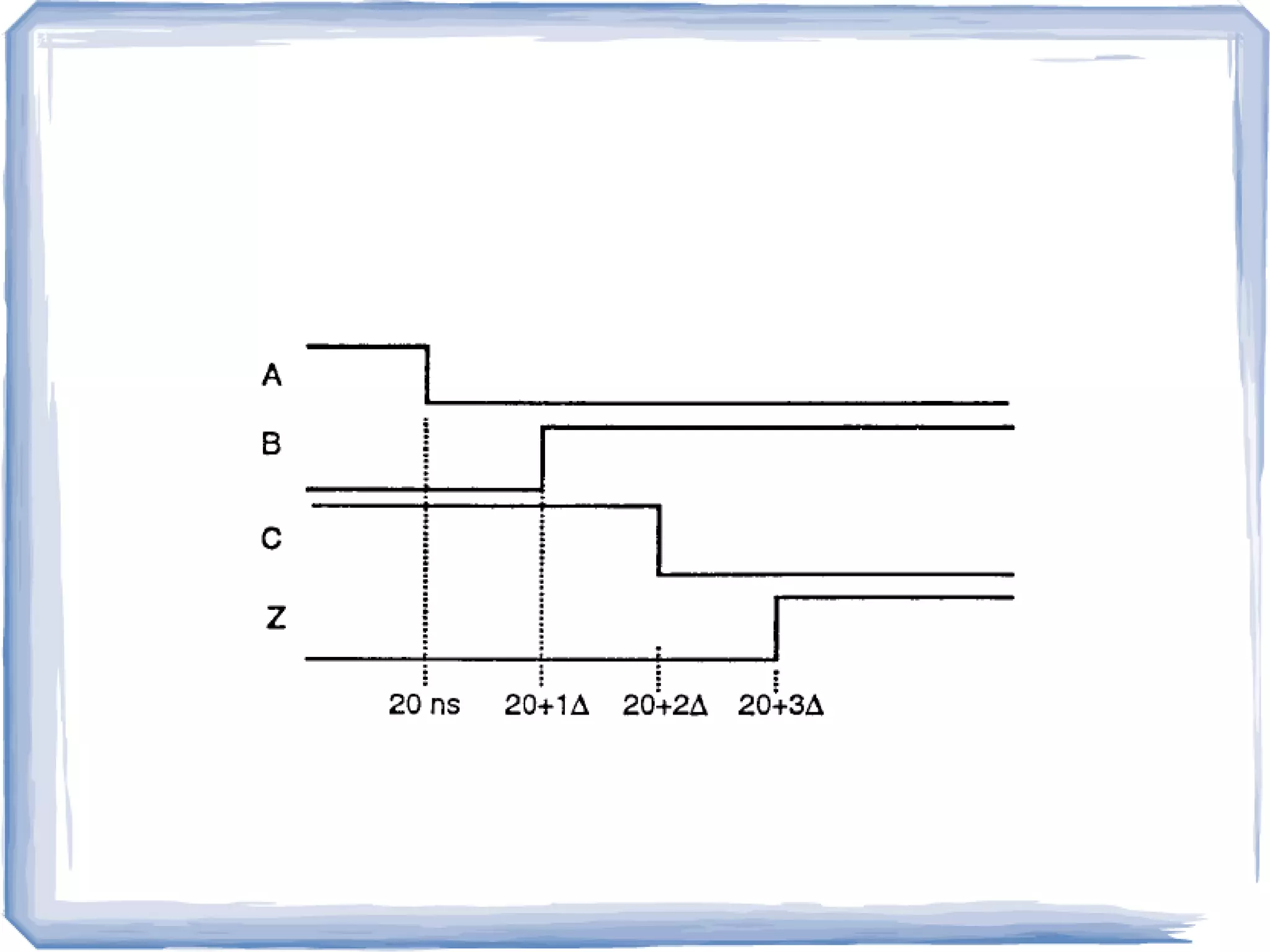
Three inverting buffers
entity INV is
port (A:in bit; Z:out bit);
end INV;
architecture DELAY of INV is
signal B,C : bit;
begin
Z <= not C;
C <= not B;
B <= not A;
end DELAY;
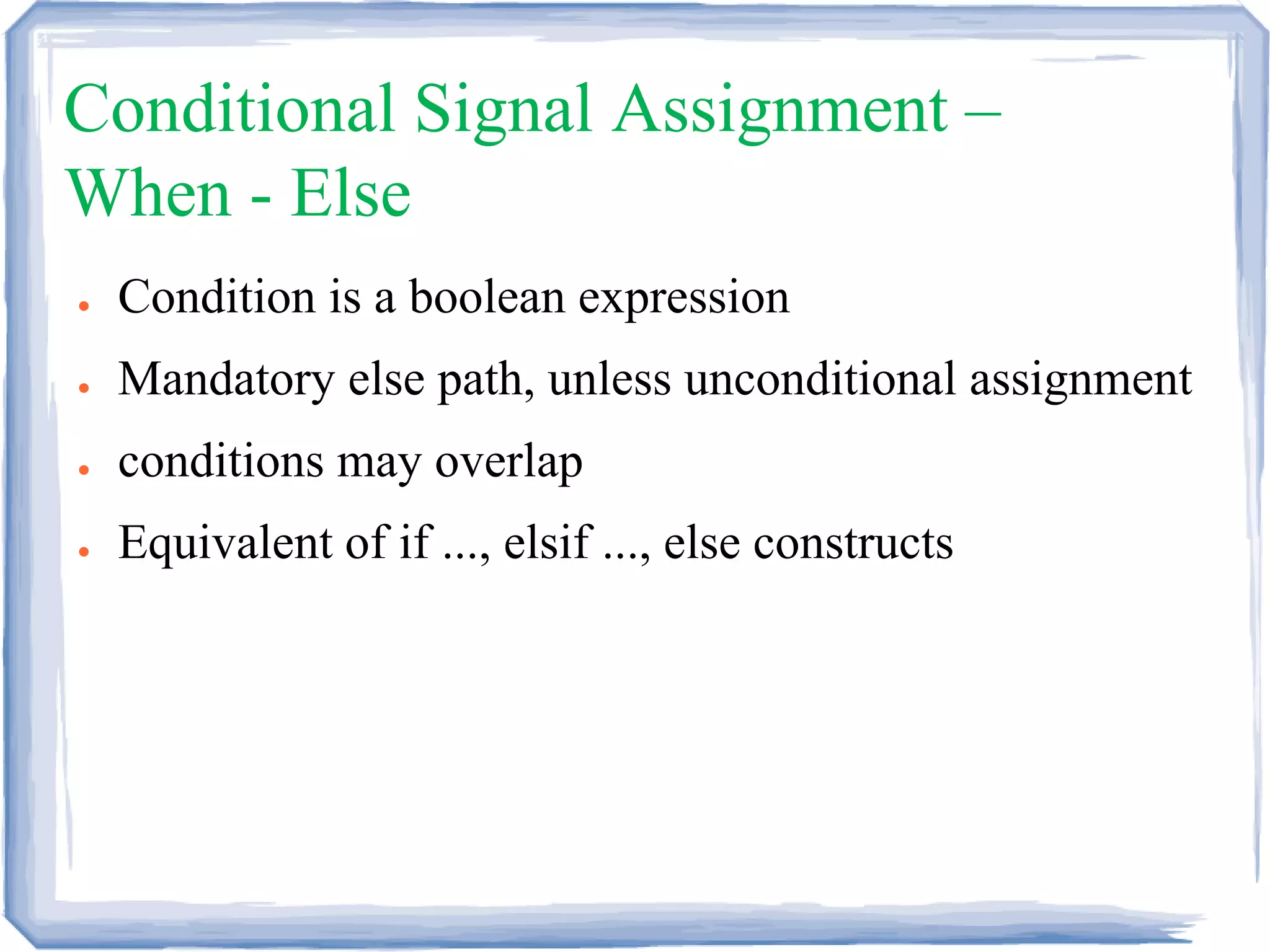
Conditional Signal Assignment –
When - Else
● Condition is a boolean expression
● Mandatory else path, unless unconditional assignment
● conditions may overlap
● Equivalent of if ..., elsif ..., else constructs
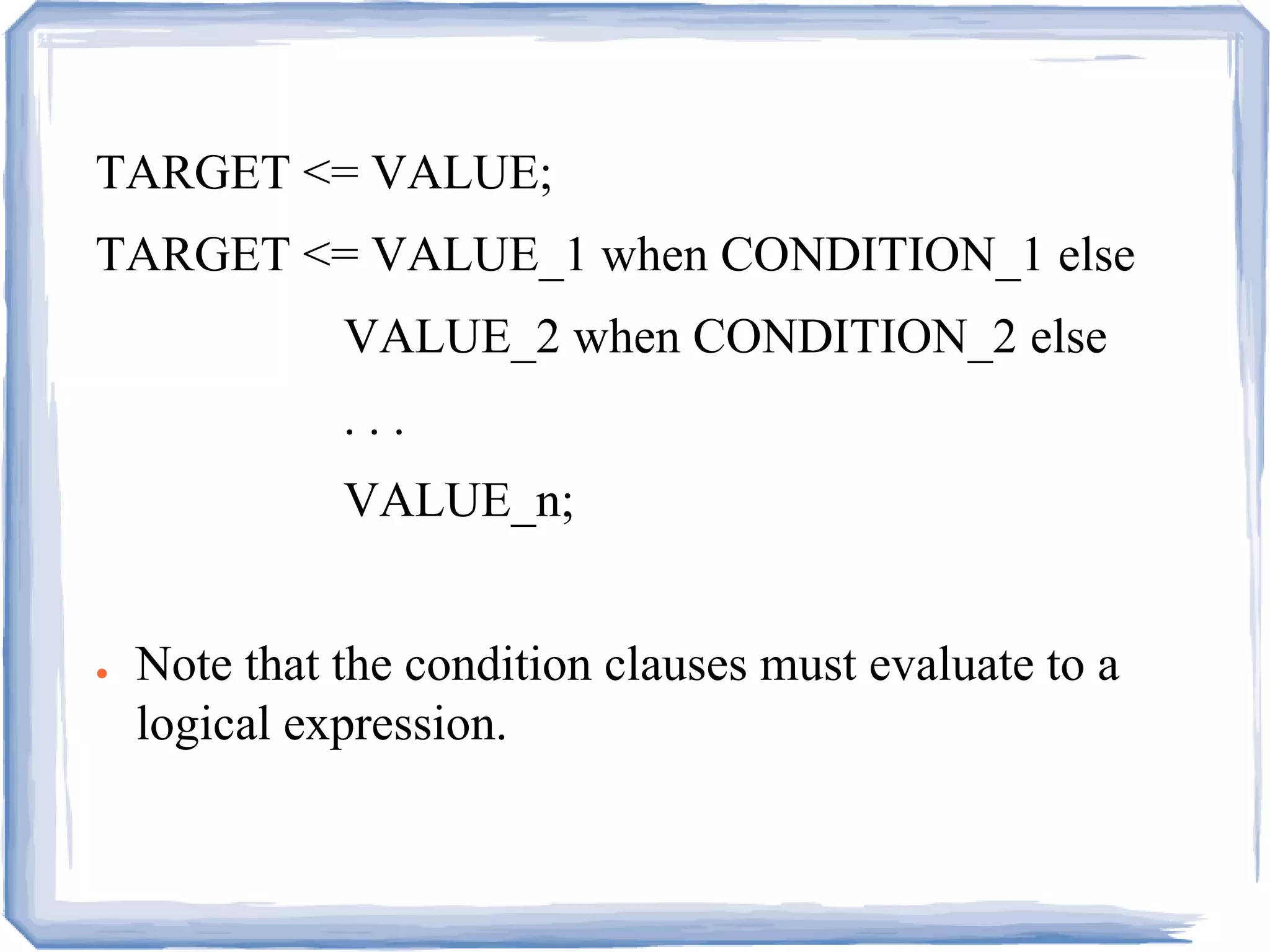
TARGET <= VALUE;
TARGET <= VALUE_1 when CONDITION_1 else
VALUE_2 when CONDITION_2 else
. . .
VALUE_n;
● Note that the condition clauses must evaluate to a
logical expression.
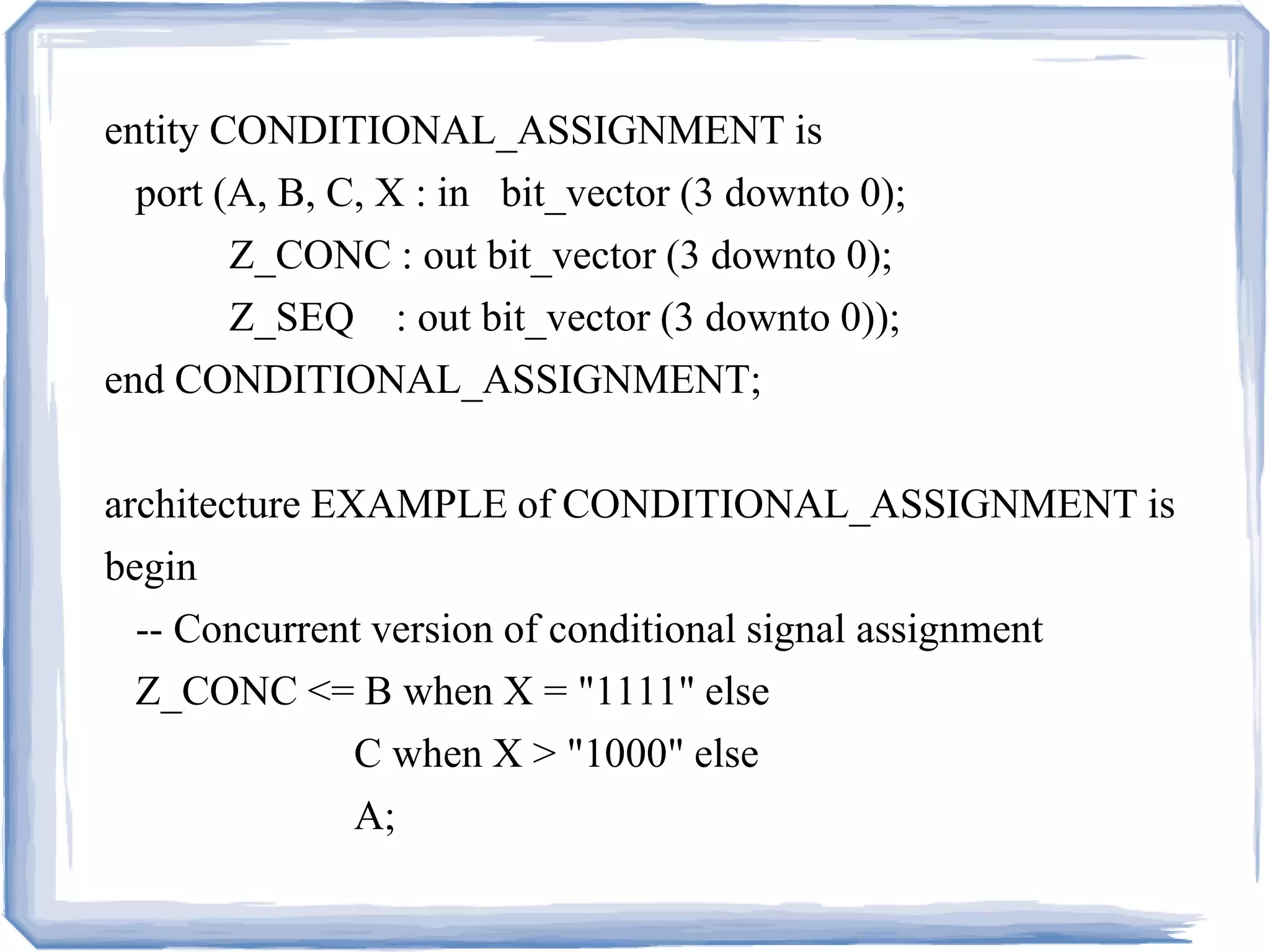
entity CONDITIONAL_ASSIGNMENT is
port (A, B, C, X : in bit_vector (3 downto 0);
Z_CONC : out bit_vector (3 downto 0);
Z_SEQ : out bit_vector (3 downto 0));
end CONDITIONAL_ASSIGNMENT;
architecture EXAMPLE of CONDITIONAL_ASSIGNMENT is
begin
-- Concurrent version of conditional signal assignment
Z_CONC <= B when X = "1111" else
C when X > "1000" else
A;
-- Equivalent sequential statements
process (A, B, C, X)
begin
if (X = "1111") then
Z_SEQ <= B;
elsif (X > "1000") then
Z_SEQ <= C;
else
Z_SEQ <= A;
end if;
end process;
end EXAMPLE;
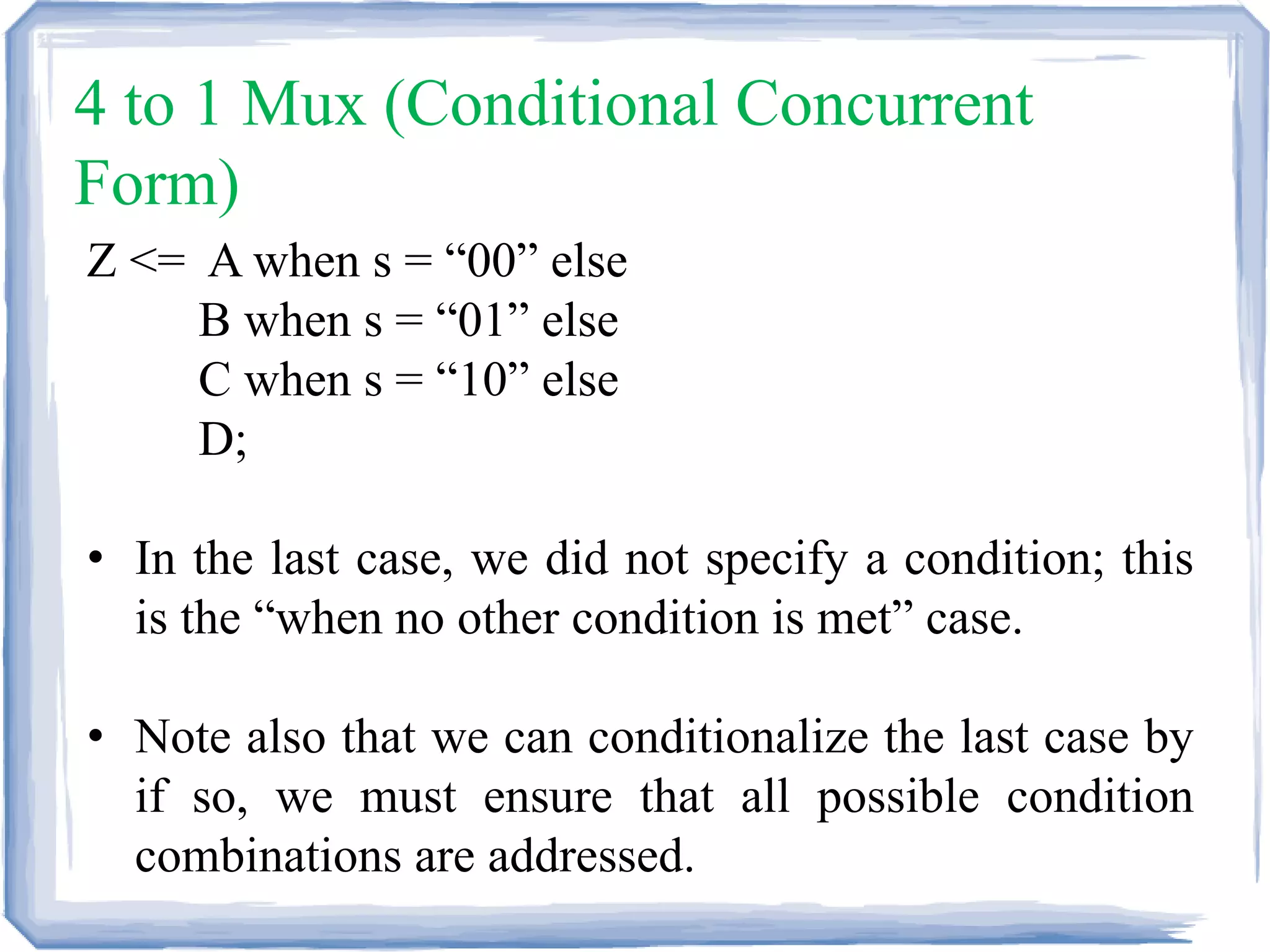
4 to 1 Mux (Conditional Concurrent
Form)
Z <= A when s = “00” else
B when s = “01” else
C when s = “10” else
D;
• In the last case, we did not specify a condition; this
is the “when no other condition is met” case.
• Note also that we can conditionalize the last case by
if so, we must ensure that all possible condition
combinations are addressed.
Selected Signal Assignment –
with - select
with EXPRESSION select
TARGET <= VALUE_1 when CHOICE_1,
VALUE_2 when CHOICE_2 | CHOICE_3,
VALUE_3 when CHOICE_4 to CHOICE_5,
· · ·
VALUE_n when others
● The “choices” are values of the discriminator; either.
– single value: when “0001”,
– multiple values: when “0100” | “0110” | “1000”,
– value range: when“1010” to “1111”,
– everything else: when others;
● The last case “when others” must be the last clause if used
● Comma separates clauses, semicolon ends the statement
entity SELECTED_ASSIGNMENT is
port (A, B, C, X : in integer range 0 to 15;
Z_CONC : out integer range 0 to 15;
Z_SEQ : out integer range 0 to 15);
end SELECTED_ASSIGNMENT;
architecture EXAMPLE of SELECTED_ASSIGNMENT is
begin
-- Concurrent version of selected signal assignment
with X select
Z_CONC <= A when 0,
B when 7 | 9,
C when 1 to 5,
0 when others;
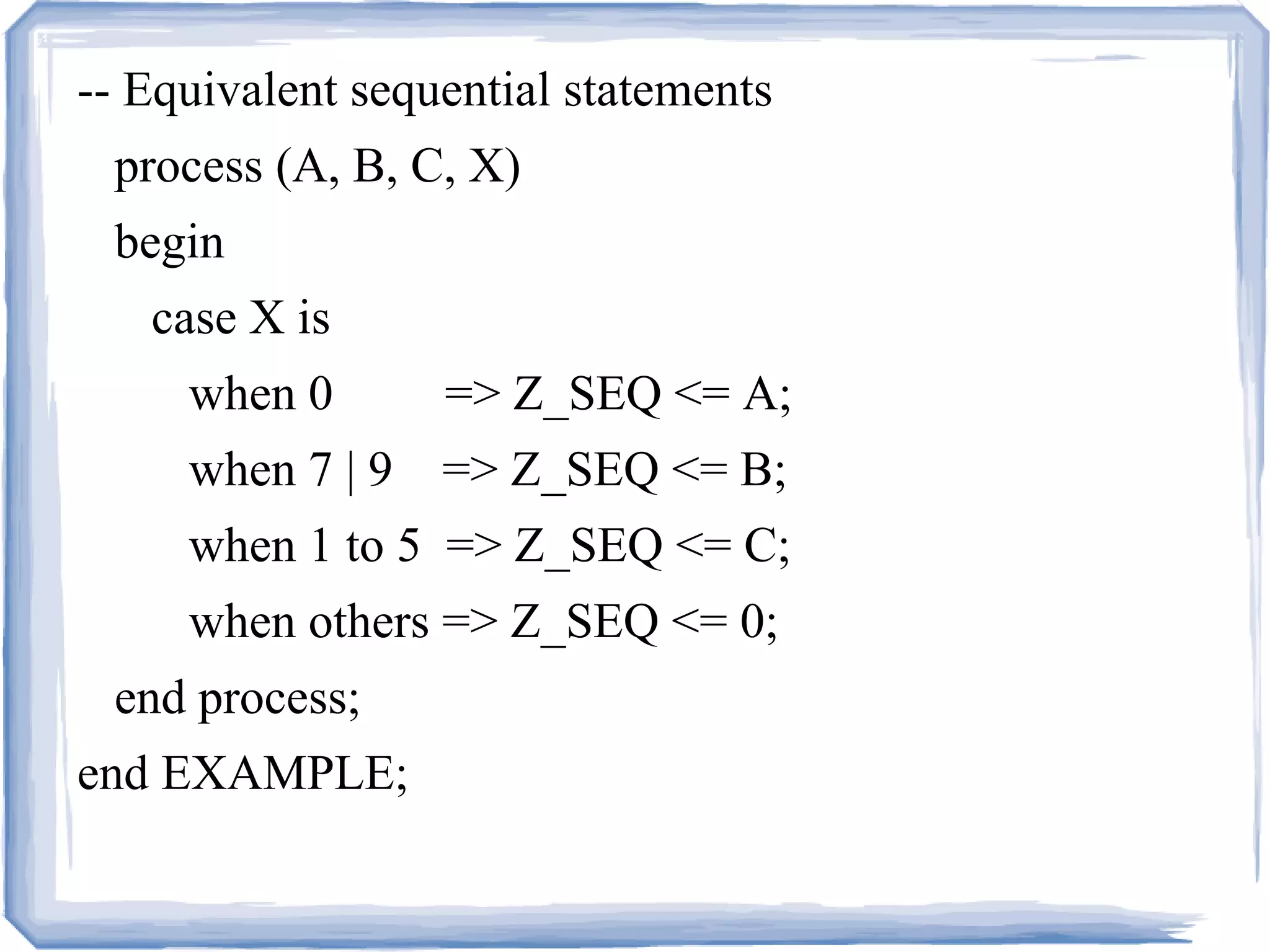
-- Equivalent sequential statements
process (A, B, C, X)
begin
case X is
when 0 => Z_SEQ <= A;
when 7 | 9 => Z_SEQ <= B;
when 1 to 5 => Z_SEQ <= C;
when others => Z_SEQ <= 0;
end process;
end EXAMPLE;
The UNAFFECTED value
MARK_FLAG <= BKDET after 5 ns when STORBE = „0‟ else
unaffected;
● unaffected is equivalent to null statement
Process
Begin
if STROBE = „0‟ then
MARK_DET <= BKDET after 5 ns;
else null;
end if;
wait on STROBE, BKDET;
end process
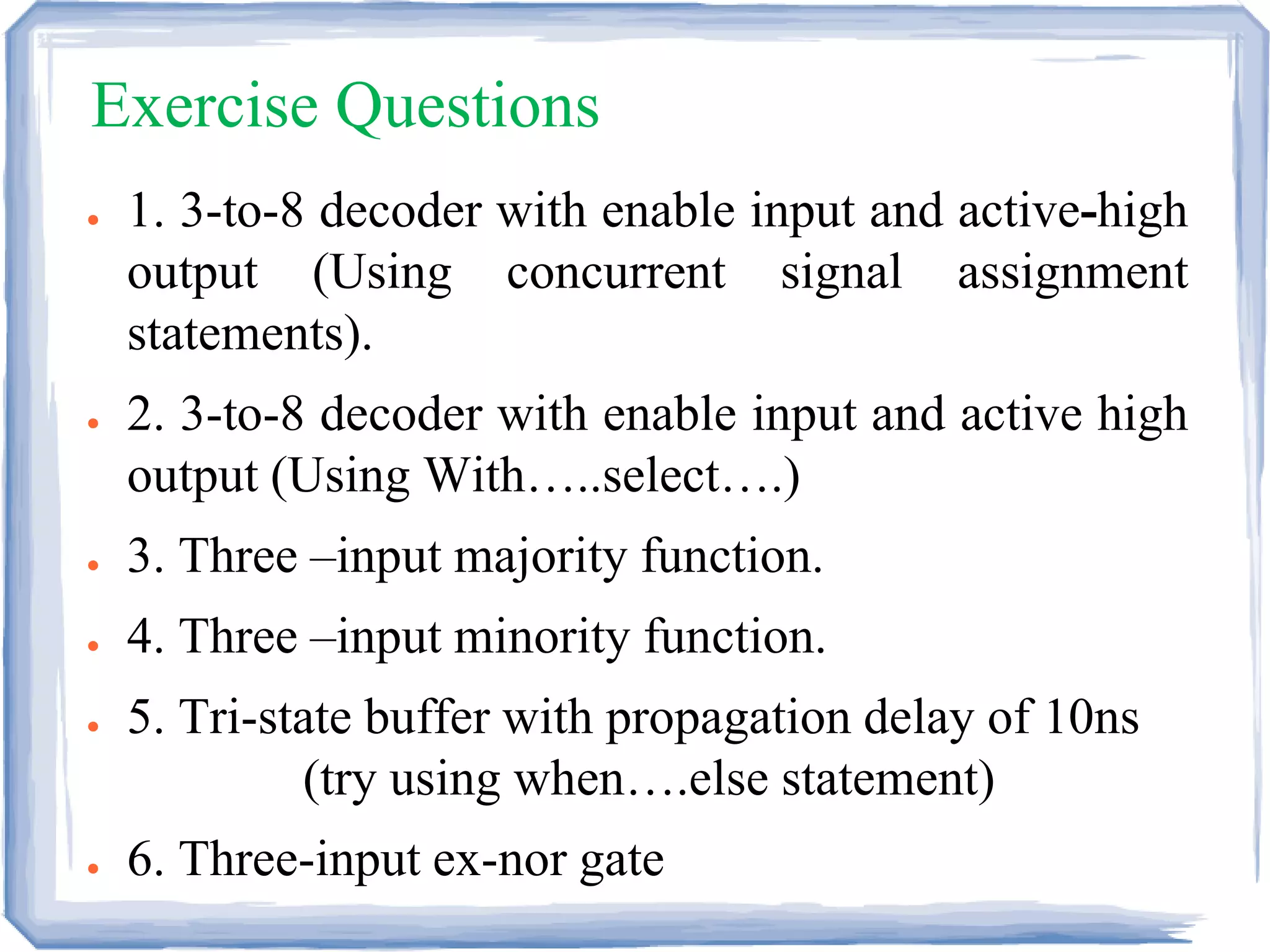
Exercise Questions
● 1. 3-to-8 decoder with enable input and active-high
output (Using concurrent signal assignment
statements).
● 2. 3-to-8 decoder with enable input and active high
output (Using With…..select….)
● 3. Three –input majority function.
● 4. Three –input minority function.
● 5. Tri-state buffer with propagation delay of 10ns
(try using when….else statement)
● 6. Three-input ex-nor gate
References
● [1]. “Digital Systems Design Using VHDL” by
Charles H Roth, Jr., Thomson Learining,
Brooks/Cole.
● [2]. “VHDL Primer” by J Bhasker, PHI, Third
edition.

Ddhdl 16

  • 1.
  • 2.
    Modeling the Dataflowway • Uses statements that defines the actual flow of data..... such as, x <= y -- this is NOT less than equal This assigns the boolean signal x to the value of boolean signal y... i.e. x = y this will occur whenever y changes....
  • 3.
    Concurrent Statements ● Concurrentstatements are executed at the same time, independent of the order in which they appear architecture…… Begin A<=B; Z<=A; End;
  • 4.
    Process model(in behavioralmodeling) for this Architecture.. Begin process (B) A<=B; Z<=A; end process; end;
  • 5.
    Three inverting buffers entityINV is port (A:in bit; Z:out bit); end INV; architecture DELAY of INV is signal B,C : bit; begin Z <= not C; C <= not B; B <= not A; end DELAY;
  • 7.
    Conditional Signal Assignment– When - Else ● Condition is a boolean expression ● Mandatory else path, unless unconditional assignment ● conditions may overlap ● Equivalent of if ..., elsif ..., else constructs
  • 8.
    TARGET <= VALUE; TARGET<= VALUE_1 when CONDITION_1 else VALUE_2 when CONDITION_2 else . . . VALUE_n; ● Note that the condition clauses must evaluate to a logical expression.
  • 9.
    entity CONDITIONAL_ASSIGNMENT is port(A, B, C, X : in bit_vector (3 downto 0); Z_CONC : out bit_vector (3 downto 0); Z_SEQ : out bit_vector (3 downto 0)); end CONDITIONAL_ASSIGNMENT; architecture EXAMPLE of CONDITIONAL_ASSIGNMENT is begin -- Concurrent version of conditional signal assignment Z_CONC <= B when X = "1111" else C when X > "1000" else A;
  • 10.
    -- Equivalent sequentialstatements process (A, B, C, X) begin if (X = "1111") then Z_SEQ <= B; elsif (X > "1000") then Z_SEQ <= C; else Z_SEQ <= A; end if; end process; end EXAMPLE;
  • 11.
    4 to 1Mux (Conditional Concurrent Form) Z <= A when s = “00” else B when s = “01” else C when s = “10” else D; • In the last case, we did not specify a condition; this is the “when no other condition is met” case. • Note also that we can conditionalize the last case by if so, we must ensure that all possible condition combinations are addressed.
  • 12.
    Selected Signal Assignment– with - select with EXPRESSION select TARGET <= VALUE_1 when CHOICE_1, VALUE_2 when CHOICE_2 | CHOICE_3, VALUE_3 when CHOICE_4 to CHOICE_5, · · · VALUE_n when others
  • 13.
    ● The “choices”are values of the discriminator; either. – single value: when “0001”, – multiple values: when “0100” | “0110” | “1000”, – value range: when“1010” to “1111”, – everything else: when others; ● The last case “when others” must be the last clause if used ● Comma separates clauses, semicolon ends the statement
  • 14.
    entity SELECTED_ASSIGNMENT is port(A, B, C, X : in integer range 0 to 15; Z_CONC : out integer range 0 to 15; Z_SEQ : out integer range 0 to 15); end SELECTED_ASSIGNMENT; architecture EXAMPLE of SELECTED_ASSIGNMENT is begin -- Concurrent version of selected signal assignment with X select Z_CONC <= A when 0, B when 7 | 9, C when 1 to 5, 0 when others;
  • 15.
    -- Equivalent sequentialstatements process (A, B, C, X) begin case X is when 0 => Z_SEQ <= A; when 7 | 9 => Z_SEQ <= B; when 1 to 5 => Z_SEQ <= C; when others => Z_SEQ <= 0; end process; end EXAMPLE;
  • 16.
    The UNAFFECTED value MARK_FLAG<= BKDET after 5 ns when STORBE = „0‟ else unaffected; ● unaffected is equivalent to null statement Process Begin if STROBE = „0‟ then MARK_DET <= BKDET after 5 ns; else null; end if; wait on STROBE, BKDET; end process
  • 17.
    Exercise Questions ● 1.3-to-8 decoder with enable input and active-high output (Using concurrent signal assignment statements). ● 2. 3-to-8 decoder with enable input and active high output (Using With…..select….) ● 3. Three –input majority function. ● 4. Three –input minority function. ● 5. Tri-state buffer with propagation delay of 10ns (try using when….else statement) ● 6. Three-input ex-nor gate
  • 18.
    References ● [1]. “DigitalSystems Design Using VHDL” by Charles H Roth, Jr., Thomson Learining, Brooks/Cole. ● [2]. “VHDL Primer” by J Bhasker, PHI, Third edition.