DBMS vs. DSMS
Event-Driven Architecture - Longo Stefano
Content
• What is a DBMS
What is a database
• What is a DSMS
What is a data stream
• Differences between DBMS and DSMS
• Limits of data stream model
• Differences on queries
• DBMS & DSMS – Case of use
• Conclusion
DBMS (DataBase Management System)
• A Database is an organized collection of data.
- There are a lot of Database Models (Hierarchical,
Relational, Semantic, XML, Object Oriented, NoSQL, …)
- The most popular database systems since the 1980s have
all supported the relational model as represented by the
SQL language
• A Database Management System is a collection of programs
that enables you to store, modify, and extract information from
a database.
DSMS (Data Stream Management System)
What is a Data Stream?
• Large data volume, likely structured, arriving at a
very high rate
• Not (only) what you see on youtube
• Definition (Golab and Ozsu, 2003):
“A data stream is a real-time, continuous, ordered (implicitly by
arrival time of explicitly by timestamp) sequence of items. It is
impossible to control the order in which items arrive, nor it is feasible
to locally store a stream in its entirety”.
DSMS (Data Stream Management System)
• A DSMS is a computer program that permits to manage continuous
data streams (assumed infinite).
• Data received from a DSMS is moving at high pace
• Queries are continuous (registered once, observed “forever”)
• Answer to queries in (nearly) real-time required
• For efficiency:
- Probabilistic method
- Sliding window (considering only a part of the stream)
Differences between DBMS and DSMS
• Fundamental difference: data stream model.
• In a data stream, data elements arrive on-line and stay only for a
limited time period in memory.
• Consequently, the DSMS has to handle the data elements before the
buffer is overwritten by new incoming data elements
• The size of data streams is potentially unbounded and can be
thought of as an open-ended relation
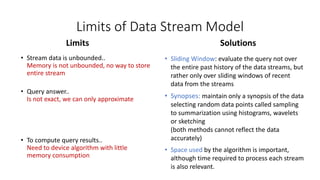
Limits of Data Stream Model
Limits Solutions
• Stream data is unbounded..
Memory is not unbounded, no way to store
entire stream
• Query answer..
Is not exact, we can only approximate
• To compute query results..
Need to device algorithm with little
memory consumption
• Sliding Window: evaluate the query not over
the entire past history of the data streams, but
rather only over sliding windows of recent
data from the streams
• Synopses: maintain only a synopsis of the data
selecting random data points called sampling
to summarization using histograms, wavelets
or sketching
(both methods cannot reflect the data
accurately)
• Space used by the algorithm is important,
although time required to process each stream
is also relevant.
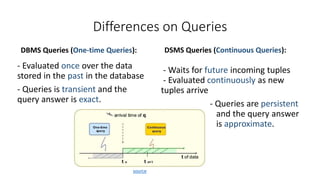
Differences on Queries
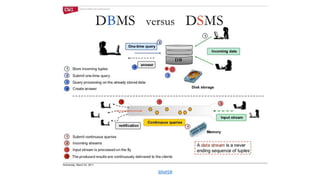
DBMS Queries (One-time Queries):
- Evaluated once over the data
stored in the past in the database
- Queries is transient and the
query answer is exact.
DSMS Queries (Continuous Queries):
- Waits for future incoming tuples
- Evaluated continuously as new
tuples arrive
- Queries are persistent
and the query answer
is approximate.
source
Differences on Queries - example
DBMS
SELECT Name, Surname, Role, City
FROM Employees
WHERE city = ‘Berlin’
ORDER BY Surname, Name
Simple query that shows the name, surname, role and
city of the company’ employees working in Berlin.
The output will be ordered by surname and name of the
employees
DSMS – Continuos Queries
SELECT Stream
Rowtime,
MIN(temp) OVER W1 AS Wmin_temp,
MAX(temp) OVER W1 AS Wmax_temp,
AVG(temp) OVER W1 AS Wavg_temp
FROM Weatherstream
WINDOW W1 AS ( RANGE INTERVAL '1' SECOND
PRECEDING );
The query aggregates a sensor stream from a weather
monitoring system.
It aggregates the minimum, maximum and average
temperature values.
Window clause create a window of one second duration
showing a stream of incrementally updated results with
zero result latency.
source
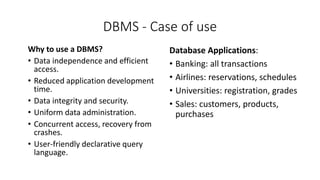
DBMS - Case of use
Database Applications:
• Banking: all transactions
• Airlines: reservations, schedules
• Universities: registration, grades
• Sales: customers, products,
purchases
Why to use a DBMS?
• Data independence and efficient
access.
• Reduced application development
time.
• Data integrity and security.
• Uniform data administration.
• Concurrent access, recovery from
crashes.
• User-friendly declarative query
language.
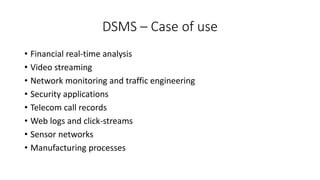
DSMS – Case of use
• Financial real-time analysis
• Video streaming
• Network monitoring and traffic engineering
• Security applications
• Telecom call records
• Web logs and click-streams
• Sensor networks
• Manufacturing processes
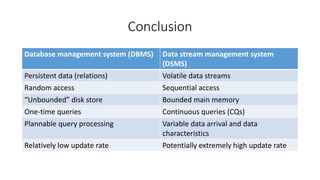
Conclusion
Database management system (DBMS) Data stream management system
(DSMS)
Persistent data (relations) Volatile data streams
Random access Sequential access
“Unbounded” disk store Bounded main memory
One-time queries Continuous queries (CQs)
Plannable query processing Variable data arrival and data
characteristics
Relatively low update rate Potentially extremely high update rate

Dbms vs dsms

  • 1.
    DBMS vs. DSMS Event-DrivenArchitecture - Longo Stefano
  • 2.
    Content • What isa DBMS What is a database • What is a DSMS What is a data stream • Differences between DBMS and DSMS • Limits of data stream model • Differences on queries • DBMS & DSMS – Case of use • Conclusion
  • 3.
    DBMS (DataBase ManagementSystem) • A Database is an organized collection of data. - There are a lot of Database Models (Hierarchical, Relational, Semantic, XML, Object Oriented, NoSQL, …) - The most popular database systems since the 1980s have all supported the relational model as represented by the SQL language • A Database Management System is a collection of programs that enables you to store, modify, and extract information from a database.
  • 4.
    DSMS (Data StreamManagement System) What is a Data Stream? • Large data volume, likely structured, arriving at a very high rate • Not (only) what you see on youtube • Definition (Golab and Ozsu, 2003): “A data stream is a real-time, continuous, ordered (implicitly by arrival time of explicitly by timestamp) sequence of items. It is impossible to control the order in which items arrive, nor it is feasible to locally store a stream in its entirety”.
  • 5.
    DSMS (Data StreamManagement System) • A DSMS is a computer program that permits to manage continuous data streams (assumed infinite). • Data received from a DSMS is moving at high pace • Queries are continuous (registered once, observed “forever”) • Answer to queries in (nearly) real-time required • For efficiency: - Probabilistic method - Sliding window (considering only a part of the stream)
  • 6.
    Differences between DBMSand DSMS • Fundamental difference: data stream model. • In a data stream, data elements arrive on-line and stay only for a limited time period in memory. • Consequently, the DSMS has to handle the data elements before the buffer is overwritten by new incoming data elements • The size of data streams is potentially unbounded and can be thought of as an open-ended relation
  • 7.
    Limits of DataStream Model Limits Solutions • Stream data is unbounded.. Memory is not unbounded, no way to store entire stream • Query answer.. Is not exact, we can only approximate • To compute query results.. Need to device algorithm with little memory consumption • Sliding Window: evaluate the query not over the entire past history of the data streams, but rather only over sliding windows of recent data from the streams • Synopses: maintain only a synopsis of the data selecting random data points called sampling to summarization using histograms, wavelets or sketching (both methods cannot reflect the data accurately) • Space used by the algorithm is important, although time required to process each stream is also relevant.
  • 8.
    Differences on Queries DBMSQueries (One-time Queries): - Evaluated once over the data stored in the past in the database - Queries is transient and the query answer is exact. DSMS Queries (Continuous Queries): - Waits for future incoming tuples - Evaluated continuously as new tuples arrive - Queries are persistent and the query answer is approximate. source
  • 9.
    Differences on Queries- example DBMS SELECT Name, Surname, Role, City FROM Employees WHERE city = ‘Berlin’ ORDER BY Surname, Name Simple query that shows the name, surname, role and city of the company’ employees working in Berlin. The output will be ordered by surname and name of the employees DSMS – Continuos Queries SELECT Stream Rowtime, MIN(temp) OVER W1 AS Wmin_temp, MAX(temp) OVER W1 AS Wmax_temp, AVG(temp) OVER W1 AS Wavg_temp FROM Weatherstream WINDOW W1 AS ( RANGE INTERVAL '1' SECOND PRECEDING ); The query aggregates a sensor stream from a weather monitoring system. It aggregates the minimum, maximum and average temperature values. Window clause create a window of one second duration showing a stream of incrementally updated results with zero result latency.
  • 10.
  • 11.
    DBMS - Caseof use Database Applications: • Banking: all transactions • Airlines: reservations, schedules • Universities: registration, grades • Sales: customers, products, purchases Why to use a DBMS? • Data independence and efficient access. • Reduced application development time. • Data integrity and security. • Uniform data administration. • Concurrent access, recovery from crashes. • User-friendly declarative query language.
  • 12.
    DSMS – Caseof use • Financial real-time analysis • Video streaming • Network monitoring and traffic engineering • Security applications • Telecom call records • Web logs and click-streams • Sensor networks • Manufacturing processes
  • 13.
    Conclusion Database management system(DBMS) Data stream management system (DSMS) Persistent data (relations) Volatile data streams Random access Sequential access “Unbounded” disk store Bounded main memory One-time queries Continuous queries (CQs) Plannable query processing Variable data arrival and data characteristics Relatively low update rate Potentially extremely high update rate