Chanderprabhu Jain College of Higher Studies & School of Law
Plot No. OCF, Sector A-8, Narela, New Delhi – 110040
(Affiliated to Guru Gobind Singh Indraprastha University and Approved by Govt of NCT of Delhi & Bar Council of India)
BBA(G)
(Second Semester)
DATABASE MANAGEMENT SYSTEM
Paper Id 17108
Topic:
Introduction to DBMS
By: Mr. Sumit Singh
AP (IT)
Chanderprabhu Jain College of Higher Studies & School of Law
Plot No. OCF, Sector A-8, Narela, New Delhi – 110040
(Affiliated to Guru Gobind Singh Indraprastha University and Approved by Govt of NCT of Delhi & Bar Council of India)
Introduction
 Purpose of Database Systems
 Database Languages
 Relational Databases
 Database Design
 Data Models
 Database Internals
 Database Users and Administrators
 Overall Structure
 History of Database Systems
Chanderprabhu Jain College of Higher Studies & School of Law
Plot No. OCF, Sector A-8, Narela, New Delhi – 110040
(Affiliated to Guru Gobind Singh Indraprastha University and Approved by Govt of NCT of Delhi & Bar Council of India)
Database Management System (DBMS)
 DBMS contains information about a particular enterprise
 Collection of interrelated data
 Set of programs to access the data
 An environment that is both convenient and efficient to use
 Database Applications:
 Banking: all transactions
 Airlines: reservations, schedules
 Universities: registration, grades
 Sales: customers, products, purchases
 Online retailers: order tracking, customized recommendations
 Manufacturing: production, inventory, orders, supply chain
 Human resources: employee records, salaries, tax deductions
 Databases touch all aspects of our lives
Chanderprabhu Jain College of Higher Studies & School of Law
Plot No. OCF, Sector A-8, Narela, New Delhi – 110040
(Affiliated to Guru Gobind Singh Indraprastha University and Approved by Govt of NCT of Delhi & Bar Council of India)
Purpose of Database Systems
 In the early days, database applications were built directly on top
of file systems
 Drawbacks of using file systems to store data:
 Data redundancy and inconsistency
 Multiple file formats, duplication of information in different
files
 Difficulty in accessing data
 Need to write a new program to carry out each new task
 Data isolation — multiple files and formats
 Integrity problems
 Integrity constraints (e.g. account balance > 0) become
“buried” in program code rather than being stated
explicitly
 Hard to add new constraints or change existing ones
Chanderprabhu Jain College of Higher Studies & School of Law
Plot No. OCF, Sector A-8, Narela, New Delhi – 110040
(Affiliated to Guru Gobind Singh Indraprastha University and Approved by Govt of NCT of Delhi & Bar Council of India)
Purpose of Database Systems (Cont.)
 Drawbacks of using file systems (cont.)
 Atomicity of updates
 Failures may leave database in an inconsistent state with partial
updates carried out
 Example: Transfer of funds from one account to another should
either complete or not happen at all
 Concurrent access by multiple users
 Concurrent accessed needed for performance
 Uncontrolled concurrent accesses can lead to inconsistencies
– Example: Two people reading a balance and updating it at the
same time
 Security problems
 Hard to provide user access to some, but not all, data
 Database systems offer solutions to all the above problems
Chanderprabhu Jain College of Higher Studies & School of Law
Plot No. OCF, Sector A-8, Narela, New Delhi – 110040
(Affiliated to Guru Gobind Singh Indraprastha University and Approved by Govt of NCT of Delhi & Bar Council of India)
Levels of Abstraction
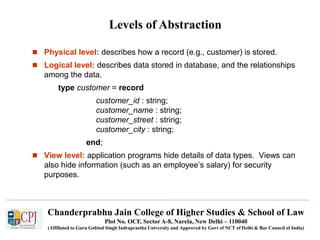
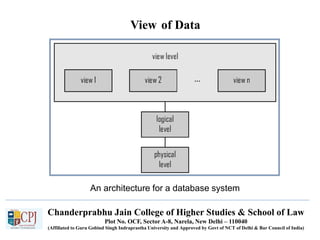
 Physical level: describes how a record (e.g., customer) is stored.
 Logical level: describes data stored in database, and the relationships
among the data.
type customer = record
customer_id : string;
customer_name : string;
customer_street : string;
customer_city : string;
end;
 View level: application programs hide details of data types. Views can
also hide information (such as an employee’s salary) for security
purposes.
Chanderprabhu Jain College of Higher Studies & School of Law
Plot No. OCF, Sector A-8, Narela, New Delhi – 110040
(Affiliated to Guru Gobind Singh Indraprastha University and Approved by Govt of NCT of Delhi & Bar Council of India)
View of Data
An architecture for a database system
Chanderprabhu Jain College of Higher Studies & School of Law
Plot No. OCF, Sector A-8, Narela, New Delhi – 110040
(Affiliated to Guru Gobind Singh Indraprastha University and Approved by Govt of NCT of Delhi & Bar Council of India)
Instances and Schemas
 Similar to types and variables in programming languages
 Schema – the logical structure of the database
 Example: The database consists of information about a set of customers and
accounts and the relationship between them)
 Analogous to type information of a variable in a program
 Physical schema: database design at the physical level
 Logical schema: database design at the logical level
 Instance – the actual content of the database at a particular point in time
 Analogous to the value of a variable
 Physical Data Independence – the ability to modify the physical schema without
changing the logical schema
 Applications depend on the logical schema
 In general, the interfaces between the various levels and components should
be well defined so that changes in some parts do not seriously influence others.
Chanderprabhu Jain College of Higher Studies & School of Law
Plot No. OCF, Sector A-8, Narela, New Delhi – 110040
(Affiliated to Guru Gobind Singh Indraprastha University and Approved by Govt of NCT of Delhi & Bar Council of India)
Data Models
 A collection of tools for describing
 Data
 Data relationships
 Data semantics
 Data constraints
 Relational model
 Entity-Relationship data model (mainly for database design)
 Object-based data models (Object-oriented and Object-relational)
 Semi structured data model (XML)
 Other older models:
 Network model
 Hierarchical model
Chanderprabhu Jain College of Higher Studies & School of Law
Plot No. OCF, Sector A-8, Narela, New Delhi – 110040
(Affiliated to Guru Gobind Singh Indraprastha University and Approved by Govt of NCT of Delhi & Bar Council of India)
Data Manipulation Language (DML)
 Language for accessing and manipulating the data organized by the
appropriate data model
 DML also known as query language
 Two classes of languages
 Procedural – user specifies what data is required and how to get
those data
 Declarative (nonprocedural) – user specifies what data is
required without specifying how to get those data
 SQL is the most widely used query language
Chanderprabhu Jain College of Higher Studies & School of Law
Plot No. OCF, Sector A-8, Narela, New Delhi – 110040
(Affiliated to Guru Gobind Singh Indraprastha University and Approved by Govt of NCT of Delhi & Bar Council of India)
Data Definition Language (DDL)
 Specification notation for defining the database schema
Example: create table account (
account_number char(10),
branch_name char(10),
balance integer)
 DDL compiler generates a set of tables stored in a data dictionary
 Data dictionary contains metadata (i.e., data about data)
 Database schema
 Data storage and definition language
 Specifies the storage structure and access methods used
 Integrity constraints
 Domain constraints
 Referential integrity (e.g. branch_name must correspond to a
valid branch in the branch table)
 Authorization
Chanderprabhu Jain College of Higher Studies & School of Law
Plot No. OCF, Sector A-8, Narela, New Delhi – 110040
(Affiliated to Guru Gobind Singh Indraprastha University and Approved by Govt of NCT of Delhi & Bar Council of India)
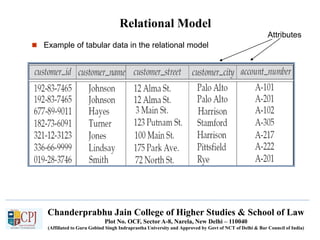
Relational Model
 Example of tabular data in the relational model
Attributes
Chanderprabhu Jain College of Higher Studies & School of Law
Plot No. OCF, Sector A-8, Narela, New Delhi – 110040
(Affiliated to Guru Gobind Singh Indraprastha University and Approved by Govt of NCT of Delhi & Bar Council of India)
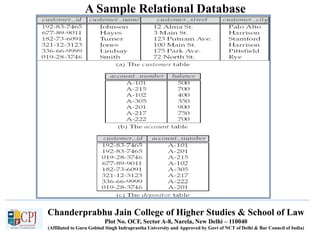
A Sample Relational Database
Chanderprabhu Jain College of Higher Studies & School of Law
Plot No. OCF, Sector A-8, Narela, New Delhi – 110040
(Affiliated to Guru Gobind Singh Indraprastha University and Approved by Govt of NCT of Delhi & Bar Council of India)
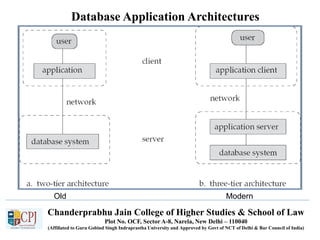
Database Application Architectures
Old Modern
Chanderprabhu Jain College of Higher Studies & School of Law
Plot No. OCF, Sector A-8, Narela, New Delhi – 110040
(Affiliated to Guru Gobind Singh Indraprastha University and Approved by Govt of NCT of Delhi & Bar Council of India)
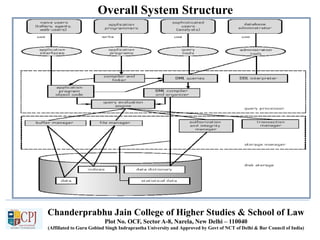
Overall System Structure

DBMS presentation

  • 1.
    Chanderprabhu Jain Collegeof Higher Studies & School of Law Plot No. OCF, Sector A-8, Narela, New Delhi – 110040 (Affiliated to Guru Gobind Singh Indraprastha University and Approved by Govt of NCT of Delhi & Bar Council of India) BBA(G) (Second Semester) DATABASE MANAGEMENT SYSTEM Paper Id 17108 Topic: Introduction to DBMS By: Mr. Sumit Singh AP (IT)
  • 2.
    Chanderprabhu Jain Collegeof Higher Studies & School of Law Plot No. OCF, Sector A-8, Narela, New Delhi – 110040 (Affiliated to Guru Gobind Singh Indraprastha University and Approved by Govt of NCT of Delhi & Bar Council of India) Introduction  Purpose of Database Systems  Database Languages  Relational Databases  Database Design  Data Models  Database Internals  Database Users and Administrators  Overall Structure  History of Database Systems
  • 3.
    Chanderprabhu Jain Collegeof Higher Studies & School of Law Plot No. OCF, Sector A-8, Narela, New Delhi – 110040 (Affiliated to Guru Gobind Singh Indraprastha University and Approved by Govt of NCT of Delhi & Bar Council of India) Database Management System (DBMS)  DBMS contains information about a particular enterprise  Collection of interrelated data  Set of programs to access the data  An environment that is both convenient and efficient to use  Database Applications:  Banking: all transactions  Airlines: reservations, schedules  Universities: registration, grades  Sales: customers, products, purchases  Online retailers: order tracking, customized recommendations  Manufacturing: production, inventory, orders, supply chain  Human resources: employee records, salaries, tax deductions  Databases touch all aspects of our lives
  • 4.
    Chanderprabhu Jain Collegeof Higher Studies & School of Law Plot No. OCF, Sector A-8, Narela, New Delhi – 110040 (Affiliated to Guru Gobind Singh Indraprastha University and Approved by Govt of NCT of Delhi & Bar Council of India) Purpose of Database Systems  In the early days, database applications were built directly on top of file systems  Drawbacks of using file systems to store data:  Data redundancy and inconsistency  Multiple file formats, duplication of information in different files  Difficulty in accessing data  Need to write a new program to carry out each new task  Data isolation — multiple files and formats  Integrity problems  Integrity constraints (e.g. account balance > 0) become “buried” in program code rather than being stated explicitly  Hard to add new constraints or change existing ones
  • 5.
    Chanderprabhu Jain Collegeof Higher Studies & School of Law Plot No. OCF, Sector A-8, Narela, New Delhi – 110040 (Affiliated to Guru Gobind Singh Indraprastha University and Approved by Govt of NCT of Delhi & Bar Council of India) Purpose of Database Systems (Cont.)  Drawbacks of using file systems (cont.)  Atomicity of updates  Failures may leave database in an inconsistent state with partial updates carried out  Example: Transfer of funds from one account to another should either complete or not happen at all  Concurrent access by multiple users  Concurrent accessed needed for performance  Uncontrolled concurrent accesses can lead to inconsistencies – Example: Two people reading a balance and updating it at the same time  Security problems  Hard to provide user access to some, but not all, data  Database systems offer solutions to all the above problems
  • 6.
    Chanderprabhu Jain Collegeof Higher Studies & School of Law Plot No. OCF, Sector A-8, Narela, New Delhi – 110040 (Affiliated to Guru Gobind Singh Indraprastha University and Approved by Govt of NCT of Delhi & Bar Council of India) Levels of Abstraction  Physical level: describes how a record (e.g., customer) is stored.  Logical level: describes data stored in database, and the relationships among the data. type customer = record customer_id : string; customer_name : string; customer_street : string; customer_city : string; end;  View level: application programs hide details of data types. Views can also hide information (such as an employee’s salary) for security purposes.
  • 7.
    Chanderprabhu Jain Collegeof Higher Studies & School of Law Plot No. OCF, Sector A-8, Narela, New Delhi – 110040 (Affiliated to Guru Gobind Singh Indraprastha University and Approved by Govt of NCT of Delhi & Bar Council of India) View of Data An architecture for a database system
  • 8.
    Chanderprabhu Jain Collegeof Higher Studies & School of Law Plot No. OCF, Sector A-8, Narela, New Delhi – 110040 (Affiliated to Guru Gobind Singh Indraprastha University and Approved by Govt of NCT of Delhi & Bar Council of India) Instances and Schemas  Similar to types and variables in programming languages  Schema – the logical structure of the database  Example: The database consists of information about a set of customers and accounts and the relationship between them)  Analogous to type information of a variable in a program  Physical schema: database design at the physical level  Logical schema: database design at the logical level  Instance – the actual content of the database at a particular point in time  Analogous to the value of a variable  Physical Data Independence – the ability to modify the physical schema without changing the logical schema  Applications depend on the logical schema  In general, the interfaces between the various levels and components should be well defined so that changes in some parts do not seriously influence others.
  • 9.
    Chanderprabhu Jain Collegeof Higher Studies & School of Law Plot No. OCF, Sector A-8, Narela, New Delhi – 110040 (Affiliated to Guru Gobind Singh Indraprastha University and Approved by Govt of NCT of Delhi & Bar Council of India) Data Models  A collection of tools for describing  Data  Data relationships  Data semantics  Data constraints  Relational model  Entity-Relationship data model (mainly for database design)  Object-based data models (Object-oriented and Object-relational)  Semi structured data model (XML)  Other older models:  Network model  Hierarchical model
  • 10.
    Chanderprabhu Jain Collegeof Higher Studies & School of Law Plot No. OCF, Sector A-8, Narela, New Delhi – 110040 (Affiliated to Guru Gobind Singh Indraprastha University and Approved by Govt of NCT of Delhi & Bar Council of India) Data Manipulation Language (DML)  Language for accessing and manipulating the data organized by the appropriate data model  DML also known as query language  Two classes of languages  Procedural – user specifies what data is required and how to get those data  Declarative (nonprocedural) – user specifies what data is required without specifying how to get those data  SQL is the most widely used query language
  • 11.
    Chanderprabhu Jain Collegeof Higher Studies & School of Law Plot No. OCF, Sector A-8, Narela, New Delhi – 110040 (Affiliated to Guru Gobind Singh Indraprastha University and Approved by Govt of NCT of Delhi & Bar Council of India) Data Definition Language (DDL)  Specification notation for defining the database schema Example: create table account ( account_number char(10), branch_name char(10), balance integer)  DDL compiler generates a set of tables stored in a data dictionary  Data dictionary contains metadata (i.e., data about data)  Database schema  Data storage and definition language  Specifies the storage structure and access methods used  Integrity constraints  Domain constraints  Referential integrity (e.g. branch_name must correspond to a valid branch in the branch table)  Authorization
  • 12.
    Chanderprabhu Jain Collegeof Higher Studies & School of Law Plot No. OCF, Sector A-8, Narela, New Delhi – 110040 (Affiliated to Guru Gobind Singh Indraprastha University and Approved by Govt of NCT of Delhi & Bar Council of India) Relational Model  Example of tabular data in the relational model Attributes
  • 13.
    Chanderprabhu Jain Collegeof Higher Studies & School of Law Plot No. OCF, Sector A-8, Narela, New Delhi – 110040 (Affiliated to Guru Gobind Singh Indraprastha University and Approved by Govt of NCT of Delhi & Bar Council of India) A Sample Relational Database
  • 14.
    Chanderprabhu Jain Collegeof Higher Studies & School of Law Plot No. OCF, Sector A-8, Narela, New Delhi – 110040 (Affiliated to Guru Gobind Singh Indraprastha University and Approved by Govt of NCT of Delhi & Bar Council of India) Database Application Architectures Old Modern
  • 15.
    Chanderprabhu Jain Collegeof Higher Studies & School of Law Plot No. OCF, Sector A-8, Narela, New Delhi – 110040 (Affiliated to Guru Gobind Singh Indraprastha University and Approved by Govt of NCT of Delhi & Bar Council of India) Overall System Structure