FCAT Cluster 4 Media Specialist: Leslie Starr Developed: 12/08
What is Reference & Research? Understanding Reference and Research Benchmarks  2. Reference/Research – Locating and Interpreting Information  3. Reference/Research – Analyzing Multiple Sources 4. Validity and Reliability 5. Fact vs. Opinion
What is Reference & Research  Continued… 6. Primary vs. Secondary Sources 7. Reference and Research on the FCAT - Components of the Test:  multiple choice  (MC)  short written response (SR)  extended written response (ER) Sample Reference and Questions Test Taking Strategies
Benchmark Clusters Reading & Language Arts: A.2.3.5/LA.A.2.3.5 organization, interpretation, & synthesis of information LA.A.2.3.6 use a variety of reference materials to gather information LA.A.2.3.7 synthesis and separates collected information into useful components A.2.3.8/LA.A.2.3.8 validity and accuracy of information
Understanding Reference &  Research Benchmarks Elementary School - Students locate, gather and use materials for research projects.  ** Many of our students are here! Middle School - Students interact with a wide variety of reference materials (maps, charts, encyclopedias, magazines, textbooks, etc.) - Students understand;  fact vs. opinion vs. personal values ,  primary vs. secondary sources,   provide supporting evidence when formulating  a response to a writing prompt.
Key Vocabulary Validity  – The degree that information that is correct, factual  and sound. Reliability  – The degree that information that can be  researched or is from a source whose credentials are  trustworthy. Fact  - A statement that can be proven to be either true or  false. Opinion  – A statement that expresses beliefs, feelings, and  judgments.  Primary Source  – First hand or original information that  comes from a reliable source. Secondary Source  –Information that has been gathered and  interpreted by more than one source.
Example Question Determine between a strong & weak arguments Which of the following quotes from the article support the idea that the Antarctic seas were far more dangerous than anyone could have expected?
Example 2 & 3 Choose a statement that provides the best evidence that an event was significant… Which fact from the article provides the best evidence that the discovery of Watson Brake was significant?
Example 4 & 5 Check validity of information: Which sentence from the article offers the best evidence that Nolan Ryan was a skillful pitcher? Determine a statement that provides evidence of the author’s point of view. Why do the researchers conclude that their encounter was “the most rewarding”?
Examples… Other key R & R skills to be tested Answer a question based on map reading skills Identify the least accurate statement Locate & synthesize indirectly stated information within the text Draw conclusions/inferences Locate & interpret information
Relationship to RPM Research Process Model Students will… Understand how fact & opinion influence a text Understand how arguments are developed in a text Understand how the author’s viewpoint influences the context of a text Choose the best evidence from the text for a particular assertion Choose which type of support the author uses for a particular argument Determine how information from the text might be accurately applied to a new situation Discuss in a short-response format the quality of both the author’s argument and the support provided
Essential Questions To Be Asked/Answered How can we determine if information is valid and reliable? How can we determine if information is fact or opinion? How can we identify information as a primary or secondary source? How can we prepare for Reference/Research FCAT questions?
Reference and Research:  Locating & Interpreting Information Students  must  be able to: locate and interpret different types of written information (text material, indexes, glossaries, maps, charts, graphs, pictures, etc.) demonstrate an understanding of information gathered from a variety of sources (library, textbook, internet, atlas, encyclopedias, newspapers, magazines) **moving them to higher levels of  Blooms Taxonomy
Reference and Research:  Locating & Interpreting Information Students must be able to: Interpret the information gathered for a variety of purposes  class writing assignments  discussion and assessments  collaborative decision-making  standardized assessment i.e. FCAT
Reference and Research: Analyzing Multiple Sources Students must be able to: comprehend information contained in  multiple sources  not just their textbook. Push non-fiction for AR respond to higher-order questions based on information analysis  oral questioning  written assessments
Reference and Research: Analyzing Multiple Sources Students must be able to: determine the reliability and validity of information. distinguish between fact and opinion. Identify primary and secondary sources.
Validity and Reliability These two Reference and Research skills require: the student to analyze the correctness (validity) and source (reliability) of information. To do this, the student needs to determine if the information is: fact or opinion primary or secondary source
Fact vs. Opinion Fact  - A statement that can be proven to be either true or false using a valid source. A fact answers specific questions such as: What happened? Who did it? When and where did it happen? Why did it happen?
Fact vs. Opinion Opinion  – A statement that expresses beliefs, feelings, and judgments. Phrases begin with  I believe,   I think, probably,   it seems to me ,   or  in my opinion . Statements often contain words such as  might,   could,   should   and  ought . Judgment words such as  good,   bad,   poor ,   and  satisfactory  indicate an opinion.
Primary vs. Secondary Sources Primary Source : First hand or original  information that comes from a reliable source. Examples include eyewitness accounts, personal interviews, autobiographies, letters, diaries, scientific journals. Secondary Source : Information that has been gathered and interpreted by more than one source. Examples include textbooks, encyclopedias, magazine articles, biographies, movie reviews.
Components on the FCAT Components of the Test: Multiple Choice (MC) Short Written Response (SR)* Extended Written Response (ER)* * The short and extended response questions are  referred to  as  Performance Tasks  on the FCAT Sample Reference and Research Questions Test Taking Strategies
Components of the FCAT: Multiple Choice The majority of the test will be multiple choice questions. There will be four possible answers. The four choices will be labeled A,B, C, D  or  F, G,H, I .  Each question is worth one point.
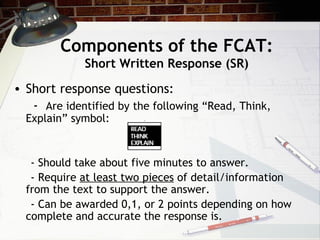
Components of the FCAT: Short Written Response (SR) Short response questions: -  Are identified by the following “Read, Think, Explain” symbol: - Should take about five minutes to answer. - Require  at least two pieces  of detail/information from the text to support the answer. - Can be awarded 0,1, or 2 points depending on how complete and accurate the response is.
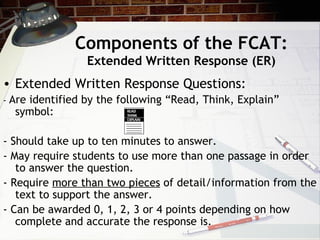
Components of the FCAT: Extended Written Response (ER) Extended Written Response Questions: -  Are identified by the following “Read, Think, Explain” symbol: - Should take up to ten minutes to answer. - May require students to use more than one passage in order to answer the question. - Require  more than two pieces  of detail/information from the text to support the answer. - Can be awarded 0, 1, 2, 3 or 4 points depending on how complete and accurate the response is.
Test Taking Strategies:   Multiple Choice ALWAYS  read the questions before you start reading the passage so you’ll know what to look for. If you think you know the answer, look to see if your answer is there. Eliminate answers you know are incorrect. Try to find a clue in the questions that will lead you to the correct answer. If the question is too complicated, skip it and come back to it later. ALWAYS  answer every question. There is no penalty for guessing. You have a one in four chance of getting it correct!  Choose 1 letter & stick with it for the whole test if you have  NO  idea of the answer use that letter
Test Taking Strategies:  Short & Extended Written Response ALWAYS read the questions before you start reading the passage.  Answer the question only using details and information  from the passage . You can paraphrase or use lines directly from the text to support your answer. Use complete sentences and write legibly within the space provided. Write something even if you aren’t sure if it is correct. You do not want to get a zero on a written response question.

Dbms Cluster 4

  • 1.
    FCAT Cluster 4Media Specialist: Leslie Starr Developed: 12/08
  • 2.
    What is Reference& Research? Understanding Reference and Research Benchmarks 2. Reference/Research – Locating and Interpreting Information 3. Reference/Research – Analyzing Multiple Sources 4. Validity and Reliability 5. Fact vs. Opinion
  • 3.
    What is Reference& Research Continued… 6. Primary vs. Secondary Sources 7. Reference and Research on the FCAT - Components of the Test: multiple choice (MC) short written response (SR) extended written response (ER) Sample Reference and Questions Test Taking Strategies
  • 4.
    Benchmark Clusters Reading& Language Arts: A.2.3.5/LA.A.2.3.5 organization, interpretation, & synthesis of information LA.A.2.3.6 use a variety of reference materials to gather information LA.A.2.3.7 synthesis and separates collected information into useful components A.2.3.8/LA.A.2.3.8 validity and accuracy of information
  • 5.
    Understanding Reference & Research Benchmarks Elementary School - Students locate, gather and use materials for research projects. ** Many of our students are here! Middle School - Students interact with a wide variety of reference materials (maps, charts, encyclopedias, magazines, textbooks, etc.) - Students understand; fact vs. opinion vs. personal values , primary vs. secondary sources, provide supporting evidence when formulating a response to a writing prompt.
  • 6.
    Key Vocabulary Validity – The degree that information that is correct, factual and sound. Reliability – The degree that information that can be researched or is from a source whose credentials are trustworthy. Fact - A statement that can be proven to be either true or false. Opinion – A statement that expresses beliefs, feelings, and judgments. Primary Source – First hand or original information that comes from a reliable source. Secondary Source –Information that has been gathered and interpreted by more than one source.
  • 7.
    Example Question Determinebetween a strong & weak arguments Which of the following quotes from the article support the idea that the Antarctic seas were far more dangerous than anyone could have expected?
  • 8.
    Example 2 &3 Choose a statement that provides the best evidence that an event was significant… Which fact from the article provides the best evidence that the discovery of Watson Brake was significant?
  • 9.
    Example 4 &5 Check validity of information: Which sentence from the article offers the best evidence that Nolan Ryan was a skillful pitcher? Determine a statement that provides evidence of the author’s point of view. Why do the researchers conclude that their encounter was “the most rewarding”?
  • 10.
    Examples… Other keyR & R skills to be tested Answer a question based on map reading skills Identify the least accurate statement Locate & synthesize indirectly stated information within the text Draw conclusions/inferences Locate & interpret information
  • 11.
    Relationship to RPMResearch Process Model Students will… Understand how fact & opinion influence a text Understand how arguments are developed in a text Understand how the author’s viewpoint influences the context of a text Choose the best evidence from the text for a particular assertion Choose which type of support the author uses for a particular argument Determine how information from the text might be accurately applied to a new situation Discuss in a short-response format the quality of both the author’s argument and the support provided
  • 12.
    Essential Questions ToBe Asked/Answered How can we determine if information is valid and reliable? How can we determine if information is fact or opinion? How can we identify information as a primary or secondary source? How can we prepare for Reference/Research FCAT questions?
  • 13.
    Reference and Research: Locating & Interpreting Information Students must be able to: locate and interpret different types of written information (text material, indexes, glossaries, maps, charts, graphs, pictures, etc.) demonstrate an understanding of information gathered from a variety of sources (library, textbook, internet, atlas, encyclopedias, newspapers, magazines) **moving them to higher levels of Blooms Taxonomy
  • 14.
    Reference and Research: Locating & Interpreting Information Students must be able to: Interpret the information gathered for a variety of purposes class writing assignments discussion and assessments collaborative decision-making standardized assessment i.e. FCAT
  • 15.
    Reference and Research:Analyzing Multiple Sources Students must be able to: comprehend information contained in multiple sources not just their textbook. Push non-fiction for AR respond to higher-order questions based on information analysis oral questioning written assessments
  • 16.
    Reference and Research:Analyzing Multiple Sources Students must be able to: determine the reliability and validity of information. distinguish between fact and opinion. Identify primary and secondary sources.
  • 17.
    Validity and ReliabilityThese two Reference and Research skills require: the student to analyze the correctness (validity) and source (reliability) of information. To do this, the student needs to determine if the information is: fact or opinion primary or secondary source
  • 18.
    Fact vs. OpinionFact - A statement that can be proven to be either true or false using a valid source. A fact answers specific questions such as: What happened? Who did it? When and where did it happen? Why did it happen?
  • 19.
    Fact vs. OpinionOpinion – A statement that expresses beliefs, feelings, and judgments. Phrases begin with I believe, I think, probably, it seems to me , or in my opinion . Statements often contain words such as might, could, should and ought . Judgment words such as good, bad, poor , and satisfactory indicate an opinion.
  • 20.
    Primary vs. SecondarySources Primary Source : First hand or original information that comes from a reliable source. Examples include eyewitness accounts, personal interviews, autobiographies, letters, diaries, scientific journals. Secondary Source : Information that has been gathered and interpreted by more than one source. Examples include textbooks, encyclopedias, magazine articles, biographies, movie reviews.
  • 21.
    Components on theFCAT Components of the Test: Multiple Choice (MC) Short Written Response (SR)* Extended Written Response (ER)* * The short and extended response questions are referred to as Performance Tasks on the FCAT Sample Reference and Research Questions Test Taking Strategies
  • 22.
    Components of theFCAT: Multiple Choice The majority of the test will be multiple choice questions. There will be four possible answers. The four choices will be labeled A,B, C, D or F, G,H, I . Each question is worth one point.
  • 23.
    Components of theFCAT: Short Written Response (SR) Short response questions: - Are identified by the following “Read, Think, Explain” symbol: - Should take about five minutes to answer. - Require at least two pieces of detail/information from the text to support the answer. - Can be awarded 0,1, or 2 points depending on how complete and accurate the response is.
  • 24.
    Components of theFCAT: Extended Written Response (ER) Extended Written Response Questions: - Are identified by the following “Read, Think, Explain” symbol: - Should take up to ten minutes to answer. - May require students to use more than one passage in order to answer the question. - Require more than two pieces of detail/information from the text to support the answer. - Can be awarded 0, 1, 2, 3 or 4 points depending on how complete and accurate the response is.
  • 25.
    Test Taking Strategies: Multiple Choice ALWAYS read the questions before you start reading the passage so you’ll know what to look for. If you think you know the answer, look to see if your answer is there. Eliminate answers you know are incorrect. Try to find a clue in the questions that will lead you to the correct answer. If the question is too complicated, skip it and come back to it later. ALWAYS answer every question. There is no penalty for guessing. You have a one in four chance of getting it correct! Choose 1 letter & stick with it for the whole test if you have NO idea of the answer use that letter
  • 26.
    Test Taking Strategies: Short & Extended Written Response ALWAYS read the questions before you start reading the passage. Answer the question only using details and information from the passage . You can paraphrase or use lines directly from the text to support your answer. Use complete sentences and write legibly within the space provided. Write something even if you aren’t sure if it is correct. You do not want to get a zero on a written response question.