Reference, Research & Reading Learning Resources & Instructional Materials Secondary Session January 16 th , 2009
Information Literacy Sunshine State Standards FCAT Data Curriculum Connections What is Reference and Research?
Think of students as “Infotectives... a student thinker capable of  asking great questions  about data in order to convert the data into information and eventually  insight .” Creating Critical Thinkers McKenzie, Jamie. (1998). Grazing the Net: Raising a Generation of Free Range Students
Locates, organizes and interprets information Uses a variety of reference materials Synthesizes information into useful information such note cards, spreadsheets and outlines. Student checks the validity and accuracy of information, strong vs. weak argument Grades 6-8  Old LA.A 2.3.5 2.3.6 2.3.7 2.3.8 Sunshine State Standards
NEW  Sunshine State Standards Select a topic for inquiry Locate, use, and analyze information from text features Use information from text to answer questions related to main idea Identify characteristics (structure) of various types of text Record information related to text Organize information to show understanding through mapping, paraphrasing, compare and contrast, and summarizing.) (currently under revision)
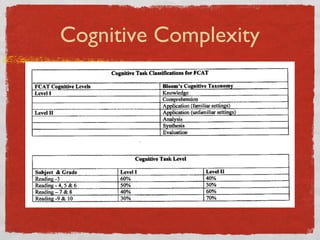
Cognitive Complexity
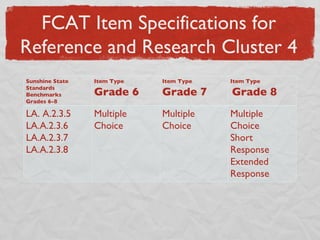
FCAT Item Specifications for Reference and Research Cluster 4 Sunshine State Standards Benchmarks Grades 6-8 Item Type Grade 6 Item Type  Grade 7 Item Type Grade 8 LA. A.2.3.5 LA.A.2.3.6 LA.A.2.3.7 LA.A.2.3.8  Multiple Choice Multiple Choice  Multiple Choice Short Response Extended Response
Grade 8 Sample Short Response Discuss the methods of…. described in the article.  Explain why the methods did or did not work. Use details and information from the article to support your answer What information in the article supports the author’s statement…. Use details and information from the article to support your answer
Teaching Implications When checking comprehension and questioning avoid “literal” references: Low Level Questions to AVOID! On what page? In which chapter? In what kind of reference book would you find information about?
Teaching Implications 6-8 Practice locating and verifying details, critically analyzing text Practice drawing correct conclusions, strong arguments to support answers Understanding of text structure and supporting details Use of graphic organizers, note-taking, summarizing skills, reading a variety of text
Typical Distracters for Cluster 4 Incorrect use of reference materials Incorrect or irrelevant information from the resource material Incorrect conclusions or generalizations based on the stimulus Take time to discuss the “why” behind wrong answers
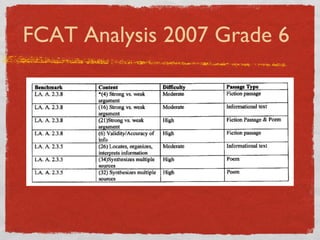
FCAT Analysis 2007 Grade 6
FCAT Passage Attributes Passage and sources should focus on one or more topics  Include grade appropriate sources, maps, charts, photos, excerpts, reference materials Reference materials should look like those found in textbooks or library reference materials. Refer the FCAT Topics for Core Subjects when designing media lessons and projects.  When selecting resources for your instruction:
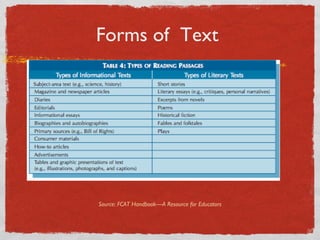
Forms of  Text  Source: FCAT Handbook––A Resource for Educators
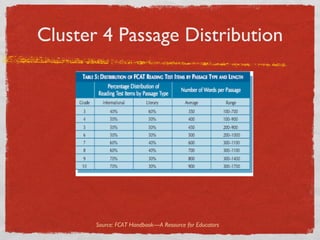
Cluster 4 Passage Distribution Source: FCAT Handbook––A Resource for Educators
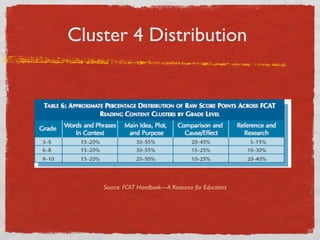
Cluster 4 Distribution  Source: FCAT Handbook––A Resource for Educators
Lessons Learned  Students who  can make connections  and  draw successful conclusions  find success in FCAT Cluster 4.
Grade 6 Cluster 4  Successful students can…. Draw conclusions; AND Identify supporting details that verify the conclusion Distinguish between strong and weak support Source: FCAT Lessons Learned -Data Analyses and Instructional Implications http://fcat.fldoe.org/lessonslearned.asp
Grade 7 Cluster 4  Successful students can…. •  Differentiate  between validity and accuracy  •  Go back to the text to confirm conclusion •  Differentiate between characters in a text  Source: FCAT Lessons Learned -Data Analyses and Instructional Implications http://fcat.fldoe.org/lessonslearned.asp
Grade 8 Cluster 4  Successful students can…. •  Differentiate between validity and accuracy when considering facts •  Include relevant details to support a response Source: FCAT Lessons Learned -Data Analyses and Instructional Implications http://fcat.fldoe.org/lessonslearned.asp
Reference, Research, & Reading
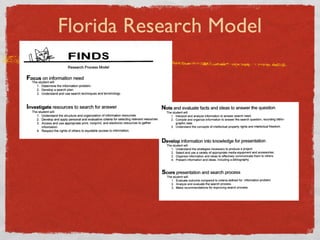
Florida Research Model
FINDS &  Sunshine State Standards Select a topic for inquiry  (FOCUS) Locate, use, and analyze information from text features  (INVESTIGATE) Use information from text to answer questions related to main idea Identify characteristics (structure) of various types of text Record information related to text  (NOTE & EVALUATE) Organize information to show understanding through mapping, paraphrasing, compare and contrast, and summarizing.  (DEVELOP)
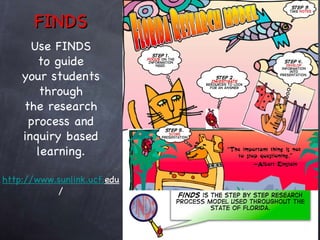
Use FINDS to guide your students through the research process and inquiry based learning. FINDS http://www. sunlink . ucf . edu /
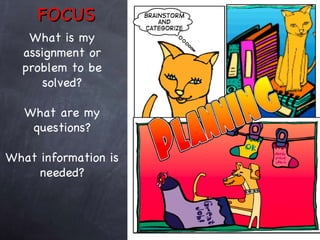
What is my assignment or problem to be solved? What are my questions? What information is needed? FOCUS
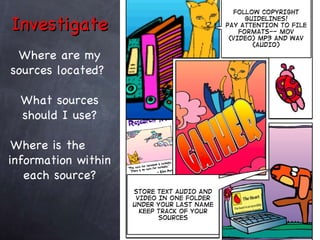
Investigate Where are my sources located?  What sources should I use? Where is the  information within each source?
NOTES How do I take notes in my own words? Which facts do I  need to create a citation? Do I have all the information I need?
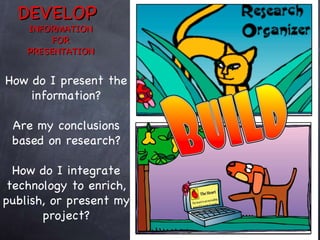
DEVELOP  INFORMATION FOR PRESENTATION How do I present the information? Are my conclusions based on research? How do I integrate technology to enrich, publish, or present my project?
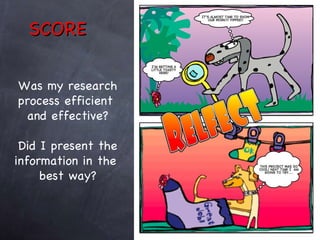
SCORE Was my research process efficient  and effective? Did I present the information in the  best way?
FINDS & Informational Text FINDS & Fiction FINDS & Novel Extensions Instructional Strategies
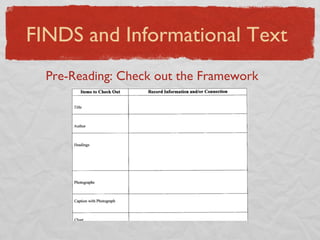
FINDS and Informational Text Pre-Reading: Check out the Framework
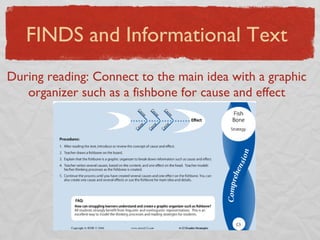
FINDS and Informational Text During reading: Connect to the main idea with a graphic organizer such as a fishbone for cause and effect
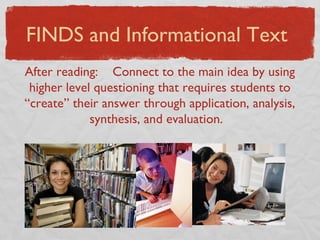
FINDS and Informational Text After reading:  Connect to the main idea by using higher level questioning that requires students to “create” their answer through application, analysis, synthesis, and evaluation.
FINDS:  Digging Deeper with Fiction “ Many children are not so engaged when they read.  They don’t know when they’re comprehending. They don’t know when they are not. They don’t know whether it is critical for them to comprehend a given piece.  And if they don’t comprehend, they don’t know what to do about it.” Keene, Ellin Oliver and Zimmerman, Susan.  Mosaic of Thought . Portsmouth, NH: Heinemann, 1997.
According to Mosaic of Thought, proficient readers: Make different types of connections to the text Text-to-Self Text-to-Text Text -to-World
Spontaneously generate questions Ask questions to clarify meaning Recognize that if the answer is not in text, they will need to infer it Are aware that as they hear other’s questions, new ones are inspired in the their own minds According to Mosaic of Thought, proficient readers:
FINDS and Fiction Make connections between different types of passages with common themes After reading informational text on a topic, have students read a literary piece or poem and identify the connection  between the texts TEXT-TO-TEXT CONNECTION © Bruce Laurance/Getty Images
FINDS:  Novel Extensions Identify a theme or topic that requires further research, exploration, or cross-curricular study.  Turn passive readers into active readers by integrating technology and inquiry-based learning into reading instruction. Podcasts, Google Lit Trips, E-Zines, wikis and blogs are just a few examples of how technology can be used to extend novels, giving students a chance for real world application.
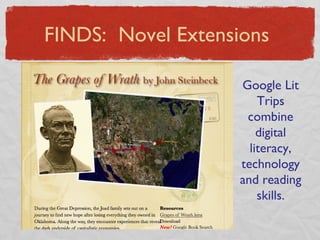
FINDS:  Novel Extensions Google Lit Trips combine digital literacy, technology and reading skills.
FINDS:  Novel Extensions BEEP resource:  teachingbooks.net   Author Interviews Multimedia presentations of research through podcasts, student created videos and Jack Gantos
FINDS & Informational Text FINDS & Fiction FINDS & Novel Extensions FINDS Re-cap
LRIM workshops Online course with Virtual  University on FINDS model.  Where can I learn more about FINDS and Reference & Research?
FCAT Item Specifications http: //fcat . fldoe .org/fcatis01.asp Reports on the 2007 Assessment http: //fcat . fldoe . org/fcatflwrites .asp   FCAT Lessons Learned -Data Analyses and Instructional Implications http: //fcat . fldoe . org/lessonslearned .asp FCAT Released Tests & Questions http: //fcat . fldoe . org/fcatrelease .asp   Florida Achieves http: //cim . florida-achieves .com/   State Instructional Resources:

Reference & Research W Finds

  • 1.
    Reference, Research &Reading Learning Resources & Instructional Materials Secondary Session January 16 th , 2009
  • 2.
    Information Literacy SunshineState Standards FCAT Data Curriculum Connections What is Reference and Research?
  • 3.
    Think of studentsas “Infotectives... a student thinker capable of asking great questions about data in order to convert the data into information and eventually insight .” Creating Critical Thinkers McKenzie, Jamie. (1998). Grazing the Net: Raising a Generation of Free Range Students
  • 4.
    Locates, organizes andinterprets information Uses a variety of reference materials Synthesizes information into useful information such note cards, spreadsheets and outlines. Student checks the validity and accuracy of information, strong vs. weak argument Grades 6-8 Old LA.A 2.3.5 2.3.6 2.3.7 2.3.8 Sunshine State Standards
  • 5.
    NEW SunshineState Standards Select a topic for inquiry Locate, use, and analyze information from text features Use information from text to answer questions related to main idea Identify characteristics (structure) of various types of text Record information related to text Organize information to show understanding through mapping, paraphrasing, compare and contrast, and summarizing.) (currently under revision)
  • 6.
  • 7.
    FCAT Item Specificationsfor Reference and Research Cluster 4 Sunshine State Standards Benchmarks Grades 6-8 Item Type Grade 6 Item Type Grade 7 Item Type Grade 8 LA. A.2.3.5 LA.A.2.3.6 LA.A.2.3.7 LA.A.2.3.8 Multiple Choice Multiple Choice Multiple Choice Short Response Extended Response
  • 8.
    Grade 8 SampleShort Response Discuss the methods of…. described in the article. Explain why the methods did or did not work. Use details and information from the article to support your answer What information in the article supports the author’s statement…. Use details and information from the article to support your answer
  • 9.
    Teaching Implications Whenchecking comprehension and questioning avoid “literal” references: Low Level Questions to AVOID! On what page? In which chapter? In what kind of reference book would you find information about?
  • 10.
    Teaching Implications 6-8Practice locating and verifying details, critically analyzing text Practice drawing correct conclusions, strong arguments to support answers Understanding of text structure and supporting details Use of graphic organizers, note-taking, summarizing skills, reading a variety of text
  • 11.
    Typical Distracters forCluster 4 Incorrect use of reference materials Incorrect or irrelevant information from the resource material Incorrect conclusions or generalizations based on the stimulus Take time to discuss the “why” behind wrong answers
  • 12.
  • 13.
    FCAT Passage AttributesPassage and sources should focus on one or more topics Include grade appropriate sources, maps, charts, photos, excerpts, reference materials Reference materials should look like those found in textbooks or library reference materials. Refer the FCAT Topics for Core Subjects when designing media lessons and projects. When selecting resources for your instruction:
  • 14.
    Forms of Text Source: FCAT Handbook––A Resource for Educators
  • 15.
    Cluster 4 PassageDistribution Source: FCAT Handbook––A Resource for Educators
  • 16.
    Cluster 4 Distribution Source: FCAT Handbook––A Resource for Educators
  • 17.
    Lessons Learned Students who can make connections and draw successful conclusions find success in FCAT Cluster 4.
  • 18.
    Grade 6 Cluster4 Successful students can…. Draw conclusions; AND Identify supporting details that verify the conclusion Distinguish between strong and weak support Source: FCAT Lessons Learned -Data Analyses and Instructional Implications http://fcat.fldoe.org/lessonslearned.asp
  • 19.
    Grade 7 Cluster4 Successful students can…. • Differentiate between validity and accuracy • Go back to the text to confirm conclusion • Differentiate between characters in a text Source: FCAT Lessons Learned -Data Analyses and Instructional Implications http://fcat.fldoe.org/lessonslearned.asp
  • 20.
    Grade 8 Cluster4 Successful students can…. • Differentiate between validity and accuracy when considering facts • Include relevant details to support a response Source: FCAT Lessons Learned -Data Analyses and Instructional Implications http://fcat.fldoe.org/lessonslearned.asp
  • 21.
  • 22.
  • 23.
    FINDS & Sunshine State Standards Select a topic for inquiry (FOCUS) Locate, use, and analyze information from text features (INVESTIGATE) Use information from text to answer questions related to main idea Identify characteristics (structure) of various types of text Record information related to text (NOTE & EVALUATE) Organize information to show understanding through mapping, paraphrasing, compare and contrast, and summarizing. (DEVELOP)
  • 24.
    Use FINDS toguide your students through the research process and inquiry based learning. FINDS http://www. sunlink . ucf . edu /
  • 25.
    What is myassignment or problem to be solved? What are my questions? What information is needed? FOCUS
  • 26.
    Investigate Where aremy sources located? What sources should I use? Where is the information within each source?
  • 27.
    NOTES How doI take notes in my own words? Which facts do I need to create a citation? Do I have all the information I need?
  • 28.
    DEVELOP INFORMATIONFOR PRESENTATION How do I present the information? Are my conclusions based on research? How do I integrate technology to enrich, publish, or present my project?
  • 29.
    SCORE Was myresearch process efficient and effective? Did I present the information in the best way?
  • 30.
    FINDS & InformationalText FINDS & Fiction FINDS & Novel Extensions Instructional Strategies
  • 31.
    FINDS and InformationalText Pre-Reading: Check out the Framework
  • 32.
    FINDS and InformationalText During reading: Connect to the main idea with a graphic organizer such as a fishbone for cause and effect
  • 33.
    FINDS and InformationalText After reading: Connect to the main idea by using higher level questioning that requires students to “create” their answer through application, analysis, synthesis, and evaluation.
  • 34.
    FINDS: DiggingDeeper with Fiction “ Many children are not so engaged when they read. They don’t know when they’re comprehending. They don’t know when they are not. They don’t know whether it is critical for them to comprehend a given piece. And if they don’t comprehend, they don’t know what to do about it.” Keene, Ellin Oliver and Zimmerman, Susan. Mosaic of Thought . Portsmouth, NH: Heinemann, 1997.
  • 35.
    According to Mosaicof Thought, proficient readers: Make different types of connections to the text Text-to-Self Text-to-Text Text -to-World
  • 36.
    Spontaneously generate questionsAsk questions to clarify meaning Recognize that if the answer is not in text, they will need to infer it Are aware that as they hear other’s questions, new ones are inspired in the their own minds According to Mosaic of Thought, proficient readers:
  • 37.
    FINDS and FictionMake connections between different types of passages with common themes After reading informational text on a topic, have students read a literary piece or poem and identify the connection between the texts TEXT-TO-TEXT CONNECTION © Bruce Laurance/Getty Images
  • 38.
    FINDS: NovelExtensions Identify a theme or topic that requires further research, exploration, or cross-curricular study. Turn passive readers into active readers by integrating technology and inquiry-based learning into reading instruction. Podcasts, Google Lit Trips, E-Zines, wikis and blogs are just a few examples of how technology can be used to extend novels, giving students a chance for real world application.
  • 39.
    FINDS: NovelExtensions Google Lit Trips combine digital literacy, technology and reading skills.
  • 40.
    FINDS: NovelExtensions BEEP resource: teachingbooks.net Author Interviews Multimedia presentations of research through podcasts, student created videos and Jack Gantos
  • 41.
    FINDS & InformationalText FINDS & Fiction FINDS & Novel Extensions FINDS Re-cap
  • 42.
    LRIM workshops Onlinecourse with Virtual University on FINDS model. Where can I learn more about FINDS and Reference & Research?
  • 43.
    FCAT Item Specificationshttp: //fcat . fldoe .org/fcatis01.asp Reports on the 2007 Assessment http: //fcat . fldoe . org/fcatflwrites .asp FCAT Lessons Learned -Data Analyses and Instructional Implications http: //fcat . fldoe . org/lessonslearned .asp FCAT Released Tests & Questions http: //fcat . fldoe . org/fcatrelease .asp Florida Achieves http: //cim . florida-achieves .com/   State Instructional Resources:

Editor's Notes

  • #2 This presentation has been updated to reflect data and information from the Florida Department of Education, “Lessons Learned” and the “FCAT Item Specifications” documents which are available online.