Doing Business 2.0—
Starting and Operating
a Nonprofit in DC
George E. Constantine, III, Esq., Partner
Venable, LLP, Washington, DC
(202) 344-4790
geconstantine@venable.com
George E. Constantine, III, Esq.
 Counsel to tax-exempt charities, trade
  associations, professional societies, labor
  organizations
 Former Staff Counsel for the American
  Society of Association Executives
 Concentrates practice on tax-exemption
  matters, contracts, election law, corporate
  governance and other issues affecting tax-
  exempt, nonprofit corporations.
Forming a Nonprofit—Preliminary
Steps
 Establish mission and goals
 Survey the landscape—are there other
  organizations pursuing similar mission and
  goals?
 Assess likelihood of funding, dedicated
  volunteer resources, etc.
Forming a Nonprofit—Legal Requirements
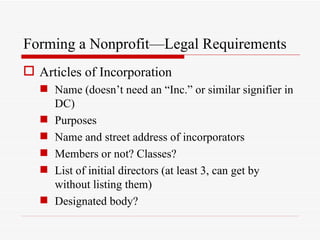
 Articles of Incorporation
   Name (doesn’t need an “Inc.” or similar signifier in
    DC)
   Purposes
   Name and street address of incorporators
   Members or not? Classes?
   List of initial directors (at least 3, can get by
    without listing them)
   Designated body?
Forming a Nonprofit—Legal Requirements
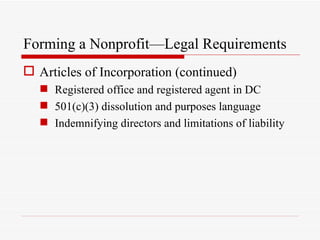
 Articles of Incorporation (continued)
    Registered office and registered agent in DC
    501(c)(3) dissolution and purposes language
    Indemnifying directors and limitations of liability
Forming a Nonprofit—Legal Requirements
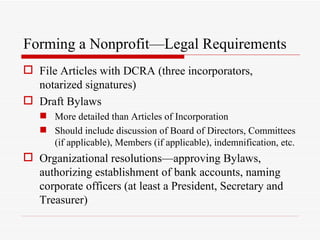
 File Articles with DCRA (three incorporators,
  notarized signatures)
 Draft Bylaws
    More detailed than Articles of Incorporation
    Should include discussion of Board of Directors, Committees
     (if applicable), Members (if applicable), indemnification, etc.
 Organizational resolutions—approving Bylaws,
  authorizing establishment of bank accounts, naming
  corporate officers (at least a President, Secretary and
  Treasurer)
Forming a Nonprofit—Legal Requirements
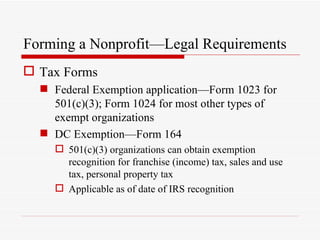
 Tax Forms
   Federal Exemption application—Form 1023 for
    501(c)(3); Form 1024 for most other types of
    exempt organizations
   DC Exemption—Form 164
     501(c)(3) organizations can obtain exemption
      recognition for franchise (income) tax, sales and use
      tax, personal property tax
     Applicable as of date of IRS recognition
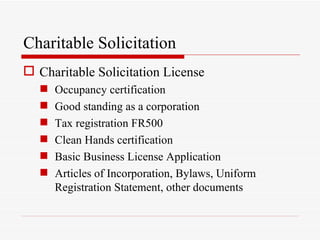
Charitable Solicitation
 Charitable Solicitation License
      Occupancy certification
      Good standing as a corporation
      Tax registration FR500
      Clean Hands certification
      Basic Business License Application
      Articles of Incorporation, Bylaws, Uniform
       Registration Statement, other documents
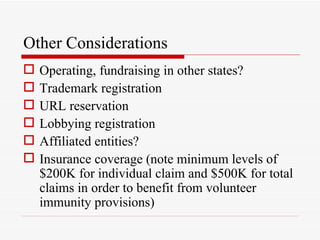
Other Considerations
   Operating, fundraising in other states?
   Trademark registration
   URL reservation
   Lobbying registration
   Affiliated entities?
   Insurance coverage (note minimum levels of
    $200K for individual claim and $500K for total
    claims in order to benefit from volunteer
    immunity provisions)
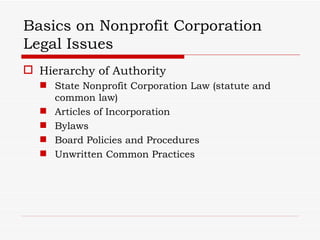
Basics on Nonprofit Corporation
Legal Issues
 Hierarchy of Authority
   State Nonprofit Corporation Law (statute and
    common law)
   Articles of Incorporation
   Bylaws
   Board Policies and Procedures
   Unwritten Common Practices
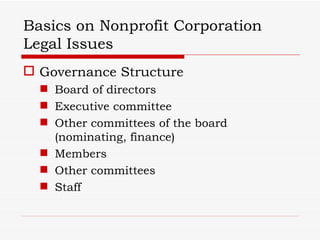
Basics on Nonprofit Corporation
Legal Issues
 Governance Structure
   Board of directors
   Executive committee
   Other committees of the board
    (nominating, finance)
   Members
   Other committees
   Staff
Corporate Governance
 Fiduciary Duties
   Care
   Loyalty
   Obedience
501(C)(3) Issues
 Public benefit requirement—charitable,
  educational, advancement of health,
  etc.
   No substantial private benefit
   No private inurement
 Political activities
 Lobbying
 UBIT
501(C)(3) Issues
 Form 990
   Once a year (May 15 deadline for calendar
    year filers)
   990-N—even very small organizations
    have to do it
   Automatic revocation
 Publicly available information
Questions?
 http://www.venable.com/associations/publications
Contact Information
George E. Constantine, III
Partner
Venable LLP
575 7th Street, NW
Washington, DC 20004-1601
Phone: 202-344-4790
Fax: 202-344-8300
Email: geconstantine@venable.com

Doing Business in DC | Starting a Nonprofit | Starting and Operating a Nonprofit in DC

  • 1.
    Doing Business 2.0— Startingand Operating a Nonprofit in DC George E. Constantine, III, Esq., Partner Venable, LLP, Washington, DC (202) 344-4790 geconstantine@venable.com
  • 2.
    George E. Constantine,III, Esq.  Counsel to tax-exempt charities, trade associations, professional societies, labor organizations  Former Staff Counsel for the American Society of Association Executives  Concentrates practice on tax-exemption matters, contracts, election law, corporate governance and other issues affecting tax- exempt, nonprofit corporations.
  • 3.
    Forming a Nonprofit—Preliminary Steps Establish mission and goals  Survey the landscape—are there other organizations pursuing similar mission and goals?  Assess likelihood of funding, dedicated volunteer resources, etc.
  • 4.
    Forming a Nonprofit—LegalRequirements  Articles of Incorporation  Name (doesn’t need an “Inc.” or similar signifier in DC)  Purposes  Name and street address of incorporators  Members or not? Classes?  List of initial directors (at least 3, can get by without listing them)  Designated body?
  • 5.
    Forming a Nonprofit—LegalRequirements  Articles of Incorporation (continued)  Registered office and registered agent in DC  501(c)(3) dissolution and purposes language  Indemnifying directors and limitations of liability
  • 6.
    Forming a Nonprofit—LegalRequirements  File Articles with DCRA (three incorporators, notarized signatures)  Draft Bylaws  More detailed than Articles of Incorporation  Should include discussion of Board of Directors, Committees (if applicable), Members (if applicable), indemnification, etc.  Organizational resolutions—approving Bylaws, authorizing establishment of bank accounts, naming corporate officers (at least a President, Secretary and Treasurer)
  • 7.
    Forming a Nonprofit—LegalRequirements  Tax Forms  Federal Exemption application—Form 1023 for 501(c)(3); Form 1024 for most other types of exempt organizations  DC Exemption—Form 164  501(c)(3) organizations can obtain exemption recognition for franchise (income) tax, sales and use tax, personal property tax  Applicable as of date of IRS recognition
  • 8.
    Charitable Solicitation  CharitableSolicitation License  Occupancy certification  Good standing as a corporation  Tax registration FR500  Clean Hands certification  Basic Business License Application  Articles of Incorporation, Bylaws, Uniform Registration Statement, other documents
  • 9.
    Other Considerations  Operating, fundraising in other states?  Trademark registration  URL reservation  Lobbying registration  Affiliated entities?  Insurance coverage (note minimum levels of $200K for individual claim and $500K for total claims in order to benefit from volunteer immunity provisions)
  • 10.
    Basics on NonprofitCorporation Legal Issues  Hierarchy of Authority  State Nonprofit Corporation Law (statute and common law)  Articles of Incorporation  Bylaws  Board Policies and Procedures  Unwritten Common Practices
  • 11.
    Basics on NonprofitCorporation Legal Issues  Governance Structure  Board of directors  Executive committee  Other committees of the board (nominating, finance)  Members  Other committees  Staff
  • 12.
    Corporate Governance  FiduciaryDuties  Care  Loyalty  Obedience
  • 13.
    501(C)(3) Issues  Publicbenefit requirement—charitable, educational, advancement of health, etc.  No substantial private benefit  No private inurement  Political activities  Lobbying  UBIT
  • 14.
    501(C)(3) Issues  Form990  Once a year (May 15 deadline for calendar year filers)  990-N—even very small organizations have to do it  Automatic revocation  Publicly available information
  • 15.
  • 16.
    Contact Information George E.Constantine, III Partner Venable LLP 575 7th Street, NW Washington, DC 20004-1601 Phone: 202-344-4790 Fax: 202-344-8300 Email: geconstantine@venable.com