Examining the
 Non-profit
 application form
Many make the process of                              1. Incorporate a nonprofit corporation in the state you
   starting a nonprofit and                                reside in
   filling out the 501c3                                 2. Create Bylaws and articles of incorporation in
   application difficult when in                          which to govern your corporation
   actuality it is a fairly simple
   process. Many when                                    2. Apply for tax exempt status by filling out and
                                                          filing the IRS Form 1023 (501c3 application)
   starting a nonprofit search
   for the “501c3 Application,”                          3. Apply for an EIN number
   when in reality there are
   more steps than just the                              4. Apply for a business license
   application.                                          5. Open a bank account once the nonprofit
There are countless companies                             corporation is established
   that make their living off of
   charging exorbitant fees to       However, starting a nonprofit through a fiscal sponsor is certainly
   help others who want to              an easier route since there is no 501c3 application. Fiscal
   start a nonprofit. It is not         Sponsorship is a formal arrangement in which a 501c3 public
   necessary to pay someone             charity sponsors a project that needs nonprofit status.
   else money to fill out the           Typically, a nonprofit set up through Fiscal Sponsorship
   501c3 application when               takes less than 4 weeks to get approved and less that $400
   starting a nonprofit.                to establish.
   Instead, starting a nonprofit
   can be done quickly and
   easily.
The IRS Form is 32 pages long, takes and average         IRS User Fees Unchanged for 2012
    of four hours to learn and 8 hours to fill it out.
                                                            The IRS has just released Revenue Procedure 2012-8,
To achieve 501(c)(3) status, you must file IRS Form          which provides details
    1023 which is the Application for Recognition
    of Exemption Under Section 501(c)(3) of the             about IRS User Fees. All fees for exemption applications
                                                             remain the same:
    Internal Revenue Code.
You can get a copy of this form plus instructions           - $400 for applicants whose gross receipts average
    for filling it out, and other helpful IRS                $10,000 or less
    publications, by calling 800-TX-FORM,                   - $850 for applicants whose gross receipts average more
    visiting your local IRS office, or by going to           than $10,000
    the IRS
                                                             - $3,000 for group exemptions
How to Form a Nonprofit Corporation, by                  


    Anthony Mancuso provides information on                 - $100 for small organizations seeking reinstatement after
    state, as well as federal, tax exemptions.               automatic

                                                            revocation (must meet IRS guidelines for Transitional
                                                             Relief)

   The hardest part of
    the application
    process
Appoint directors.
  501(c)(3) Organizations Must Fulfill the
      Following Responsibilities:            A nonprofit'sdirectors make the major policy and financial
                                                 decisions for the nonprofit. Many states allow nonprofits
     Keep Adequate Records                      to have just one director, but other states require at least
     File Required Returns                      three.
     Provide Donor Substantiation
     Obey Disclosure Laws                   Hold a meeting of the board.
     Generate Public Support                At the first meeting of the board of directors, the directors take
     Avoid "Excess Benefits" for insiders        care of formalities such as adopting the bylaws, electing
     Shun Political Activity                     officers, and recording the receipt of federal and state tax
                                                  exemptions. After the meeting is completed,minutes of
     Limit Legislative Activity
                                                  the meeting should be created and filed in the nonprofit's
     Limit Unrelated Business Activity           records binder. For more information, see Nolo's article
                                                  Protecting Your Nonprofit Corporation's Tax-Exempt
                                                  Status.

                                             Obtain licenses and permits.

                                             Check with your state department of consumer affairs (or
                                                 similar state licensing agency) for information concerning
                                                 state licensing requirements for your type of organization.
                                                 For instance,if you sell anything to consumers, you'll need
Have a plan for each                             a sales tax permit, and your activitiesmay require a
                                                 zoning permit.

 one of these items
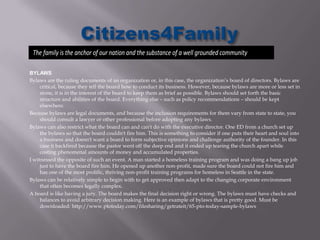
The family is the anchor of our nation and the substance of a well grounded community

BYLAWS
Bylaws are the ruling documents of an organization or, in this case, the organization’s board of directors. Bylaws are
     critical, because they tell the board how to conduct its business. However, because bylaws are more or less set in
     stone, it is in the interest of the board to keep them as brief as possible. Bylaws should set forth the basic
     structure and abilities of the board. Everything else – such as policy recommendations – should be kept
     elsewhere.
Because bylaws are legal documents, and because the inclusion requirements for them vary from state to state, you
     should consult a lawyer or other professional before adopting any bylaws.
Bylaws can also restrict what the board can and can't do with the executive director. One ED from a church set up
     the bylaws so that the board couldn't fire him. This is something to consider if one puts their heart and soul into
     a business and doesn't want a board to form subjective opinions and challenge authority of the founder. In this
     case it backfired because the pastor went off the deep end and it ended up tearing the church apart while
     costing phenomenal amounts of money and accumulated properties.
I witnessed the opposite of such an event. A man started a homeless training program and was doing a bang up job
     just to have the board fire him. He opened up another non-profit, made sure the board could not fire him and
     has one of the most prolific, thriving non-profit training programs for homeless in Seattle in the state.
Bylaws can be relatively simple to begin with to get approved then adapt to the changing corporate environment
     that often becomes legally complex.
A board is like having a jury. The board makes the final decision right or wrong. The bylaws must have checks and
     balances to avoid arbitrary decision making. Here is an example of bylaws that is pretty good. Must be
     downloaded: http://www.ptotoday.com/filesharing/getrateit/65-pto-today-sample-bylaws
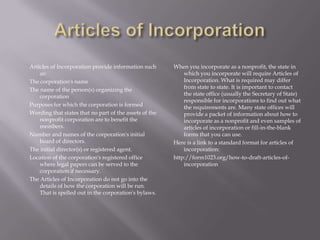
Articles of Incorporation provide information such      When you incorporate as a nonprofit, the state in
    as:                                                     which you incorporate will require Articles of
The corporation's name                                      Incorporation. What is required may differ
The name of the person(s) organizing the                    from state to state. It is important to contact
    corporation                                             the state office (usually the Secretary of State)
                                                            responsible for incorporations to find out what
Purposes for which the corporation is formed                the requirements are. Many state offices will
Wording that states that no part of the assets of the       provide a packet of information about how to
    nonprofit corporation are to benefit the                incorporate as a nonprofit and even samples of
    members.                                                articles of incorporation or fill-in-the-blank
Number and names of the corporation's initial               forms that you can use.
    board of directors.                                 Here is a link to a standard format for articles of
The initial director(s) or registered agent.                incorporation:
Location of the corporation's registered office         http://form1023.org/how-to-draft-articles-of-
    where legal papers can be served to the                 incorporation
    corporation if necessary.
The Articles of Incorporation do not go into the
    details of how the corporation will be run.
    That is spelled out in the corporation's bylaws.
Add the following to your portfolio and resume:
 Researched basic non-profit steps to

  incorporate in-state and IRS requirements
 Grasped an introductory presentation on

  bylaws and articles of incorporation
 Reviewed organizational and management

  skills necessary for founders

C4 f training 1

  • 1.
    Examining the Non-profit application form
  • 2.
    Many make theprocess of 1. Incorporate a nonprofit corporation in the state you starting a nonprofit and reside in filling out the 501c3  2. Create Bylaws and articles of incorporation in application difficult when in which to govern your corporation actuality it is a fairly simple process. Many when  2. Apply for tax exempt status by filling out and filing the IRS Form 1023 (501c3 application) starting a nonprofit search for the “501c3 Application,”  3. Apply for an EIN number when in reality there are more steps than just the  4. Apply for a business license application.  5. Open a bank account once the nonprofit There are countless companies corporation is established that make their living off of charging exorbitant fees to However, starting a nonprofit through a fiscal sponsor is certainly help others who want to an easier route since there is no 501c3 application. Fiscal start a nonprofit. It is not Sponsorship is a formal arrangement in which a 501c3 public necessary to pay someone charity sponsors a project that needs nonprofit status. else money to fill out the Typically, a nonprofit set up through Fiscal Sponsorship 501c3 application when takes less than 4 weeks to get approved and less that $400 starting a nonprofit. to establish. Instead, starting a nonprofit can be done quickly and easily.
  • 3.
    The IRS Formis 32 pages long, takes and average IRS User Fees Unchanged for 2012 of four hours to learn and 8 hours to fill it out.  The IRS has just released Revenue Procedure 2012-8, To achieve 501(c)(3) status, you must file IRS Form which provides details 1023 which is the Application for Recognition of Exemption Under Section 501(c)(3) of the  about IRS User Fees. All fees for exemption applications remain the same: Internal Revenue Code. You can get a copy of this form plus instructions  - $400 for applicants whose gross receipts average for filling it out, and other helpful IRS $10,000 or less publications, by calling 800-TX-FORM,  - $850 for applicants whose gross receipts average more visiting your local IRS office, or by going to than $10,000 the IRS - $3,000 for group exemptions How to Form a Nonprofit Corporation, by  Anthony Mancuso provides information on  - $100 for small organizations seeking reinstatement after state, as well as federal, tax exemptions. automatic  revocation (must meet IRS guidelines for Transitional Relief) The hardest part of the application process
  • 4.
    Appoint directors. 501(c)(3) Organizations Must Fulfill the Following Responsibilities: A nonprofit'sdirectors make the major policy and financial decisions for the nonprofit. Many states allow nonprofits  Keep Adequate Records to have just one director, but other states require at least  File Required Returns three.  Provide Donor Substantiation  Obey Disclosure Laws Hold a meeting of the board.  Generate Public Support At the first meeting of the board of directors, the directors take  Avoid "Excess Benefits" for insiders care of formalities such as adopting the bylaws, electing  Shun Political Activity officers, and recording the receipt of federal and state tax exemptions. After the meeting is completed,minutes of  Limit Legislative Activity the meeting should be created and filed in the nonprofit's  Limit Unrelated Business Activity records binder. For more information, see Nolo's article Protecting Your Nonprofit Corporation's Tax-Exempt Status. Obtain licenses and permits. Check with your state department of consumer affairs (or similar state licensing agency) for information concerning state licensing requirements for your type of organization. For instance,if you sell anything to consumers, you'll need Have a plan for each a sales tax permit, and your activitiesmay require a zoning permit. one of these items
  • 5.
    The family isthe anchor of our nation and the substance of a well grounded community BYLAWS Bylaws are the ruling documents of an organization or, in this case, the organization’s board of directors. Bylaws are critical, because they tell the board how to conduct its business. However, because bylaws are more or less set in stone, it is in the interest of the board to keep them as brief as possible. Bylaws should set forth the basic structure and abilities of the board. Everything else – such as policy recommendations – should be kept elsewhere. Because bylaws are legal documents, and because the inclusion requirements for them vary from state to state, you should consult a lawyer or other professional before adopting any bylaws. Bylaws can also restrict what the board can and can't do with the executive director. One ED from a church set up the bylaws so that the board couldn't fire him. This is something to consider if one puts their heart and soul into a business and doesn't want a board to form subjective opinions and challenge authority of the founder. In this case it backfired because the pastor went off the deep end and it ended up tearing the church apart while costing phenomenal amounts of money and accumulated properties. I witnessed the opposite of such an event. A man started a homeless training program and was doing a bang up job just to have the board fire him. He opened up another non-profit, made sure the board could not fire him and has one of the most prolific, thriving non-profit training programs for homeless in Seattle in the state. Bylaws can be relatively simple to begin with to get approved then adapt to the changing corporate environment that often becomes legally complex. A board is like having a jury. The board makes the final decision right or wrong. The bylaws must have checks and balances to avoid arbitrary decision making. Here is an example of bylaws that is pretty good. Must be downloaded: http://www.ptotoday.com/filesharing/getrateit/65-pto-today-sample-bylaws
  • 6.
    Articles of Incorporationprovide information such When you incorporate as a nonprofit, the state in as: which you incorporate will require Articles of The corporation's name Incorporation. What is required may differ The name of the person(s) organizing the from state to state. It is important to contact corporation the state office (usually the Secretary of State) responsible for incorporations to find out what Purposes for which the corporation is formed the requirements are. Many state offices will Wording that states that no part of the assets of the provide a packet of information about how to nonprofit corporation are to benefit the incorporate as a nonprofit and even samples of members. articles of incorporation or fill-in-the-blank Number and names of the corporation's initial forms that you can use. board of directors. Here is a link to a standard format for articles of The initial director(s) or registered agent. incorporation: Location of the corporation's registered office http://form1023.org/how-to-draft-articles-of- where legal papers can be served to the incorporation corporation if necessary. The Articles of Incorporation do not go into the details of how the corporation will be run. That is spelled out in the corporation's bylaws.
  • 7.
    Add the followingto your portfolio and resume:  Researched basic non-profit steps to incorporate in-state and IRS requirements  Grasped an introductory presentation on bylaws and articles of incorporation  Reviewed organizational and management skills necessary for founders