BUSINESS
COMPLIANCE
BASICS
AN OVERVIEW OF FEDERAL
AND STATE CONSIDERATIONS
PRESENTED BY:
LORI ANN FOX, ESQ.
There is only one definition for compliance.
A. True
B. False
POLLING QUESTION NO. 1
2
DEFINING COMPLIANCE
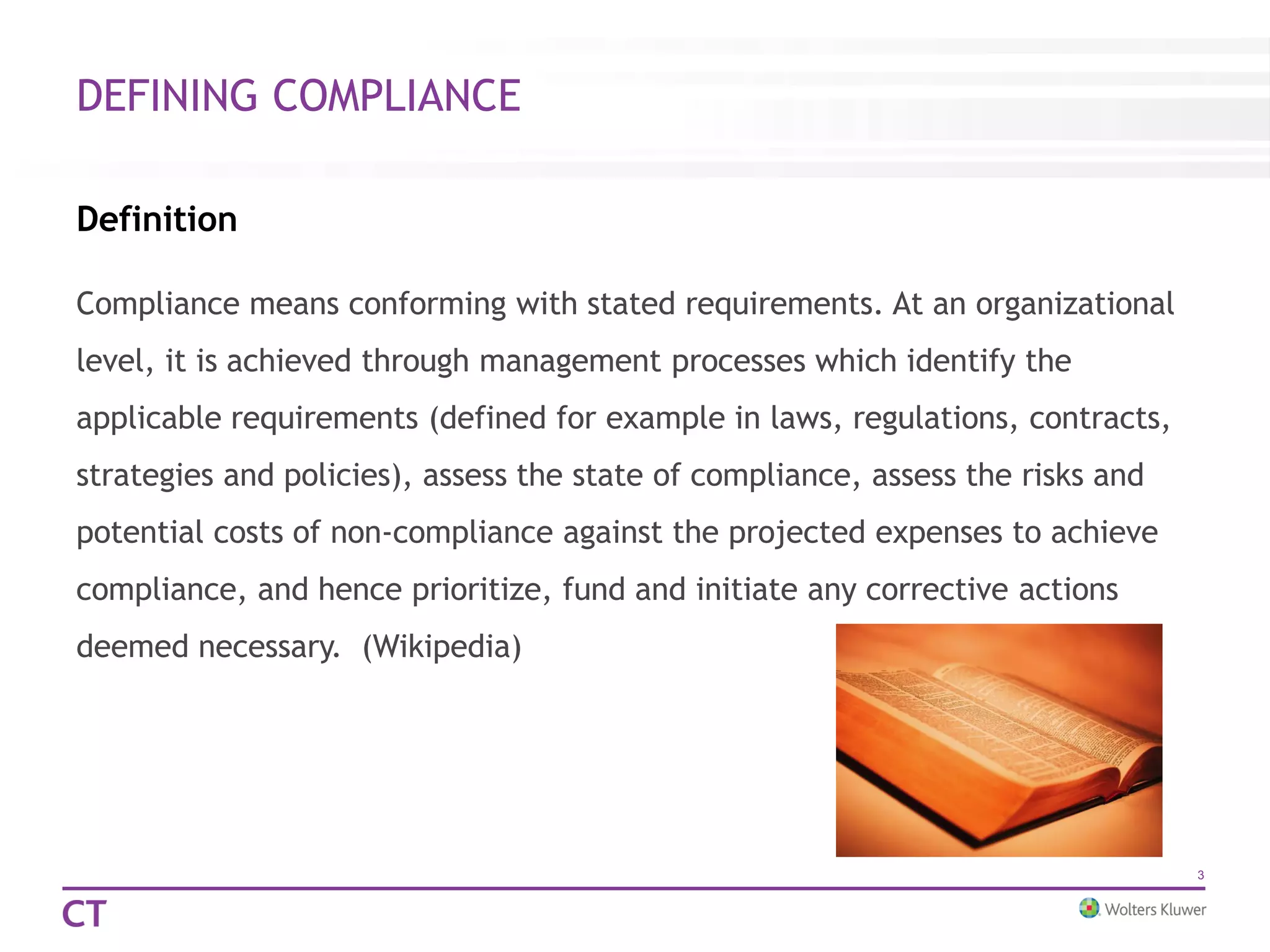
Definition
Compliance means conforming with stated requirements. At an organizational
level, it is achieved through management processes which identify the
applicable requirements (defined for example in laws, regulations, contracts,
strategies and policies), assess the state of compliance, assess the risks and
potential costs of non-compliance against the projected expenses to achieve
compliance, and hence prioritize, fund and initiate any corrective actions
deemed necessary. (Wikipedia)
3
TODAY’S TOPICS
Compliance
• State
• Federal
• Regulated Industries
4
STATE COMPLIANCE
5
STATE CORPORATION/LLC ACTS
• Considered “enabling” acts
• Compliance requirements
• Main areas of focus
– Annual report
– Franchise taxes
– Registered agent
– Transactional filings
– Foreign qualification
6
WHY IS COMPLIANCE IMPORTANT?
• Penalties and late fees
• Lose good standing
• Continued non-compliance can result in
– Administrative dissolution
– Administrative revocation of authority in foreign states
– Loss of exclusive rights to name
– Loss of access to state courts
– Personal liability for individuals doing business on corporation’s/LLC’s
behalf
7
ANNUAL REPORT
• Corps and LLCs required to file an information report
– Domestic
– Foreign
• Annual or biennial
• Varying titles/names of filing
8
ANNUAL REPORT BASICS
Main function is to provide state residents, investors, gov’t
agencies with info necessary to locate and communicate with
domestic and foreign corps and LLCs
• Statutes prescribe minimum required content
• Possible administrative discretion for content
• Could be related to franchise tax
• Due date may be fixed or based on anniversary
• Delivery - paper or electronic
9
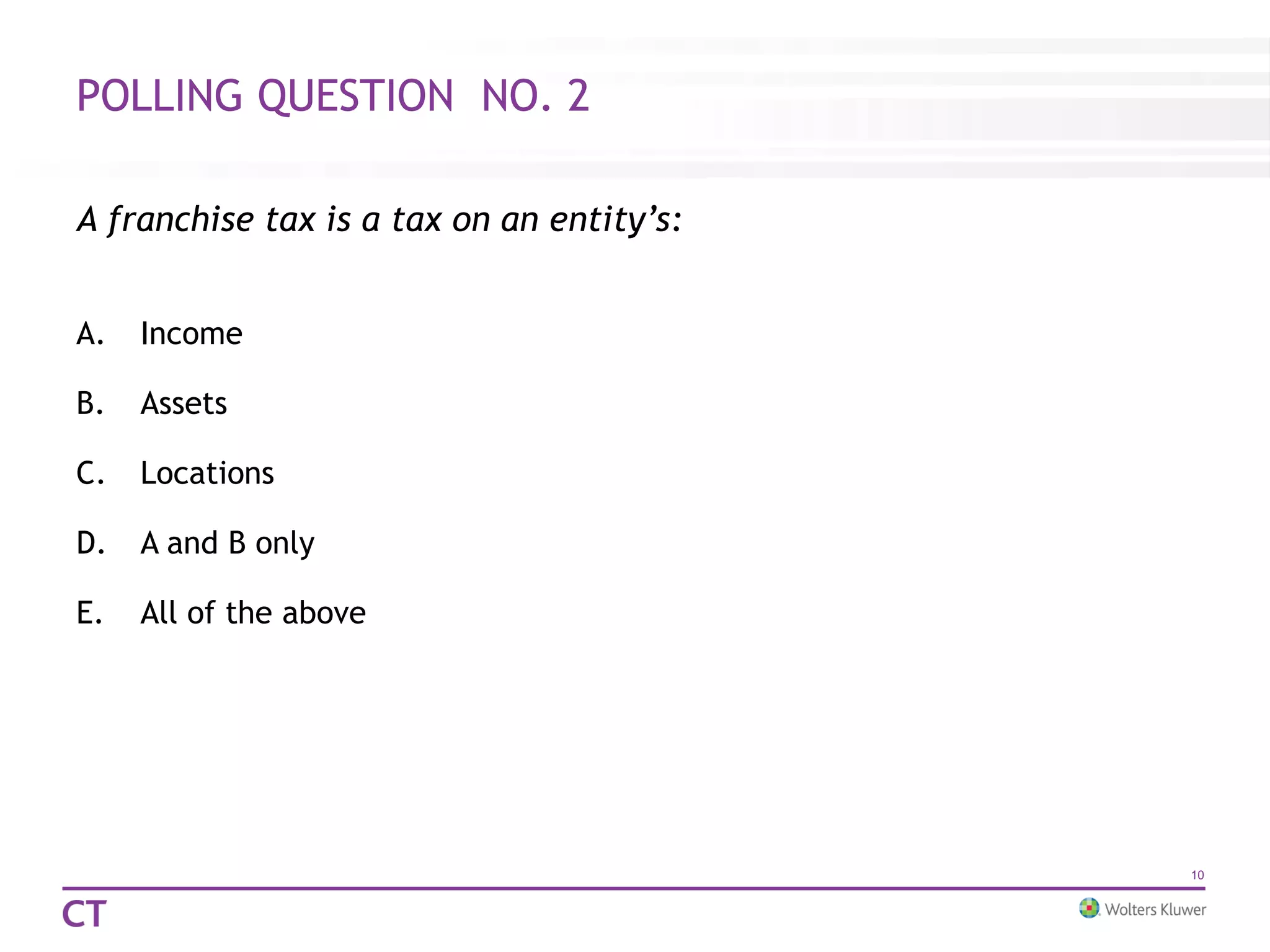
POLLING QUESTION NO. 2
A franchise tax is a tax on an entity’s:
A. Income
B. Assets
C. Locations
D. A and B only
E. All of the above
10
FRANCHISE TAX
• Privilege tax for entity’s right to do business
– For corporation, tax is generally based on authorized shares or net
income
– For LLC, may be fixed amount, number of members, net capital
accounts or other
• Not an income tax
• Usually found in business entity statute, not tax code
• Alternate names
11
REGISTERED AGENT REQUIREMENT
• Purpose – streamline service on entities
• Two mandatory requirements
– Maintain agent, located in state, authorized to receive process on
entity’s behalf
– Notify filing office of any change in agent or address
• Consent may be required in some states
12
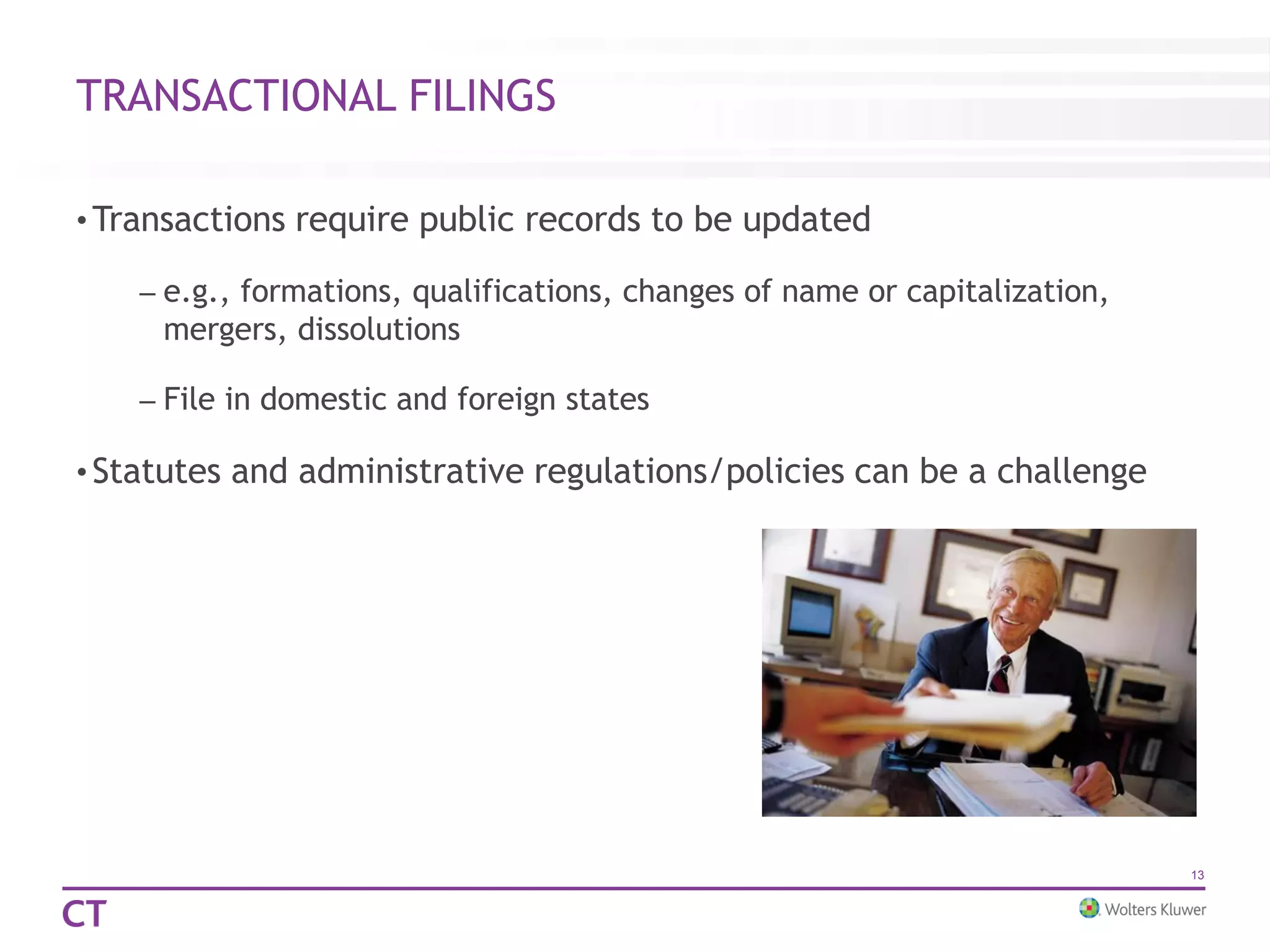
TRANSACTIONAL FILINGS
• Transactions require public records to be updated
– e.g., formations, qualifications, changes of name or capitalization,
mergers, dissolutions
– File in domestic and foreign states
• Statutes and administrative regulations/policies can be a challenge
13
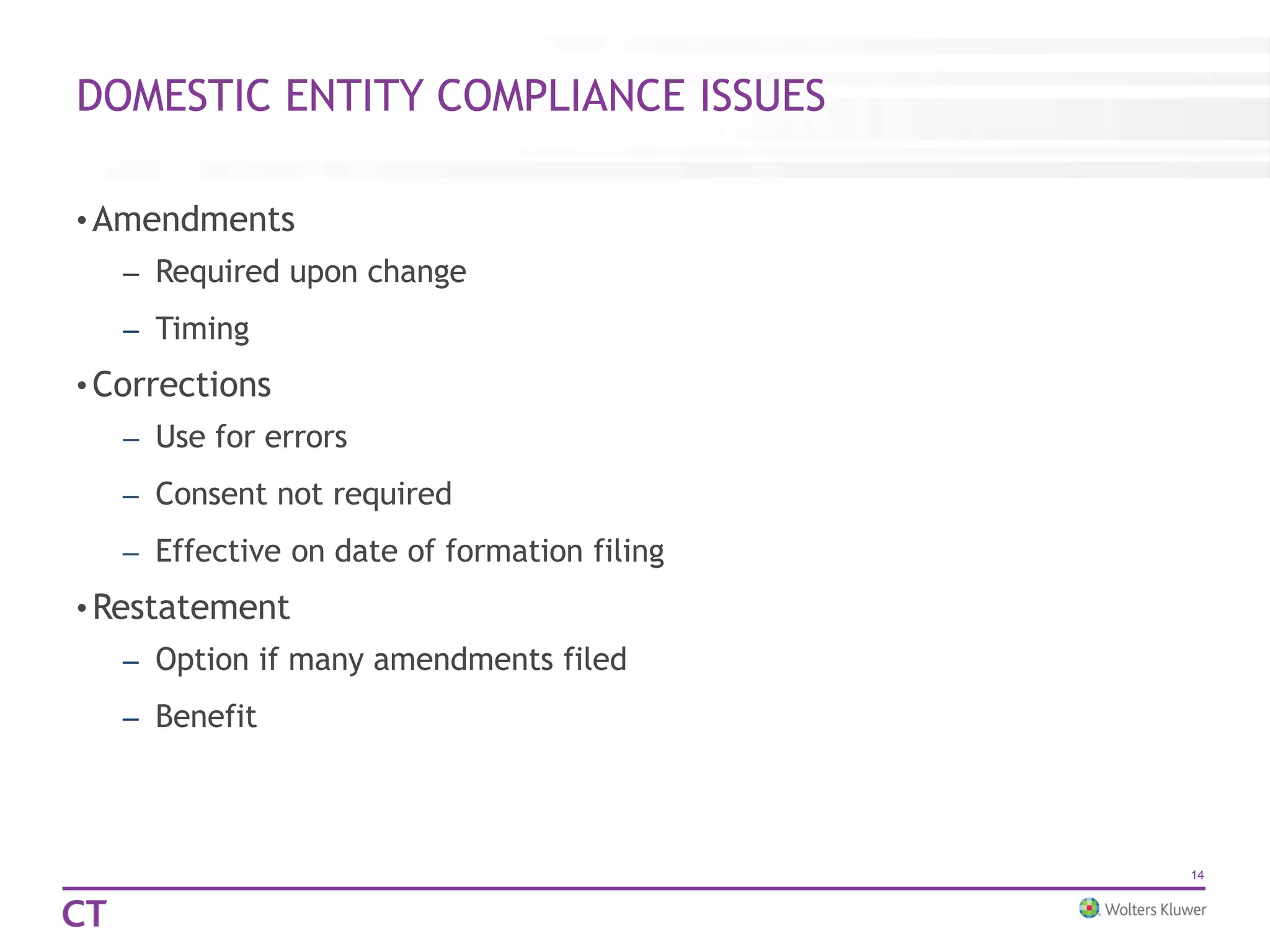
DOMESTIC ENTITY COMPLIANCE ISSUES
• Amendments
– Required upon change
– Timing
• Corrections
– Use for errors
– Consent not required
– Effective on date of formation filing
• Restatement
– Option if many amendments filed
– Benefit
14
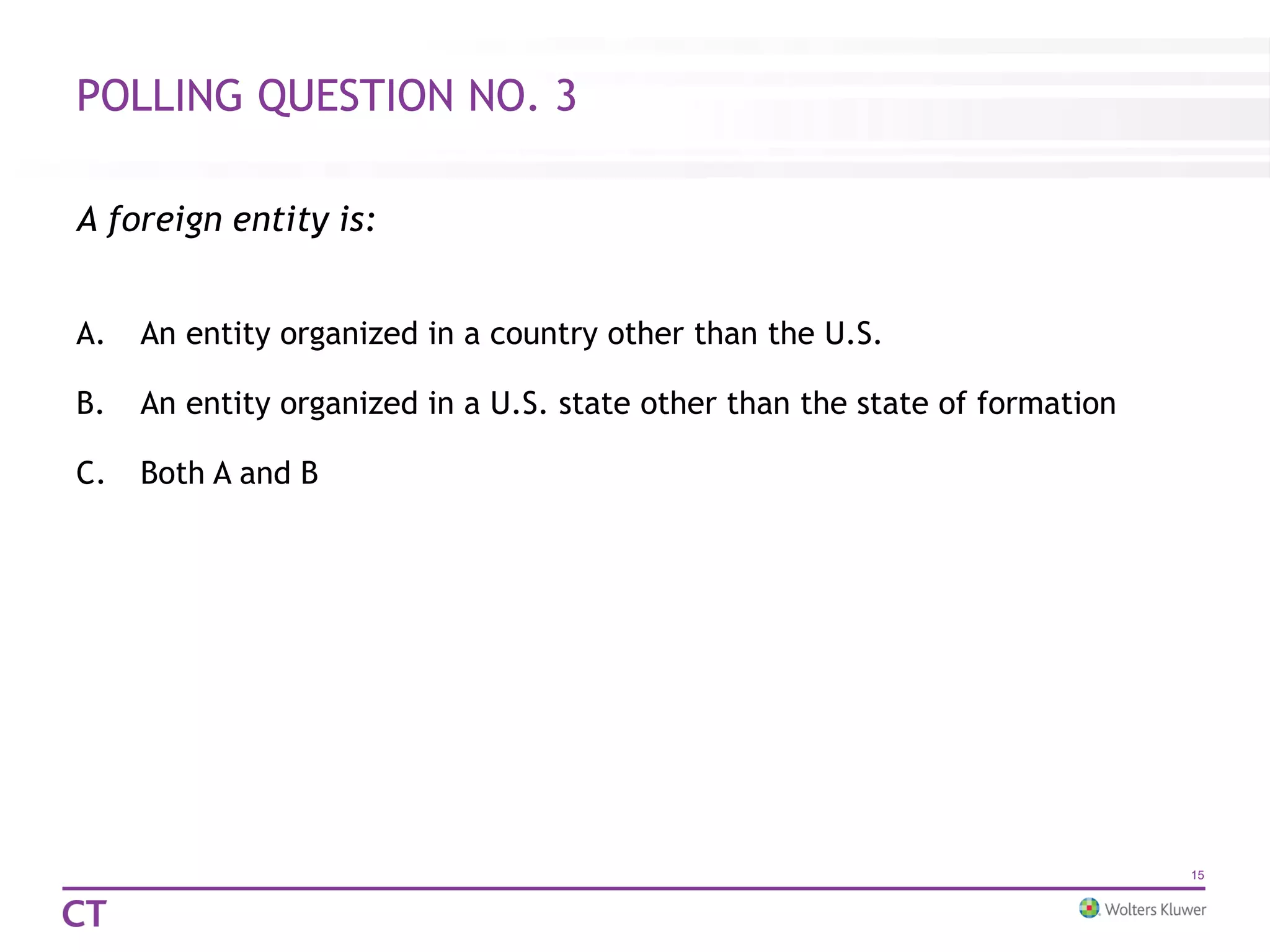
POLLING QUESTION NO. 3
A foreign entity is:
A. An entity organized in a country other than the U.S.
B. An entity organized in a U.S. state other than the state of formation
C. Both A and B
15
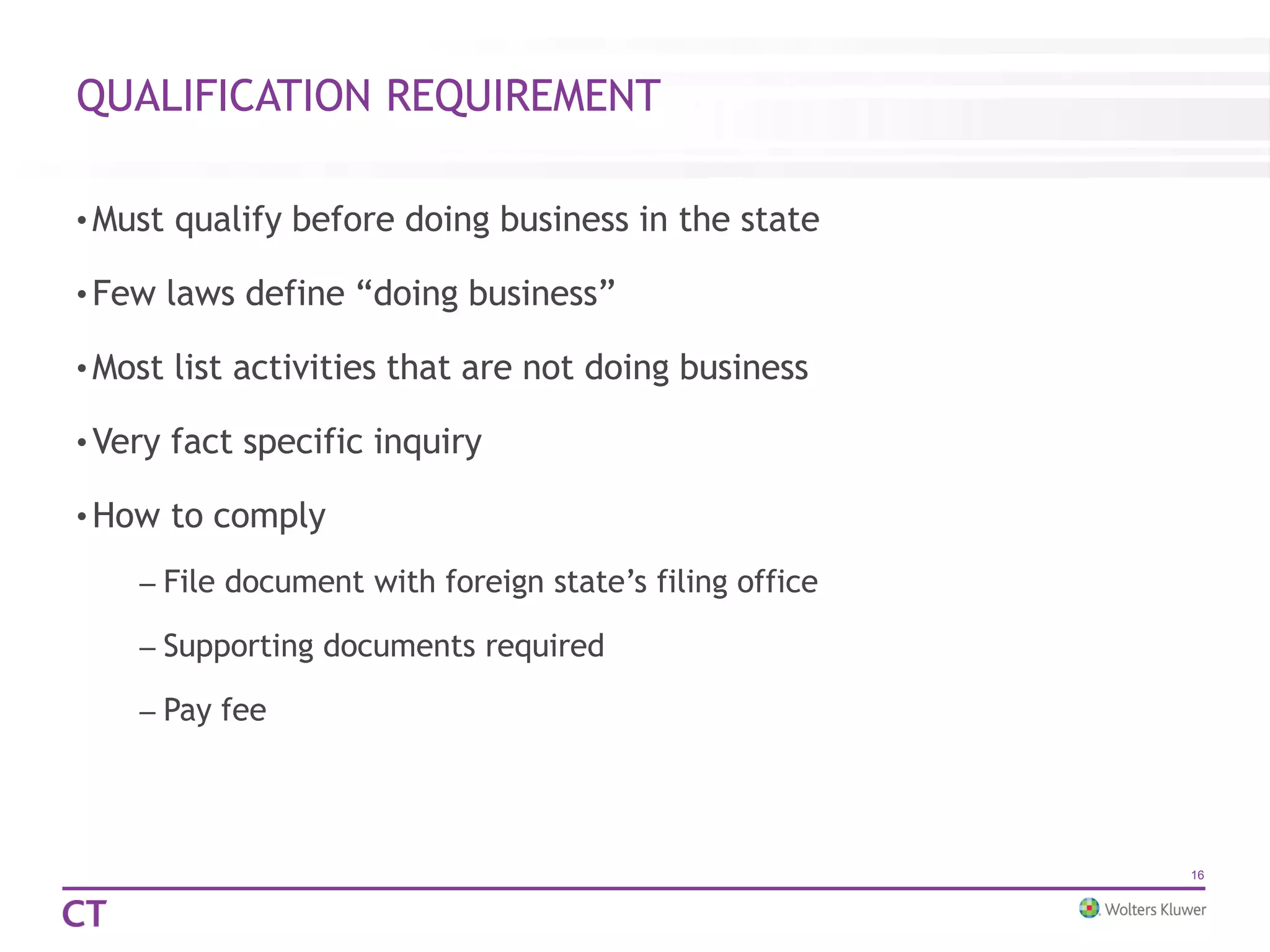
QUALIFICATION REQUIREMENT
• Must qualify before doing business in the state
• Few laws define “doing business”
• Most list activities that are not doing business
• Very fact specific inquiry
• How to comply
– File document with foreign state’s filing office
– Supporting documents required
– Pay fee
16
POST-QUALIFICATION FILING REQUIREMENTS
• Qualified entity required to update public record
– Change of name in home jurisdiction
– Notify state if involved in merger, conversion or dissolution
• Check statutes for requirements
– Annual report
– Franchise tax
– Registered agent and office
– Amended certificate
– Withdrawal
17
OTHER STATE & LOCAL COMPLIANCE ISSUES
• Business Licenses
• Taxes
• Property
• Disclosure Filings
18
FEDERAL
COMPLIANCE
19
FEDERAL COMPLIANCE
Major Federal Compliance Areas
• Anti-Trust
• Securities
• Anti-Money Laundering
20
ANTI-TRUST
• Hart-Scott-Rodino Act
– Federal law requiring pre-merger notification filing
– 1976 law – refers to corporations & partnerships only as LLCs did not
exist
• Treatment of LLCs over time
• Thresholds
21
SECURITIES
• Federal law definition
– Corporation
– LLC
• Securities cannot be sold to the public unless seller discloses material
information
• 1933 and 1934 acts require filings
– Form S-1
– Form 10
– Form 10-K
– Form 10-Q
– Form 8-K
– Forms 3, 4, and 5
22
ANTI-MONEY LAUNDERING
• How might anti-money laundering affect a company?
—OFAC
—SDN List
• Relevant legislation
23
REGULATED
INDUSTRIES
POLLING QUESTION NO. 4
Is your company is in a regulated industry (ex. - insurance,
tobacco, airlines)?
A. Yes
B. No
C. Uncertain
25
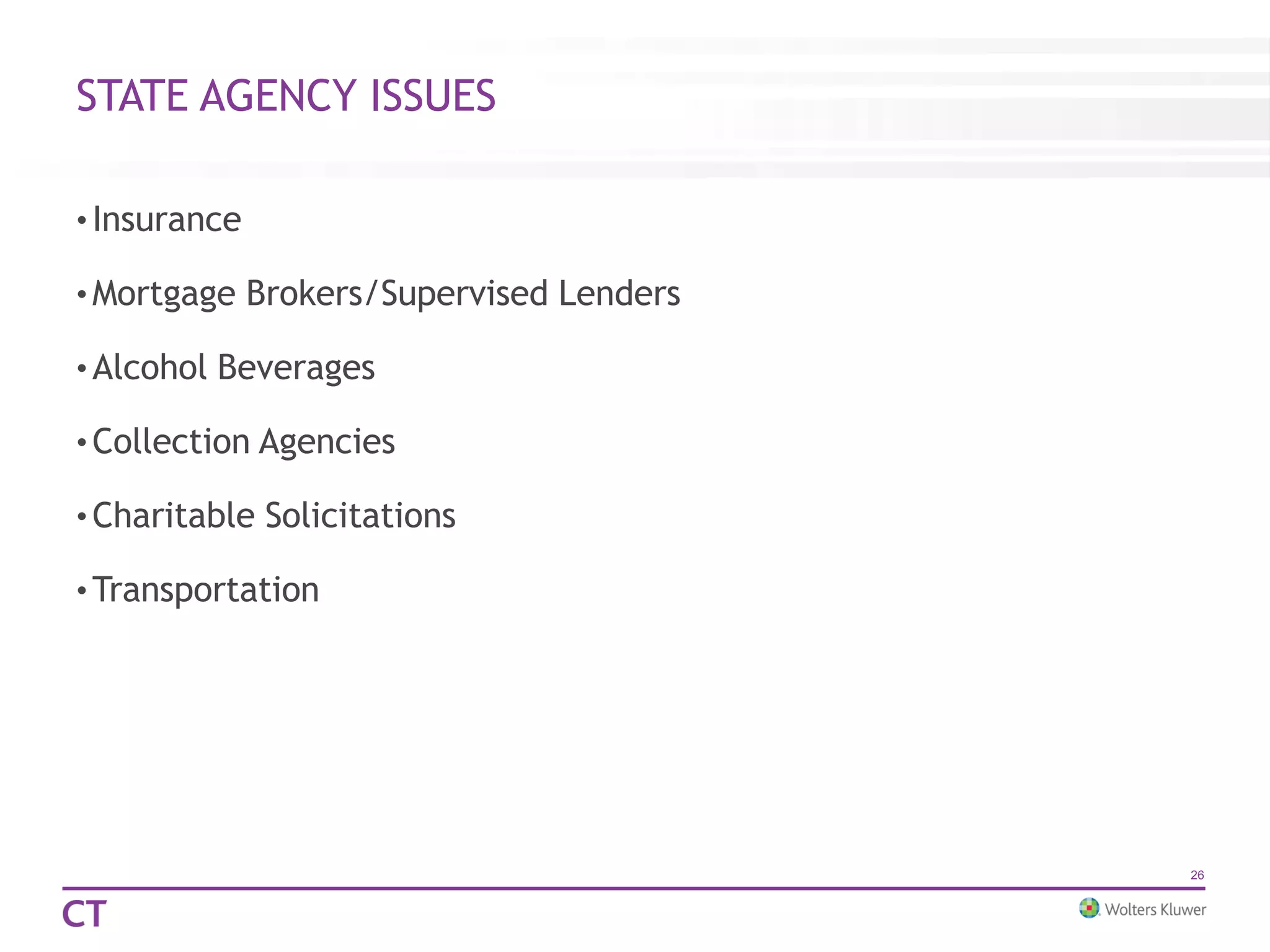
STATE AGENCY ISSUES
• Insurance
• Mortgage Brokers/Supervised Lenders
• Alcohol Beverages
• Collection Agencies
• Charitable Solicitations
• Transportation
26
FEDERAL AGENCY ISSUES
• ERISA
• FCC
• Interstate Commerce Act
• FAA
• USPTO
• DMCA
27
RECAP & QUESTIONS
• Compliance definition
• State
• Federal
• Regulated Industries
28
THANK YOU FOR
ATTENDING!
BUSINESS
COMPLIANCE
BASICS
AN OVERVIEW OF FEDERAL
AND STATE CONSIDERATIONS
29

Business Compliance Basics

  • 1.
    BUSINESS COMPLIANCE BASICS AN OVERVIEW OFFEDERAL AND STATE CONSIDERATIONS PRESENTED BY: LORI ANN FOX, ESQ.
  • 2.
    There is onlyone definition for compliance. A. True B. False POLLING QUESTION NO. 1 2
  • 3.
    DEFINING COMPLIANCE Definition Compliance meansconforming with stated requirements. At an organizational level, it is achieved through management processes which identify the applicable requirements (defined for example in laws, regulations, contracts, strategies and policies), assess the state of compliance, assess the risks and potential costs of non-compliance against the projected expenses to achieve compliance, and hence prioritize, fund and initiate any corrective actions deemed necessary. (Wikipedia) 3
  • 4.
    TODAY’S TOPICS Compliance • State •Federal • Regulated Industries 4
  • 5.
  • 6.
    STATE CORPORATION/LLC ACTS •Considered “enabling” acts • Compliance requirements • Main areas of focus – Annual report – Franchise taxes – Registered agent – Transactional filings – Foreign qualification 6
  • 7.
    WHY IS COMPLIANCEIMPORTANT? • Penalties and late fees • Lose good standing • Continued non-compliance can result in – Administrative dissolution – Administrative revocation of authority in foreign states – Loss of exclusive rights to name – Loss of access to state courts – Personal liability for individuals doing business on corporation’s/LLC’s behalf 7
  • 8.
    ANNUAL REPORT • Corpsand LLCs required to file an information report – Domestic – Foreign • Annual or biennial • Varying titles/names of filing 8
  • 9.
    ANNUAL REPORT BASICS Mainfunction is to provide state residents, investors, gov’t agencies with info necessary to locate and communicate with domestic and foreign corps and LLCs • Statutes prescribe minimum required content • Possible administrative discretion for content • Could be related to franchise tax • Due date may be fixed or based on anniversary • Delivery - paper or electronic 9
  • 10.
    POLLING QUESTION NO.2 A franchise tax is a tax on an entity’s: A. Income B. Assets C. Locations D. A and B only E. All of the above 10
  • 11.
    FRANCHISE TAX • Privilegetax for entity’s right to do business – For corporation, tax is generally based on authorized shares or net income – For LLC, may be fixed amount, number of members, net capital accounts or other • Not an income tax • Usually found in business entity statute, not tax code • Alternate names 11
  • 12.
    REGISTERED AGENT REQUIREMENT •Purpose – streamline service on entities • Two mandatory requirements – Maintain agent, located in state, authorized to receive process on entity’s behalf – Notify filing office of any change in agent or address • Consent may be required in some states 12
  • 13.
    TRANSACTIONAL FILINGS • Transactionsrequire public records to be updated – e.g., formations, qualifications, changes of name or capitalization, mergers, dissolutions – File in domestic and foreign states • Statutes and administrative regulations/policies can be a challenge 13
  • 14.
    DOMESTIC ENTITY COMPLIANCEISSUES • Amendments – Required upon change – Timing • Corrections – Use for errors – Consent not required – Effective on date of formation filing • Restatement – Option if many amendments filed – Benefit 14
  • 15.
    POLLING QUESTION NO.3 A foreign entity is: A. An entity organized in a country other than the U.S. B. An entity organized in a U.S. state other than the state of formation C. Both A and B 15
  • 16.
    QUALIFICATION REQUIREMENT • Mustqualify before doing business in the state • Few laws define “doing business” • Most list activities that are not doing business • Very fact specific inquiry • How to comply – File document with foreign state’s filing office – Supporting documents required – Pay fee 16
  • 17.
    POST-QUALIFICATION FILING REQUIREMENTS •Qualified entity required to update public record – Change of name in home jurisdiction – Notify state if involved in merger, conversion or dissolution • Check statutes for requirements – Annual report – Franchise tax – Registered agent and office – Amended certificate – Withdrawal 17
  • 18.
    OTHER STATE &LOCAL COMPLIANCE ISSUES • Business Licenses • Taxes • Property • Disclosure Filings 18
  • 19.
  • 20.
    FEDERAL COMPLIANCE Major FederalCompliance Areas • Anti-Trust • Securities • Anti-Money Laundering 20
  • 21.
    ANTI-TRUST • Hart-Scott-Rodino Act –Federal law requiring pre-merger notification filing – 1976 law – refers to corporations & partnerships only as LLCs did not exist • Treatment of LLCs over time • Thresholds 21
  • 22.
    SECURITIES • Federal lawdefinition – Corporation – LLC • Securities cannot be sold to the public unless seller discloses material information • 1933 and 1934 acts require filings – Form S-1 – Form 10 – Form 10-K – Form 10-Q – Form 8-K – Forms 3, 4, and 5 22
  • 23.
    ANTI-MONEY LAUNDERING • Howmight anti-money laundering affect a company? —OFAC —SDN List • Relevant legislation 23
  • 24.
  • 25.
    POLLING QUESTION NO.4 Is your company is in a regulated industry (ex. - insurance, tobacco, airlines)? A. Yes B. No C. Uncertain 25
  • 26.
    STATE AGENCY ISSUES •Insurance • Mortgage Brokers/Supervised Lenders • Alcohol Beverages • Collection Agencies • Charitable Solicitations • Transportation 26
  • 27.
    FEDERAL AGENCY ISSUES •ERISA • FCC • Interstate Commerce Act • FAA • USPTO • DMCA 27
  • 28.
    RECAP & QUESTIONS •Compliance definition • State • Federal • Regulated Industries 28
  • 29.
    THANK YOU FOR ATTENDING! BUSINESS COMPLIANCE BASICS ANOVERVIEW OF FEDERAL AND STATE CONSIDERATIONS 29