to
Expository - Part I
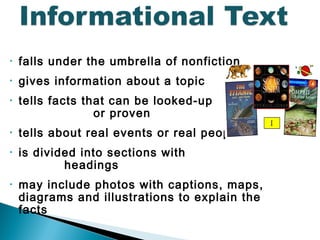
• falls under the umbrella of nonfiction
• gives information about a topic
• tells facts that can be looked-up
or proven
• tells about real events or real people
• is divided into sections with
headings
• may include photos with captions, maps,
diagrams and illustrations to explain the
facts
Expository text is nonfiction reading material. The author’s
purpose, or reason for writing, is to inform or explain
something to the reading audience.
Some examples are:
• textbooks,
• encyclopedias,
• scientific books/journals,
• atlases,
• directions,
• guides,
• biographies,
• newspapers
• descriptive – tells about something
• sequential – series or steps, items
or events in numerical or
chronological order
• problem/solution – problem
attempted solutions, results;
question and answer format
• compare/contrast – similarities and
differences between two or more
things
• cause/effect – reasons why
something happens or exists
features in text to
help locate
information
(title, table of contents, illustrations,
photographs, bold text, italicized
texts, charts, graphs)
pictures
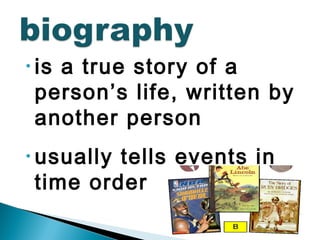
• is a true story of a
person’s life, written by
another person
• usually tells events in
time order
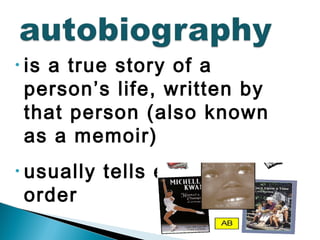
• is a true story of a
person’s life, written by
that person (also known
as a memoir)
• usually tells events in time
order
an account of one’s
personal life and
experiences
an account of one’s
personal life and
experiences

Day 5 introduction to expository

  • 1.
  • 2.
    • falls underthe umbrella of nonfiction • gives information about a topic • tells facts that can be looked-up or proven • tells about real events or real people • is divided into sections with headings • may include photos with captions, maps, diagrams and illustrations to explain the facts
  • 3.
    Expository text isnonfiction reading material. The author’s purpose, or reason for writing, is to inform or explain something to the reading audience. Some examples are: • textbooks, • encyclopedias, • scientific books/journals, • atlases, • directions, • guides, • biographies, • newspapers
  • 4.
    • descriptive –tells about something • sequential – series or steps, items or events in numerical or chronological order • problem/solution – problem attempted solutions, results; question and answer format • compare/contrast – similarities and differences between two or more things • cause/effect – reasons why something happens or exists
  • 5.
    features in textto help locate information (title, table of contents, illustrations, photographs, bold text, italicized texts, charts, graphs)
  • 6.
  • 7.
    • is atrue story of a person’s life, written by another person • usually tells events in time order
  • 8.
    • is atrue story of a person’s life, written by that person (also known as a memoir) • usually tells events in time order
  • 9.
    an account ofone’s personal life and experiences
  • 10.
    an account ofone’s personal life and experiences