Data and Its Types
Dr Sarita Sharma
Reader
CTE, BTTC, GVM
SARDARSHAHR
saritabttc@gmail.com
• Data are basic values or facts.
•
Note that the term 'data' is considered plural in the scientific community,
as in 'the data are collected', not 'the data is collected';
•
however, not everyone follows this, so sometimes you'll see data used as
singular.
•
Every task a computer carries out works with data in some way.
•
Identifying Resources Sources of information are often categorized as
primary or secondary depending upon their originality.
•
Primary Sources
A primary source provides direct or firsthand evidence about an event,
object, person, or work of art.
Primary sources provide the original materials on which other research is
based
Enable students and other researchers to get as close as possible to what
actually happened during a particular event or time period.
Published materials can be viewed as primary resources if they come from
the time period that is being discussed, and were written or produced by
someone with firsthand experience of the event.
Often primary sources reflect the individual viewpoint of a participant or
observer.
Primary sources can be written or non-written (sound, pictures, artifacts,
etc.).
In scientific research, primary sources present original thinking, report on
discoveries, or share new information.
Examples of primary sources:
Autobiographies and memoirs Diaries, personal letters, and correspondence
Interviews, surveys, and fieldwork Internet communications on email, blogs,
listservs, and newsgroups Photographs, drawings, and posters.
Works of art and literature Books, magazine and newspaper articles and ads
published at the time
Public opinion polls Speeches and oral histories Original documents (birth
certificates, property deeds, trial transcripts)
Research data, such as census statistics Official and unofficial records of
organizations and government agencies Artifacts of all kinds, such as tools, coins,
clothing, furniture, etc.
Audio recordings, DVDs, and video recordings Government documents (reports,
bills, proclamations, hearings, etc.)
Patents Technical reports Scientific journal articles reporting experimental
research results
• Secondary Sources
Secondary sources describe, discuss, interpret, comment upon, analyze,
evaluate, summarize, and process primary sources.
• A secondary source is generally one or more steps removed from the event or
time period and are written or produced after the fact with the benefit of
hindsight.
• Secondary sources often lack the freshness and immediacy of the original
material.
• On occasion, secondary sources will collect, organize, and repackage primary
source information to increase usability and speed of delivery, such as an
online encyclopedia.
• Like primary sources, secondary materials can be written or non-written
(sound, pictures, movies, etc.).
• Examples of secondary sources:
• Bibliographies
• Biographical works
• Reference books, including dictionaries, encyclopedias, and atlases
• Articles from magazines, journals, and newspapers after the event
• Literature reviews and review articles (e.g., movie reviews, book reviews)
• History books and other popular or scholarly books
• Works of criticism and interpretation
• Commentaries and treatises, Textbooks , Indexes and abstracts
• Differentiating between primary and secondary sources
• Time of publication.
• Material written close to the time of the event is often primary material.
• For instance, a diary written a women traveling on the Oregon Trail is primary
material as is an article in the newspaper at the time of her arrival in Portland.
• However, a contemporary article about the hardships of the trip along the
Trail would be secondary material.
• Purpose of the material. An article, book, essay, etc. written with an analytical
or persuasive point of view is secondary.
• The latest population data for New York Counties are primary material; an
article describing trends and analyzing the data is secondary.
• Context of the researching scholar.
• Primary materials for a critic studying the literature of Desert Storm, the
first Iraq War, differ significantly from primary materials for a physician
studying the health problems of the soldiers in that war.
• The critic’s primary materials are the stories, poems, songs of the era.
• The physician would study the soldiers’ medical records.
• Primary and secondary sources are not fixed categories.
• The use of evidence as primary or secondary is determined by the type of
research you are conducting.
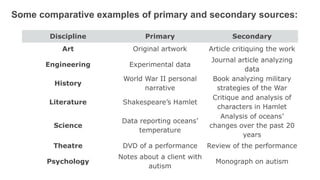
Some comparative examples of primary and secondary sources:
Discipline Primary Secondary
Art Original artwork Article critiquing the work
Engineering Experimental data
Journal article analyzing
data
History
World War II personal
narrative
Book analyzing military
strategies of the War
Literature Shakespeare’s Hamlet
Critique and analysis of
characters in Hamlet
Science
Data reporting oceans’
temperature
Analysis of oceans’
changes over the past 20
years
Theatre DVD of a performance Review of the performance
Psychology
Notes about a client with
autism
Monograph on autism
Data and its types

Data and its types

  • 1.
    Data and ItsTypes Dr Sarita Sharma Reader CTE, BTTC, GVM SARDARSHAHR saritabttc@gmail.com
  • 2.
    • Data arebasic values or facts. • Note that the term 'data' is considered plural in the scientific community, as in 'the data are collected', not 'the data is collected'; • however, not everyone follows this, so sometimes you'll see data used as singular. • Every task a computer carries out works with data in some way. • Identifying Resources Sources of information are often categorized as primary or secondary depending upon their originality.
  • 3.
    • Primary Sources A primarysource provides direct or firsthand evidence about an event, object, person, or work of art. Primary sources provide the original materials on which other research is based Enable students and other researchers to get as close as possible to what actually happened during a particular event or time period. Published materials can be viewed as primary resources if they come from the time period that is being discussed, and were written or produced by someone with firsthand experience of the event. Often primary sources reflect the individual viewpoint of a participant or observer. Primary sources can be written or non-written (sound, pictures, artifacts, etc.). In scientific research, primary sources present original thinking, report on discoveries, or share new information.
  • 4.
    Examples of primarysources: Autobiographies and memoirs Diaries, personal letters, and correspondence Interviews, surveys, and fieldwork Internet communications on email, blogs, listservs, and newsgroups Photographs, drawings, and posters. Works of art and literature Books, magazine and newspaper articles and ads published at the time Public opinion polls Speeches and oral histories Original documents (birth certificates, property deeds, trial transcripts) Research data, such as census statistics Official and unofficial records of organizations and government agencies Artifacts of all kinds, such as tools, coins, clothing, furniture, etc. Audio recordings, DVDs, and video recordings Government documents (reports, bills, proclamations, hearings, etc.) Patents Technical reports Scientific journal articles reporting experimental research results
  • 5.
    • Secondary Sources Secondarysources describe, discuss, interpret, comment upon, analyze, evaluate, summarize, and process primary sources. • A secondary source is generally one or more steps removed from the event or time period and are written or produced after the fact with the benefit of hindsight. • Secondary sources often lack the freshness and immediacy of the original material. • On occasion, secondary sources will collect, organize, and repackage primary source information to increase usability and speed of delivery, such as an online encyclopedia. • Like primary sources, secondary materials can be written or non-written (sound, pictures, movies, etc.).
  • 6.
    • Examples ofsecondary sources: • Bibliographies • Biographical works • Reference books, including dictionaries, encyclopedias, and atlases • Articles from magazines, journals, and newspapers after the event • Literature reviews and review articles (e.g., movie reviews, book reviews) • History books and other popular or scholarly books • Works of criticism and interpretation • Commentaries and treatises, Textbooks , Indexes and abstracts
  • 7.
    • Differentiating betweenprimary and secondary sources • Time of publication. • Material written close to the time of the event is often primary material. • For instance, a diary written a women traveling on the Oregon Trail is primary material as is an article in the newspaper at the time of her arrival in Portland. • However, a contemporary article about the hardships of the trip along the Trail would be secondary material. • Purpose of the material. An article, book, essay, etc. written with an analytical or persuasive point of view is secondary. • The latest population data for New York Counties are primary material; an article describing trends and analyzing the data is secondary.
  • 8.
    • Context ofthe researching scholar. • Primary materials for a critic studying the literature of Desert Storm, the first Iraq War, differ significantly from primary materials for a physician studying the health problems of the soldiers in that war. • The critic’s primary materials are the stories, poems, songs of the era. • The physician would study the soldiers’ medical records. • Primary and secondary sources are not fixed categories. • The use of evidence as primary or secondary is determined by the type of research you are conducting.
  • 9.
    Some comparative examplesof primary and secondary sources: Discipline Primary Secondary Art Original artwork Article critiquing the work Engineering Experimental data Journal article analyzing data History World War II personal narrative Book analyzing military strategies of the War Literature Shakespeare’s Hamlet Critique and analysis of characters in Hamlet Science Data reporting oceans’ temperature Analysis of oceans’ changes over the past 20 years Theatre DVD of a performance Review of the performance Psychology Notes about a client with autism Monograph on autism