EXPOSITORY
TEXT
• presents or provides information about a particular
topic or issue.
• sometimes called informational writing where the
writer provides facts on a given topic in a way that is
educational and purposeful.
• may also include providing descriptions, citing
reasons, presenting explanations, and enumerating
steps of a specific process.
What is an Expository text?
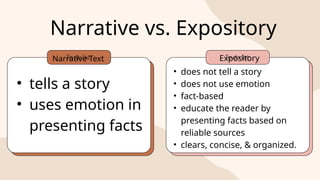
Narrative vs. Expository
Narrative Text Expository
• tells a story
• uses emotion in
presenting facts
• does not tell a story
• does not use emotion
• fact-based
• educate the reader by
presenting facts based on
reliable sources
• clears, concise, & organized.
Key Structural
Elements in an
Exposition
• Clear and Concise Thesis
Statement
Usually presented in the initial
paragraph, the thesis
statement introduces the main
topic or idea and provides the
overall direction for the text.
2. Clear transitions
the use of clear and proper
transitions will glue the
introduction, the body, and
the conclusion together.
3. A body that contains
evidence and support
the use of supporting
evidence like examples and
explanations forms a huge
part of a fact-based
expository text.
4. An effective Conclusion
a conclusion should tie the
ideas altogether while
highlighting the true
essence of the main idea in
the text.
STRUCTURES
AND PATTERNS
OF IDEA
DEVELOPMENT
CAUSE AND EFECT
presents the information by
explaining how or why a
certain event or occurrence
happened (cause) and what
resulted from that particular
cause or occurrence (effect).
COMPARISON AND
CONTRAST
the writer presents the
information by providing
details to how things,
concepts, or ideas are alike
or different.
DESCRIPTION
the topic is presented
by providing
descriptions about its
attributes, features,
and examples.
PROBLEM AND
SOLUTION
the writer may
present a problem
and provide one or
more solutions to the
said problem.
SEQUENCE
information may be
presented in a way that
follows numerical or
chronological sequence
eitherexplicitlyorimplicitly.
BE READY FOR A
RECITATION
NEXT MEETING

English-10-EXPOSITORY POWERPOINT PRESENTATION

  • 1.
  • 2.
    • presents orprovides information about a particular topic or issue. • sometimes called informational writing where the writer provides facts on a given topic in a way that is educational and purposeful. • may also include providing descriptions, citing reasons, presenting explanations, and enumerating steps of a specific process. What is an Expository text?
  • 3.
    Narrative vs. Expository NarrativeText Expository • tells a story • uses emotion in presenting facts • does not tell a story • does not use emotion • fact-based • educate the reader by presenting facts based on reliable sources • clears, concise, & organized.
  • 4.
  • 5.
    • Clear andConcise Thesis Statement Usually presented in the initial paragraph, the thesis statement introduces the main topic or idea and provides the overall direction for the text.
  • 6.
    2. Clear transitions theuse of clear and proper transitions will glue the introduction, the body, and the conclusion together.
  • 7.
    3. A bodythat contains evidence and support the use of supporting evidence like examples and explanations forms a huge part of a fact-based expository text.
  • 8.
    4. An effectiveConclusion a conclusion should tie the ideas altogether while highlighting the true essence of the main idea in the text.
  • 9.
  • 10.
    CAUSE AND EFECT presentsthe information by explaining how or why a certain event or occurrence happened (cause) and what resulted from that particular cause or occurrence (effect).
  • 11.
    COMPARISON AND CONTRAST the writerpresents the information by providing details to how things, concepts, or ideas are alike or different.
  • 12.
    DESCRIPTION the topic ispresented by providing descriptions about its attributes, features, and examples.
  • 13.
    PROBLEM AND SOLUTION the writermay present a problem and provide one or more solutions to the said problem.
  • 14.
    SEQUENCE information may be presentedin a way that follows numerical or chronological sequence eitherexplicitlyorimplicitly.
  • 15.
    BE READY FORA RECITATION NEXT MEETING