Transforming long-term plot-based
research in Australia: LTERN, MSPN and
future synthesis and integration
David Lindenmayer, ANU
Emma Burns, ANU

On behalf of LTER/MSPN
members
Collaborative book project
A landmark project was undertaken from late 2011 until early 2013 involving 83
contributing environmental professionals (primarily ecological scientists). The
task was to develop a cohesive book that described changes in a range of
Australian ecosystems that have been subject to detailed long-term research.
The overarching purpose of these long-term studies has been to document the
changes and provide the evidence and knowledge needed to inform better
natural resource management in Australia.
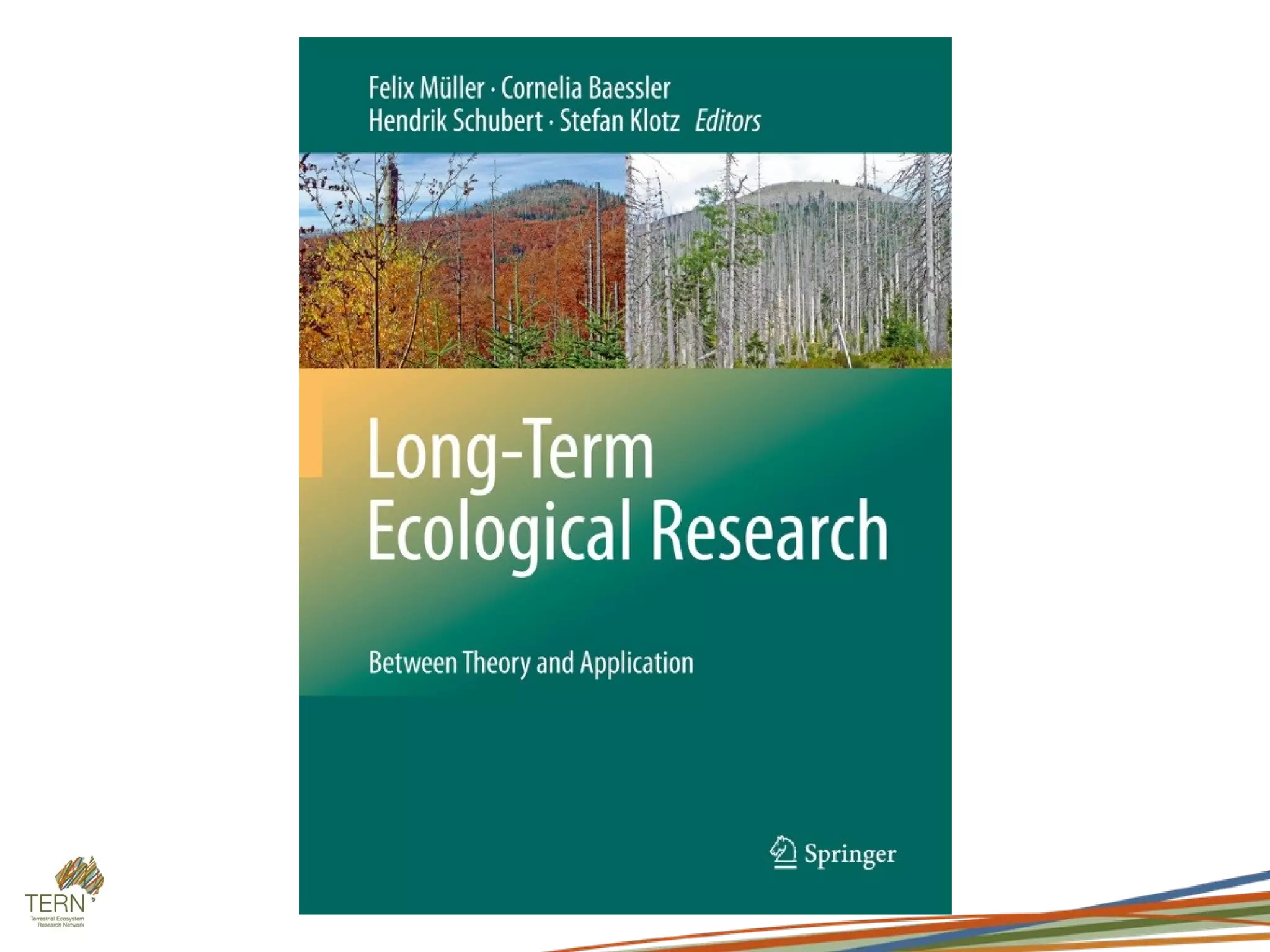
Some past books outlining cases of
long-term ecological work
But no systematic overview as per
the new book
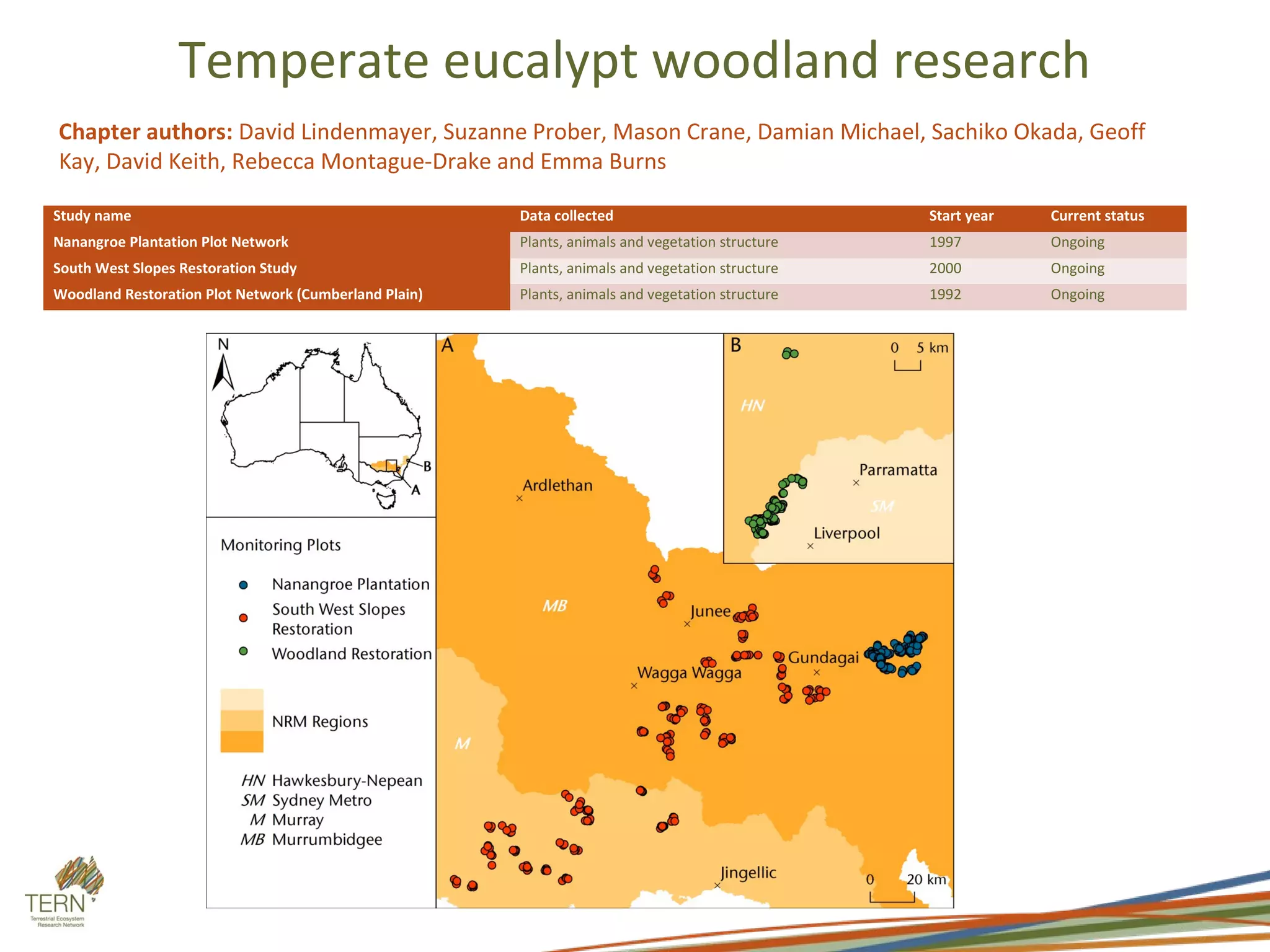
Temperate eucalypt woodland research
Chapter authors: David Lindenmayer, Suzanne Prober, Mason Crane, Damian Michael, Sachiko Okada, Geoff
Kay, David Keith, Rebecca Montague-Drake and Emma Burns

Study name                                             Data collected                             Start year   Current status
Nanangroe Plantation Plot Network                      Plants, animals and vegetation structure   1997         Ongoing
South West Slopes Restoration Study                    Plants, animals and vegetation structure   2000         Ongoing
Woodland Restoration Plot Network (Cumberland Plain)   Plants, animals and vegetation structure   1992         Ongoing
Key discoveries
•   Detection rates of some species of temperate woodland birds in southern New South Wales
    have increased over the past decade, including several which were previously considered to
    be declining, such as the brown treecreeper and superb parrot

•   Both re-planted temperate woodland and natural regrowth temperate woodland are
    important habitats for birds and reptiles, including a range of species of conservation
    concern. Such areas support a significantly different (but also complementary) assemblage of
    birds to old-growth woodland, particularly small-bodied, non-seed eating birds

•   Interventions such as grazing control lead to improvements in vegetation condition and
    these changes can, in turn, have positive impacts on temperate woodland birds


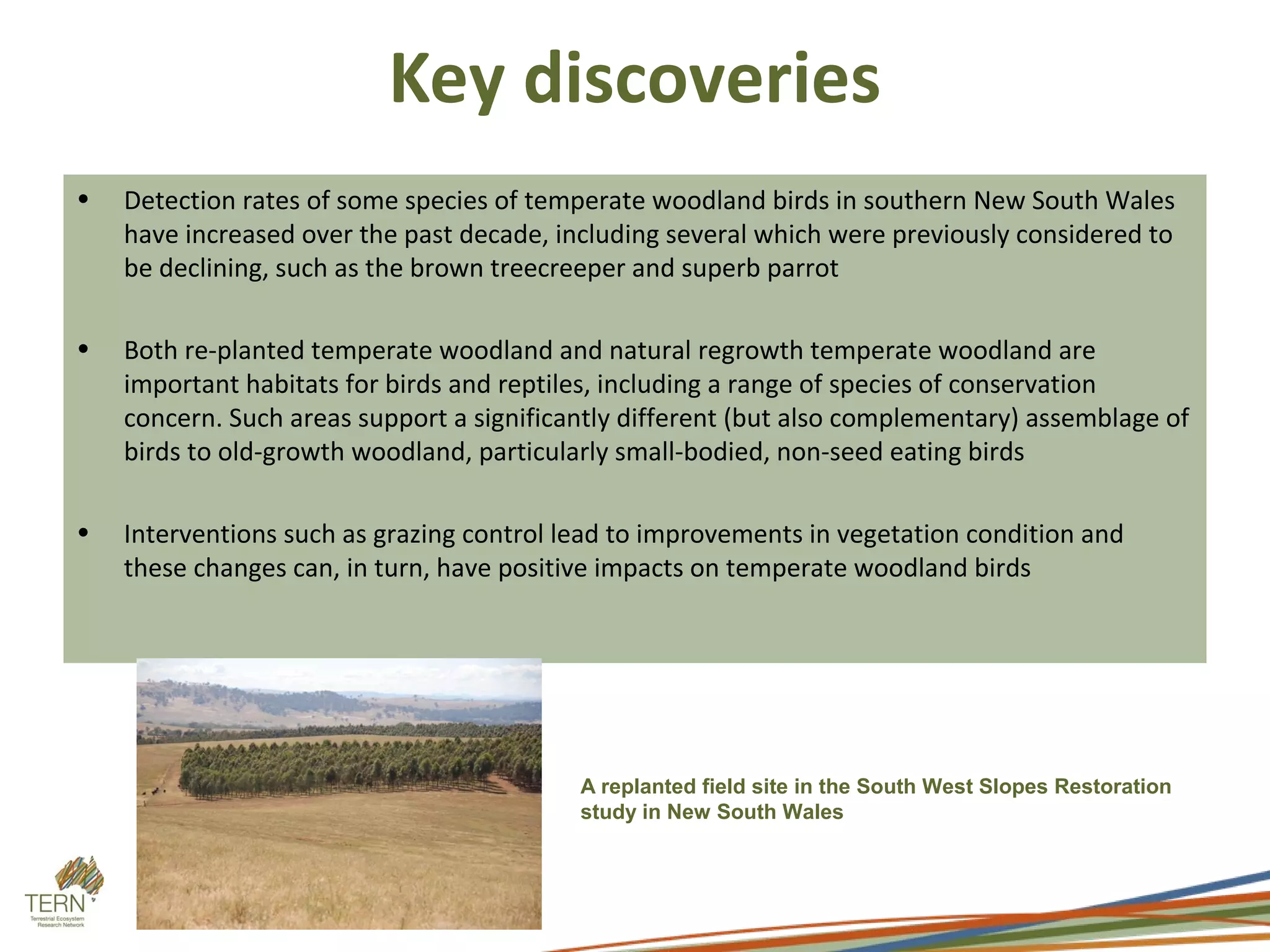
                                           A replanted field site in the South West Slopes Restoration
                                           study in New South Wales
Key management recommendations
•   Conservation initiatives focused on private land are needed. There is a particular need to
    support incentive programs that prevent clearing of temperate eucalypt woodlands and
    control damaging grazing regimes like high-intensity set stocking

•   Maintain funding schemes that are clearly leading to successful outcomes, such as those that
    have catalysed major restoration efforts—both natural regeneration and replanting


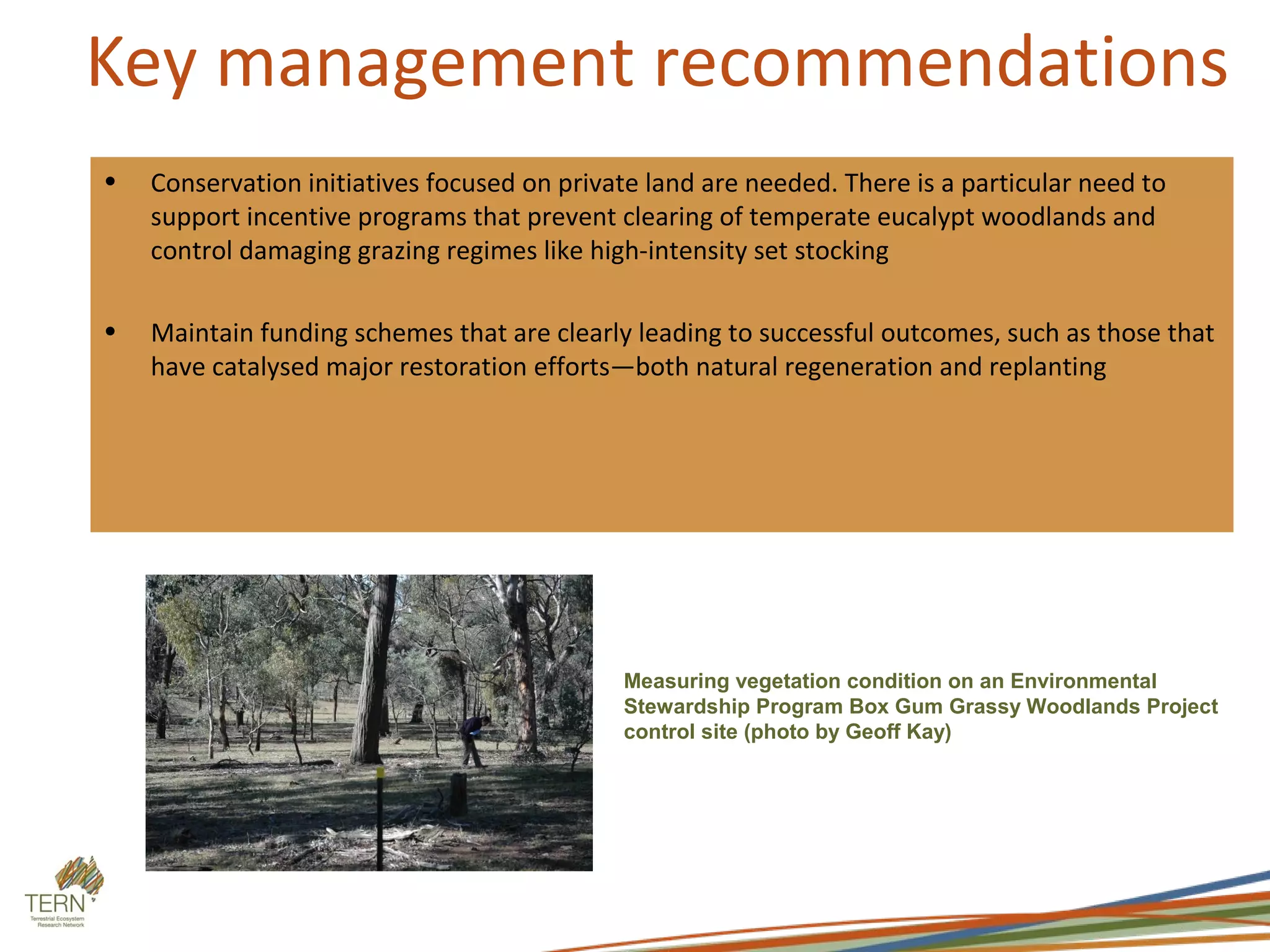
                                             Measuring vegetation condition on an Environmental
                                             Stewardship Program Box Gum Grassy Woodlands Project
                                             control site (photo by Geoff Kay)
Overview
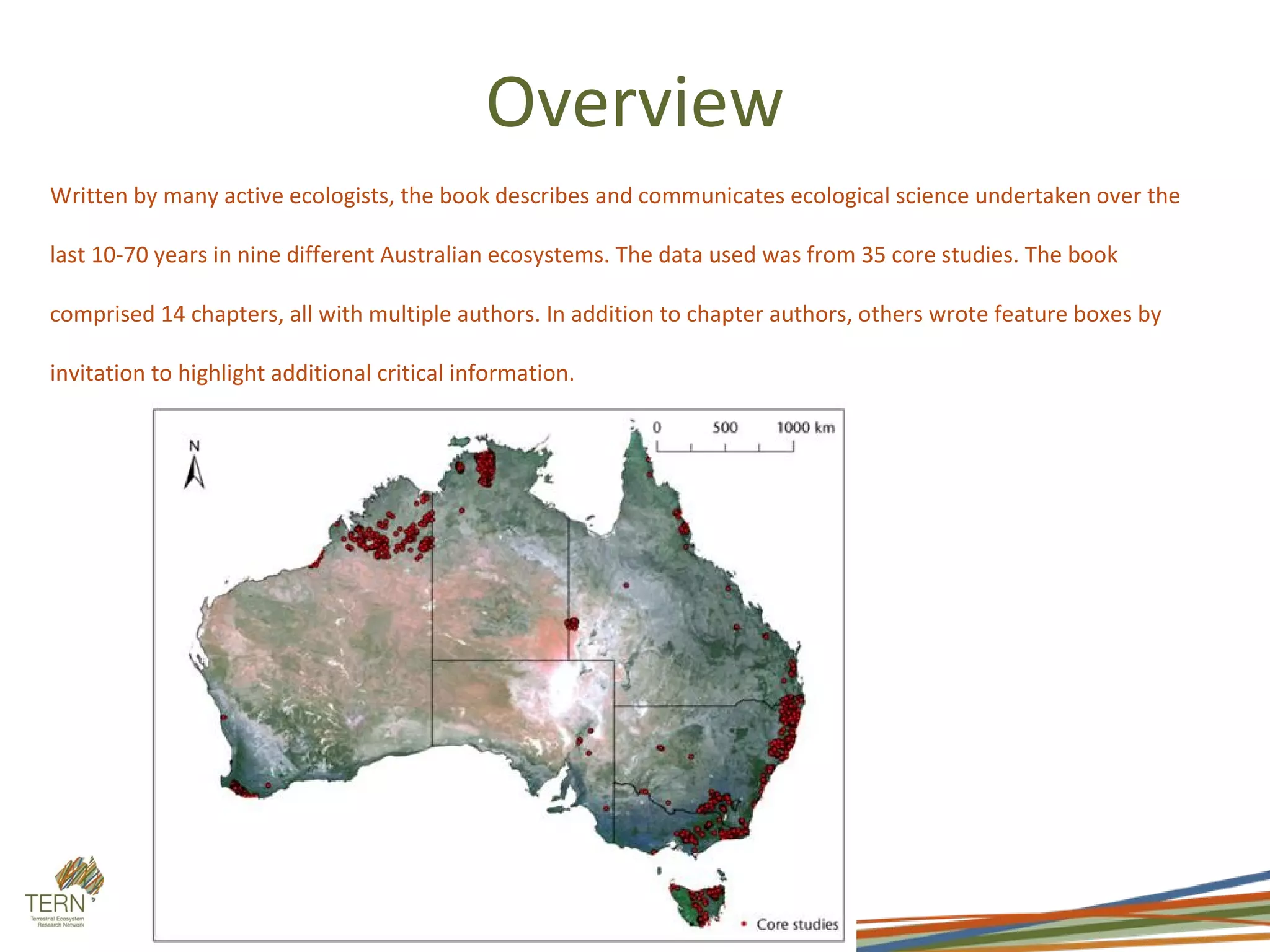
Written by many active ecologists, the book describes and communicates ecological science undertaken over the

last 10-70 years in nine different Australian ecosystems. The data used was from 35 core studies. The book

comprised 14 chapters, all with multiple authors. In addition to chapter authors, others wrote feature boxes by

invitation to highlight additional critical information.
Introductory chapters
General introduction
Chapter authors: David Lindenmayer, Emma Burns, Nicole Thurgate, and Andrew Lowe

The value of long-term research and how to design effective ecological research and
     monitoring
Chapter authors: David Lindenmayer, Emma Burns, Nicole Thurgate, and Andrew Lowe

The first section is a modified version of Lindenmayer et al. (2012) The value of long-term ecological studies. Austral Ecology 37, 745-
     757.

Our capacity to tell an Australian ecological story
Chapter authors: Ben Sparrow, Eleanor Dormontt, Nicole Thurgate, Emma Burns, David Lindenmayer, and Andrew Lowe


The cultural imperative: broadening the vision of long-term ecological monitoring to
     enhance environmental policy and management outcomes
Chapter authors: Emilie Ens, Emma Burns, Jeremy Russell-Smith, Ben Sparrow, and Glenda M. Wardle
Ecosystem chapters
Tropical rainforests of eastern Australia
Chapter authors: Daniel J. Metcalfe, Michael J. Liddell, Matt G. Bradford, and Peter T. Green

Heathland
Chapter authors: David A. Keith, David Lindenmayer, Andrew Lowe, Jeremy Russell-Smith, Sarah Barrett, Neal J. Enright, Barry J.
     Fox, Greg Guerin, David C. Paton, Mark G. Tozer, and Colin J. Yates

Alpine ecosystems
Chapter authors: Richard J Williams, Warwick A Papst, Keith L McDougall, Ian M Mansergh, Dean Heinze, James S Camac, Michael
     A Nash, John W Morgan, and Ary A Hoffmann

Temperate eucalypt woodland
Chapter authors: David Lindenmayer, Suzanne Prober, Mason Crane, Damian Michael, Sachiko Okada, Geoff Kay, David Keith,
     Rebecca Montague-Drake and Emma Burns

Northern Australian tropical savannas
Chapter authors: Jeremy Russell-Smith, Andrew C Edwards, John CZ Woinarski, Alaric Fisher, Brett P Murphy, Mike J Lawes, Beth
     Crase, and Nicole Thurgate
Ecosystem chapters

Desert complex ecosystems
Chapter authors: Christopher R. Dickman, Glenda M. Wardle, Jeff N. Foulkes, and Nicki de Preu

Chenopod and Acacia shrublands
Chapter authors: Jeff Foulkes, Nicki de Preu, Russell Sinclair, Nicole Thurgate, Ben Sparrow and Andrew White

Tussock grasslands
Chapter authors: Andrew White, David Orr, Paul Novelly and Gary Bastin

Tall eucalypt forests
Chapter authors: Sam Wood, David Bowman, Lynda Prior, David Lindenmayer, Tim Wardlaw, and Richard Robinson
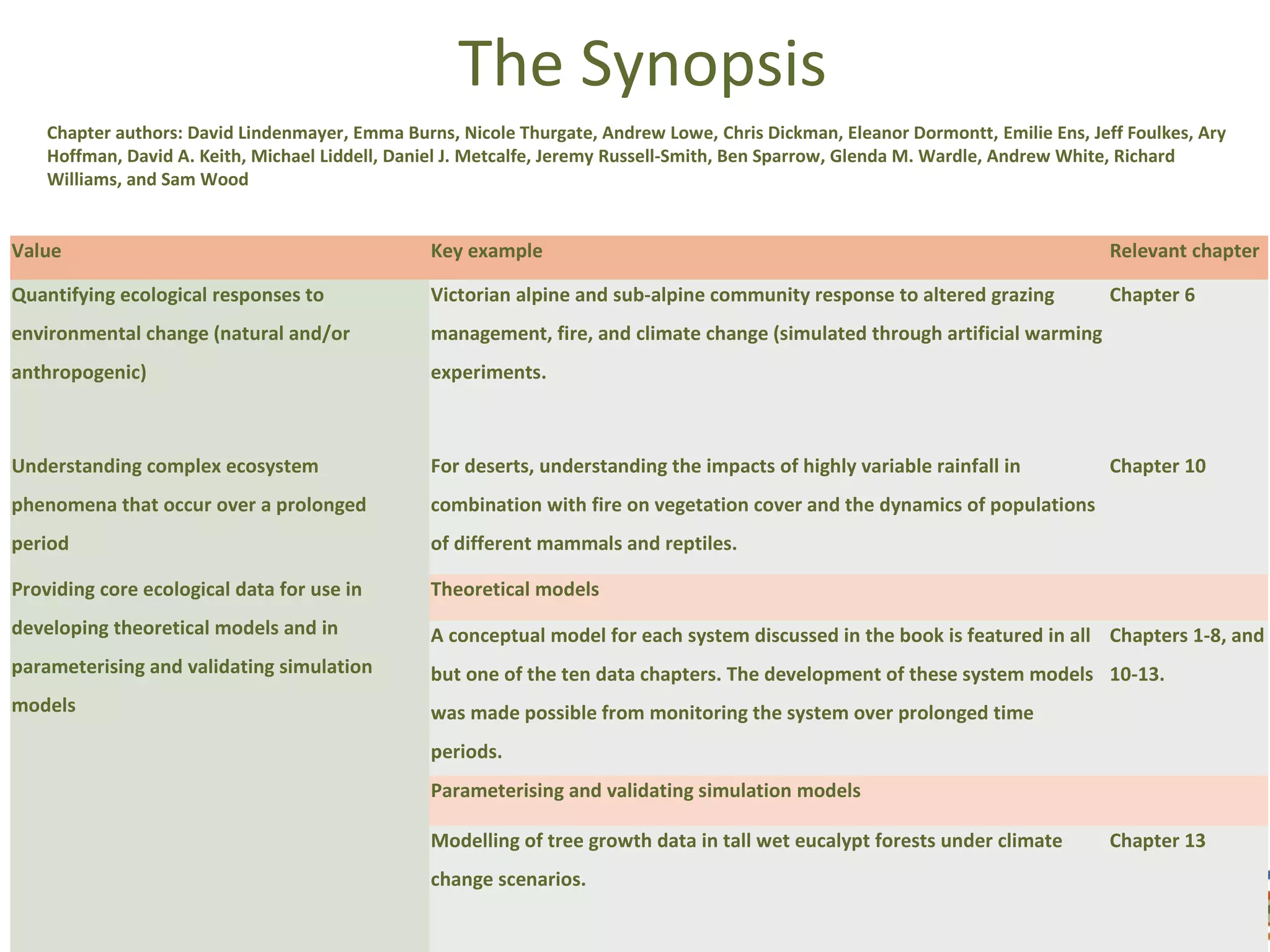
The Synopsis
    Chapter authors: David Lindenmayer, Emma Burns, Nicole Thurgate, Andrew Lowe, Chris Dickman, Eleanor Dormontt, Emilie Ens, Jeff Foulkes, Ary
    Hoffman, David A. Keith, Michael Liddell, Daniel J. Metcalfe, Jeremy Russell-Smith, Ben Sparrow, Glenda M. Wardle, Andrew White, Richard
    Williams, and Sam Wood


Value                                            Key example                                                                      Relevant chapter

Quantifying ecological responses to              Victorian alpine and sub-alpine community response to altered grazing            Chapter 6
environmental change (natural and/or             management, fire, and climate change (simulated through artificial warming
anthropogenic)                                   experiments.


Understanding complex ecosystem                  For deserts, understanding the impacts of highly variable rainfall in            Chapter 10
phenomena that occur over a prolonged            combination with fire on vegetation cover and the dynamics of populations
period                                           of different mammals and reptiles.

Providing core ecological data for use in        Theoretical models
developing theoretical models and in             A conceptual model for each system discussed in the book is featured in all Chapters 1-8, and
parameterising and validating simulation         but one of the ten data chapters. The development of these system models 10-13.
models                                           was made possible from monitoring the system over prolonged time
                                                 periods.
                                                 Parameterising and validating simulation models

                                                 Modelling of tree growth data in tall wet eucalypt forests under climate         Chapter 13
                                                 change scenarios.
POLICY HANDBOOK
Learning from long-term research to better manage
  biodiversity in Australia


This handbook describes the key findings and messages from
  the long-term ecological research for policy makers and the
  general public
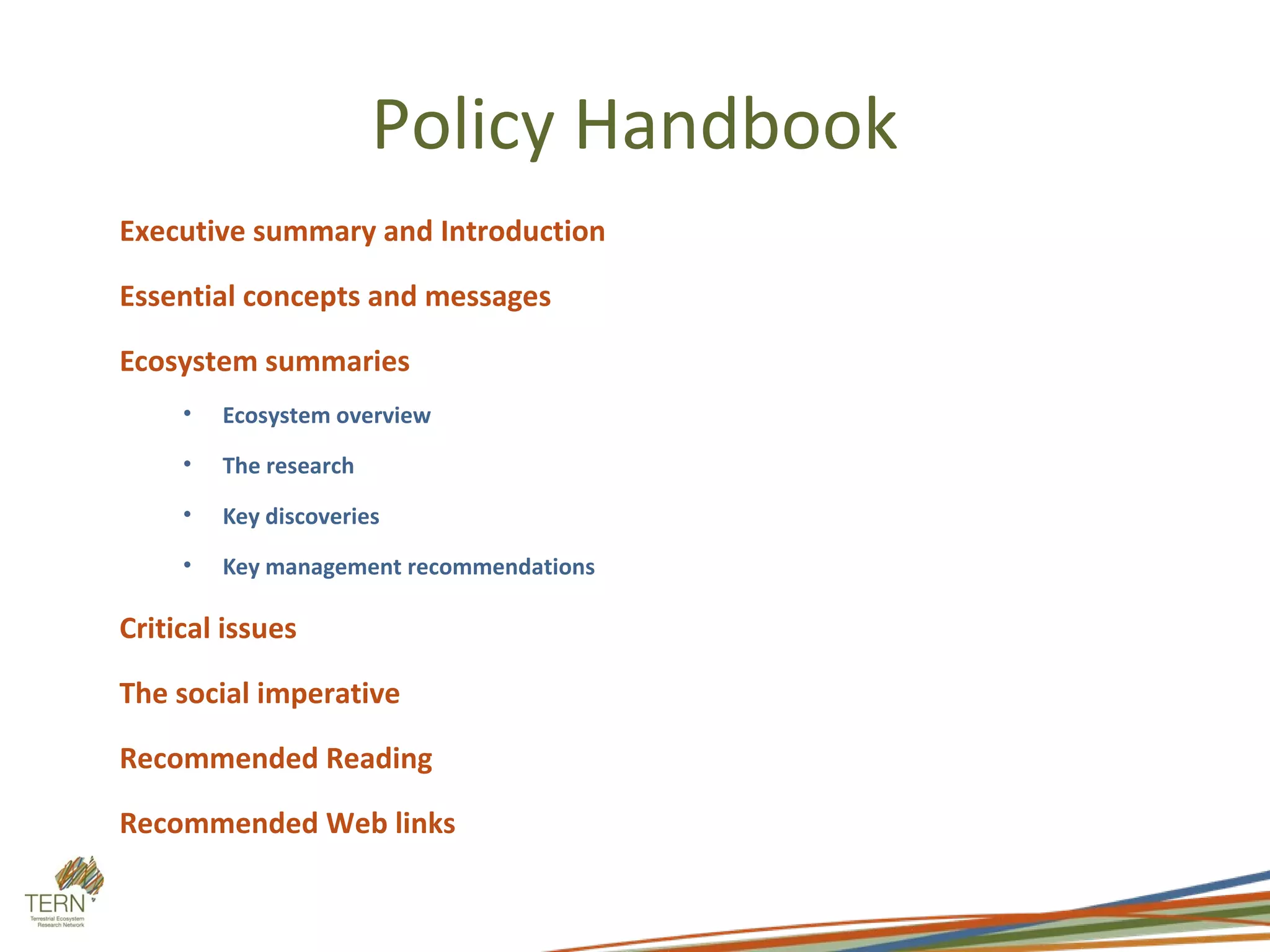
Policy Handbook
Executive summary and Introduction

Essential concepts and messages

Ecosystem summaries
     •   Ecosystem overview
     •   The research
     •   Key discoveries
     •   Key management recommendations

Critical issues

The social imperative

Recommended Reading

Recommended Web links
New synthesis work –
2013/2014 and beyond
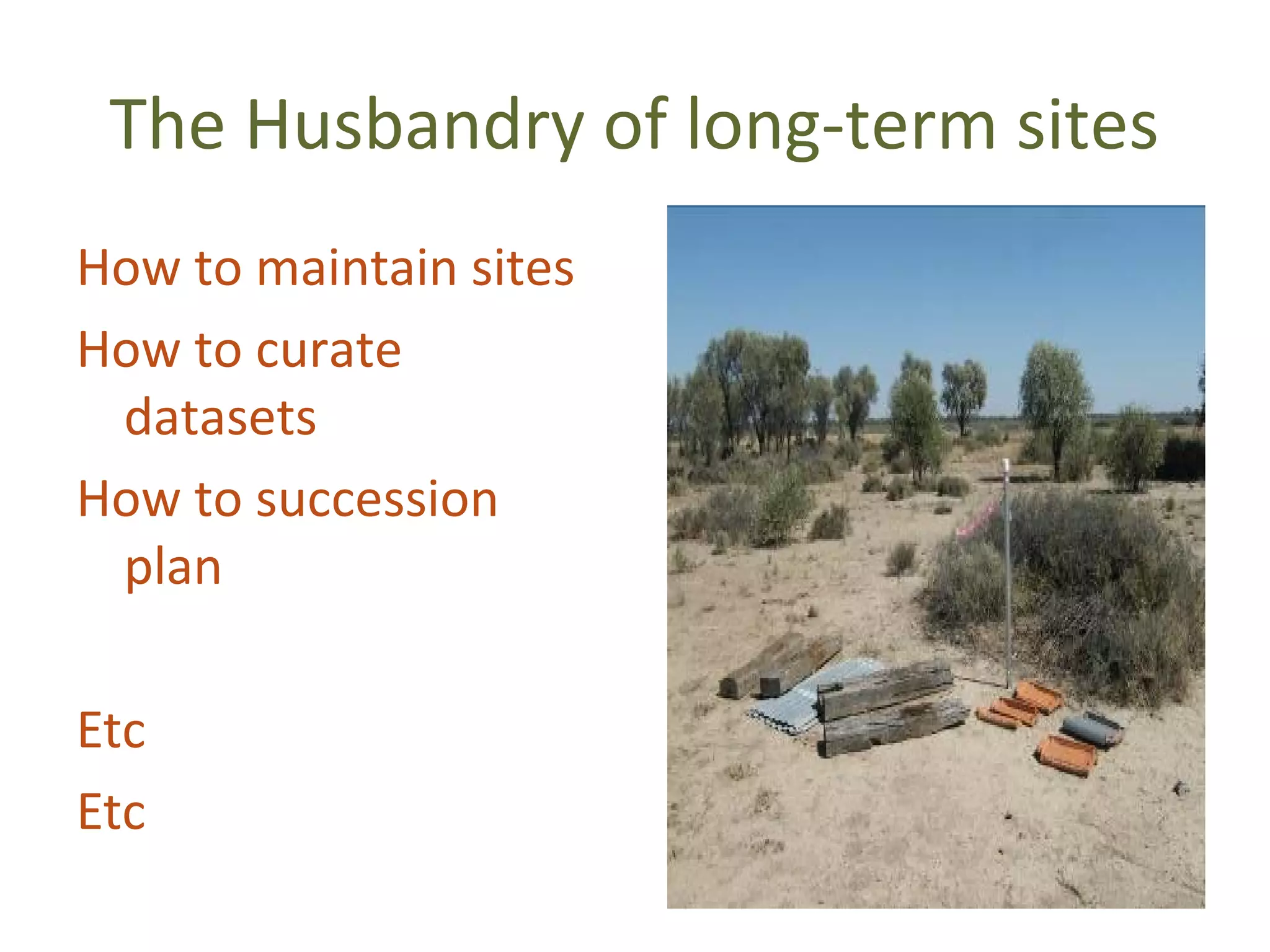
The Husbandry of long-term sites
How to maintain sites
How to curate
 datasets
How to succession
 plan

Etc
Etc
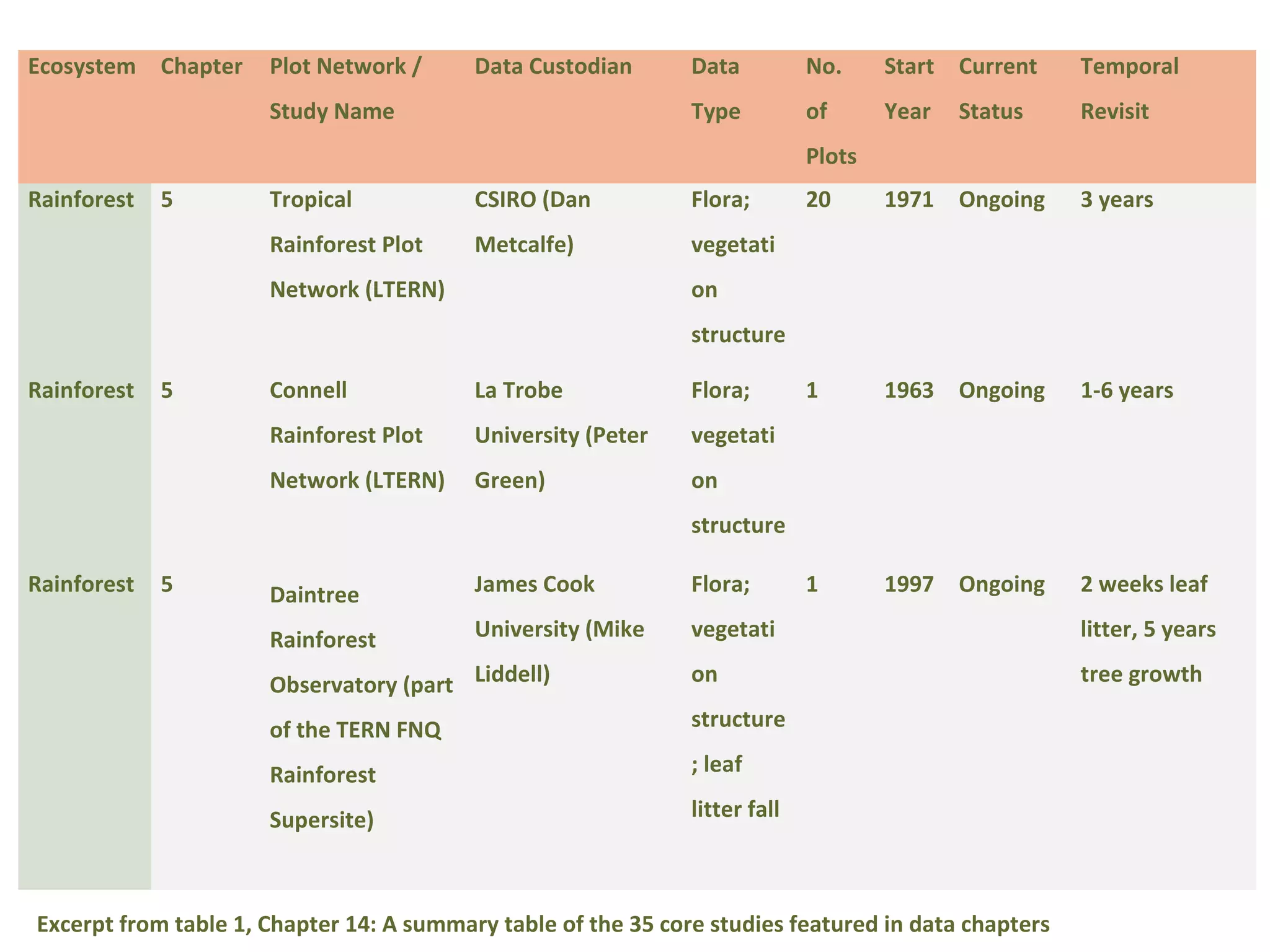
Ecosystem Chapter     Plot Network /      Data Custodian       Data          No.     Start Current   Temporal
                      Study Name                               Type          of      Year   Status   Revisit
                                                                             Plots
Rainforest   5        Tropical            CSIRO (Dan           Flora;        20      1971 Ongoing    3 years
                      Rainforest Plot     Metcalfe)            vegetati
                      Network (LTERN)                          on
                                                               structure

Rainforest   5        Connell             La Trobe             Flora;        1       1963 Ongoing    1-6 years
                      Rainforest Plot     University (Peter    vegetati
                      Network (LTERN)     Green)               on
                                                               structure

Rainforest   5        Daintree            James Cook           Flora;        1       1997 Ongoing    2 weeks leaf

                      Rainforest          University (Mike     vegetati                              litter, 5 years

                      Observatory (part Liddell)               on                                    tree growth

                      of the TERN FNQ                          structure

                      Rainforest                               ; leaf

                      Supersite)                               litter fall


Excerpt from table 1, Chapter 14: A summary table of the 35 core studies featured in data chapters
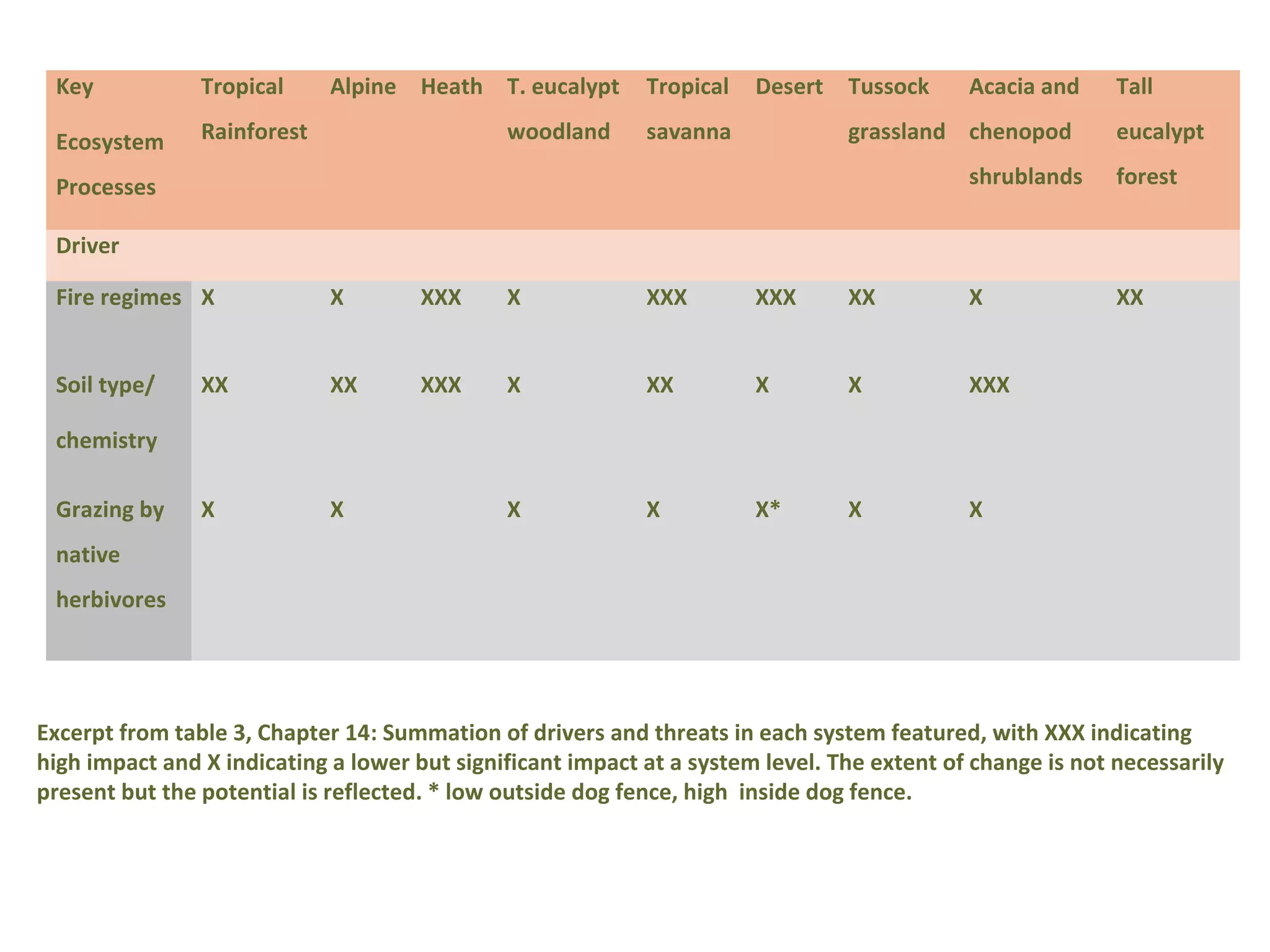
Key            Tropical     Alpine Heath T. eucalypt       Tropical   Desert   Tussock     Acacia and     Tall

 Ecosystem      Rainforest                    woodland      savanna             grassland chenopod         eucalypt

 Processes                                                                                  shrublands     forest

 Driver

 Fire regimes X              X        XXX     X             XXX        XXX      XX          X              XX


 Soil type/     XX           XX       XXX     X             XX         X        X           XXX

 chemistry

 Grazing by     X            X                X             X          X*       X           X
 native
 herbivores


Excerpt from table 3, Chapter 14: Summation of drivers and threats in each system featured, with XXX indicating
high impact and X indicating a lower but significant impact at a system level. The extent of change is not necessarily
present but the potential is reflected. * low outside dog fence, high inside dog fence.
Time series [longitudinal]data and
patterns in temporal trends
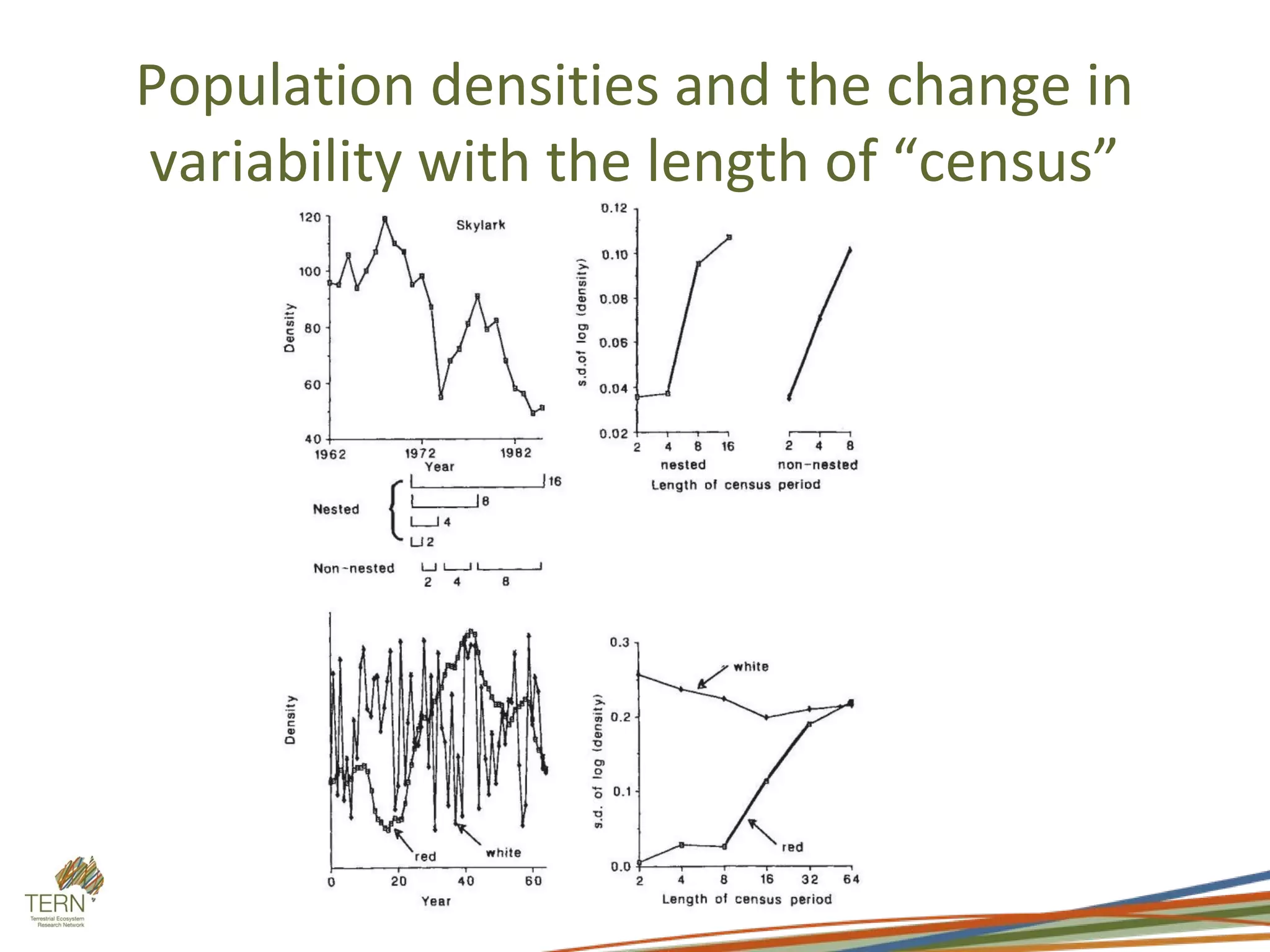
Do patterns become more variable
over time? How does variability vary
between ecosystem types and taxa?
Population densities and the change in
variability with the length of “census”
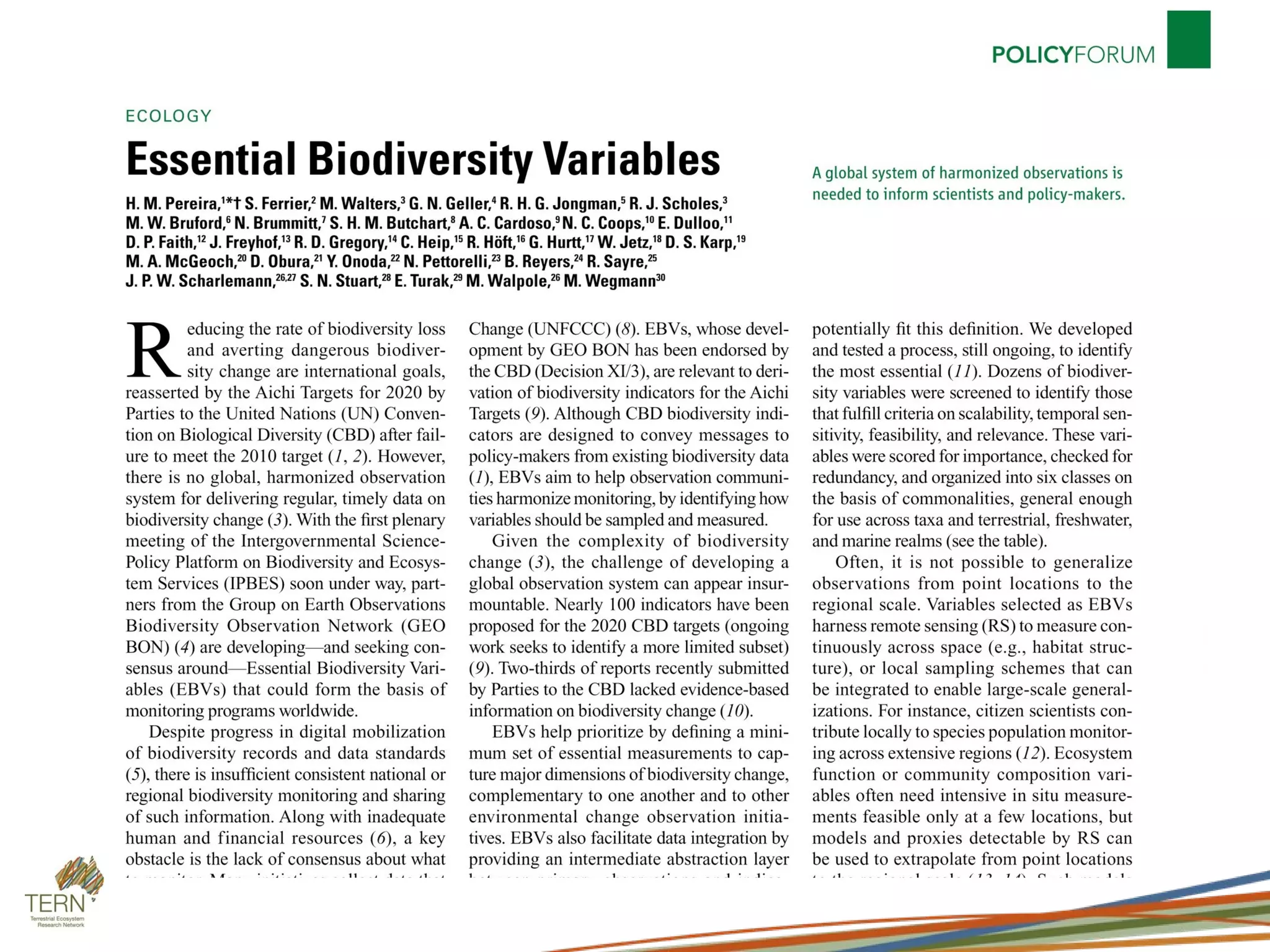
Can we develop statistically robust
“essential biodiversity variables”?
How to deliver?
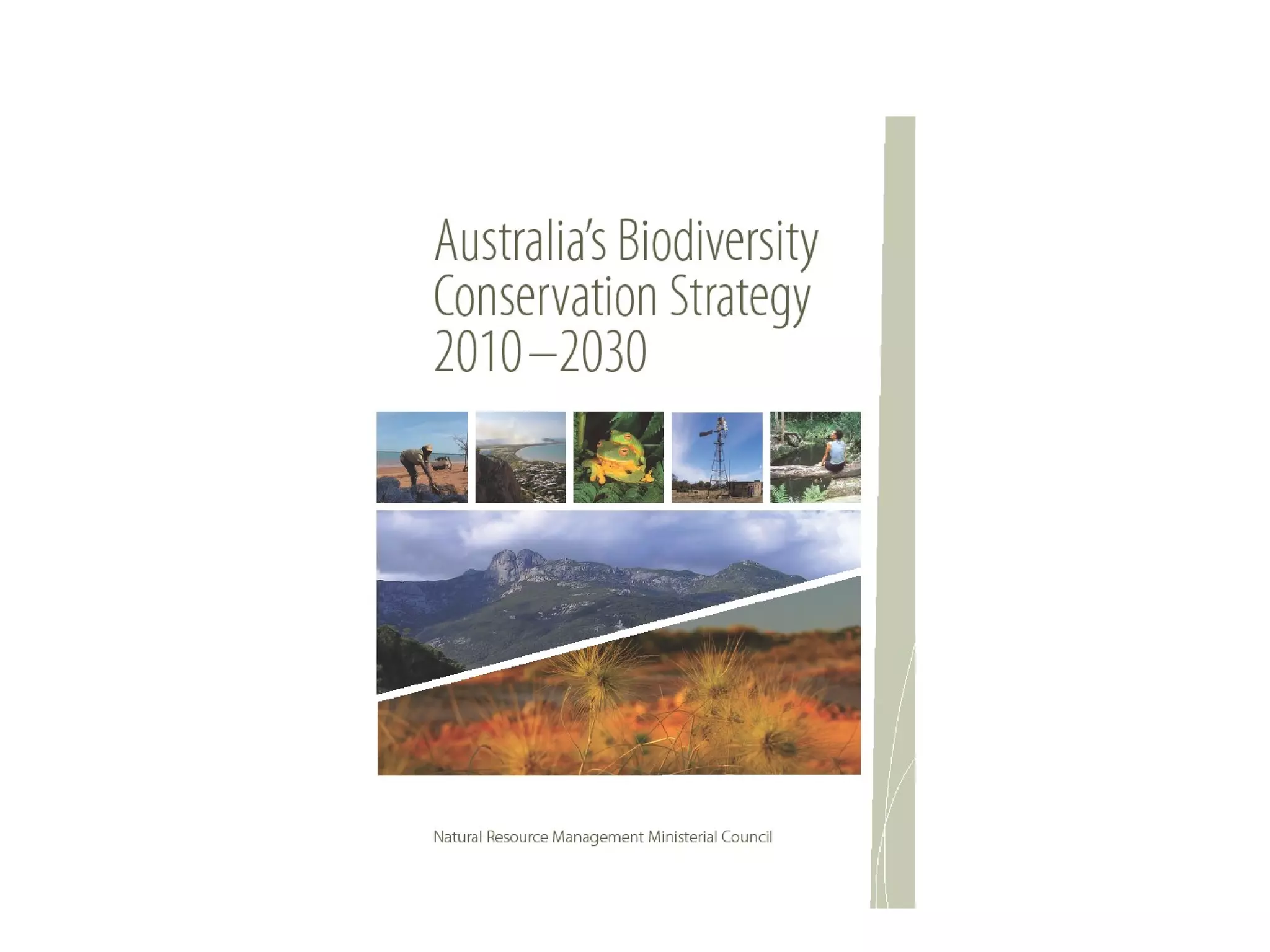
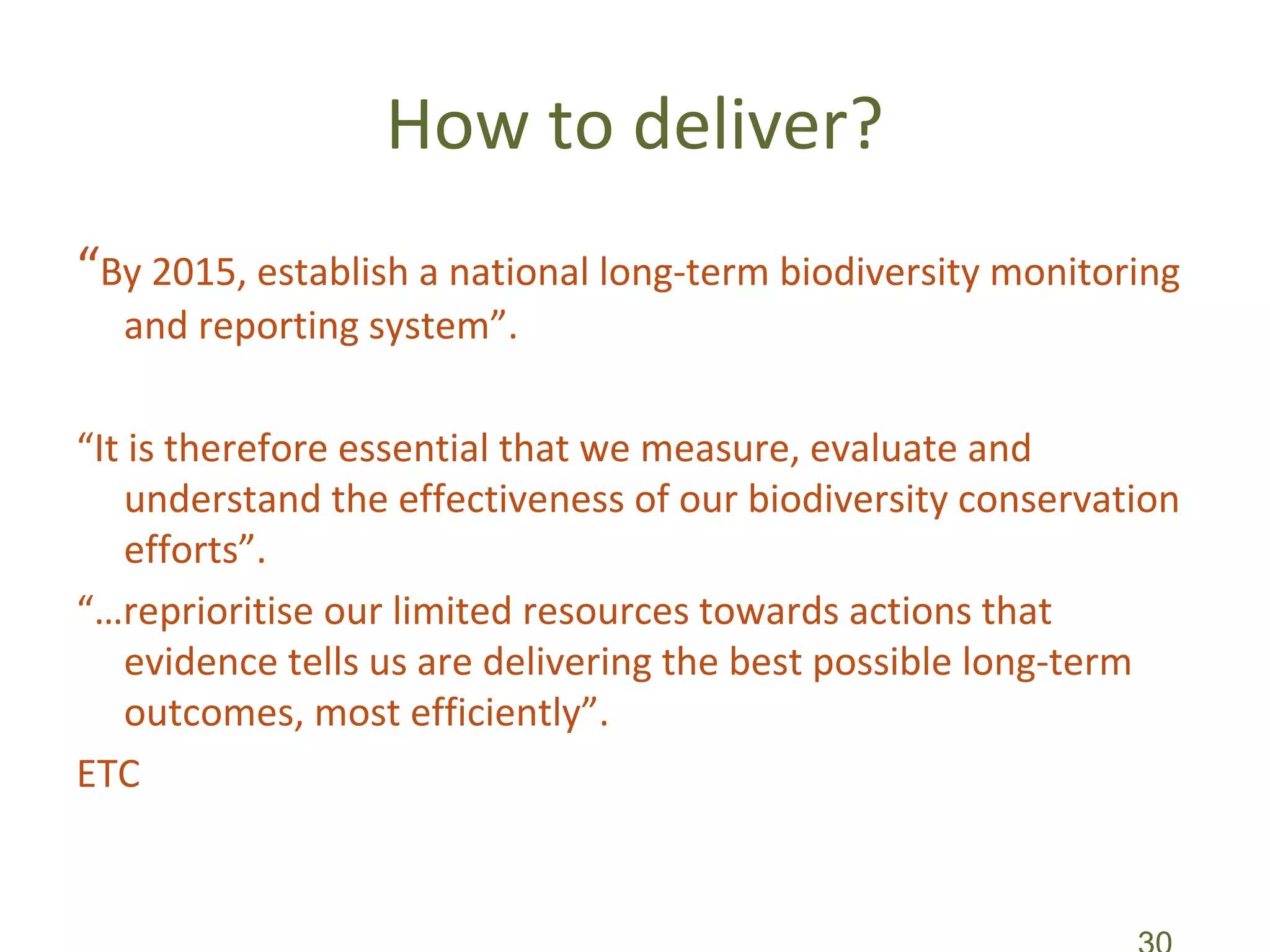
“By 2015, establish a national long-term biodiversity monitoring
  and reporting system”.

“It is therefore essential that we measure, evaluate and
    understand the effectiveness of our biodiversity conservation
    efforts”.
“…reprioritise our limited resources towards actions that
    evidence tells us are delivering the best possible long-term
    outcomes, most efficiently”.
ETC
Can we develop statistically robust
“essential biodiversity variables”?
A lot of active cross-system synthesis
work in the coming 2 years that will be
based on long-term ecological data

David Lindenmayer_Transforming long-term plot-based research in Australia: LTERN, MSPN and future synthesis and integration

  • 1.
    Transforming long-term plot-based researchin Australia: LTERN, MSPN and future synthesis and integration David Lindenmayer, ANU Emma Burns, ANU On behalf of LTER/MSPN members
  • 2.
    Collaborative book project Alandmark project was undertaken from late 2011 until early 2013 involving 83 contributing environmental professionals (primarily ecological scientists). The task was to develop a cohesive book that described changes in a range of Australian ecosystems that have been subject to detailed long-term research. The overarching purpose of these long-term studies has been to document the changes and provide the evidence and knowledge needed to inform better natural resource management in Australia.
  • 3.
    Some past booksoutlining cases of long-term ecological work
  • 5.
    But no systematicoverview as per the new book
  • 6.
    Temperate eucalypt woodlandresearch Chapter authors: David Lindenmayer, Suzanne Prober, Mason Crane, Damian Michael, Sachiko Okada, Geoff Kay, David Keith, Rebecca Montague-Drake and Emma Burns Study name Data collected Start year Current status Nanangroe Plantation Plot Network Plants, animals and vegetation structure 1997 Ongoing South West Slopes Restoration Study Plants, animals and vegetation structure 2000 Ongoing Woodland Restoration Plot Network (Cumberland Plain) Plants, animals and vegetation structure 1992 Ongoing
  • 7.
    Key discoveries • Detection rates of some species of temperate woodland birds in southern New South Wales have increased over the past decade, including several which were previously considered to be declining, such as the brown treecreeper and superb parrot • Both re-planted temperate woodland and natural regrowth temperate woodland are important habitats for birds and reptiles, including a range of species of conservation concern. Such areas support a significantly different (but also complementary) assemblage of birds to old-growth woodland, particularly small-bodied, non-seed eating birds • Interventions such as grazing control lead to improvements in vegetation condition and these changes can, in turn, have positive impacts on temperate woodland birds A replanted field site in the South West Slopes Restoration study in New South Wales
  • 8.
    Key management recommendations • Conservation initiatives focused on private land are needed. There is a particular need to support incentive programs that prevent clearing of temperate eucalypt woodlands and control damaging grazing regimes like high-intensity set stocking • Maintain funding schemes that are clearly leading to successful outcomes, such as those that have catalysed major restoration efforts—both natural regeneration and replanting Measuring vegetation condition on an Environmental Stewardship Program Box Gum Grassy Woodlands Project control site (photo by Geoff Kay)
  • 9.
    Overview Written by manyactive ecologists, the book describes and communicates ecological science undertaken over the last 10-70 years in nine different Australian ecosystems. The data used was from 35 core studies. The book comprised 14 chapters, all with multiple authors. In addition to chapter authors, others wrote feature boxes by invitation to highlight additional critical information.
  • 10.
    Introductory chapters General introduction Chapterauthors: David Lindenmayer, Emma Burns, Nicole Thurgate, and Andrew Lowe The value of long-term research and how to design effective ecological research and monitoring Chapter authors: David Lindenmayer, Emma Burns, Nicole Thurgate, and Andrew Lowe The first section is a modified version of Lindenmayer et al. (2012) The value of long-term ecological studies. Austral Ecology 37, 745- 757. Our capacity to tell an Australian ecological story Chapter authors: Ben Sparrow, Eleanor Dormontt, Nicole Thurgate, Emma Burns, David Lindenmayer, and Andrew Lowe The cultural imperative: broadening the vision of long-term ecological monitoring to enhance environmental policy and management outcomes Chapter authors: Emilie Ens, Emma Burns, Jeremy Russell-Smith, Ben Sparrow, and Glenda M. Wardle
  • 11.
    Ecosystem chapters Tropical rainforestsof eastern Australia Chapter authors: Daniel J. Metcalfe, Michael J. Liddell, Matt G. Bradford, and Peter T. Green Heathland Chapter authors: David A. Keith, David Lindenmayer, Andrew Lowe, Jeremy Russell-Smith, Sarah Barrett, Neal J. Enright, Barry J. Fox, Greg Guerin, David C. Paton, Mark G. Tozer, and Colin J. Yates Alpine ecosystems Chapter authors: Richard J Williams, Warwick A Papst, Keith L McDougall, Ian M Mansergh, Dean Heinze, James S Camac, Michael A Nash, John W Morgan, and Ary A Hoffmann Temperate eucalypt woodland Chapter authors: David Lindenmayer, Suzanne Prober, Mason Crane, Damian Michael, Sachiko Okada, Geoff Kay, David Keith, Rebecca Montague-Drake and Emma Burns Northern Australian tropical savannas Chapter authors: Jeremy Russell-Smith, Andrew C Edwards, John CZ Woinarski, Alaric Fisher, Brett P Murphy, Mike J Lawes, Beth Crase, and Nicole Thurgate
  • 12.
    Ecosystem chapters Desert complexecosystems Chapter authors: Christopher R. Dickman, Glenda M. Wardle, Jeff N. Foulkes, and Nicki de Preu Chenopod and Acacia shrublands Chapter authors: Jeff Foulkes, Nicki de Preu, Russell Sinclair, Nicole Thurgate, Ben Sparrow and Andrew White Tussock grasslands Chapter authors: Andrew White, David Orr, Paul Novelly and Gary Bastin Tall eucalypt forests Chapter authors: Sam Wood, David Bowman, Lynda Prior, David Lindenmayer, Tim Wardlaw, and Richard Robinson
  • 13.
    The Synopsis Chapter authors: David Lindenmayer, Emma Burns, Nicole Thurgate, Andrew Lowe, Chris Dickman, Eleanor Dormontt, Emilie Ens, Jeff Foulkes, Ary Hoffman, David A. Keith, Michael Liddell, Daniel J. Metcalfe, Jeremy Russell-Smith, Ben Sparrow, Glenda M. Wardle, Andrew White, Richard Williams, and Sam Wood Value Key example Relevant chapter Quantifying ecological responses to Victorian alpine and sub-alpine community response to altered grazing Chapter 6 environmental change (natural and/or management, fire, and climate change (simulated through artificial warming anthropogenic) experiments. Understanding complex ecosystem For deserts, understanding the impacts of highly variable rainfall in Chapter 10 phenomena that occur over a prolonged combination with fire on vegetation cover and the dynamics of populations period of different mammals and reptiles. Providing core ecological data for use in Theoretical models developing theoretical models and in A conceptual model for each system discussed in the book is featured in all Chapters 1-8, and parameterising and validating simulation but one of the ten data chapters. The development of these system models 10-13. models was made possible from monitoring the system over prolonged time periods. Parameterising and validating simulation models Modelling of tree growth data in tall wet eucalypt forests under climate Chapter 13 change scenarios.
  • 14.
    POLICY HANDBOOK Learning fromlong-term research to better manage biodiversity in Australia This handbook describes the key findings and messages from the long-term ecological research for policy makers and the general public
  • 15.
    Policy Handbook Executive summaryand Introduction Essential concepts and messages Ecosystem summaries • Ecosystem overview • The research • Key discoveries • Key management recommendations Critical issues The social imperative Recommended Reading Recommended Web links
  • 16.
    New synthesis work– 2013/2014 and beyond
  • 20.
    The Husbandry oflong-term sites How to maintain sites How to curate datasets How to succession plan Etc Etc
  • 21.
    Ecosystem Chapter Plot Network / Data Custodian Data No. Start Current Temporal Study Name Type of Year Status Revisit Plots Rainforest 5 Tropical CSIRO (Dan Flora; 20 1971 Ongoing 3 years Rainforest Plot Metcalfe) vegetati Network (LTERN) on structure Rainforest 5 Connell La Trobe Flora; 1 1963 Ongoing 1-6 years Rainforest Plot University (Peter vegetati Network (LTERN) Green) on structure Rainforest 5 Daintree James Cook Flora; 1 1997 Ongoing 2 weeks leaf Rainforest University (Mike vegetati litter, 5 years Observatory (part Liddell) on tree growth of the TERN FNQ structure Rainforest ; leaf Supersite) litter fall Excerpt from table 1, Chapter 14: A summary table of the 35 core studies featured in data chapters
  • 22.
    Key Tropical Alpine Heath T. eucalypt Tropical Desert Tussock Acacia and Tall Ecosystem Rainforest woodland savanna grassland chenopod eucalypt Processes shrublands forest Driver Fire regimes X X XXX X XXX XXX XX X XX Soil type/ XX XX XXX X XX X X XXX chemistry Grazing by X X X X X* X X native herbivores Excerpt from table 3, Chapter 14: Summation of drivers and threats in each system featured, with XXX indicating high impact and X indicating a lower but significant impact at a system level. The extent of change is not necessarily present but the potential is reflected. * low outside dog fence, high inside dog fence.
  • 23.
    Time series [longitudinal]dataand patterns in temporal trends
  • 25.
    Do patterns becomemore variable over time? How does variability vary between ecosystem types and taxa?
  • 26.
    Population densities andthe change in variability with the length of “census”
  • 27.
    Can we developstatistically robust “essential biodiversity variables”?
  • 30.
    How to deliver? “By2015, establish a national long-term biodiversity monitoring and reporting system”. “It is therefore essential that we measure, evaluate and understand the effectiveness of our biodiversity conservation efforts”. “…reprioritise our limited resources towards actions that evidence tells us are delivering the best possible long-term outcomes, most efficiently”. ETC
  • 31.
    Can we developstatistically robust “essential biodiversity variables”?
  • 32.
    A lot ofactive cross-system synthesis work in the coming 2 years that will be based on long-term ecological data