AusPlots
Designing a surveillance monitoring
network for Australia.
Presentation by Ben Sparrow
With help from the Ausplots Team
ben.sparrow@adelaide.edu.au
Political/Historical context
• Global Financial Crisis
• Australian Government response -Stimulus
• Favoured Infrastructure – NCRIS (National
Collaborative Research Infrastructure Scheme)
• Research infrastructure – Environmental =
TERN
• Not tangible infrastructure eg. Roads, but not
classical research either research – need to
deliver Data – Different measures of Success
Primarily funded to support / develop ecological research
infrastructure
– integrate existing data and make it accessible to the
national and global ecosystem sciences community in a
common format; and
– collect new data strategically in areas of high priority to
allow subsequent analysis and modeling of the assimilated
data.
In the context of AusPlots the Plots and their associated data are
considered to be infrastructure.
TERN
the Terrestrial Ecosystem Research Network
What is TERN?
• A Network of scientists and practitioners
collecting and delivering ecological research
infrastructure.
• Delivered as a number of facilities:
• Auscover: Ecological/ biophysical remote
sensing products
• Ausplots: Surveillance monitoring of
Australian ecosystems
• ACEAS – A Synthesis facility similar to NCEAS
• Coasts: Info in the interface between
terrestrial and marine
• Australian Supersite Network (ASN): Highly
instrumented study sites.
• Australian Transect Network (ATN): Data and
questions on environmental gradients; Space
as a proxy for time
• Eco-informatics – Data delivery warehouse;
Fully integrated data
• E-Mast – Ecological and biophysical modelling
• Long Term Ecological Research Network
(LTERN): Brings together scientists working on
long term sites – Question based targeted
monitoring
• Ozflux: a series of flux towers to understand
fluxes between land and atmosphere
• Soil and Landscape Grid: Delivering Australian
Soil information in line from plot to continent
• Many facilities collaborate together on aspects
of their work.
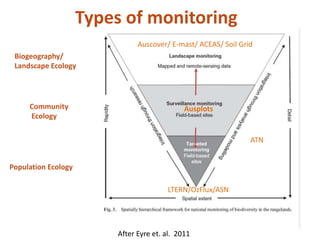
After Eyre et. al. 2011
Population Ecology
Community
Ecology
Biogeography/
Landscape Ecology
Types of monitoring
Auscover/ E-mast/ ACEAS/ Soil Grid
LTERN/OzFlux/ASN
ATN
Ausplots
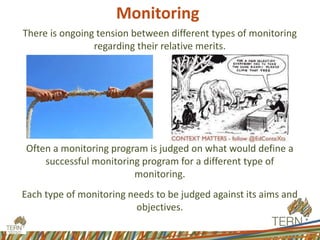
Monitoring
There is ongoing tension between different types of monitoring
regarding their relative merits.
Often a monitoring program is judged on what would define a
successful monitoring program for a different type of
monitoring.
Each type of monitoring needs to be judged against its aims and
objectives.
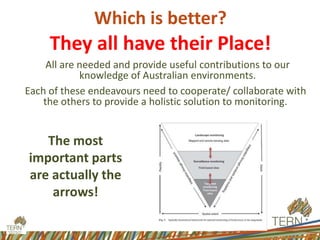
Which is better?
They all have their Place!
All are needed and provide useful contributions to our
knowledge of Australian environments.
Each of these endeavours need to cooperate/ collaborate with
the others to provide a holistic solution to monitoring.
The most
important parts
are actually the
arrows!
Surveillance Monitoring
• Looks at entire communities ( Is more likely to be concerned with
the trajectory of communities rather than individuals or species)
• Versatile and reusable – Useful for many purposes
• Drivers unknown (May provide some insight, but that is not the
focus of design)
• Broad stakeholder base, given multiple purposes
• Detect and quantify change that we don’t know about and weren’t
anticipating
• Some hope of method standardisation – If method broad in scope
• Likely to be able to adapt to emerging issues – If method
broad in scope
• Has focus areas rather than tightly defined questions – it is
likely that this information will inform on many questions.
• Aims to detect and quantify environmental change across
large geographical areas.
• Less likely for the same sites to be regularly revisited –
Longer re-visit time. (Duration of many years)
• More often assessing long term change rather than shorter
term dynamics.
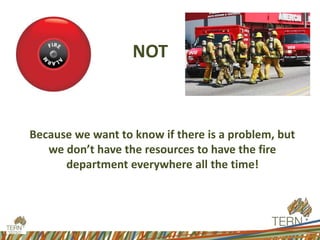
NOT
Because we want to know if there is a problem, but
we don’t have the resources to have the fire
department everywhere all the time!
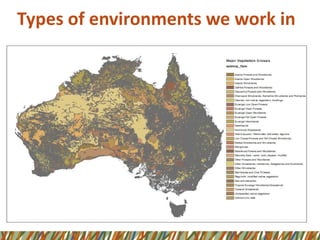
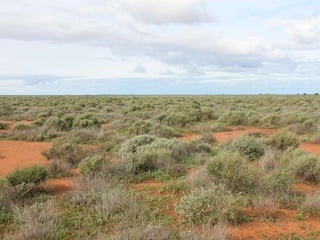
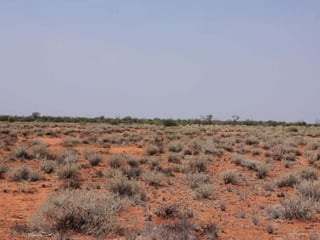
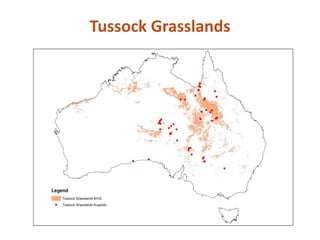
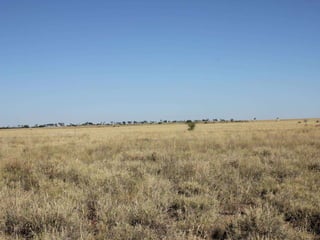
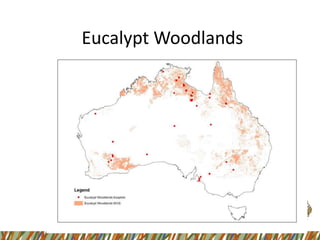
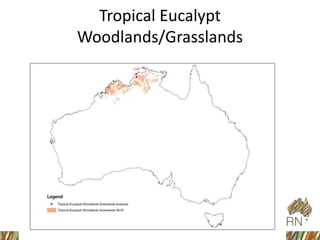
Types of environments we work in
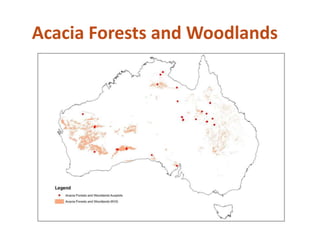
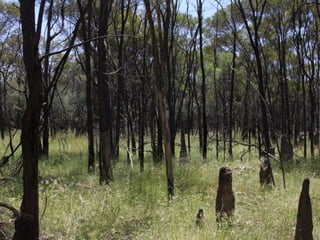
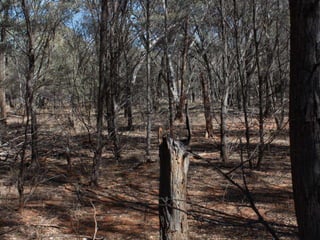
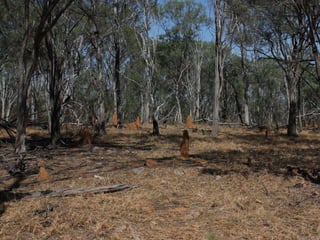
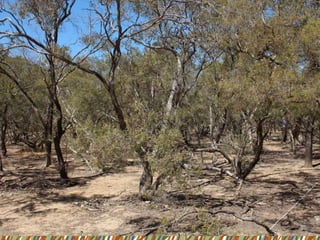
Acacia Forests and Woodlands
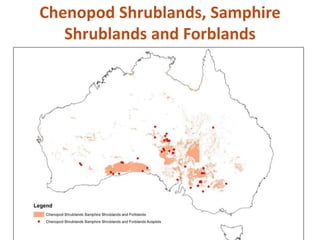
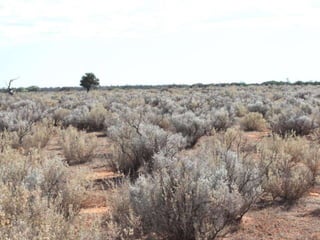
Chenopod Shrublands, Samphire
Shrublands and Forblands
Tussock Grasslands
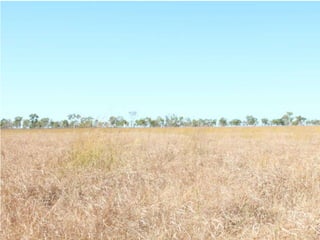
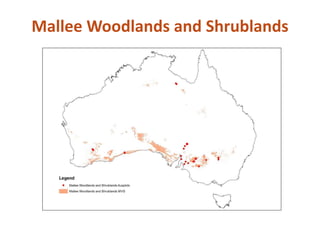
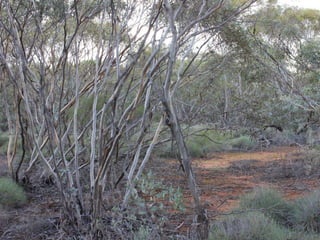
Mallee Woodlands and Shrublands
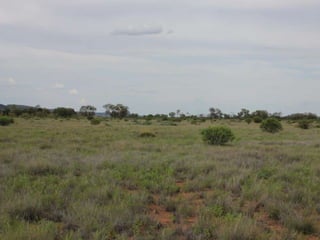
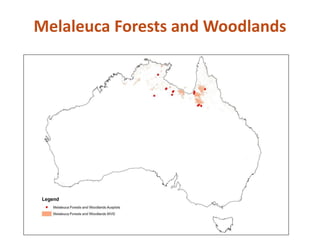
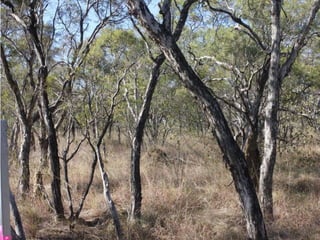
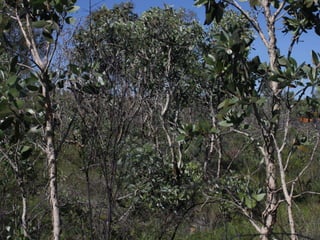
Melaleuca Forests and Woodlands
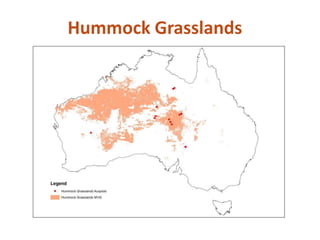
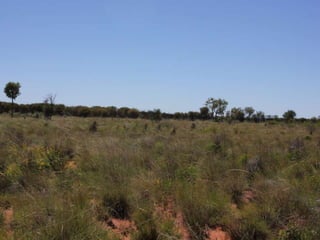
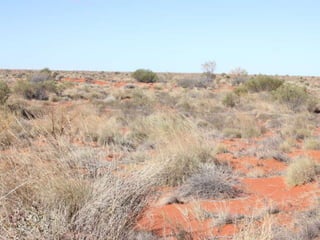
Hummock Grasslands
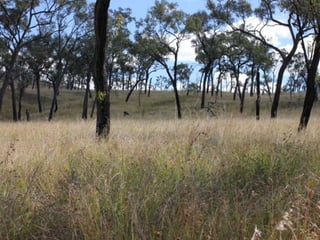
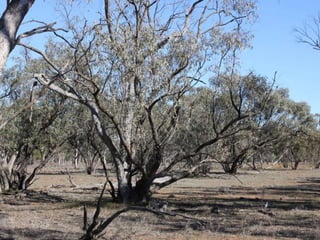
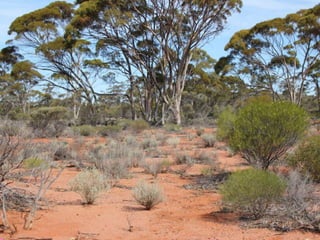
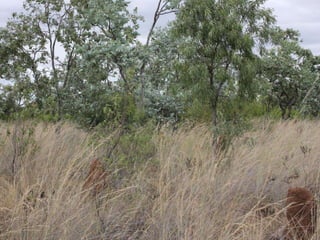
Eucalypt Woodlands
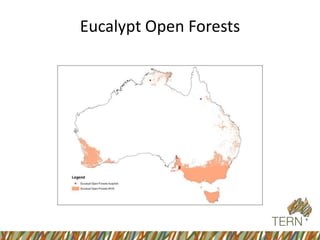
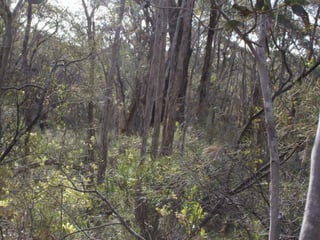
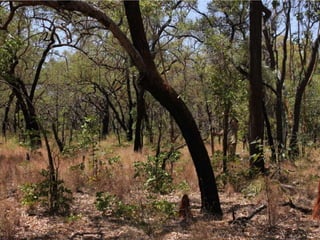
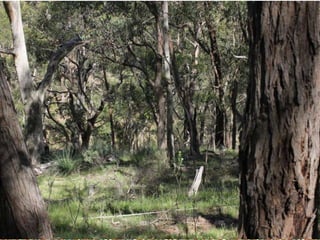
Eucalypt Open Forests
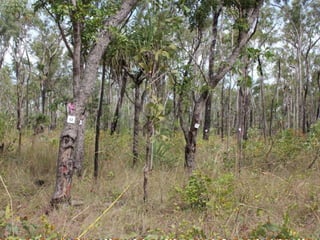
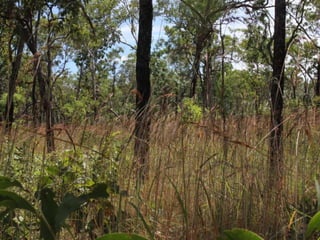
Tropical Eucalypt
Woodlands/Grasslands
AusPlots
An example of surveillance monitoring
Objectives of AusPlots
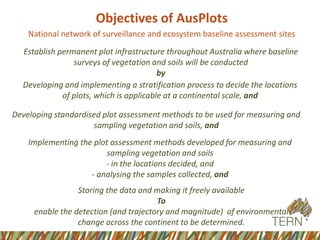
National network of surveillance and ecosystem baseline assessment sites
Developing standardised plot assessment methods to be used for measuring and
sampling vegetation and soils, and
Developing and implementing a stratification process to decide the locations
of plots, which is applicable at a continental scale, and
Establish permanent plot infrastructure throughout Australia where baseline
surveys of vegetation and soils will be conducted
by
Implementing the plot assessment methods developed for measuring and
sampling vegetation and soils
- in the locations decided, and
- analysing the samples collected, and
Storing the data and making it freely available
To
enable the detection (and trajectory and magnitude) of environmental
change across the continent to be determined.
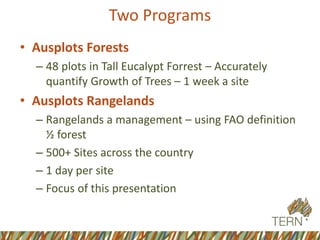
Two Programs
• Ausplots Forests
– 48 plots in Tall Eucalypt Forrest – Accurately
quantify Growth of Trees – 1 week a site
• Ausplots Rangelands
– Rangelands a management – using FAO definition
½ forest
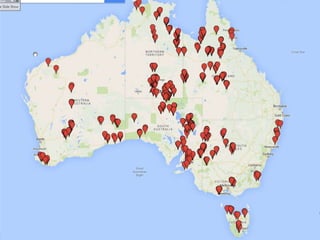
– 500+ Sites across the country
– 1 day per site
– Focus of this presentation
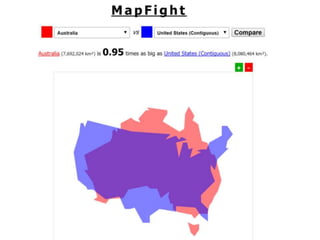
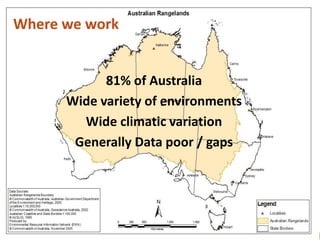
81% of Australia
Wide variety of environments
Wide climatic variation
Generally Data poor / gaps
Where we work
AusPlots
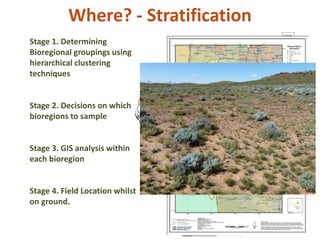
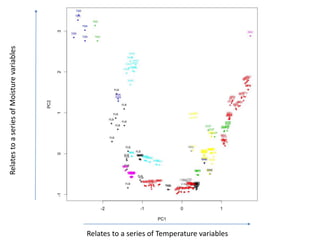
Stage 1. Determining
Bioregional groupings using
hierarchical clustering
techniques
Stage 2. Decisions on which
bioregions to sample
Stage 3. GIS analysis within
each bioregion
Stage 4. Field Location whilst
on ground.
Where? - Stratification
Addresses
knowledge gaps
Located where
there is a NEED for
data
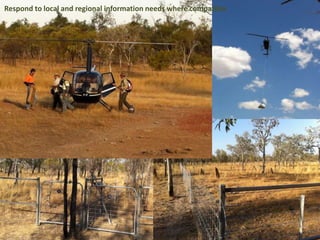
Respond to local and regional information needs where compatible
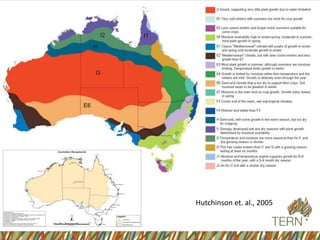
Hutchinson et. al., 2005
Prentice/Dong u diag
Relates to a series of Temperature variables
RelatestoaseriesofMoisturevariables
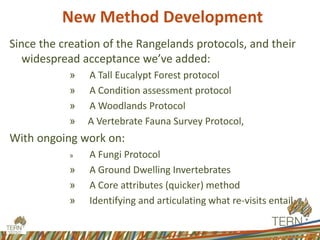
Since the creation of the Rangelands protocols, and their
widespread acceptance we’ve added:
» A Tall Eucalypt Forest protocol
» A Condition assessment protocol
» A Woodlands Protocol
» A Vertebrate Fauna Survey Protocol,
With ongoing work on:
» A Fungi Protocol
» A Ground Dwelling Invertebrates
» A Core attributes (quicker) method
» Identifying and articulating what re-visits entail.
New Method Development
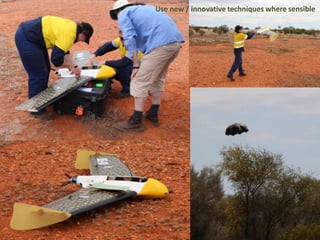
Use new / innovative techniques where sensible
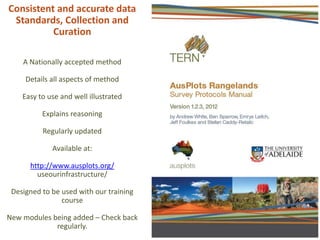
Consistent and accurate data
Standards, Collection and
Curation
A Nationally accepted method
Details all aspects of method
Easy to use and well illustrated
Explains reasoning
Regularly updated
Available at:
http://www.ausplots.org/
useourinfrastructure/
Designed to be used with our training
course
New modules being added – Check back
regularly.
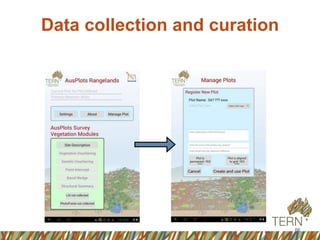
Data collection and curation
66
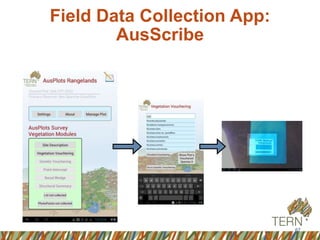
Field Data Collection App:
AusScribe
67
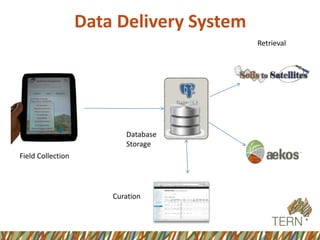
Data Delivery System
Field Collection
Curation
Database
Storage
Retrieval
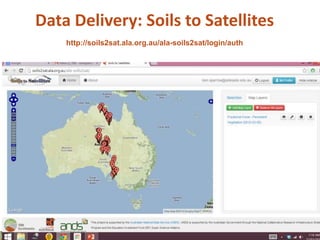
Data Delivery: Soils to Satellites
http://soils2sat.ala.org.au/ala-soils2sat/login/auth
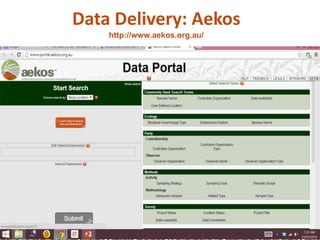
Data Delivery: Aekos
http://www.aekos.org.au/
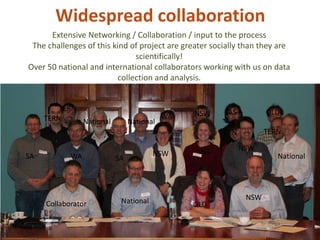
Widespread collaboration
Extensive Networking / Collaboration / input to the process
The challenges of this kind of project are greater socially than they are
scientifically!
Over 50 national and international collaborators working with us on data
collection and analysis.
SA SA
National
NationalNational
Collaborator
TAS QLD
NSW
NSW
NSWNT
WA
WA NSW
National
TERN
TERN
TERN TERN
QLD
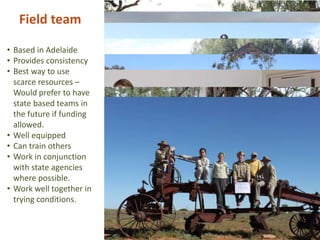
Field team
• Based in Adelaide
• Provides consistency
• Best way to use
scarce resources –
Would prefer to have
state based teams in
the future if funding
allowed.
• Well equipped
• Can train others
• Work in conjunction
with state agencies
where possible.
• Work well together in
trying conditions.
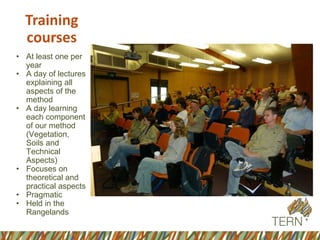
Training
courses
• At least one per
year
• A day of lectures
explaining all
aspects of the
method
• A day learning
each component
of our method
(Vegetation,
Soils and
Technical
Aspects)
• Focuses on
theoretical and
practical aspects
• Pragmatic
• Held in the
Rangelands
Outputs
Still early days for the project given that re-visits are
only just starting (along with further roll out)
Currently used for validation of groundcover
Rangeland management programs
Taxonomy – New species and range extensions
Modelling of climate change scenarios
Government are supporting surveillance monitoring
as an essential input to future state of
environment reporting.
Inform on soil crust ( and hence erosion)
…and many publications
2015
Christmas M., Breed M., and Lowe A.J. (In review) Constraints and conservation implications for climate change adaptation in plants. Biological Conservation
Guerin G.R., Sweeney S.M., Pisanu P., Caddy-Retalic S., and Lowe A.J. (In review) Establishment of an ecosystem transect to address climate change policy
questions for natural resource management. Environmental Management
Guerin G.R. and Lowe A.J. (In review) Mapping phylogenetic endemism using georeferenced branch extents. Methods in Ecology and Evolution
Guerin G.R., Ruokolainen L. and Lowe A.J. (In press) A georeferenced implementation of weighted endemism. Methods in Ecology and Evolution
2014
Bowman D.M.J.S., Williamson G.J., Keenan R.J. and Prior L.D. (2014) A warmer world will reduce tree growth in evergreen broadleaf forests: Evidence from
Australian temperate and subtropical eucalypt forests. Global Ecology and Biogeography, 23(8): 925-934. (DOI: 10.1111/geb.12171)
Breed M.F., Christmas M.J. and Lowe A.J. (2014) Higher levels of multiple paternities increase seedling survival in the long-lived tree Eucalyptus gracilis.PLOS
ONE, 9(2) e90478 (DOI:10.1371/journal.pone.0090478)
Guerin G.R., Martín-Forés I., Biffin E., Baruch Z., Breed M.F., Christmas M.J., Cross H.B. and Lowe A.J. (2014) Global change community ecology beyond
species sorting: a quantitative framework based on Mediterranean Biome examples. Global Ecology and Biogeography, 23: 1062–
1072.http://dx.doi.org/10.1111/geb.12184
Guerin G.R., Biffin E., Jardine D.I., Cross H.B. and Lowe A.J. (2014) A spatially predictive baseline for monitoring multivariate species occurrences and
phylogenetic shifts in Mediterranean southern Australia. Journal of Vegetation Science, 25: 338–348. http://dx.doi.org/10.1111/jvs.12111
McCallum K., Guerin G.R., Breed M.F. and Lowe A.J. (2014) Combining population genetics, species distribution modelling and field assessments to
understand a species vulnerability to climate change. Austral Ecology, 39: 17–28. http://dx.doi.org/10.1111/aec.12041
Prior L.D. and Bowman D.M.J.S. (2014) Across a macro-ecological gradient forest competition is strongest at the most productive sites. Frontiers in Plant
Science, 5: 260. (DOI: 10.3389/fpls.2014.00260)
Prior L.D. and Bowman D.M.J.S. (2014) Big eucalypts grow more slowly in a warm climate: evidence of an interaction between tree size and
temperature. Global Change Biology, 20(9): 2793-2799. (DOI: 10.1111/gcb.12540)
Schut A.G.T., Wardell-Johnson G.W., Yates C.J., Keppel G., Baran I., Franklin S.E., Hopper S.D., Van Neil K., Mucina L. and Byrne M. (2014) Rapid
characterisation of vegetation structure to predict refugia and climate change impacts across a global biodiversity hotspot. PLOS ONE, 9: e82778.
(DOI: 10.1371/journal.pone.0082778)
Tapper S-L., Byrne M., Yates C.J., Keppel G., Hopper S.D., Van Niel K., Schut A.G.T., Mucina L. and Wardell-Johnson G.W. (2014) Isolated with persistence or
dynamically connected? Genetic patterns in a common granite outcrop endemic. Diversity and Distributions, 20(9): 987-1001 (DOI:
10.1111/ddi.12185)
Tapper S-L., Byrne M., Yates C.J., Keppel G., Hopper S.D., Van Niel K., Schut A.G.T., Mucina L. and Wardell-Johnson G.W. (2014) Long-term isolation and
persistence of Stypandra glauca R.Br. (Hemerocallidaceae) on granite outcrops in both mesic and arid environments in southwestern Australia.
Journal of Biogeography, 41: 2032-2044. (DOI: 10.1111/jbi.12343)
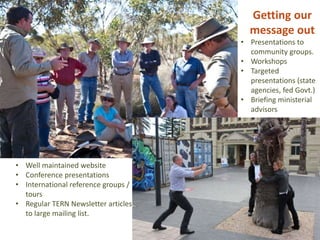
Getting our
message out
• Presentations to
community groups.
• Workshops
• Targeted
presentations (state
agencies, fed Govt.)
• Briefing ministerial
advisors
• Well maintained website
• Conference presentations
• International reference groups /
tours
• Regular TERN Newsletter articles
to large mailing list.
About Our Method
• Practicality/pragmatism has had to prevail
• “It’s not about developing the perfect method, but rather
understanding how imperfect the method is.”
Modular Methods
• The method has been designed in modules
• Ease of use in the field
• For your own purposes (not AusPlots funded) there is the
possibility of only including some modules
• For AusPlots and training purposes we will cover all modules
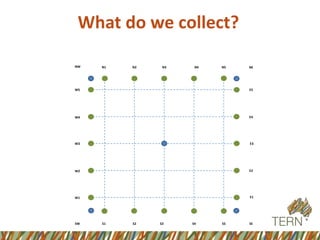
S1
NEN5N4N3N2N1NW
W5
W4
W3
W2
W1
SW S2 S3 S4 S5 SE
E1
E2
E3
E4
E5
What do we collect?
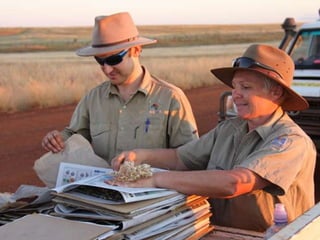
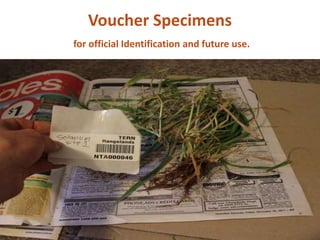
Voucher Specimens
for official Identification and future use.
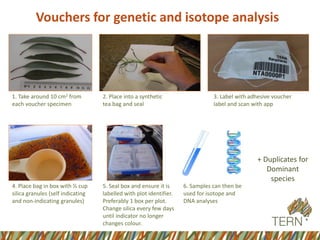
Vouchers for genetic and isotope analysis
1. Take around 10 cm2 from
each voucher specimen
2. Place into a synthetic
tea bag and seal
3. Label with adhesive voucher
label and scan with app
4. Place bag in box with ⅓ cup
silica granules (self indicating
and non-indicating granules)
5. Seal box and ensure it is
labelled with plot identifier.
Preferably 1 box per plot.
Change silica every few days
until indicator no longer
changes colour.
6. Samples can then be
used for isotope and
DNA analyses
+ Duplicates for
Dominant
species
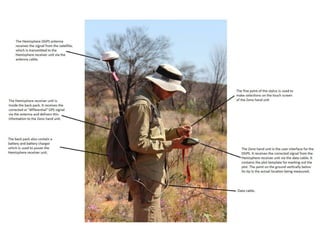
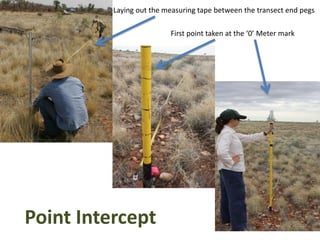
Laying out the measuring tape between the transect end pegs
First point taken at the ‘0’ Meter mark
Point Intercept
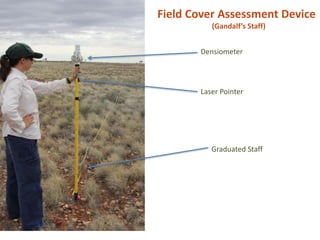
Densiometer
Graduated Staff
Laser Pointer
Field Cover Assessment Device
(Gandalf’s Staff)
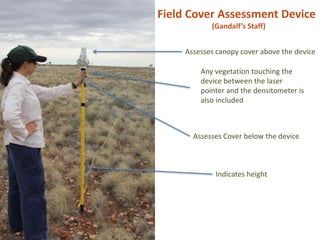
Assesses canopy cover above the device
Indicates height
Assesses Cover below the device
Field Cover Assessment Device
(Gandalf’s Staff)
Any vegetation touching the
device between the laser
pointer and the densitometer is
also included
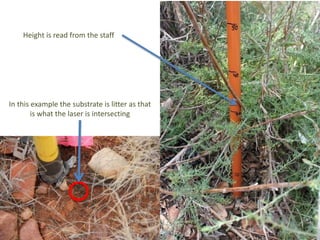
In this example the substrate is litter as that
is what the laser is intersecting
Height is read from the staff
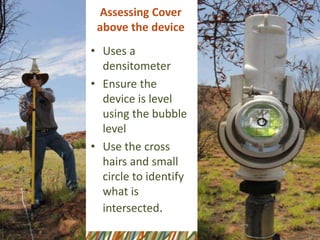
Assessing Cover
above the device
• Uses a
densitometer
• Ensure the
device is level
using the bubble
level
• Use the cross
hairs and small
circle to identify
what is
intersected.
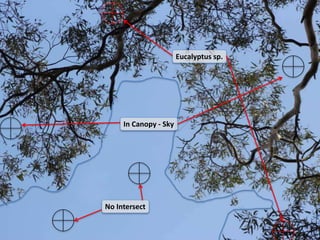
No Intersect
In Canopy - Sky
Eucalyptus sp.
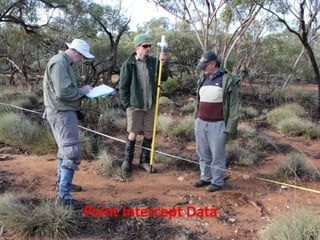
Point Intercept Data
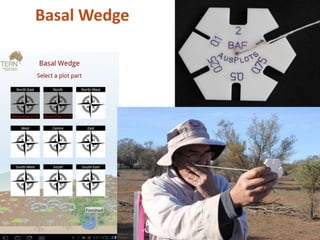
Basal Wedge
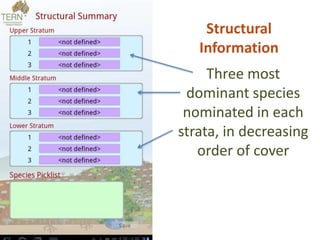
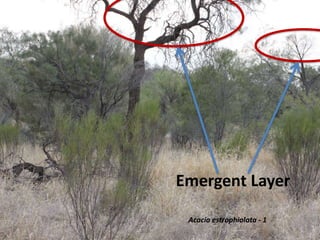
Three most
dominant species
nominated in each
strata, in decreasing
order of cover
Structural
Information
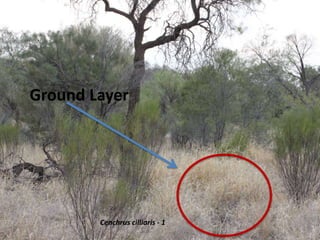
Ground Layer
Cenchrus cilliaris - 1
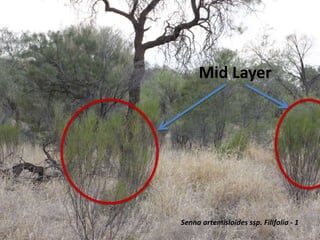
Mid Layer
Senna artemisioides ssp. Filifolia - 1
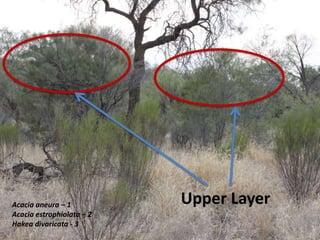
Upper LayerAcacia aneura – 1
Acacia estrophiolata – 2
Hakea divaricata - 3
Emergent Layer
Acacia estrophiolata - 1
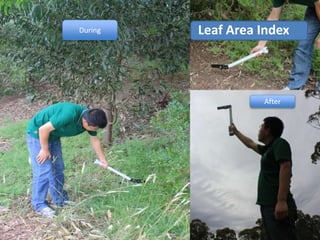
During
After
Leaf Area Index
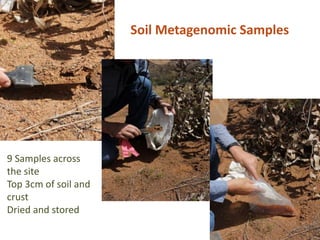
Soil Metagenomic Samples
9 Samples across
the site
Top 3cm of soil and
crust
Dried and stored
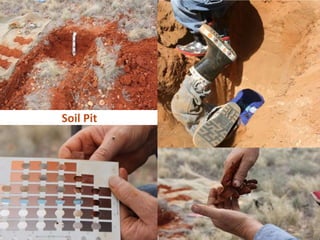
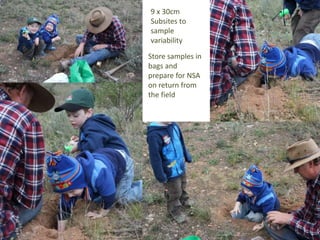
Soil Pit
9 x 30cm
Subsites to
sample
variability
Store samples in
bags and
prepare for NSA
on return from
the field
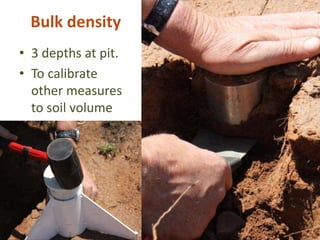
Bulk density
• 3 depths at pit.
• To calibrate
other measures
to soil volume
1
Basal Area from Photopoints…..
• Is it possible?
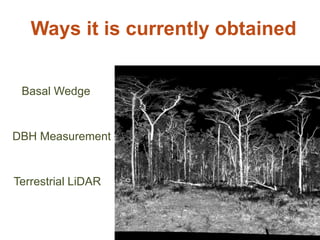
Ways it is currently obtained
10
5
Basal Wedge
DBH Measurement
Terrestrial LiDAR
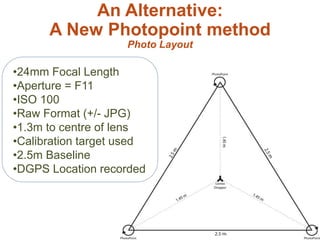
An Alternative:
A New Photopoint method
Photo Layout
10
6
•24mm Focal Length
•Aperture = F11
•ISO 100
•Raw Format (+/- JPG)
•1.3m to centre of lens
•Calibration target used
•2.5m Baseline
•DGPS Location recorded
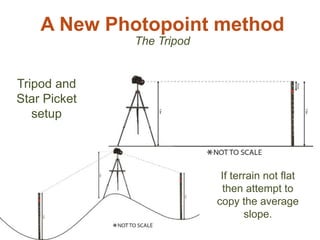
A New Photopoint method
The Tripod
10
7
Tripod and
Star Picket
setup
If terrain not flat
then attempt to
copy the average
slope.
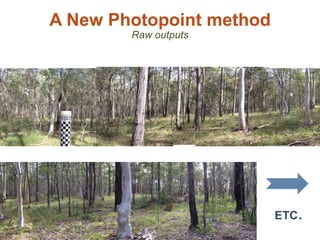
A New Photopoint method
Raw outputs
10
8
ETC.
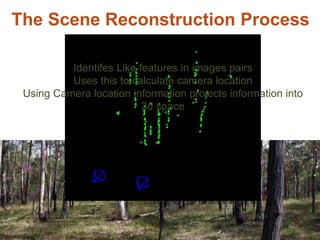
The Scene Reconstruction Process
10
9
Identifes Like features in images pairs
Uses this to calculate camera location
Using Camera location information projects information into
3d space
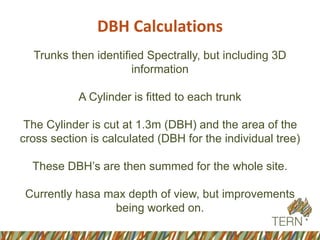
DBH Calculations
Trunks then identified Spectrally, but including 3D
information
A Cylinder is fitted to each trunk
The Cylinder is cut at 1.3m (DBH) and the area of the
cross section is calculated (DBH for the individual tree)
These DBH’s are then summed for the whole site.
Currently hasa max depth of view, but improvements
being worked on.
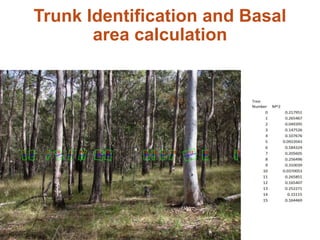
Trunk Identification and Basal
area calculation
11
1
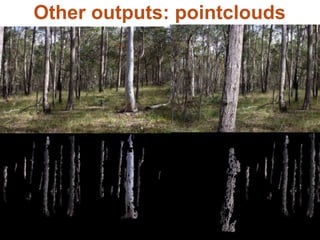
Other outputs: pointclouds
11
2
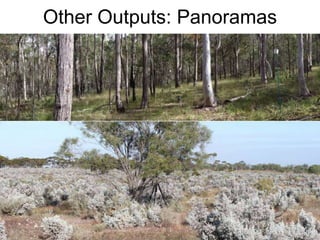
Other Outputs: Panoramas
11
3
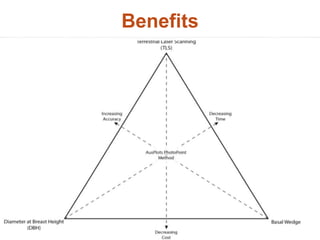
Benefits
11
4
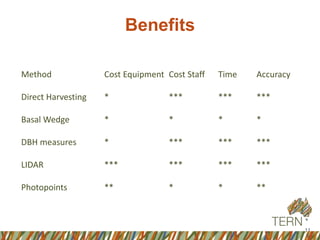
Benefits
11
5
Method Cost Equipment Cost Staff Time Accuracy
Direct Harvesting * *** *** ***
Basal Wedge * * * *
DBH measures * *** *** ***
LIDAR *** *** *** ***
Photopoints ** * * **
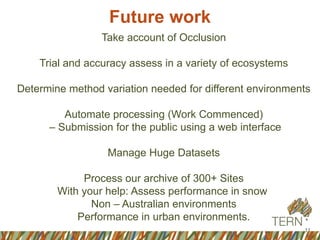
Future work
11
6
Take account of Occlusion
Trial and accuracy assess in a variety of ecosystems
Determine method variation needed for different environments
Automate processing (Work Commenced)
– Submission for the public using a web interface
Manage Huge Datasets
Process our archive of 300+ Sites
With your help: Assess performance in snow
Non – Australian environments
Performance in urban environments.
Link To Video
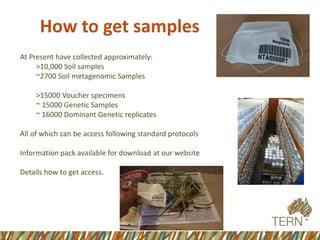
How to get samples
At Present have collected approximately:
>10,000 Soil samples
~2700 Soil metagenomic Samples
>15000 Voucher specimens
~ 15000 Genetic Samples
~ 16000 Dominant Genetic replicates
All of which can be access following standard protocols
Information pack available for download at our website
Details how to get access.
What can AusPlots offer you?
www.ausplots.org.au
For details including Volunteering, HDR, Data, methods,
Samples, Training, App etc.
Ben.sparrow@adelaide.edu.au
08 8313 1201
Morton presentation6

Morton presentation6

  • 2.
    AusPlots Designing a surveillancemonitoring network for Australia. Presentation by Ben Sparrow With help from the Ausplots Team ben.sparrow@adelaide.edu.au
  • 3.
    Political/Historical context • GlobalFinancial Crisis • Australian Government response -Stimulus • Favoured Infrastructure – NCRIS (National Collaborative Research Infrastructure Scheme) • Research infrastructure – Environmental = TERN • Not tangible infrastructure eg. Roads, but not classical research either research – need to deliver Data – Different measures of Success
  • 4.
    Primarily funded tosupport / develop ecological research infrastructure – integrate existing data and make it accessible to the national and global ecosystem sciences community in a common format; and – collect new data strategically in areas of high priority to allow subsequent analysis and modeling of the assimilated data. In the context of AusPlots the Plots and their associated data are considered to be infrastructure. TERN the Terrestrial Ecosystem Research Network
  • 5.
    What is TERN? •A Network of scientists and practitioners collecting and delivering ecological research infrastructure. • Delivered as a number of facilities: • Auscover: Ecological/ biophysical remote sensing products • Ausplots: Surveillance monitoring of Australian ecosystems • ACEAS – A Synthesis facility similar to NCEAS
  • 6.
    • Coasts: Infoin the interface between terrestrial and marine • Australian Supersite Network (ASN): Highly instrumented study sites. • Australian Transect Network (ATN): Data and questions on environmental gradients; Space as a proxy for time • Eco-informatics – Data delivery warehouse; Fully integrated data • E-Mast – Ecological and biophysical modelling
  • 7.
    • Long TermEcological Research Network (LTERN): Brings together scientists working on long term sites – Question based targeted monitoring • Ozflux: a series of flux towers to understand fluxes between land and atmosphere • Soil and Landscape Grid: Delivering Australian Soil information in line from plot to continent • Many facilities collaborate together on aspects of their work.
  • 8.
    After Eyre et.al. 2011 Population Ecology Community Ecology Biogeography/ Landscape Ecology Types of monitoring Auscover/ E-mast/ ACEAS/ Soil Grid LTERN/OzFlux/ASN ATN Ausplots
  • 9.
    Monitoring There is ongoingtension between different types of monitoring regarding their relative merits. Often a monitoring program is judged on what would define a successful monitoring program for a different type of monitoring. Each type of monitoring needs to be judged against its aims and objectives.
  • 10.
    Which is better? Theyall have their Place! All are needed and provide useful contributions to our knowledge of Australian environments. Each of these endeavours need to cooperate/ collaborate with the others to provide a holistic solution to monitoring. The most important parts are actually the arrows!
  • 11.
    Surveillance Monitoring • Looksat entire communities ( Is more likely to be concerned with the trajectory of communities rather than individuals or species) • Versatile and reusable – Useful for many purposes • Drivers unknown (May provide some insight, but that is not the focus of design) • Broad stakeholder base, given multiple purposes • Detect and quantify change that we don’t know about and weren’t anticipating • Some hope of method standardisation – If method broad in scope
  • 12.
    • Likely tobe able to adapt to emerging issues – If method broad in scope • Has focus areas rather than tightly defined questions – it is likely that this information will inform on many questions. • Aims to detect and quantify environmental change across large geographical areas. • Less likely for the same sites to be regularly revisited – Longer re-visit time. (Duration of many years) • More often assessing long term change rather than shorter term dynamics.
  • 13.
    NOT Because we wantto know if there is a problem, but we don’t have the resources to have the fire department everywhere all the time!
  • 15.
  • 16.
  • 20.
  • 24.
  • 28.
  • 32.
  • 36.
  • 40.
  • 44.
  • 48.
  • 51.
    AusPlots An example ofsurveillance monitoring
  • 52.
    Objectives of AusPlots Nationalnetwork of surveillance and ecosystem baseline assessment sites Developing standardised plot assessment methods to be used for measuring and sampling vegetation and soils, and Developing and implementing a stratification process to decide the locations of plots, which is applicable at a continental scale, and Establish permanent plot infrastructure throughout Australia where baseline surveys of vegetation and soils will be conducted by Implementing the plot assessment methods developed for measuring and sampling vegetation and soils - in the locations decided, and - analysing the samples collected, and Storing the data and making it freely available To enable the detection (and trajectory and magnitude) of environmental change across the continent to be determined.
  • 53.
    Two Programs • AusplotsForests – 48 plots in Tall Eucalypt Forrest – Accurately quantify Growth of Trees – 1 week a site • Ausplots Rangelands – Rangelands a management – using FAO definition ½ forest – 500+ Sites across the country – 1 day per site – Focus of this presentation
  • 54.
    81% of Australia Widevariety of environments Wide climatic variation Generally Data poor / gaps Where we work
  • 55.
  • 56.
    Stage 1. Determining Bioregionalgroupings using hierarchical clustering techniques Stage 2. Decisions on which bioregions to sample Stage 3. GIS analysis within each bioregion Stage 4. Field Location whilst on ground. Where? - Stratification
  • 57.
  • 58.
    Respond to localand regional information needs where compatible
  • 59.
  • 61.
    Prentice/Dong u diag Relatesto a series of Temperature variables RelatestoaseriesofMoisturevariables
  • 62.
    Since the creationof the Rangelands protocols, and their widespread acceptance we’ve added: » A Tall Eucalypt Forest protocol » A Condition assessment protocol » A Woodlands Protocol » A Vertebrate Fauna Survey Protocol, With ongoing work on: » A Fungi Protocol » A Ground Dwelling Invertebrates » A Core attributes (quicker) method » Identifying and articulating what re-visits entail. New Method Development
  • 64.
    Use new /innovative techniques where sensible
  • 65.
    Consistent and accuratedata Standards, Collection and Curation A Nationally accepted method Details all aspects of method Easy to use and well illustrated Explains reasoning Regularly updated Available at: http://www.ausplots.org/ useourinfrastructure/ Designed to be used with our training course New modules being added – Check back regularly.
  • 66.
  • 67.
    Field Data CollectionApp: AusScribe 67
  • 68.
    Data Delivery System FieldCollection Curation Database Storage Retrieval
  • 69.
    Data Delivery: Soilsto Satellites http://soils2sat.ala.org.au/ala-soils2sat/login/auth
  • 70.
  • 72.
    Widespread collaboration Extensive Networking/ Collaboration / input to the process The challenges of this kind of project are greater socially than they are scientifically! Over 50 national and international collaborators working with us on data collection and analysis. SA SA National NationalNational Collaborator TAS QLD NSW NSW NSWNT WA WA NSW National TERN TERN TERN TERN QLD
  • 73.
    Field team • Basedin Adelaide • Provides consistency • Best way to use scarce resources – Would prefer to have state based teams in the future if funding allowed. • Well equipped • Can train others • Work in conjunction with state agencies where possible. • Work well together in trying conditions.
  • 74.
    Training courses • At leastone per year • A day of lectures explaining all aspects of the method • A day learning each component of our method (Vegetation, Soils and Technical Aspects) • Focuses on theoretical and practical aspects • Pragmatic • Held in the Rangelands
  • 76.
    Outputs Still early daysfor the project given that re-visits are only just starting (along with further roll out) Currently used for validation of groundcover Rangeland management programs Taxonomy – New species and range extensions Modelling of climate change scenarios Government are supporting surveillance monitoring as an essential input to future state of environment reporting. Inform on soil crust ( and hence erosion)
  • 77.
    …and many publications 2015 ChristmasM., Breed M., and Lowe A.J. (In review) Constraints and conservation implications for climate change adaptation in plants. Biological Conservation Guerin G.R., Sweeney S.M., Pisanu P., Caddy-Retalic S., and Lowe A.J. (In review) Establishment of an ecosystem transect to address climate change policy questions for natural resource management. Environmental Management Guerin G.R. and Lowe A.J. (In review) Mapping phylogenetic endemism using georeferenced branch extents. Methods in Ecology and Evolution Guerin G.R., Ruokolainen L. and Lowe A.J. (In press) A georeferenced implementation of weighted endemism. Methods in Ecology and Evolution 2014 Bowman D.M.J.S., Williamson G.J., Keenan R.J. and Prior L.D. (2014) A warmer world will reduce tree growth in evergreen broadleaf forests: Evidence from Australian temperate and subtropical eucalypt forests. Global Ecology and Biogeography, 23(8): 925-934. (DOI: 10.1111/geb.12171) Breed M.F., Christmas M.J. and Lowe A.J. (2014) Higher levels of multiple paternities increase seedling survival in the long-lived tree Eucalyptus gracilis.PLOS ONE, 9(2) e90478 (DOI:10.1371/journal.pone.0090478) Guerin G.R., Martín-Forés I., Biffin E., Baruch Z., Breed M.F., Christmas M.J., Cross H.B. and Lowe A.J. (2014) Global change community ecology beyond species sorting: a quantitative framework based on Mediterranean Biome examples. Global Ecology and Biogeography, 23: 1062– 1072.http://dx.doi.org/10.1111/geb.12184 Guerin G.R., Biffin E., Jardine D.I., Cross H.B. and Lowe A.J. (2014) A spatially predictive baseline for monitoring multivariate species occurrences and phylogenetic shifts in Mediterranean southern Australia. Journal of Vegetation Science, 25: 338–348. http://dx.doi.org/10.1111/jvs.12111 McCallum K., Guerin G.R., Breed M.F. and Lowe A.J. (2014) Combining population genetics, species distribution modelling and field assessments to understand a species vulnerability to climate change. Austral Ecology, 39: 17–28. http://dx.doi.org/10.1111/aec.12041 Prior L.D. and Bowman D.M.J.S. (2014) Across a macro-ecological gradient forest competition is strongest at the most productive sites. Frontiers in Plant Science, 5: 260. (DOI: 10.3389/fpls.2014.00260) Prior L.D. and Bowman D.M.J.S. (2014) Big eucalypts grow more slowly in a warm climate: evidence of an interaction between tree size and temperature. Global Change Biology, 20(9): 2793-2799. (DOI: 10.1111/gcb.12540) Schut A.G.T., Wardell-Johnson G.W., Yates C.J., Keppel G., Baran I., Franklin S.E., Hopper S.D., Van Neil K., Mucina L. and Byrne M. (2014) Rapid characterisation of vegetation structure to predict refugia and climate change impacts across a global biodiversity hotspot. PLOS ONE, 9: e82778. (DOI: 10.1371/journal.pone.0082778) Tapper S-L., Byrne M., Yates C.J., Keppel G., Hopper S.D., Van Niel K., Schut A.G.T., Mucina L. and Wardell-Johnson G.W. (2014) Isolated with persistence or dynamically connected? Genetic patterns in a common granite outcrop endemic. Diversity and Distributions, 20(9): 987-1001 (DOI: 10.1111/ddi.12185) Tapper S-L., Byrne M., Yates C.J., Keppel G., Hopper S.D., Van Niel K., Schut A.G.T., Mucina L. and Wardell-Johnson G.W. (2014) Long-term isolation and persistence of Stypandra glauca R.Br. (Hemerocallidaceae) on granite outcrops in both mesic and arid environments in southwestern Australia. Journal of Biogeography, 41: 2032-2044. (DOI: 10.1111/jbi.12343)
  • 78.
    Getting our message out •Presentations to community groups. • Workshops • Targeted presentations (state agencies, fed Govt.) • Briefing ministerial advisors • Well maintained website • Conference presentations • International reference groups / tours • Regular TERN Newsletter articles to large mailing list.
  • 80.
    About Our Method •Practicality/pragmatism has had to prevail • “It’s not about developing the perfect method, but rather understanding how imperfect the method is.” Modular Methods • The method has been designed in modules • Ease of use in the field • For your own purposes (not AusPlots funded) there is the possibility of only including some modules • For AusPlots and training purposes we will cover all modules
  • 81.
    S1 NEN5N4N3N2N1NW W5 W4 W3 W2 W1 SW S2 S3S4 S5 SE E1 E2 E3 E4 E5 What do we collect?
  • 84.
    Voucher Specimens for officialIdentification and future use.
  • 85.
    Vouchers for geneticand isotope analysis 1. Take around 10 cm2 from each voucher specimen 2. Place into a synthetic tea bag and seal 3. Label with adhesive voucher label and scan with app 4. Place bag in box with ⅓ cup silica granules (self indicating and non-indicating granules) 5. Seal box and ensure it is labelled with plot identifier. Preferably 1 box per plot. Change silica every few days until indicator no longer changes colour. 6. Samples can then be used for isotope and DNA analyses + Duplicates for Dominant species
  • 86.
    Laying out themeasuring tape between the transect end pegs First point taken at the ‘0’ Meter mark Point Intercept
  • 87.
    Densiometer Graduated Staff Laser Pointer FieldCover Assessment Device (Gandalf’s Staff)
  • 88.
    Assesses canopy coverabove the device Indicates height Assesses Cover below the device Field Cover Assessment Device (Gandalf’s Staff) Any vegetation touching the device between the laser pointer and the densitometer is also included
  • 89.
    In this examplethe substrate is litter as that is what the laser is intersecting Height is read from the staff
  • 90.
    Assessing Cover above thedevice • Uses a densitometer • Ensure the device is level using the bubble level • Use the cross hairs and small circle to identify what is intersected.
  • 91.
    No Intersect In Canopy- Sky Eucalyptus sp.
  • 92.
  • 93.
  • 94.
    Three most dominant species nominatedin each strata, in decreasing order of cover Structural Information
  • 95.
  • 96.
  • 97.
    Upper LayerAcacia aneura– 1 Acacia estrophiolata – 2 Hakea divaricata - 3
  • 98.
  • 99.
  • 100.
    Soil Metagenomic Samples 9Samples across the site Top 3cm of soil and crust Dried and stored
  • 101.
  • 102.
    9 x 30cm Subsitesto sample variability Store samples in bags and prepare for NSA on return from the field
  • 103.
    Bulk density • 3depths at pit. • To calibrate other measures to soil volume
  • 104.
    1 Basal Area fromPhotopoints….. • Is it possible?
  • 105.
    Ways it iscurrently obtained 10 5 Basal Wedge DBH Measurement Terrestrial LiDAR
  • 106.
    An Alternative: A NewPhotopoint method Photo Layout 10 6 •24mm Focal Length •Aperture = F11 •ISO 100 •Raw Format (+/- JPG) •1.3m to centre of lens •Calibration target used •2.5m Baseline •DGPS Location recorded
  • 107.
    A New Photopointmethod The Tripod 10 7 Tripod and Star Picket setup If terrain not flat then attempt to copy the average slope.
  • 108.
    A New Photopointmethod Raw outputs 10 8 ETC.
  • 109.
    The Scene ReconstructionProcess 10 9 Identifes Like features in images pairs Uses this to calculate camera location Using Camera location information projects information into 3d space
  • 110.
    DBH Calculations Trunks thenidentified Spectrally, but including 3D information A Cylinder is fitted to each trunk The Cylinder is cut at 1.3m (DBH) and the area of the cross section is calculated (DBH for the individual tree) These DBH’s are then summed for the whole site. Currently hasa max depth of view, but improvements being worked on.
  • 111.
    Trunk Identification andBasal area calculation 11 1
  • 112.
  • 113.
  • 114.
  • 115.
    Benefits 11 5 Method Cost EquipmentCost Staff Time Accuracy Direct Harvesting * *** *** *** Basal Wedge * * * * DBH measures * *** *** *** LIDAR *** *** *** *** Photopoints ** * * **
  • 116.
    Future work 11 6 Take accountof Occlusion Trial and accuracy assess in a variety of ecosystems Determine method variation needed for different environments Automate processing (Work Commenced) – Submission for the public using a web interface Manage Huge Datasets Process our archive of 300+ Sites With your help: Assess performance in snow Non – Australian environments Performance in urban environments.
  • 117.
  • 118.
    How to getsamples At Present have collected approximately: >10,000 Soil samples ~2700 Soil metagenomic Samples >15000 Voucher specimens ~ 15000 Genetic Samples ~ 16000 Dominant Genetic replicates All of which can be access following standard protocols Information pack available for download at our website Details how to get access.
  • 119.
    What can AusPlotsoffer you? www.ausplots.org.au For details including Volunteering, HDR, Data, methods, Samples, Training, App etc. Ben.sparrow@adelaide.edu.au 08 8313 1201