WebRTC-to-SIP and back
It’s not all about audio and video!
Lorenzo Miniero
@lminiero@fosstodon.org
OpenSIPS Summit
May 15th 2024, Valencia
A chance to practice my broken Spanish!
Who am I?
Lorenzo Miniero
• Ph.D @ UniNA
• Chairman @ Meetecho
• Main author of Janus
Contacts and info
• lorenzo@meetecho.com
• https://fosstodon.org/@lminiero
• https://www.meetecho.com
• https://lminiero.it
Just a few words on Meetecho
• Co-founded in 2009 as an academic spin-off
• University research efforts brought to the market
• Completely independent from the University
• Focus on real-time multimedia applications
• Strong perspective on standardization and open source
• Several activities
• Consulting services
• Commercial support and Janus licenses
• Streaming of live events (IETF, ACM, etc.)
• Proudly brewed in sunny Napoli, Italy
A bit of context: Janus, WebRTC and SIP
Janus
General purpose, open source WebRTC server
• https://github.com/meetecho/janus-gateway
• Demos and documentation: https://janus.conf.meetecho.com
• Community: https://janus.discourse.group/
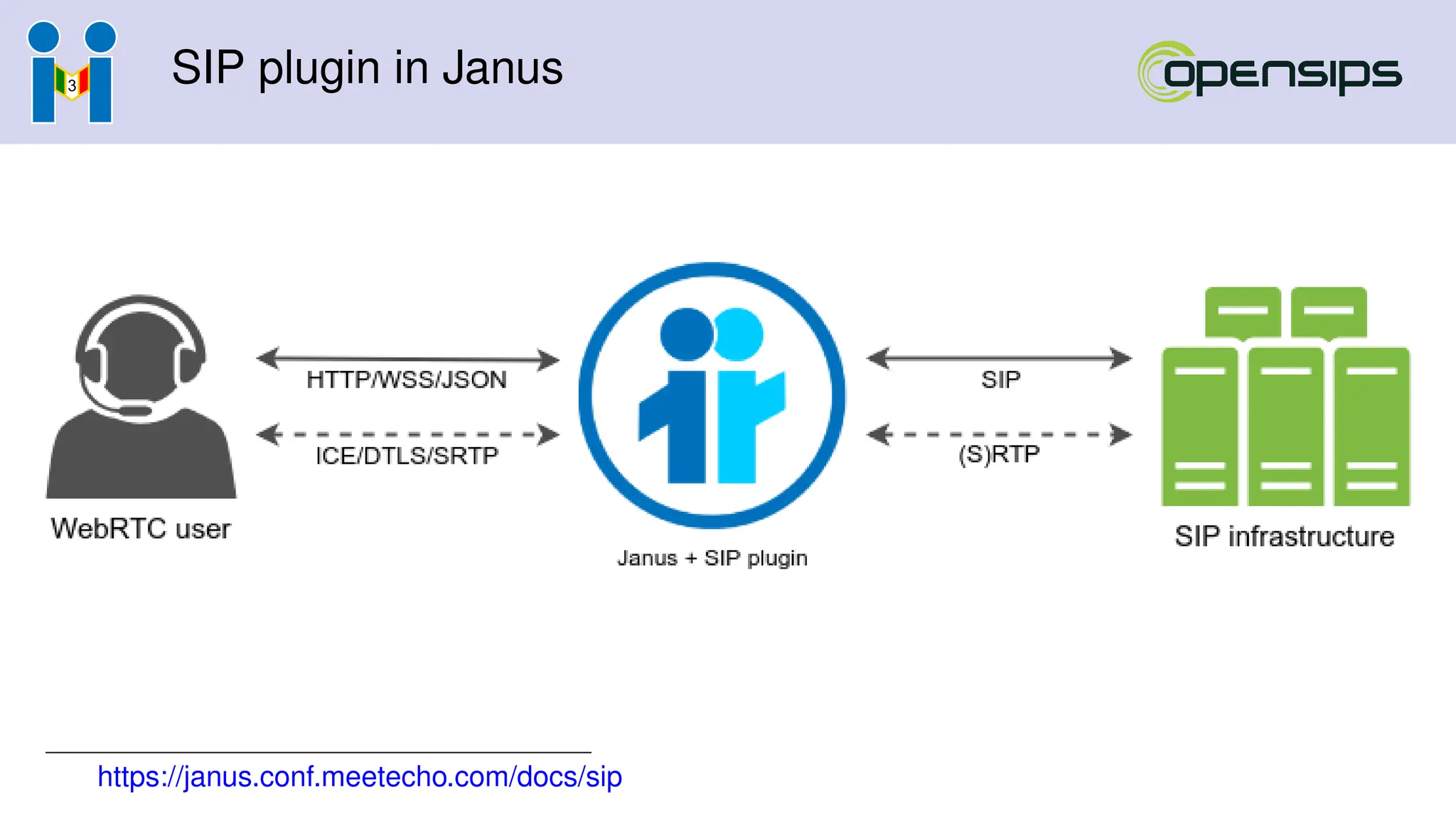
SIP plugin in Janus
https://janus.conf.meetecho.com/docs/sip
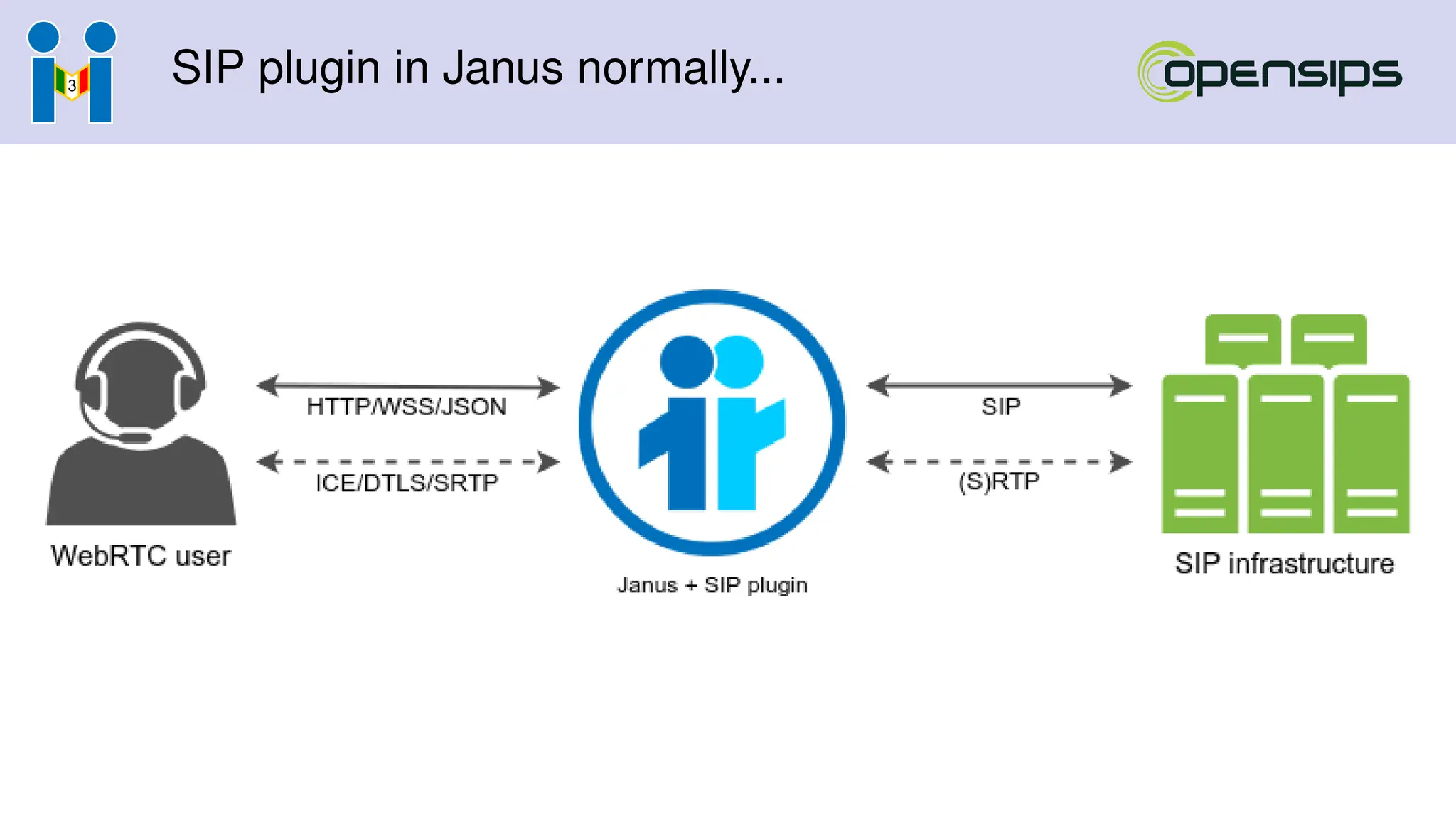
An endpoint of behalf of WebRTC users
• Janus SIP plugin acts as a collection of SIP endpoints, not a server/trunk
• SIP stack implemented with Sofia-SIP
• WebRTC users only see the Janus API (JSON), no SIP
• No transcoding, media is only relayed
• Built-in recording (separate media legs)
• Simplifies life for web developers
• No need to worry about a SIP stack (only SIP URIs)
• Basic methods/events to handle dialogs (call, answer, hangup, message, etc.)
• Allows SIP headers injection/interception in many requests
• Support for more advanced features too (e.g., hold, transfer, etc.)
An endpoint of behalf of WebRTC users
• Janus SIP plugin acts as a collection of SIP endpoints, not a server/trunk
• SIP stack implemented with Sofia-SIP
• WebRTC users only see the Janus API (JSON), no SIP
• No transcoding, media is only relayed
• Built-in recording (separate media legs)
• Simplifies life for web developers
• No need to worry about a SIP stack (only SIP URIs)
• Basic methods/events to handle dialogs (call, answer, hangup, message, etc.)
• Allows SIP headers injection/interception in many requests
• Support for more advanced features too (e.g., hold, transfer, etc.)
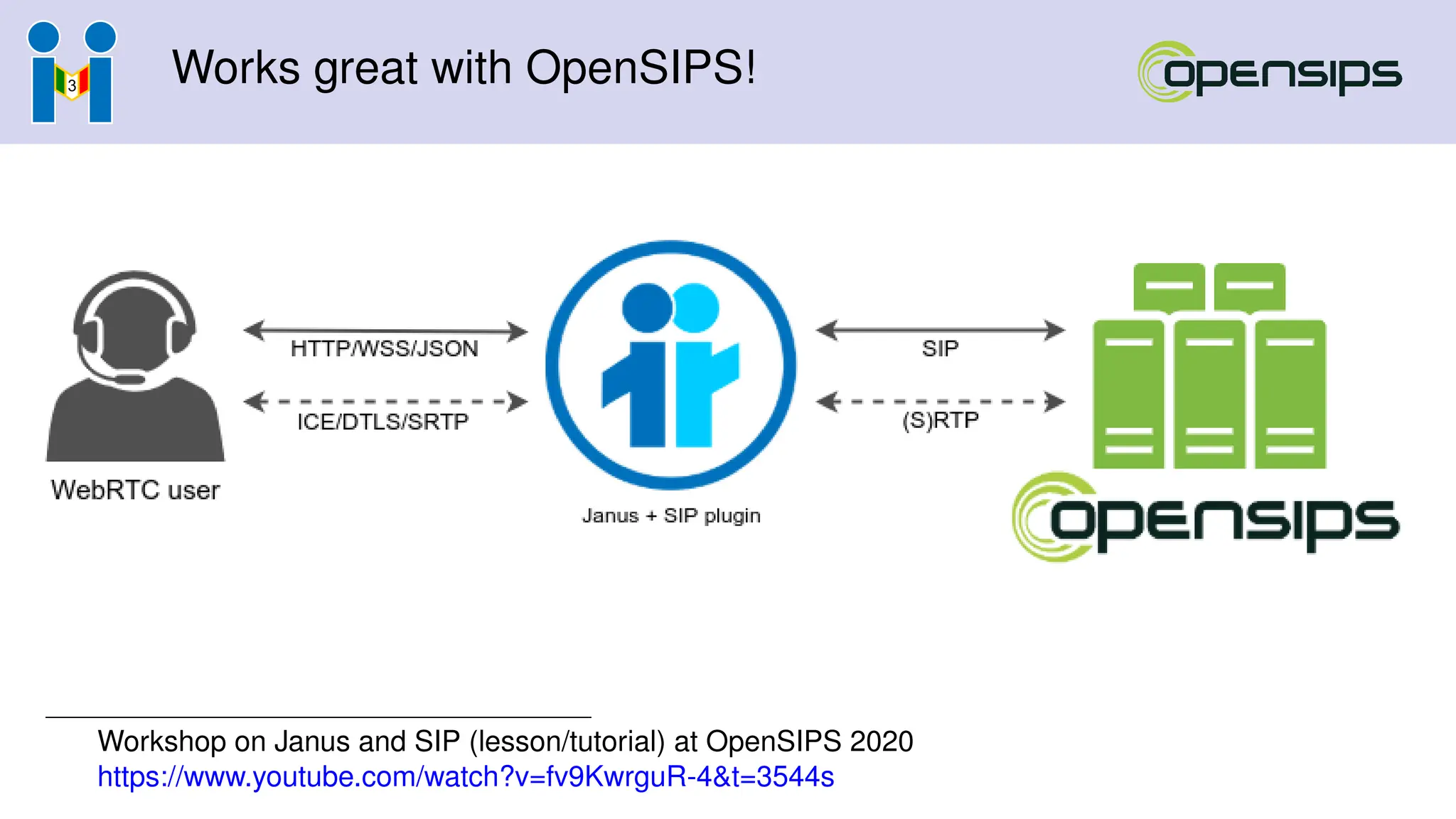
Works great with OpenSIPS!
Workshop on Janus and SIP (lesson/tutorial) at OpenSIPS 2020
https://www.youtube.com/watch?v=fv9KwrguR-4&t=3544s
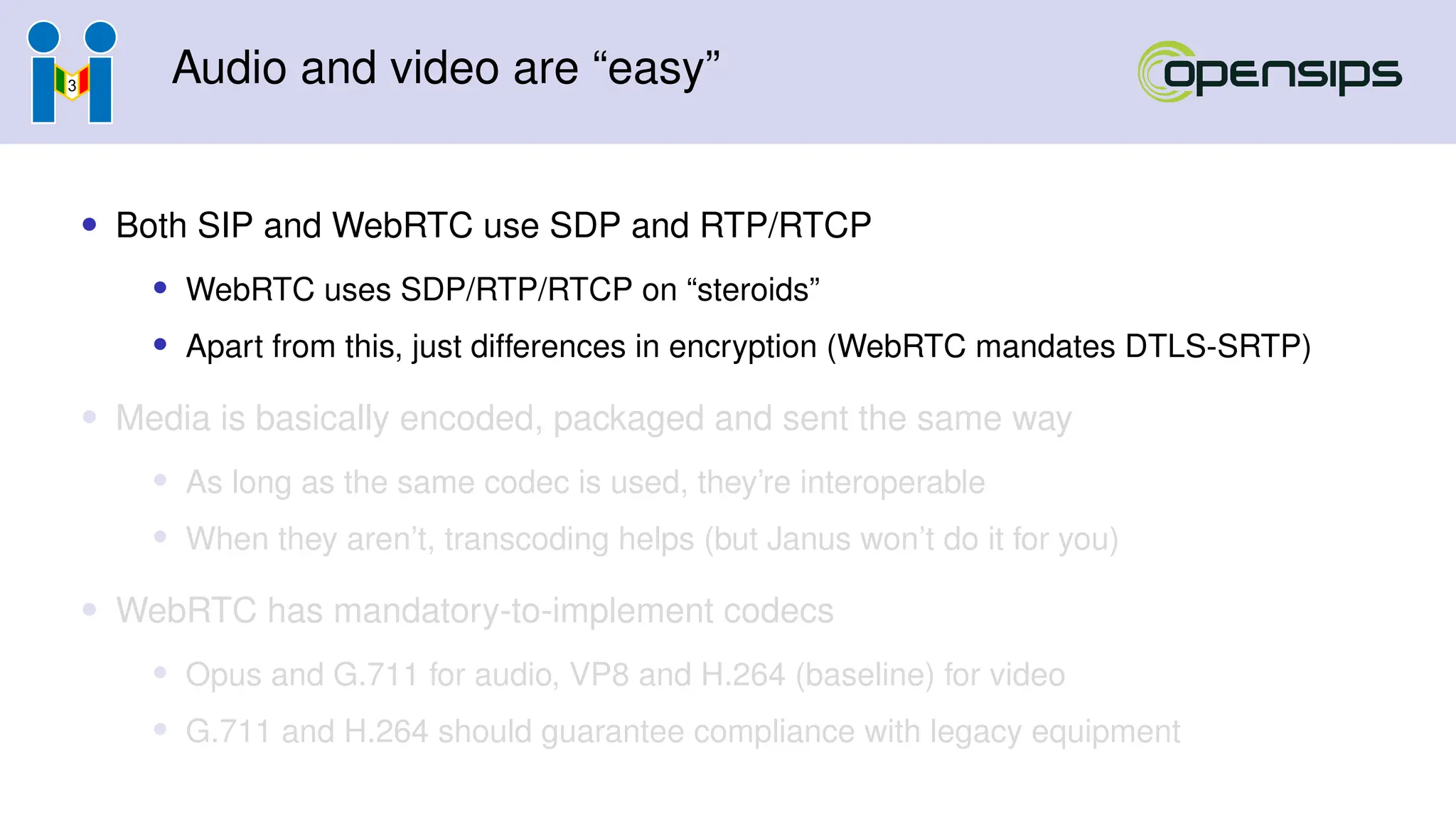
Audio and video are “easy”
• Both SIP and WebRTC use SDP and RTP/RTCP
• WebRTC uses SDP/RTP/RTCP on “steroids”
• Apart from this, just differences in encryption (WebRTC mandates DTLS-SRTP)
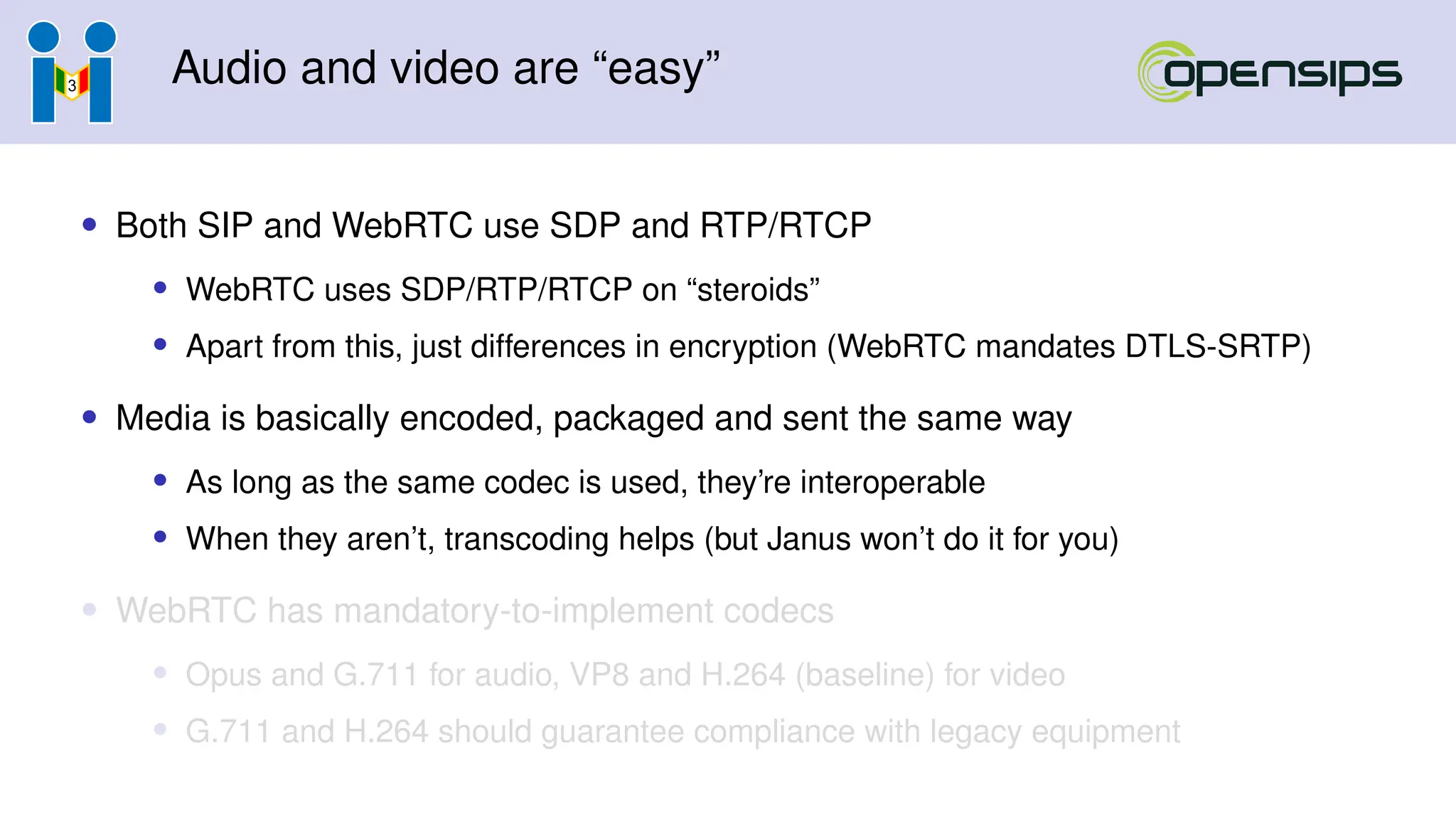
• Media is basically encoded, packaged and sent the same way
• As long as the same codec is used, they’re interoperable
• When they aren’t, transcoding helps (but Janus won’t do it for you)
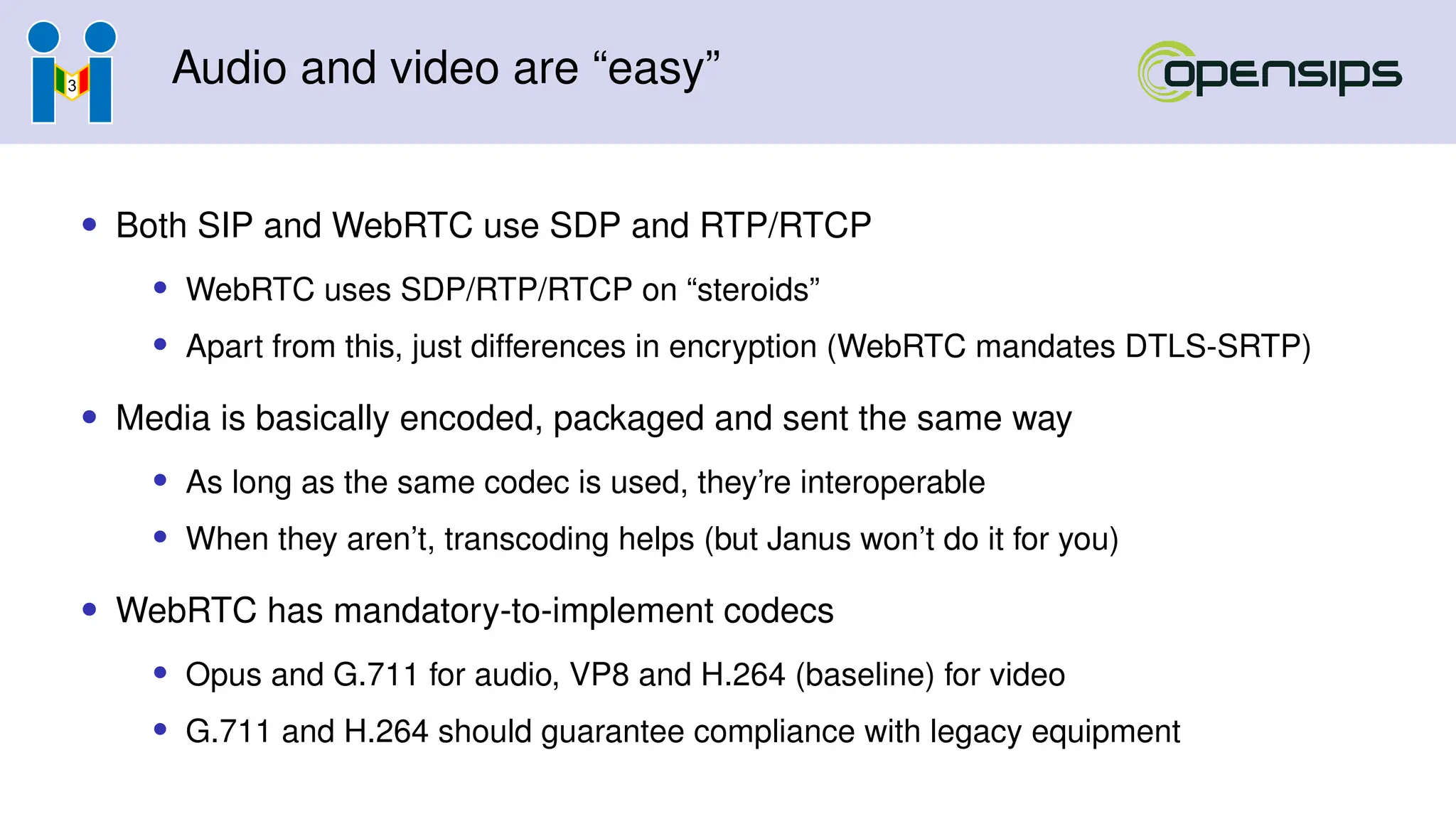
• WebRTC has mandatory-to-implement codecs
• Opus and G.711 for audio, VP8 and H.264 (baseline) for video
• G.711 and H.264 should guarantee compliance with legacy equipment
Audio and video are “easy”
• Both SIP and WebRTC use SDP and RTP/RTCP
• WebRTC uses SDP/RTP/RTCP on “steroids”
• Apart from this, just differences in encryption (WebRTC mandates DTLS-SRTP)
• Media is basically encoded, packaged and sent the same way
• As long as the same codec is used, they’re interoperable
• When they aren’t, transcoding helps (but Janus won’t do it for you)
• WebRTC has mandatory-to-implement codecs
• Opus and G.711 for audio, VP8 and H.264 (baseline) for video
• G.711 and H.264 should guarantee compliance with legacy equipment
Audio and video are “easy”
• Both SIP and WebRTC use SDP and RTP/RTCP
• WebRTC uses SDP/RTP/RTCP on “steroids”
• Apart from this, just differences in encryption (WebRTC mandates DTLS-SRTP)
• Media is basically encoded, packaged and sent the same way
• As long as the same codec is used, they’re interoperable
• When they aren’t, transcoding helps (but Janus won’t do it for you)
• WebRTC has mandatory-to-implement codecs
• Opus and G.711 for audio, VP8 and H.264 (baseline) for video
• G.711 and H.264 should guarantee compliance with legacy equipment
SIP sometimes does more than that, though!
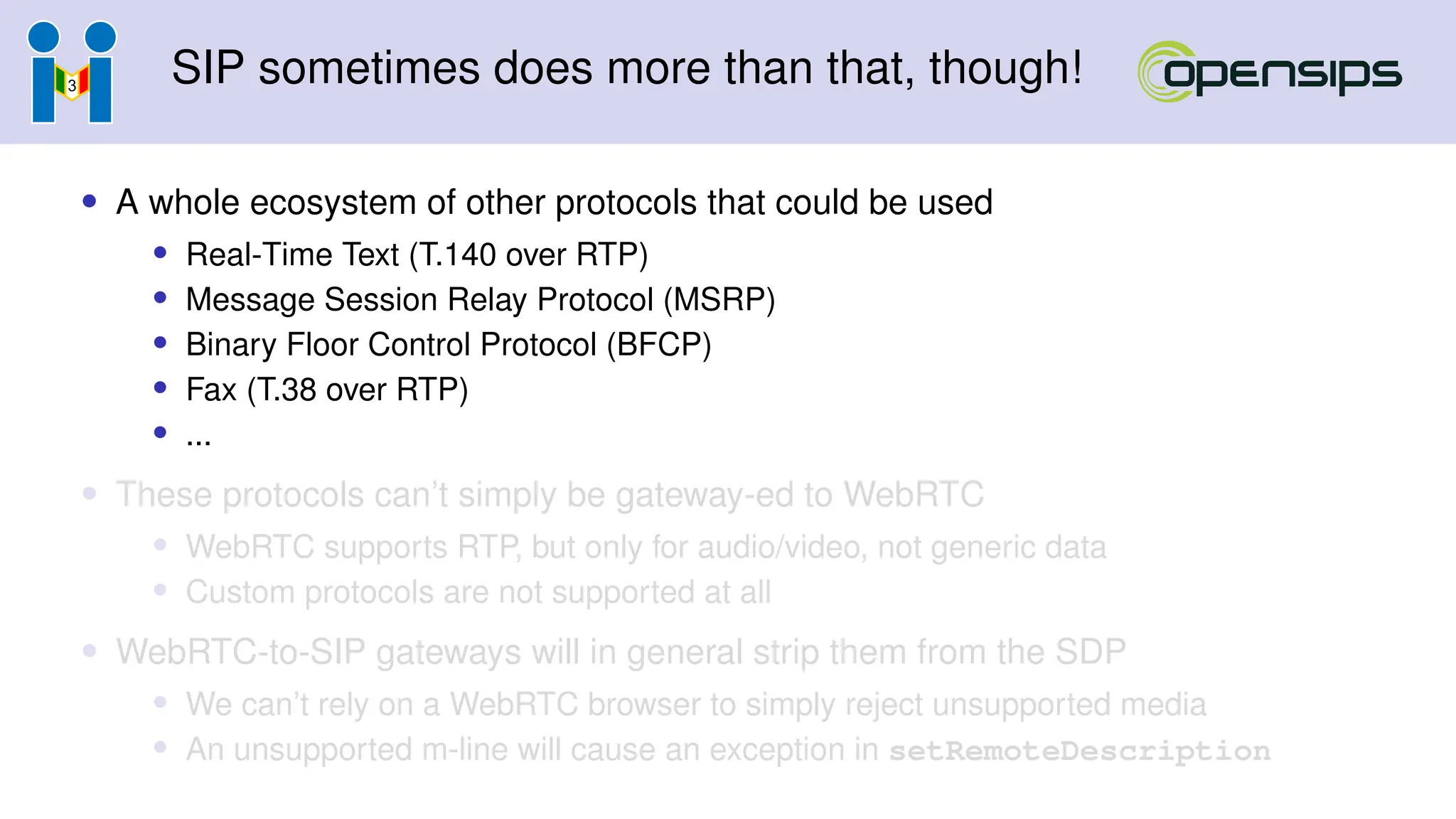
• A whole ecosystem of other protocols that could be used
• Real-Time Text (T.140 over RTP)
• Message Session Relay Protocol (MSRP)
• Binary Floor Control Protocol (BFCP)
• Fax (T.38 over RTP)
• ...
• These protocols can’t simply be gateway-ed to WebRTC
• WebRTC supports RTP, but only for audio/video, not generic data
• Custom protocols are not supported at all
• WebRTC-to-SIP gateways will in general strip them from the SDP
• We can’t rely on a WebRTC browser to simply reject unsupported media
• An unsupported m-line will cause an exception in setRemoteDescription
SIP sometimes does more than that, though!
• A whole ecosystem of other protocols that could be used
• Real-Time Text (T.140 over RTP)
• Message Session Relay Protocol (MSRP)
• Binary Floor Control Protocol (BFCP)
• Fax (T.38 over RTP)
• ...
• These protocols can’t simply be gateway-ed to WebRTC
• WebRTC supports RTP, but only for audio/video, not generic data
• Custom protocols are not supported at all
• WebRTC-to-SIP gateways will in general strip them from the SDP
• We can’t rely on a WebRTC browser to simply reject unsupported media
• An unsupported m-line will cause an exception in setRemoteDescription
SIP sometimes does more than that, though!
• A whole ecosystem of other protocols that could be used
• Real-Time Text (T.140 over RTP)
• Message Session Relay Protocol (MSRP)
• Binary Floor Control Protocol (BFCP)
• Fax (T.38 over RTP)
• ...
• These protocols can’t simply be gateway-ed to WebRTC
• WebRTC supports RTP, but only for audio/video, not generic data
• Custom protocols are not supported at all
• WebRTC-to-SIP gateways will in general strip them from the SDP
• We can’t rely on a WebRTC browser to simply reject unsupported media
• An unsupported m-line will cause an exception in setRemoteDescription
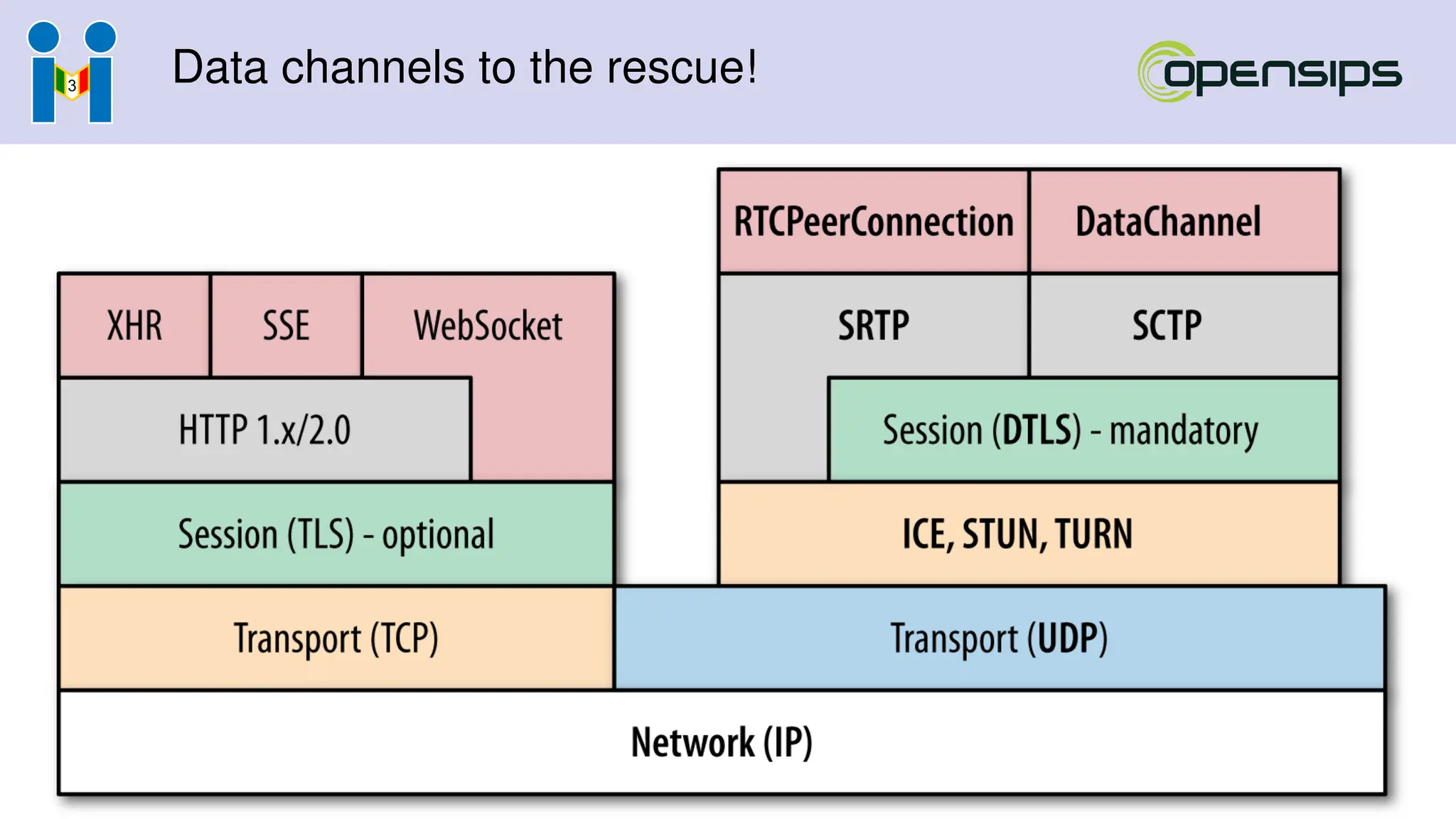
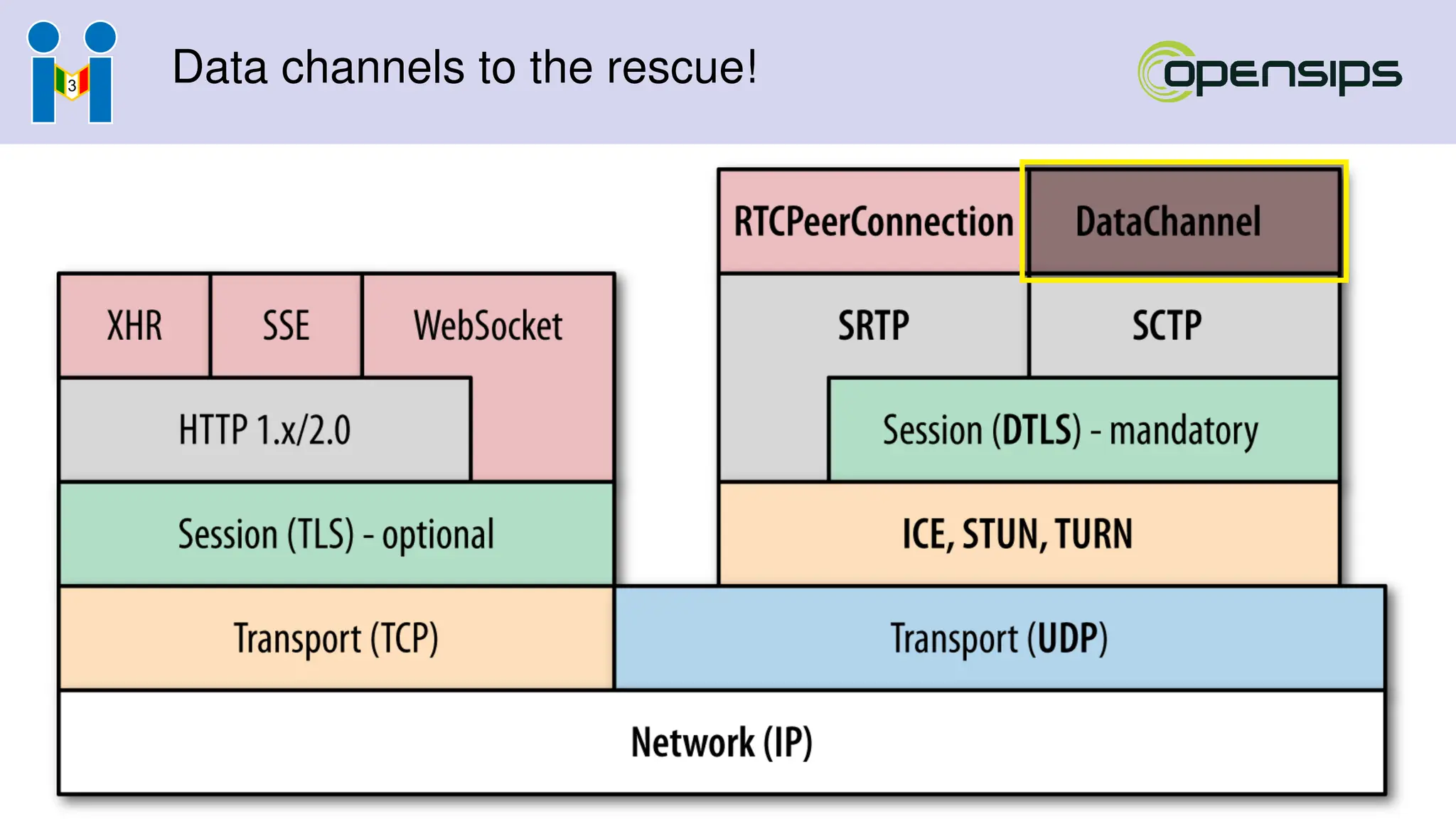
Data channels to the rescue!
What are data channels?
• Arbitrary real-time connection for pretty much anything
• Bidirectional data between two WebRTC peers
• Support for multiple channels of different kinds
• Supports ordered/unordered and reliable/unreliable
• Generic data sent via SCTP and encapsulated in DTLS
• SCTP implements features, DTLS implements security
• Negotiated as an application in the SDP
• m=application 9 UDP/DTLS/SCTP webrtc-datachannel
What are data channels?
• Arbitrary real-time connection for pretty much anything
• Bidirectional data between two WebRTC peers
• Support for multiple channels of different kinds
• Supports ordered/unordered and reliable/unreliable
• Generic data sent via SCTP and encapsulated in DTLS
• SCTP implements features, DTLS implements security
• Negotiated as an application in the SDP
• m=application 9 UDP/DTLS/SCTP webrtc-datachannel
What are data channels?
• Arbitrary real-time connection for pretty much anything
• Bidirectional data between two WebRTC peers
• Support for multiple channels of different kinds
• Supports ordered/unordered and reliable/unreliable
• Generic data sent via SCTP and encapsulated in DTLS
• SCTP implements features, DTLS implements security
• Negotiated as an application in the SDP
• m=application 9 UDP/DTLS/SCTP webrtc-datachannel
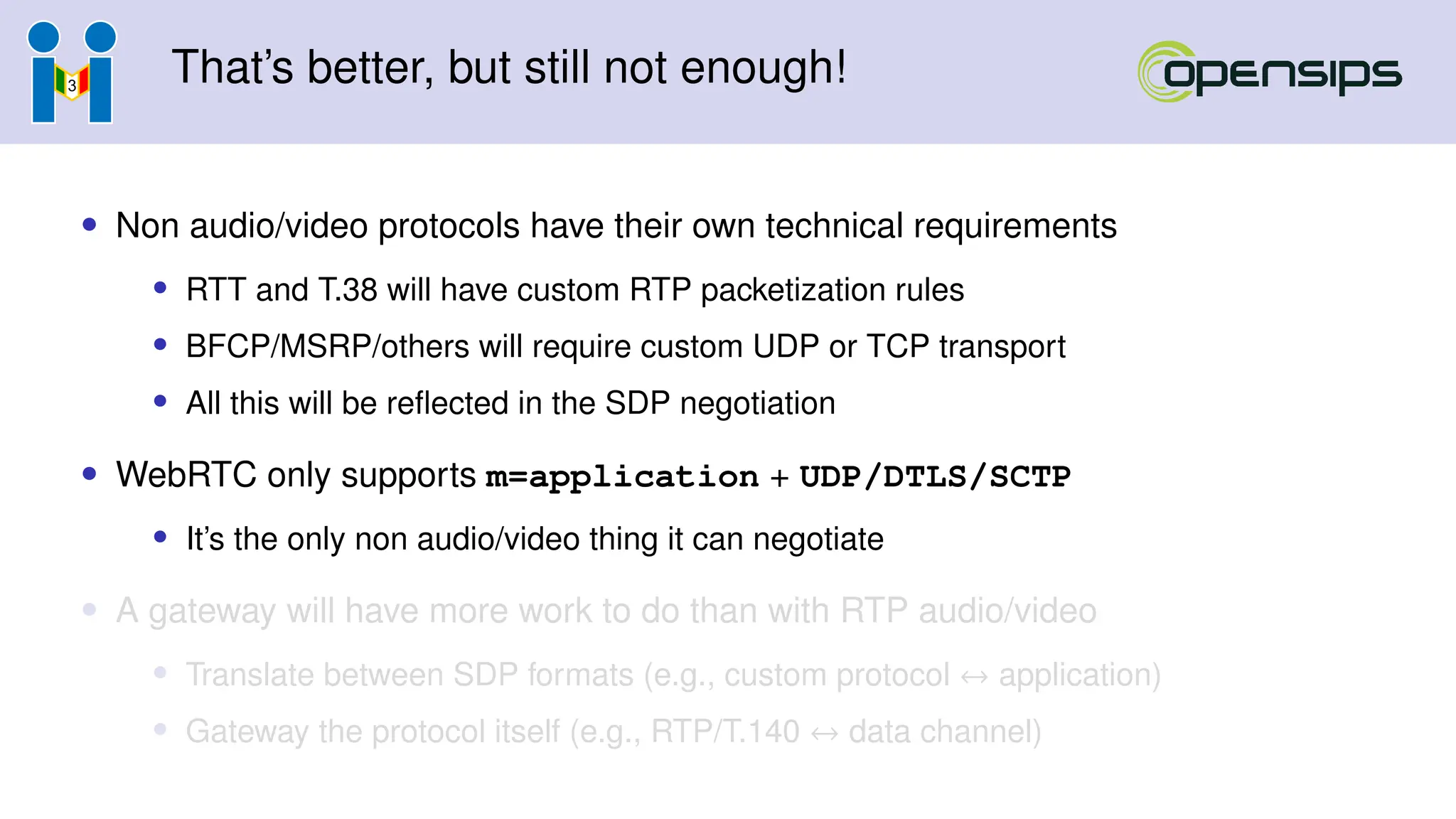
That’s better, but still not enough!
• Non audio/video protocols have their own technical requirements
• RTT and T.38 will have custom RTP packetization rules
• BFCP/MSRP/others will require custom UDP or TCP transport
• All this will be reflected in the SDP negotiation
• WebRTC only supports m=application + UDP/DTLS/SCTP
• It’s the only non audio/video thing it can negotiate
• A gateway will have more work to do than with RTP audio/video
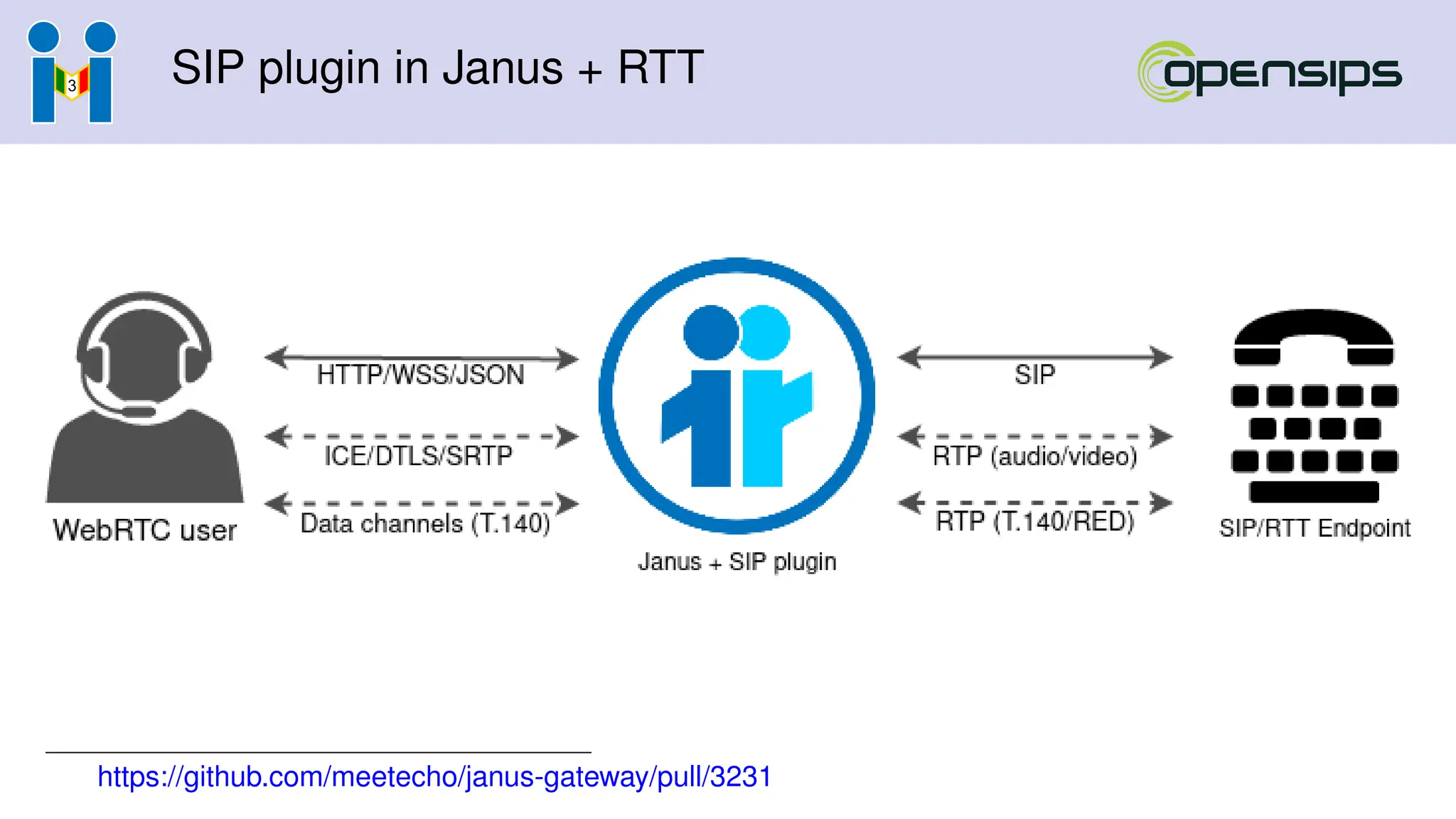
• Translate between SDP formats (e.g., custom protocol ↔ application)
• Gateway the protocol itself (e.g., RTP/T.140 ↔ data channel)
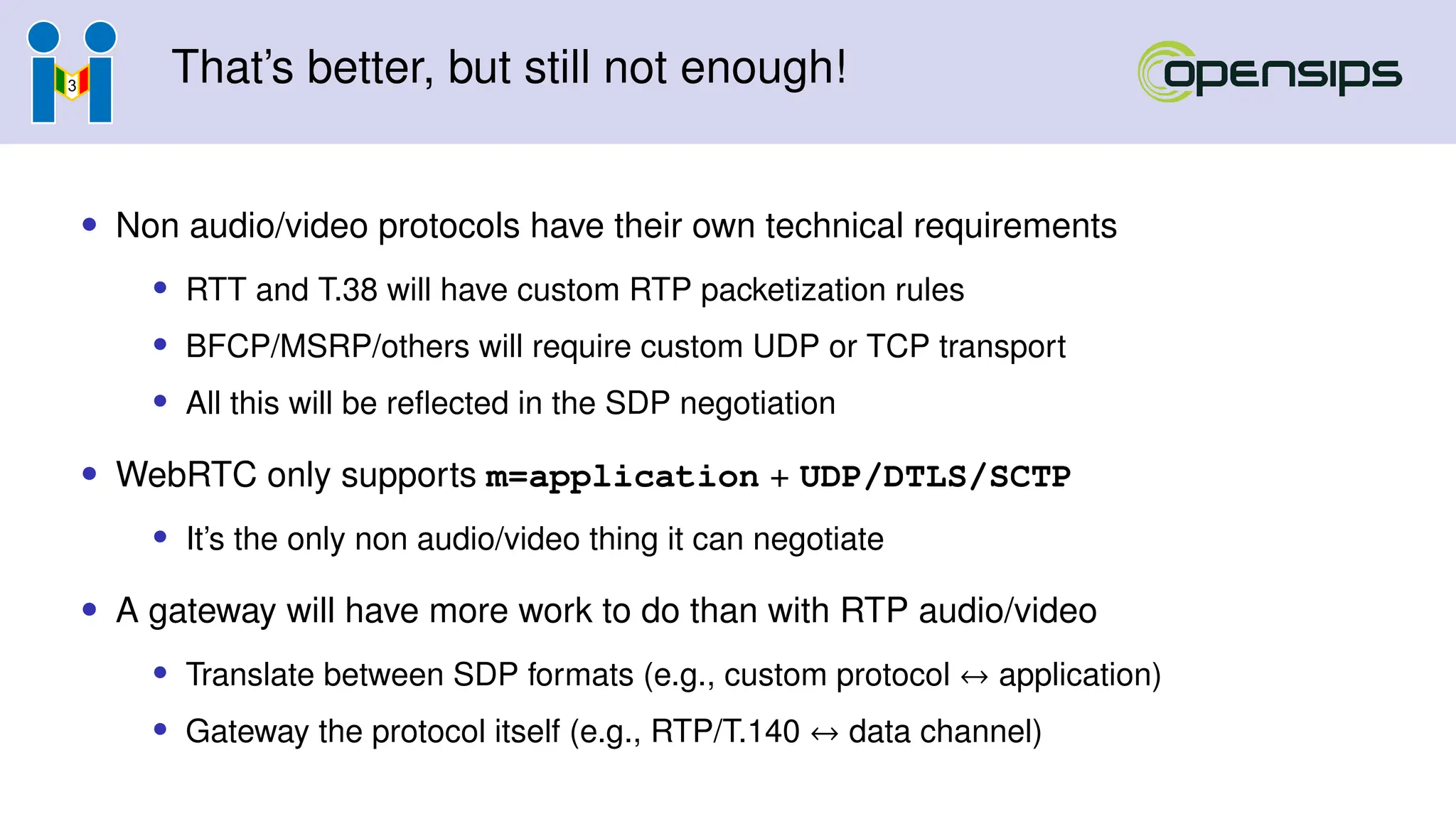
That’s better, but still not enough!
• Non audio/video protocols have their own technical requirements
• RTT and T.38 will have custom RTP packetization rules
• BFCP/MSRP/others will require custom UDP or TCP transport
• All this will be reflected in the SDP negotiation
• WebRTC only supports m=application + UDP/DTLS/SCTP
• It’s the only non audio/video thing it can negotiate
• A gateway will have more work to do than with RTP audio/video
• Translate between SDP formats (e.g., custom protocol ↔ application)
• Gateway the protocol itself (e.g., RTP/T.140 ↔ data channel)
That’s better, but still not enough!
• Non audio/video protocols have their own technical requirements
• RTT and T.38 will have custom RTP packetization rules
• BFCP/MSRP/others will require custom UDP or TCP transport
• All this will be reflected in the SDP negotiation
• WebRTC only supports m=application + UDP/DTLS/SCTP
• It’s the only non audio/video thing it can negotiate
• A gateway will have more work to do than with RTP audio/video
• Translate between SDP formats (e.g., custom protocol ↔ application)
• Gateway the protocol itself (e.g., RTP/T.140 ↔ data channel)
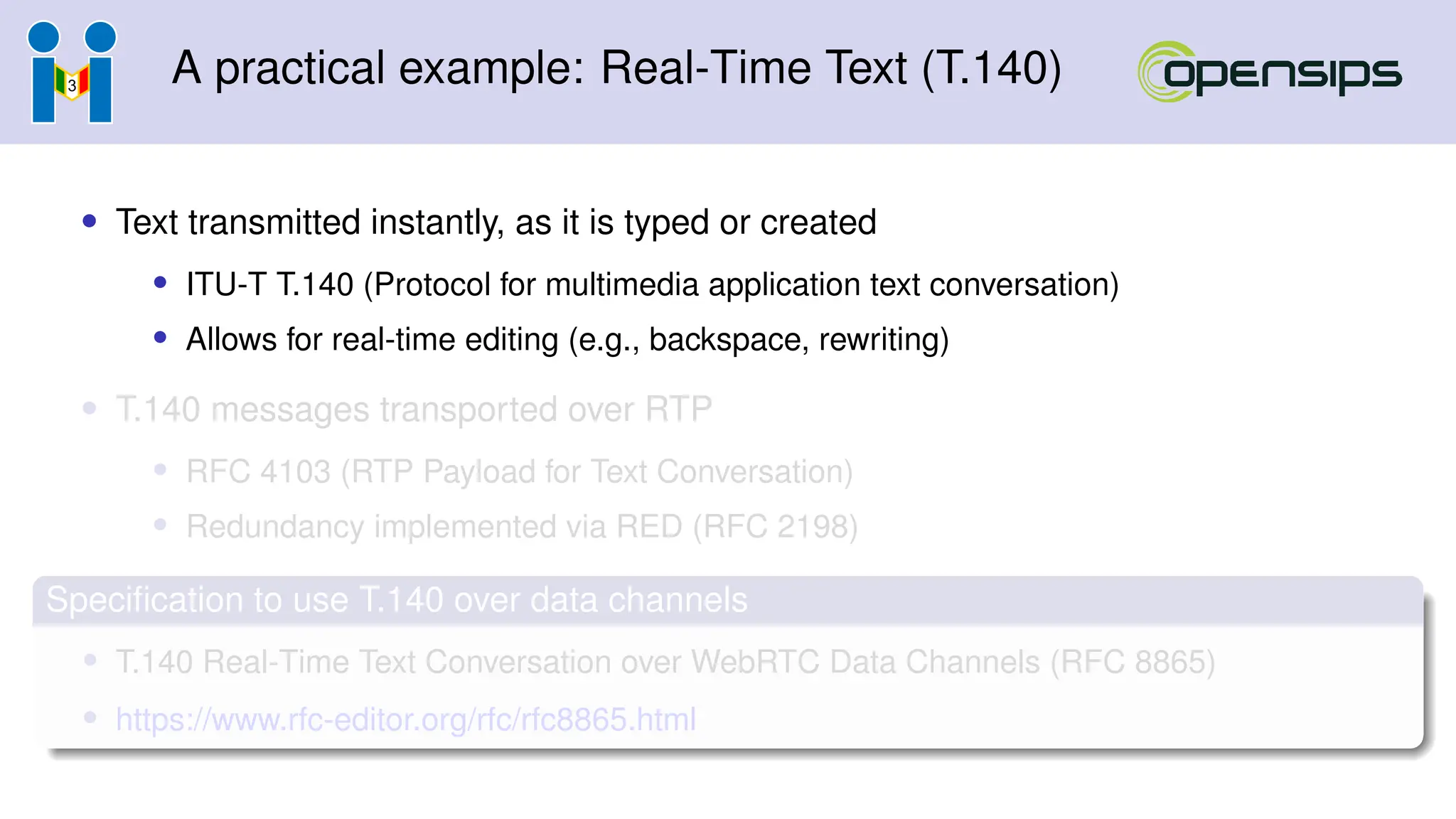
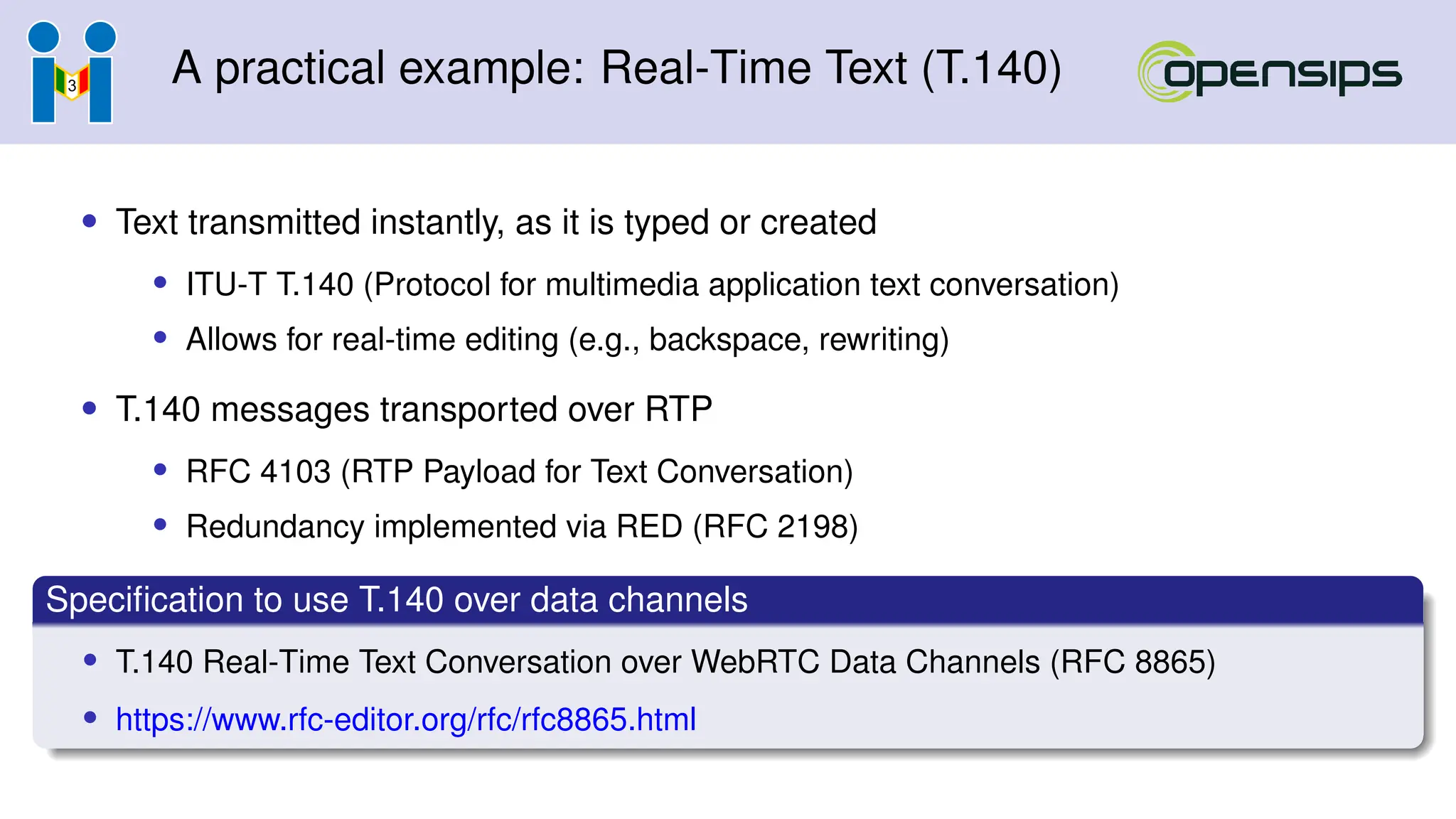
A practical example: Real-Time Text (T.140)
• Text transmitted instantly, as it is typed or created
• ITU-T T.140 (Protocol for multimedia application text conversation)
• Allows for real-time editing (e.g., backspace, rewriting)
• T.140 messages transported over RTP
• RFC 4103 (RTP Payload for Text Conversation)
• Redundancy implemented via RED (RFC 2198)
Specification to use T.140 over data channels
• T.140 Real-Time Text Conversation over WebRTC Data Channels (RFC 8865)
• https://www.rfc-editor.org/rfc/rfc8865.html
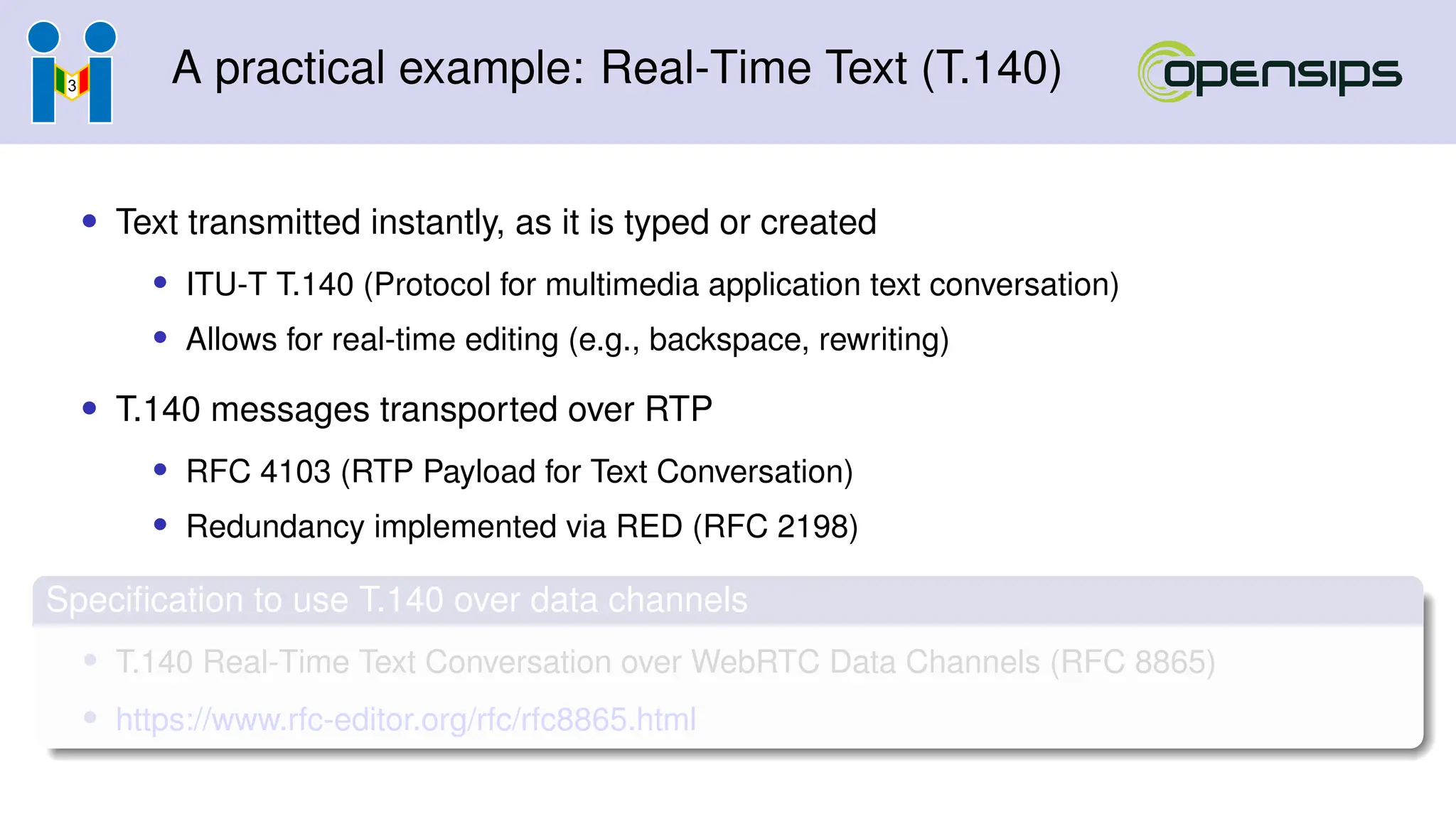
A practical example: Real-Time Text (T.140)
• Text transmitted instantly, as it is typed or created
• ITU-T T.140 (Protocol for multimedia application text conversation)
• Allows for real-time editing (e.g., backspace, rewriting)
• T.140 messages transported over RTP
• RFC 4103 (RTP Payload for Text Conversation)
• Redundancy implemented via RED (RFC 2198)
Specification to use T.140 over data channels
• T.140 Real-Time Text Conversation over WebRTC Data Channels (RFC 8865)
• https://www.rfc-editor.org/rfc/rfc8865.html
A practical example: Real-Time Text (T.140)
• Text transmitted instantly, as it is typed or created
• ITU-T T.140 (Protocol for multimedia application text conversation)
• Allows for real-time editing (e.g., backspace, rewriting)
• T.140 messages transported over RTP
• RFC 4103 (RTP Payload for Text Conversation)
• Redundancy implemented via RED (RFC 2198)
Specification to use T.140 over data channels
• T.140 Real-Time Text Conversation over WebRTC Data Channels (RFC 8865)
• https://www.rfc-editor.org/rfc/rfc8865.html
SIP plugin in Janus normally...
SIP plugin in Janus + RTT
https://github.com/meetecho/janus-gateway/pull/3231
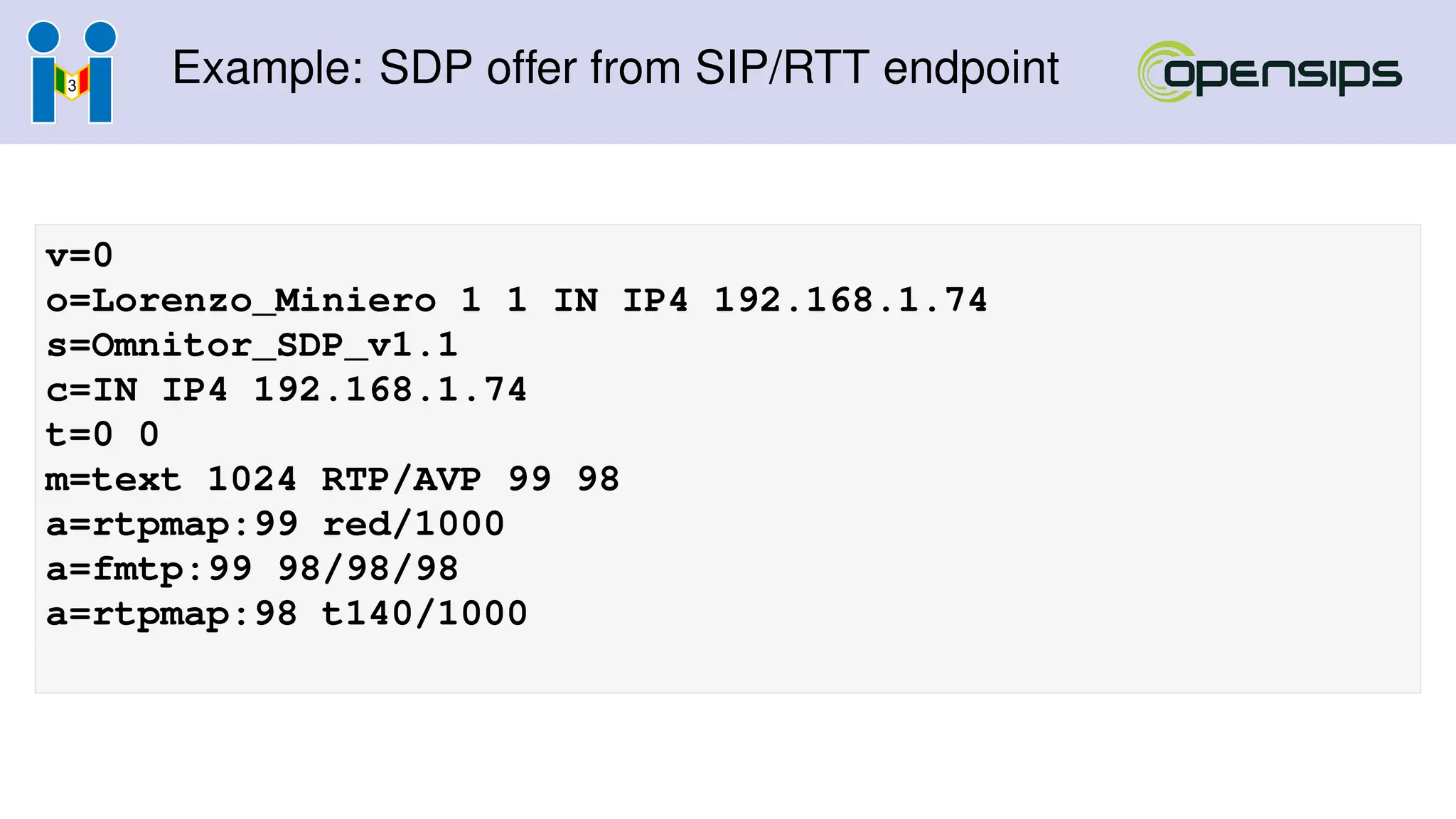
Example: SDP offer from SIP/RTT endpoint
v=0
o=Lorenzo_Miniero 1 1 IN IP4 192.168.1.74
s=Omnitor_SDP_v1.1
c=IN IP4 192.168.1.74
t=0 0
m=text 1024 RTP/AVP 99 98
a=rtpmap:99 red/1000
a=fmtp:99 98/98/98
a=rtpmap:98 t140/1000
Example: SDP offer to WebRTC endpoint
v=0
o=Lorenzo_Miniero 1 1 IN IP4 192.168.1.74
s=Omnitor_SDP_v1.1 t=0 0
a=group:BUNDLE data
a=msid-semantic: WMS janus
m=application 9 UDP/DTLS/SCTP webrtc-datachannel
c=IN IP4 192.168.1.74
a=sendrecv
a=sctp-port:5000
a=mid:0
[.. ICE/DTLS details follow ..]
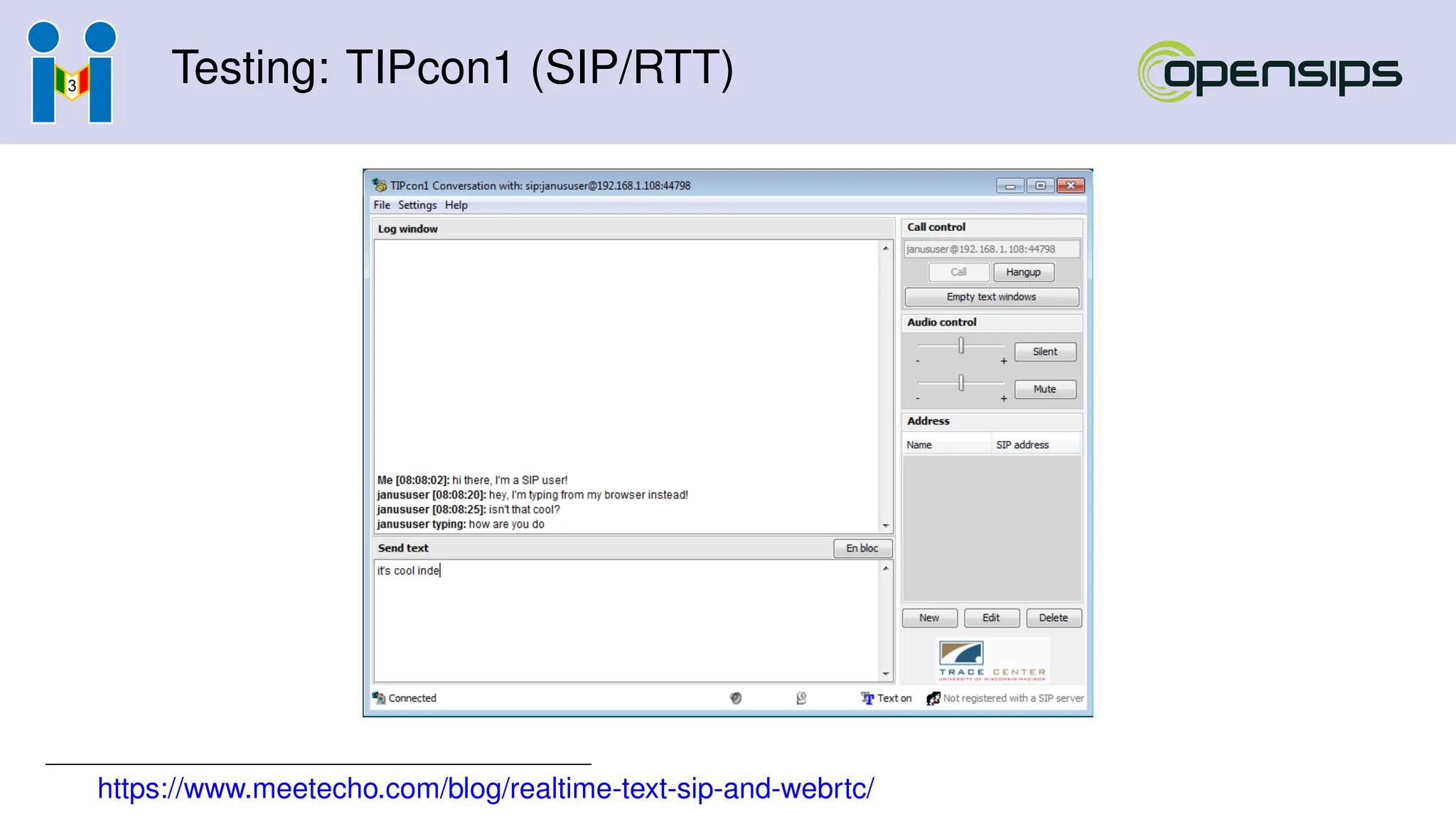
Testing: TIPcon1 (SIP/RTT)
https://www.meetecho.com/blog/realtime-text-sip-and-webrtc/
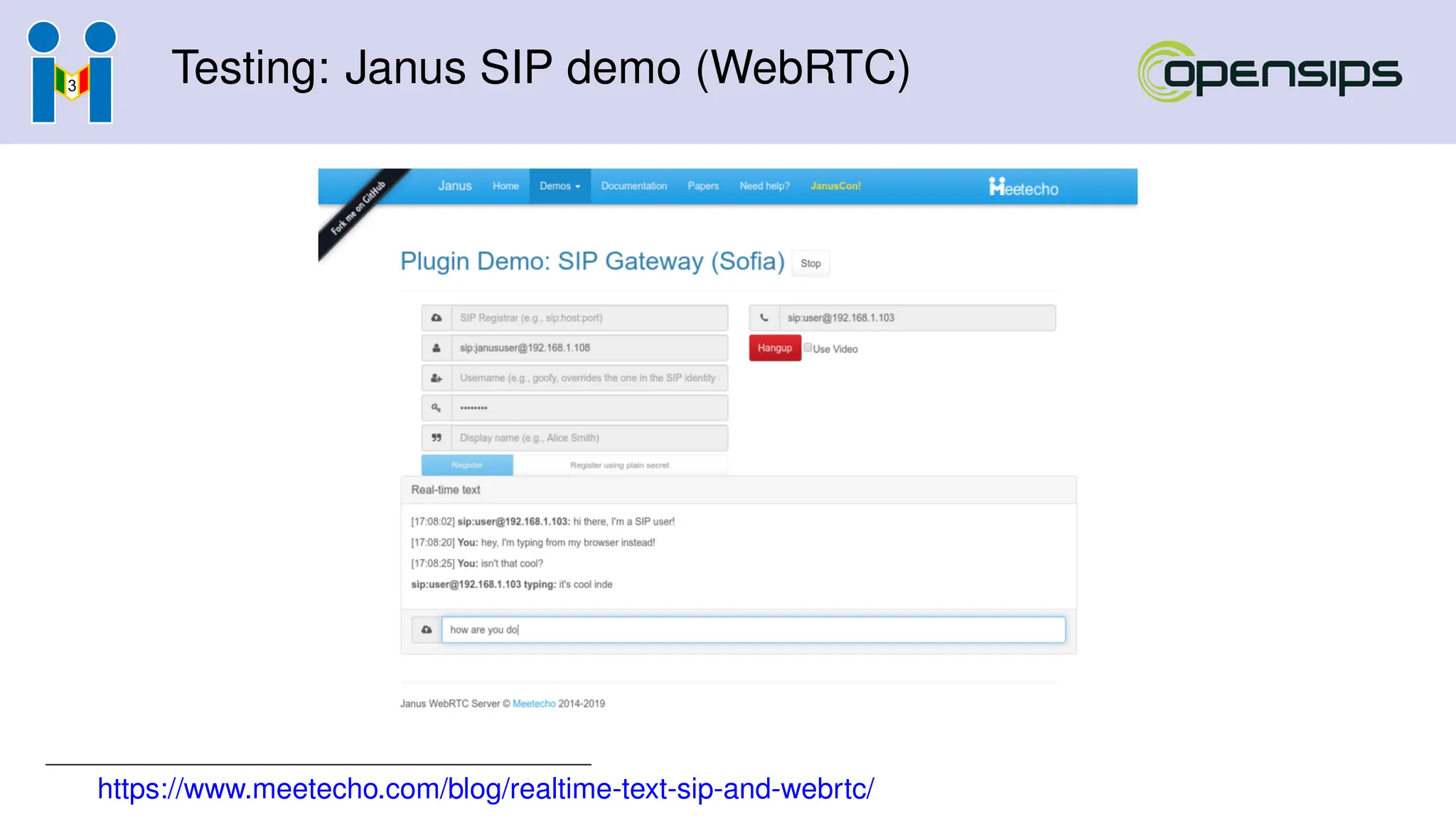
Testing: Janus SIP demo (WebRTC)
https://www.meetecho.com/blog/realtime-text-sip-and-webrtc/
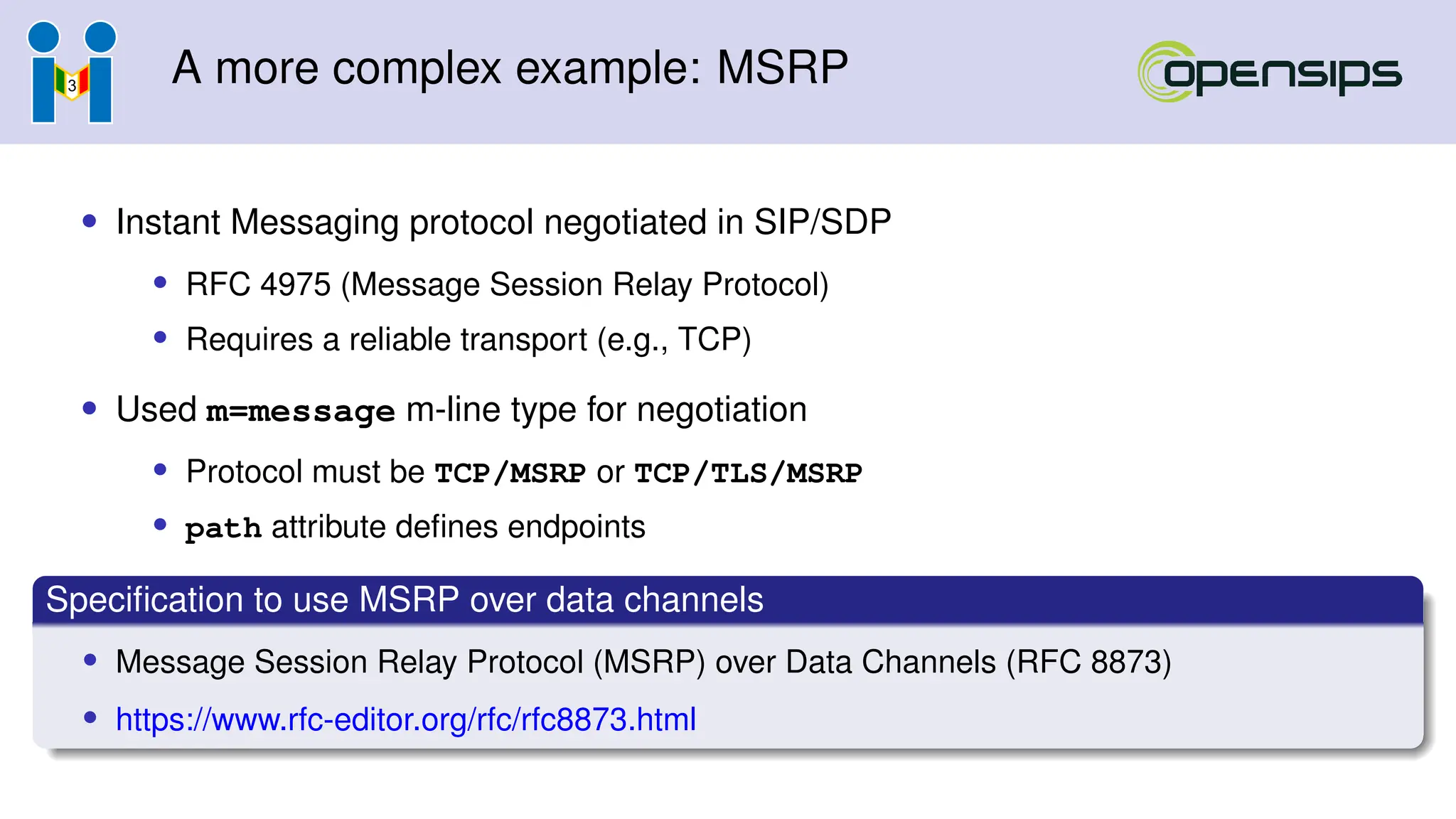
A more complex example: MSRP
• Instant Messaging protocol negotiated in SIP/SDP
• RFC 4975 (Message Session Relay Protocol)
• Requires a reliable transport (e.g., TCP)
• Used m=message m-line type for negotiation
• Protocol must be TCP/MSRP or TCP/TLS/MSRP
• path attribute defines endpoints
Specification to use MSRP over data channels
• Message Session Relay Protocol (MSRP) over Data Channels (RFC 8873)
• https://www.rfc-editor.org/rfc/rfc8873.html
A more complex example: MSRP
• Instant Messaging protocol negotiated in SIP/SDP
• RFC 4975 (Message Session Relay Protocol)
• Requires a reliable transport (e.g., TCP)
• Used m=message m-line type for negotiation
• Protocol must be TCP/MSRP or TCP/TLS/MSRP
• path attribute defines endpoints
Specification to use MSRP over data channels
• Message Session Relay Protocol (MSRP) over Data Channels (RFC 8873)
• https://www.rfc-editor.org/rfc/rfc8873.html
A more complex example: MSRP
• Instant Messaging protocol negotiated in SIP/SDP
• RFC 4975 (Message Session Relay Protocol)
• Requires a reliable transport (e.g., TCP)
• Used m=message m-line type for negotiation
• Protocol must be TCP/MSRP or TCP/TLS/MSRP
• path attribute defines endpoints
Specification to use MSRP over data channels
• Message Session Relay Protocol (MSRP) over Data Channels (RFC 8873)
• https://www.rfc-editor.org/rfc/rfc8873.html
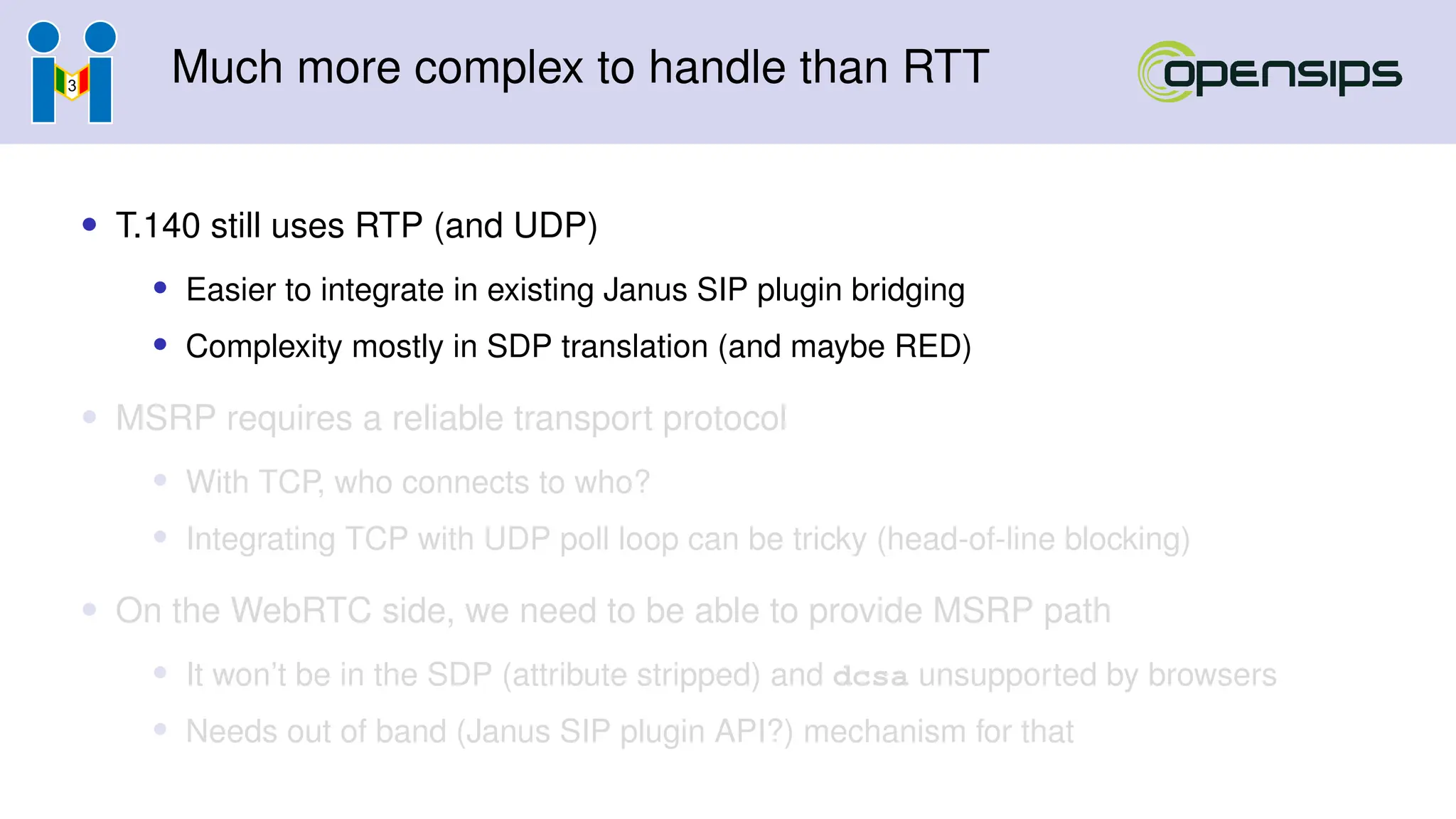
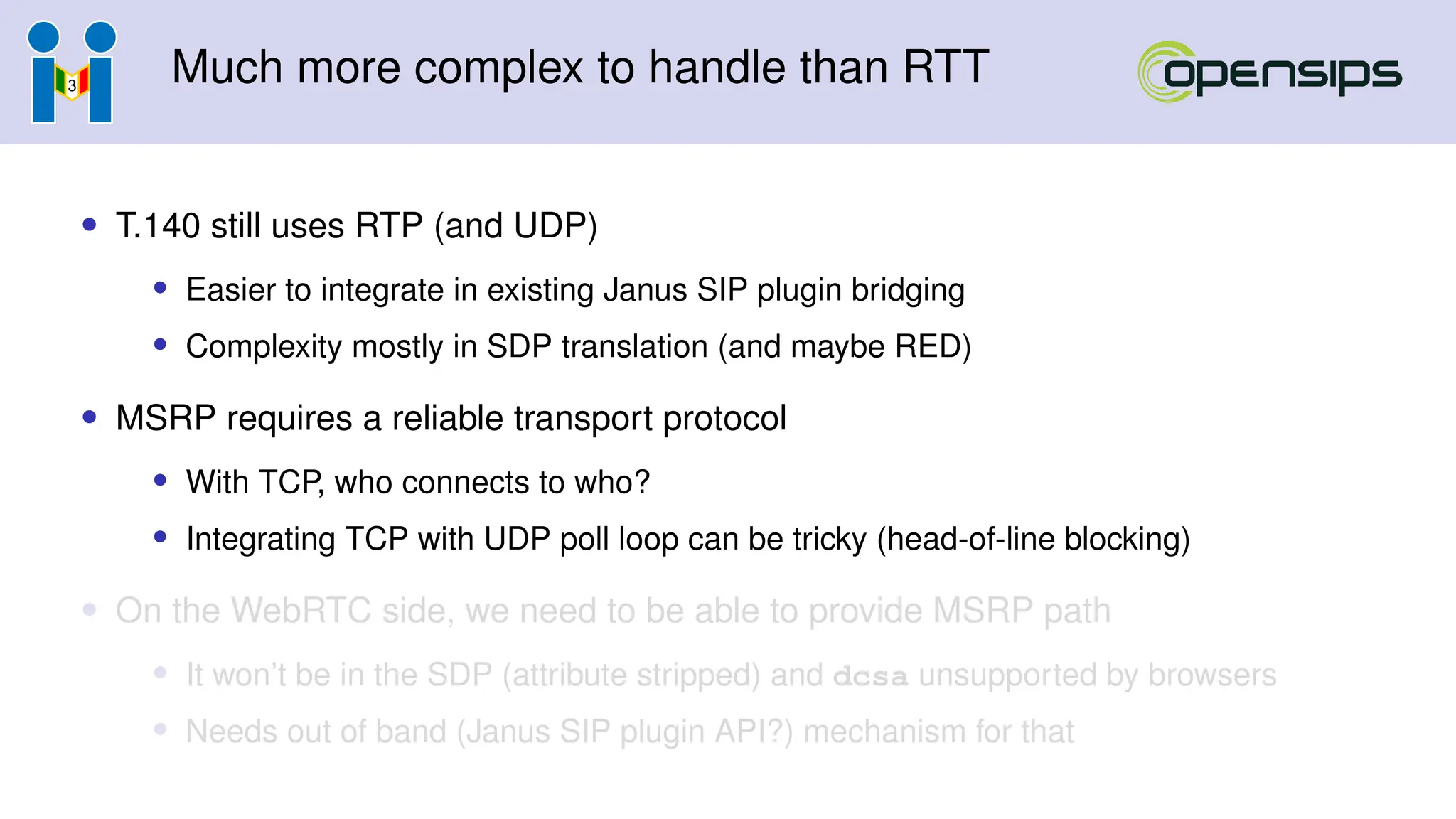
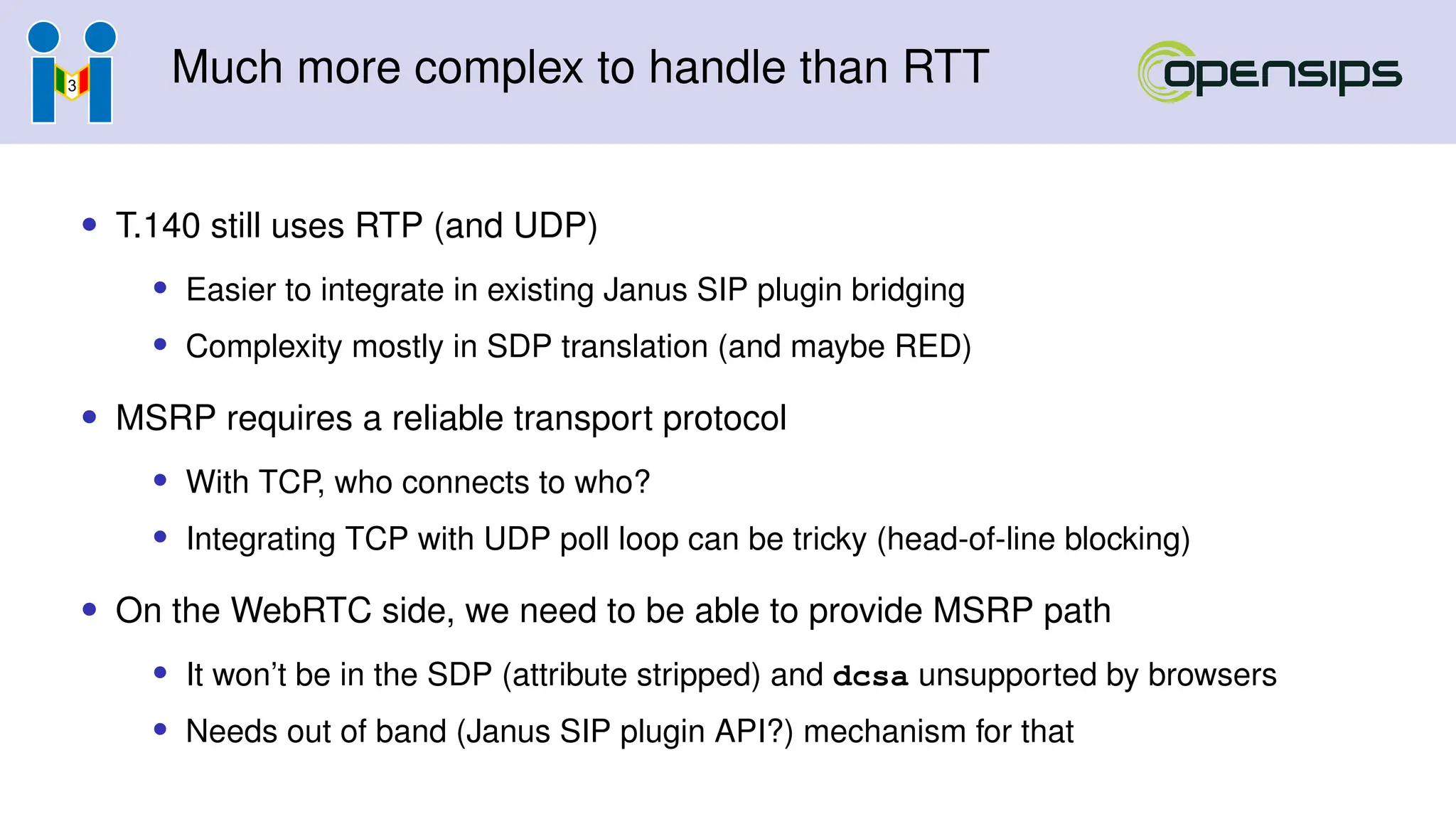
Much more complex to handle than RTT
• T.140 still uses RTP (and UDP)
• Easier to integrate in existing Janus SIP plugin bridging
• Complexity mostly in SDP translation (and maybe RED)
• MSRP requires a reliable transport protocol
• With TCP, who connects to who?
• Integrating TCP with UDP poll loop can be tricky (head-of-line blocking)
• On the WebRTC side, we need to be able to provide MSRP path
• It won’t be in the SDP (attribute stripped) and dcsa unsupported by browsers
• Needs out of band (Janus SIP plugin API?) mechanism for that
Much more complex to handle than RTT
• T.140 still uses RTP (and UDP)
• Easier to integrate in existing Janus SIP plugin bridging
• Complexity mostly in SDP translation (and maybe RED)
• MSRP requires a reliable transport protocol
• With TCP, who connects to who?
• Integrating TCP with UDP poll loop can be tricky (head-of-line blocking)
• On the WebRTC side, we need to be able to provide MSRP path
• It won’t be in the SDP (attribute stripped) and dcsa unsupported by browsers
• Needs out of band (Janus SIP plugin API?) mechanism for that
Much more complex to handle than RTT
• T.140 still uses RTP (and UDP)
• Easier to integrate in existing Janus SIP plugin bridging
• Complexity mostly in SDP translation (and maybe RED)
• MSRP requires a reliable transport protocol
• With TCP, who connects to who?
• Integrating TCP with UDP poll loop can be tricky (head-of-line blocking)
• On the WebRTC side, we need to be able to provide MSRP path
• It won’t be in the SDP (attribute stripped) and dcsa unsupported by browsers
• Needs out of band (Janus SIP plugin API?) mechanism for that
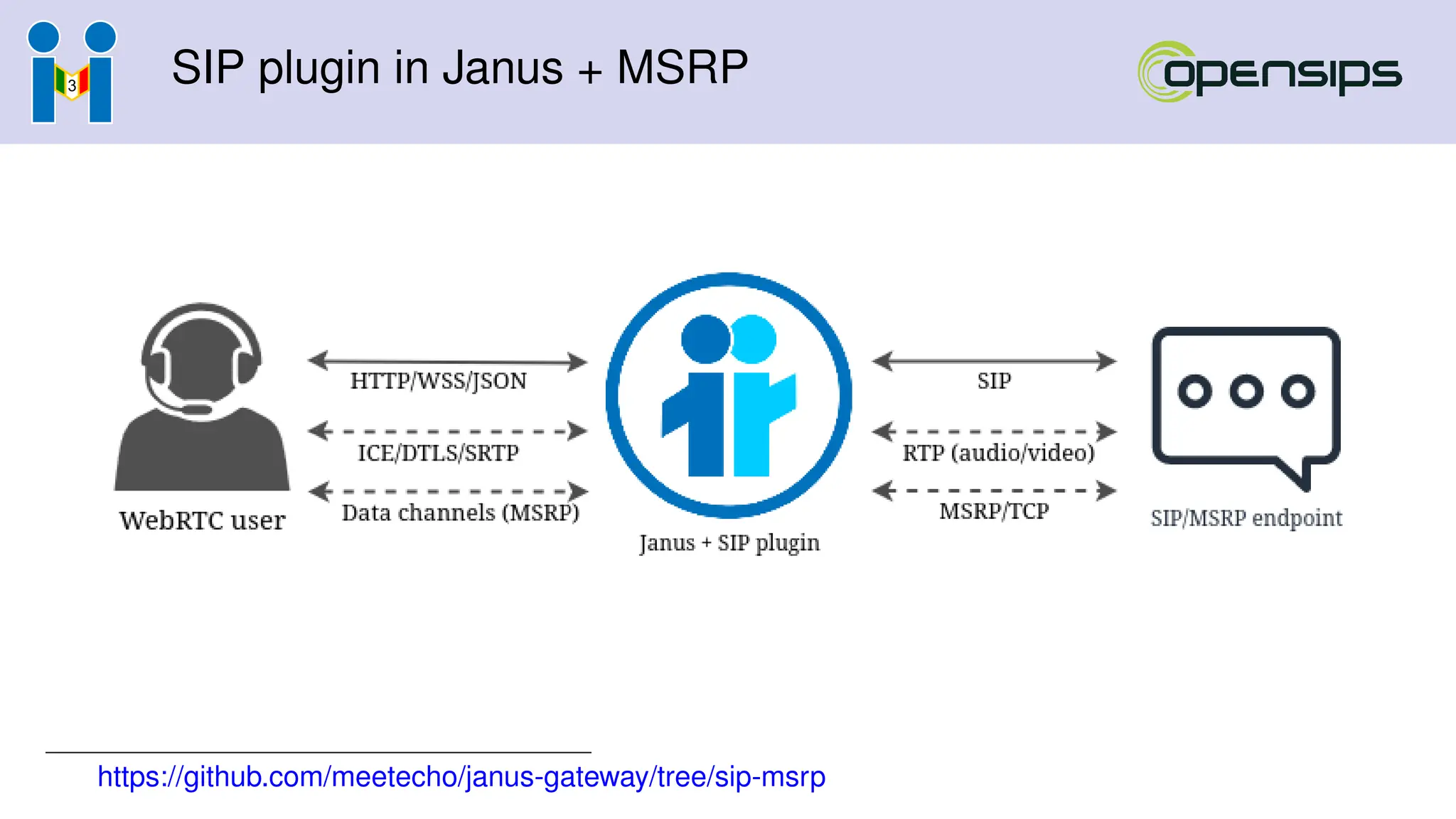
SIP plugin in Janus + MSRP
https://github.com/meetecho/janus-gateway/tree/sip-msrp
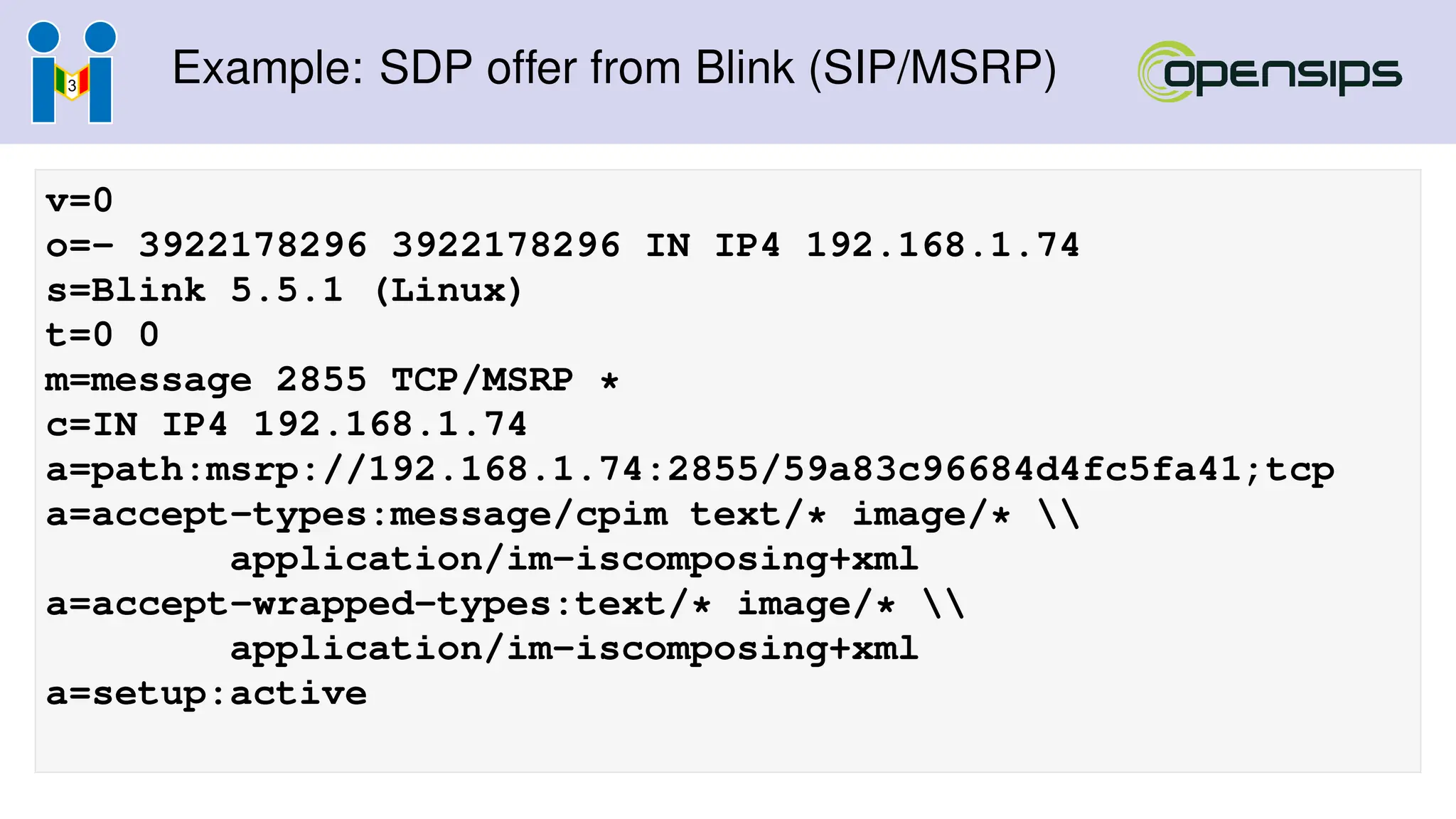
Example: SDP offer from Blink (SIP/MSRP)
v=0
o=- 3922178296 3922178296 IN IP4 192.168.1.74
s=Blink 5.5.1 (Linux)
t=0 0
m=message 2855 TCP/MSRP *
c=IN IP4 192.168.1.74
a=path:msrp://192.168.1.74:2855/59a83c96684d4fc5fa41;tcp
a=accept-types:message/cpim text/* image/* 
application/im-iscomposing+xml
a=accept-wrapped-types:text/* image/* 
application/im-iscomposing+xml
a=setup:active
Example: SDP offer to WebRTC endpoint
v=0
o=- 3922178296 3922178296 IN IP4 192.168.1.74
s=Blink 5.5.1 (Linux)
t=0 0
a=group:BUNDLE 0
a=extmap-allow-mixed
a=msid-semantic: WMS *
m=application 9 UDP/DTLS/SCTP webrtc-datachannel
c=IN IP4 192.168.1.74
a=sendrecv
a=sctp-port:5000
[.. ICE/DTLS details follow ..]
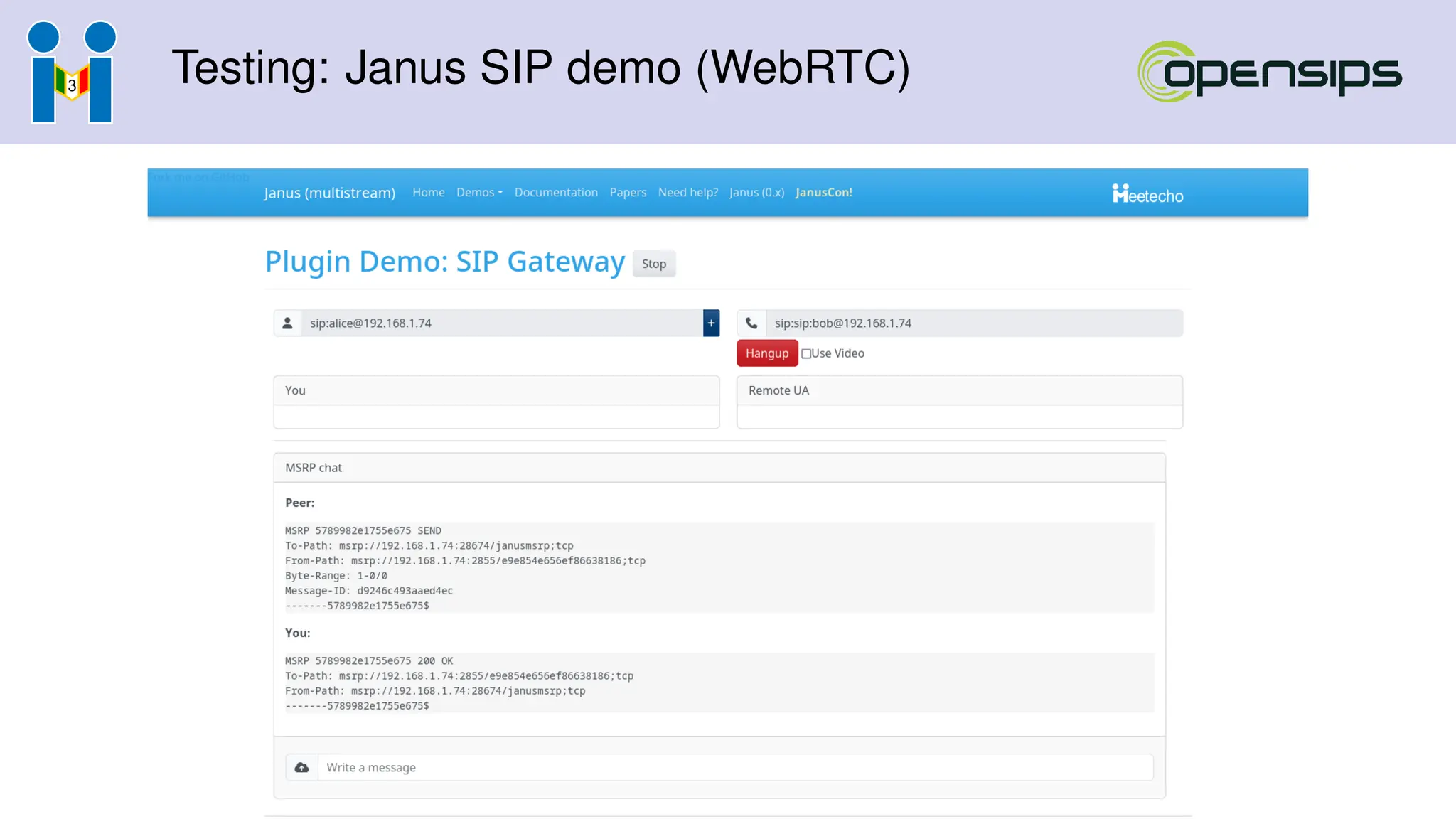
Testing: Janus SIP demo (WebRTC)
What’s next?
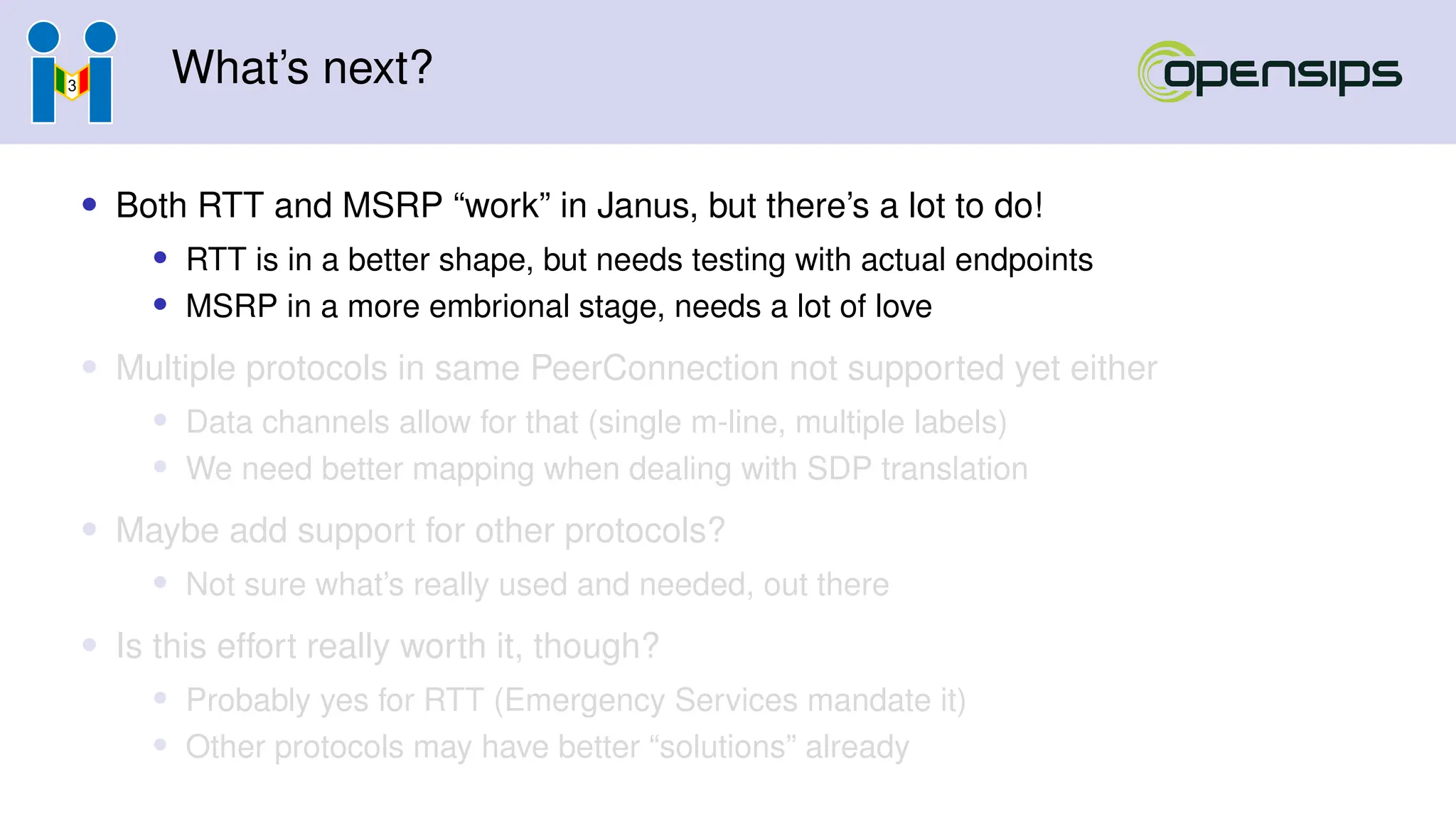
• Both RTT and MSRP “work” in Janus, but there’s a lot to do!
• RTT is in a better shape, but needs testing with actual endpoints
• MSRP in a more embrional stage, needs a lot of love
• Multiple protocols in same PeerConnection not supported yet either
• Data channels allow for that (single m-line, multiple labels)
• We need better mapping when dealing with SDP translation
• Maybe add support for other protocols?
• Not sure what’s really used and needed, out there
• Is this effort really worth it, though?
• Probably yes for RTT (Emergency Services mandate it)
• Other protocols may have better “solutions” already
What’s next?
• Both RTT and MSRP “work” in Janus, but there’s a lot to do!
• RTT is in a better shape, but needs testing with actual endpoints
• MSRP in a more embrional stage, needs a lot of love
• Multiple protocols in same PeerConnection not supported yet either
• Data channels allow for that (single m-line, multiple labels)
• We need better mapping when dealing with SDP translation
• Maybe add support for other protocols?
• Not sure what’s really used and needed, out there
• Is this effort really worth it, though?
• Probably yes for RTT (Emergency Services mandate it)
• Other protocols may have better “solutions” already
What’s next?
• Both RTT and MSRP “work” in Janus, but there’s a lot to do!
• RTT is in a better shape, but needs testing with actual endpoints
• MSRP in a more embrional stage, needs a lot of love
• Multiple protocols in same PeerConnection not supported yet either
• Data channels allow for that (single m-line, multiple labels)
• We need better mapping when dealing with SDP translation
• Maybe add support for other protocols?
• Not sure what’s really used and needed, out there
• Is this effort really worth it, though?
• Probably yes for RTT (Emergency Services mandate it)
• Other protocols may have better “solutions” already
What’s next?
• Both RTT and MSRP “work” in Janus, but there’s a lot to do!
• RTT is in a better shape, but needs testing with actual endpoints
• MSRP in a more embrional stage, needs a lot of love
• Multiple protocols in same PeerConnection not supported yet either
• Data channels allow for that (single m-line, multiple labels)
• We need better mapping when dealing with SDP translation
• Maybe add support for other protocols?
• Not sure what’s really used and needed, out there
• Is this effort really worth it, though?
• Probably yes for RTT (Emergency Services mandate it)
• Other protocols may have better “solutions” already
Thanks! Questions? Comments?
Contacts
• https://fosstodon.org/@lminiero
• https://twitter.com/elminiero
• https://twitter.com/meetecho
• https://www.meetecho.com/blog/

WebRTC and SIP not just audio and video @ OpenSIPS 2024

  • 1.
    WebRTC-to-SIP and back It’snot all about audio and video! Lorenzo Miniero @lminiero@fosstodon.org OpenSIPS Summit May 15th 2024, Valencia
  • 2.
    A chance topractice my broken Spanish!
  • 3.
    Who am I? LorenzoMiniero • Ph.D @ UniNA • Chairman @ Meetecho • Main author of Janus Contacts and info • lorenzo@meetecho.com • https://fosstodon.org/@lminiero • https://www.meetecho.com • https://lminiero.it
  • 4.
    Just a fewwords on Meetecho • Co-founded in 2009 as an academic spin-off • University research efforts brought to the market • Completely independent from the University • Focus on real-time multimedia applications • Strong perspective on standardization and open source • Several activities • Consulting services • Commercial support and Janus licenses • Streaming of live events (IETF, ACM, etc.) • Proudly brewed in sunny Napoli, Italy
  • 5.
    A bit ofcontext: Janus, WebRTC and SIP Janus General purpose, open source WebRTC server • https://github.com/meetecho/janus-gateway • Demos and documentation: https://janus.conf.meetecho.com • Community: https://janus.discourse.group/
  • 6.
    SIP plugin inJanus https://janus.conf.meetecho.com/docs/sip
  • 7.
    An endpoint ofbehalf of WebRTC users • Janus SIP plugin acts as a collection of SIP endpoints, not a server/trunk • SIP stack implemented with Sofia-SIP • WebRTC users only see the Janus API (JSON), no SIP • No transcoding, media is only relayed • Built-in recording (separate media legs) • Simplifies life for web developers • No need to worry about a SIP stack (only SIP URIs) • Basic methods/events to handle dialogs (call, answer, hangup, message, etc.) • Allows SIP headers injection/interception in many requests • Support for more advanced features too (e.g., hold, transfer, etc.)
  • 8.
    An endpoint ofbehalf of WebRTC users • Janus SIP plugin acts as a collection of SIP endpoints, not a server/trunk • SIP stack implemented with Sofia-SIP • WebRTC users only see the Janus API (JSON), no SIP • No transcoding, media is only relayed • Built-in recording (separate media legs) • Simplifies life for web developers • No need to worry about a SIP stack (only SIP URIs) • Basic methods/events to handle dialogs (call, answer, hangup, message, etc.) • Allows SIP headers injection/interception in many requests • Support for more advanced features too (e.g., hold, transfer, etc.)
  • 9.
    Works great withOpenSIPS! Workshop on Janus and SIP (lesson/tutorial) at OpenSIPS 2020 https://www.youtube.com/watch?v=fv9KwrguR-4&t=3544s
  • 10.
    Audio and videoare “easy” • Both SIP and WebRTC use SDP and RTP/RTCP • WebRTC uses SDP/RTP/RTCP on “steroids” • Apart from this, just differences in encryption (WebRTC mandates DTLS-SRTP) • Media is basically encoded, packaged and sent the same way • As long as the same codec is used, they’re interoperable • When they aren’t, transcoding helps (but Janus won’t do it for you) • WebRTC has mandatory-to-implement codecs • Opus and G.711 for audio, VP8 and H.264 (baseline) for video • G.711 and H.264 should guarantee compliance with legacy equipment
  • 11.
    Audio and videoare “easy” • Both SIP and WebRTC use SDP and RTP/RTCP • WebRTC uses SDP/RTP/RTCP on “steroids” • Apart from this, just differences in encryption (WebRTC mandates DTLS-SRTP) • Media is basically encoded, packaged and sent the same way • As long as the same codec is used, they’re interoperable • When they aren’t, transcoding helps (but Janus won’t do it for you) • WebRTC has mandatory-to-implement codecs • Opus and G.711 for audio, VP8 and H.264 (baseline) for video • G.711 and H.264 should guarantee compliance with legacy equipment
  • 12.
    Audio and videoare “easy” • Both SIP and WebRTC use SDP and RTP/RTCP • WebRTC uses SDP/RTP/RTCP on “steroids” • Apart from this, just differences in encryption (WebRTC mandates DTLS-SRTP) • Media is basically encoded, packaged and sent the same way • As long as the same codec is used, they’re interoperable • When they aren’t, transcoding helps (but Janus won’t do it for you) • WebRTC has mandatory-to-implement codecs • Opus and G.711 for audio, VP8 and H.264 (baseline) for video • G.711 and H.264 should guarantee compliance with legacy equipment
  • 13.
    SIP sometimes doesmore than that, though! • A whole ecosystem of other protocols that could be used • Real-Time Text (T.140 over RTP) • Message Session Relay Protocol (MSRP) • Binary Floor Control Protocol (BFCP) • Fax (T.38 over RTP) • ... • These protocols can’t simply be gateway-ed to WebRTC • WebRTC supports RTP, but only for audio/video, not generic data • Custom protocols are not supported at all • WebRTC-to-SIP gateways will in general strip them from the SDP • We can’t rely on a WebRTC browser to simply reject unsupported media • An unsupported m-line will cause an exception in setRemoteDescription
  • 14.
    SIP sometimes doesmore than that, though! • A whole ecosystem of other protocols that could be used • Real-Time Text (T.140 over RTP) • Message Session Relay Protocol (MSRP) • Binary Floor Control Protocol (BFCP) • Fax (T.38 over RTP) • ... • These protocols can’t simply be gateway-ed to WebRTC • WebRTC supports RTP, but only for audio/video, not generic data • Custom protocols are not supported at all • WebRTC-to-SIP gateways will in general strip them from the SDP • We can’t rely on a WebRTC browser to simply reject unsupported media • An unsupported m-line will cause an exception in setRemoteDescription
  • 15.
    SIP sometimes doesmore than that, though! • A whole ecosystem of other protocols that could be used • Real-Time Text (T.140 over RTP) • Message Session Relay Protocol (MSRP) • Binary Floor Control Protocol (BFCP) • Fax (T.38 over RTP) • ... • These protocols can’t simply be gateway-ed to WebRTC • WebRTC supports RTP, but only for audio/video, not generic data • Custom protocols are not supported at all • WebRTC-to-SIP gateways will in general strip them from the SDP • We can’t rely on a WebRTC browser to simply reject unsupported media • An unsupported m-line will cause an exception in setRemoteDescription
  • 16.
    Data channels tothe rescue!
  • 17.
    Data channels tothe rescue!
  • 18.
    What are datachannels? • Arbitrary real-time connection for pretty much anything • Bidirectional data between two WebRTC peers • Support for multiple channels of different kinds • Supports ordered/unordered and reliable/unreliable • Generic data sent via SCTP and encapsulated in DTLS • SCTP implements features, DTLS implements security • Negotiated as an application in the SDP • m=application 9 UDP/DTLS/SCTP webrtc-datachannel
  • 19.
    What are datachannels? • Arbitrary real-time connection for pretty much anything • Bidirectional data between two WebRTC peers • Support for multiple channels of different kinds • Supports ordered/unordered and reliable/unreliable • Generic data sent via SCTP and encapsulated in DTLS • SCTP implements features, DTLS implements security • Negotiated as an application in the SDP • m=application 9 UDP/DTLS/SCTP webrtc-datachannel
  • 20.
    What are datachannels? • Arbitrary real-time connection for pretty much anything • Bidirectional data between two WebRTC peers • Support for multiple channels of different kinds • Supports ordered/unordered and reliable/unreliable • Generic data sent via SCTP and encapsulated in DTLS • SCTP implements features, DTLS implements security • Negotiated as an application in the SDP • m=application 9 UDP/DTLS/SCTP webrtc-datachannel
  • 21.
    That’s better, butstill not enough! • Non audio/video protocols have their own technical requirements • RTT and T.38 will have custom RTP packetization rules • BFCP/MSRP/others will require custom UDP or TCP transport • All this will be reflected in the SDP negotiation • WebRTC only supports m=application + UDP/DTLS/SCTP • It’s the only non audio/video thing it can negotiate • A gateway will have more work to do than with RTP audio/video • Translate between SDP formats (e.g., custom protocol ↔ application) • Gateway the protocol itself (e.g., RTP/T.140 ↔ data channel)
  • 22.
    That’s better, butstill not enough! • Non audio/video protocols have their own technical requirements • RTT and T.38 will have custom RTP packetization rules • BFCP/MSRP/others will require custom UDP or TCP transport • All this will be reflected in the SDP negotiation • WebRTC only supports m=application + UDP/DTLS/SCTP • It’s the only non audio/video thing it can negotiate • A gateway will have more work to do than with RTP audio/video • Translate between SDP formats (e.g., custom protocol ↔ application) • Gateway the protocol itself (e.g., RTP/T.140 ↔ data channel)
  • 23.
    That’s better, butstill not enough! • Non audio/video protocols have their own technical requirements • RTT and T.38 will have custom RTP packetization rules • BFCP/MSRP/others will require custom UDP or TCP transport • All this will be reflected in the SDP negotiation • WebRTC only supports m=application + UDP/DTLS/SCTP • It’s the only non audio/video thing it can negotiate • A gateway will have more work to do than with RTP audio/video • Translate between SDP formats (e.g., custom protocol ↔ application) • Gateway the protocol itself (e.g., RTP/T.140 ↔ data channel)
  • 24.
    A practical example:Real-Time Text (T.140) • Text transmitted instantly, as it is typed or created • ITU-T T.140 (Protocol for multimedia application text conversation) • Allows for real-time editing (e.g., backspace, rewriting) • T.140 messages transported over RTP • RFC 4103 (RTP Payload for Text Conversation) • Redundancy implemented via RED (RFC 2198) Specification to use T.140 over data channels • T.140 Real-Time Text Conversation over WebRTC Data Channels (RFC 8865) • https://www.rfc-editor.org/rfc/rfc8865.html
  • 25.
    A practical example:Real-Time Text (T.140) • Text transmitted instantly, as it is typed or created • ITU-T T.140 (Protocol for multimedia application text conversation) • Allows for real-time editing (e.g., backspace, rewriting) • T.140 messages transported over RTP • RFC 4103 (RTP Payload for Text Conversation) • Redundancy implemented via RED (RFC 2198) Specification to use T.140 over data channels • T.140 Real-Time Text Conversation over WebRTC Data Channels (RFC 8865) • https://www.rfc-editor.org/rfc/rfc8865.html
  • 26.
    A practical example:Real-Time Text (T.140) • Text transmitted instantly, as it is typed or created • ITU-T T.140 (Protocol for multimedia application text conversation) • Allows for real-time editing (e.g., backspace, rewriting) • T.140 messages transported over RTP • RFC 4103 (RTP Payload for Text Conversation) • Redundancy implemented via RED (RFC 2198) Specification to use T.140 over data channels • T.140 Real-Time Text Conversation over WebRTC Data Channels (RFC 8865) • https://www.rfc-editor.org/rfc/rfc8865.html
  • 27.
    SIP plugin inJanus normally...
  • 28.
    SIP plugin inJanus + RTT https://github.com/meetecho/janus-gateway/pull/3231
  • 29.
    Example: SDP offerfrom SIP/RTT endpoint v=0 o=Lorenzo_Miniero 1 1 IN IP4 192.168.1.74 s=Omnitor_SDP_v1.1 c=IN IP4 192.168.1.74 t=0 0 m=text 1024 RTP/AVP 99 98 a=rtpmap:99 red/1000 a=fmtp:99 98/98/98 a=rtpmap:98 t140/1000
  • 30.
    Example: SDP offerto WebRTC endpoint v=0 o=Lorenzo_Miniero 1 1 IN IP4 192.168.1.74 s=Omnitor_SDP_v1.1 t=0 0 a=group:BUNDLE data a=msid-semantic: WMS janus m=application 9 UDP/DTLS/SCTP webrtc-datachannel c=IN IP4 192.168.1.74 a=sendrecv a=sctp-port:5000 a=mid:0 [.. ICE/DTLS details follow ..]
  • 31.
  • 32.
    Testing: Janus SIPdemo (WebRTC) https://www.meetecho.com/blog/realtime-text-sip-and-webrtc/
  • 33.
    A more complexexample: MSRP • Instant Messaging protocol negotiated in SIP/SDP • RFC 4975 (Message Session Relay Protocol) • Requires a reliable transport (e.g., TCP) • Used m=message m-line type for negotiation • Protocol must be TCP/MSRP or TCP/TLS/MSRP • path attribute defines endpoints Specification to use MSRP over data channels • Message Session Relay Protocol (MSRP) over Data Channels (RFC 8873) • https://www.rfc-editor.org/rfc/rfc8873.html
  • 34.
    A more complexexample: MSRP • Instant Messaging protocol negotiated in SIP/SDP • RFC 4975 (Message Session Relay Protocol) • Requires a reliable transport (e.g., TCP) • Used m=message m-line type for negotiation • Protocol must be TCP/MSRP or TCP/TLS/MSRP • path attribute defines endpoints Specification to use MSRP over data channels • Message Session Relay Protocol (MSRP) over Data Channels (RFC 8873) • https://www.rfc-editor.org/rfc/rfc8873.html
  • 35.
    A more complexexample: MSRP • Instant Messaging protocol negotiated in SIP/SDP • RFC 4975 (Message Session Relay Protocol) • Requires a reliable transport (e.g., TCP) • Used m=message m-line type for negotiation • Protocol must be TCP/MSRP or TCP/TLS/MSRP • path attribute defines endpoints Specification to use MSRP over data channels • Message Session Relay Protocol (MSRP) over Data Channels (RFC 8873) • https://www.rfc-editor.org/rfc/rfc8873.html
  • 36.
    Much more complexto handle than RTT • T.140 still uses RTP (and UDP) • Easier to integrate in existing Janus SIP plugin bridging • Complexity mostly in SDP translation (and maybe RED) • MSRP requires a reliable transport protocol • With TCP, who connects to who? • Integrating TCP with UDP poll loop can be tricky (head-of-line blocking) • On the WebRTC side, we need to be able to provide MSRP path • It won’t be in the SDP (attribute stripped) and dcsa unsupported by browsers • Needs out of band (Janus SIP plugin API?) mechanism for that
  • 37.
    Much more complexto handle than RTT • T.140 still uses RTP (and UDP) • Easier to integrate in existing Janus SIP plugin bridging • Complexity mostly in SDP translation (and maybe RED) • MSRP requires a reliable transport protocol • With TCP, who connects to who? • Integrating TCP with UDP poll loop can be tricky (head-of-line blocking) • On the WebRTC side, we need to be able to provide MSRP path • It won’t be in the SDP (attribute stripped) and dcsa unsupported by browsers • Needs out of band (Janus SIP plugin API?) mechanism for that
  • 38.
    Much more complexto handle than RTT • T.140 still uses RTP (and UDP) • Easier to integrate in existing Janus SIP plugin bridging • Complexity mostly in SDP translation (and maybe RED) • MSRP requires a reliable transport protocol • With TCP, who connects to who? • Integrating TCP with UDP poll loop can be tricky (head-of-line blocking) • On the WebRTC side, we need to be able to provide MSRP path • It won’t be in the SDP (attribute stripped) and dcsa unsupported by browsers • Needs out of band (Janus SIP plugin API?) mechanism for that
  • 39.
    SIP plugin inJanus + MSRP https://github.com/meetecho/janus-gateway/tree/sip-msrp
  • 40.
    Example: SDP offerfrom Blink (SIP/MSRP) v=0 o=- 3922178296 3922178296 IN IP4 192.168.1.74 s=Blink 5.5.1 (Linux) t=0 0 m=message 2855 TCP/MSRP * c=IN IP4 192.168.1.74 a=path:msrp://192.168.1.74:2855/59a83c96684d4fc5fa41;tcp a=accept-types:message/cpim text/* image/* application/im-iscomposing+xml a=accept-wrapped-types:text/* image/* application/im-iscomposing+xml a=setup:active
  • 41.
    Example: SDP offerto WebRTC endpoint v=0 o=- 3922178296 3922178296 IN IP4 192.168.1.74 s=Blink 5.5.1 (Linux) t=0 0 a=group:BUNDLE 0 a=extmap-allow-mixed a=msid-semantic: WMS * m=application 9 UDP/DTLS/SCTP webrtc-datachannel c=IN IP4 192.168.1.74 a=sendrecv a=sctp-port:5000 [.. ICE/DTLS details follow ..]
  • 42.
    Testing: Janus SIPdemo (WebRTC)
  • 43.
    What’s next? • BothRTT and MSRP “work” in Janus, but there’s a lot to do! • RTT is in a better shape, but needs testing with actual endpoints • MSRP in a more embrional stage, needs a lot of love • Multiple protocols in same PeerConnection not supported yet either • Data channels allow for that (single m-line, multiple labels) • We need better mapping when dealing with SDP translation • Maybe add support for other protocols? • Not sure what’s really used and needed, out there • Is this effort really worth it, though? • Probably yes for RTT (Emergency Services mandate it) • Other protocols may have better “solutions” already
  • 44.
    What’s next? • BothRTT and MSRP “work” in Janus, but there’s a lot to do! • RTT is in a better shape, but needs testing with actual endpoints • MSRP in a more embrional stage, needs a lot of love • Multiple protocols in same PeerConnection not supported yet either • Data channels allow for that (single m-line, multiple labels) • We need better mapping when dealing with SDP translation • Maybe add support for other protocols? • Not sure what’s really used and needed, out there • Is this effort really worth it, though? • Probably yes for RTT (Emergency Services mandate it) • Other protocols may have better “solutions” already
  • 45.
    What’s next? • BothRTT and MSRP “work” in Janus, but there’s a lot to do! • RTT is in a better shape, but needs testing with actual endpoints • MSRP in a more embrional stage, needs a lot of love • Multiple protocols in same PeerConnection not supported yet either • Data channels allow for that (single m-line, multiple labels) • We need better mapping when dealing with SDP translation • Maybe add support for other protocols? • Not sure what’s really used and needed, out there • Is this effort really worth it, though? • Probably yes for RTT (Emergency Services mandate it) • Other protocols may have better “solutions” already
  • 46.
    What’s next? • BothRTT and MSRP “work” in Janus, but there’s a lot to do! • RTT is in a better shape, but needs testing with actual endpoints • MSRP in a more embrional stage, needs a lot of love • Multiple protocols in same PeerConnection not supported yet either • Data channels allow for that (single m-line, multiple labels) • We need better mapping when dealing with SDP translation • Maybe add support for other protocols? • Not sure what’s really used and needed, out there • Is this effort really worth it, though? • Probably yes for RTT (Emergency Services mandate it) • Other protocols may have better “solutions” already
  • 47.
    Thanks! Questions? Comments? Contacts •https://fosstodon.org/@lminiero • https://twitter.com/elminiero • https://twitter.com/meetecho • https://www.meetecho.com/blog/