Database management
system
Presented By :
Rishi Ram Khanal
BIM 4th Semester (TU)
1
Content
• Introduction to DBMS
• Purpose of DBMS
• Data abstraction
• Database model
2
Introduction
• DBMS stand for database management
system.
• Database is a collection of data and
management system.
• It is a set of programs to store and retrieve
data .
• This system is basically developed for large
.amount of data .
• There are two things required optimization
store of data and retrieval of data.
3
Purpose
• It is a software tool that makes it possible to
organize data in data base .
• To store and transform data into information
to support making decision .
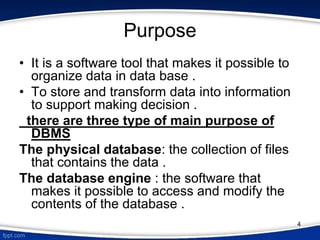
there are three type of main purpose of
DBMS
The physical database: the collection of files
that contains the data .
The database engine : the software that
makes it possible to access and modify the
contents of the database .
4
The database scheme: the specification of
the logical structure of the data stored in
the database.
5
Data abstraction
• It hides complexity of data .
• It hides unnecessary data and function .
There are three level of data abstraction
• Physical level :The lowest level
abstraction describe how the data are
actually stored
• The physical level describe complex low-
level data structures in detail .
6
Logical level : this level of abstraction
describe what data are stored in the data
base .
• what relationship exist among those data .
View level
• It is the highest level of data abstraction
• view level describe only part of the entire
database
7
• view level describes the user interaction
with database system.
8
Data base model
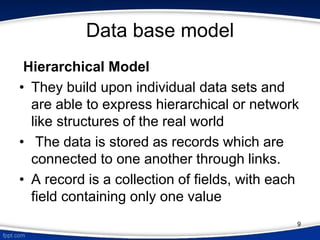
Hierarchical Model
• They build upon individual data sets and
are able to express hierarchical or network
like structures of the real world
• The data is stored as records which are
connected to one another through links.
• A record is a collection of fields, with each
field containing only one value
9
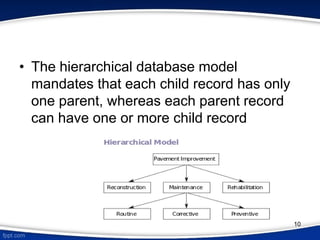
• The hierarchical database model
mandates that each child record has only
one parent, whereas each parent record
can have one or more child record
10
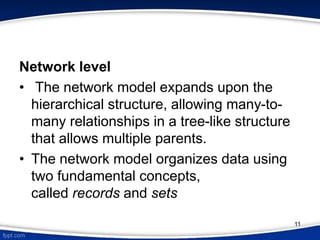
Network level
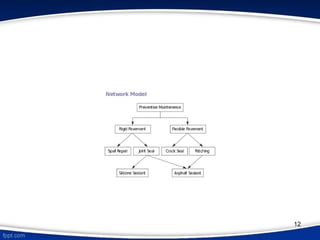
• The network model expands upon the
hierarchical structure, allowing many-to-
many relationships in a tree-like structure
that allows multiple parents.
• The network model organizes data using
two fundamental concepts,
called records and sets
11
12
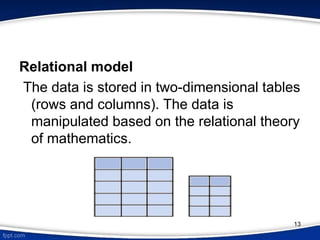
Relational model
The data is stored in two-dimensional tables
(rows and columns). The data is
manipulated based on the relational theory
of mathematics.
13
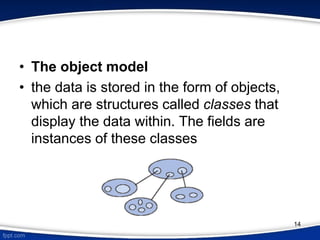
• The object model
• the data is stored in the form of objects,
which are structures called classes that
display the data within. The fields are
instances of these classes
14
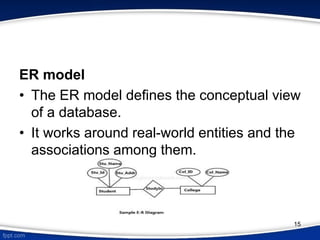
ER model
• The ER model defines the conceptual view
of a database.
• It works around real-world entities and the
associations among them.
15
16

Database management system

  • 1.
    Database management system Presented By: Rishi Ram Khanal BIM 4th Semester (TU) 1
  • 2.
    Content • Introduction toDBMS • Purpose of DBMS • Data abstraction • Database model 2
  • 3.
    Introduction • DBMS standfor database management system. • Database is a collection of data and management system. • It is a set of programs to store and retrieve data . • This system is basically developed for large .amount of data . • There are two things required optimization store of data and retrieval of data. 3
  • 4.
    Purpose • It isa software tool that makes it possible to organize data in data base . • To store and transform data into information to support making decision . there are three type of main purpose of DBMS The physical database: the collection of files that contains the data . The database engine : the software that makes it possible to access and modify the contents of the database . 4
  • 5.
    The database scheme:the specification of the logical structure of the data stored in the database. 5
  • 6.
    Data abstraction • Ithides complexity of data . • It hides unnecessary data and function . There are three level of data abstraction • Physical level :The lowest level abstraction describe how the data are actually stored • The physical level describe complex low- level data structures in detail . 6
  • 7.
    Logical level :this level of abstraction describe what data are stored in the data base . • what relationship exist among those data . View level • It is the highest level of data abstraction • view level describe only part of the entire database 7
  • 8.
    • view leveldescribes the user interaction with database system. 8
  • 9.
    Data base model HierarchicalModel • They build upon individual data sets and are able to express hierarchical or network like structures of the real world • The data is stored as records which are connected to one another through links. • A record is a collection of fields, with each field containing only one value 9
  • 10.
    • The hierarchicaldatabase model mandates that each child record has only one parent, whereas each parent record can have one or more child record 10
  • 11.
    Network level • Thenetwork model expands upon the hierarchical structure, allowing many-to- many relationships in a tree-like structure that allows multiple parents. • The network model organizes data using two fundamental concepts, called records and sets 11
  • 12.
  • 13.
    Relational model The datais stored in two-dimensional tables (rows and columns). The data is manipulated based on the relational theory of mathematics. 13
  • 14.
    • The objectmodel • the data is stored in the form of objects, which are structures called classes that display the data within. The fields are instances of these classes 14
  • 15.
    ER model • TheER model defines the conceptual view of a database. • It works around real-world entities and the associations among them. 15
  • 16.